
Introduction
Salvia L. is the most diverse genus of the mint family (Labiatae). It belongs to the Nepetoideae (Dumort.) Luerss subfamily and the Mentheae Dumort. tribe (Harley et al., 2004; Baskin & Baskin, 2007; Drew & Sytsma, 2012). It includes about 1036 accepted species names (POWO, 2025a). Species of the genus involves shrubby, subshrubby, herbaceous perennials, and annuals, slightly to markedly aromatic plants. Among these species many are used as ornamentals (usually for their flower interest and sometimes for their aromatic foliage) namely Salvia microphylla Kunth. Some others, such as Salvia columbariae Benth. (var. columbariae Benth.) and Salvia hispanica L., grown for their seeds sold all over the word under the name ‘Chia seeds’ (Salviae hispanicae semen). This latter has extended wild populations within pine forests in the high mountains of western Mexico and Guatemala above 2000 m (Cahill, 2004; Wood et al., 2022: 374-376). It was later domesticated and cultivated throughout Mesoamerica (Cahill, 2003). More recently, the plant became an important cultural plant in Australia, Bolivia, Colombia, Guatemala, Mexico, Peru and Argentina (Baginsky et al., 2016) and a potential invasive species in Europe including about 274 localities among which Bosnia, Bulgaria, Italy, Slovenia and Spain where plants were found in full bloom (see e.g., Sádlo & Marek, 2018; Šilc et al., 2019; Maslo & Šarić, 2020; Kunev, 2021; Galasso et al., 2024; Hand et al., 2025). In continental Africa (including Canary Islands), no official reports were published except those from Canary Islands with only a single individual or in small number within Valle Tabares and barranco de Santos in La Laguna and Santa Cruz de Tenerife (Verloove, 2017) and from Algeria as casual alien with only one individual (Sakhraoui et al., 2024) despite several observations on the online platform iNaturalist 2025 (https://www.inaturalist.org/). In fact, reports of Salvia hispanica from the African continent were mentioned from: 1) Canary Islands in three scattered locations; in San Cristóbal de La Laguna, 28.53868, -16.36185, 16 April 2021, iNaturalist-observation: https://www.inaturalist.org/observations/74131032, in 38758 El Paso, La Palma, Santa Cruz de Tenerife, 28.69115, -17.90313, 6 November 2022, iNaturalist-observation: https://www.inaturalist.org/observations/141389079, and in Santa Cruz de Tenerife, Spanyolország, 28.615, -17.785, 13 March 2023, iNaturalist-observation: https://www.inatu-ralist.org/observations/254412318; 2) Algeria in only one location, Skikda, Algérie, 36.85589, 6.92134, 25 May 2021, iNaturalist-observation: https://www.inaturalist.org/observations/80251209; and 3) Morocco in only one location, Tanger-Tétouan, MA (Region), College Maa Al Aynine, 35.78268, -5.81978, 27 March 2024, iNaturalist-observation: https://www.inaturalist.org/observations/204184259. In July 2023, during a field survey in the northern part of Tunisia, an annual species (with a Lantana-like! habit) of the Lamiales order has been noted. It impressed with its dense racemes and typical bicolored corollas, referring to the taxonomic identity Salvia hispanica L.
The aim of the present contribution is to report the neophyte Salvia hispanica L., for the first time as adventitious for the Tunisian flora and to give a national update distribution of the two non-native S. microphylla Kunth, and S. officinalis L. In addition, a global status about the specific diversity of the genus Salvia L. at national level is presented based on personal surveys for more than two decades.
Materials and methods
The work is based on field surveys carried out in Tunisia over the last 3 years. Collected specimens are deposited at the personal collections of the author in the Herbarium of the Faculty of Monastir of Monastir (not yet listed in Index Herbariorum), duplicates are in PAL and RO (herbarium codes follow Thiers, 2025). Analysis of relevant literature and examination of specimens preserved in the herbaria AIX, CLF, LY, LYJ, MHLCLF, MPU, NCY, P SLA were also carried out. Morphological description is according to Tunisian fresh material and following Song et al. (2017: 2263-2264), Šilc et al. (2019: 255), Wood et al. (2022: 374-376). Occurrences within Mediterranean is checked on GBIF.org (2025) whether observations within the African continent was checked in iNaturalist (2025). The nomenclature follows Plants of the World Online (POWO, 2025b). Data about abundance of the subpopulations and accompanying species is based on personal observations from the field. The degree of naturalization complies with the terminology of Pyšek & al. (2004). Reported taxa are ordered alphabetically in two categories: i) first records in the wild of Salvia hispanica and ii) new distributional records of non-native Salvia that were already known from Tunisia.
Results
1. First records in the wild of Salvia hispanica from Tunisia
Salvia hispanica L., Sp. Pl.: 25 (1753)
Lectotype (Wood & Harley in Kew Bull. 44: 225. 1989): [icon] “ Sclarea hispanica “ in Tabernaemontanus, Hist. [New Vollkommen Kräuterbuch] 764, t. 374 (1664)
Description (Figure 1). An annual herb 30–70 (-200) cm high; stems erect, simple or sparingly branched, quadrangular; leaves petiolate, lamina 1.4–11.5 × 0.5–6.0 cm, ovate to ovate-elliptic, apex acute to shortly acuminate, base cuneate to rounded, margin serrate, adaxially pubescent, abaxially densely pubescent with whitish hairs; inflorescences of dense racemes, (1-)5–17 cm long and 1.3–2.0 cm wide, terminal on the main stem and on branches from the uppermost leaf axils, usually solitary but occasionally with a pair of racemes arising at the base of the main raceme; flowers in 6–12-flowered verticillasters, mostly imbricate except lowermost up to 5 mm apart; peduncles 1.5–11.5 cm long, pubescent; bracts 5–8 × 3–5 mm, narrowly to broadly deltoid, acuminate and mucronate, entire, pubescent, 3-veined, persistent; calyx c. 5 mm long in flower, accrescent to 11 mm in fruit, rather bulbous (ventricose) at the base, pubescent with sessile glands near base, 2-lipped, the upper lip with 3 prominent veins and sometimes two additional less prominent veins, teeth mucronate, the lower lip 2-lobed; corolla 2-lipped, blue with small white ‘honey guide’ on lower lip, 7–8 mm long, tube 4–5 mm long, ± enclosed by the calyx, white, ±glabrous, the upper lip c. 3 mm long, blue, hooded, densely pubescent, the lower lip 4–5 mm long, shallowly 3-lobed, pubescent on the exterior, papillae absent from the interior; stamens included in upper lip, anthers c. 1.25 mm long, yellowish; style whitish, glabrous, glandular at base, shortly exserted, bilobed, the arms blue, upper arm reflexed, twice as long as the lower arm. Nutlets ovoid, 1.4–2 mm long, smooth, glabrous, pale grey-brown mottled with white or (rarely) entirely white.
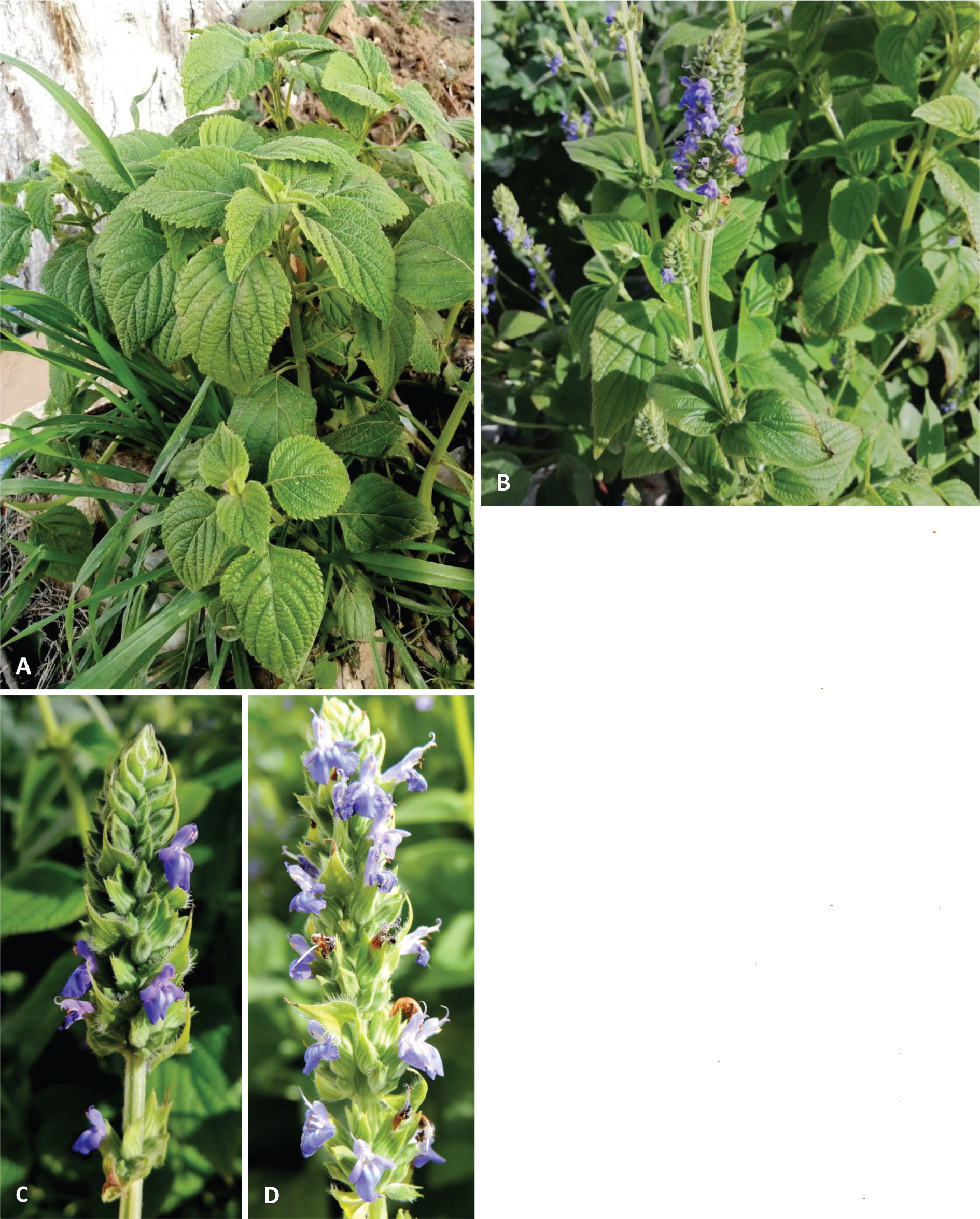
Figure 1:
Salvia hispanica in Tunisia. A) habit and habitat within roadsides in Jemmal region (CE, Monastir) before flowering period; B) habit in the beginning of the flowering period within roadsides in Hiboun region (CE, Mahdia); C-D) inflorescence details in terminal dense racemes during different blooming periods with typical blue colored corollas with small white stripes on lower lips. Photograph by R. El Mokni (07.02.2023 & 11.07.2023).
Flowering-fruiting period in Tunisia. February-April.
Iconography. (Wood et al., 2022, plate 1028: 361)
Salvia hispanica in Tunisia
Five diffuse micropopulations of Salvia hispanica have so far been confirmed, two in the north-eastern part of Tunisia (governorates of Bizerta and Tunis) and three in central-eastern part of Tunisia (governorates of Mahdia and Monastir) (Figure 4).
1) Tunis, Bab-Alouia, (36°47’18” N; 010’11’05” E), 6–10 m a.s.l., 11 July 2023, El Mokni s.n. (Herb. El Mokni!), ibidem, 21.01.2025, ibidem, 07.02.2025, ibidem, 11.03.2025. Several scattered individuals along the edges of the road and growing at the base of old walls with roadsides (Figure 1). The floristic composition at the site includes :Amaranthus viridis L., Bidens sp., Centaurea calcitrapa L., Chenopodiastrum murale (L.) S. Fuentes, Uotila & Borsch, Cuscuta sp., Lepidium didymum L., Malva sp., Parietaria judaica L., Portulaca oleracea L., Poa infirma Kunth, Sisymbrium irio L., Senecio leucanthemifolius Poir., Sonchus tenerrimus L., Stellaria apetala Ucria.
2) Bizerta, Bizerta-city (37°16’27” N; 009°53’02” E), 7–10 m a.s.l., 02 June 2024, El Mokni s.n. (Herb. El Mokni!). An extended population with about twelve mature individuals, within ruderal communities and in urban areas, in flowers and fruits. The most common species in close proximity were: Amaranthus viridis L., Chenopodiastrum murale (L.) S. Fuentes, Uotila & Borsch, Coincya tournefortii (Gouan) Alcaraz, T.E.Díaz, Rivas Mart. & Sánchez-Gómez, Cynodon dactylon (L.) Pers., Lepidium didymum L., Malva sp., Plantago albicans L., Spergularia flaccida (Madden) I.M.Turner.
3) Monastir, Jemmal, (35°37’15” N; 010°45’34” E), 32–40 m a.s.l., 20 January 2025, ElMokni s.n. (Herb. El Mokni!). a condensed subpopulation with about seven mature individuals (Figure 1), within ruderal communities in urban areas, in flowers and fruits. The common species in close proximity were: Amaranthus blitoides S.Watson, Amaranthus viridis L., Chenopodiastrum murale (L.) S. Fuentes, Uotila & Borsch, Chenopodium album L., Cynodon dactylon (L.) Pers., Euphorbia peplus L., Galium aparine L., Hordeum murinum L., Hordeum vulgare L., Lamium amplexicaule L., Malva sp., Oloptum miliaceum (L.) Röser & Hamasha, Poa infirma Kunth, Reichardia picroides (L.) Roth, Reseda alba L., Rumex bucephalophorus L., Sinapis alba L., Sisymbrium irio L., Sonchus oleraceus L., Spergularia flaccida (Madden) I.M.Turner, Symphyotrichum squamatum (Spreng.) G.L.Nesom, Trigonella foenum-graecum L., Triticum aestivum L., Urtica urens L., Vicia faba L.
4) Mahdia, Hiboun, (35’31’20” N; 011’01’52” E), 1920 m a.s.l., 15 February 2025, ElMokni s.n. (Herb. El Mokni!). Only two mature individuals, in flower and fruits, within ruderal floristic communities and near human settlements, in flower and fruits (Figure 1). The common species in close proximity were: Amaranthus albus L., Bassia indica (Wight) A. J. Scott, Chenopodiastrum murale (L.) S. Fuentes, Uotila & Borsch, Coincya tournefortii (Gouan) Alcaraz, Cynodon dactylon (L.) Pers., Malva sp., Plantago albicans L., Spergularia flaccida (Madden) I.M.Turner.
5) Monastir, Ksar Hellal, (35°38’48” N; 010°53’16” E), 28-30 m a.s.l., 20 February 2025, ElMoknis.n. (Herb. El Mokni!). Only two individuals, within ruderal communities and near human settlements, in flower and fruits. The common species in close proximity were: Amaranthus albus L., Bassia indica (Wight) A. J. Scott, Chenopodiastrum murale (L.) S. Fuentes, Uotila & Borsch, Coincya tournefortii (Gouan) Alcaraz, Cynodon dactylon (L.) Pers., Malva sp., Plantago albicans L., Spergularia flaccida (Madden) I.M.Turner.
All identified microsites of Salvia hispanica occupy ruderal clayey, gravelly or sandy soils at about 6-40 m a.s.l., often near human settlements, in arid, semiarid and humid regions. The species seems well naturalizing in many regions among the Tunisian territory.
2. New distributional records for two non-native Salvia already known from Tunisia
Salvia microphylla Kunth, F.WH.von Humboldt, A.J.A. Bonpland & C.S.Kunth, Nov. Gen. Sp. 2: 294 (1818)
New records. TUNISIA. Jendouba, Aîn Draham: Béni-Mtir, 10.06.2024; Babbouch, 13.12.2024.
Identification. (Figure 2). Salvia microphylla is a small, perennial to evergreen shrubby plant, up to 130 cm in height. It produces flowers mostly in pairs on terminal racemes up to 15 cm long with corolla lips rich red on first opening, changing with age to magenta-purple. The species shares with other relatives of the genus high morphological similarities except a spicy fragrance mainly with the closely related species S. greggii A. Gray. S. microphylla is main distinguished by its serrated leaf margins on its narrow, elliptical shaped leaves (vs. smooth leaf margins in S. greggii). In addition, both species easily hybridize, which is shown by the description of Salvia × jamensis J.Compton (S. greggii A.Gray × S. microphylla Kunth) when cohabitate, within their native range (Compton, 1994). All taxa shared macromorphological similarities with intermediate sizes for several features including flowers length and corollas colors from red to rose, white, pink, lavender, apricot, and violet. (Compton, 1994).
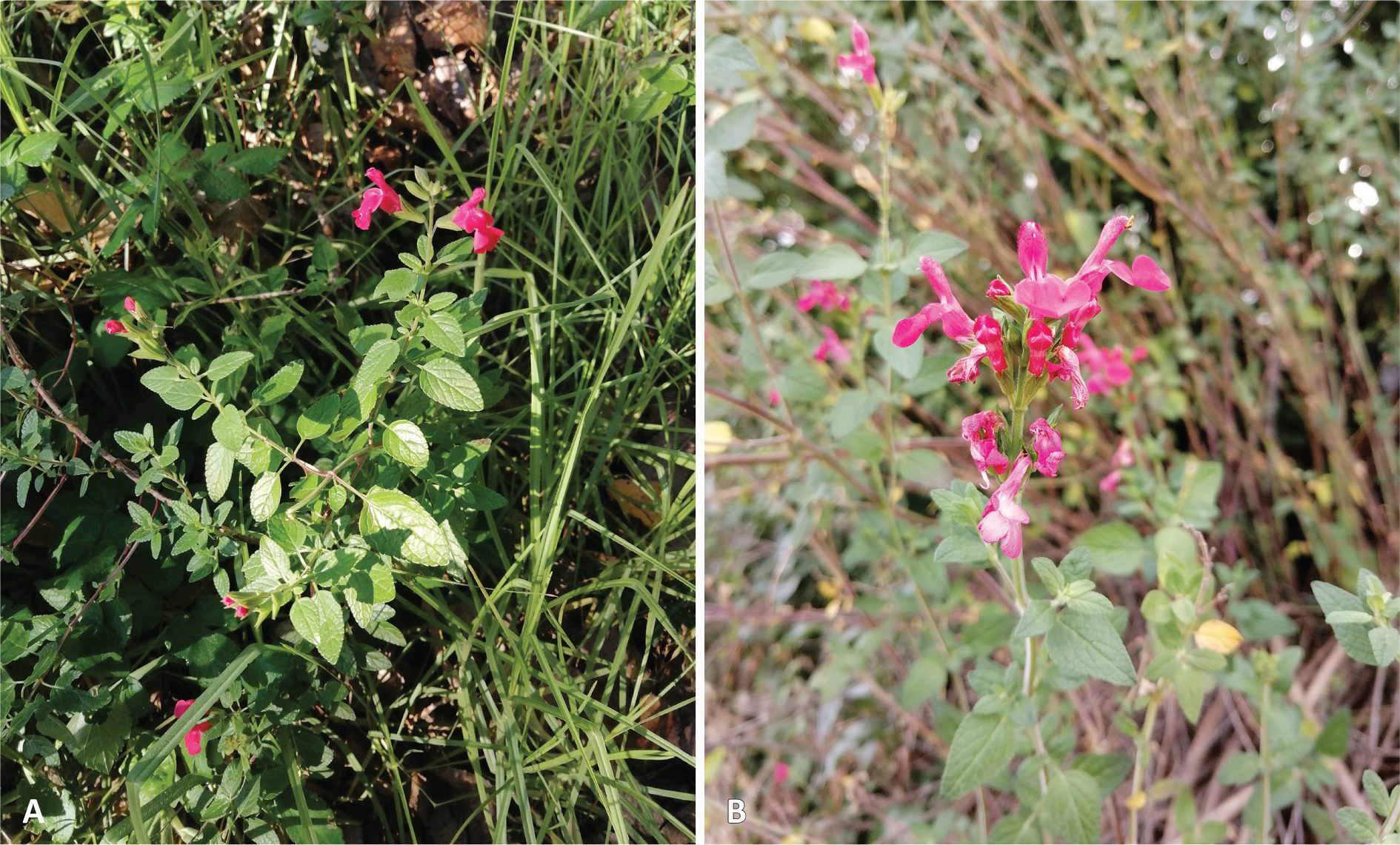
Figure 2:
Salvia microphylla in Tunisia. A) habit and habitat within Aîn Draham region (K, Jendouba); B) inflorescence details with opened flowers and typical red corollas. Photographs by R. El Mokni (13.12.2024).
Previous distribution, habitat and degree of naturalization. Native to South-eastern Arizona and the mountains of east, west and south Mexico to Guatemala. The species was first reported in Tunisia (second report within the Mediterranean region) as casual only within Béja region in the north western (El Mokni, 2019: 434). Additional records are here presented from north western Tunisia but firstly from Jendouba governorate (Aîn Draham, Babbouch and Béni Mtir) (Figure 4). In all reported localities, the plant was observed in scattered individuals. These growing individuals are issued from parental fragmented pieces of rhizomes, cultivated as ornamentals on the edges of public gardens and/or within abandoned old houses. The status as casual alien in previous reports is here confirmed.
Salvia officinalis L., Sp. Pl.: 23 (1753)
New records. TUNISIA. Monastir: Monastir-city, 29.05.2019, ibidem, 05.03.2025; Nabeul: Hammamet-North, 11.04.2025.
Identification. (Figure 3). It is an evergreen (sub-)shrub growing up to 60 cm tall that shares with other species of the same genus similar morphologically rugose leaves, and spike-like inflorescences of pink, purple, or whitish flowers. It can be easily distinguished by its entire (oblong-) lanceolate leaves which are rather three-lobed (oblong-) lanceolate in the morphologically similar S. fruticosa Mill.
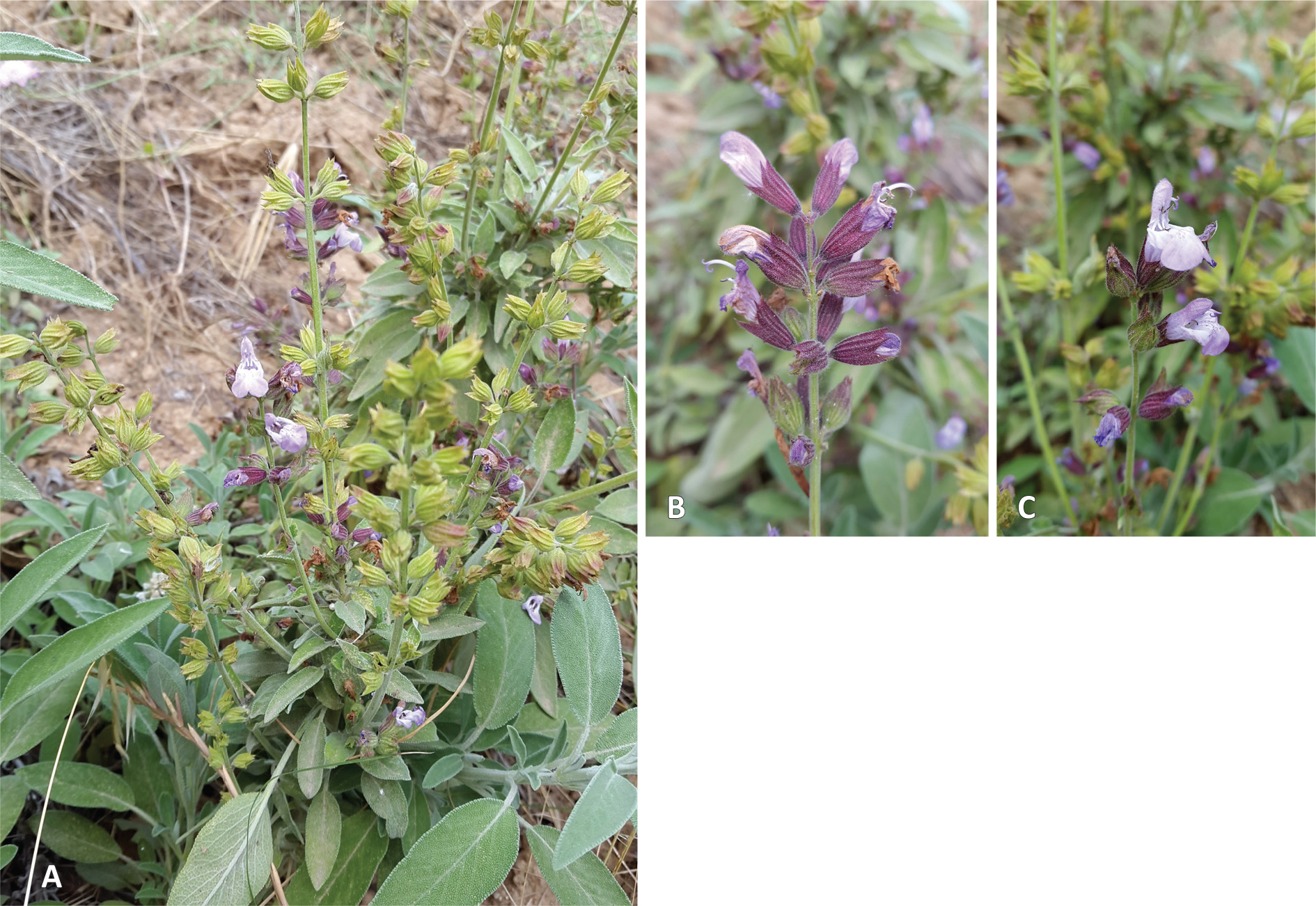
Figure 3:
Salvia officinalis in Tunisia. A) habit and habitat within Monastir region (TC, Monastir); B) inflorescence details with mostly closed flowers; C) details of two opened flowers. Photographs by R. El Mokni (29.05.2019).
Previous distribution, habitat and degree of naturalization in Tunisia. Native to Europe, former Yugoslavia, Albania, Greece and Italy, the species was first reported in Tunisia as cultivated only within the Cap-Bon region (CB sensu Cuénod et al., 1954) since 1981 (Pottier-Alapétite, 1981: 799). In 2010, le Floc’h et al. in their commented synonymous catalog of the flora of Tunisia do not cite this taxon. Two years later, Dobignard & Chatelain (2012: 309) in their synonymic index of the flora of North Africa reported the taxon as cultivated/subspontaneous and naturalized within North Africa. The first official record of Salvia officinalis as casual alien in Tunisia is here. The plant was firstly reported as adventitious in the border of a public garden within Monastir-city in 2019 and also later in 2025. In addition, more recently, the species was seen escaping from cultivated plants within Mornag towards Hammamet-North in April 2025 (Figure 4). We here assign the status of casual alien for this alien taxon in Tunisia.
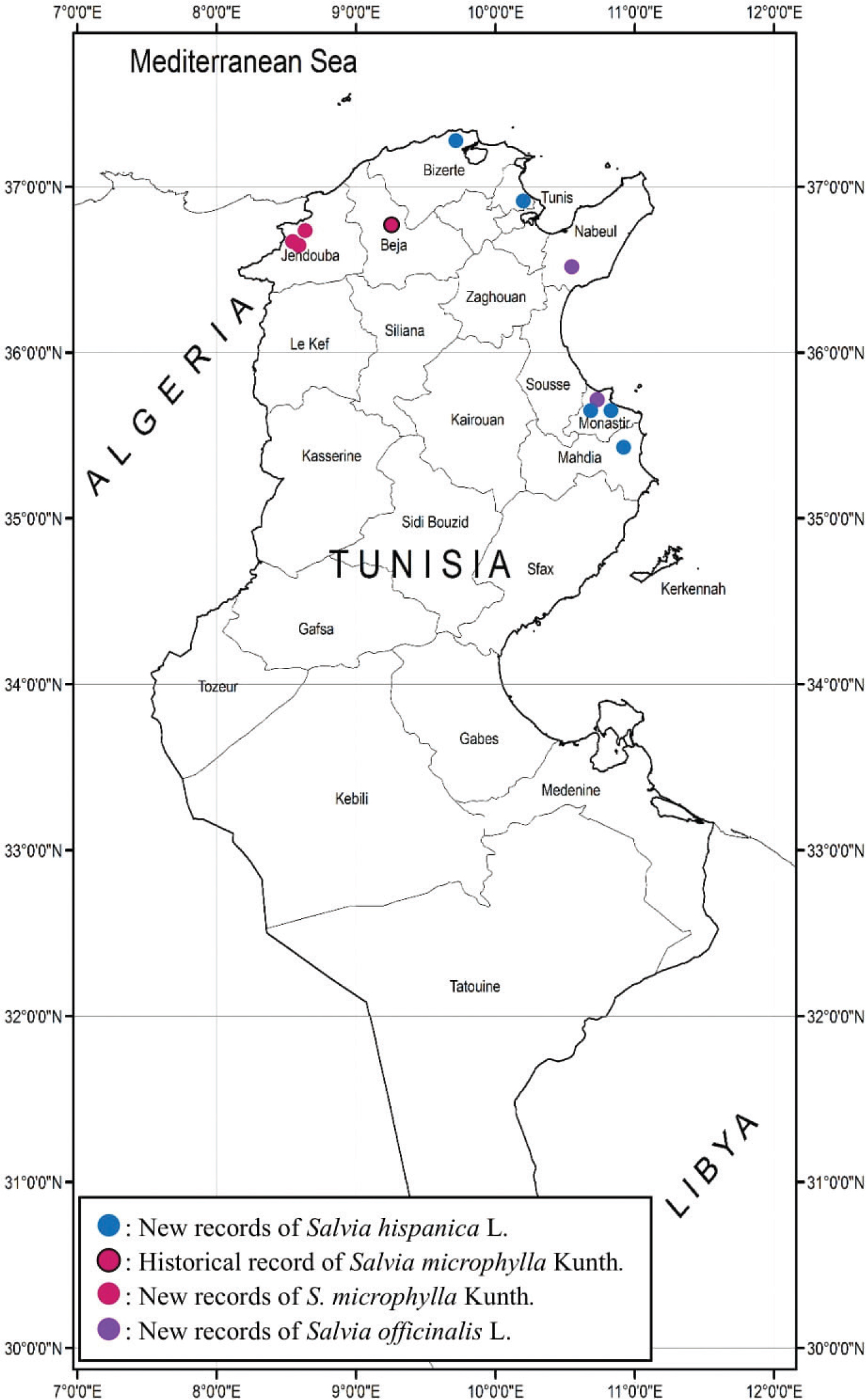
Figure 4:
A distributive map of all localities of Salvia hispanica with an updated range of the non-native Salvia microphylla and S. officinalis found during the present study.
Key to the non-native species of Salvia known in Tunisia
a) Plant annual; leaves simple, denticulate; corolla sky blue to dark blue with small white stripes on the…………Salvia hispanica L.
– Plant perennial, shrubby; corolla with other colors…………2
b) leaves narrow elliptical shaped with serrated margins; corolla pink or bright red (more rarely white or bi colored)…………S. microphylla Kunth
– Leaves are grey-green, rugose on the upper side, and nearly white underneath due to the many short soft hairs; corolla usually purplish-blue (more rarely pink)…………S. officinalis L.
3. Actual status about the specific diversity of the genus Salvia L. in Tunisia
In Tunisia, historically the Linnean genus Salvia was represented by 10 species, 5 subspecies and only one variety (Pottier-Alapétite, 1981: 798–804) among which only one annual (S. viridis L.) and only two endemics, S. jaminiana de Noé to Algeria and Tunisia and to the Maghreb (Tunisia+Algeria+Morocco), S. barrelieri Etl. subsp. bicolor (Lam.) Maire. More recently, Dobignard & Chatelain (2012: 303–311) reported 11 species of Salvia to Tunisian vascular flora with only one subspecies among which three taxa are endemics, S. jaminiana de Noé is still endemic to Algeria and Tunisia where S. barrelieri Etl and S. phlomoides subsp. africana (Maire) Greuter & Burdet are endemic to Morocco, Algeria and Tunisia.
As regards actual accepted species of the Rosmarinus genus (all perennials) under the genus Salvia (POWO, 2025a) and the present contribution, the actual number of Tunisian species of the Salvia genus is 15 species with only one subendemic subspecies [S. aegyptiaca L., S. argentea L., S. barrelieri Etl., S. hispanica L., S. jaminiana de Noé, S. jordanii J.B.Walker (syn. Rosmarinus eriocalyx Jord. & Fourr.), S. lanigera Poir., S. microphylla Kunth, S. officinalis L., S. phlomoides subsp. africana (Maire) Greuter & Burdet, S. rosmarinus Spenn. (syn. R. officinalis L.), S. sclarea L., S. tingitana Etl., S. verbenaca L., and S. viridis L.]. Remember that S. tingitana Etl., is considered as an Extinct taxon [E] from Tunisia (still questionable and has to be proved!) whereas S. phlomoides subsp. africana and S. barrelieri are very rare and Critically Endangered [CR] (Pers. Obs., during the last two decades!) due to habitats disturbance and destruction [coded in IUCN (2025) as 7. Natural system modifications, 7.1 Fire and Fire suppression, 7.1.1 Increase in fire frequency/intensity] and high grazing [coded in IUCN (2025) as 2. Agriculture & aquaculture, 2.3 Livestock farming & ranching, 2.3.2 Small-holder grazing, ranching or farming and 2.3.3 Agro-industry grazing, ranching or farming] within their very restricted known localities, for S. phlomoides subsp. africana (DT, Ouled Bou Ghanem, Hidra, Thala, Kasserine) and for X barrelieri (K, Fernana, Jendouba; TC, not seen!). In addition, the Linnean X sclarea has not been seen since 1874 and its actual status remains unclear till new data/rediscoveries. Interesting to note that the Tunisian-Algerian endemic X jaminiana has been considered very rare since its first observation/discovery and no data about its actual status neither at national level nor in its native area within North Africa!
Discussion
In Tunisia, the annual Salvia hispanica was not recorded prior to 2023 despite regular field prospections within almost the same extended areas. The species was reported mainly near human settlements and seems a recent escape of imported seeds offered for sale from seed merchants/seed wholesalers known under the name ‘Chia seeds’ or from the importation of bird seed mixes used for feeding domesticated birds. This importation was massive mainly during the last few years. For the moment, the plant manages to flower and to produce seeds (nutlets) within roadsides and abandoned areas mainly within north and central eastern Tunisia.
As regards, the two perennial non-native Salvia species (S. microphylla and S. officinalis), both are introduced as ornamentals and are considered as casual aliens in north western and central eastern Tunisia. According to personal observations, their escape still with no negative effects either on native species of the same genus or within floristic communities where they can be present.
All things previously specified stated that a monitoring/follow-up is to be considered in the future to i) assess the viability/survival of the produced nutlets (for Salvia hispanica) and their seedlings for an eventual spontaneous spread and a future naturalization, and ii) evaluate the appropriate status of naturalization of all non-native Salvia species.
Acknowledgments
The author is very grateful to anonymous reviewers for their comments and suggesting improvements made to the first version of the Manuscript.
Notes
[1] Research data availability
Research data used in paper are included in the published paper.