
Introduction
Molinia caerulea (L.) Moench is a caespitose, perennial grass with a N-Eurasian distribution area (Oberdorfer, 2001; Aeschimann et al., 2004), also reported in some African countries and introduced into the USA and Canada (Dančak et al., 2012). It is widespread in open plant communities on moors, heaths, bogs, fens, wet meadows, cliffs and lake shores, always on at least seasonally wet or peaty ground (Tutin et al., 1980; Taylor et al., 2001).
It is present in Italy together with its congener Molinia arundinacea Schrank, previously known as Molinia caerulea (L.) Moench subsp. arundinacea (Schrank) K. Richt. in an earlier Italian flora (Conti et al., 2005). We refer here only to Molinia caerulea, known as Molinia caerulea (L.) Moench subsp. caerulea in the above-mentioned earlier flora.
The presence of Molinia caerulea in central Italy is documented in Lazio and Abruzzo (Bartolucci et al., 2024a), although with a punctiform distribution (Guarrera & Tammaro, 1996; Anzalone et al., 2010; Conti & Bartolucci, 2016; Lucchese, 2018; Conti et al., 2019).
This species develops plant communities which take its name, purple moorgrass meadows on mineral, damp and/or peaty soils. In Europe, these occur predominantly in temperate to subarctic zones and, in their typical aspect, correspond to the mown grasslands also known as litter meadows (Ellenberg, 2009; Mucina et al., 2016).
In Italy, Molinia caerulea communities are mainly present in the north, from the plains to the mountains (e.g. Poldini, 1973; Marchiori & Sburlino, 1982; Gerdol, 1987; Balátová-Tulačková & Venanzoni, 1989, 1990; Bracco et al., 1994, 1998; Bracco & Nola, 1995; Sburlino et al., 1995; Andreis & Zavagno, 1996; Minghetti & Pedrotti, 2000; Pedrotti, 2001, 2004; Rivieccio et al., 2021), while they are rare and highly localised along the peninsula to the south (Guido & Montanari, 1983; Barberis & Mariotti, 1981; Venanzoni, 1988; Bassi et al., 2015; Mariotti et al., 2015; Ciaschetti & Venanzoni, 2024). To date, there are no studies on Molinia caerulea communities in central Italy.
In terms of phytosociology, European purple moorgrass meadows are mostly attributed to the Molinion caeruleae alliance (Molinietalia caeruleae, Molinio-Arrhenatheretea) (e.g. Nowak & Fartmann, 2004; Havlová, 2006; Zelnik, 2011; Borhidi, et al. 2012; Mucina et al., 2016). Plant communities of this type have, however, also been attributed to other alliances belonging to the same class (Horvatić, 1963; Rivas-Martínez et al., 2001; Collaud et al., 2020) or to other classes (Oberdorfer, 1993; Kočí, 2010; Hájek & Hájková, 2011; Bergmeier, 2020).
Starting from Koch’s fundamental work (1926) in which he describes “Molinietum caeruleae”, many associations have been proposed in Europe, for example Tüxen (1954), Philippi (1960), Passarge (1964), Marchiori & Sburlino (1982), Oberdorfer et al. (1967), Ellmauer & Mucina (1993), Redžić et al. (2013) etc. The syntaxonomy of these communities is, however, controversial. While some authors (Nowak & Fartmann, 2004; Havlová, 2006; Řezníčková, 2007; etc.) advocate a more comprehensive approach according to which, at least in large part and excluding acidophilous sphagnum fens, this association is still attributable to the association described by Koch (1926), others (Ellmauer & Mucina, 1993; Rivas-Martinez et al., 2001; Zelnik, 2011; Lafon et al., 2024) prefer instead an approach favouring differentiation into several syntaxa on an ecological and phytogeographic basis, similar to the earlier proposal by De Foucault & Géhu (1980).
The abovementioned association is, in fact, considered “central” to the Molinion caeruleae alliance (Oberdorfer, 1993) and it is therefore difficult to distinguish the diagnostic species of the many associations proposed (Sburlino et al., 1995).
In addition, in transitional situations between different phytogeographical areas as is often the case, the diagnostic species of a syntaxon are far from being exclusive to it. It is therefore often more appropriate to use geographical differentials to identify the different vegetation types (e.g. Werger & Van Gils, 1976; Poldini et al., 1998; Košir et al., 2008).
Excluding purple moorgrass meadows with sphagnum bogs associated with acidophilous fens (e.g. Brusa et al., 2006), the following syntaxa have been recognised in Italy as belonging to the Molinion caeruleae alliance:
1a. Plantagini altissimae-Molinietum caeruleae Marchiori et Sburlino 1982 (Marchiori & Sburlino, 1982; Sburlino et al., 1995);
1b. Plantagini altissimae-Molinietum caeruleae Marchiori et Sburlino 1982 typicum (Sburlino et al., 1995);
1c. Plantagini altissimae-Molinietum caeruleae cladietosum marisci Sburlino, Bracco, Buffa et Andreis 1995 (Sburlino et al., 1995);
2a. Selino-Molinietum caeruleae Kuhn 1937 (Gerdol, 1987; Balátová-Tulačková & Venanzoni, 1989; Sburlino et al., 1995);
2b. Selino-Molinietum caeruleae inuletosum salicinae Balátová-Tulačková et Venanzoni 1989 (Balátová-Tulačková & Venanzoni, 1989);
3a. Succiso-Molinietum caeruleae (Kovacs 1962) Soò 1969 (Minghetti & Pedrotti, 2000; Pedrotti, 2001);
3b. Succiso-Molinietum caeruleae caricetosum elatae Minghetti et Pedrotti 2000 (Minghetti & Pedrotti, 2000);
4. Junco-Molinietun caeruleae Preising 1951 (Barberis & Mariotti, 1981; Pedrotti, 2004; Venanzoni, 1988);
5. Juncus acutiflorus and Molinia caerulea community (Bracco & Nola, 1995; Sburlino et al., 1995). It was included in the Juncion acutiflori alliance, but according to Mucina et al. (2016) this alliance should be considered invalid according to Art. 2b of the ICPN (Theurillat et al. 2020) and should instead be attributed to Molinion caeruleae.
6. Gentiano asclepiadeae-Molinietum caeruleae Oberdorfer 1957 em. Oberdorfer et al. 1967 (Canullo et al., 1994; Vanacore Falco & Venanzoni, 2009);
7. Stachyo-Molinietum Passarge 1964 (Canullo et al., 1994, without data). This association was reported by Pedrotti (2003) too, but the author himself changed this attribution to Junco-Molinietum in a later paper (Pedrotti, 2004).
8. Molinietum caeruleae Koch 1926 (Montacchini, 1982);
9. Trollio europaei-Molinietum coeruleae trifolietosum medii de Foucault 1976 (Balátová-Tulačková & Venanzoni, 1990).
In the Dinaric Alps, Molinia caerulea meadows have been attributed both to the Trifolio-Hordeetalia order in areas with a submediterranean climate (Horvatić, 1963; Gaži-Baskova, 1963; Ritter-Studnička, 1972; Hulina, 2007) and to Molinion caeruleae in the montane belt, especially on siliceous substrates (e.g. Milanović et al., 2015). The Molinietalia order is associated with the temperate to subarctic zones of Europe, while the Trifolio-Hordeetalia order is limited to the Apennine and Balkan peninsulas (Mucina et al., 2016), although some authors also report it in a number of areas in Western Europe (e.g. Mercadal, 2020).
The floristic and vegetational affinities between the Apennines and the Balkan Peninsula have also been highlighted numerous times for other vegetation types (e.g. Biondi et al., 2002, 2006; 2014; Terzi et al., 2010; Di Pietro, 2011; Taffetani et al., 2012; Blasi & Del Vico, 2012; Terzi & D’Amico, 2016) and this affinity underlies the placement of both these geographical areas in the Apennine-Balkan phytogeographical province of the Eurosiberian region (Rivas-Martinez et al., 2004).
Molinia caerulea meadows are characterised by a high floristic diversity and rich fauna and are therefore of exceptional importance for the protection of species and biotopes. Moreover, their extent is now considerably reduced due to agricultural drainage and the use of fertilisers, as well as the abandonment of traditional mowing practices (Sburlino et al., 1995; Nowak & Fartmann, 2004, Nowak et al. 2015). The conservation of at least some complexes of the vast, unfertilised Molinia caerulea grasslands is, in fact, one of the most pressing nature conservation problems in Europe (Ellenberg, 2009). In temperate transitional climates, namely those corresponding to the Submediterranean variant of the Temperate bioclimate according to the classification of Rivas-Martinez et al. (2011), also widespread in Abruzzo, Molinia caerulea communities are even more important in terms of conservation as they are home to numerous rare and endangered species at national or regional level (Venanzoni, 1988).
The Molinia caerulea grassland communities are mostly referable to the EU habitat “6410: Molinia meadows on calcareous, peaty or clayey-silt-laden soils (Molinion caeruleae)”, which is in poor condition in almost all biogeographical regions where it occurs (https://www.biodiversity.europa.eu/habitats/6410 accessed on December 14th 2024).
This paper will attempt to answer the following questions:
do the Molinia caerulea meadows in the central Apennines have their own syntaxonomic autonomy, or are they related to any of the associations already found in Italy?
are the Molinia caerulea meadows in the central Apennines to be attributed to the Molinion caeruleae alliance or, like other meadows on temporarily flooded soils on central Italy’s karst plateaus, to the endemic Ranunculion velutini alliance of the Trifolio-Hordeetalia order (see Pedrotti & Sanesi, 1969; Pedrotti, 1976, 2019; Canullo et al., 1988; Pedrotti et al., 1992; Venanzoni, 1992; Pirone, 1997; Biondi et al., 1999; Tardella & Di Agostino, 2020)?
Methods
The vegetation studied was surveyed in the Sirente-Velino Regional Park, in the province of L’Aquila (Abruzzo), in an altitudinal range between 1300 and 1350 m a.s.l. Morphologically, this constitutes the central endorheic depression of the three making up the vast “Altopiano delle Rocche-Piano di Ovindoli” system of tectonic-karst plateaus. The karst nature of the area is evidenced by the presence of sinkholes through which the waters of the plain are drained, resulting in wide fluctuations in the water table throughout the year. The geological substrate consists of Plio-Quaternary sediments of fluvio-lacustrine origin. The soils are deep, with a scarce stony content, moderately fine texture and a reaction sub-acidic on the surface and neutral at depth.
Analysed over a thirty-year period, the bioclimate of the Rocca di Mezzo station (1329 m a.s.l.) is Oceanic Temperate, Submediterranean variant, with an Upper Supra-Temperate thermo-type and a Lower Humid ombro-type, according to the bioclimatic classification of Rivas-Martínez et al. (2011). The Index of Continentality (IC = difference between the average temperature of the hottest month and the coldest month) is around 17°C, quite a high value compared to the rest of peninsular Italy (Pesaresi et al., 2017).
In the summers of 2023 and 2024, 17 phytosociological relevés were carried out using the classical phytosociological method of the Zurich-Montpellier school (Braun-Blanquet, 1964). The 83 x 17 matrix obtained was transformed according to Van der Maarel (1979) and used for numerical processing employing the Syntax 2000 software (Podani, 2001). For the cluster analysis, the chord distance was used as the distance coefficient and the complete linkage as the clustering strategy. Type NMDS (Non Metric Multidimensional Scaling) ordination was used.
In order to assess whether Abruzzo’s Molinia caerulea communities are closer to the associations/subassociations of northern Italy and the Alps, or to those described in the territories located further south, namely southern Italy and the western Balkans, a Minimum Spanning Tree was performed (again with the chord distance as the dissimilarity coefficient) on the synoptic table obtained with the data from the associations/subassociations found in these geographical areas (data sources in Appendix 1). With regard to the Balkans, the Molinio-Lathyretum pannonici associations in Croatia and Bosnia (Horvatić, 1963; Gaži-Baskova, 1963; Ritter-Studnicka, 1954, 1972) and the Lathyro pannonici-Molinietum caeruleae association in Serbia (Tatić et al., 1988; Aćić et al., 2013) were considered, together with the related subassociations, with the exception of Molinio-Lathyretum pannonici klaseetosum lycopifoliae as this refers to grasslands not dominated by Molinia caerulea.
Based on the results of the Minimum Spanning Tree and using the same methods as before, a further cluster analysis and NMDS sorting were carried out within the group of associations shown to be closest to those in Abruzzo.
A number of authors consider some of the associations to be synonyms, as in the case of Selino carvifoliae-Molinietum caeruleae Kuhn 1937, considered a synonym for Carici davallianae-Molinietum caeruleae Špániková 1978 (www.geobot.org.ua/syntaxonomy/300/ accessed on December 12th 2024), and other authors propose considerably restricting the number of associations described (e.g. Havlová, 2006). We, however, deemed it appropriate to treat them separately, both because they represent geographical variations that could prove significant and because it is not the purpose of this paper to review the nomenclature of the communities considered.
Phytosociological tables consisting of a single relevé were not considered (e.g. Balátová-Tulačková & Venanzoni, 1990). For Bosnia, the data published in Ritter-Studnička (1972) were used, although the tables are not complete.
For the nomenclature of the species, the checklist of the Italian flora (Bartolucci et al., 2024a, 2024b; Galasso et al., 2024a, 2024b) was adopted. The syntaxonomic framework down to alliance level refers to the checklist of European vegetation (Mucina et al., 2016). As far as possible, the authors of the syntaxa names conform to Izco (2002).
Results
Phytosociological data collected on the Molinia caerulea plant communities found in Abruzzo are reported in Table 1. Statistical analysis of them revealed two main groups of findings (I and II in Figure 2). In greater detail, in Group I, a separation can be noted between relevés 1–6 (Ia) and relevés 7–9 (Ib). A further separation can also be observed in group II (IIa and IIb in Figure 2), at a slightly lower dissimilarity level than in group I.
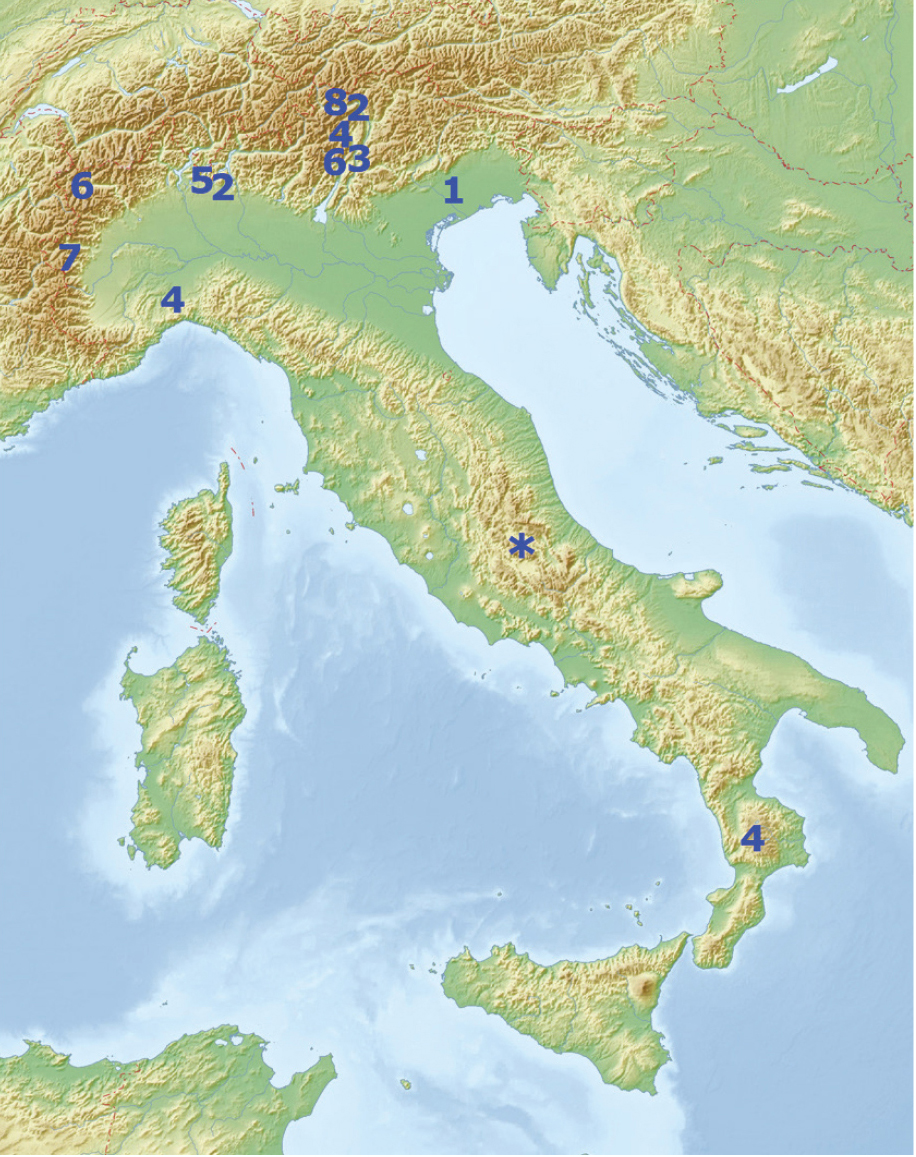
Figure 1:
Study area (*) and distribution of the main Molinia caerulea plant communities reported in Italy.
DISTRIBUTION OF THE MAIN MOLINIA CAERULEA
PLANT COMMUNITIES IN ITALY
Plantagini altissimae-Molinietum caeruleae
Selino-Molinietum caeruleae
Succiso-Molinietum caeruleae
Junco-Molinietum caeruleae
Juncus acutiflorus and Molinia caerulea community
Gentiano asclepiadeae-Molinietum caeruleae
Stachyo-Molinietum
Trollio europaei-Molinietum caeruleae
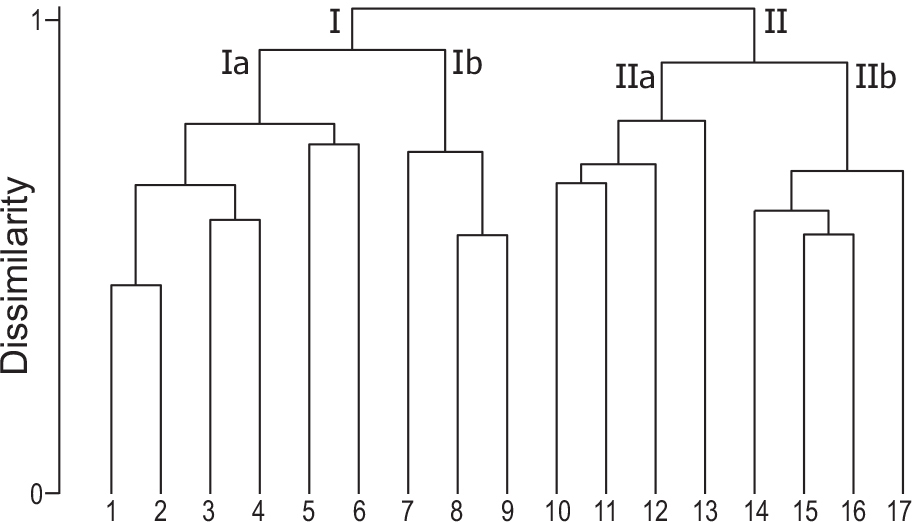
Figure 2:
Cluster analysis of the relevés carried out on Molinia caerulea plant communities found in the central Apennines (Table 1): main clusters are labelled as I and II, subclusters as Ia, Ib, IIa, and IIb.
Table 1:
Centaureo jaceae-Molinietum caeruleae Ciaschetti, Sburlìno et Venanzoni ass. nova.
| Relevé No. | 1* | 2 | 3 | 4 | 5 | 6 | 7 | 8 | 9 | 10 | 11 | 12 | 13 | 14* | 15 | 16 | 17 |
|---|---|---|---|---|---|---|---|---|---|---|---|---|---|---|---|---|---|
| Coverage (%) | 100 | 100 | 100 | 100 | 100 | 100 | 100 | 100 | 100 | 100 | 100 | 100 | 100 | 100 | 100 | 100 | 100 |
| Area (s. m.) | 16 | 16 | 16 | 16 | 16 | 20 | 30 | 30 | 16 | 25 | 20 | 16 | 16 | 25 | 20 | 20 | 25 |
| Centaureo jaceae~Molinietum caeruleae ass. nova | |||||||||||||||||
| Molinia caerulea (L.) Moench | 4.4 | 4.4 | 4.4 | 4.4 | 4.4 | 4.4 | 2.2 | 3.4 | 4.4 | 5.5 | 5.5 | 5.5 | 4.4 | 4.4 | 4.4 | 4.4 | 4.4 |
| Centaurea jacea L. subsp. jacea | 1.1 | 1.1 | 1.1 | 2.2 | 1.1 | + | 2.2 | 2.3 | 2.2 | 1.1 | 2.2 | + | 2.2 | 2.2 | 2.2 | 1.1 | 2.2 |
| Rhinanthus minor L. | 1.1 | + | 1.1 | 1.1 | 1.1 | 2.2 | 1.1 | 1.1 | 1.1 | 2.2 | 1.1 | 1.1 | + | 2.2 | 1.1 | 1.1 | |
| Sesleria uliginosa Opìz | 3.3 | 3.3 | 2.2 | 2.2 | 1.1 | 4.4 | 4.4 | 3.3 | 2.2 | 2.2 | 1.1 | 1.1 | |||||
| Ranunculus polyanthemoides Boreau | + | + | 1.1 | + | 1.1 | 1.1 | + | 2.2 | |||||||||
| typicum | |||||||||||||||||
| Genista tinctoria L. | 1.2 | 1.1 | 1.1 | 1.1 | 1.1 | 1.1 | + | 2.2 | 1.2 | + | |||||||
| Filipendula vulgaris Moench | + | + | + | 1.1 | + | + | 3.3 | 2.2 | 2.2 | ||||||||
| Trifolium montanum L. subsp. rupestre (Ten.) Nyman | 1.1 | 1.1 | 2.2 | 2.2 | + | + | 1.1 | + | |||||||||
| Lathyruspannonicus (Jacq.) Garcke subsp. asphodeloides (Gouan) Bassler | 1.1 | + | + | 1.1 | 1.1 | 1.1 | |||||||||||
| Plantago media L. subsp. media | + | + | 2.2 | 1.1 | 1.1 | ||||||||||||
| Roa sylvicola Guss. | 1.1 | + | + | 1.1 | |||||||||||||
| Klasea lycopifolia variant | |||||||||||||||||
| Klasea lycopifolia (Vìll.) A. Love & D.Löve | 1.2 | 3.4 | 1.2 | ||||||||||||||
| Thesium humifusum DC. | 1.1 | 2.2 | 1.2 | 1.2 | |||||||||||||
| Bromopsis erecta (Huds.) Fourr. | 1.2 | 1.2 | + | ||||||||||||||
| Knautia arvensis (L.) Coult. | 1.1 | + | + | ||||||||||||||
| Brachypodiumgenuense (DC.) Roem. & Schult. | 2.2 | 2.2 | |||||||||||||||
| Euphorbia gasparrinii Boîss. subsp. samnitica (Fiori) Pìgnattì | 1.2 | + | |||||||||||||||
| Trifolium ochroleucon Huds. | 1.1 | 1.2 | |||||||||||||||
| Avenulapubescens (Huds.) Dumort. | + .2 | ||||||||||||||||
| caricetosum bostianae subass. nova | |||||||||||||||||
| Carex hostiana DC. | + .2 | 1.2 | + | 1.2 | 1.2 | + | 1.1 | ||||||||||
| Juncus inflexus L. subsp. inflexus | + | + | + | + .2 | + | ||||||||||||
| Dactylorhiza incarnata (L.) Soo subsp. incarnata | + | 1.1 | + | + | + | ||||||||||||
| Juncus articulatus L. subsp. articulatus | 1.2 | + | + .2 | + | + | ||||||||||||
| Carex davalliana Sm. | 2.2 | 1.2 | |||||||||||||||
| Carex nigra (L.) Reichard subsp. nigra | 1.2 | ||||||||||||||||
| Molinion/Molinietalia | |||||||||||||||||
| Succis a pratensis Moench | 2.2 | 2.2 | 1.2 | + | 2.2 | 2.2 | 3.3 | 2.2 | 1.1 | 2.2 | 3.3 | 2.2 | 3.3 | 3.3 | 2.2 | 2.2 | 2.2 |
| Sanguisorba officinalis L. | + | 2.2 | + | 1.1 | + .2 | 1.1 | 1.1 | 2.2 | + | + | 1.1 | 1.1 | 1.1 | 1.1 | |||
| Serratula tinctoria L. subsp. tinctoria | 1.1 | 2.2 | 3.3 | 3.3 | 3.3 | 2.2 | + | 2.2 | 2.2 | 1.1 | 1.2 | 2.2 | |||||
| Gentiana pneumonanthe L. subsp. pneumonanthe | 1.1 | + | + .2 | + | 1.1 | 2.2 | 1.1 | 1.1 | 2.2 | + | 2.2 | ||||||
| Linum catharticum L. s.l. | 1.1 | + | 1.1 | + | 1.1 | 1.1 | 1.1 | + | 1.1 | 1.1 | |||||||
| Deschampsia cespitosa (L.) P. Beauv. subsp. cespitosa | + .2 | + .2 | 1.2 | + | + | 1.1 | 1.1 | + | |||||||||
| Carex panicea L. | + | 1.1 | 1.1 | + | + | ||||||||||||
| Bistorta officinalis Delarbre | 1.2 | + | + | ||||||||||||||
| Carex tomentosa L. | + | ||||||||||||||||
| Equisetum palustre L. | + .2 | ||||||||||||||||
| Gymnadenia conopsea (L.) R. Br. | + | ||||||||||||||||
| Valeriana officinalis L. subsp. officinalis | + | ||||||||||||||||
| Molinio-Arrhenatheretea | |||||||||||||||||
| Vicia cracca L. | 2.2 | + | 1.1 | + | + | 1.1 | 1.1 | 1.1 | 2.2 | 2.2 | + | 1.1 | 1.1 | 1.1 | + | + | |
| Festuca rubra L. subsp. commutata (Gaudin) Markgr.-Dann. | 2.2 | 2.2 | 2.2 | 2.2 | 2.2 | 1.2 | 1.2 | 1.1 | 1.1 | 1.1 | 2.2 | 1.2 | 2.2 | 2.2 | 1.1 | ||
| Carex flacca Schreb. subsp. flacca | 1.1 | 2.2 | 2.2 | 2.2 | 1.1 | 1.1 | 1.1 | 2.2 | + .2 | 1.1 | + | 2.2 | 3.3 | + | 1.1 | ||
| Potentilla erecta (L.) Raeusch. | 3.3 | 3.3 | 2.2 | 2.2 | 1.1 | 2.2 | + | 2.2 | 2.2 | 1.1 | 1.1 | 2.3 | 2.2 | 2.2 | |||
| Trifolium pratense L. subsp. pratense | + | 1.1 | 1.1 | 1.1 | + | 2.2 | 1.2 | + | 1.1 | + | 2.3 | 2.2 | 1.1 | 2.2 | |||
| Lotus corniculatus L. subsp. corniculatus | 1.1 | 1.1 | 1.1 | 2.2 | 2.2 | 2.2 | + | 1.1 | + | 2.2 | 1.1 | 1.1 | 1.1 | ||||
| Ranunculus acris L. s.l. | + .2 | 1.1 | 1.1 | 1.1 | + | + | 1.1 | 1.1 | + | 1.1 | |||||||
| Trifolium repens L. | + | + | + | 2.2 | 2.2 | + .2 | 1.2 | 1.1 | + | ||||||||
| Cerastium holosteoides Fr. | + | + | 1.1 | 1.1 | 1.2 | + | + | + | 1.1 | ||||||||
| Holcus lanatus L. subsp. lanatus | + .2 | 1.2 | 2.2 | 1.1 | 1.1 | 1.1 | 1.2 | ||||||||||
| Lolium interruptum (Desf.) Banri, Galasso, Foggî, Kopecký & Ardenghî | + | + .2 | + | + | + | 1.1 | |||||||||||
| Cynosurus cristatus L. | 2.2 | 1.1 | 1.1 | 1.1 | 1.1 | + | |||||||||||
| Anthoxanthum odoratum L. | 2.2 | 2.2 | 1.1 | + | + | 1.1 | |||||||||||
| Lathyrus pratensis L. subsp. pratensis | + | 1.1 | 1.1 | + | + | + | |||||||||||
| Carex hirta L. | 1.1 | + | + | + | 1.1 | 1.1 | |||||||||||
| Poa trivialis L. | + | 1.2 | 2.3 | 1.1 | + | ||||||||||||
| Leontodon hispidus L. subsp. hispidus | 1.1 | 1.1 | 1.1 | 1.1 | 1.1 | ||||||||||||
| Colchicum lusitanum Brot. | + | + | + | + | |||||||||||||
| Phleum nodosum L. | 1.1 | + | + | 1.1 | |||||||||||||
| Dactylis giomerata L. subsp. glomerata | + | + | 2.2 | + | |||||||||||||
| Rumex acetosa L. subsp. acetosa | + | 1.1 | + | ||||||||||||||
| Potentilla reptans L. | + | + | + | ||||||||||||||
| Scorzoneroides autumnalis (L.) Moench | + | 1.1 | |||||||||||||||
| Hypericum tetrapterum Fr. | + | ||||||||||||||||
| Other species | |||||||||||||||||
| Briza media L. | 1.1 | 1.1 | + .2 | 1.1 | 1.1 | 1.1 | 2.3 | 2.2 | 1.1 | 2.2 | 1.1 | 2.2 | 1.1 | 1.1 | 2.2 | 1.1 | 1.1 |
| Galium verum L. subsp. verum | + | 2.2 | 1.1 | + | 1.2 | 2.2 | 1.1 | 1.1 | 1.1 | + | 2.2 | + | |||||
| Dactylorhiza maculata (L.) Soo subsp. saccifera (Brongn.) Dìklìć | + | 1.1 | 1.1 | 1.1 | + | 1.1 | + | + | |||||||||
| Euphrasia stricta D. Wo Iff ex J. F. Lehm. | + | 1.1 | + | + | 1.1 | 1.1 | |||||||||||
| Cirsium acaulon (L.) Scop, subsp. acaulon | + .2 | + | 2.2 | + | 1.1 | ||||||||||||
| Cerastium hrachypetalum Desp. ex Pers, subsp. brachypetalum | + | + | + | 1.1 | |||||||||||||
| Plantago maritima L. subsp. serpentina (All.) Arcang. | + | 2.2 | + | + | |||||||||||||
| Luzula multiflora (Ehrh.) Lej. subsp. multiflora | + | + | + | 1.1 | |||||||||||||
| Anacamptis morio (L.) R. M. Bateman, Prîdgeon & M. W. Chase | + | + | + | ||||||||||||||
| Trifolium pratense L. subsp. semipurpureum (Strobl) Pìgnattì | 1.1 | 1.1 | + | ||||||||||||||
| Carex caryophyllea Latourr. | + | + | |||||||||||||||
| Bromus commutatus Schrad. s.l. | + | +.2 | |||||||||||||||
| Daucus carota L. subsp. carota | + | + | |||||||||||||||
| ?halictrum simplex L. subsp. simplex | 1.2 | 1.1 | |||||||||||||||
| Narcissus poёticus L. | + | + | |||||||||||||||
| Sporadic species | 1 | 0 | 0 | 0 | 1 | 2 | 2 | 7 | 1 | 2 | 0 | 1 | 2 | 0 | 0 | 1 | 0 |
The NMDS ordination (Figure 3) shows the arrangement of the relevés in two-dimensional space. The two groups identified by the cluster analysis (I, II) are located along axis 2, while subclusters Ia and Ib are positioned along axis 1.
The Minimum Spanning Tree (Figure 4, detailed data source in Appendix 1) shows that the Abruzzo communities (numbers 1 and 2 in Figure 4) have a greater affinity with the Balkan communities (numbers 3 to 9 in Figure 4) than with those in northern Italy and the Alps (numbers 11 to 24 in Figure 4). Although positioned close to the other “southern” communities in the diagram, the Calabrian phytocoenoses are linked to them with quite a high dissimilarity value. This is probably due to the particularly lithological characteristics of the Calabrian phytocoenoses, which grow on granitic-crystalline substrates.
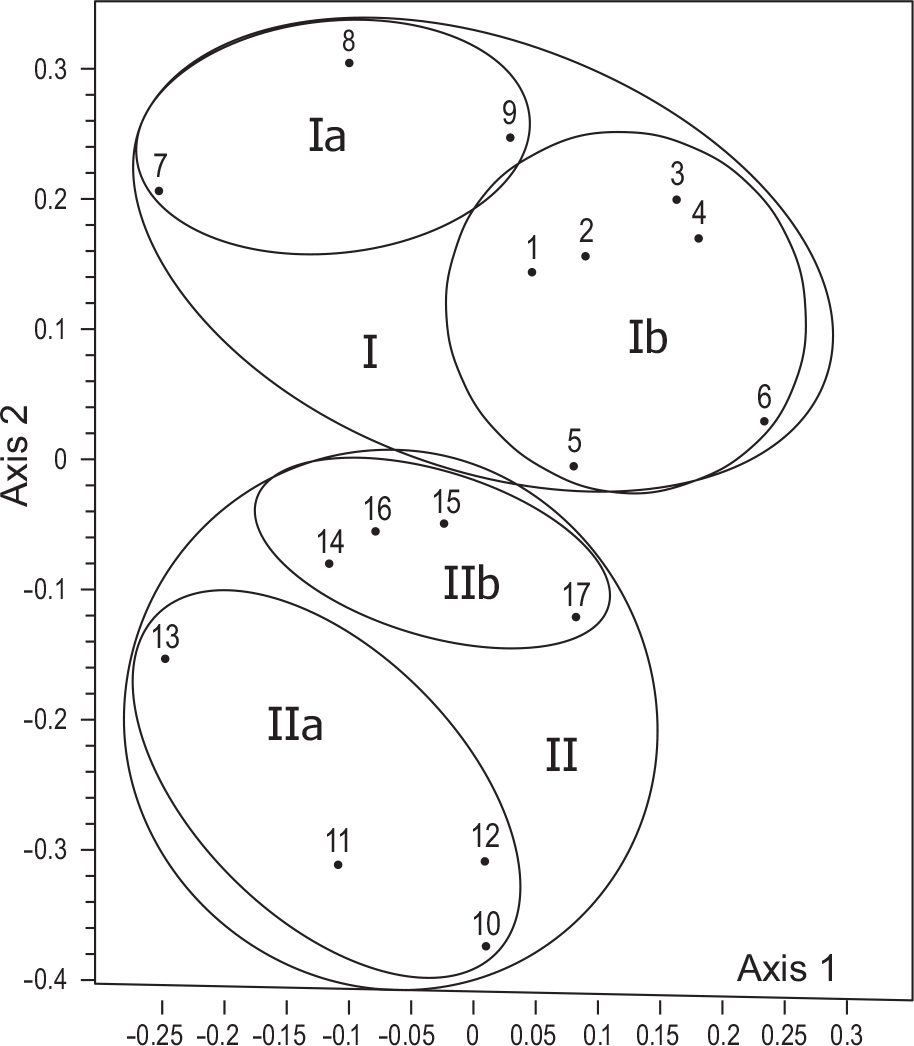
Figure 3:
NMDS ordination of the relevés carried out on Molinia caerulea plant communities found in the central Apennines (Table 1): main clusters are labelled as I and II, subclusters as Ia, Ib, IIa, and IIb.
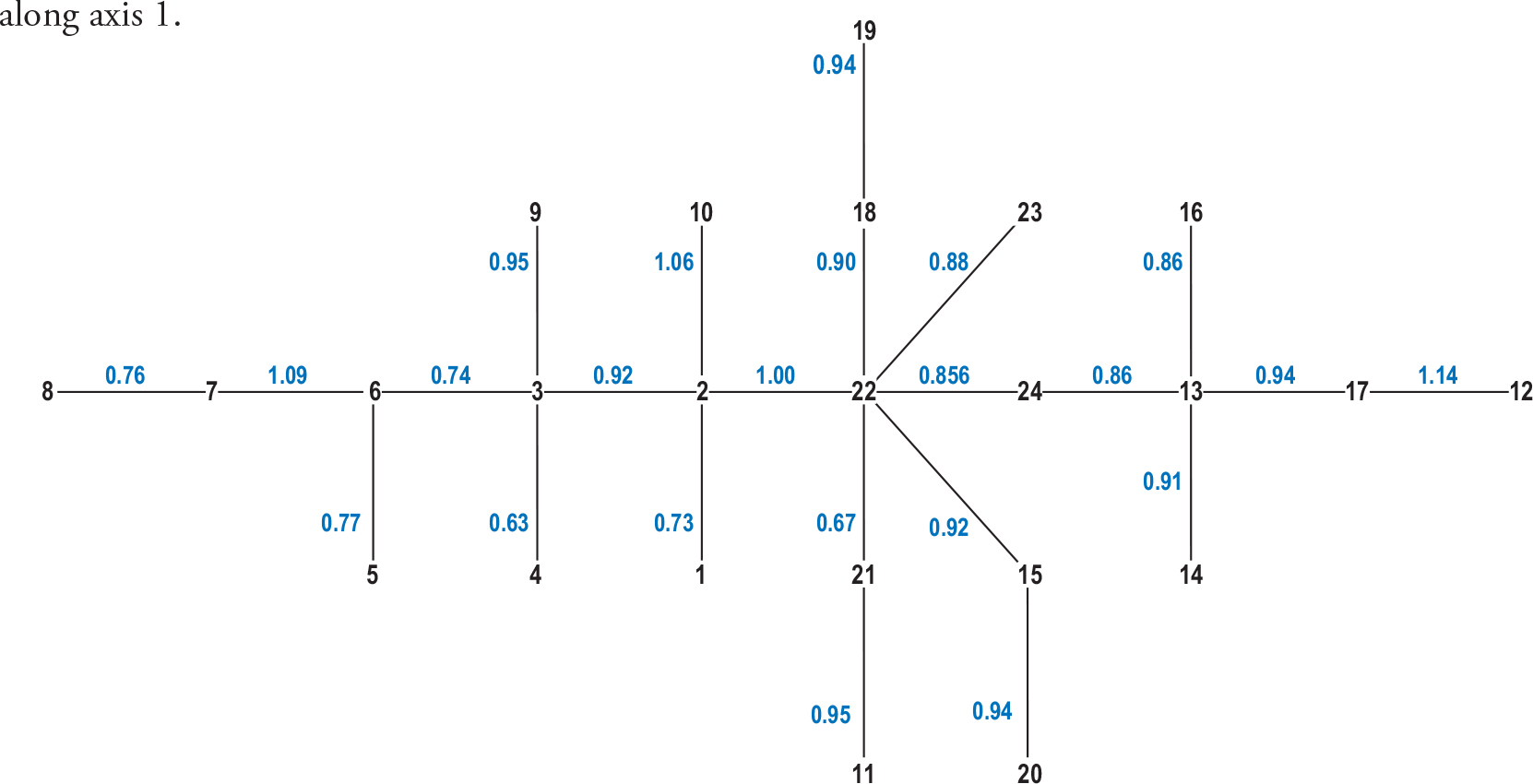
Figure 4:
Minimum Spanning Tree of the Molinia communities from Italy (1–2, 10 to 19), Alps outside Italy (20 to 24) and western Balkan (3 to 9). Detailed data source in Appendix 1. The blue numbers indicate the distance values among the groups.
The results of the MST make it possible to analyse the similarities/divergences between the communities in central-southern Italy and those on the Balkan Peninsula in greater detail.
The cluster analysis of the Molinia caerulea relevés in central-southern Italy and the western Balkans (Figure 5) shows two main groups (A and B in Figure 5 and 6), the second of which (B) consists of the relevés from Bosnia-Herzegovina. In the first cluster, the Calabrian relevés (A2) are shown to be independent of the rest of cluster A (A1), which in turn is divided into two sub-clusters: A1a, consisting of the Abruzzo and Serbia relevés, and A1b, including all the subassociations in the Croatian Molinio-Lathyretum.
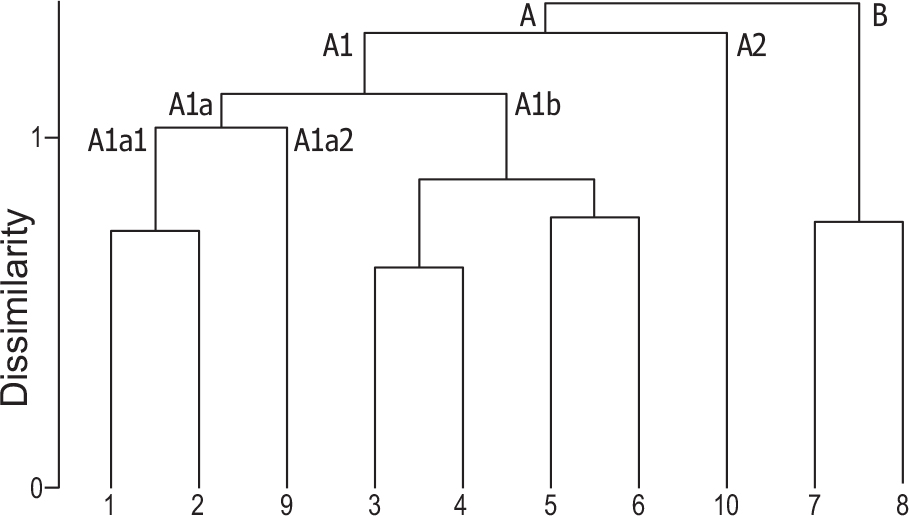
Figure 5:
Cluster analysis of the Molinia caerulea meadows in centralsouthern Italy and western Balkans: 1-2 = data from Abruzzo; 3 to 6 = Molinio-Lathyretumpannonici from Croatia; 7–8 = Molinio-Lathyretum pannonici from Bosnia; 9 = Lathyro pannonici-Molinietum caeruleae from Serbia; 10 = Junco effusi-Molinietum caeruleae from Calabria (numbers as in Figure 4 and 6). Detailed data source in Appendix 1.
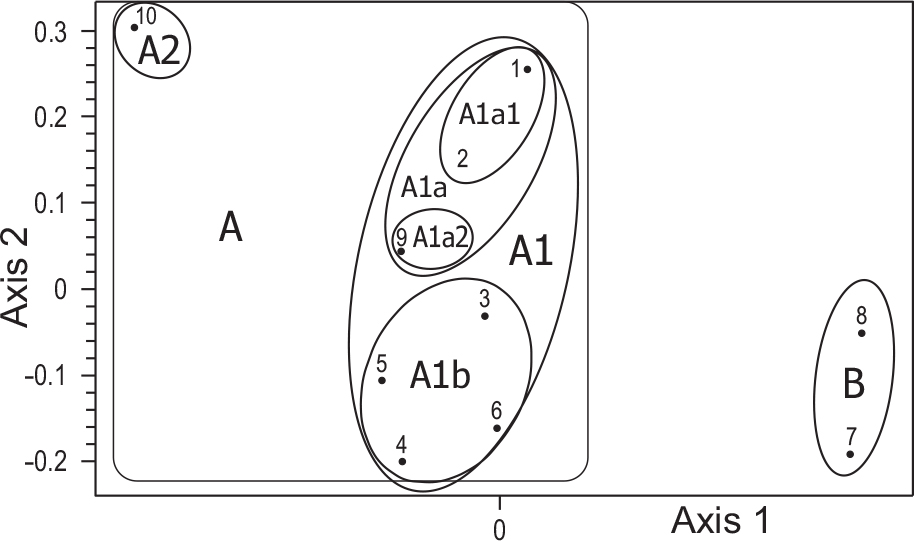
Figure 6:
NMDS ordination of the Molinia caerulea meadows in central-southern Italy and western Balkans: 1–2 = data from Abruzzo; 3 to 6 = Molinio-Lathyretumpannonici from Croatia; 7–8 = Molinio-Lathyretum pannonici from Bosnia; 9 = Lathyro pannonici-Molinietum caeruleae from Serbia; 10 = Junco effusi-Molinietum caeruleae from Calabria (numbers as in Figure 4–5). Detailed data source in Appendix 1.
The NMDS ordination (Figure 6) confirms a separation of both clusters A and B and subclusters A1 and A2 along the first axis. The second axis not only emphasises the opposite positioning of A2 and B in two-dimensional space, it also indicates the sequential placement of subclusters A1a and A1b and, within the former, A1a1 and A1a2.
Discussion
In the southern and south-eastern European context, the Molinia caerulea phytocoenoses of Abruzzo (nos. 1 and 2 in Figure 4) are markedly different from those in northern Italy and the Alps (nos. 11–24 in Figure 4), although they share some Molinion and Molinietalia caeruleae diagnostic species, such as Succisa pratensis, Serratula tinctoria and Sanguisorba officinalis. It is, however, important to note that these species are also present, with varying frequencies, in the Balkan associations (nos. 3–9 in Figure 4).
The affinity between the Abruzzo and Balkan relevés is evidenced by the common presence of several species that are absent or poorly represented in the other phytocoenoses considered (see Appendix 1), such as Lathyrus pannonicus s.l., Cynosurus cristatus, Trifolium repens and Trifolium montanum s.l. Restricting the comparison to the Abruzzo and Balkan communities alone, the former share some species such as Linum catharticum, Potentilla erecta and Filipendula vulgaris only with the Serbian Lathyro-Molinietum caeruleae, and other species such as Sesleria uliginosa, Carex hostiana and Festuca rubra s.l. only with Molinio-Lathyretum pannonici from Croatia and Bosnia-Herzegovina.
Looking at the cluster analysis and NMDS ordination of the “southern” Molinia grasslands investigated in the present study (Figs. 5–6), it can be seen that cluster B, relating to the Bosnia-Herzegovina formations is isolated at the top of the graph, probably due to the fact that incomplete synoptic columns were used (16 and 24 species, respectively). A considerable distance also separates the communities in Calabria (A2 in Figure 5–6) from the others. This is due to the different nature of the substrates, which, in the case of the Calabrian rocks, determine greater water retention and soils with an acidic pH (Venanzoni, 1988).
With regard to cluster A1, the Abruzzo phytocoenoses (A1a1 in Figs. 5–6) is more closely linked to the Serbian Lathyro pannonici-Molinietum caeruleae (A1a2) than to the Croatian Molinio-Lathyretum pannonici (A1b).
Despite apparent similarities in nomenclature, the syntaxonomic placement of the two Balkan associations is very different. Like most of the European associations, the Serbian Lathyro-Molinietum caeruleae is included in the Molinion caeruleae (Aćić et al., 2013), while the Molinio-Lathyretum pannonici in Croatia and Bosnia-Herzegovina is attributed to the Molinio-Hordeion secalini (Trifolio-Hordeetalia order) (Horvatić, 1963; Ritter-Studnička, 1972). This different syntaxonomic positioning reflects the bioclimatic diversity of the areas concerned: subcoastal areas in the colline belt with a submediterranean climate for Molinio-Lathyretum pannonici; montane areas with a more continental climate for Lathyro-Molinietum caeruleae. As confirmation of this, among the species considered diagnostic of Molinio-Hordeion secalini and Trifolio-Hordeetalia (Horvatić, 1963; Šilc et al., 2014), only Carex distans, a species with a broad ecology, is present in the latter association.
The affinity of the Abruzzo relevés with those of the Balkans is primarily due to the latitudinal gradient which unites the Italian and Balkan peninsulas. Moreover, the central Apennine plateaus are karst in nature, as are the areas of the Balkan from which the relevés considered originate. On the other hand, the distinctly montane and moderately continental climate of the surveyed area explains its greater similarity to the Pešter Plateau (Serbia), rather than to the subcoastal areas of Croatia and Bosnia.
In the relevés presented here, as with the Serbian Lathyro pannonici-Molinietum caeruleae, the diagnostic species of the Trifolio-Hordeetalia are almost absent, while, as mentioned above, those diagnostic of the Molinion caeruleae and Molinietalia caeruleae are quite well represented.
Finally, several species are present in the Abruzzo relevés but absent from those from the Balkans: Genista tinctoria, Carex flacca, Galium verum, Plantago media, Vicia cracca and Ranunculus polyanthemoides. On the contrary, other species are present in the Balkan relevés and absent in those from the central Apennines: Cirsium canum, Trifolium patens, Lysimachia nummularia, Anacamptis palustris, Oenanthe fistulosa, etc. This gives the Abruzzo phytocoenoses a certain degree of autonomy, as shown by the separation of subcluster A1a1 in Figs. 5–6.
As can be seen, the Molinia caerulea communities studied are differentiated in two main aspects. The first (cluster I in Figs. 2–3) is associated with the more mesophilous situations, in contact with surrounding hay meadows growing on soils with a lower water content. The species differentiating this cluster are, in fact, typical of little to moderately fertilised hay meadows and/or pastures (e.g. Genista tinctoria, Filipendula vulgaris, Plantago media subsp. media, Lathyrus pannonicus subsp. asphodeloides, Poa sylvicola, Trifolium montanum subsp. rupestre. The meso-xerophilous species are even more prominent in subcluster Ib, which also includes species such as Klasea lycopifolia, Thesium humifusum, Bromopsis erecta, Brachypodium genuense and Euphorbia gasparrini subsp. samnitica. Of these, the last two species are endemic to Italy, while Klasea lycopifolia is a rare species protected by the European Habitats Directive 92/43 EEC and the subject of specific conservation actions in the study area (Gigante et al., 2014; Di Martino et al., 2016).
Cluster II (Figure 2–3), on the other hand, relates to edaphic situations with a shallower water table and higher content of organic matter, bordering on the low fen vegetation of the Caricetalia davallianae Br.-Bl. 1949 order described in Ciaschetti et al. (2024). The cluster is differentiated by a number of peatland or otherwise hygrophilous species: Carex hostiana, Juncus inflexus subsp. inflexus, Dactylorhiza incarnata subsp. incarnata, Juncus articulatus subsp. articulatus, Carex davalliana, Carex nigra subsp. nigra. In other areas, Carex hostiana in particular (also the most frequent) has already been used to distinguish autonomous associations, subassociations or their variants, together with Carex davalliana and other alkaline fenrelated species (e.g. Koch, 1926; Klötzli, 1969; Havlová, 2006; Borhidi et al., 2012).
In light of these considerations, we consider it appropriate to classify the phytocoenoses studied into Molinion, Molinietalia, Molinio-Arrhenatheretea and, on the basis of their floristic-sociological autonomy, we propose the following new association:
CENTAUREO JACEAE-MOLINIETUM CAERULEAE Ciaschetti, Sburlino et Venanzoni ass. nova hoc loco (holotypus rel. 1 of Table 1 this paper)
Description: this association refers to the Molina caerulea dominated meadows found in flat areas of the karst montane plateaus of the central Apennines, on fine-textured, deep, temporary flooded soils, sub-acid on the surface and neutral in depth, generated on fluvio-lacustrine deposits.
Structure and floristic composition: it takes the form of a continuous hay meadow whose physiognomy is determined by the clearly dominant Molinia caerulea, accompanied by, among the most abundant species, Succisa pratensis, Sesleria uliginosa, Serratula tinctoria, Festuca rubra subsp. commutata, Carex flacca subsp. flacca and Potentilla erecta. Klasea lycopifolia is also very abundant locally. In particular, in the karst highlands of the central Apennines, Sesleria uliginosa, a species associated with moist soils (Sburlino et al., 1995; Foggi et al., 2001; Aeschimann et al., 2004) but with “a wide ecological amplitude with respect to moisture gradient” (Gonda & Dítě, 2011), had already been indicated as diagnostic of the meso-xerophilous Cirsio acaulis-Seslerietum uliginosae pasture association, (Biondi et al., 1992; Ciaschetti et al., 2006).
Diagnostic species: Molinia caerulea, Centaurea jacea subsp. jacea, Rhinanthus minor, Ranunculus polyanthemoides, Sesleria uliginosa. The last of these can be considered as a characteristic species at regional level (sensu Mucina, 1993).
Syntaxonomy: the association is included in the Molinion caeruleae alliance (Molinietalia caeruleae, Molinio-Arrhenatheretea). Several diagnostic species of these syntaxa are, in fact, very well represented. These include Succisa pratensis, Sanguisorba officinalis and Serratula tinctoria. The high edaphic humidity and biogeographical position in which these communities develop, namely the Alpine-Caucasian subregion of the Eurosiberian region (Rivas-Martinez et al., 2004), also justify this positioning.
Chorology: the association is so far known only for the Sirente-Velino Regional Park (Abruzzo, central Italy).
EU Reference Habitat: 6410 Molinia meadows on calcareous, peaty or clayey-silt-laden soils (Molinion caeruleae) (Blasi et al., 2010, available at http://vnr.unipg.it/habitat).
Conservation status, pressures and threats: the conservation status can be considered as relatively good. The area is mown for hay production once a year in the second half of July and no artificial fertilisation is used. After mowing, cattle grazing is permitted, but to such a modest extent that it does not pose an imminent threat.
CENTAUREO JACEAE-MOLINIETUM CAERULEAE TYPICUM Ciaschetti, Sburlino et Venanzoni subass. nova hoc loco (Table 1 rel. 1-9; holotypus rel. 1 of Table 1 this paper)
Description: this is the most widespread aspect in the study area, associated with the less hygrophilous aspects of the association, in contact with the meadows and pastures on areas not subject to flooding or only partially flooded. The lower water content enables greater mineralisation of the organic matter in the soil, resulting in greater floristic richness, with an average of 34.6 species per relevé.
Structure and floristic composition: in addition to Molinia caerulea, the physiognomy is determined by Succisa pratensis, Serratula tinctoria and Sesleria uliginosa. The species of the Molinion/Molinietalia and Molinio-Arrhenatheretea are fairly well represented with an average of 6.2 and 9.7 entities per relevé respectively.
Diagnostic species: Genista tinctoria, Filipendula vulgaris, Trifolium montanum subsp. rupestre, Lathyrus pannonicus subsp. asphodeloides, Plantago media subsp. media, Poa sylvicola.
Klasea lycopifolia variant (Table 1 rel. 7–9)
Description: this variant has a richer presence of mesoxerophilous species from the little to moderately fertilised hay meadows and the pastures and can therefore be considered as an aspect of transition to the surrounding grassland communities in more elevated positions. Some similarities can be observed between this variant and Lathyro asphodeloidis-Klaseetum lycopifoliae, a type of meadow described in other localities close to the study area and attributed to the Cynosurion cristati alliance (Ciaschetti & Pirone, 2019). It should be noted that Klasea lycopifolia [= Serratula lycopifolia (Vill.) A.Kern] is also particularly abundant in Molinio-Lathyretum pannonici serratuletosum lycopifoliae, the assocation’s least hygrophilous subassociation, with an abundance of Festuco-Brometea species (Ritter-Studnička, 1972) which, as mentioned before, were not considered here as Molinia caerulea is absent.
Structure and floristic composition: In addition to the species determining the physiognomy of the association, Klasea lycopifolia, Thesium humifusum, Brachypodium genuense and Bromopsis erecta are also abundant.
CENTAUREO JACEAE-MOLINIETUM CAERULEAE CARICETOSUM HOSTIANAE Ciaschetti, Sburlino et Venanzoni subass. nova hoc loco (Table 1 rel. 10-17; holotypus rel. 14 of Table 1 this paper)
Description: This subassociation relates to the more hygrophilous aspects, in contact with the alkaline fens of the Caricetalia davallianae.
Structure and floristic composition: the physiognomy is established by Molinia caerulea, Succisa pratensis, Gentiana pneumonanthe subsp. pneumonanthe, Centaurea jacea subsp. jacea, Carex flacca subsp. flacca, Potentilla erecta, Trifoliumpratense subsp. pratense and Festuca rubra subsp. commutata are also abundant.
Diagnostic species: Carex hostiana (regional characteristic sensu Mucina, (1993)). Juncus inflexus subsp. inflexus, Dactylorhiza incarnata subsp. incarnata, Juncus articulatus subsp. articulatus, Carex davalliana and Carex nigra sub-sp. nigra. There is a certain depletion of diagnostic species in relevés 10–13, corresponding to subcluster Ila in Figure 2.
Overall, the vegetation studied can be classified as follows:
Syntaxonomic scheme
MOLINIO-ARRHENATHERETEA Tüxen 1937
MOLINIETALIA CAERULEAE Koch 1926
Molinion caeruleae Koch 1926
Centaureo jaceae-Molinietum caeruleae Ciaschetti, Sburlino et Venanzoni ass. nova hoc loco
–typicum Ciaschetti, Sburlino et Venanzoni subass. nova
– variant with Klasea lycopifolia
– caricetosum hostianae Ciaschetti, Sburlino et Venanzoni subass. nova
List of the syntaxa not quoted in the syntaxonomic scheme:
Carici davallianae-Molinietum caeruleae Špániková 1978 Cirsio acaulis-Seslerietum uliginosae Biondi, Ballelli, Allegrezza, Frattaroli et Taffetani 1992 corr. Ciaschetti et al. 2006
Cynosurion cristati Tüxen 1947
Festuco-Brometea Br.-Bl. et Tüxen ex Soo 1947
Gentiano asclepiadeae-Molinietum caeruleae Oberdorfer 57 em. Oberdorfer et al. 1967
Juncion acutiflori Br.-Bl. 1947
Junco-Molinietun caeruleae Preising 1951
Junco effusi-Molinietum caeruleae Tüxen 1954
Lathyro-asphodeloidis-Klaseetum lycopifoliae Ciaschetti et Pirone 2019
Lathyro pannonici-Molinietum caeruleae Tatić et al. ex Aćić, Šilc, Lakušić, Vukojičić et Dajić Stevanović 2013
Molinietum caeruleae Koch 1926
Molinietun coeruleae caricetosum hostianae Koch 1926
Molinietun coeruleae caricetosum paniceae Koch 1926
Molinietun coeruleae caricetosum tomentosae Koch 1926
Molinio-Lathyretum pannonici Horvatić 1963
Molinio-Lathyretum pannonici typicum Horvatić 1963
Molinio-Lathyretum pannonici caricetosum davallianae Gaži-Baskova 1963
Molinio-Lathyretum pannonici caricetosum paniceae Ritter-Studnička 1972
Molinio-Lathyretum pannonici serratuletosum lycopifoliae Ritter-Studnička 1972
Molinio-Lathyretum pannonici salicetosum rosmarinifoliae Ritter-Studnička 1972
Molinio-Lathyretum pannonici scilletosum pratensis Horvatić 1963
Molinio-Lathyretum pannonici sieglingietosum Gaži-Baskova 1963
Plantagini altissimae-Molinietum caeruleae Marchiori et Sburlino 1982
Plantagini altissimae-Molinietum caeruleae typicum Sburlino, Bracco, Buffa et Andreis 1995
Plantagini altissimae-Molinietum caeruleae cladietosum marisci Sburlino, Bracco, Buffa et Andreis 1995
Ranunculion velutini Pedrotti 1978
Selino-Molinietum caeruleae Kuhn 1937
Selino-Molinietum caeruleae inuletosum salicinae Balátová et Venanzoni 1989
Stachyo-Molinietum Passarge 1964
Succiso-Molinietum caeruleae (Kovacs 1962) Soó 1969
Succiso-Molinietum caeruleae caricetosum elatae Minghetti et Pedrotti 2000
Trifolio-Hordeetalia Horvatić 1963
Trollio europaei-Molinietum coeruleae trifolietosum medii de Foucault 1976
Conclusions
The Molinia caerulea meadows described here are the first reported in central Italy, as are plant communities referable to the Molinion caeruleae alliance.
Molinia caerulea meadows in central Italy, together with those in Calabria, the southern Alps and the northern Apennines, represent important fragments of vegetation that can be considered relicts of the Ice Age, in common with other Caricetalia davallianae and Magnocaricetalia communities (e.g. Ciaschetti et al., 2021; Venanzoni et al., 2021; Ciaschetti et al., 2024).
The study shows how, in the transition zone between the submediterranean and temperate climates, high level of soil humidity and high-water table during the year can determine the establishment of phytocoenoses traced back to central European models, rather than to submediterranean communities of the Trifolio-Hordeetalia order. It is highly probable that this is also due to the altitudinal factor and degree of continentality, as is also the case in the Western Balkans.
From a strictly phytosociological point of view, the Molinion caeruleae alliance enriches the list of alliances to which the grasslands on wet and/or temporarily flooded soils of the central Apennine karst plateau can be attributed: Salvio pratensis-Dactylidion glomeratae Ubaldi et al. in Ubaldi 2003 (Venanzoni, 1992; Allegrezza & Biondi, 2011; Biondi et al., 2011); Cynosurion cristati (Cortini Pedrotti et al., 1973; Pedrotti et al., 1992; Venanzoni, 1992; Pirone, 1997; Blasi et al., 2012; Ciaschetti & Pirone, 2019; Ciaschetti et al., 2021; Ranunculion velutini (Pedrotti, 1976, 2019; Pedrotti & Sanesi, 1969; Canullo et al., 1988; Pedrotti et al., 1992; Venanzoni, 1992; Pirone, 1997; Biondi et al., 1999; Tardella & Di Agostino, 2020); Potentillion anserinae (Cortini Pedrotti et al., 1973; Pedrotti et al., 1992; Venanzoni, 1992; Pedrotti, 2019; Ciaschetti et al., 2021; Tardella & Di Agostino, 2020); Mentho-Juncion inflexi (Pedrotti, 1976; Pirone, 1997; Tardella & Di Agostino, 2020).
Notes
[1] Research data availability
The data used in this study are available from the corresponding author upon reasonable request.
Appendices
APPENDIX 1
Data sources of Figures 4-6
Data sources are in brackets.
1: Centaureo jaceae-Molinietum caeruleae typicum Ciaschetti, Sburlino et Venanzoni subass. nova hoc loco – Abruzzo, Italy;
2: Centaureo jaceae-Molinietum caeruleae caricetosum hostianae Ciaschetti, Sburlino et Venanzoni subass. nova hoc loco – Abruzzo, Italy;
3: Molinio-Lathyretum pannonici typicum Horvatić 1963 – Croatia (Horvatić 1963);
4: Molinio-Lathyretum pannonici scilletosum pratensis Horvatić 1963 – Croatia (Horvatić 1963);
5: Molinio-Lathyretum pannonici sieglingietosum Gaži-Baskova 1963 – Croatia (Gaži-Baskova 1963);
6: Molinio-Lathyretum pannonici caricetosum davallianae Gaži-Baskova 1963 – Croatia (Gaži-Baskova 1963);
7: Molinio-Lathyretumpannonici caricetosumpaniceae Ritter-Studnička 1972 – Bosnia (Ritter-Studnicka 1972);
8: Molinio-Lathyretum pannonici salicetosum rosmarinifoliae Ritter-Studnicka 1972 – Bosnia (Ritter-Studnicka 1972);
9: Lathyropannonici-Molinietum caeruleae Tatić et alii. ex Aćić, Šilc, Lakušić, Vukojičić, Dajić Stevanović 2013 – Serbia (Tatić et al. 1988);
10: Junco effusi-Molinietum caeruleae Tüxen 1954 – Calabria, Italy (Venanzoni 1988 sub Junco-Molinietum caeruleae Preising 1951);
11: ĵunco effusi-Molinietum caeruleae Tüxen 1954 – Liguria, Italy (Barberis & Mariotti 1981 sub ĵunco-Molinietum caeruleae Preising 1951);
12: ĵuncus acutiflorus and Molinia caerulea groupment – Piedmont, Italy (Bracco & Nola 1995);
13: Gentiano asclepiadeae-Molinietum Oberdorfer 57 em. Oberdorfer et alii 1967 – Trento Province, Italy (Canullo et al. 1994);
14: Succiso-Molinietum caeruleae (Kovacs 1962) Soó 1969–Trento Province, Italy (Minghetti & Pedrotti 2000);
15: Selino-Molinietum caeruleae Kuhn 1937 – Lombardy, Italy (Sburlino et al. 1995);
16: Selino-Molinietum caeruleae inuletosum salicinae Balatova et Venanzoni 1989 – South Tyrol, Italy (Balátová-Tulacková & Venanzoni 1989);
17: Molinia caerulea groupment – Lombardy, Italy (Andreis & Zavagno 1996);
18: Plantagini altissimae-Molinietum caeruleae typicum Sburlino, Bracco, Buffa & Andreis 1995 – Eastern Po Valley, Italy (Sburlino et al. 1995);
19: Plantagini altissimae-Molinietum caeruleae cladieto-sum marisci Sburlino, Bracco, Buffa & Andreis 1995 – Friuli, Italy (Sburlino et al. 1995);
20: Trollio-Molinietum caeruleae Guinochet 1955 – Jura Mountains, France/Switzerland (Oberdorfer 1993);
21: Molinietun coeruleae caricetosum hostianae Koch 1926 – Switzerland (Koch 1926);
22: Molinietun coeruleae caricetosum paniceae Koch 1926 – Switzerland (Koch 1926);
23: Molinietun coeruleae caricetosum tomentosae Koch 1926 – Switzerland (Koch 1926);
24: Carici davallianae-Molinietum caeruleae Špániková 1978 – Slovenia (Zelnik & Čarni 2008).
Appendix 2
Dates and localities of the relevés in Table 1
Rell. 1, 5, 6, 9, 13: Campo di Rovere, Rocca di Mezzo (L’Aquila), 03 July 2023
Rell. 2–4, 14–15, 17: Campo di Rovere, Rocca di Mezzo (L’Aquila), 04 July 2023
Rell. 7–8: Campo di Rovere, Rocca di Mezzo (L’Aquila), 30 June 2023
Rell. 10–13: Le Conche, Ovindoli (L’Aquila), 02 July 2024
Appendix 3
Sporadic species
Rel. 1: Scorzoneroides cichoriacea (Ten.) Greuter +. Rel. 5: Trifolium hybridum L. subsp. hybridum +. Rel. 6: Gentiana verna L. subsp. verna +.2; Parnassiapalustris L. subsp. palustris +. Rel. 7: Alchemilla sp. 1.2; Hypericumperforatum L. subsp. perforatum +. Rel. 8: Campanula glomerata L. 1.2; Stellaria graminea L. +.2; Campanula rapunculus L. +; Lophiolepis tenoreana (Petr.) Del Guacchio, Bureš, Iamonico & P.Caputo +; Cruciata laevipes Opiz +; Saxifraga bulbifera L. +; Tragopogon porrifolius L. +. Rel. 9: Carex liparocarpos Gaudin subsp. liparocarpos +. Rel. 10: Danthonia decumbens (L.) DC. subsp. decumbens 1.2; Agrimonia eupatoria L. subsp. eupatoria +. Rel. 12: Valeriana stolonifera Czern. subsp. angustifolia Soó +. Rel. 13: Anthyllis vulneraria L. subsp. weldeniana (Rchb.) Cullen 1.1; Phragmites australis (Cav.) Trin. ex Steud. +. Rel. 16: Mentha aquatica L. subsp. aquatica +.