
Introduction
In Slovenia, sycamore maple (Acer pseudoplatanus) communities usually occur as potential natural vegetation in small areas, most often in stony or rocky gullies, in sinkholes, ravines and gorges, and on torrential fans (Zupančič, 1996; Zupančič & Žagar, 1999; Košir, 2005a,b; Košir et al., 2008; Dakskobler, 2007; Dakskobler et al., 2013a; Dakskobler & Poldini, 2022). The soil is usually colluvial-deluvial and very biologically active, rich in nitrogen. Litter decomposition is relatively fast. Stands of maple communities occur intrazonally, mainly in the beech and fir-beech zone, from the (colline) montane to the subalpine belt. Their floristic composition is very similar to the neighbouring communities, but includes more hygrophilous and nitrophilic species. Sycamore maple communities are predominantly classified into the alliance Tilio-Acerion (Willner, 2007; Košir et al., 2008) and they belong to the European priority habitat type 9180 * Tilio-Acerion forests of slopes, screes and ravines, which requires special nature conservation concern (Dakskobler et al., 2013a). They are often in close spatial or syndynamic contact with beech communities from the alliance Aremonio-Fagion. It is not always possible to draw a clear line between forest communities; there are many transitions, and sites with moist and nitrogen-rich soils are not necessarily also the sites of communities from the alliance Tilio-Acerion s. lat. Certain montane and altimontane beech communities also have a higher proportion of Acer pseudoplatanus, Ulmus glabra and (or) Fraxinus excelsior in the upper layer (Isopyro-Fagetum, Stellario montanae-Fagetum, Aconito paniculati-Fagetum) – Zupančič (2012) and Dakskobler (2014). We also have to take into the account secondary successions after radical clearing, where the original forest was probably still dominated by beech, whereas the secondary forest may be equally dominated by beech and sycamore maple.
The article focuses on a large number of relevés of montane-subalpine communities of sycamore maple on calcareous bedrock from the Julian Alps and their foothills, the Karavanke Mts. and the Trnovo Forest Plateau, which have been made since 2007 and their classification.
Methods
The relevés (altogether 65) were made using the Central-European method (Braun-Blanquet, 1964) and entered into the FloVegSi database (Seliškar et al., 2003). They were arranged in tables based on hierarchical classification, unweighted average linkage clustering (UPGMA), and Wishart’s similarity ratio, using the programme package SYN-TAX (Podani, 2001). Combined coverabundance values were converted into the ordinal scale 1 to 9 (van der Maarel, 1979). Obtained groups of relevés were compared to previously described noble hardwood communities that occur in the Illyrian beech forest zone (Aremonio-Fagion) and to the beech-maple community of the montane-subalpine zone (Aconito paniculati-Fagetum) from the Julian Alps.
The nomenclatural sources for the names of syntaxa are Šilc & Čarni (2012), Dakskobler et al. (2013a), Mucina et al. (2016) and Bončina et al. (2021). The nomenclatural sources for the names of vascular plants are Mala flora Slovenije (Martinčič et al., 2007) and the FloVegSi database. We used name Aconitum lycotonum subsp. ranun-culifolium (Martinčič et al., 2007), but in other sources are mentioned another names: A. lycoctonum subsp. neapolitanum (Aeschimann et al., 2004: 130) or A. lupicida (Martini et al., 2023: 140–141). Martinčič (2024a, b) is nomenclatural source for the names of mosses. The moss layer (including certain lichen species) was not fully inventoried and the determination of certain less frequent species is less reliable.
The geographical coordinates of relevés are determined based on the Slovenian geographical coordinate system D 48 (zone 5) on the Bessel ellipsoid and with Gauss-Krüger projection.
Results and discussion
Using numerical classification of 65 relevés, we identified three large clusters of maple forest communities, which we consider as separate syntaxa (Figure 2).
Lamio orvalae-Aceretum pseudoplatani fraxinetosum excelsioris
Hierarchical classification of montane and subalpine maple stands from northern, nortwestern and western Slovenia (Figure 1) showed two distinct clusters, with several relevés standing out from the rest (Figure 2).
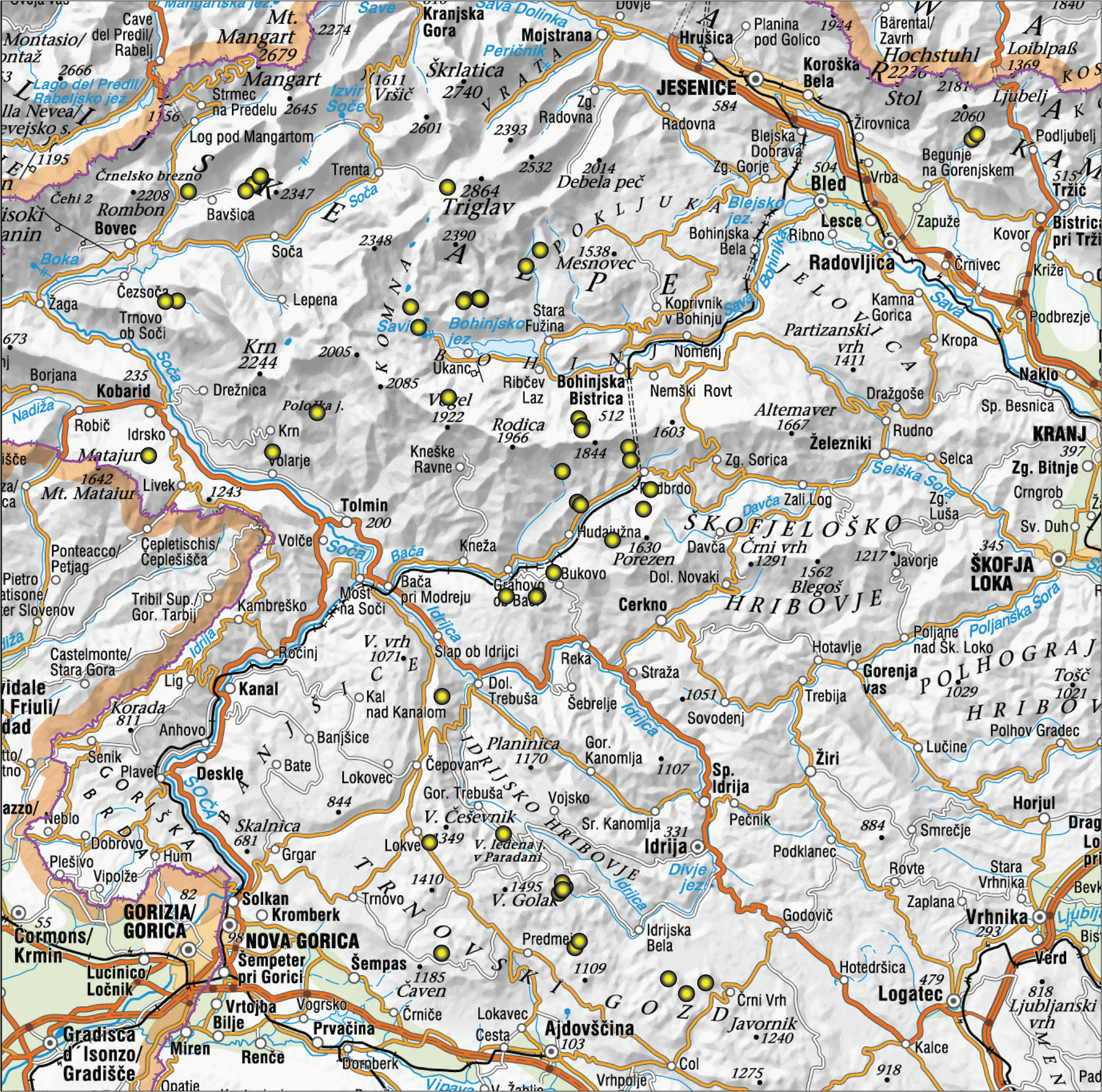
Figure 1:
Approximate localities of the recorded montane and subalpine sycamore maple stands from northern, nortwestern and western Slovenia.
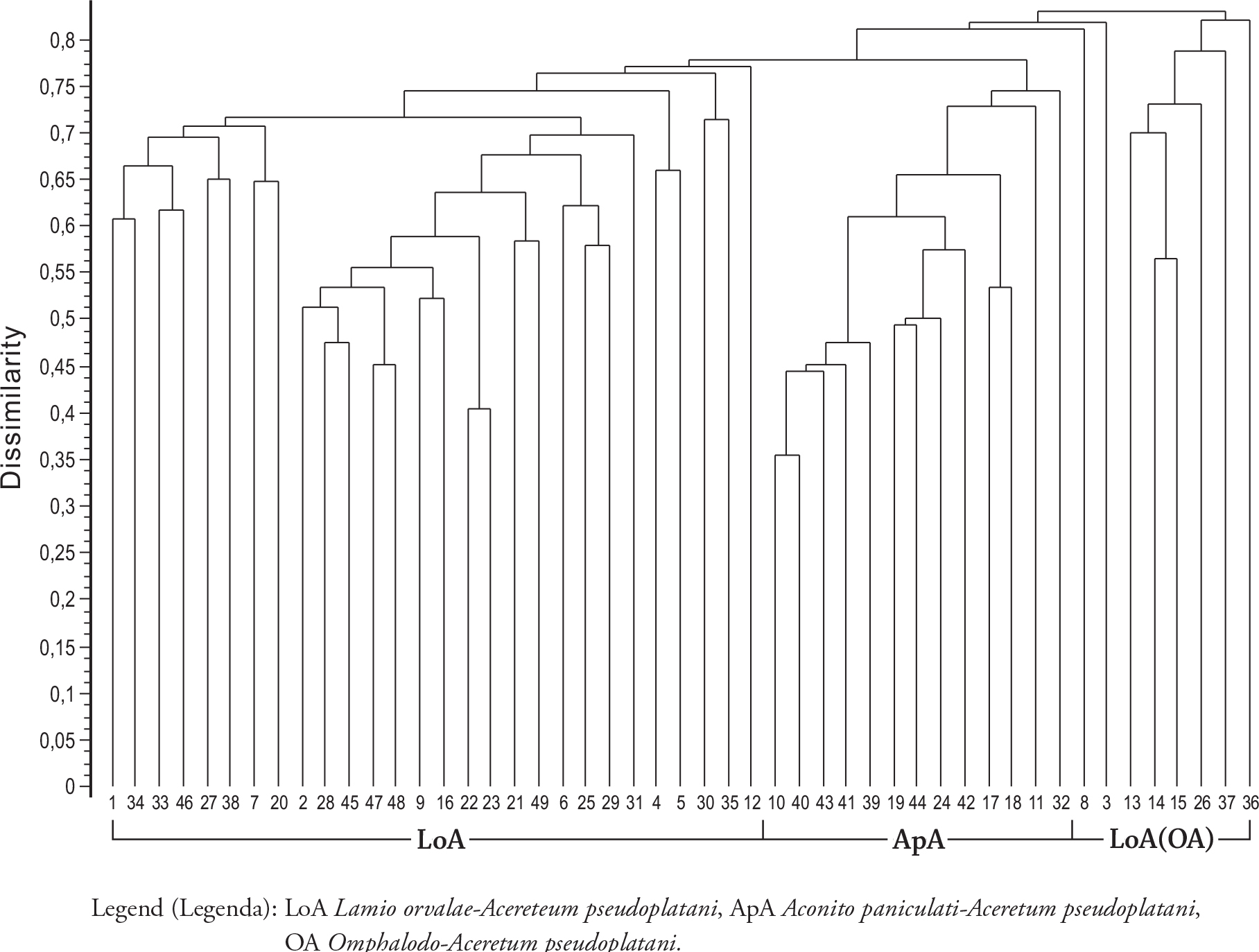
Figure 2:
Dendrogram of recorded forest stands with dominant Acer pseudoplatanus in northern, northwestern and western Slovenia (UPGMA, 1-similarity ratio).
The relevés in the large cluster on the left side of the dendrogram in Figure 2 are presented in Table 1. Based on the comparison with three phytosociological tables of similar maple communities (Košir, 2005a; Dakskobler, 2007; Dakskobler & Martinčič, 2021) they are classified into the association Lamio orvalae-Aceretum pseudoplatani and its subassociation fraxinetosum excelsioris (Figure 3). The diagnostic species of the association and subassociation are present, but less frequent than in the original phytosociological table of this syntaxon (Košir, 2005a). In addition to Fraxinus excelsior, we propose Aconitum degenii subsp. paniculatum and Scopolia carniolica as the differential species of the subassociation. As our relevés provide no basis for the classification into any other association or subassociation, we find this classification the most appropriate. Košir (2005a) differentiates between two geographic variants: Alpine–northern-Dinaric (var. geogr. Dentaria pentaphyllos) and Dinaric (var. geogr. Calamintha grandiflora). The relevés from the Upper Soča Valley and the fringes of the Trnovo Forest Plateau were classified into the geographic variant Anemone trifolia (Dakskobler, 2007). Since Table 1 comprises differential species of two geographic variants, Cardamine pentaphyllos (syn. Dentaria pentaphyllos) and Anemone trifolia, we classify these relevés into the geographic variant with Dentaria pentaphyllos and its subvariant with Anemone trifolia. We differentiate two ecological variants within the subassociation fraxinetosum excelsioris. The differential species of the variant with Corylus avellana (relevés 1–11 in Table 1) include Ostrya carpinifolia, Laburnum alpinum, Acer platanoides, Brachypodium sylvaticum, Pre-nanthespurpurea, Prnus avium and Viola reichenbachiana, and characterise a slightly more thermophilous type of this maple community. We also differentiate the subvariant with Alnus incana (relevés 10 and 11 in Table 1). Its stands indicate the contact of colluvium and alluvium as well as a certain similarity with the stands of the association Lamio orvalae-Alnetum incanae. Relevés 12–25 in Table 1 are classified into a slightly more frigoriphilic type variant of the same subassociation, which also has several relevés with Leucojum vernum and Anthriscus nitida.
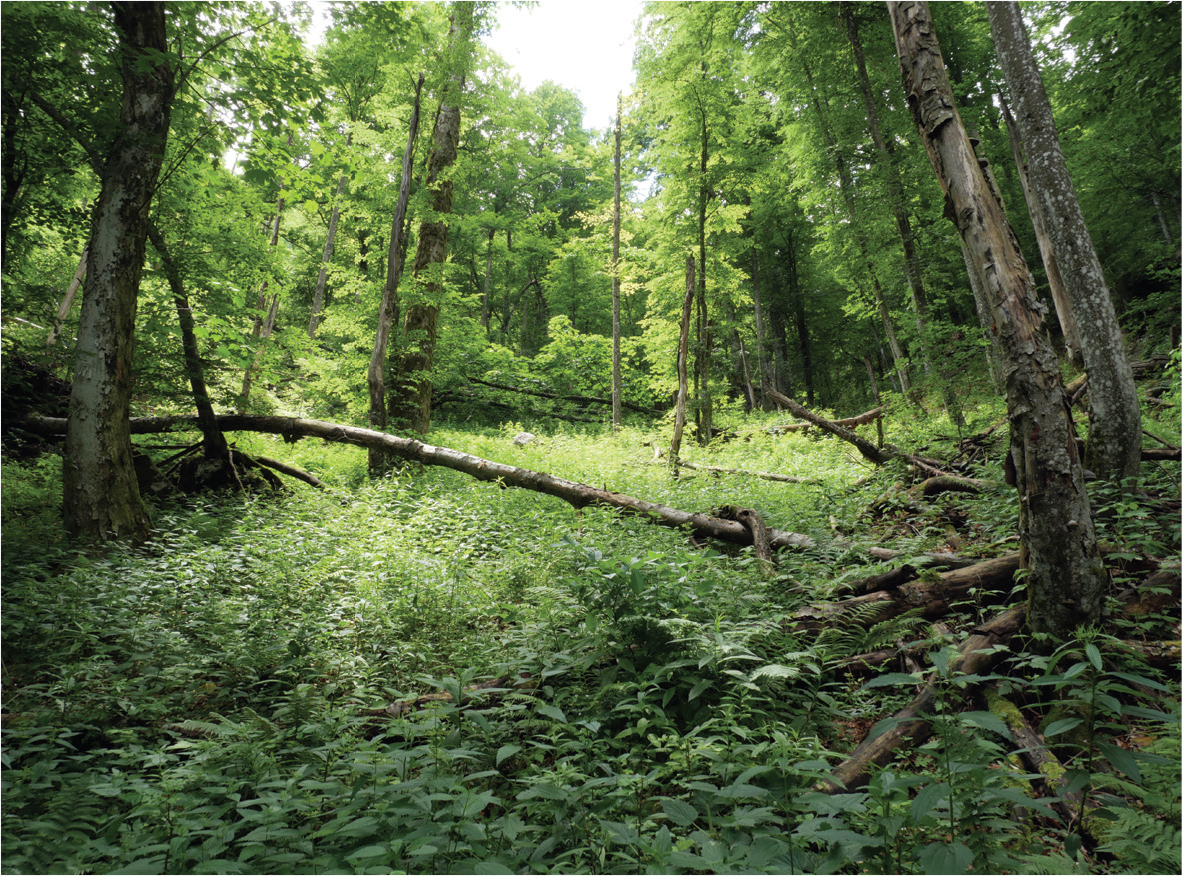
Figure 3:
Stand of the subassociation Lamio orvalae-Aceretum pseudoplatani fraxinetosum excelsioris, under Vratca above the Belca valley (Landscape park Zgornja Idrijca), relevé 15 in Table 1. Photo: I. Dakskobler.
Relevés on the right side of the dendrogram (Figure 2, Table 4) are very diverse in terms of species composition and we provisionally classified most of them (relevés 1–10) still into the association Lamio orvalae-Aceretum psudoplatani, even though we made some of them in the lower montane belt at elevations between 600 m and 750 m. Relevés 1–9 are classified into the subassociation fraxinetosum excelsioris, and relevés 1–6 into its variant with Geranium robertianum, which is characterised by a higher proportion of Fraxinus excelsior in the tree layer. Four relevés (1–4, subvar. Carpinus betulus), in which Carpinus betulus and Ostrya carpinifolia also occcur in the tree layer, show certain similarity with stands of the association Veratro nigri-Fraxinetum excelsioris (Dakskobler, 2007). Relevé 10 is treated only at the rank of association, and relevé 11 is provisionally classified into the association Omphalodo-Aceretum pseudoplatani (Košir, 2005b).
Aconito paniculati-Aceretum pseudoplatani ass. nov
Table 2 comprises 13 relevés from the large cluster to the right of the middle of the dendrogram in Figure 2. We added another relevé, namely the syntaxon Alno viridis-Aceretum pseudoplatani nom. prov. from the cirque of Komar under the Dolič pass above the Zadnjica valley in Trenta (Dakskobler et al., 2013b). According to its species composition, this relevé belongs into this table, which mainly comprises relevés from the upper montane and subalpine belt in Bohinj: mountain pastures of Fužinske and Bukovske Planine (Figure 4), the Triglav Lakes Valley, under Mt. Vogel (Žagarjev graben / Žagar Gorge) and above Uskovnica mountain pasture (near Trstje mountain pasture). Some of the relevés (6, 7, 8 and 12) were made already in the subalpine spruce and larch forest zone, near the upper beech line. The tree layer in all of these relevés is dominated by sycamore maple, frequently with individual spruce, only occasionally beech trees. The shrub layer in some of the relevés features character species of subalpine shrub communities from the class Betulo-Alnetea viridis (Alnus viridis, Ribes alpinum, Sorbus chamaemespilus, Salix appendiculata). We did not find Lamium orvala in the herb layer, which is dominated by character species of tall herbs from the class Mulgedio-Aconitetea. Taking into account only the species presence and absence, we can see substantial similarity with the stands of the association Aconito paniculati-Fagetum sylvaticae (Zupančič, 2012; phytosociological table 1, relevés 17–24), also from the Julian Alps, mainly from Spodnja Komna. According to Zupančič (2012), the character species of the association are Rumex arifolius, Crepis paludosa, Aconitum degenii subsp. paniculatum, Salix appendiculata, Geranium sylvaticum, Aconitum lycoctonum subsp. ranunculiifolium and Senecio cacaliaster, and its differential species are Myrrhis odorata and Geum rivale. All of the listed species are more or less frequent also in our relevés.
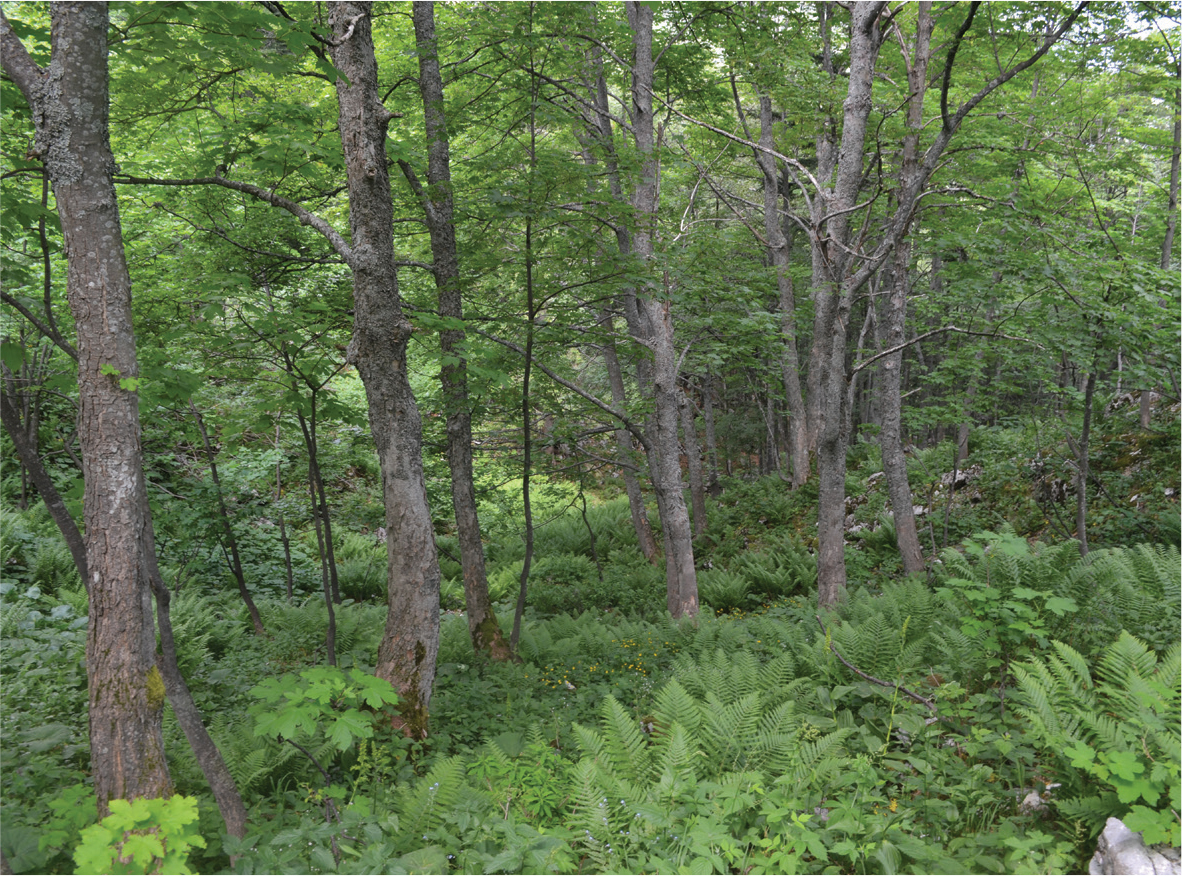
Figure 4:
Stand of the asscociation Aconito paniculati-Aceretum pseudoplatani, Bohinj, Bukovske Planine, near the montane pasture Osredki, Silj, relevé 10 in Table 2. Photo: I. Dakskobler.
The cover value of sycamore maple in relevés of the association Aconito-Fagetum is between 2 and 5 in the tree layer, and + to 2 in the shrub layer; cover value of beech in the tree layer is + to 4, and + to 3 in the shrub layer (Zupančič, 2012). In our relevés, sycamore maple cover in the tree layer is 4 or 5, and beech cover between + and 2, but only in six out of fourteen relevés. Beech is almost completely absent from the shrub layer, but sporadically occurs at a value of + in the herb layer.
The most important difference between the stands of both similar communities are their sites. Maple stands were mainly recorded in gravelly hollows under rock walls and on rockfall (except for relevé 14, which was made on an avalancheprone promontory between two gorges, so the stand has a low, bushy, and sabrelike growth habitus). Stoniness or rockiness is substantial across the relevés (20–70%), the soil is colluvial-deluvial, except for the Komar site on rendzina (relevé 14). The altitude of the localities ranges from 1210 m to 1540 m a.s.l. Relevés of Aconito-Fagetum were made on limestone, dolomite or dolomite limestone; the table indicates no rockiness and brown soils on limestone, rarely rendzina. The altitude of the localities ranges from 1260 m to 1500 m a.s.l. (Zupančič, 2012: 97–98 and 106–113). Our relevés therefore cannot be classified into the beech community and the two relevés from Zupančič’s table (Nr. 23 and 24 in Table 1) could possibly be classified as maple stands.
Our decision to classify these relevés into a new maple community is supported also by Table 3 in present study, which comprises seven relevés of pioneer sycamore maple forests on debris slopes in the narrow gorge of Tesna under mountain pasture Bukovec and in the gorges of Bukovska Korita above it, under the rock walls of the ridges of Pihavci, Veliki Jelenk and Skutnik above the Bavšica valley, where snow avalanches are very frequent. In these stands the predominant species of the highest stand layer is sycamore maple, only occasionally with individual beech trees. These pioneer stands, whose dynamics is largely influenced by snow avalanches, partly also by torrential waters, cannot be classified into the beech community.
Since natural forest stands are classified into forest communities at the rank of association based on the dominant species in the upper stand layer, and since the studied maple and beech stands are classified into two different alliances (Tilio-Acreion and Aremonio-Fagion), or according to the criteria in Mucina et al. (2016) even into two different orders (Aceretalia pseudoplatani and Fagetalia sylvaticae), we classify the studied sycamore maple stands into the new association Aconito paniculati-Aceretum pseudoplatani ass. nov., hoc loco. Its nomenclatural type, holotypus, is relevé 9 in Table 2. Diagnostic species of the new association are Acer pseudoplatanus, Aconitum lycotonum subsp. ranunculifolium, A. degenii subsp. paniculatum, Picea abies, Senecio cacaliaster, Rumex arifolius, Viola biflora, Dryopteris dilatata and Cystopteris montana.
Relevé 14 in Table 2 is classified into the variant with Lycopodium annotinum, where green alder (Alnus viridis, syn. A. alnobetula) has a high cover in the shrub layer.
Stands in Table 3 are classified into the variant with Heracleum pollinianum (syn. H. sphondylium subsp. pyrenaicum, H. pyrenaicum subsp. pollinianum) – Figure 5. Its differential species include Angelica sylvestris, Festuca calva, Geranium macrorrhizum, Cirsium erisithales and Tephroseris crispa. We distinguish between two subvariants: subvar. Lunaria rediviva (pioneer stands in the bottom part of the torrential gorge Tesna – Figure 6) and subvar. Saxifraga rotundifolia (forest stands and shrub communities on relief-based upper timberline on debris / talus in the upper spring area of the gorge Bukovska Korita (Figure 7). The complete list of differential species of both subvariants is available in Table 3.
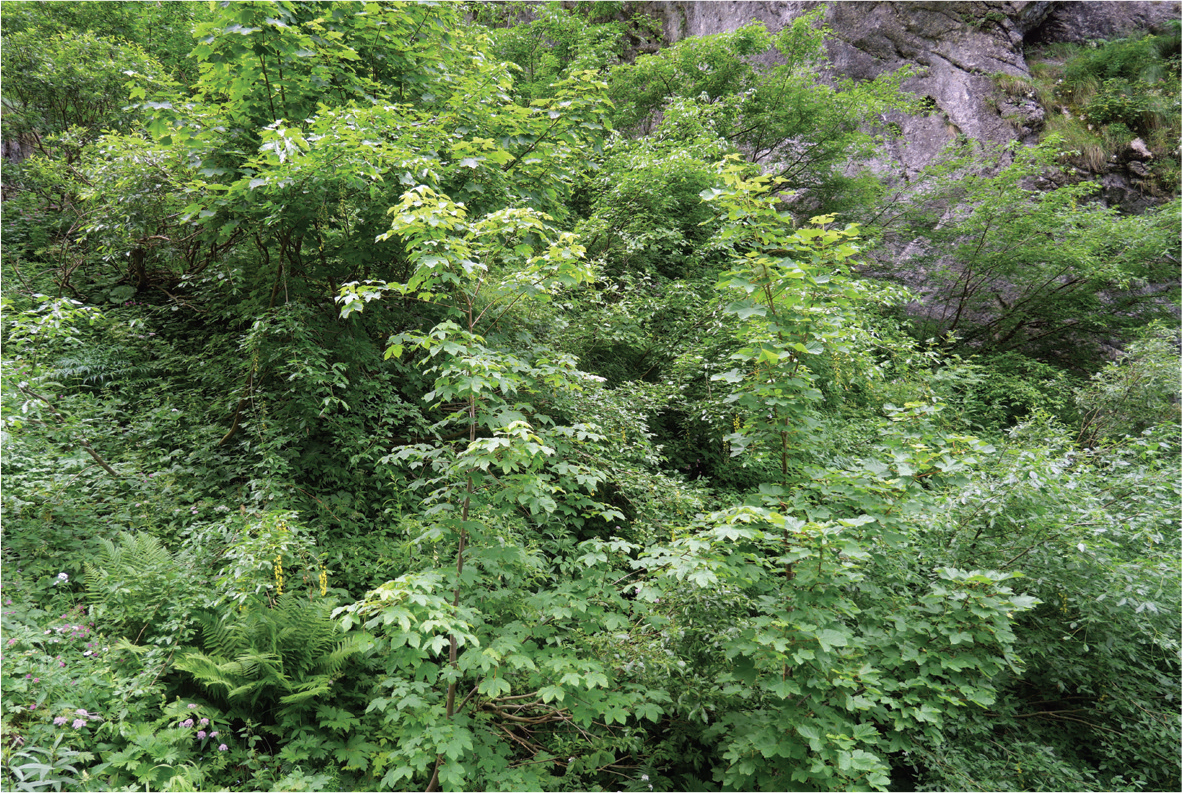
Figure 5:
Stand of the variant Aconito paniculati-Aceretum pseudoplatani var. Heracleum pollinianum, the Bovec region, Bavšica valley, Bukovska Korita gorge, relevé 5 in Table 3. Photo: I. Dakskobler.
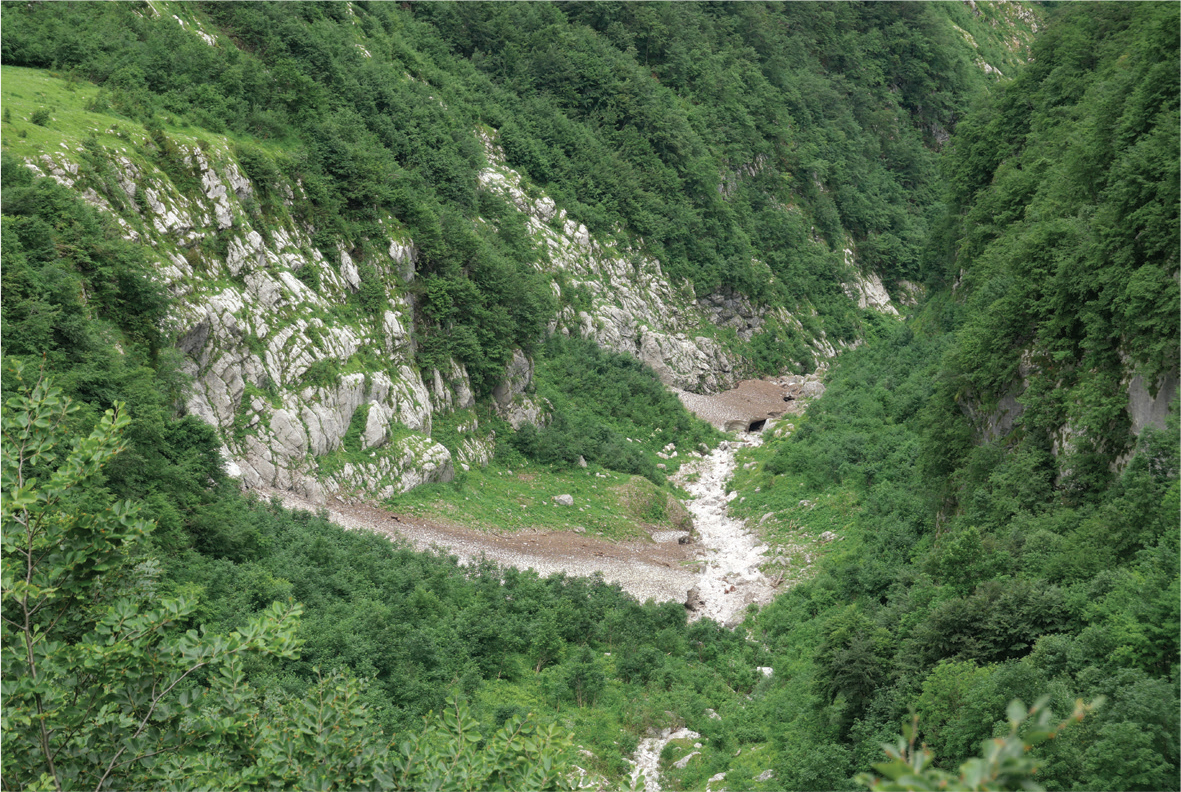
Figure 6:
Tesne gorge, with stands of the subvariant Aconito paniculati-Aceretum pseudoplatani var. Heracleum pollinianum subvar. Lunaria rediviva. Photo: I. Dakskobler.
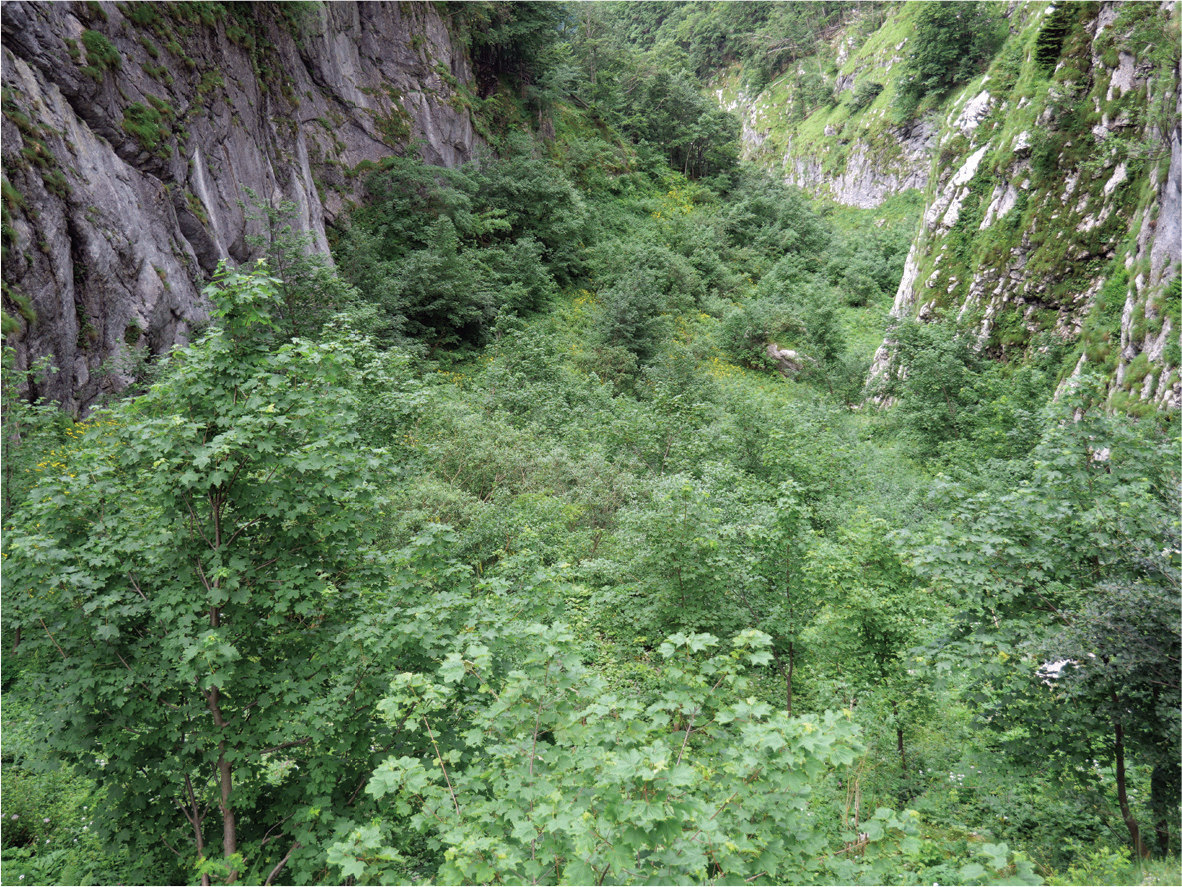
Figure 7:
Bukovska Korita gorge with stands of the subvariant Aconito paniculati-Aceretum pseudoplatani var. Heracleum pollinianum subvar. Saxifraga rotundifola. Photo: I. Dakskobler.
Senecio fuchsii-Aceretum pseudoplatani nom. prov
Noble deciduous trees, in particular sycamore maple, European ash, broad-leaved lime and small-leaved lime often occur as pioneers on abandoned farmland. So far, we have studied the phytosociology of pioneer forests of European ash on flysch and marl (Ornithogalo pyrenaici-Fraxinetum excelsioris; Čušin & Dakskobler, 2006; Dakskobler, 2007), pioneer European ash stands on former military camps in the Karst (Veronico sublobatae-Fraxinetum excelsioris; Dakskobler, 2006), and pioneer stands of broad- and small-leaved lime in the Čepovan valley (Lamio orvalae-Tilietum platyphylli; Dakskobler & Poldini, 2021).
Table 5 comprises eight relevés of maple stands on former fields, pastures or hay meadows in the montane belt on marl or marl and limestone with eutric brown soil, very rarely also on limestone and colluvial-deluvial soil in western Slovenia (Figure 8). Recently, we published four relevés of a similar pioneer maple community on flysch in the submontane belt in the Brkini Hills, and classified them into the provisional association Ornithogalo pyrenaici-Aceretum pseudoplatani (Dakskobler, 2024, Table 6, relevés 8–11). For comparison we publish these relevés in this paper as well (Table 6). The comparison between these two pioneer maple communities demonstrates that they cannot be classified into the same association. The potential natural vegetation in Brkini is most likely beech forest from the association Ornithogalo pyrenaici-Fagetum sylvaticae (in part possibly also beech forest from the association Castaneo-Fagetum sylvaticae), and potential vegetation on former farmland above the right bank of the Zakojca Gorge near solitary homesteads of Cemerija (Hudajužna) and Obid (Zakojca) (relevés 1–4 in Table 5) and above the mountain pasture of Koriška Planina under Kotel (relevés 5 and 6) is probably beech forest from associations Polysticho braunii-Fagetum sylvaticae s. lat. (partly also beech forest from associations Lamio orvalae-Fagetum sylvaticae, in places possibly also Luzulo-Fagetum sylvaticae s. lat.); above the valley of the Hotenja (by the former homestead V Robeh, Figure 9) the potential natural vegetation is likely beech forest from the association Arunco-Fagetum, and on Čaven (under Mali Modrasovec) probably beech forest from the association Ranunculo platanifolii-Fagetum. The compared pioneer communities nevertheless share several species, but with very different cover. For the time being, we classify relevés in Table 5 into the provisional association Senecio fuchsii-Aceretum pseuoplatani nom. prov. To typify the new association, we would need more relevés from several different localities. For now, we selected Acer pseudoplatanus, Fraxinus excelsior, Senecio fuchsii (syn. S. ovatus), Urtica dioica, Salvia glutinosa, Aegopodium podagraria, Circaea lutetiana and Stellaria montana as the diagnostic species that well indicate the site conditions of these pioneer forests and in part also their origin or previous landuse.
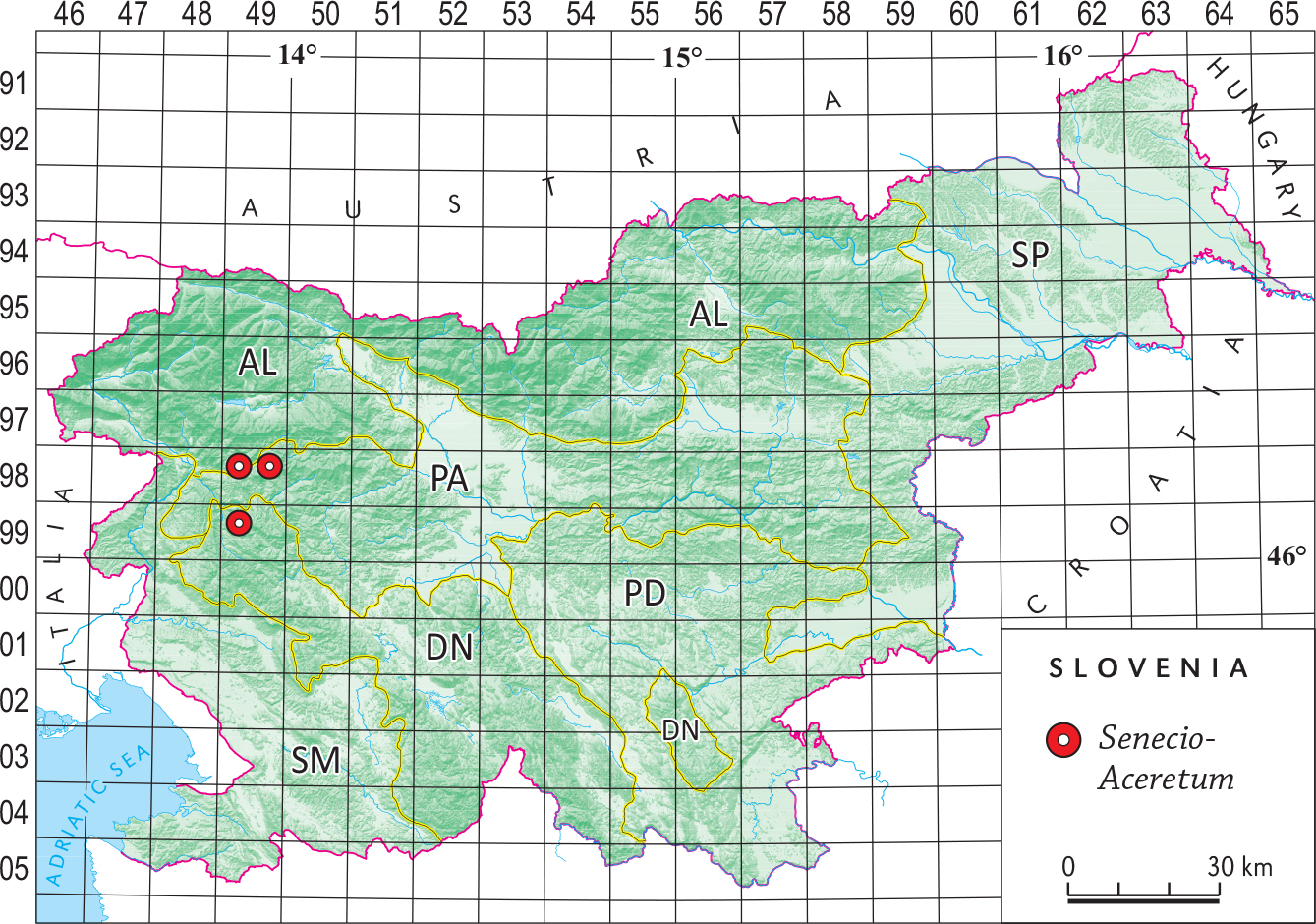
Figure 8:
Approximate localities of the stands of the association Senecio fuchsii-Aceretum pseudoplatani nom. prov. on the map of Slovenia.
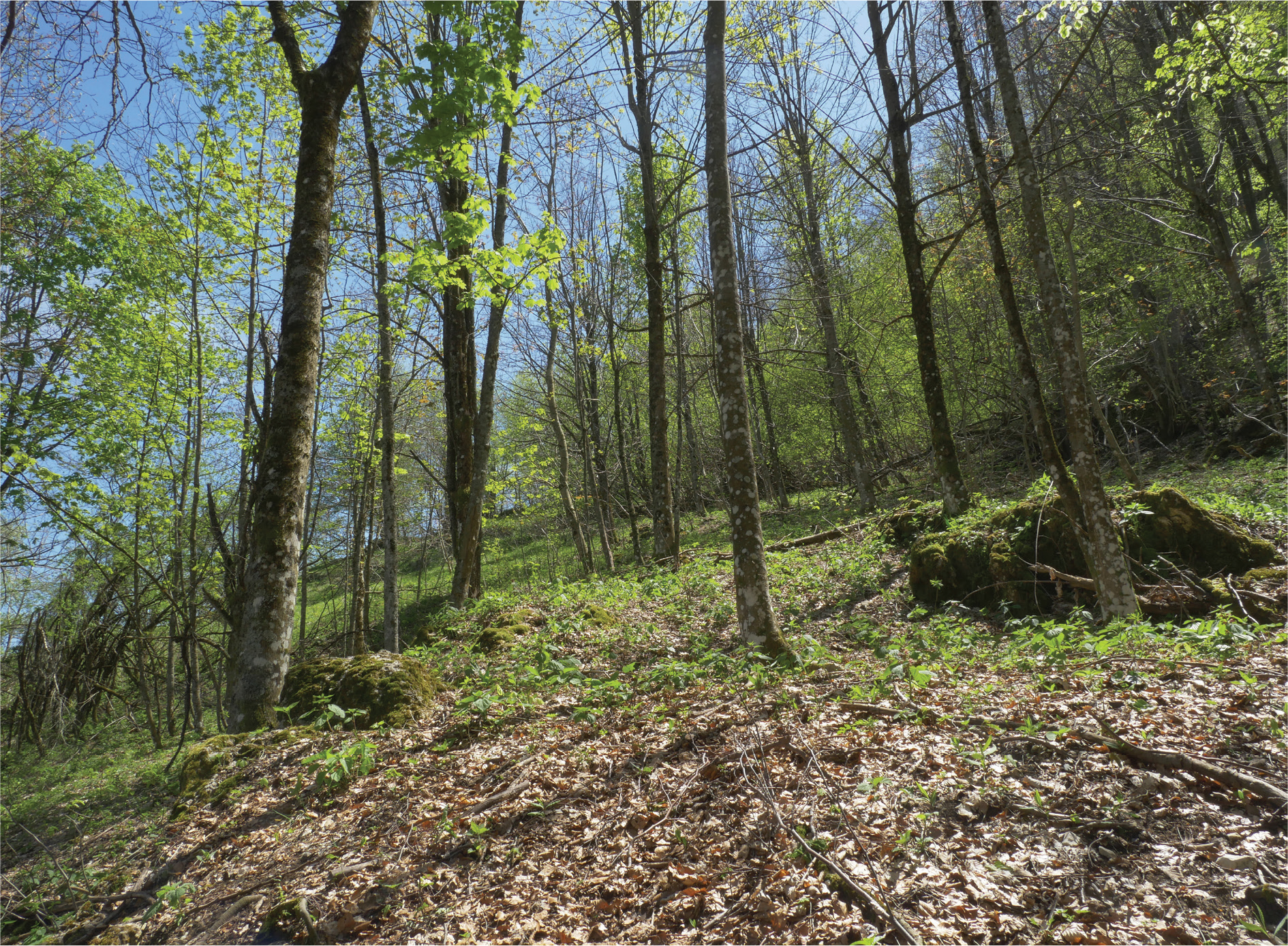
Figure 9:
Stand of the asscociation Senecio fuchsii-Aceretum pseudoplatani nom. prov. The Hotenja valley, V Robeh, relevé 7 in Table 5. Photo: I. Dakskobler.
The relevés above the Zakojca Gorge are classified into the variant with Silene dioica, relevés above the Koriška Planina pasture into the variant with Alnus glutinosa (a more hygrophilous and acidophilic form, its differential species include Impatiens noli-tangere, Matteuccia struthiopteris, Phegopteris connectilis and others).
The stand above the Hotenja valley is classified into the variant with Rhamnus fallax. Its differential species include several other character species of the alliance Aremonio-Fagion and order Fagetalia sylvaticae, as well as Veratrum album subsp. lobelinaum, Colchicum autumnale and Ophioglossum vulgatum (pioneer sycamore maple stands with dominant Veratrum lobelinaum in herb layer on former hay meadows were recently observed also under the Kolovrat ridge above the Soča Valley between Kobarid and Tolmin).
The stand on Čaven is classified into the variant with Angelica sylvestris, the differential species include Deschampsia cespitosa, Laserpitium latifolium, Lilium bulbiferum, Arabis turrita, Aconitum degenii subsp. paniculatum and Peucedanum schottii.
Based on the dominant species in the upper stand layer we provisionally classify the provisionally described new association into the alliance Tilio-Acerion, even though its floristic composition is not typical for the communities from this alliance, and the potential natural vegetation on these sites are mostly different (sub)montane beech communities from the alliance Aremonio-Fagion.
Classification of studied communities into the syntaxonomical system
Querco-Fagetea Br.-Bl. & Vlieg. 1937 (Carpino-Fagetea Passarge et Hofmann 1968)
Fagetalia sylvaticae Walas 1933
Tilio-Acerion Klika 1955
Lamio orvalae-Acerenionpseudoplatani P. Košir, Čarni & Di Pietro 2008
Omphalodo vernae-Aceretum pseudoplatani P. Košir et Marinček 1999
Lamio orvalae-Aceretum pseudoplatani P. Košir et Marinček 1999
fraxinetosum excelsioris P. Košir 2005
Aconito paniculati-Aceretum pseudoplatani ass. nov. (incl. Alno viridis-Aceretum pseudoplatani Dakskobler, Rozman & Seliškar 2013 nom. prov.)
Senecio fuchsii-Aceretum pseudoplatani nom. prov.
Ornithogalo pyrenaici-Aceretum pseudoplatani Dakskobler 2024 nom. prov.
According to Mucina et al. (2016), the studied communities belong to the order Aceretalia pseudoplatani Moor 1976 and the alliance Tilio-Acerion Klika 1955.
Conclusions
In the upper montane and subalpine zones of the Julian Alps, in Bohinj and the Bovec region (the valleys of Bavšica and Trenta) we inventoried the stands of sycamore maple on talus or rockfall, in hollows and narrow torrential gorges, and classified them into the new association Aconito paniculati-Aceretum pseudoplatani. Even though these stands are limited to small areas and for now their development is influenced only by natural factors, they deserve attention because they belong to the European priority habitat type 9180 *Tilio-Acerion forests of slopes, screes and ravines, which requires special nature conservation concern. A forest community with similar species composition (Aconito paniculati-Fagetum sylvaticae) has already been described at the same altitudinal belt at Spodnja Komna in the Triglav National Park; in this community beech and sycamore maple have near equal cover; its sites are less stony or rocky, and the soil is chromic cambisol or rendzina. These two, syntaxonomically similar forest communities belong to two different alliances (Tilio-Acerion and Aremonio-Fagion), and in terms of forest site typology (Kutnar et al., 2012; Bončina et al., 2021) to two forest site types (Montane–upper montane sycamore maple forests with wych elm, and Beech forests with Isopyrum thalictroides and sycamore maple-beech forest). We propose a correction to the first forest site type name: Montane-subalpine sycamore maple forests with wych elm.
We supplemented the knowledge of montane-upper montane maple forests (Lamio orvalae-Aceretum pseudoplatni). Our description of for the being only provisional association Senecio fuchsii-Aceretum pseudoplatani supplements the knowledge of pioneer noble hardwood forests on abandoned farmland. Its stands were found in the Bača valley, on former fields above the Zakojca Gorge (between Hudajužna and Zakojca) and between the mountain pasture of Koriška Planina and Kotel (where the geological bedrock is marlstone or marlstone and limestone, and the soil is eutric), above the Hotenja valley (the geological bedrock is dolomite and marlstone, the soil is chromic cambisol) and on the Trnovo Forest Plateau (Čaven, Mali Modrasovec), where the geological bedrock is limestone, and the soil is colluvial-deluvial. In terms of syntaxonomy, this secondary maple community is provisionally classified into the alliance Tilio-Acerion, and in terms of forest site typology into the forest site type Montane-subalpine sycamore maple forests with wych elm, since their potential natural vegetation belongs to different beech communities and different forest site types.
Povzetek
V zgornjem gorskem in podvisokogorskem pasu v Julijskih Alpah, v Bohinju in na Bovškem (dolini Bavšice in Trente) smo popisali sestoje gorskega javorja na pobočnem grušču ali podornem skalovju, v kotanjah in ozkih hudourniških grapah in jih uvrstili v novo asociacijo Aconito paniculati-Aceretum pseudoplatani, ki je novost v rastju Triglavskega narodnega parka. Čeprav so ti sestoji omejeni na majhne površine in za zdaj na njihov razvoj vplivajo le naravni dejavniki, so vredni naše pozornosti, saj sodijo v evropski prednostni habitatni tip 9180 *Javorjevi gozdovi v grapah in na pobočnih gruščih (Tilio-Acerion), za katerega je predvidena posebna naravovarstvena skrb. V Triglavskem narodnem parku, na Spodnji Komni, je bila v istem višinskem pasu že opisana po vrstni sestavi podobna gozdna združba (Aconito paniculati-Fagetum sylvaticae), v kateri pa sta v drevesni plasti bukev in gorski javor precej enakovredna in njena rastišča so nekoliko drugačna (geološka podlaga je dolomitni apnenec, tla so rjava pokarbonatna ali rendzina). V sintaksonomskem smislu dve sicer podobni gozdni združbi pripadata dvema različnima zvezama (Tilio-Acerion in Aremonio-Fagion), v smislu tipologije gozdnih rastišč (Kutnar et al., 2012, Bončina et al., 2021) pa v dva gozdna rastiščna tipa (Gorsko-zgornjegorsko javorovje z brestom in Bukovje s polžarko in javorovo bukovje). Za prvi gozdni rastiščni tip predlagamo popravek imena: Gorsko-podvisokogorsko javorovje z brestom.
Dopolnili smo vedenje o gorsko-zgornjegorskem javorovju (Lamio orvalae-Aceretum pseudoplatni) in o pionirskih gozdovih plemenitih listavcev na opuščenih kmetijskih površinah, z opisom za zdaj le provizorične ascociacije Senecio fuchsii-Aceretum pseudoplatani. Njene sestoje smo našli v Baški dolini, na nekdanjih njivah nad Zakojško grapo (med Hudajužno in Zakojco) ter med Koriško planino in Kotlom (kjer je geološka podlaga laporovec ali laporovec in apnenec, tla pa evtrična), nad dolino Hotenje (geološka podlaga dolomit in laporovec, tla rjava pokarbonatna) in v Trnovskem gozdu (Čaven, Mali Modrasovec), kjer je geološka podlaga apnenec, tla pa koluvialno-deluvialna. V sintaksonomskem smislu to drugotno javorovo združbo za zdaj uvrščamo v zvezo Tilio-Acerion, v smislu tipologije gozdnih rastišč pa v gozdni rastiščni tip Gorsko-podvisokogorsko javorovje z brestom, saj njihova potencialno-naravna vegetacija pripada različnim bukovim združbam in gozdnim rastiščnim tipom.
Acknowledgements
The co-authors of some of the relevés published herein are Doc. Dr. Andrej Rozman, Branko Zupan and Ivan Veber. Prof. Dr. Jean-Paul Theurillat, Mag. Andrej Podobnik and Prof. Dr. Sead Vojniković kindly helped me with their advice and opinion in the description of the new sycamore maple community. Iztok Sajko prepared Figures 1, 2 and 8 for print. Doc. Dr. Lado Kutnar, anonymous reviewer and Assoc. Prof. Dr. Urban Šilc valuable improved and corrected the text. The paper received the financial support of the Slovenian Research and Innovation Agency (programme P1-0236) and the LIFE-IP NATURA.SI project (LIFE17 IPE/SI/000011), co-financed by the European Union from the LIFE programme funds, the Ministry of Natural Resources and Spatial Planning, and project partners. English translation by Andreja Šalamon Verbič.
Notes
[1] Research data availability
The data analysed during this study are available from the corresponding author upon reasonable request.


