
Introduction
Bryophytes are a group of plants that grow in environments with different humidity and contamination levels over substrates such as trunks, branches, foliage and roots of trees and in the soil, even concrete. As pioneer plants, bryophytes -including hornworts, liverworts, and mosses-, create a microhabitat that facilitates the establishment of other plants and contributes to soil development (Delgadillo et al., 2022).
Approximately 1650 taxa of bryophytes have been recorded in Colombia, including 932 species of mosses (Churchill, 2016), 705 liverworts, and 15 hornworts (Gradstein, 2021). The highest bryophyte diversity occurs within specific altitudinal ranges, predominantly in high Andean Forest and paramo ecosystems, between 2200 and 4000 meters above sea level (Churchill & Linares, 1995; Gradstein, 2021).
Floristic studies in Colombia have been conducted according to the administrative level: at the national scale (Churchill & Linares, 1995; Uribe & Gradstein, 1998; Churchill, 2016; Gradstein, 2021), the departmental scale (Sastre-De Jesús et al., 1986; Churchill & Hollaender, 1988; Parra et al., 2002; Ramírez & Churchill, 2002; Ramírez, 2013; Aponte-R. et al., 2022), and mostly at the local level (Avendaño & Aguirre, 2007; Gil et al., 2017; Martínez et al., 2019; Mejía et al., 2020). However, no studies have been conducted at the district level, so there is no inventory for Bogotá.
Bogotá is the capital city of Colombia and has also been considered the capital of Cundinamarca department. However, since the 1991 National Constitution, Bogotá has been recognized as a department itself, which explains the overlapping information about its diversity. Floristic research indicates that studies in Cundinamarca have included Bogotá’s geographic area and specific ecosystems. Meanwhile, floristic records for Bogotá have been compiled in three photographic guide booklets (Aguirre, 2000; Santos & Alfonso, 2013; Gualteros et al., 2019), each containing fewer than 30 specimens, most of them identified at the genus level. Additionally, Franco & Betancur (1999) reported 176 bryophyte species for the Sumapáz paramo, which extends across four departments: Cundinamarca, Meta, Huila, and Bogotá.
The study of bryophytes in metropolitan areas has demonstrated that they serve as important refugia for these plants (Masimpaka et al., 1988; Pokorny et al., 2006; Brinda et al., 2007; Sabovljević & Grdović, 2009; Ardiles & Peñaloza, 2013; Aleffi, 2015). Even though Bogotá is one of the most populous cities in Latin America, it is situated within the Andean Forest and páramo ecosystems, which correspond with the areas with the highest presence of bryophytes in Colombia (Churchill, 1991; Gradstein, 2021).
The first author conducts the curatorial review of the bryological collection of the JBB Herbarium finding many specimens from Bogotá. The analysis of sampling representativity and taxonomic determination led to the discovery of a new national record (Aponte et al., 2022), paving the way for future research which can use the present checklist as a base for the accurate knowledge of bryophyte diversity in Bogotá.
Materials and methods
Area of Study
Bogotá, located in central Colombia, lies on the eastern edge of the northern Andes. The city maintains a stable average annual temperature of 14 °C, with minimal variation. Annual rainfall reaches approximately 1,000 mm, and relative humidity averages 73% (Appendix 1). Home to over 8 million inhabitants, Bogotá serves as Colombia’s political, economic, administrative, and cultural capital.
Bogotá spans a total area of 1,775 km2, with 378 km2 forming the metropolitan region. Administratively, the city is divided into 20 localities (Table 1; Figure 1), each responsible for managing and delivering public services. The rural areas feature páramos, high Andean forests, rivers, and streams, while the urban zones include wetlands, parks, and the Bogotá Botanical Garden.
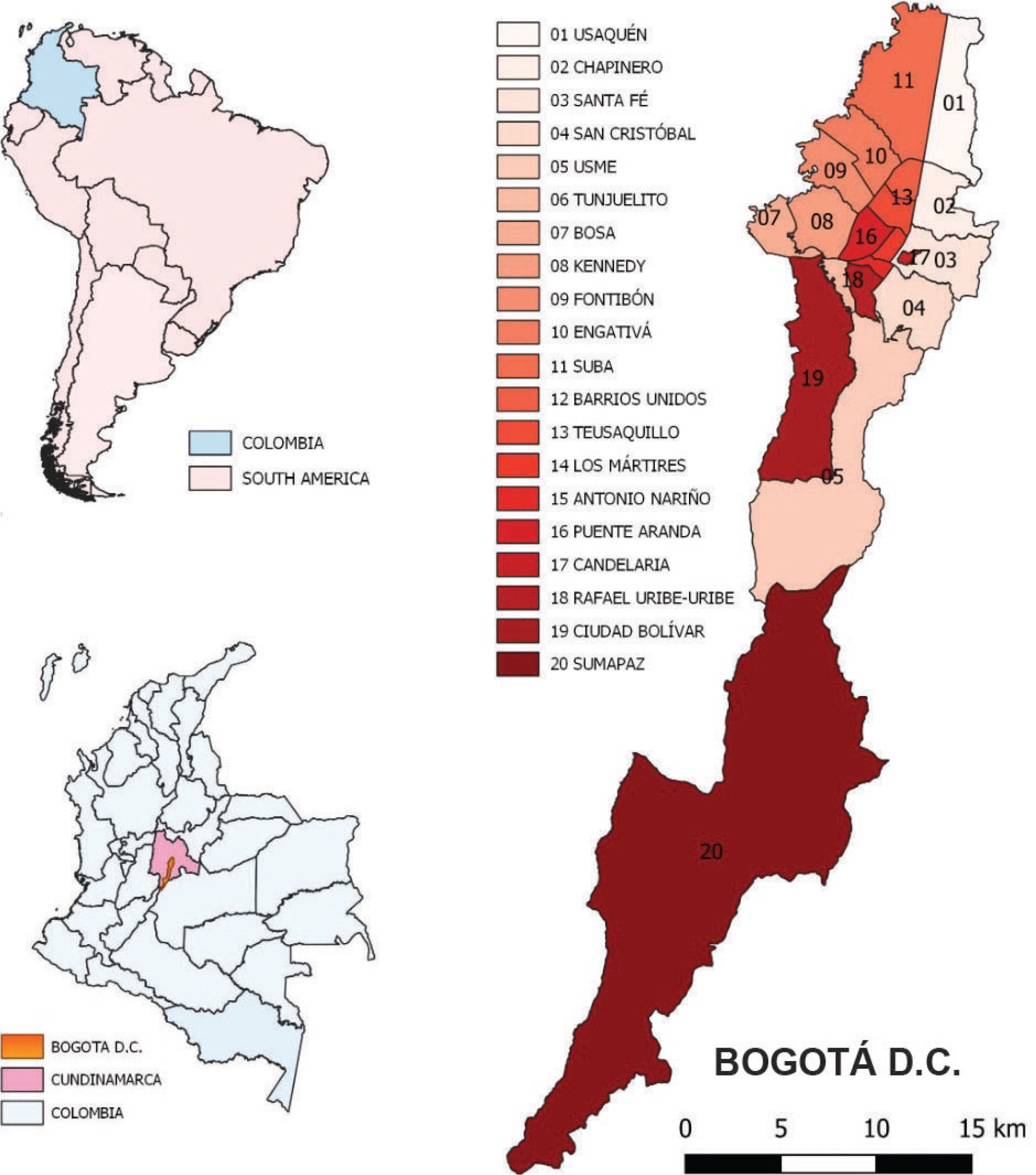
Figure 1:
Administrative map of Bogotá.
Table 1:
Localities of Bogotá and their corresponding political nomenclature.
| Localities | |||
|---|---|---|---|
| 1. Usaquén | 6. Tunjuelito | 11. Suba | 16. Puente Aranda |
| 2. Chapinero | 7. Bosa | 12. Barrios Unidos | 17. Candelaria |
| 3. Santa Fé | 8. Kennedy | 13. Teusaquillo | 18. Rafael Uribe-Uribe |
| 4. San Cristóbal | 9. Fontibón | 14. Los Mártires | 19. Ciudad Bolívar |
| 5. Usme | 10. Engativá | 15. Antonio Nariño | 20. Sumapáz |
Review of available information
This research compiles data from the Colombian National Herbarium (COL), the Herbarium of the Bogotá Botanical Garden (JBB), and the Tropicos (2025) database of the Missouri Botanical Garden.
The names of families, genera, species, and lower taxonomic ranks follow the latest catalogs for Colombia: Gradstein (2021) for liverworts and hornworts, and Churchill (2016) and Churchill et al. (2020) for mosses.
Results
The initial dataset comprised 2,111 specimens representing 633 species. Each name was linked to its biological group, family, source (COL-JBB or Tropicos), locality, and ecosystem of origin, assigned based on the predominant environment of the locality or label information. In exceptional cases, additional details such as threat category, historical collector, or unique specimen were included. The data were then refined and organized alphabetically by species. Some moss names have undergone taxonomic changes in relation to the most recent national catalog for Colombia (Churchill, 2016); however, their original classification was retained in this study.
Richness
The bryophyte diversity within the political jurisdiction of Bogotá’s Capital District represents 25% of the total known at the national level. It includes 450 species – 279 mosses, 167 liverworts, and 4 hornworts (Table 2) – distributed across 178 genera (127 mosses, 49 liverworts, and 2 hornworts) and grouped into 80 families (50 mosses, 28 liverworts, and 2 hornworts).
Table 2:
Bryophyte species recorded in Bogotá, along with the political nomenclature of the localities where they were collected. (L: Liverworts; H: Hornworts; M: Mosses).
| GROUP | FAMILY | TAXA | LOCALITIES | |
|---|---|---|---|---|
| 1 | H | Dendrocerotaceae | Nothoceros aenigmaticus J.C. Villarreal & K.D. McFarland | 3 |
| 2 | H | Dendrocerotaceae | Nothoceros vincentianus (Lehm. & Lindenb.) J.C. Villarreal | 2, 3 |
| 3 | H | Notothyladaceae | Phaeoceros carolinianus (Michx.) Prosk. | 10 |
| 4 | H | Notothyladaceae | Phaeoceros laevis (L.) Prosk. | 10 |
| 5 | L | Lejeuneaceae | Acanthocoleus aberrans (Lindenb. & Gottsche) | 19 |
| 6 | L | Adelanthaceae | Adelanthus lindenbergianus (Lehm.) Mitt. | 20 |
| 7 | L | Anastrophyllaceae | Anastrophyllum auritum (Lehm.) Steph. | 20 |
| 8 | L | Anastrophyllaceae | Anastrophyllum nigrescens (Mitt.) Steph. | 20, 5 |
| 9 | L | Anastrophyllaceae | Anastrophyllum piligerum (Nees) Steph. | 3 |
| 10 | L | Anastrophyllaceae | Anastrophyllum stellatum R.M.Schust | 20 |
| 11 | L | Anastrophyllaceae | Anastrophyllum tubulosum (Nees) Grolle | 3 |
| 12 | L | Lejeuneaceae | Anoplolejeunea conferta (C.F.W Meissn. ex Spreng.) A. Evans | 19, 20 |
| 13 | L | Lepidoziaceae | Bazzania affinis (Lindenb. & Gottsche) Trevis. | 20 |
| 14 | L | Lepidoziaceae | Bazzania falcata (Lindenb.) Trevis. | 3, 20 |
| 15 | L | Lepidoziaceae | Bazzania hookeri var. hookeri (Lindenb.) Trevis. | 20 |
| 16 | L | Lepidoziaceae | Bazzania longistipula (Lindenb.) Trevis. | 20 |
| 17 | L | Lepidoziaceae | Bazzania stolonifera (Sw.) Trevis. | 2 |
| 18 | L | Lejeuneaceae | Blepharolejeunea incongrua (Lindenb. & Gottsche) van Slageren & Kruijt | 19 |
| 19 | L | Lejeuneaceae | Blepharolejeunea securifolia (Steph.) R.M. Schust. | 20 |
| 20 | L | Blepharostomataceae | Blepharostoma trichophyllum (L.) Dumort. | 20 |
| 21 | L | Lejeuneaceae | Brachiolejeunea laxifolia (Taylor) Schiffn. | 20 |
| 22 | L | Calypogeiaceae | Calypogeia andicola Bischl. | 3, 20 |
| 23 | L | Calypogeiaceae | Calypogeia laxa Gottsche & Lindenb. | 3 |
| 24 | L | Calypogeiaceae | Calypogeia peruviana Nees & Mont. | 3 |
| 25 | L | Calypogeiaceae | Calypogeia subintegra (Gottsche, Lindenb. & Nees) Bischl. | 19 |
| 26 | L | Cephaloziaceae | Cephalozia bicuspidata (L.) Dumort. | 19 |
| 27 | L | Cephaloziaceae | Cephalozia crossii Spruce | 19 |
| 28 | L | Cephaloziellaceae | Cephaloziella divaricata (Sm.) Schiffn. | 20 |
| 29 | L | Cephaloziellaceae | Cephaloziella fragillima (Spruce) Fulford | 19 |
| 30 | L | Lejeuneaceae | Cheilolejeunea acutangula (Nees) Grolle | 19 |
| 31 | L | Lejeuneaceae | Cheilolejeunea aurifera (R.M. Schust.) W Ye, R.L. Zhu & Gradst. | 20 |
| 32 | L | Lejeuneaceae | Cheilolejeunea filiformis (Sw.) W. Ye, R.L. Zhu & Gradst. | 19 |
| 33 | L | Lejeuneaceae | Cheilolejeunea laevicalyx (J.B. Jack & Steph.) Grolle | 19 |
| 34 | L | Lejeuneaceae | Cheilolejeunea lobulata (Lindenb.) C.J. Bastos & Gradst. | 19 |
| 35 | L | Lejeuneaceae | Cheilolejeunea paramicola (Herzog) W Ye, R.L. Zhu & Gradst. | 20 |
| 36 | L | Lejeuneaceae | Cheilolejeunea xanthocarpa (Lehm. & Lindenb.) Malombe | 3 |
| 37 | L | Lejeuneaceae | Cololejeunea microscopica (Taylor) Schiffn. | 3 |
| 38 | L | Lophocoleaceae | Cryptolophocolea connata (Sw.) L. Söderstr. & Váňa | 19 |
| 39 | L | Lophocoleaceae | Cryptolophocolea guadalupensis (Steph.) L. Söderstr. & Váňa | 20 |
| 40 | L | Lophocoleaceae | Cryptolophocolea martiana var. martiana (Nees) L. Söderstr., Crand.-Stotl. & Stotler | 20 |
| 41 | L | Lejeuneaceae | Drepanolejeunea araucariae Steph. | 3 |
| 42 | L | Lejeuneaceae | Drepanolejeunea inchoata (C.F.W. Meissn. ex Lehm.) Steph. | 19 |
| 43 | L | Lejeuneaceae | Drepanolejeunea mosenii (Steph.) Bischl. | 2 |
| 44 | L | Lejeuneaceae | Drepanolejeunea orthophylla (Nees & Mont.) Bischl. | 19 |
| 45 | L | Lejeuneaceae | Drepanolejeunea pungens Bischl. | 20 |
| 46 | L | Dumortieraceae | Dumortiera hirsuta (Sw.) Nees | 3 |
| 47 | L | Fossombroniaceae | Fossombronia peruviana Gottsche & Hampe | 20 |
| 48 | L | Frullaniaceae | Frullania atrata (Sw.) Nees ex Mont. | 20 |
| 49 | L | Frullaniaceae | Frullania beyrichiana (Lehm. & Lindenb.) Lehm. & Lindenb. | 3 |
| 50 | L | Frullaniaceae | Frullania bogotensis Steph. | 3 |
| 51 | L | Frullaniaceae | Frullania brasiliensis Raddi | 2, 10 |
| 52 | L | Frullaniaceae | Frullania convoluta Lindenb. & Hampe | 19, 20 |
| 53 | L | Frullaniaceae | Frullania dusenii Steph. | 5 |
| 54 | L | Frullaniaceae | Frullania ecklonii (Spreng.) Gottsche, Lindenb. & Nees | 3 |
| 55 | L | Frullaniaceae | Frullania intumescens (Lehm. & Lindenb.) Lehm. & Lindenb. | 20 |
| 56 | L | Frullaniaceae | Frullania jelskii Loitl. | 19 |
| 57 | L | Frullaniaceae | Frullania lobatohastata Steph. | 20 |
| 58 | L | Frullaniaceae | Frullania macrocephala (Lehm. & Lindenb.) Lehm. & Lindenb. | 17 |
| 59 | L | Frullaniaceae | Frullania obscura (Sw.) Nees ex Mont. | 19, 10 |
| 60 | L | Frullaniaceae | Frullaniaparadoxa Lehm. & Lindenb. | 3 |
| 61 | L | Frullaniaceae | Frullania peruviana Gottsche | 20, 11 |
| 62 | L | Frullaniaceae | Frullania pluricarinata Gottsche | 3 |
| 63 | L | Frullaniaceae | Frullania riojaneirensis (Raddi) Ångstr. | 2, 10, 20 |
| 64 | L | Frullaniaceae | Frullania sphaerocephala Spruce | 20 |
| 65 | L | Frullaniaceae | Frullania tetraptera Nees & Mont. | 20 |
| 66 | L | Frullaniaceae | Frullania winteri var. vanderhammenii (Haarbrink) Yuzawa | 10 |
| 67 | L | Cephaloziaceae | Fuscocephaloziopsis pleniceps (Austin) Váňa & L. Söderstr. | 1 |
| 68 | L | Southbryaceae | Gongylanthus granatensis (Gottsche) Steph. | 20, 5 |
| 69 | L | Southbryaceae | Gongylanthus liebmannianus (Lindenb. & Gottsche) Steph. | 20, 5 |
| 70 | L | Gymnomitriaceae | Gymnomitrion bolivianum (Steph.) Váňa | 3 |
| 71 | L | Gymnomitriaceae | Gymnomitrion truncatoapiculatum Herzog | 3 |
| 72 | L | Herbertaceae | Herbertus bivittatus Spruce | 2, 20 |
| 73 | L | Herbertaceae | Herbertus juniperoideus subsp. acanthelius (Spruce) K. Feldberg & Heinrichs | 20 |
| 74 | L | Herbertaceae | Herbertus sendtneri (Nees) A. Evans | 19 |
| 75 | L | Lophocoleaceae | Heteroscyphus contortuplicatus (Nees & Mont.) Grolle | 2 |
| 76 | L | Balantiopsidaceae | Isotachis multiceps (Lindenb. & Gottsche) Gottsche | 19, 20 |
| 77 | L | Balantiopsidaceae | Isotachis serrulata (Sw.) Gottsche | 3 |
| 78 | L | Pallaviciniaceae | Jensenia spinosa (Lindenb. & Gottsche) Grolle | 3, 20 |
| 79 | L | Lepidoziaceae | Kurzia capillaris subsp. paramicola Pócs | 1 |
| 80 | L | Trichocoleaceae | Leiomitra flaccida Spruce | 20 |
| 81 | L | Trichocoleaceae | Leiomitra paraphyllina (Steph.) R.M. Schust. | 20 |
| 82 | L | Trichocoleaceae | Leiomitra tomentosa (Sw.) Lindb. | 3 |
| 83 | L | Lejeuneaceae | Lejeunea acanthogona var. cristulata (Steph.) Gradst. & C.J. Bastos | 3 |
| 84 | L | Lejeuneaceae | Lejeunea deplanata Nees | 3 |
| 85 | L | Lejeuneaceae | Lejeunea flava (Sw.) Nees | 10, 20 |
| 86 | L | Lejeuneaceae | Lejeunea laetevirens Nees & Mont. | 2 |
| 87 | L | Lejeuneaceae | Lejeunea pallescens Mitt. | 20 |
| 88 | L | Lepicoleaceae | Lepicoleapruinosa (Taylor) Spruce | 20 |
| 89 | L | Lepidoziaceae | Lepidozia auriculata Steph. | 3 |
| 90 | L | Lepidoziaceae | Lepidozia cupressina (Sw.) Lindenb. | 20 |
| 91 | L | Lepidoziaceae | Lepidozia dendritica Spruce | 3 |
| 92 | L | Lepidoziaceae | Lepidozia macrocolea Spruce | 20 |
| 93 | L | Lepidoziaceae | Lepidozia reptans (L.) Dumort. | 19 |
| 94 | L | Lepidoziaceae | Lepidozia squarrosa Steph. | 3 |
| 95 | L | Lophocoleaceae | Leptoscyphus amphibolous (Nees) Grolle | 3 |
| 96 | L | Lophocoleaceae | Leptoscyphus cleefii Fulford | 20 |
| 97 | L | Lophocoleaceae | Leptoscyphusphysocalyx (Hampe & Gottsche) Gottsche | 20 |
| 98 | L | Lophocoleaceae | Leptoscyphus porphyrius (Nees) Grolle | 19, 20 |
| 99 | L | Lophocoleaceae | Leptoscyphus trapezoïdes (Mont.) L. Söderstr. | 3 |
| 100 | L | Lophocoleaceae | Lophocolea aberrans Lindenb. & Gottsche | 2 |
| 101 | L | Lophocoleaceae | Lophocolea bidentata (L.) Dumort. | 19, 3 |
| 102 | L | Lophocoleaceae | Lophocolea fragmentissima R.M. Schust. | 20 |
| 103 | L | Lophocoleaceae | Lophocolea muricata (Lehm.) Nees | 10 |
| 104 | L | Cephaloziellaceae | Lophonardia jamesonii (Mont.) L. Söderstr. & Váňa | 20 |
| 105 | L | Cephaloziellaceae | Lophonardia laxifolia (Mont.) L.Söderstr. & Váňa | 20 |
| 106 | L | Lunulariaceae | Lunularia cruciata (L.) Dumort. ex Lindb. | 10, 3 |
| 107 | L | Marchantiaceae | Marchantia berteroana Lehm. & Lindenb. | 20 |
| 108 | L | Marchantiaceae | Marchantia breviloba A. Evans | 3 |
| 109 | L | Marchantiaceae | Marchantia chenopoda L. | 2, 10 |
| 110 | L | Marchantiaceae | Marchantia paleacea Bertol. | 3 |
| 111 | L | Marchantiaceae | Marchantia plicata Nees & Mont. | 3, 20 |
| 112 | L | Marchantiaceae | Marchantia polymorpha L. | 2, 10, 20 |
| 113 | L | Metzgeriaceae | Metzgeria albinea Spruce | 20 |
| 114 | L | Metzgeriaceae | Metzgeria chilensis Steph. | 20 |
| 115 | L | Metzgeriaceae | Metzgeria ciliata Raddi | 2, 19, 1, 5 |
| 116 | L | Metzgeriaceae | Metzgeria consanguinea Schiffn. | 2, 19, 20 |
| 117 | L | Metzgeriaceae | Metzgeria dorsipara (Herzog) Kuwah. | 19 |
| 118 | L | Metzgeriaceae | Metzgeria furcata (L.) Corda | 20 |
| 119 | L | Metzgeriaceae | Metzgeria lechleri Steph. | 3 |
| 120 | L | Metzgeriaceae | Metzgeria liebmanniana Lindenb. & Gottsche | 19 |
| 121 | L | Metzgeriaceae | Metzgeria polytricha Spruce | 20 |
| 122 | L | Lejeuneaceae | Microlejeunea bullata (Taylor) Steph. | 19 |
| 123 | L | Lejeuneaceae | Microlejeunea capillaris (Gottsche) Steph. | 19 |
| 124 | L | Calypogeiaceae | Mnioloma cellulosum (Spreng.) R.M. Schust. | 2 |
| 125 | L | Calypogeiaceae | Mnioloma cyclostipum (Spruce) R.M. Schust. | 20 |
| 126 | L | Monocleaceae | Monoclea gottschei subsp. gottschei Lindb. | 3, 1 |
| 127 | L | Gymnomitriaceae | Nardia succulenta (Rich. ex Lehm.) Spruce | 19 |
| 128 | L | Noterocladaceae | Noteroclada confluens Taylor ex Hook. & Wilson | 19, 20 |
| 129 | L | Plagiochilaceae | Plagiochila adianthoides (Sw.) Lindenb. | 19 |
| 130 | L | Plagiochilaceae | Plagiochila aerea Taylor | 19 |
| 131 | L | Plagiochilaceae | Plagiochila bifaria (Sw.) Lindenb. | 19 |
| 132 | L | Plagiochilaceae | Plagiochila cristata (Sw.) Lindenb. | 20 |
| 133 | L | Plagiochilaceae | Plagiochila exigua (Taylor) Taylor | 20 |
| 134 | L | Plagiochilaceae | Plagiochila fuscolutea Taylor | 20 |
| 135 | L | Plagiochilaceae | Plagiochila grandicrista Steph. | 3 |
| 136 | L | Plagiochilaceae | Plagiochila guevarae H.Rob. | 20 |
| 137 | L | Plagiochilaceae | Plagiochila laetevirens Lindenb. | 8 |
| 138 | L | Plagiochilaceae | Plagiochila longispina Lindenb. & Gottsche | 20 |
| 139 | L | Plagiochilaceae | Plagiochila macra Taylor | 2 |
| 140 | L | Plagiochilaceae | Plagiochila macrostachya Lindenb. | 19, 20 |
| 141 | L | Plagiochilaceae | Plagiochila ovata Lindenb. & Gottsche | 19 |
| 142 | L | Plagiochilaceae | Plagiochila paraphyllina Herzog | 3 |
| 143 | L | Plagiochilaceae | Plagiochila punctata (Taylor) Taylor | 20 |
| 144 | L | Plagiochilaceae | Plagiochila raddiana Lindenb. | 2, 5 |
| 145 | L | Plagiochilaceae | Plagiochila superba (Nees ex Spreng.) Mont. & Nees | 5 |
| 146 | L | Plagiochilaceae | Plagiochila vincentina Lindenb. | 3 |
| 147 | L | Porellaceae | Porella brachiata (Taylor) Spruce | 20 |
| 148 | L | Porellaceae | Porella brasiliensis (Raddi) Schiffn. | 2 |
| 149 | L | Porellaceae | Porella crispata (Hook.) Trevis. | 2 |
| 150 | L | Porellaceae | Porella swartziana (F.Weber) Trevis | 3 |
| 151 | L | Radulaceae | Radula nudicaulis Steph. | 20 |
| 152 | L | Radulaceae | Radula quadrata Gottsche | 2, 19 |
| 153 | L | Radulaceae | Radula voluta Taylor ex Gottsche, Lindenb. & Nees | 20 |
| 154 | L | Radulaceae | Radula xalapensis Nees & Mont. | 3 |
| 155 | L | Aneuraceae | Riccardia cataractarum (Spruce) Schiffn. | 2 |
| 156 | L | Aneuraceae | Riccardia latifrons subsp. parasitans (Steph.) Gradst. & Reeb | 2 |
| 157 | L | Aneuraceae | Riccardia pallida (Spruce) Meenks & C.De Jong | 20 |
| 158 | L | Aneuraceae | Riccardia regnellii (Ångstr.) K.G. Hell | 2 |
| 159 | L | Pallaviciniaceae | Symphyogyna aspera Steph. ex F.A. McCormick | 2, 19, 20 |
| 160 | L | Pallaviciniaceae | Symphyogyna brasiliensis Nees | 19, 3 |
| 161 | L | Pallaviciniaceae | Symphyogyna brongniartii Mont. | 2 |
| 162 | L | Pallaviciniaceae | Symphyogyna podophylla (Thunb.) Mont. & Nees | 20 |
| 163 | L | Adelanthaceae | Syzygiella anomala (Lindenb. & Gottsche) Steph. | 3, 20 |
| 164 | L | Adelanthaceae | Syzygiella campanulata Herzog | 20 |
| 165 | L | Adelanthaceae | Syzygiella concreta (Gottsche) Spruce | 17 |
| 166 | L | Adelanthaceae | Syzygiella rubricaulis (Nees) Steph. | 2, 20 |
| 167 | L | Adelanthaceae | Syzygiella sonderi (Gottsche) K. Feldberg, Váňa, Hentschel & Heinrichs | 20 |
| 168 | L | Adelanthaceae | Syzygiella trigonifolia (Steph.) Herzog | 20 |
| 169 | L | Adelanthaceae | Syzygiella undata (Mont.) K. Feldberg, Váňa, Hentschel & Heinrichs | 20 |
| 170 | L | Lepidoziaceae | Telaranea nematodes (Gottsche ex Austin) M. Howe | 19, 3, 20 |
| 171 | L | Herbertaceae | Triandrophyllum subtrifidum (Hook. f. & Taylor) Fulford & Hatcher | 19 |
| 172 | M | Bryaceae | Acidodontium megalocarpum (Hook.) Renauld & Cardot | 20 |
| 173 | M | Sematophyllaceae | Acroporium pungens (Hedw.) Broth. | 2 |
| 174 | M | Daltoniaceae | Adelothecium bogotense (Hampe) Mitt. | 1 |
| 175 | M | Amblystegiaceae | Amblystegium serpens (Hedw.) Schimp. | 2 |
| 176 | M | Bartramiaceae | Anacolia laevisphaera (Taylor) Flowers | 3 |
| 177 | M | Pottiaceae | Anoectangium aestivum (Hedw.) Spruce | 3, 20, 5 |
| 178 | M | Bryaceae | Anomobryum julaceum (Schrad. ex G. Gaertn., B. Mey. & Scherb.) Schimp. | 2 |
| 179 | M | Bryaceae | Anomobryum prostratum (Müll. Hal.) Besch. | 20 |
| 180 | M | Dicranaceae | Aongstroemia julacea (Hook.) Mitt. | 20 |
| 181 | M | Pylaisiadelphaceae | Aptychella proligera (Broth.) Herzog | 20 |
| 182 | M | Sematophyllaceae | Aptychopsis pycnodonta Herzog | 20 |
| 183 | M | Leucobryaceae | Atractylocarpus longisetus (Hook.) E.B. Bartram | 19, 20 |
| 184 | M | Polytrichaceae | Atrichum polycarpum (Müll. Hal.) A. Jaeger | 2, 19, 3, 20 |
| 185 | M | Pottiaceae | Barbula arcuata Griff. | 2, 4 |
| 186 | M | Pottiaceae | Barbula stenocarpa Hampe | 3 |
| 187 | M | Bartramiaceae | Bartramia brevifolia Brid. | 2 |
| 188 | M | Bartramiaceae | Bartramia longifolia Hook. | 20 |
| 189 | M | Bartramiaceae | Bartramia mathewsii Mitt. | 20 |
| 190 | M | Bartramiaceae | Bartramia potosica Mont. | 20 |
| 191 | M | Bartramiaceae | Bartramia strumosa (Hampe) Mitt. | 3 |
| 192 | M | Seligeraceae | Brachydontium flexisetum (Hampe) Paris | 3 |
| 193 | M | Bryaceae | Brachymenium consimile (Mitt:.) A. Jaeger | 19 |
| 194 | M | Bryaceae | Brachymenium speciosum (Hook. & Wilson) Steere | 2 |
| 195 | M | Splachnaceae | Brachymitrion moritzianum (Müll. Hal.) A.K. Kop. | 20 |
| 196 | M | Brachytheciaceae | Brachythecium cirriphylloides McFarland | 20 |
| 197 | M | Brachytheciaceae | Brachythecium occidentale (Hampe) A. Jaeger | 20 |
| 198 | M | Brachytheciaceae | Brachythecium plumosum (Hedw.) Schimp. | 10 |
| 199 | M | Brachytheciaceae | Brachythecium rutabulum (Hedw.) Schimp. | 2, 19 |
| 200 | M | Bartramiaceae | Breutelia chrysea (Müll. Hal.) A. Jaeger | 20 |
| 201 | M | Bartramiaceae | Breutelia inclinata (Hampe & Lorentz) A. Jaeger | 19, 20 |
| 202 | M | Bartramiaceae | Breutelia karsteniana (Müll. Hal.) A. Jaeger | 20 |
| 203 | M | Bartramiaceae | Breuteliapolygastrica (Müll. Hal.) Broth. | 20 |
| 204 | M | Bartramiaceae | Breutelia rhythidioides Herzog | 1 |
| 205 | M | Bartramiaceae | Breutelia squarrosa A. Jaeger | 19 |
| 206 | M | Bartramiaceae | Breutelia subarcuata (Müll. Hal.) Schimp. | 2, 20, 1 |
| 207 | M | Bartramiaceae | Breutelia tomentosa (Sw. ex Brid.) Spruce | 3, 20 |
| 208 | M | Bartramiaceae | Breutelia trianae (Hampe) A. Jaeger | 19, 20 |
| 209 | M | Pottiaceae | Bryoerythrophyllum campylocarpum (Müll. Hal.) H.A. Crum | 20, 1 |
| 210 | M | Pottiaceae | Bryoerythrophyllum jamesonii (Taylor) H.A. Crum | 4, 20, 1 |
| 211 | M | Pottiaceae | Bryoerythrophyllum subcespitosum (Hampe) J.A. Jiménez & M.J. Cano | 3 |
| 212 | M | Leucobryaceae | Bryohumbertiafilifolia (Hornsch.) J.-P Frahm | 20 |
| 213 | M | Bryaceae | Bryum andicola Hook. | 3 |
| 214 | M | Bryaceae | Bryum argenteum Hedw. | 2, 19, 10, 3, 11, 20, 13 |
| 215 | M | Bryaceae | Bryum capillare Hedw. | 19, 10, 4, 20 |
| 216 | M | Bryaceae | Bryum ellipsifolium Müll. Hal. | 20 |
| 217 | M | Bryaceae | Bryum laevigatum Hook. f. & Wilson | 20 |
| 218 | M | Bryaceae | Bryum microchaeton Hampe | 3 |
| 219 | M | Bryaceae | Bryum paradoxum Schwägr. | 20 |
| 220 | M | Amblystegiaceae | Campylophyllum sommerfeltii (Myrin) Hedenäs | 19, 3 |
| 221 | M | Leucobryaceae | Campylopus anderssonii (Müll. Hal.) A. Jaeger | 2, 19, 10, 3, 20 |
| 222 | M | Leucobryaceae | Campylopus areodictyon (Müll. Hal.) Spruce | 20 |
| 223 | M | Leucobryaceae | Campylopus argyrocaulon (Müll. Hal.) Broth. | 10, 4 |
| 224 | M | Leucobryaceae | Campylopus asperifolius Mitt. | 3, 20 |
| 225 | M | Leucobryaceae | Campylopus cavifolius Mitt. | 20 |
| 226 | M | Leucobryaceae | Campylopus cleefii J.-P. Frahm | 19 |
| 227 | M | Leucobryaceae | Campylopus concolor (Hook.) Brid. | 3, 20 |
| 228 | M | Leucobryaceae | Campylopus densicoma (Müll. Hal.) Paris | 2, 3 |
| 229 | M | Leucobryaceae | Campylopus edithae Broth. | 20 |
| 230 | M | Leucobryaceae | Campylopus fragilis (Brid.) Bruch & Schimp. | 2, 3, 20 |
| 231 | M | Leucobryaceae | Campylopus heterostachys (Hampe) A. Jaeger | 2, 20 |
| 232 | M | Leucobryaceae | Campylopus incertus Thér. | 20 |
| 233 | M | Leucobryaceae | Campylopus jamesonii (Hook.) A. Jaeger | 20 |
| 234 | M | Leucobryaceae | Campylopus nivalis (Brid.) Brid. | 3, 20 |
| 235 | M | Leucobryaceae | Campylopus oblongus Thér. | 3, 4 |
| 236 | M | Leucobryaceae | Campylopus pauper (Hampe) Mitt. | 20 |
| 237 | M | Leucobryaceae | Campylopus pilifer Brid. | 3, 20 |
| 238 | M | Leucobryaceae | Campylopuspittieri R.S. Williams | 20 |
| 239 | M | Leucobryaceae | Campylopus reflexisetus (Müll. Hal.) Broth. | 20 |
| 240 | M | Leucobryaceae | Campylopus richardii Brid. | 3, 20 |
| 241 | M | Leucobryaceae | Campylopus tallulensis Sull. & Lesq. | 20 |
| 242 | M | Leucobryaceae | Campylopus trivialis Müll. Hal. ex E. Britton | 5 |
| 243 | M | Leucobryaceae | Campylopus zygodonticarpus (Müll. Hal.) Paris | 1 |
| 244 | M | Hypnaceae | Caribaeohypnum polypterum (Mitt.) Ando & Higuchi | 20 |
| 245 | M | Catagoniaceae | Catagonium brevicaudatum Müll. Hal. | 20 |
| 246 | M | Ditrichaceae | Ceratodon purpureus (Hedw.) Brid. | 1 |
| 247 | M | Ditrichaceae | Ceratodon stenocarpus Bruch & Schimp. | 3, 20 |
| 248 | M | Dicranaceae | Chorisodontium mittenii (Müll. Hal.) Broth. | 20 |
| 249 | M | Dicranaceae | Chorisodontium speciosum (Hook. & Wilson) Broth. | 20 |
| 250 | M | Hypnaceae | Chryso-hypnum diminutivum (Hampe) W.R. Buck | 1 |
| 251 | M | Cryphaceae | Cryphaea brevipila Mitt. | 3 |
| 252 | M | Cryphaceae | Cryphaea patens Hornsch. ex Müll. Hal. | 2, 10 |
| 253 | M | Cryphaceae | Cryphaea pilifera Mitt. | 10 |
| 254 | M | Cryphaceae | Cryphaea ramosa (Mitt.) Mitt. | 19 |
| 255 | M | Hylocomiaceae | Ctenidium malacodes Mitt. | 20 |
| 256 | M | Pilotrichaceae | Cyclodictyon roridum (Hampe) Kuntze | 20 |
| 257 | M | Thuidiaceae | Cyrto-hypnum arzobispoae (Müll. Hal.) S.P. Churchill & E.L. Linares | 3 |
| 258 | M | Daltoniaceae | Daltonia bilimbata Hampe | 3 |
| 259 | M | Daltoniaceae | Daltonia lindigiana Hampe | 3 |
| 260 | M | Daltoniaceae | Daltonia ovalis Taylor | 3 |
| 261 | M | Cryphaceae | Dendrocryphaea latifolia D.G. Griffin, Gradst. & J. Aguirre | 20, 5 |
| 262 | M | Dicranaceae | Dicranella bogotensis (Hampe) Mitt. | 20 |
| 263 | M | Dicranaceae | Dicranella vaginata (Hook.) Spruce | 20 |
| 264 | M | Dicranaceae | Dicranum frigidum Müll. Hal. | 2, 19, 3, 20, 1 |
| 265 | M | Pottiaceae | Didymodon australasiae (Hook. & Grev.) R.H. Zander | 2 |
| 266 | M | Pottiaceae | Didymodon pruinosus (Mitt.) R.H. Zander | 3 |
| 267 | M | Pottiaceae | Didymodon rigidulus Hedw. | 10, 3 |
| 268 | M | Pottiaceae | Didymodon tophaceus (Brid.) Lisa | 20 |
| 269 | M | Hypnaceae | Ditrichum bogotense (Hampe) Broth. | 3 |
| 270 | M | Ditrichaceae | Ditrichum crinale (Taylor) Kuntze | 1 |
| 271 | M | Ditrichaceae | Ditrichum difficile (Duby) M. Fleisch. | 3 |
| 272 | M | Ditrichaceae | Ditrichum gracile (Mitt.) Kuntze | 20 |
| 273 | M | Ditrichaceae | Ditrichum submersum Cardot & Herzog | 20 |
| 274 | M | Amblystegiaceae | Drepanocladus aduncus (Hedw.) Warnst. | 20 |
| 275 | M | Amblystegiaceae | Drepanocladus longifolius (Wilson ex Mitt.) Broth. ex Paris | 20 |
| 276 | M | Amblystegiaceae | Drepanocladus sordidus (Müll. Hal.) Hedenäs | 20 |
| 277 | M | Entodontaceae | Entodon beyrichii (Schwägr.) Müll. Hal. | 2, 10 |
| 278 | M | Entodontaceae | Entodon jamesonii (Taylor) Mitt. | 10 |
| 279 | M | Funariaceae | Entosthodon bonplandii (Hook.) Mitt. | 3 |
| 280 | M | Entodontaceae | Erythrodontium longisetum (Hook.) Paris | 10 |
| 281 | M | Entodontaceae | Erythrodontium squarrosum (Hampe) Paris | 10 |
| 282 | M | Brachytheciaceae | Eurhynchium pulchellum (Hedw.) Jenn. | 2 |
| 283 | M | Fabroniaceae | Fabronia ciliaris (Brid.) Brid. | 2, 10, 13 |
| 284 | M | Fabroniaceae | Fabronia jamesonii Taylor | 2, 10 |
| 285 | M | Fissidentaceae | Fissidens asplenioides Hedw. | 2 |
| 286 | M | Fissidentaceae | Fissidens bryoides Hedw. | 13 |
| 287 | M | Fissidentaceae | Fissidens crispus Mont. | 2, 19 |
| 288 | M | Fissidentaceae | Fissidens curvatus Hornsch. | 10 |
| 289 | M | Fissidentaceae | Fissidens elegans Brid. | 2 |
| 290 | M | Fissidentaceae | Fissidens intramarginatus (Hampe) A. Jaeger | 2 |
| 291 | M | Fissidentaceae | Fissidens polypodioides Hedw. | 2, 3 |
| 292 | M | Fissidentaceae | Fissidens rigidulus Hook. f. & Wilson | 2 |
| 293 | M | Fissidentaceae | Fissidens wallisii Müll. Hal. | 2, 10 |
| 294 | M | Fissidentaceae | Fissidens weirii Mitt. | 10, 13 |
| 295 | M | Fontinalaceae | Fontinalis bogotensis Hampe | 20 |
| 296 | M | Funariaceae | Funaria calvescens Schwägr. | 10, 20 |
| 297 | M | Funariaceae | Funaria hygrometrica Hedw. | 10 |
| 298 | M | Pottiaceae | Gertrudiella glaucescens (Hampe) J.A. Jiménez & M.J. Cano | 3 |
| 299 | M | Grimmiaceae | Grimmia longirostris Hook. | 19 |
| 300 | M | Hedwigiaceae | Hedwigia nivalis (Müll. Hal.) Mitt. | 19 |
| 301 | M | Hedwigiaceae | Hedwigidium imberbe (Sm.) Bruch & Schimp. | 3, 20 |
| 302 | M | Pilotrichaceae | Helicoblepharum daltoniaceum (Hampe) Broth. | 2 |
| 303 | M | Dicranaceae | Holomitrium arboreum Mitt. | 19 |
| 304 | M | Pottiaceae | Hymenostylium recurvirostrum (Hedw.) Dixon | 3 |
| 305 | M | Hypnaceae | Hypnum amabile (Mitt.) Hampe | 3, 20 |
| 306 | M | Hypnaceae | Hypnum cupressiforme Hedw. | 20 |
| 307 | M | Hypopterygiaceae | Hypopterygium tamarisci (Sw.) Brid. ex Müll. Hal. | 10, 3, 11, 20 |
| 308 | M | Brachytheciaceae | Kindbergia praelonga (Hedw.) Ochyra | 2, 19, 10 |
| 309 | M | Bartramiaceae | Leiomela bartramioides (Hook.) Paris | 3 |
| 310 | M | Pilotrichaceae | Lepidopilum longifolium Hampe | 20 |
| 311 | M | Pilotrichaceae | Lepidopilum muelleri (Hampe) Hampe | 20 |
| 312 | M | Meesiaceae | Leptobryum pyriforme (Hedw.) Wilson | 10 |
| 313 | M | Pottiaceae | Leptodontium brachyphyllum Broth. & Thér. | 4 |
| 314 | M | Pottiaceae | Leptodontium capituligerum Müll. Hal. | 4, 3 |
| 315 | M | Pottiaceae | Leptodontium erythroneuron Herzog | 3, 20 |
| 316 | M | Pottiaceae | Leptodontium flexifolium (Dicks.) Hampe ex Lindb. | 20 |
| 317 | M | Pottiaceae | Leptodontium longicaule Mitt. | 19, 20 |
| 318 | M | Pottiaceae | Leptodontium luteum (Taylor) Mitt. | 2, 3, 20 |
| 319 | M | Pottiaceae | Leptodontium proliferum Herzog | 20 |
| 320 | M | Pottiaceae | Leptodontium pungens (Mitt.) Kindb. | 3 |
| 321 | M | Pottiaceae | Leptodontium viticulosoides (P. Beauv.) Wijk & Margad. | 4, 3 |
| 322 | M | Pottiaceae | Leptodontium wallisii (Müll. Hal.) Kindb. | 2 |
| 323 | M | Lepyrodontaceae | Lepyrodon tomentosus (Hook.) Spruce | 20 |
| 324 | M | Leskeaceae | Leskeadelphus angustatus (Taylor) B.H. Allen | 2, 4 |
| 325 | M | Daltoniaceae | Leskeodon cubensis (Mitt:.) Thér. | 3 |
| 326 | M | Orthotrichaceae | Macromitrium cirrosum (Hedw.) Brid. | 20 |
| 327 | M | Orthotrichaceae | Macromitrium crosbyorum B.H. Allen & Vitt | 19, 10, 3, 20 |
| 328 | M | Orthotrichaceae | Macromitrium longifolium (Hook.) Brid. | 1 |
| 329 | M | Orthotrichaceae | Macromitrium punctatum (Hook. & Grev.) Brid. | 20, 1 |
| 330 | M | Brachytheciaceae | Meteoridium remotifolium (Müll. Hal.) Manuel | 10, 20, 5 |
| 331 | M | Meteoriaceae | Meteorium deppei (Hornsch. ex Müll. Hal.) Mitt. | 19, 1 |
| 332 | M | Meteoriaceae | Meteorium nigrescens (Sw. ex Hedw.) Dozy & Molk. | 20 |
| 333 | M | Hypnaceae | Mittenothamnium lehmannii (Besch.) Cardot | 20, 1 |
| 334 | M | Hypnaceae | Mittenothamnium loriforme (Hampe) Cardot | 2 |
| 335 | M | Hypnaceae | Mittenothamnium reptans (Hedw.) Cardot | 2, 1 |
| 336 | M | Neckeraceae | Neckera chilensis Schimp. | 19, 1 |
| 337 | M | Neckeraceae | Neckera obtusifolia Taylor | 3 |
| 338 | M | Neckeraceae | Neckera scabridens Müll. Hal. | 10, 11, 1 |
| 339 | M | Rhabdoweisiaceae | Oreoweisia brasiliensis Hampe | 20 |
| 340 | M | Rhabdoweisiaceae | Oreoweisia erosa (Hampe ex Müll. Hal.) Kindb. | 4 |
| 341 | M | Orthodontiaceae | Orthodontiumpellucens (Hook.) Bruch & Schimp. | 10 |
| 342 | M | Neckeraceae | Orthostichella rigida (Müll. Hal.) B.H. Allen & Magill | 4 |
| 343 | M | Neckeraceae | Orthostichella versicolor (Müll. Hal.) Hampe | 4 |
| 344 | M | Orthotrichaceae | Orthotrichum aequatoreum Mitt. | 2 |
| 345 | M | Orthotrichaceae | Orthotrichum diaphanum Schrad. ex Brid. | 13, 11 |
| 346 | M | Orthotrichaceae | Orthotrichum elongatum Taylor | 3 |
| 347 | M | Orthotrichaceae | Orthotrichum penicillatum Mitt. | 2 |
| 348 | M | Orthotrichaceae | Orthotrichum pungens Mitt. | 3 |
| 349 | M | Orthotrichaceae | Orthotrichum pycnophyllum (Müll. Hal.) Lewinsky | 2 |
| 350 | M | Brachytheciaceae | Palamocladium leskeoides (Hook.) E. Britton | 19, 1 |
| 351 | M | Bartramiaceae | Philonotis cernua (Wilson) D.G. Griffin & W.R. Buck | 3 |
| 352 | M | Bartramiaceae | Philonotis fontanella (Mitt.) A. Jaeger | 20 |
| 353 | M | Bartramiaceae | Philonotis sphaericarpa (Hedw.) Brid. | 3 |
| 354 | M | Bartramiaceae | Philonotis striatula (Mitt.) A. Jaeger | 3 |
| 355 | M | Bartramiaceae | Philonotis uncinata (Schwägr.) Brid. | 20 |
| 356 | M | Phyllogoniaceae | Phyllogonium viscosum (P Beauv.) Spruce | 4 |
| 357 | M | Leucobryaceae | Pilopogon guadalupensis (Brid.) J.-P. Frahm | 3 |
| 358 | M | Leucobryaceae | Pilopogon laevis (Taylor) Thér. | 4 |
| 359 | M | Lembophyllaceae | Pilotrichella flexilis (Hedw.) Ångstr. | 2 |
| 360 | M | Mniaceae | Plagiomnium rhynchophorum (Harv.) T.J. Kop. | 3, 20 |
| 361 | M | Plagiotheciaceae | Plagiothecium novogranatense (Hampe) Spruce | 20 |
| 362 | M | Hylocomiaceae | Pleurozium schreberi (Willd. ex Brid.) Mitt. | 19, 3, 20 |
| 363 | M | Polytrichaceae | Pogonatum campylocarpum (Müll. Hal.) Mitt. | 19, 3 |
| 364 | M | Polytrichaceae | Pogonatum neglectum (Hampe) A. Jaeger | 3 |
| 365 | M | Polytrichaceae | Pogonatum perichaetiale subsp. oligodus (Kunze ex Müll. Hal.) Hyvönen | 3, 5 |
| 366 | M | Mniaceae | Pohlia elongata Hedw. | 10 |
| 367 | M | Mniaceae | Pohlia papillosa (Spruce) Broth. | 4, 5 |
| 368 | M | Polytrichaceae | Polytrichadelphus longisetus (Brid.) Mitt. | 2 |
| 369 | M | Polytrichaceae | Polytrichastrum tenellum (Müll. Hal.) G.L. Sm. | 20 |
| 370 | M | Polytrichaceae | Polytrichum ericoides Hampe | 19, 3, 20 |
| 371 | M | Polytrichaceae | Polytrichum juniperinum Hedw. | 19, 3, 20, 5 |
| 372 | M | Neckeraceae | Porotrichodendron lindigii (Hampe) W.R. Buck | 11 |
| 373 | M | Neckeraceae | Porotrichodendron superbum (Taylor) Broth. | 19 |
| 374 | M | Neckeraceae | Porotrichum expansum (Taylor) Spruce | 2 |
| 375 | M | Neckeraceae | Porotrichum korthalsianum (Dozy & Molk.) Mitt. | 20 |
| 376 | M | Neckeraceae | Porotrichum lancifrons (Hampe) Mitt. | 19 |
| 377 | M | Neckeraceae | Porotrichum longirostre (Hook.) Spruce | 2, 20 |
| 378 | M | Neckeraceae | Porotrichum mutabile Hampe | 20 |
| 379 | M | Prionodontaceae | Prionodon densus (Sw. ex Hedw.) Müll. Hal. | 19, 11, 20, 1 |
| 380 | M | Prionodontaceae | Prionodon fuscolutescens Hampe | 20 |
| 381 | M | Prionodontaceae | Prionodon luteovirens (Taylor) Mitt. | 20 |
| 382 | M | Prionodontaceae | Prionodon lycopodioides Hampe | 20, 1 |
| 383 | M | Amblystegiaceae | Pseudocalliergon trifarium (F. Weber & D. Mohr) Loeske | 20 |
| 384 | M | Pottiaceae | Pseudocrossidium replicatum (Taylor) R.H. Zander | 19 |
| 385 | M | Pterobryaceae | Pterobryon densum (Hornsch.) Hornsch. | 1 |
| 386 | M | Ptychomitriaceae | Ptychomitrium lepidomitrium (Müll. Hal.) Schimp. | 4 |
| 387 | M | Pylaisiaceae | Pylaisia falcata Schimp. | 20 |
| 388 | M | Rhizogoniaceae | Pyrrhobryum mnioides (Hook.) Manuel | 20 |
| 389 | M | Grimmiaceae | Racomitrium crispipilum (Taylor) Spruce | 3, 20 |
| 390 | M | Grimmiaceae | Racomitrium cucullatifolium Hampe | 3 |
| 391 | M | Grimmiaceae | Racomitrium lanuginosum (Hedw.) Brid. | 3 |
| 392 | M | Regmatodontaceae | Regmatodon orthostegius Mont. | 3 |
| 393 | M | Rhabdoweisiaceae | Rhabdoweisia crenulata (Mitt.) H. Jameson | 20 |
| 394 | M | Rhabdoweisiaceae | Rhabdoweisia fugax (Hedw.) Bruch & Schimp. | 2 |
| 395 | M | Rhacocarpaceae | Rhacocarpuspurpurascens (Brid.) Paris | 19, 20 |
| 396 | M | Rhizogoniaceae | Rhizogonium novae-hollandiae (Brid.) Brid. | 3 |
| 397 | M | Bryaceae | Rhodobryum grandifolium (Taylor) Schimp. | 19, 3 |
| 398 | M | Bryaceae | Rhodobryum huillense (Welw. & Duby) Touw | 19, 3 |
| 399 | M | Bryaceae | Rhodobryum perspinidens (Broth.) Pócs | 3 |
| 400 | M | Bryaceae | Rhodobryum procerum (Schimp. ex Besch.) Paris | 20 |
| 401 | M | Brachytheciaceae | Rhynchostegium conchophyllum (Taylor) A. Jaeger | 10 |
| 402 | M | Brachytheciaceae | Rhynchostegium scariosum (Taylor) Spruce | 10 |
| 403 | M | Lembophyllaceae | Rigodium toxarion (Schwägr.) A. Jaeger | 19 |
| 404 | M | Mniaceae | Schizymenium campylocarpum (Arn. & Hook.) A.J. Shaw | 4, 20 |
| 405 | M | Mniaceae | Schizymenium dolichothecum (Herzog) A.J. Shaw & S.P. Churchill | 20 |
| 406 | M | Mniaceae | Schizymenium gracilisetum (Hampe) A.J. Shaw | 20 |
| 407 | M | Cryphaceae | Schoenobryum concavifolium (Griff.) Gangulee | 10 |
| 408 | M | Sematophyllaceae | Sematophyllum cucullatifolium (Hampe) Mitt. | 20 |
| 409 | M | Sematophyllaceae | Sematophyllum fragilirostrum (Hampe) Mitt. | 3 |
| 410 | M | Sematophyllaceae | Sematophyllum swartzii (Schwägr.) W.H. Welch & H.A. Crum | 2, 19, 10 |
| 411 | M | Sematophyllaceae | Sematophyllum tequendamense (Hampe) Mitt. | 10 |
| 412 | M | Leucobryaceae | Sphaerothecium phascoideum (Hampe) Hampe | 20 |
| 413 | M | Sphagnaceae | Sphagnum compactum DC | 20 |
| 414 | M | Sphagnaceae | Sphagnum cuspidatum Ehrh. ex Hoffm. | 3, 20 |
| 415 | M | Sphagnaceae | Sphagnum cyclophyllum Sull. & Lesq. | 20 |
| 416 | M | Sphagnaceae | Sphagnum magellanicum Brid. | 2, 19, 20 |
| 417 | M | Sphagnaceae | Sphagnum meridense (Hampe) Müll. Hal. | 3 |
| 418 | M | Sphagnaceae | Sphagnum recurvum P. Beauv. | 20 |
| 419 | M | Sphagnaceae | Sphagnum sancto-josephense H.A. Crum & Crosby | 20 |
| 420 | M | Sphagnaceae | Sphagnum sparsum Hampe | 11 |
| 421 | M | Sphagnaceae | Sphagnum subsecundum Nees | 20 |
| 422 | M | Sphagnaceae | Sphagnum trollii H.A. Crum | 20 |
| 423 | M | Splachnaceae | Splachnum weberbaueri Reimers | 20 |
| 424 | M | Brachytheciaceae | Squamidium leucotrichum (Taylor) Broth. | 19 |
| 425 | M | Brachytheciaceae | Squamidium livens (Schwägr.) Broth. | 19, 20 |
| 426 | M | Brachytheciaceae | Squamidium nigricans (Hook.) Broth. | 1 |
| 427 | M | Calliergonaceae | Straminergon stramineum (Dicks. ex Brid.) Hedenäs | 20 |
| 428 | M | Pottiaceae | Streptopogon calymperes Müll. Hal. | 3 |
| 429 | M | Pottiaceae | Streptopogon erythrodontus (Taylor) Wilson ex Mitt. | 20 |
| 430 | M | Pottiaceae | Streptopogon lindigii Hampe | 3 |
| 431 | M | Pottiaceae | Syntrichia bogotensis (Hampe) Mitt. ex R.H. Zander | 10 |
| 432 | M | Pottiaceae | Syntrichia fragilis (Taylor) Ochyra | 2, 10, 3, 13 |
| 433 | M | Pottiaceae | Syntrichia papillosa (Wilson ex Spruce) Spruce | 2, 10, 13 |
| 434 | M | Calymperaceae | Syrrhopodon gaudichaudii Mont. | 3 |
| 435 | M | Hypnaceae | Taxiphyllum laevifolium (Mitt.) WR. Buck | 3 |
| 436 | M | Splachnaceae | Tetraplodon mnioides (Hedw.) Bruch & Schimp. | 20 |
| 437 | M | Pilotrichaceae | Thamniopsis undata (Hedw.) WR. Buck | 20 |
| 438 | M | Neckeraceae | Thamnobryum fasciculatum (Sw. ex Hedw.) I. Sastre | 2 |
| 439 | M | Thuidiaceae | Thuidium delicatulum (Hedw.) Schimp. | 3, 11, 20, 1 |
| 440 | M | Thuidiaceae | Thuidium peruvianum Mitt. | 19, 3, 20, 1 |
| 441 | M | Thuidiaceae | Thuidium tomentosum Schimp. | 5 |
| 442 | M | Brachytheciaceae | Torrentaria aquatica (Spruce) Ochyra | 2 |
| 443 | M | Pottiaceae | Tortula muralis Hedw. | 2, 10 |
| 444 | M | Pilotrichaceae | Trachyxiphium subfalcatum (Hampe) W.R. Buck | 1 |
| 445 | M | Pottiaceae | Trichostomum lindigii (Hampe) R.H. Zander | 3 |
| 446 | M | Amblystegiaceae | Vittia pachyloma (Mont.) Ochyra | 2 |
| 447 | M | Calliergonaceae | Warnstorfia exannulata (Schimp.) Loeske | 20 |
| 448 | M | Calliergonaceae | Warnstorfia fluitans (Hedw.) Loeske | 3, 20 |
| 449 | M | Orthotrichaceae | Zygodon reinwardtii (Hornsch.) A. Braun | 20 |
| 450 | M | Orthotrichaceae | Zygodon rufescens (Hampe) Broth. | 3 |
Among mosses, the families with the highest species diversity are Pottiaceae, Leucobryaceae, Bartramiaceae, Bryaceae, and Brachytheciaceae. For liverworts, the most diverse families include Lejeuneaceae, Frullaniaceae, Plagiochilaceae, Lepidoziaceae, and Lophocoleaceae (Table 3). This study presents the first documented report of hornworts in Bogotá. The moss genera with the greatest species richness in the city are Campylopus, Fissidens, Leptodontium, and Sphagnum. Among liverworts, the genera with the highest taxonomic diversity are Frullania, Plagiochila, Metzgeria, and Cheilolejeunea (Table 4).
Table 3:
Bryophyte families with the largest number of species in the city of Bogotá (M: moss; L: liverwort).
| Division | Family | Genus | Species |
|---|---|---|---|
| M | Pottiaceae | 12 | 31 |
| M | Leucobryaceae | 5 | 28 |
| L | Lejeuneaceae | 9 | 25 |
| M | Bartramiaceae | 5 | 21 |
| L | Frullaniaceae | 1 | 19 |
| L | Plagiochilaceae | 1 | 18 |
| M | Bryaceae | 5 | 16 |
| M | Brachytheciaceae | 8 | 14 |
| L | Lepidoziaceae | 4 | 13 |
| L | Lophocoleaceae | 4 | 13 |
| M | Neckeraceae | 5 | 13 |
| M | Orthotrichaceae | 3 | 12 |
| M | Fissidentaceae | 1 | 10 |
| M | Sphagnaceae | 1 | 10 |
Table 4:
Bryophyte genera with the largest number of species in the city of Bogotá (M: moss; L: liverwort).
| Division | Family | Genus | Species |
|---|---|---|---|
| M | Leucobryaceae | Campylopus | 23 |
| L | Frullaniaceae | Frullania | 19 |
| L | Plagiochilaceae | Plagiochila | 18 |
| M | Fissidentaceae | Fissidens | 10 |
| M | Pottiaceae | Leptodontium | 10 |
| M | Sphagnaceae | Sphagnum | 10 |
| M | Bartramiaceae | Breutelia | 9 |
| L | Metzgeriaceae | Metzgeria | 9 |
| L | Lejeuneaceae | Cheilolejeunea | 7 |
| L | Adelanthaceae | Syzygiella | 7 |
| M | Bryaceae | Bryum | 7 |
Information by localities
The specimens listed in this study come from 12 of Bogotá’s 20 localities. For a detailed overview of the rural and urban extention of each locality, see Appendix 1. The most species-rich areas are Sumapáz, Santafé, Ciudad Bolívar, Chapinero and Engativá (Figure 2).
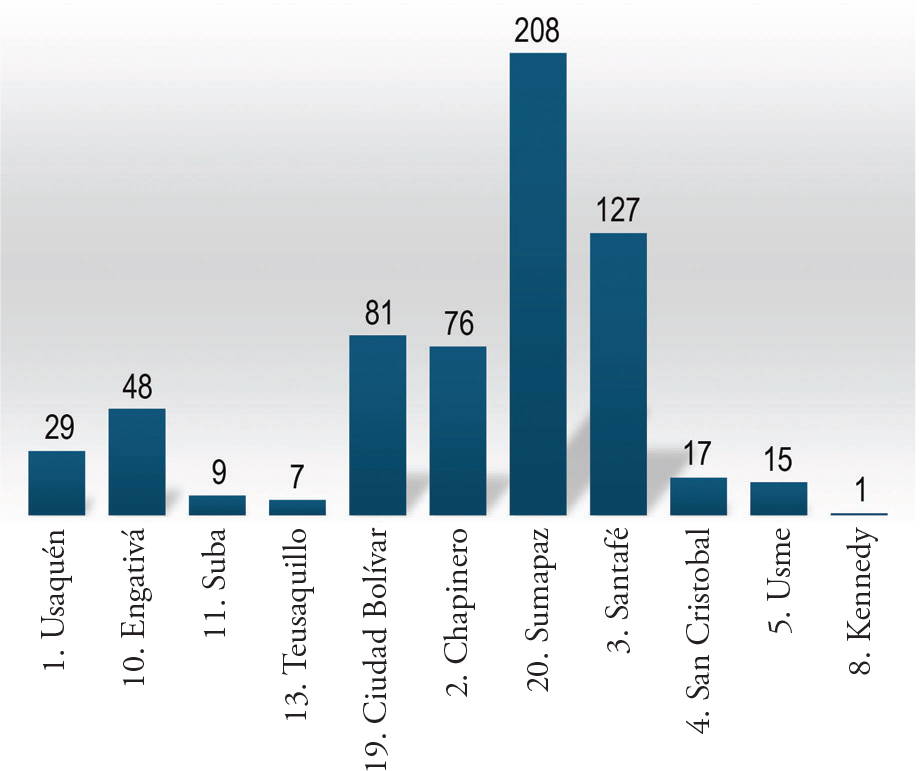
Figure 2:
Distribution of bryophyte taxa across Bogotá’s localities, highlighting variation in species richness.
The predominant ecosystems include páramo, high Andean forests, urban areas and urban forests (Table 5, Figure 3) as follows: Sumapáz (78,095 Ha) is a completely rural locality composed mostly of páramo; Santafé (4,517 Ha) is characterized by high Andean forest and the presence of the San Francisco River; Ciudad Bolívar (12,999 Ha) contains páramo, Andean and subxerophytic forest; Chapinero (3,816 Ha) presents high Andean forest and numerous streams; Engativá (3,588 ha) is associated with urban forests including the Botanical Garden and other metropolitan parks.
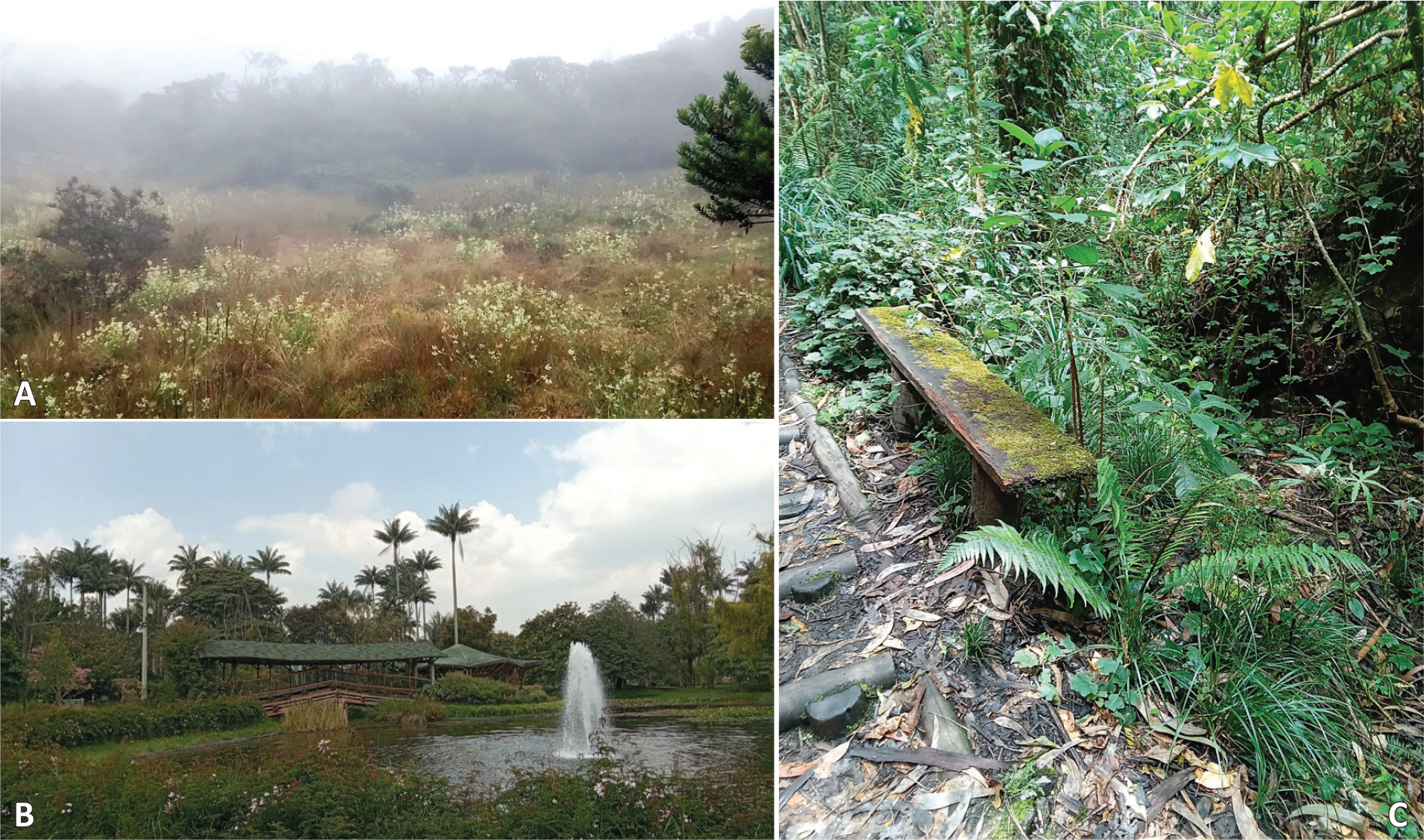
Figure 3:
Representative ecosystems of Bogotá sampled for bryophytes. A. Páramo (Sumapáz); B. Urban Forest (Bogotá Botanical Garden); C. Montane Forest (eastern hills).
Table 5:
Bryophyte taxa documented across Bogotá’s principal ecosystems, with patterns of ecological distribution observed in this study.
| Locality | Ecosystem | No. of species | Percentage | |||
|---|---|---|---|---|---|---|
| Páramo | High Andean Forest | Urban Forest (botanical garden) | Urban | |||
| Sumapáz | 208 | |||||
| Ciudad Bolívar | 81 | 304 | 67,5% | |||
| Usme | 15 | |||||
| Chapinero | 76 | |||||
| Santafé | 127 | 249 | 55,3% | |||
| Usaquén | 29 | |||||
| San Cristobal | 17 | |||||
| Engativá | 48 | 57 | 12,6% | |||
| Suba | 9 | |||||
| Teusaquillo | 7 | 8 | 1,7% | |||
| Kennedy | 1 | |||||
| TOTAL | 304 | 249 | 57 | 8 | ||
As part of the research initiatives led by the curation of the bryophyte collection at the Bogotá Botanical Garden between 2021 and 2025, various areas within the localities of Chapinero, Santafé, Engativá, and Ciudad Bolívar were sampled, covering 15.23% of the city’s territory and accounting for 51.59% of the total species recorded. However, a review of the databases revealed that only partial sampling has been conducted in Sumapáz, which comprises 47.2% of the territory. Despite this, Sumapáz harbors the highest diversity, representing 35.34% of the total species. In contrast, the localities of Usme and Suba, which together cover 19.29% of the territory, have been scarcely sampled and exhibit only 4% of the city’s species richness. These findings underscore the need to expand the geographic coverage of sampling efforts, particularly in areas where the relation between territorial extent and species diversity is disproportionately low (Figure 4).
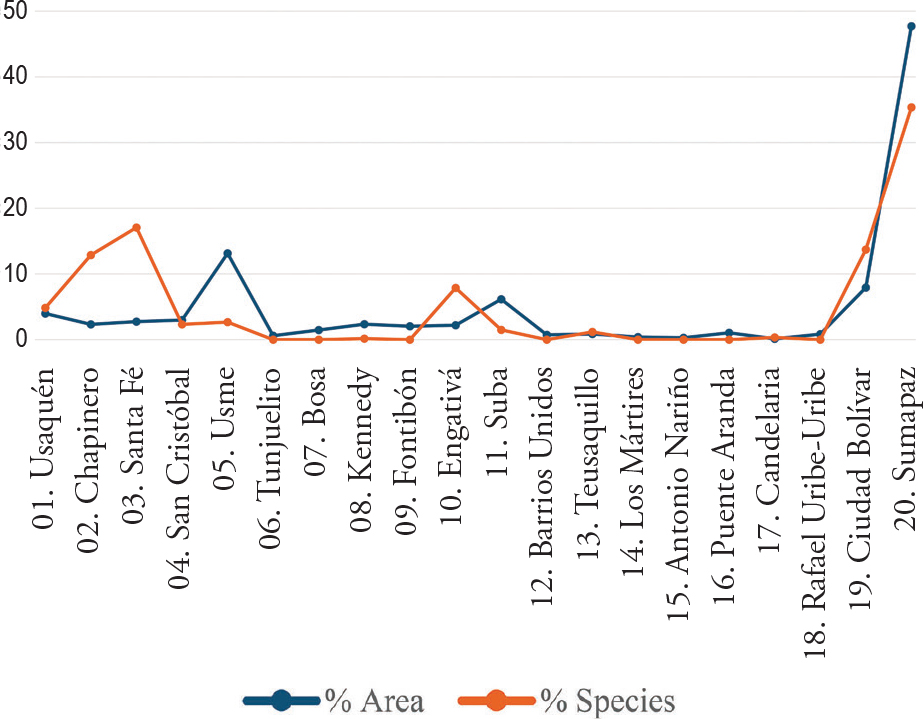
Figure 4:
Correlation between the spatial extent of each locality and the diversity of bryophytes observed.
Additionally, analysis of the existing records reveals that Bryum argenteum accounts for 58% of the species representation across the city’s territory. Meanwhile, 54% of the species analyzed have only been collected once, and it is estimated that 2.22% of the total corresponds to endemic species (Table 6).
Table 6:
Species recorded from only one voucher specimen, with herbarium acronyms indicate.
| Division | Family | Specie | Herbarium |
|---|---|---|---|
| Liverwort | Lejeuneaceae | Drepanolejeunea pungens | NY |
| Liverwort | Frullaniaceae | Frullania bogotensis | G |
| Moss | Sematophyllaceae | Aptychopsis pycnodonta | JE |
| Moss | Pottiaceae | Barbula stenocarpa | BM |
| Moss | Thuidiaceae | Cyrto-hypnum arzobispoae | No information |
| Moss | Dicranaceae | Dicranella bogotensis | BM |
| Moss | Mniaceae | Schizymenium dolichothecum | JE |
| Moss | Leucobryaceae | Sphaerothecium phascoideum | PC |
| Moss | Sphagnaceae | Sphagnum trollii | M |
| Moss | Pottiaceae | Trichostomum lindigii | BM |
Categorization
The number of species in the city known from a single specimen led to their classification under the criterion of “restricted extent of occurrence,” one of the conditions for assigning a “Vulnerable” risk status (IUCN, 2012). In Colombia, bryophytes considered at risk of extinction (Linares & Uribe, 2002; Instituto Humboldt, 2019; Ministerio de Ambiente, 2024) include 24 species found within the city. Among these, Cephaloziella divaricata has been categorized as Critically Endangered (CR), Metz-geria lechleri as Endangered (EN) - both also present in other countries - and Cyrto-hypnum arzobispoae as Vulnerable (VU), a species endemic to the city (Table 7).
Table 7:
Conservation categories assigned to bryophyte species from Bogotá according to national assessments: Linares & Uribe (2002), Humboldt Institute (2019), and Ministry of Environment (2024). Status codes: VU – Vulnerable; LC – Least Concern; CR – Critically Endangered; DD – Data Deficient.
| Group | Species | 2002 | 2019 | 2024 |
|---|---|---|---|---|
| L | Cephalozia bicuspidata | VU | LC | |
| L | Cephaloziella divaricata | VU | CR | CR |
| L | Cheilolejeunea paramicola | LC | ||
| L | Drepanolejeunea pungens | DD | ||
| L | Frullania bogotensis | LC | ||
| L | Metzgeria lechleri | VU | EN | EN |
| M | Aptychopsis pycnodonta | DD | ||
| M | Bryoerythrophyllum subcespitosum | LC | ||
| M | Cyrto-hypnum arzobispoae | VU | VU | |
| M | Dicranella bogotensis | CR | LC | |
| M | Fontinalis bogotensis | LC | ||
| M | Philonotis striatula | DD | ||
| M | Helicoblepharum daltoniaceum | VU | DD | |
| M | Schizymenium dolichothecum | VU | DD | |
| M | Sematophyllum fragilirostrum | DD | ||
| M | Sphagnum compactum | LC | ||
| M | Sphagnum cuspidatum | LC | ||
| M | Sphagnum cyclophyllum | LC | ||
| M | Sphagnum magellanicum | LC | ||
| M | Sphagnum meridense | LC | ||
| M | Sphagnum recurvum | LC | ||
| M | Sphagnum sancto-josephense | LC | ||
| M | Sphagnum sparsum | LC | ||
| M | Sphagnum subsecundum | LC | ||
| M | Sphagnum trollii | DD | ||
| M | Trichostomum lindigii | DD |
Sources of information
The 450 bryophyte species reported for Bogotá in this study are distributed as follows: 196 in COL, 227 in JBB, and 261 in Tropicos. Table 8 provides further insights into the relationships among these data sources.
Historical collectors and specimen records
The principal bryophyte collectors in Bogotá have included Alexander Lindig (1813–1882), John Weir (–1898), Ellsworth Killip (1890-1968), Carl Troll (1899-1975), José Cuatrecasas (1903-1996), Helene Bischler (19322005), Thomas van der Hammen (1924-2010), Steve Churchill (1948-2023), Antoine Cleef (1941), Jaime Aguirre (1951), and the first author. Notably, 60 species - representing 14% of those recorded in Bogotá - are known solely from one or two specimens collected by Lindig, Troll, or Weir in the 19th century. These specimens are housed in herbaria in Europe or the United States, due to the absence of national repositories at the time (Díaz-Piedrahíta, 2016).
Discussion
The bryophyte catalogs of Colombia (Churchill, 2016; Gradstein, 2021) recognizes a national richness of 1,652 species (932 mosses, 720 liverworts and hornworts). This study demonstrates that Bogotá, despite occupying less than 1% of Colombia’s land area, harbors 25% of the country’s bryophyte diversity. The families and genera with the greatest number of species in the city are similar to those reported for the tropical Andes (Gradstein et al., 2001) and paramo and high Andean forest ecosystems (Churchill, 1991; Churchill et al., 2020).
The high bryophyte species richness in Bogotá can be attributed to the presence of rural and mixed-use localities containing specialized ecosystems that serve as critical refuges for biodiversity. However, this richness is increasingly threatened by the rapid transformations typical of a capital city, including: the expansion of both legal and informal urban settlements; mining activities, both excavated and open-pit; tourism in protected areas; the advancement of agricultural frontiers; water and air pollution; waste management practices; and civic culture (Brown, 2012; Escobedo et al., 2015; Salamanca et al., 2023).
In urban localities, the resistance, resilience, and adaptability ofbryophytes (Capozzi et al, 2016; Jovan et al., 2022) enable them to tolerate conditions of pollution and nutrient scarcity. These traits contribute to high species diversity and, in some cases, even endemism.
Acknowledgements
To Boris Villanueva as the coordinator of the research project “Checklist of Bryophytes of Bogotá” registered at SIDIC (Research system of Bogotá’s Botanical Garden); to Laura Clavijo (Head curator of the Colombian National Herbarium) for allow the access to bryophytes specimens information; to the bryophyte collectors in the political jurisdiction of Bogotá, who contributed to the consolidation of this catalogue; to María Fernanda Lozano Bernal for making the map included in this study; to John Atwood (MO), Bryan Espinosa-Prieto (UNMSM), Ana Aponte and the anonymous reviewers for their contributions to improving the manuscript.
Notes
[1] Research data availability
All data supporting this study are included within the article and/or supporting materials. The information is also available as a search at https://www.tropicos.org/home, https://herbario.jbb.gov.co/especimen/simple and http://www.biovirtual.unal.edu.co/es/colecciones/search/plants/
APPENDIX 1
Geographic characterization of each locality: rural and urban extent.
| Number of Locality | Locality | Total area (Ha) | Urban area (Ha) | Rural area (Ha) |
|---|---|---|---|---|
| 1 | Usaquén | 6532 | 3807 | 2724 |
| 2 | Chapinero | 3816 | 1316 | 2500 |
| 3 | Santafé | 4517 | 697 | 3820 |
| 4 | San Cristobal | 4910 | 1648 | 3262 |
| 5 | Usme | 21507 | 3029 | 18477 |
| 6 | Tunjuelito | 987 | 987 | 0 |
| 7 | Bosa | 2394 | 2394 | 0 |
| 8 | Kennedy | 3859 | 3859 | 0 |
| 9 | Fontibón | 3327 | 3327 | 0 |
| 10 | Engativá | 3588 | 3588 | 0 |
| 11 | Suba | 10056 | 6271 | 3785 |
| 12 | Barrios Unidos | 1190 | 1190 | 0 |
| 13 | Teusaquillo | 1419 | 1419 | 0 |
| 14 | Los Mártires | 651 | 651 | 0 |
| 15 | Antonio Nariño | 488 | 488 | 0 |
| 16 | Puente Aranda | 1731 | 1731 | 0 |
| 17 | La Candelaria | 206 | 206 | 0 |
| 18 | Rafael Uribe Uribe | 1388 | 1388 | 0 |
| 19 | Ciudad Bolívar | 12999 | 3391 | 9608 |
| 20 | Sumapáz | 78095 | 0 | 78095 |