
Introduction
The present short article continues the series of our earlier nomenclatural and taxonomic publications on types and other important historical specimens deposited in the Turczaninow and Besser Memorial Herbaria (e.g., Mosyakin et al., 2017a, 2017b, 2018a, 2018b, 2019, 2020; Mosyakin & de Lange, 2019; Kellermann et al., 2022; Boiko et al., 2023, etc.) at the National Herbarium of Ukraine, KW (see Shiyan, 2011; Mosyakin & Shiyan, 2021). Here we report the re-discovery of three holotypes of species-rank names published by N.S. Turczaninow in Malvaceae and provide several miscellaneous nomenclatural comments on some other names of taxa of that family.
Material and methods
Standard methods of herbarium taxonomy and herbarium management and digitization were used (see de Vogel, 1987; Bridson & Forman, 1992; Shiyan, 2011; Davies et al., 2023, etc.). Botanical nomenclature in this article follows the International Code of Nomenclature for algae, fungi, and plants (Turland et al., 2025). Throughout the text, herbarium acronyms are cited following Index Herbariorum (Thiers, 2008–onward).
For basic information about the Turczaninow Memorial Herbarium (KW-TURCZ) at the National Herbarium of Ukraine (KW, the Herbarium of the M.G. Kholodny Institute of Botany of the National Academy of Sciences of Ukraine, Kyiv) and their exceptional importance for global plant taxonomy, see Shiyan (2011), Mosyakin et al. (2019, 2020), and references therein.
Results and discussion
Turczaninow’s taxa in Malvaceae s. str.: a brief overview
According to Fryxell & Krapovickas (1990), Turczaninow published at least 58 binomials (species-rank names) in Malvaceae sensu stricto (s. str.). As of 16 August 2025, our advanced search in the International Plant Names Index (IPNI, 2025–onward) for plant taxa described by Turczaninow in Malvaceae (sensu stricto, as currently accepted in IPNI; the publishing author only, excluding later nomenclatural combinations) resulted in 69 records, including three genus-rank names and a few species-rank duplicates. Similar searches for Turczaninow’s names in Tiliaceae and Sterculiaceae yielded 41 and 101 records, respectively. In this publication we consider only taxa of Malvaceae s. str.
The names of taxa of Malvaceae validated by Turczaninow remain important for the present-day taxonomy and nomenclature and are considered in many relevant taxonomic publications (see, e.g., Fryxell, 1971, 1979, 2002; Dorr, 2017, 2023a, 2023b; Shepherd & Wilkins, 2017; Mosyakin et al., 2019; Saunders & Dorr, 2022, etc.).
Genera of Malvaceae s. str. described by Turczaninow
In addition to names of species-rank taxa of Malvaceae, Turczaninow also published two generic names for South American taxa, Nototriche Turcz. (Turczaninow, 1863: 567) and Peltostegia Turcz. (Turczaninow, 1858a: 223), of which the first one is morphologically distinct and currently accepted taxonomically (Colli-Silva et al., 2025; POWO, 2025–onward: https://powo.science.kew.org/taxon/urn:lsid:ipni.org:names:301092-2; however, it was earlier reported as phylogenetically rooted in Tarasa Phil.: see Tate & Simpson, 2003; Tate et al., 2005) and the second one, despite being of priority, was rejected in favor of a later name, Peltaea (C. Presl) Standl., following the proposal by Fryxell & Krapovickas (1986, see also Fryxell & Krapovickas, 1990: 179).
In addition to the two generic names mentioned above, Turczaninow also published the generic name Arcynospermum Turcz. with one species, A. nodiflorum Turcz. (Turczaninow, 1858a: 191; holotype KW001000207: https://plants.jstor.org/stable/10.5555/al.ap.specimen.kw001000207), which is currently considered taxonomically unplaced (POWO, 2025–onward). The two small branches that served as original material available to Turczaninow were (supposedly?) collected by Jurgensen (collection number 121) in Mexico, as indicated in the protologue. However, the original label Jurgensen 121 is currently attached (evidently misplaced!) at KW to the specimen listed online at JSTOR Global Plants as an original specimen (probably the holotype) of Waltheria boliviensis Turcz. described by Turczaninow (1863: 571) based on “Bolivia, prope Chiquitos, d’Orbigny N 920” (see KW001001726: https://plants.jstor.org/stable/10.5555/al.ap.specimen.kw001001726), which is now considered a synonym of W. communis A. St.-Hil. see Saunders & Dorr (2022) and POWO (2025–onward). However, the latter species does not occur in Mexico. The story of this confusion is described in detail by Saunders, first on her annotation label attached to the specimen KW001001726, then in her PhD dissertation (Saunders, 1995), and finally by Saunders & Dorr (2022), who concluded that the holotype status of KW001001726 cannot be reliably confirmed (no associated label, no other reliable evidence). Thus, as a result, Saunders & Dorr (2022) designated as the lectotype another specimen of the same gathering from Bolivia (Santa Cruz, “prope Chiquitos”, 1850, A. DOrbigny 920, G00358717). In that case, the Turczaninow’s holotype of Waltheria boliviensis is technically considered to be lost.
Identifìed and digitized types of Turczaninow’s Malvaceae at KW
In the course of digitization projects at the National Herbarium of Ukraine (KW) supported by the Andrew W. Mellon Foundation in 2007–2015, 48 herbarium sheets of Malvaceae from the Turczaninow historical herbarium (KW-TURCZ), representing 49 specimens (see the note below, on Abutilon divaricatum) referring to 42 species names authored by Turczaninow, have been digitized and are currently available at JSTOR Global Plants (https://plants.jstor.org/).
One herbarium sheet contains two specimens of Abutilon divaricatum Turcz. (Turczaninow, 1858a: 204), a currently accepted species. These specimens from Mexico are the lectotype (Galeotti 4072, designated by Fryxell, 1976; KW001000176) and a syntype (Linden 1378; KW001000175) mounted on the same herbarium sheet; the scanned image is available at JSTOR Global Plants (https://plants.jstor.org/stable/10.5555/al.ap.specimen.kw001000175).
Some previously missing types of Turczaninow’s Malvaceae
In their nomenclatural overview of taxa of Malvaceae described by Turczaninow, Fryxell & Krapovickas (1990) reported several holotypes (or supposed holotypes) as “not located” and provided for such names the data on duplicate original specimens available in other herbaria. Before preparing their article, Fryxell and Krapovickas borrowed many specimens of Malvaceae from the Turczaninow herbarium (KW-TURCZ), and thus many type specimens now bear annotations by Fryxell, made mainly in 1985. The loan from KW was apparently prepared under the supervision of Taisiya Y. Omelchuk-Myakushko, who was then the Head Curator of KW and who greatly contributed to the proper curation of the Turczaninow Memorial Collection (see Myakushko, 1976; Myakushko et al., 1979; Shiyan, 2023).
Our recent special search in the unmounted part of the main collection of KW-TURCZ resulted in the discovery of several additional specimens which, following the type designation procedure for names published in Turczaninow’s Animadversiones… series, should be considered the holotypes, as discussed in Mosyakin et al. (2019), and applied in several other publications, e.g. Brownsey & Perrie (2022), Kellermann et al. (2022), Anderson et al. (2023), Barrett et al. (2024), Schmidt-Lebuhn et al. (2024), etc. Thus, holotypes (if applicable; see McNeill, 2013; Mosyakin et al., 2019) of names published by Turczaninow (1855, 1858a, 1858b, 1859, 1863) in his Animadversiones … series are normally deposited in KW-TURCZ, if not indicated otherwise in the protologue.
In our earlier article (Mosyakin et al., 2019) we have already reported the rediscovered holotype (KW001003068) of the name Abelmoschus achanioides Turcz. (Turczaninow, 1858a: 196), which is now treated as a synonym of the accepted name Malvaviscus achanioides (Turcz.) Fryxell (1979: 253). Fryxell & Krapovickas (1990: 174) earlier reported that type as “holotype: LE?”.
Type specimens rediscovered
Phymosia umbellata (Cav.) Kearney, Leafl. W. Bot. 5: 190. 1949 ≡ Malva umbellata Cav., Icon. 1: 64. 1791 ≡ Sphaeralcea umbellata (Cav.) G. Don, Gen. Hist. 1: 465. 1831 ≡ Sphaeroma umbellatum (Cav.) Schltdl., Linnaea 11: 352. 1837. – Type (lectotype, designated by Fuertes & Fryxell, 1993: 661–662; see also lamonico & El Mokni, 2020: 329): Spain, cultivated at the Botanic Garden of Madrid, 1800 (MA-CAV-475960). = Sphaeralcea galeottii Turcz., Bull. Soc. Imp. Naturalistes Moscou 31 (p. 1, no. 1): 186. 1858. – Type (holotype, reported here for the first time): “4102 | fl. purpureis | Oaxaca Mexici 3000 | h G. [herbarium Galeotti]”, KW001003073! (Figure 1).
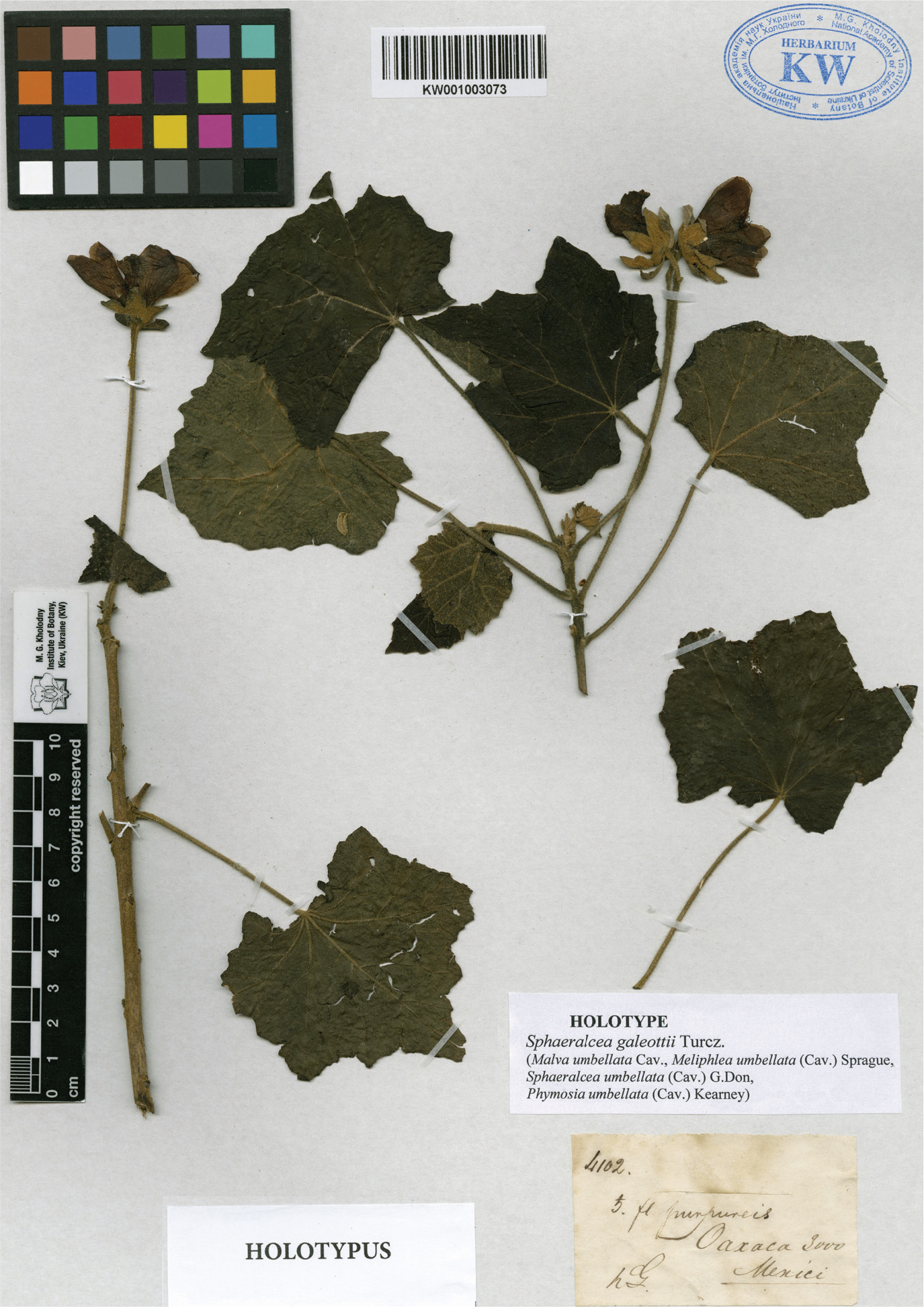
Figure 1:
Holotype of the name Sphaeralcea galeottii Turcz. (KW001003073).
Sphaeralcea galeottii was described by Turczaninow (1858a: 186) with the following information on its geographical origin and collector: “Oxaca Mexici alt. 3000 ped. Galeotti n. 4102”. At present this name is considered as a taxonomic (heterotypic) synonym of Phymosia umbellata (Fryxell, 1971; Iamonico & El Mokni, 2020; POWO, 2025-onward).
Following the data from the protologue, Fryxell (1971: 163) reported three original specimens of Sphaeralcea galeottii deposited in BR: “Type: Veracruz, Tlachichuca, al pié del Volcán, s.d., Galeotti 4102 (BR-3 sheets)”. However, he did not indicate any specific BR specimen as the type (lectotype), and because of that, Iamonico & El Mokni (2020: 327, 329) designated the specimen BR0000005215393 as the lectotype (second-step lecto-typification). These nomenclatural acts were well justified and correct at that time because the supposed holotype of the name Sphaeralcea galeottii in the Turczaninow herbarium at KW was considered missing and the type was reported by Fryxell & Krapovickas (1990: 181) as “holo-type: not located; isotypes: BR! K! P”. However, now we have the rediscovered holotype and thus the specimen BR0000005215393 has no lectotype status; the three specimens at BR and any other duplicates in other herbaria belonging to the gathering Galeotti 4102 should now be considered isotypes.
The holotype at KW has most likely not been discovered earlier because there was no identification written by Turczaninow on the original label. As we mentioned in our earlier article (see Mosyakin et al., 2019: 385), sometimes Turczaninow wrote the names of his new taxa not on original labels but only on the paper folders or envelopes, or on separate paper slips. Also, in some cases the unmounted identifications slips (which also often contained handwritten descriptions of new species made by Turczaninow) were displaced or lost during the turbulent history of the Turczaninow herbarium, especially its several relocations (see Mosyakin et al., 2018a, 2019, and references therein). However, the discovered specimen is the only one at KW that, with its label and plant material, is the perfect match to the protologue, and thus there is no reason to doubt its holotype status.
Phymosia floribunda (≡ Sphaeroma floribunda): an additional isoneotype at KW
The neotype of the name Sphaeroma floribunda Schltdl. (“Oaxaca: Yavesía, Galeotti 4088 (BR)”), the basionym of the currently accepted name Phymosia floribunda (Schltdl.) Fryxell, was designated by Fryxell (1971: 157) because the orginal material at B was destroyed during World War II. However, Iamonico & El Mokni (2020: 328) reported that there are in fact three Galeotti 4088 specimens at BR, i.e., BR000000517838, BR0000005188031, and BR000000517897, and published their second-step typification, designating the specimen BR000000517897 as the neotype and considering the other two BR specimens as isoneotypes. They also reported an additional isoneotype at K (K000328820: https://plants.jstor.org/stable/10.5555/al.ap.specimen.k000328820). We discovered one more isoneotype specimen in the Turczaninow Herbarium at KW (KW001003077!, Figure 2).
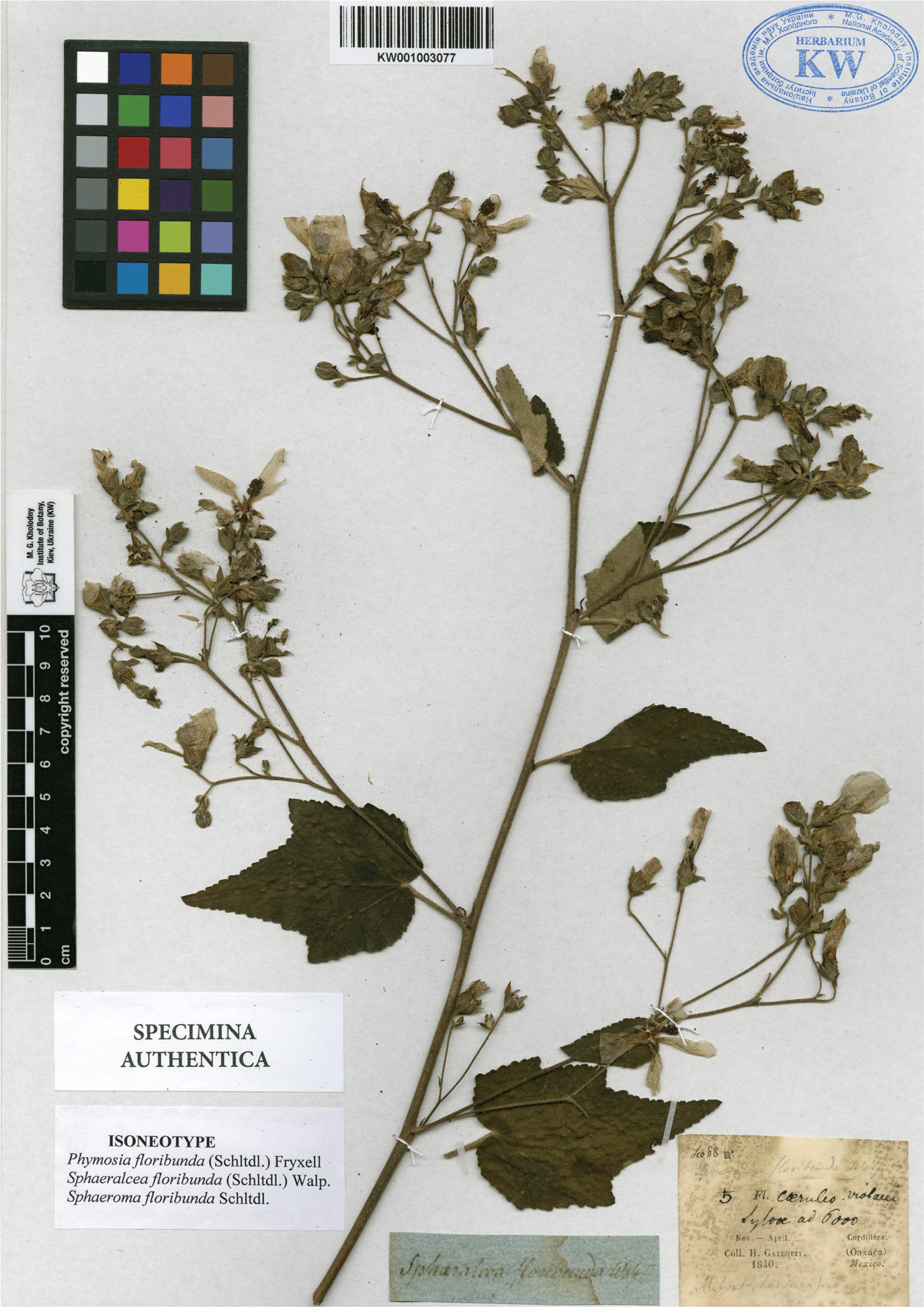
Figure 2:
Isoneotype of the name Sphaeroma floribunda Schltdl. (KW001003077).
Fuertesimalva chilensis (A. Braun & C.D. Bouché) Fryxell, Sida 17: 72. 1996 ≡ Malva chilensis A. Braun & C.D. Bouché, Index Seminum Berolinensis (B) 1857(App.): 1. 1857 ≡ Urocarpidium chilense (A. Braun & C.D. Bouché) Krapov., Darwiniana 10: 619. 1954. – Type (neotype, designated by Fryxell 1996: 72): “CHILE. ex hort. Berolinensis (B as photo F-9322)”, a Berlin Negative of the Field Museum of Natural History, Chicago, Ill., U.S.A.
= Malva scorpioides Turcz., Bull. Soc. Imp. Naturalistes Moscou 36 (p. 1, no. 2): 562. 1863 ≡ Malvastrum peruvianum (L.) A. Gray var. scorpioides (Turcz.) Baker, J. Bot. 29: 168. 1891. – Type (holotype, reported here for the first time): “Malva scorpioides Turcz. | Ab affini M: Limensi differt foliis | praesertim superioribus digitatiore par-|-titis, atque carpellis ad latera tuberculatis | Peru | Mathews n: 1006”, KW001003080! (Figure 3).
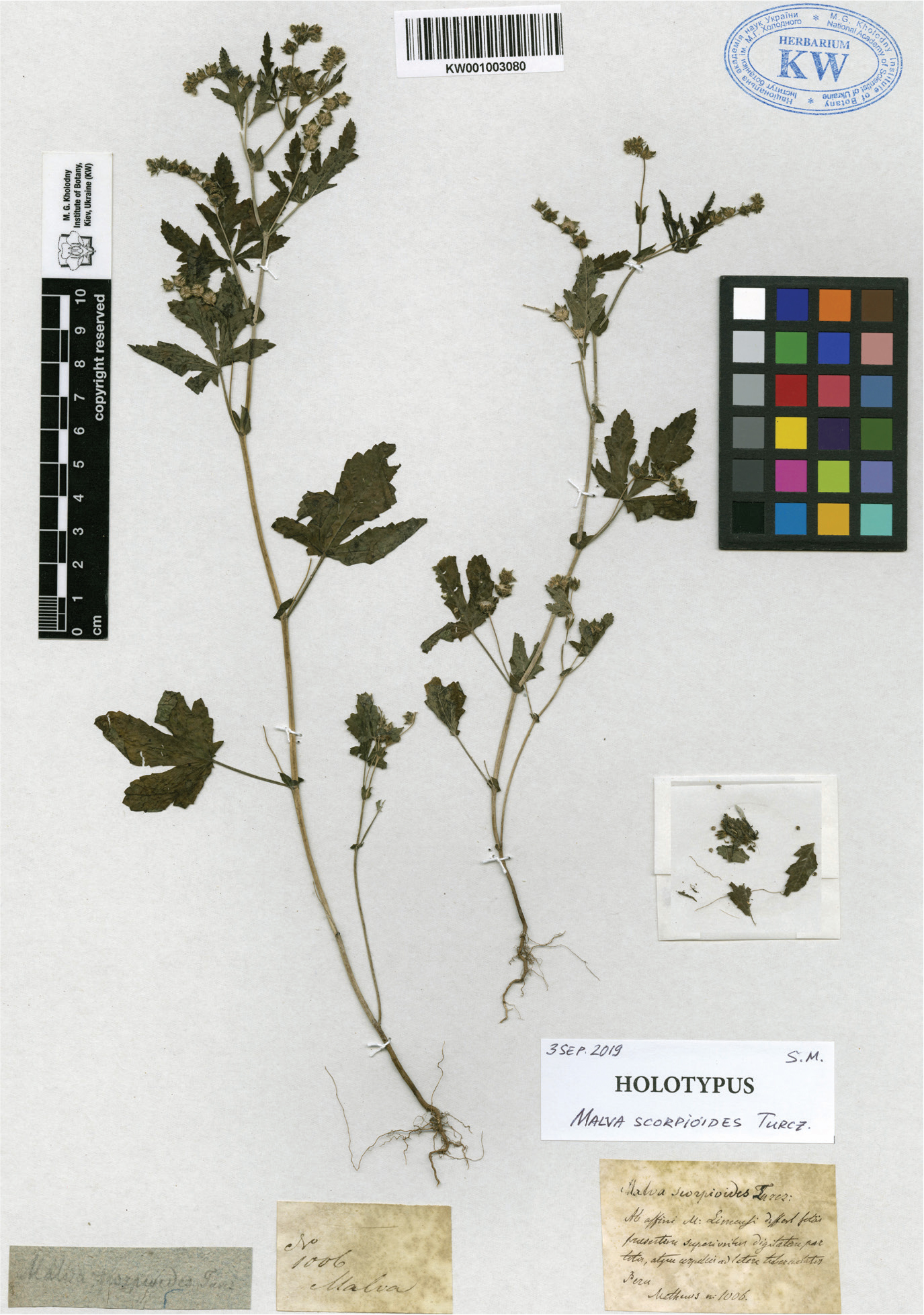
Figure 3:
Holotype of the name Malva scorpioides Turcz. (KW001003080).
Malva scorpioides was described by Turczaninow (1863: 562–563) with the following indication of its geographical origin and collector: “Peru, Mathews N 1006”. At present this name is considered as a taxonomic (heterotypic) synonym of Fuertesimalva chilensis (see Fryxell, 1996; POWO, 2025–onward, etc.).
Translation of a preliminary description of M. scorpioides by Turczaninow, written on the label of the holotype (KW001003080): “Differs from similar Malva limensis in having leaves, especially the upper ones, more palmately divided, and carpels tuberculated at sides”. The holotype sheet also contains a field slip with a slit through which the plant stem was inserted (“N 1006 | Malva”) and a grayish-blue paper slip with the plant name in pencil, in Turczaninow’s hand, originally from the specimen folder.
Fuertesimalva peruviana (L.) Fryxell, Sida 17: 74. 1996 ≡ Malvaperuviana L., Sp. Pl.: 688. 1753 ≡ Malvastrum peruvianum (L.) A. Gray, U.S. Expl. Exped., Phan. 1: 146. 1854 ≡ Malveopsis peruviana (L.) Kuntze, Revis. Gen. Pl. 1: 72. 1891 ≡ Urocarpidiumperuvianum (L.) Krapov., Darwiniana 10: 629. 1954. – Type (neotype, designated by Krapovickas, 1954: 629): Herb. Linn. No. 870.5 (LINN, see https://linnean.access.preservica.com/uncategorized/IO_b5cbe47f-b8c9-4e48-8c50-91d20a41898c).
= Malva mathewsii Turcz., Bull. Soc. Imp. Naturalistes Moscou 36 (p. 1, no. 2): 563. 1863 ≡ Urocarpidium mathewsii (Turcz.) Krapov., Darwiniana 10: 616. 1954. – Type (holotype, reported here for the first time): “Malva Mathewsii Turcz. | Peru | Mathews n 402”, KW001003082! (Figure 4).
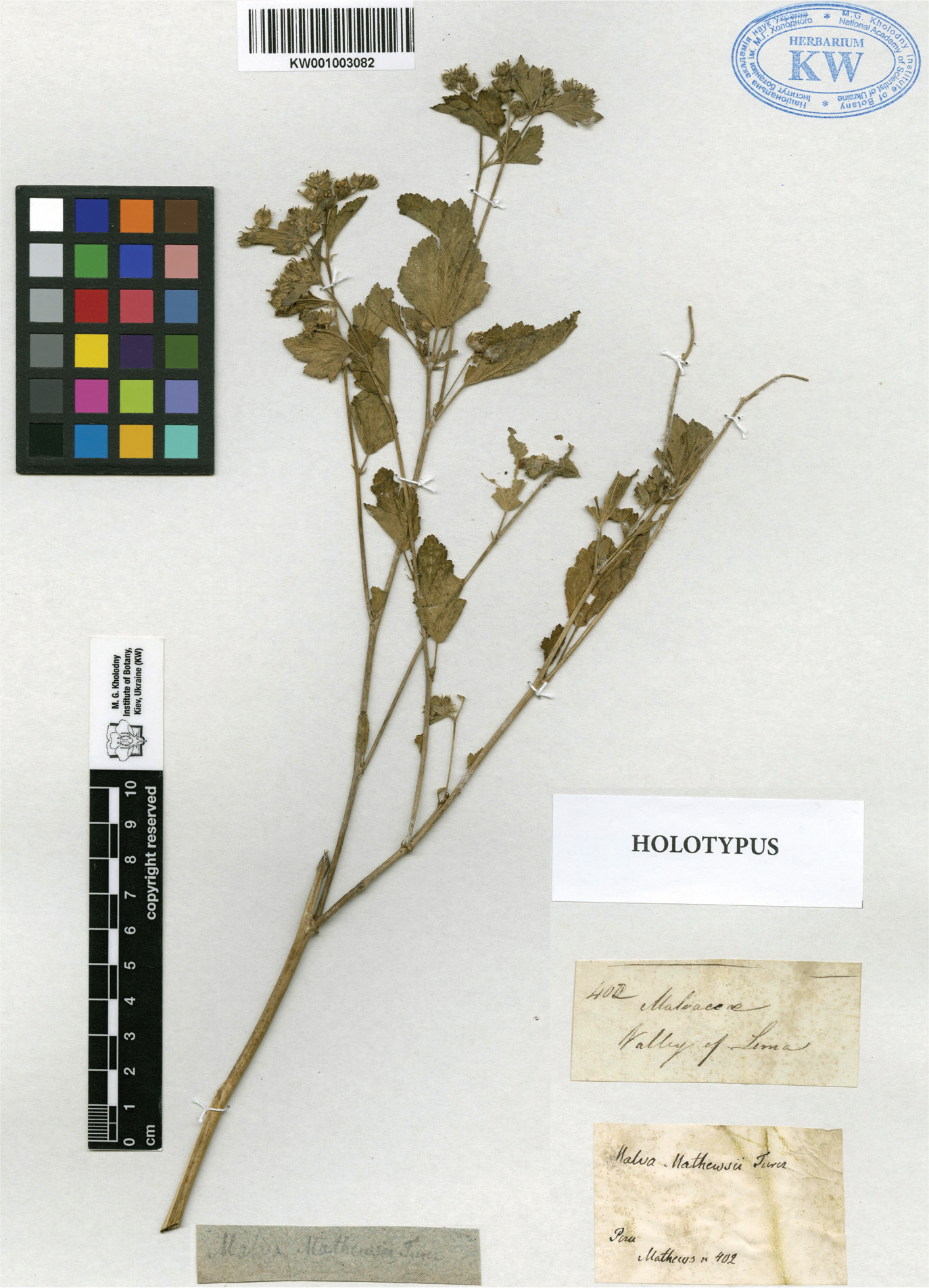
Figure 4:
Holotype of the name Malva mathewsii Turcz. (KW001003082).
Malva mathewsii was described by Turczaninow (1863: 563) with the following indication of its geographical origin and collector: “Peru, in planitiebus Limae, Mathews N 402”. At present this name is considered a taxonomic (heterotypic) synonym of Fuertesimalva peruviana (see Fryxell, 1996; POWO, 2025-onward, etc.). The holotype sheet also contains a field slip with slits (“402 Malvaceae | Valley of Lima”) and a grayish-blue paper slip with the plant name in pencil, in Turczaninow’s hand, originally from the specimen folder.
Conclusions
Here and in our previous article (Mosyakin et al., 2019) we reported four previously missing holotypes of names of taxa published by Turczaninow in Malvaceae, namely Abelmoschus achanioides, Malva mathewsii, M. scorpioides, and Sphaeralcea galeottii.
Of the possible holotypes in Malvaceae reported by Fryxell & Krapovickas (1990) as presumably missing at KW, the following supposed holotypes of at least eight names are still missing: Abutilonpyramidale Turcz., A. verbascoides Turcz., Malachra lineariloba Turcz., Malva deflexa Turcz., Malvaviscus cuspidatus Turcz., Pavonia brachypoda Turcz., P dasypetala Turcz., and Sida mathewsii Turcz. For two names, Cristaria grandiflora Turcz. and C. lata Turcz., Fryxell & Krapovickas (1990) reported type specimens at K, not at KW. Further search for these and other type specimens in the vast main part of the Turczaninow herbarium (KW-TURCZ) is planned. When performing this search, it should be kept in mind that the corresponding specimens may not always bear clear Turczaninow’s annotations and identifications directly associated with the plant material (see examples above), so circumstantial evidence should be also taken into consideration for determining the possible type status of specimens.
In addition to the type specimens of names in Malvaceae validated by Turczaninow reported above, we also identified in KW-TURCZ several other original specimens (syntypes, isotypes, isolectotypes, etc.) of various names of taxa described by other researchers, such as Malvastrum meridae A.W. Hill, Nototriche jamesonii A.W. Hill, Lawrencia squamata Nees, Sphaeralcea fendleri A. Gray, etc. A more detailed analysis of these and other original specimens of Malvaceae at KW-TURCZ awaits further research.
As we emphasized earlier on several occasions (see, e.g. Boiko et al., 2023; Kellermann et al., 2022; Mosyakin & Shiyan, 2021; Mosyakin et al., 2017a, 2017b, 2018a, 2019, 2020), the KW collections, especially historical herbaria of W.S.J.G. Besser, N.S. Turczaninow, I.F. Schmalhausen, etc., which contain many type specimens, are of exceptional scientific value for the global plant taxonomy. Further digitization and scientific curation of the globally important Turczaninow herbarium (KW-TURCZ), as well as other unique collections at the National Herbarium of Ukraine, are especially urgent tasks under the present wartime circumstances, when the collections are constantly under the threat of physical destruction (see Mosyakin & Shiyan, 2022; Novikov et al., 2024; Novikov & Nachychko, 2025, etc.). In continuing our digitization efforts, we would welcome our closer collaboration with colleagues from other countries who might be interested in research in our herbaria and in preservation of these rich and important biodiversity collections officially recognized as part of the National Heritage of Ukraine.
Acknowledgments
We express our sincere gratitude to our colleagues Natalia M. Shiyan, Head Curator of KW, and Alisa V. Shumilova (both of the M.G. Kholodny Institute of Botany, National Academy of Sciences of Ukraine, Kyiv, Ukraine) for their kind assistance at the National Herbarium of Ukraine. The generous support of digitization of herbarium specimens provided by the Andrew W. Mellon Foundation (2007–2015) and the Volkswagen Foundation (Volkswagen-Stiftung, 2023–2024) is greatly appreciated. We are grateful to Jürgen Kellermann (State Herbarium of South Australia (AD), Adelaide, South Australia, Australia) and an anonymous reviewer for their valuable comments on the manuscript. Moreover, last but not least, we are greatly indebted to the Armed Forces of Ukraine for giving us this opportunity to continue our research, curation, and preservation of the herbarium collections of the National Heritage of Ukraine, against all wartime odds.
Notes
[1] Research data availability
The data used in this study are available from the corresponding author upon reasonable request.