
Introduction
Abutilon Mill. is a large genus mainly occurring in tropical and subtropical areas worldwide, with a few species extending to warm-temperate regions. The genus is most diverse in the Neotropics (Areces Berazaín & Fryxell, 2007). It is one of the largest Malveae genera, although the number of species considerably varies, depending on species delimitation. The genus includes 178 accepted species (POWO, 2025). More than 500 names were included in a nomenclator for the genus by Fryxell (2002), although many synonyms exist. Abutilon is a genus without a solid, modern revisionary worldwide treatment, and its extended molecular phylogeny is also lacking.
Only nine species are native to the Mediterranean and Macaronesia (Valdés, 2011), and probably none of these naturally occur in Europe, although the residence status of A. theophrasti Medik. remains uncertain. Several alien species, however, have been introduced to this area, either as ornamentals or as weeds, and at least one of these, A. grandifolium (Willd.) Sweet, is an increasing environmental weed in the warm-temperate to subtropical areas.
Many of these species, both native and introduced, are poorly understood, and their identity may require critical reassessment. As part of taxonomic and nomenclatural studies by the author in this genus (Verloove et al., 2020; Verloove & Galasso, 2020; Verloove & Sennikov, 2022; Verloove et al., 2023), some noteworthy information regarding non-native species that occur in the Mediterranean area and Macaronesia is here presented.
Materials and methods
The information provided here was acquired mainly after many years of fieldwork by the author in the study area, especially in Macaronesia (Canary Islands and Madeira). In addition, several relevant local herbaria were inspected (LPA, MADM, MADS, MADJ, ORT), as well as some major western European herbaria (BR, L, incl. U and WAG). Several online herbaria were also examined, inclu ding P, MPU, etc. (herbarium acronyms follow Thiers, 2025).
Results and discussion
Abutilon grandiflorum G. Don is a species erroneously reported from the Canary Islands
This species is native to São Tomé, Kenya, South Africa, Madagascar, and the Arabian Peninsula (POWO, 2025) and, in all probability, not grown as an ornamental (e.g. Huxley, 1999; Sánchez de Lorenzo Cáceres, 2000; Le Huquet, 2011). It is only moderately weedy, if at all (Holm et al., 1979). Yet, it was included in a list of invasive alien vascular plants in the Canary Islands (Sanz-Elorza et al., 2005). Randall (2017) subsequently took over this record in his Global Compendium of Weeds.
However, upon request, one of the authors of the Canarian checklist confirmed that an orthographic error was involved (pers. comm. Dr. E. Dana). The naturalized invasive species in the Canary Islands is Abutilon grandifolium (Figure 1), not A. grandiflorum (for morphological and other differences between these two species, see Table 1). It was first recorded in Gran Canaria in the 1960s (Kunkel, 1967) and is now known from all islands except Fuerteventura (Acebes Ginovés et al., 2010). It is classified as an invasive species in the archipelago (https://www.biodiversidadcanarias.es/biota/especie/F01000).
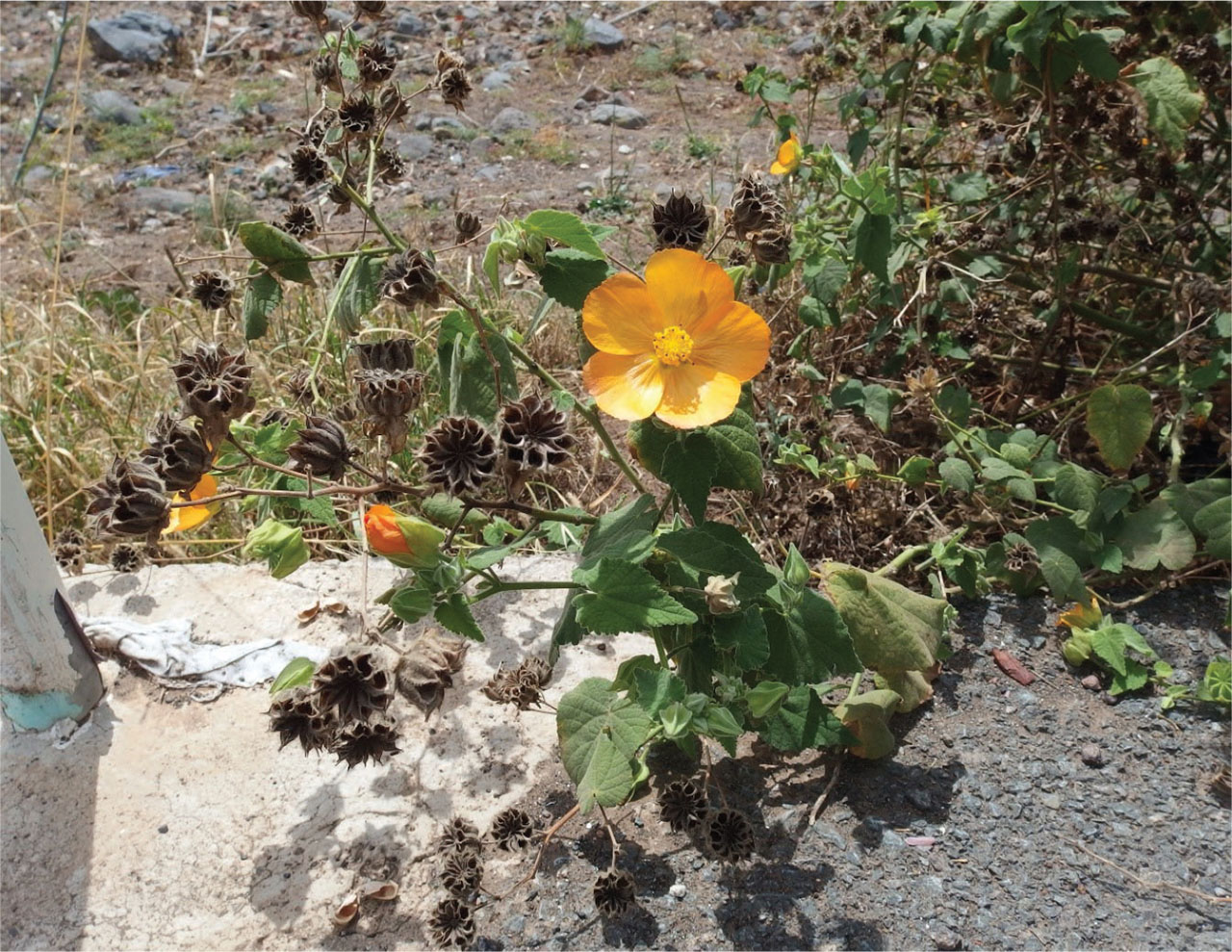
Figure 1:
Abutilon grandifolium, naturalized in a dried-out barranco in Telde, Gran Canaria, April 2017. Photo by F. Verloove.
Slika 1: Abutilon grandifolium, naturaliziran v izsušenem “barranco” v Telde, Gran Canaria, aprila 2017. Fotografija F. Verloove.
Table 1:
Diagnostic differences between Abutilon grandifolium, A. grandiflorum, and A. sonneratianum, based on various flora accounts mentioned in the text, e.g. Ulbrich (1913), Meeuse (1961), Exell & Gonçalves (1979), and Verdcourt & Mwachala (2009).
Tabela 1: Diagnostične razlike med vrstami Abutilon grandifolium, A. grandiflorum in A. sonneratianum glede na različna floristična dela, navedena v besedilu, npr. Ulbrich (1913), Meeuse (1961), Exell & Gonçalves (1979) in Verdcourt & Mwachala (2009).
| Character | A. grandifolium | A. grandiflorum | A. sonneratianum |
|---|---|---|---|
| Habit | Erect shrub, 1.5–3 m tall (occasionally taller), with coarse stems | Herb or subshrub, 0.75–1.5 m tall, with coarse stems | Shrub, 0.5–1.5 (–2) m tall, with slender stems |
| Stem indumentum | Densely covered with long (2–4 mm) simple hairs | Softly velvety, with dense stellate hairs | Densely velvety with short dense stellate hairs and scattered long white hairs |
| Leaves | 3–15 × 2–12 cm, cordate, coarsely serrate | Up to ~15 × 14 cm, broadly ovate-cordate, serrate | 2–7 (–10) × 1–5 (–7) cm, ovate to cordate, sometimes 3-lobed, dentate |
| Flowers | Yellow-orange, corolla 2–3.5 cm across | Yellow, corolla ~1.5–2 cm across | Yellow to orange-yellow; corolla ~2 cm across |
| Fruit (mericarps) | 10–17 mericarps per schizocarp, short-beaked, 5–7 mm long; 2–3 seeds per mericarp; fruit depressed-globose | ±20 shortly awned mericarps, 12–14 × 6–7 mm; 2–3 seeds per mericarp; fruit depressed-globose | 8–15 mericarps with an awn up to 2 mm, 10–14 × 7–9 mm; 3–8 (usually 5) seeds per mericarp; fruit subcylindrical to semiglobose |
| Distribution | Native to tropical America; locally invasive elsewhere (e.g. Canary Islands, Oceania, South Africa, Pacific Ocean Islands) | Native to Africa | Native to southern tropical Africa and South Africa |
Selection of specimens examined from the area under study:
Spain, Canary Islands: Gran Canaria, vicinity Mogan, 4. IV. 1972, Andreas C.H. & Schotsman H.D. (WAG.1075432; image: https://bioportal.naturalis.nl/nl/specimen/WAG.1075432);
Gran Canaria, Puerto de Mogán, fond du barranco, échappé de cultures, observé aussi à San Bartolomé de Tirajana [translation author: “at the bottom of the ravine, escaped from cultures, also seen in San Bartolomé de Tirajana”], 23. IX. 1975, J. Duvigneaud 75 Can 1043 (BR0000006127213; image: https://www.botanicalcollections.be/specimen/BR0000006127213);
Tenerife, between Guia de Isora and Playa San Juan, roadside, alt. 300 m, 10. II. 2005, Maas P.J.M. & Maas-van de Kamer H. 9590 (U.1369422 and U.1369423; sub Abutilon spec.);
La Palma, Santa Cruz de la Palma, Barranco las Nieves, gravelly riverbed 300 m above Barco Sta. Maria, ruderal site, 6.X.2017, R. Otto 22973 (BR0000025337938V; image: https://www.botanicalcollections.be/specimen/BR0000025337938V).
Abutilon grandifolium, a new record for the flora of Algeria
Abutilon grandifolium is native to tropical America but widely grown as an ornamental in tropical and subtropical areas worldwide. It readily escapes and subsequently naturalizes in suitable, mostly ruderal habitats to such an extent that it is often considered a weed. As such, it is naturalized and is usually considered a potentially invasive species in South Africa, Australia, New Zealand, and the Pacific Ocean islands (Jaca et al., 2015). Also in the Canary Islands, it is classified as an invasive species (Acebes Ginovés et al., 2010). From North Africa, A. grandifolium has been reported from Egypt (Badry et al., 2018) and Morocco (Dobignard & Chatelain, 2012). Recently, it was also reported to be locally naturalized in the Cap-Bon area in Tunisia (El Mokni & Verloove, 2020).
In the MPU herbarium, a specimen is preserved with details given below. It was identified as Abutilon theophrasti Medik., an annual weed of agricultural fields, probably native to Asia. However, the specimen collected in Algeria differs from the latter in having mericarps that are merely acute (not aristate) at the apex and a stem indumentum that consists of long patent hairs. It corresponds in all details to A. grandifolium, a species that had not been reported before from Algeria. Like in other North African countries, it is probably not rare, locally naturalized, or neglected.
Specimen examined from the area under study:
Algeria: Alger, Maison Carrée [current name: El-Harrach], Domaine de l’ E.N.A.A., bois El Alia, 12. VI. 1960, G. Chevassut s.n. in Herb. P. Litzler (MPU 350305; sub A. theophrasti). Image available at: http://mediaphoto.mnhn.fr/media/1474021237449s6rzHm2UwAUy0c9F
Abutilon sonneratianum (Cav.) Sweet in Madeira
In the Flora of Madeira and adjacent islands, Lowe (1857) mentioned “Abutilon indicum (L.) Wight & Arnott var. populifolium (Lamk.) Wight & Arnott ex Mast.” from the Funchal area. In contemporary floras and checklists, this record was corrected to A. sonneratianum (Cav.) Sweet (Press & Short, 1994; Vieira, 2002), but the species is believed to be long gone: for instance, it was no longer mentioned in a recent checklist of Madeira plants by Menezes de Sequeira et al. (2012). Yet, it was included in the official list of invasive Portuguese vascular plants (Decreto-Lei n.° 92/2019).
Abutilon sonneratianum is native to southeastern Africa (e.g., Mozambique, South Africa, Zambia; Meeuse, 1961; Exell & Gonçalves, 1979) and probably only very exceptionally grown as a garden ornamental elsewhere (a few online sources, if reliable). It is a rather distinctive species with slender, wiry stems that are often purplish-brown with age, small (only 2–7 × 1–5 cm), markedly bicolored leaves (the lower leaf surface is much paler, almost glaucous), a stem indumentum that consists of very dense and short, soft-velvety, stellate hairs and sparse long, white, patent hairs, small petals only 10 mm long and more or less rectangular mericarps that are almost glabrous at maturity (Table 1; see also: Ulbrich, 1913; Meeuse, 1961; Exell & Gonçalves, 1979).
Upon request, no specimens of this species were retrieved in the main public herbaria in Madeira (MADM, MADS, and MADJ; comm. Drs. Juan Silva and Carlos Lobo). In BR, however, a specimen is preserved that was collected by J. Bornmüller in 1900 in the area indicated by Lowe (1857); Bornmüller identified it as Sida indica ß populifolia, using the historical nomenclature, and it allegedly corresponds to the taxon later ascribed to A. sonneratianum (Press & Short, 1994; Vieira, 2002). The Bornmüller collection considerably differs from specimens preserved under that name in BR, originating from Mozambique and South Africa (Cape Province, Natal, and Transvaal). It is a coarser plant with almost concolorous, much larger leaves, green stems that are copiously long-pi-lose, densely villous mericarps, and larger petals ca. 20 mm long. It agrees in all details with A. grandifolium (Table 1).
However, in BM – which houses most of Lowe’s collection – three specimens are preserved, all mounted on a single sheath (BM000083249, BM013837729 and BM013837730). These plants were collected by Lowe in 1826 and 1828 on waste ground in Funchal (Quinta do Vale) and indeed much resemble Abutilon sonneratianum. This area has dramatically changed in the past 200 years, and it is quite unlikely that this species will still be present in that particular area (or elsewhere in Funchal or Madeira; pers. comm. Dr. Juan Silva, January 2020). Despite a targeted search by the author, it was not recorded during fieldwork in 2021 and 2022, with only A. grandifolium being present in that area. The latter species has become quite common locally, especially in Funchal.
In conclusion, both Abutilon sonneratianum and A. grandifolium probably have been present in Madeira in the past, but only the latter currently occurs. That species should be on the official list of invasive Portuguese vascular plants (Decreto-Lei n.º 92/2019).
Specimens examined of A. grandifolium from the area under study:
Portugal, Madeira:
Madeira, 1866, Quintus W.J. s.n. (WAG.1075641; image: https://bioportal.naturalis.nl/nl/specimen/WAG.1075641, sub A. mollissimum);
Funchal, subspontanea, 22. III. 1900, J. Bornmüller 3711 (in Plantae exsicc. Maderensis 1900 (BR000 0031103558; image: https://www.botanicalcollections.be/specimen/BR0000031103558);
ZO van [translation author – SE of ] Funchal, 20. VIII. 1948, J. Landjouw & Lindeman J.C. 60 (U.1369419; image: https://bioportal.naturalis.nl/nl/multimedia/U.1369419_0737028787, sub A. mollissimum);
Funchal, rochas da Pena sobre o Matadouro [translation author: “Rocha da Pena above Matadouro”, 22. V. 1957, Beliz & R. Santos 4819
Quinta das Cruzes, 08. I. 1958, R. Vieira R.S. 4820 (MADJ);
Haven van Funchal, algemeen op ruderale plaatsen [translation author – Port of Funchal, common in ruderal places], 29. X. 1960, Kramer K.U. & Hekking W.H.A. 2002 (U.1369418; image: https://bioportal.naturalis.nl/nl/multimedia/U.1369418_0231470162, sub A. fruticosum);
Funchal, 20. III. 1971, Meijer Drees E. Aç. 28 (WAG.1883430; image: https://bioportal.naturalis.nl/nl/multimedia/WAG.1883430_01896827763, sub Abutilon arboreum);
Funchal, em sitio húmido, próximo do Estádio [translation author: “in a damp site, near the Stadium”], 30. III. 1973, A. Hansen 4821 (MADJ);
Funchal, Rua dos Ilhéus, casa particular, muito comun na zona, subespontânea [translation author: “Private house, very common in the area, subspontaneous”], 13. X. 1980, R. Vieira 4822 (MADJ).
To clarify distinctions and reduce misidentification, the key morphological characters of Abutilon grandifolium are compared below with those of A. grandiflorum (historically confused with A. grandifolium as a result of orthographic similarity) and A. sonneratianum (formerly recorded but no longer present).
Conclusions
Based on the author’s fieldwork and herbarium study, it is concluded that:
1) Abutilon grandiflorum does not occur in the Canary Islands. Plants referred to by that name belong to A. grandifolium;
2) The South American weed Abutilon grandifolium is reported for the first time from Algeria;
3) In Madeira, historical claims of the South African weed Abutilon sonneratianum are at least in part referable to A. grandifolium. Only the latter species is currently naturalized in Madeira. The name A. sonneratianum should be removed from the official list of Portuguese invasive vascular plants and replaced by A. grandifolium.
Acknowledgements
I thank Drs. Juan Silva (Museu de História Natural do Funchal, Madeira), Carlos Lobo (Instituto das Florestas e da Conservação da Natureza, Madeira), and Dr. Ranee Prakash (Natural History Museum, London, England) for sending images of herbarium specimens relevant for this study. I also thank the curator of the Naturalis herbarium (Leiden, the Netherlands) for allowing me to study some specimens from L (incl. WAG, U). Finally, I thank Elias Dana (Research Group Transferencia de I+D en Recursos Naturales, Spain) for his help in clarifying the status of A. grandiflorum in the Canary Islands.