
Table 1:
Changes of synphytoindication indexes (according to Ya. P. Didukh scale) of plant communities in the old territory of the reserve Mykhailivska Tsilyna during 95 years.
Tabela 1: Spremembe sinfitoindikacijskih indeksov (po lestvici Ya. P. Didukha) rastlinskih združb na starem ozemlju rezervata Mykhailivska Tsilyna v 95 letih.
| Author | V. S. Tkachenko, H. M. Lysenko & A. P. Vakal | H. M. Lysenko | M. S. Larionov | |||||||||
|---|---|---|---|---|---|---|---|---|---|---|---|---|
| Year | 1927 | 1971 | 1991 | 2003 | 2022 | |||||||
| Index | Mean | Mean | PMS | SPS | Mean | PMS | SPS | Mean | Min | Max | AFLs | EMS |
| Hd | 8.90 ± 0.14 | 9.60 ± 0.60 | 9.60 ± 0.21 | 9.70 ± 0.24 | 10.11 ± 0.65 | 9.92 ± 0.15 | 10.23 ± 0.29 | 10.18 | 9.02 | 12.6 | 9.85 ± 0.04 | 10.04 ± 0.03 |
| Rc | 8.66 ± 0.21 | 8.27 ± 0.22 | 8.25 ± 0.09 | 8.23 ± 0.08 | 7.90 ± 0.24 | 7.99 ± 0.05 | 7.82 ± 0.11 | 8.23 | 7.26 | 8.65 | 8.47 ± 0.02 | 8.33 ± 0.02 |
| Nt | 4.36 ± 0.18 | 4.71 ± 0.40 | 4.72 ± 0.15 | 4.76 ± 0.13 | 5.04 ± 0.38 | 4.90 ± 0.09 | 5.12 ± 0.18 | 6.25 | 4.87 | 7.64 | 5.64 ± 0.03 | 5.88 ± 0.02 |
| Sl | 8.43 ± 0.24 | 8.25 ± 0.20 | 8.20 ± 0.06 | 8.36 ± 0.07 | 8.00 ± 0.22 | 7.99 ± 0.05 | 8.07 ± 0.06 | - | - | - | 8.18 ± 0.03 | 8.20 ± 0.03 |
| Tm | 8.82 ± 0.09 | 8.65 ± 0.20 | 8.64 ± 0.06 | 8.57 ± 0.07 | 8.40 ± 0.17 | 8.51 ± 0.06 | 8.44 ± 0.05 | 7.06 | 6.2 | 7.93 | 8.76 ± 0.02 | 8.70 ± 0.2 |
| Regime | NR, mow.+ gra. | mow.+ strict | mow. | strict | mow.+ strict | mow. | strict | mow.+ strict | - | - | mow. | strict |
[i] Remark: Mean – mean value in the reserve, PMS – mean value in “periodically mown steppe”, SPS – mean value in “strictly pro-tected steppe” (strictly protected area from 1947 to the present), AFLs – mean value in mown “anti-fire lines” (territory of PMS, that still mown), EMS – mean value in “earlier mown steppe” (territory of PMS strictly reserved from 2011), Regime – regime of reservation, NR – not reserved, mow. – mowing, gra. – grazing, strict – strictly protected, Hd – soil humidity, Rc – soil acidity, Nt – nitrogen content in the soil, Sl – salt regime, Tm – thermal climate.
[ii] Opomba: Mean – srednja vrednost v rezervatu, PMS – srednja vrednost v »občasno pokošeni stepi«, SPS – srednja vrednost v »strogo zavarovani stepi« (strogo zavarovano območje od leta 1947 do danes), AFLs – srednja vrednost v pokošenih »protipožarnih pasovih” (ozemlje PMS, ki je še košeno), EMS – srednja vrednost v “prej košeni stepi” (ozemlje PMS strogo zavarovano od 2011), Režim – režim zavarovanja, NR – ni zavarovano, mow. – košnja, gra. – paša, strict – strogo zavarovane, Hd – vlažnost tal, Rc – kislost tal, Nt – vsebnost dušika v tleh, Sl –režim slanosti, Tm – toplota podnebja.
Table 2:
Changes in abundance of dominant species in the reserve Mykhailivska Tsilyna during the period 1927 – 2011 under different regimes of preservation.
Tabela 2: Spremembe abundance dominantnih vrst v rezervatu Mykhailivska Tsilyna v obdobju 1927–2011 v različnih režimih ohranjanja.
| Not reserved | Periodically mown steppe | |||||
|---|---|---|---|---|---|---|
| 1927 | 1956 | 1971 | 1981 | 1991 | 2001 | 2011 |
| Festuca stricta subsp. sulcata (dom.), Agrostis vinealis, Carex humilis | F. stricta subsp. sulcata (dom.), Stipa capillata (dom.), Bromopsis inermis (>), Calamagrostis epigejos (>) | B. inermis (dom.), C. epigejos (>) tussock grasses (<) Poa angustifolia (<) | Elytrigia repens (>), Cytisus ruthenicus (>) B. inermis (<) C. epigejos (<) tussock grasses (<) | C. ruthenicus (dom.), E. repens (>) P. angustifolia (<) | Arrhenatherum elatius (dom.), C. ruthenicus (<), E. repens (>) P. angustifolia (>) | A. elatius (dom.), E. repens (<), tussock grasses (>) |
| non-controlled mow. & gra. | mow. 1 time per 5 years | mow. 1 time per 4 years | mow. 1 time per 3 years | mow. 1 time per 2 years | mow. 4 times per 5 years | |
| Strictly protected steppe | ||||||
| 1956 | 1971 | 1981 | 1991 | 2001 | 2011 | |
| B. inermis (dom.), tussock grasses | B. inermis (dom.), C. epigejos (>), P angustifolia (>), tussock grasses (<) | B. inermis (dom.), E. repens (>), P. angustifolia (<), tussock grasses (<) | E. repens (dom.), mesic forb species (>), B. inermis (<) | Urtica dioica (dom.), E. repens (<), C. ruthenicus (>) | U. dioica (<), E. repens (<), C. ruthenicus (<) C. epigejos (>), Prunus spinosa (>) | |
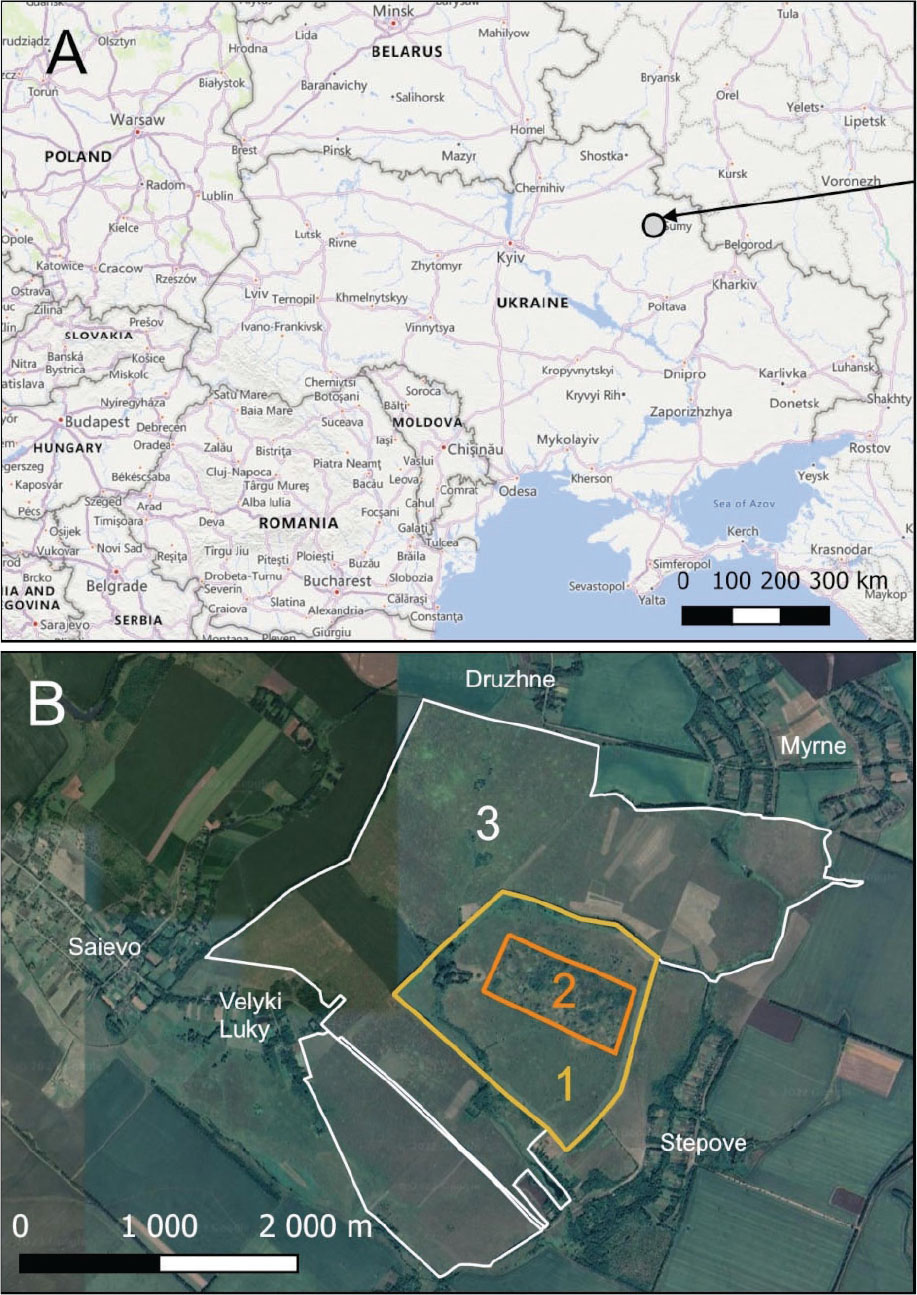
Figure 1:
Map of study area: A – position in Europe; B – schematic map of the nature reserve “Mykhailivska Tsilyna”: 1 – “old territory” of the reserve, 2 – “strictly protected steppe”, 3 – “new territory” of the reserve.
Slika 1: Zemljevid raziskovanega območja: A – položaj v Evropi; B – shematski zemljevid naravnega rezervata “Mykhailivska Tsilyna”: 1 - “staro ozemlje” rezervata, 2 - “strogo zaščitena stepa”, 3 - “novo ozemlje” rezervata.
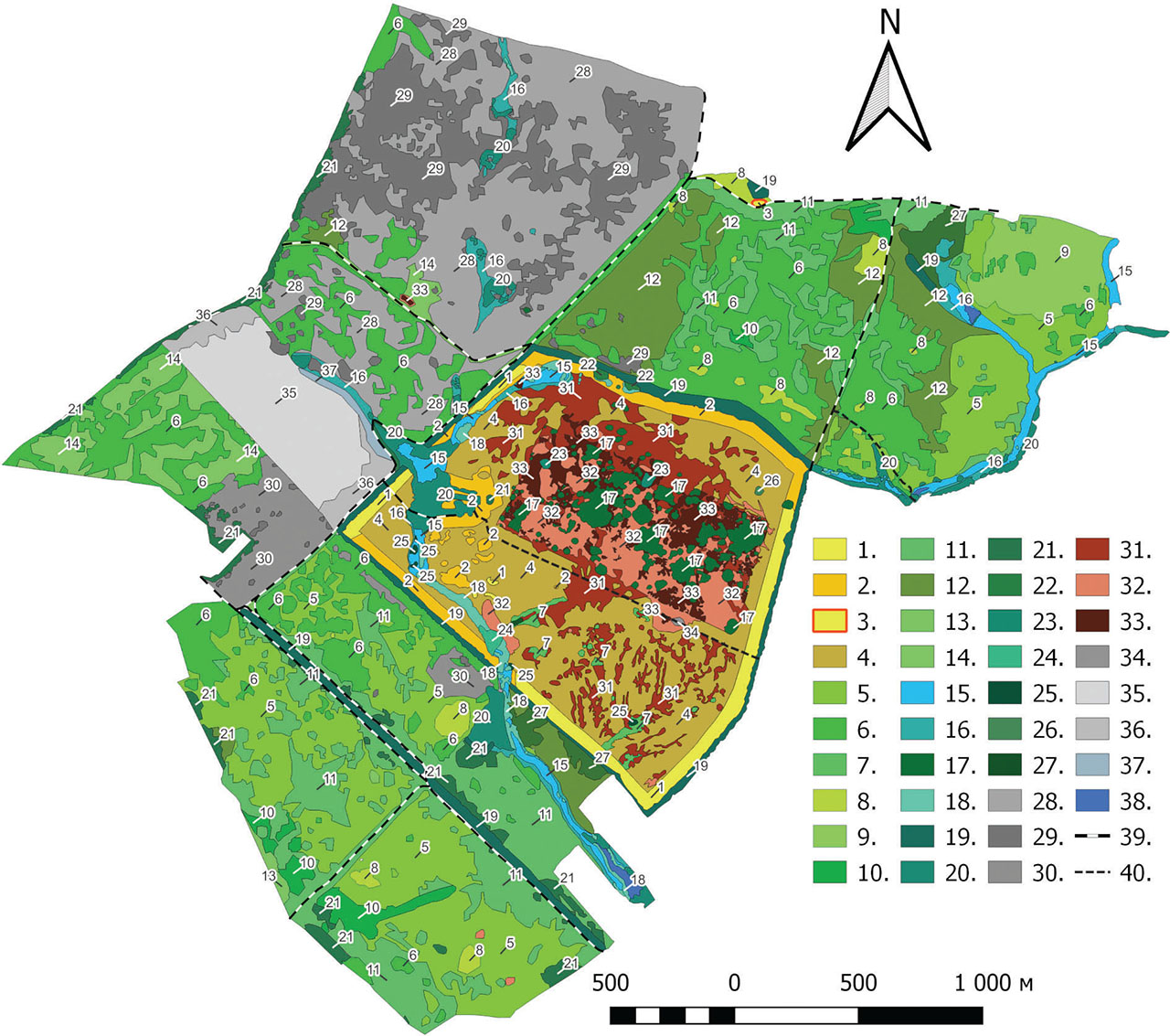
Figure 2:
Vegetation map of the nature reserve Mykhailivska Tsilyna based on the research data (2021–2023).
Slika 2: Vegetacijska karta naravnega rezervata Mihailivska Tsilina narejena na podlagi raziskav v letih 2021–2023.
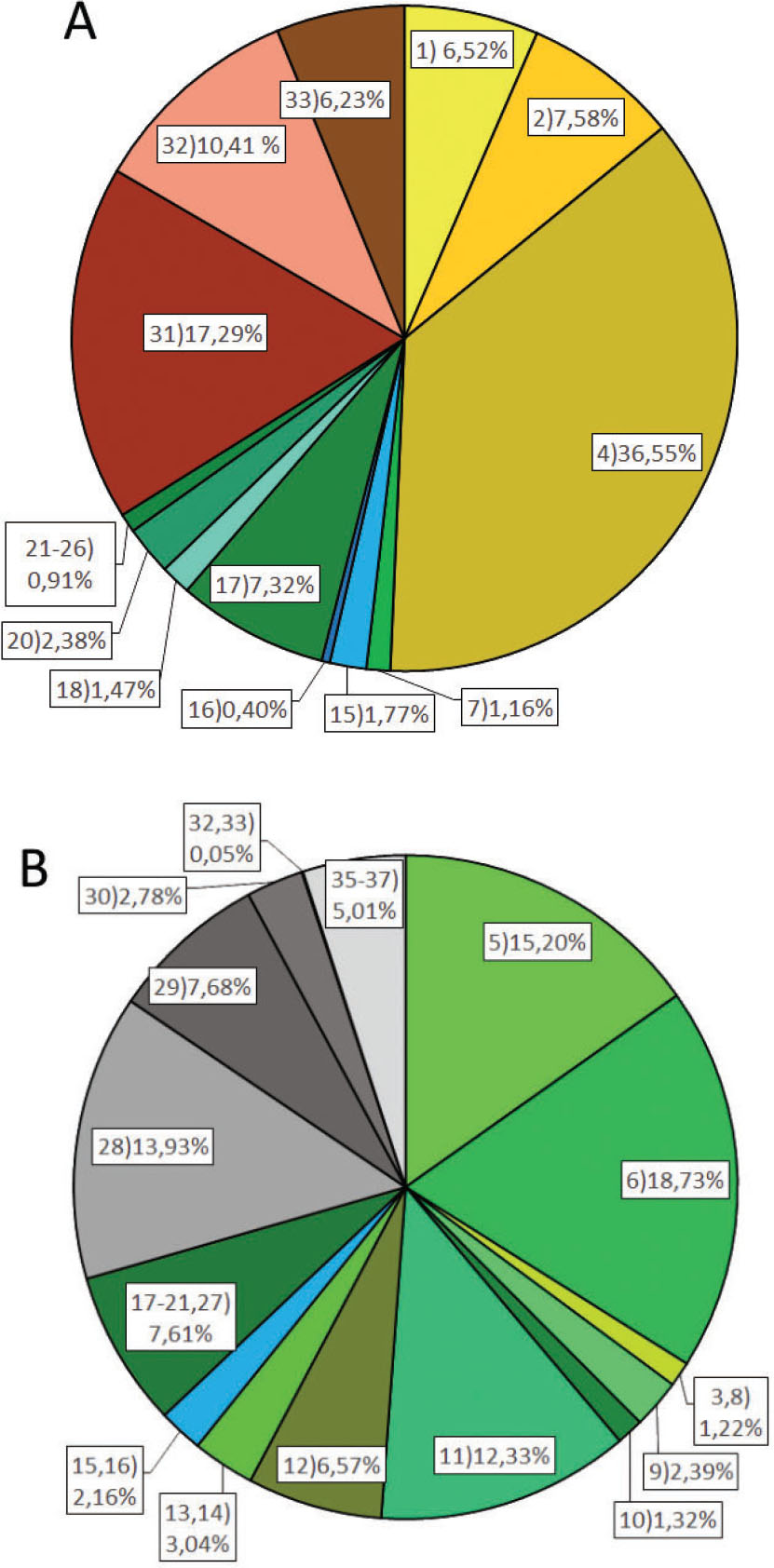
Figure 3:
Percentage ratio between the areas occupied by the main complexes of phytocenoses of the reserve Mykhailivska Tsilyna.
Remarks: A – old territory of the reserve (OT), B – new territory of the reserve (NT), the number(s) in brackets – the number(s) of the complex(es) in the map legend listed above.
Slika 3: Razmerje v odsotkih med površinami, ki jih pokrivajo glavni kompleksi fitocenoz v rezervatu Mykhailivska Tsilyna.
Opombe: A – staro ozemlje rezervata (OT), B – novo ozemlje rezervata (NT), številka(-e) v oklepaju – številka(-e) kompleksa( ov) v zgoraj navedeni legendi karte.
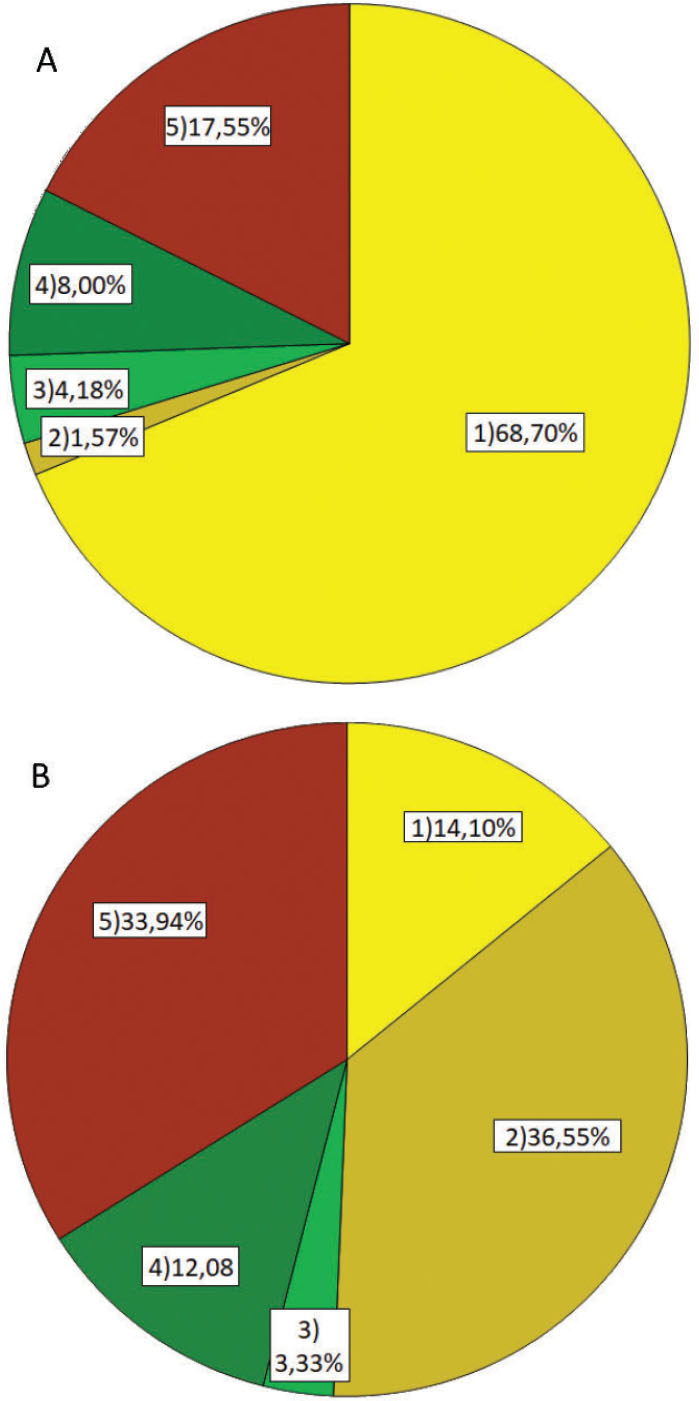
Figure 4:
Generalized changes of the vegetation in the old territory of the nature reserve Mykhailivska Tsilyna. Remarks: A – state of the vegetation in 2011 (Tkachenko & Fitsailo, 2016), B – state of the vegetation in 2022, 1 – meadow-steppe communities, 2 – shrub-steppe communities, 3 – meadow communities, 4 – tree and shrub communities, 5 – ruderal and forb communities.
Slika 4: Splošne spremembe vegetacije na starem ozemlju naravnega rezervata “Mykhailivska Tsilyna”. Opombe: A – stanje vegetacije v letu 2011 (Tkachenko & Fitsailo, 2016), B – stanje vegetacije v letu 2022, 1 – travniško-stepske združbe, 2 – grmiščno-stepske združbe, 3 – travniške združbe, 4 – drevesne in grmiščne združbe, 5 – ruderalne združbe in združbe steblik.
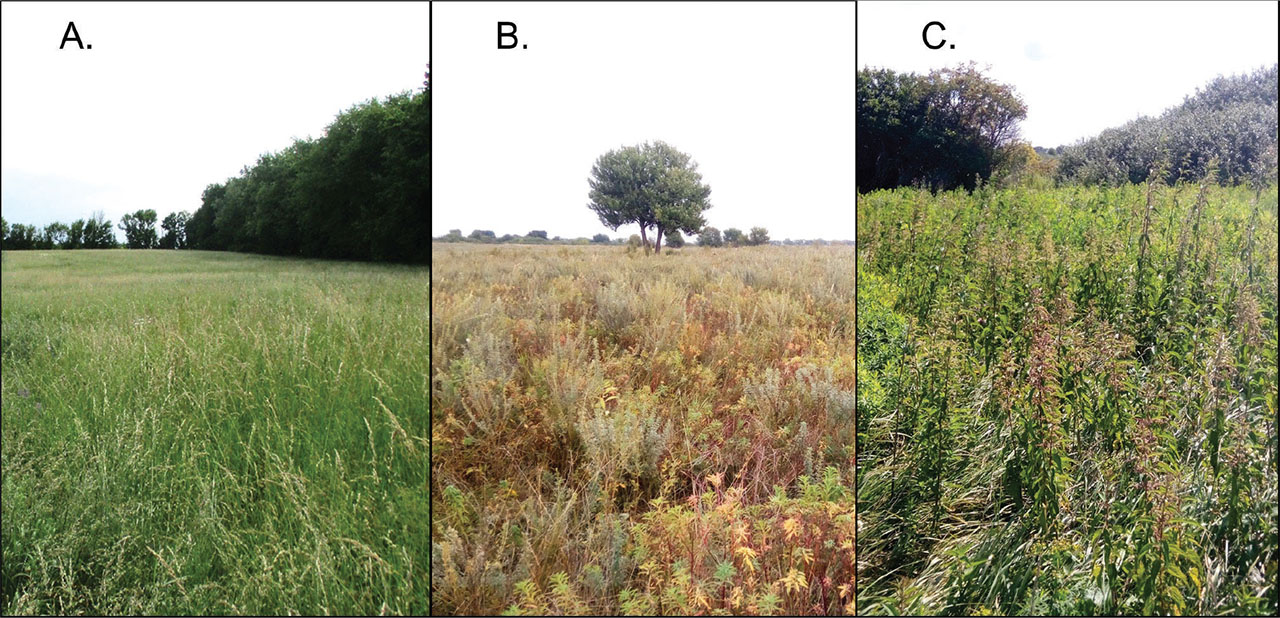
Figure 5.
Influence of cessation of mowing on the steppe vegetation of the reserve. Remarks: A – vegetation of AFLs (every year mown area), B – vegetation of EMS (area that was not mown during 11 years), C – vegetation of SPS (area that was not mown during 75 years).
Slika 5: Vpliv opustitve košnje na stepsko vegetacijo rezervata. Opombe: A – vegetacija AFL (površina pokošena vsako leto), B – vegetacija EMS (površina, ki ni bila pokošena 11 let), C – vegetacija SPS (površina, ki ni bila pokošena 75 let).