
Introduction
The Velika plaža area in Ulcinj and its hinterland is considered one of the most botanically researched sites on the southeastern Adriatic, with its flora, vegetation and habitats documented by numerous publications (Rohlena, 1942; Bubanja et al., 2019; Stešević et al., 2020; Caković et al., 2021) or herbarium specimens in e.g. TGU, NHMM, BEO, GZU, PRC (Thiers, 2024). In the dune systems of Velika plaža and its hinterland, ca. 970 taxa of vascular plants have been recorded so far (Bubanja et al., 2019; Stešević et al., 2020; Stešević et al., 2021; Caković et al., 2021), and ca. 30 plant communities have been listed (Blečić & Lakušić, 1976; Mijović, 1994; Stešević et al., 2020; Milanović et al., 2021). This area is characterised by a mosaic of different coastal, dune and riparian habitats that have high conservation value, but are also subject to strong and constant anthropogenic pressures that led to degradation or complete disappearance of the most sensitive habitats (Šilc et al., 2020; Milanović et al., 2021). This unique area in Montenegro, still does not enjoy an adequate protection status in the country. So far, only a part of the dunes on Velika plaža and the Ulcinj Salina have the status of a protected area, more precisely, the first one is a natural monument, category III and IUCN category of protected area III, and the second one is a nature park, category II and IUCN category of protected area IV (CGIS, 2017). However, for the former area, the boundary has not yet been officially established, so a revision is needed.
With the primary goal of further vulnerability monitoring of NATURA 2000 habitat types to invasion by alien plant species (Stešević et al., 2017; Šilc et al., 2019), a systematic survey of the Velika plaža hinterland was conducted in 2021. Two new species for the adventitious flora of Montenegro were found, but also some peculiarities for the native flora were recorded, such as Isoetes histrix and Solenopsis laurentia ssp. gasparrinii. Other new records for the flora of this place are an incentive for further research (synecological, vegetation, conservation, etc.), but also for monitoring of priority species, either from the point of view of protection or control of dispersal. By highlighting the biological value of the Velika plaža and its hinterland and also drawing attention to the threats that lead to its further devastation and the disappearance of important habitats and then stenovalent species, we contribute to the protection of this area.
Material and methods
The field survey was conducted in 2021 in the hinterland of Velika plaža near Ulcinj (Figure 1). With the length of ca. 12 km, Velika plaža is considered to be the longest beach on the eastern Adriatic coast, which despite the anthropogenic pressure still has well-developed vegetation (Šilc et al., 2016). Due to the fact that 11 NATURA 2000 habitats are reported for the beach and its hinterland (Stešević et al., 2020; Milanović et al., 2021), an initial goal of the survey was to monitor plant invasions in following non-forest NATURA 2000 habitats: 2240 Brachypodietalia dune grasslands with annuals, 3170 *Mediterranean temporary ponds, 6220* Pseudo-steppe with grasses and annuals of the Thero-Brachypodietea, 6420 Mediterranean tall humid herb grasslands of the Molinio-Holoschoenion, and 6540 Sub-Mediterranean grasslands of the Molinio-Hordeion secalini.
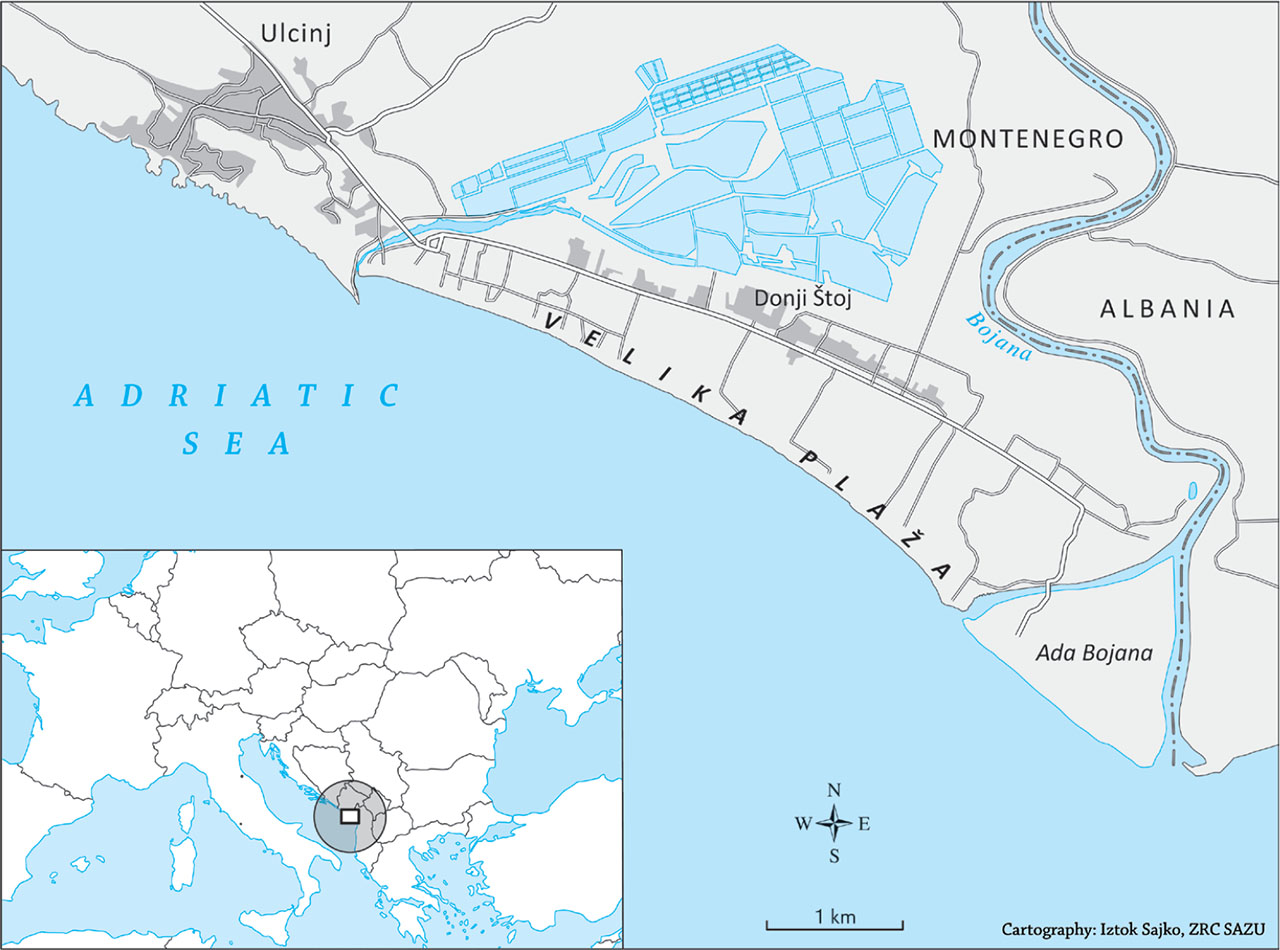
Figure 1:
Geographic position of Velika plaža near Ulcinj (Montenegro).
Slika 1: Geografska lokacija Velike plaže pri Ulcinju (Črna gora).
The collected plant material has been deposited in the Herbarium Collection of the University of Montenegro (TGU) and in the Herbarium of the Faculty of Forestry of the University of Banja Luka (BALU).
Specimens of Solenopsis were identified according to Brullo et al. (2023), of the Isoetes according to Bagella et al. (2015) and Troia & Greuter (2014, 2015) and Juncus tenuis according to Verloove (2010), while the specimens of the other species were identified according to Tutin et al. (1972, 1976, 1980), Pignatti (1982), and Nikolić (2020). The nomenclature of the species follows POWO (2023), except for Solenopsis (Brullo et al., 2023).
The assessment of threats to native species on national/regional level was carried out according to the IUCN method (IUCN Category Standards and Petitions Committee, 2022). The spatial analysis sensu calculation of the geographic range size of a species (EOO – the extent of occurrence) and the area in which a species occurs (AOO – the area of occupancy) for the Red List assessment was carried out using GeoCAT – Geospatial Conservation Assessment Tool algorithms (Bachman et al., 2011). For the final regional assessment (Step 3) the potential rescue effects from populations occurring outside of the assessment region were evaluated and corresponding up- or down-listing of the species’ extinction risk status at the regional level was considered.
Results and discussion
Isoetes histrix
Bory, Montenegro, Ulcinj – Velika plaža, hinterland, temporary Mediterranean ponds, 07. 05. 2021, 19. 05. 2021, 02. 6. 2021, Det. D. Stešević, M. Stanišić-Vujačić, Đ. Milanović (Herbarium TGU, BALU).
In the ecological environment of the Velika plaža hinterland, this summer-deciduous perennial species spends part of its annual cycle under water and begins the emergent life phase from mid or late March. The above-ground parts of the plant ( Figure 6a) remain until the beginning of the summer drought, which starts as early as mid-June. Compared to other taxa from the complex Isoetes histrix s.l., the species in the narrower sense (Isoetes histrix s.str.) is characterized by persistent black phyllopodia on top of the corm and around the leaf bases ( Figure 6B), longer than 3 mm, while the megaspores are tuberculate and measure up to 500 µm. In addition to individuals with long phyllopodium prickles, those with shorter ones were also collected, but due to the impossibility of a more precise comparison of spores, observation of microspore and megaspore ornamentation using SEM, the question of whether this is only an infraspecies variation or the coexistence of different species remains open. Compared to other species of this genus, the species I. histrix is characterized by exceptional morphological variability in terms of leaf length, phyllopodia, and spore ornamentation (Bagella et al., 2011). According to Troia & Greuter (2014), the species complex I. histrix s.l. consists of two taxa, and according to Bagella et al. (2015) of three. Namely, the second group of authors separates I. gymnocarpa from I. sicula, while the first group of authors synonymizes them. Recently, Romanov et al. (2024) recorded the taxon I. gymnocarpa (= I. sicula) near the Ulcinj Salina, which is an additional reason for further research not only on taxon diversity but also on its synecology.
Specimens of Isoetes histrix s.str. were collected on 3170* – Mediterranean temporary ponds ( Figure 3), where it grows together with Polypogon maritimus, Trifolium lappaceum, Isolepis cernua, Juncus bufonius, Juncus capitatus, Leontodon saxatilis, Trifolium patens, Lotus angustissimus, Linum bienne, Poa jubata, Plantago lanceolata, Avellinia festucoides, Radiola linoides.
Seasonally flooded habitats, including Mediterranean temporary ponds, are common habitats for species included into Isoetes histrix s.l. (Biondi et al., 2012; Bagella & Podani, 2017; Tomaselli et al., 2022). It is not uncommon that two taxa from the complex grow together, for example, I. histrix and I. sicula in plant communities Solenopsidetum caespitosae and Poo jubatae-Isoetetum histricis (Tomaselli et al., 2022). Therefore, it is important to resolve the identity of the species of the genus Isoetes inhabiting Mediterranean temporary ponds in Montenegro, and then to determine the plant communities in which they thrive.
Data on the distribution of Isoetes histrix in the eastern part of the Adriatic Sea are rather scarce. So far, the species has not been recorded in neighbouring Croatia (Nikolić, 2023), while in Albania it is considered “occurrence not proven” - i.e. it is included in the checklist because the species is mentioned in some synthetic works, but without specifying the exact locality or supporting it with a herbarium voucher (Barina et al., 2018).
In the territory of Montenegro, species of the genus Isoetes have been intensively searched for in the coastal area of Lake Skadar in the last decade, as this area is considered a potential habitat for its amphibious and terrestrial representatives (Hadžiablahović, pers. comm.). Recent findings confirmed two new taxa (both from Isoetes histrix complex) for the lycopod flora in Montenegro.
In terms of conservation importance, I. histrix is listed as Least Concern in the European Red List of Species (European Environmental Agency, 2023), as Least Concern in the 2016 IUCN Red List of Threatened Species (Christenhusz et al., 2017), in England it has the status VU (Stroh et al., 2014), in France LC, and in certain regions of France: EN (Provence-Alpes-Côte d’Azur, Poitou-Charentes), CR (la région Centre), VU (d’Aquitaine, Pays de la Loire), NT (Bretagne) – Inventaire national du patrimoine naturel (2023).
Despite the current uncertainty regarding the intra-population variability of Isoetes histrix in the Velika plaža hinterland or coexistence with another taxon from the species complex of the same name, we consider I. histrix a good candidate for the national list of legally protected plants. A final assessment of the IUCN category still requires further research. Based on available data (Table 1, Fugure 2), the species is preliminary assessed as CR, according to criteria B1ab(ii,iii,v). When assessing the regional population and status in neighbouring countries, we conclude that no changes are needed compared to step 2, so the preliminary category remains unchanged. The main threat is the change in the ecosystem due to urban sprawl, shrub encroachment, but also due to changes in the climate and water regime.
Table 1:
Assessment of Isoetes histrix, Solenopsis laurentia ssp. gasparrinii, Avellinia festucoides and Corynephorus divaricatus to IUCN criteria.
Tabela 1: Ocena ogroženosti po merilih IUCN za taksone Isoetes histrix, Solenopsis laurentia ssp. gasparrinii, Avellinia festucoides in Corynephorus divaricatus.
| Species | EOO (km2) /assessment | AOO (km2) /assessment | Assessment category |
|---|---|---|---|
| Isoetes histrix | 3.733 (CR) | 24 (EN) | CR B1ab(ii,iii,v) |
| Solenopsis laurentia ssp. gasparrinii | 0.003 (CR) | 8 (CR) | CR B1+2ab(ii,iii,v) |
| Avellinia festucoides | 5.026 (CR) | 24 (EN) | EN B1ab(ii,iii,v) |
| Corynephorus divaricatus | 2.336 (CR) | 24 (EN) | CR B1ab(ii,iii,v) |
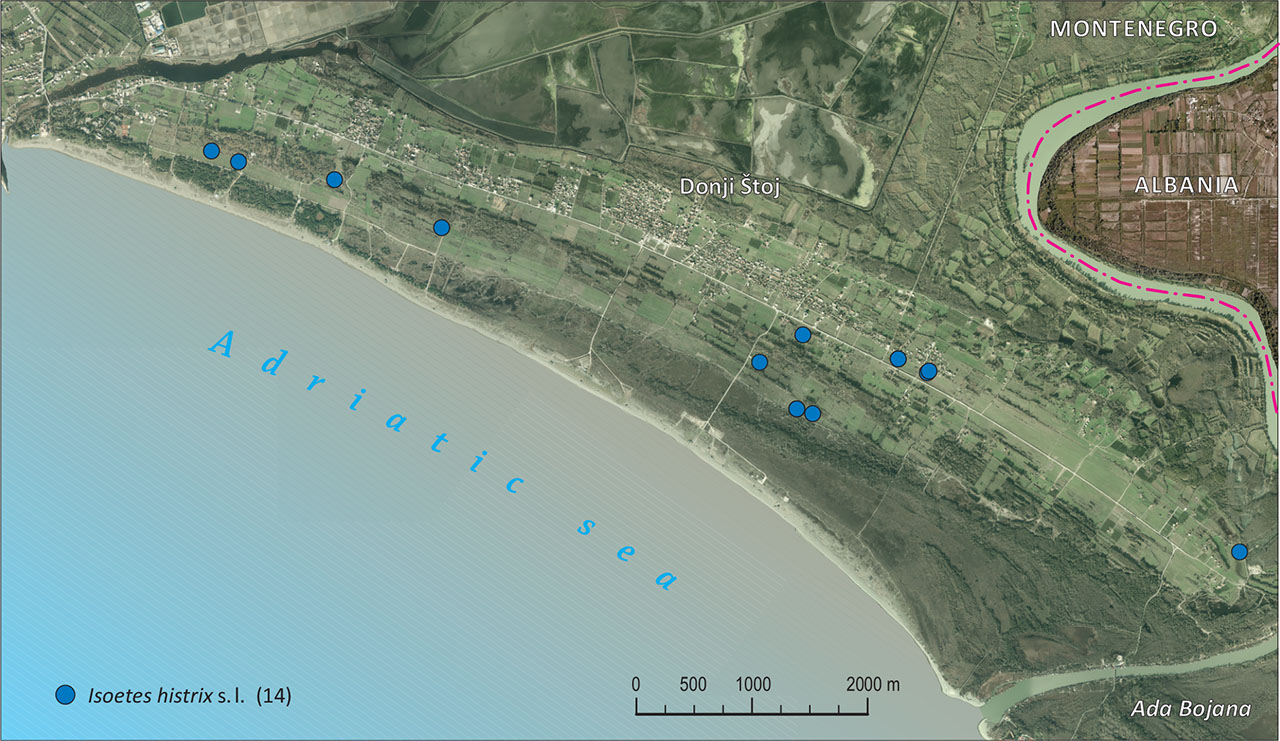
Figure 2:
Locations of Isoetes histrix s. l. localities in the Velika plaža hinterland.
Slika 2: Nahajališča vrste Isoetes histrix s. l. v zaledju Velike plaže.
Solenopsis laurentia ssp. gasparrinii
(Tineo) Brullo, Montenegro, Ulcinj – Velika plaža, hinterland Mediterranean temporary ponds, 21. 05. 2021, 03. 6. 2021, Det. D. Stešević, M. Stanišić-Vujačić, Đ. Milanović (Herbarium TGU, BALU).
Temporarily flooded and grassy habitats in the Velika plaža hinterland are inhabited by Solenopsis laurentia ssp. gasparrinii (Tineo) Brullo, Myosotis laxa ssp. cespitosa (Schultz) Nordh. and Avellinia festucoides (Link) Valdés & H. Scholz ( Figure 6d, e, g Figure 3, Figure 4). The finding of the former taxon is particularly important, because it has not been recorded before in the Balkan Peninsula (Brullo et al., 2023). The genus Solenopsis is also new for the territory of Montenegro (Rohlena, 1942; Pulević, 2005).
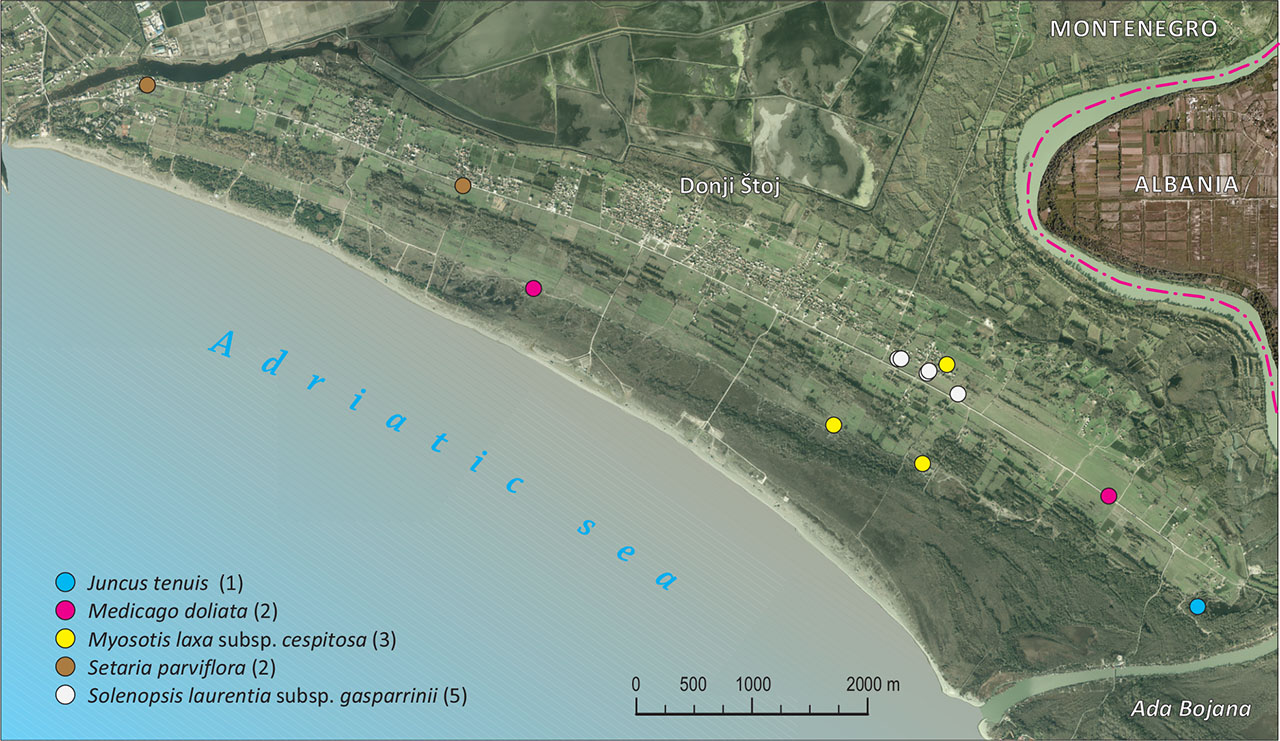
Figure 3:
Distribution of Juncus tenuis, Medicago doliata, Myosotis laxa ssp. cespitosa, Setaria parviflora, Solenopsis laurentia ssp. gasparrinii in the hinterland of Velika plaža. Numbers in the bracket represent the number of sites on which species were found.
Slika 3: Razširjenost taksonov Juncus tenuis, Medicago doliata, Myosotis laxa ssp. cespitosa, Setaria parviflora, Solenopsis laurentia ssp. gasparrinii v zaledju Velike plaže. Številke v oklepajih predstavljajo število nahajališč, kjer smo našli posamezen takson.
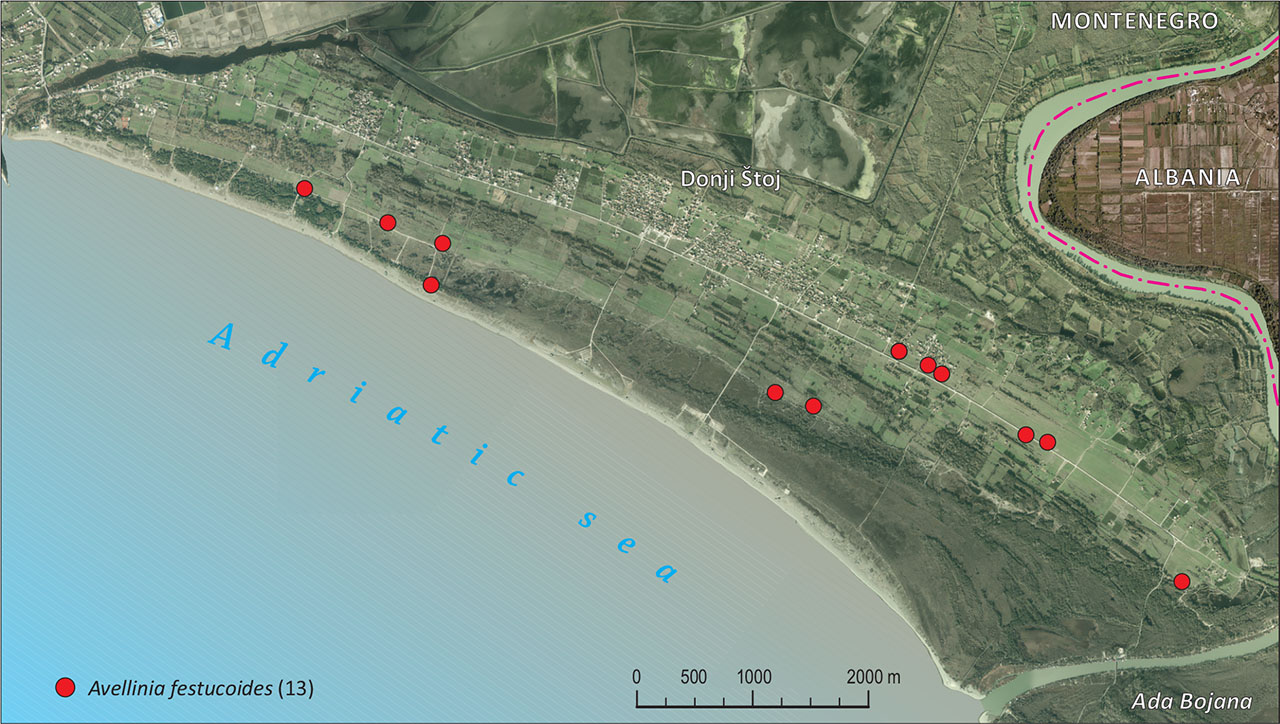
Figure 4:
Distribution on Avellinia festucoides in Montenegro, in the hinterland of Velika plaža.
Slika 4: Razširjenost vrste Avellinia festucoides v Črni gori v zaledju Velike plaže.
It is a species complex with several taxa at specific and infraspecific ranks. The genus Solenopsis is considered endemic to the Mediterranean region (Crespi et al., 1998). Of the S. laurentia subordinate taxa, the S. laurentia ssp. laurentia has the widest distribution – throughout the Mediterranean region. The subspecies gasparrinii occurs in Sicily, Apulia, Sardinia, Corsica, and northern Morocco (Brullo et al., 2023). However, Montenegro has now been included in its distribution range. So far, representatives of the genus Solenopsis have not been recorded in neighbouring Croatia (Nikolić, 2023), while the review list of the Flora of Albania mentions Solenopsis laurentia, but as “occurrence not proven” (Barina et al., 2018).
In the hinterland of Velika plaža in Ulcinj, Solenopsis laurentia ssp. gasparrinii was detected in Mediterranean temporary ponds together with Polypogon maritimus, Carex flacca ssp. erythrostachys, Cyperus flavescens, Isolepis cernua, Lotus angustissimus, Trifolium lappaceum, Juncus bufonius, Myosotis laxa ssp. cespitosa. The life cycle begins in April, when the water has already receded but the soil is still quite marshy. The cycle ends in late May or early June, when the summer drought begins. In the whole distribution range this taxon is closely associated with the Mediterranean temporary ponds (Brullo et al., 2023).
In Italy, the conservation status of the taxon is Endangered [EN, B2ab(ii,iii)] (Brullo et al., 2023). Taking into account the ecological connection of the species to Mediterranean temporary ponds, which so far have been recorded only in the hinterland of Velika plaža in Ulcinj, it is highly unlikely to expect the species elsewhere in Montenegro. According to the estimated number of locations, EOO and AOO ( Table 1), the species is provisionally assessed as CR according to IUCN criteria B1+2ab(ii,iii,v). When assessing the regional population and status in neighbouring countries, we conclude that no changes are necessary compared to step 2, so the provisional category remains unchanged. Due to the relatively high anthropogenic pressure in the area, especially urban sprawl, the range (ii), habitat quality (iii), and number of mature individuals (v) are predicted to steadily decline.
Medicago doliata
Carmign. (syn. Medicago aculeata Willd.), Montenegro, Ulcinj – Velika plaža, hinterland, dry grassland, 21. 05. 2021, 21. 06. 2021, Det. D. Stešević (Herbarium TGU).
Medicago doliata was found on the dry grassland (Figure 3) dominated by the species Aegilops neglecta with the following species also present: Crepis neglecta, Lagurus ovatus, Poa bulbosa, Vulpia ciliata, Onobrychis caput-galli, Plantago bellardi, Trifolium cherleri, Trifolium scabrum, Sherardia arvensis, and Catapodium rigidum. It differs from other species of this genus recorded in the hinterland of Velika plaža (Bubanja et al., 2019) by its globose to ellipsoid legumes with dense, short, sometimes glandular hairs and mostly conical and straight spines (Figure 6c). The natural range includes dry grassland habitats in the Mediterranean region and Iran (Pignatti, 1982; POWO, 2023).
It has the status LC at the global level and in Europe (European Environmental Agency, 2023). It is expected that the species will be recorded in more localities during further surveys of the coastal area of Montenegro. According to current information it is not possible to adequately assess the threat status, thus we propose DD (Data Deficient).
Myosotis laxa ssp. cespitosa
(syn. Myosotis cespitosa Schultz, Myosotis laxa var. cespitosa (Schultz) Apelgren, Myosotis scorpioides ssp. cespitosa (Schultz) F. Hermann), Montenegro, Ulcinj – Velika plaža, hinterland, wet meadows, 15. 05. 2021, 08. 06. 2021; Mediterranean temporary ponds, 21. 05. 2021, Det. D. Stešević (Herbarium TGU). In addition to Mediterranean temporary ponds, it was also detected in wet meadows (Habitat 6540), where it grows together with Alopecurus rendlei, Ranunculus sardous, Trifolium resupinatum, Anacamptys laxiflora, Silene flos-cuculi, Lotus angustissimus, Poa trivialis (Figure 1). From the other species of the genus Myosotis, which have been recorded so far in the hinterland of Velika plaža: Myosotis arvensis, M. discolor (Bubanja et al., 2019) and M. ramosissima (TGU 2155908), it differs by the straight hairiness of the calyx (Figure 6g), while from the M. scorpioides that is common species in wet habitats in Montenegro (Rohlena, 1942), by its annual form. Due to the characteristic that the calyx remains open on the fruit, it is possible that it is confused with M. ramosisima or M. arvensis if identified on pressed herbarium material.
Considering the size of the range – Temperate Eurasia and NW Africa (POWO, 2023), the ecology of the species and its attachment to a wide number of wet habitats, banks of standing and flowing waters, wet meadow ditches, edges of floodplain forests, sedge stands, Mediterranean temporary wetland systems (Grau & Merxmüller, 1972; Pignatti, 2005; Gigante et al., 2013), it is realistic to expect that this taxon is present in a larger number of localities in Montenegro.
At the European level, the species has no conservation status and has not yet been assessed for the IUCN Red List (European Environmental Agency, 2023). However, it is Red Listed in some countries (e.g. Czech Red List, Grulich, 2017). As in the case of the previous taxon, the proposed category for threat status in Montenegro is DD (Data Deficient).
Avellinia festucoides
(Link) Valdés & H. Scholz (syn. Avellinia michelii (Savi) Parl.), Montenegro, Ulcinj – Velika plaža, hinterland, Mediterranean temporary pond 03. 06. 2021, dry grasslands 17. 06. 2021, Det. D. Stešević, Đ. Milanović (Herbarium TGU, BALU).
In the Velika plaža hinterland (Figure 4), this grass was recorded in rather different habitats, such as Mediterranean temporary ponds (Habitat 3170), Humid dune slack (Habitat 2190), in fringe vegetation of Scirpoides holoshoenus community, in Wooded dunes with Pinus pinea and/or Pinus pinaster (Habitat *2270), Brachypodietalia dune grasslands with annuals (Habitat 2240) and Vulpio-Lotion annual grasslands (Habitat *6220). It belongs to a genus that has not yet been recorded in the flora of Montenegro, while in the past it has been recorded in Croatia on the Dalmatian islands of Biševo and Vis in numerous populations on dry, sunny and grassy sandy habitats, as well as sporadically in garrigue and along roads (Pavletić, 1972). This Mediterranean species (POWO, 2023) prefers dry, open, sandy habitats, usually near the sea (Tutin, 1976; Pignatti, 1982). It is characterized by a delicate annual herbaceous form, a compact panicle with multi-flowered spikelets (Figure 6d), glumes very unequal, the upper of which is almost as long as the floret, the lemma 2-pinnate at the apex, with a short awn from the sinus, the palea shorter than the lemma, deeply 2-feed. We assume that the discovery of the species was postponed for a long time due to a possible confusion with similar species of the genera Trisetaria and Koeleria.
At the European level, the species has no protection status and it has not yet been assessed for the IUCN Red List (European Environmental Agency, 2023). In Croatia, this rare grass species has been assigned the status NT (Nikolić, 2023).
Due to restricted distribution, the species presents a good candidate for the national list of legally protected species. The sandy and maritime habitats, which are considered as ecological preference of the species (Tutin, 1976; Pignatti, 1982), are found on Velika plaža, its hinterland and a few small patches further along the coast. In a recently conducted survey of the patches, the species was not recorded. According to the estimated number of locations, EOO and AOO (Table 1), the species is provisionally classified as CR according to IUCN criteria B1ab(ii,iii,v). The assessment of the regional population and status in neighbouring countries in the final assessment category is a downgrade from step 2 in EN B1ab(ii,iii,v). Taking into account the relatively high anthropogenic pressure on the area, especially urban sprawl, a steady decline in range (ii), habitat quality (iii) and number of mature individuals (v) is predicted.
Corynephorus divaricatus
(Pourr.) Breistr., Montenegro, Ulcinj – Velika plaža hinterland, dune grassland 15. 05. 2021, 02. 06. 2021, 08. 06. 2021, Det. D. Stešević (Herbarium TGU, BALU).
It is common on dry, sandy and decalcified grasslands, both on Brachypodietalia dune grasslands with annuals (Habitat 2240) and Vulpio-Lotion annual grasslands (Habitat *6220), where it grows with relatively low cover of up to 5%. It is characterized by an annual, erect, and rather graceful form, a loose panicle whose two-flowered panicles contain a short, clavate awn strongly enlarge towards apex (Figure 6f), articulated near the middle, and with a ring of short hairs at the joint. Although it is not explicitly mentioned as part of the flora of Montenegro, in the overview of plant communities of Montenegro (Blečić & Lakušić, 1976) the association Laguro-Corynephoretum divaricati H-ić 1964 is mentioned for the coastal part of the country. So far, this community has not been documented, either in the published references or in the manuscripts. According to our observations, Corynephorus divaricatus is common in the hinterland of Velika plaža (Figure 5), but never with high abundance and forming the communities that could be classified into mentioned association. This grass is a species of Mediterranean range (POWO, 2023), characteristic of pastures and grasslands (Pignatti, 1982), so the habitat in the hinterland of Velika plaža can be considered as a typical one. As for the conservation status, it has no protection status at European level and has not yet been assessed for the IUCN Red List (European Environmental Agency, 2023). In Italy it has the status LC (Orsenigo et al., 2020), and in Croatia CR (Nikolić, 2023). The species can be considered a good candidate for the national list of legally protected species.
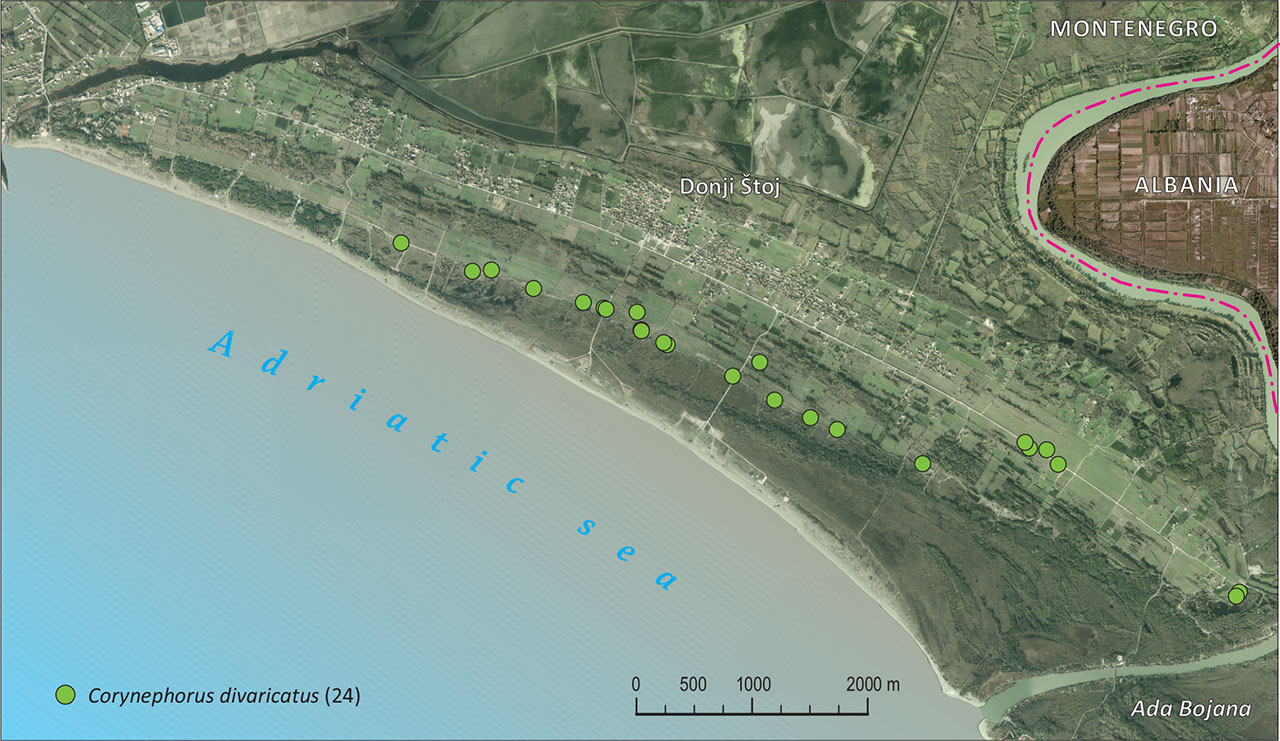
Figure 5:
Distribution of Corynephorus divaricatus in the hinterland of Velika plaža.
Slika 5: Razširjenost vrste Corynephorus divaricatus v zaledju Velike plaže.
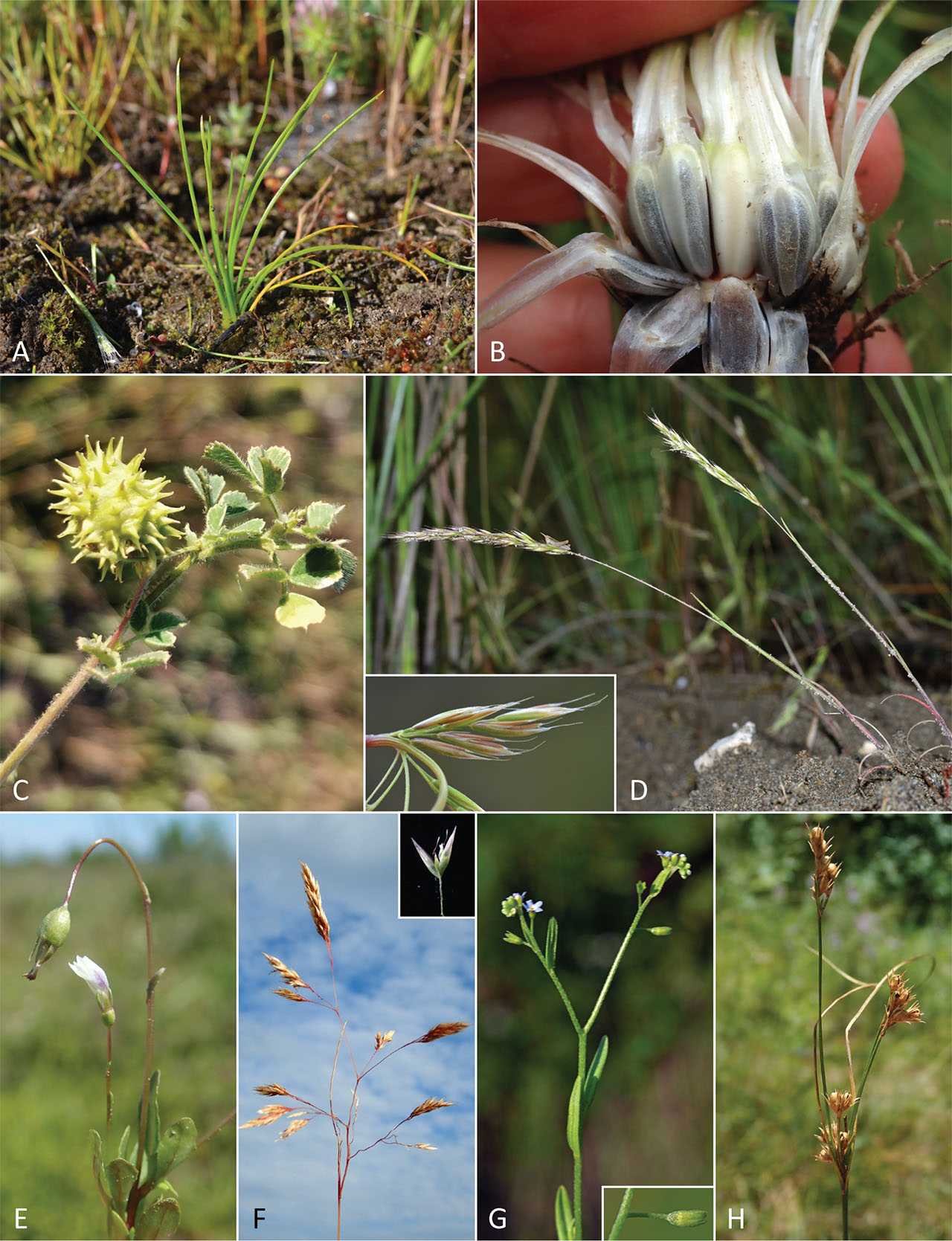
Figure 6 (Slika 6):
A, B – Isoetes histrix, C – Medicago doliata, D – Avellinia festucoides, E – Solenopsis laurentia ssp. gasparrinii, F – Corynephorus divaricatus, G – Myosotis laxa ssp. cespitosa, H – Juncus tenuis.
As in the case of the Avellinia festucoides, the C. divaricatus was not recorded elsewhere along the coast, thus Velika plaža with the hinterland is considered the only site in Montenegro. According to the estimated number of location, EOO and AOO (Table 1), the species is preliminary assessed as CR according to IUCN criteria B1ab(ii,iii,v). In the assessment of the regional population and status in neighbouring countries, the preliminary category is left unchanged. Taking into account a relatively high anthropogenic pressure on the area, especially urban sprawl, a steady decline in range (ii), habitat quality (iii) and number of mature individuals (v) is predicted.
Juncus tenuis
Willd., Montenegro, Ulcinj – Velika plaža, hinterland, wet sites, 17. 06. 2021, Det. D. Stešević (Herbarium TGU), Figure 6h.
Sand embankments between artificial water bodies in the hinterland of Velika plaža were colonized by Juncus tenuis, Fimbristylis dichotoma, Cyperus fuscus and Eleocharis acicularis (Figure 3). Juncus tenuis s.str. is distinguished from other species in the Juncus tenuis complex by its long leaf sheath auricules (Verloove, 2010). This North American species has a secondary distribution across most of Europe (POWO, 2023), where it inhabits a wide range of habitats: dry, sandy, and more acidic soils, tracks or clearings in forests, disturbed heaths, along rivers, and other wet or urban habitats (Verloove, 2010). Seeds are well adapted to human or animal dispersal and mud colonization, so it is common along trails and roads (Salisbury, 1974).
It is on the global list of invasive species (Global Invasive Species Database, 2023), but not on the EU list. This North American species was in Europe first recorded in the UK in 1790 (Arianoutsou et al., 2021). Nevertheless, it has the status of invasive species in neighbouring countries (Croatia – Nikolić, 2023; Serbia – Lazarević et al., 2012; Bosnia and Herzegovina – Maslo, 2016), while it is extinct casual in Albania (Barina et al., 2014). Further monitoring of this species is needed to determine its status. In future research, attention should also be paid to other species from the complex, such as J. dudleyi, which was recently recorded in Bosnia and Herzegovina (Milanović et al., 2018).
Setaria parviflora
(Poir.) Kerguélen, Montenegro, Ulcinj – Velika plaža hinterland, ruderalized lawn 15. 07. 2021, Det. D. Stešević, Đ. Milanović (Herbarium TGU, BALU).
On the ruderalized lawn dominated by annual species (e.g. Avena barbata, Vulpia ligustica, Haynaldia villosa, Lagurus ovatus, Vicia grandiflora), a perennial plant from the genus Setaria – S. parviflora – was recorded (Figure 3). It differs from the species of this genus previously recorded in the Velika plaža hinterland (S. viridis, Bubanja et al., 2019) by its perennial form, spike-like panicles up to 10 cm long and numerous yellow to purple bristles up to 6 times longer than the spikelets (Hitchcock, 1971). This American species has a secondary distribution in the Mediterranean region, southern Africa and Madagascar, Southeast Asia, and Polynesia (POWO, 2023). Although it was first recorded in Europe more than two centuries ago (1800 in Austria, Arianoutsou et al., 2021), it has not spread widely. In Italy and Croatia, it has the status of a naturalized neophyte (Galasso et al., 2018; Nikolić, 2023). Further monitoring of this species is needed to determine its status, either as a casual alien, naturalized neophyte or invasive species.
Conclusions
Our study and results support that it would be justified to propose the extension of the protected area of sand dunes to the hinterland itself, where very rare plant species and also NATURA habitats are found, such as: 1150 Coastal lagoons, 1410 Mediterranean salt meadows (Juncetalia maritimi), 2190 Humid dune slacks, 3170 *Mediterranean temporary ponds and 6420 Mediterranean tall humid herb grasslands of the Molinio-Holoschoenion (Milanović et al., 2021). It would be worthwhile to combine sand dunes and hinterland into one protected area with a buffer zone due to exceptional species and vegetation types. Nevertheless, the human impact has been very destructive in the last decades by urbanisation and tourism, therefore the first step would be to at least protect the most valuable and preserved parts of Velika plaža hinterland.
Acknowledgements
The authors would like to thank Angelo Troia and Simonetta Bagella for valuable discussions considering Isoetes histrix s.l. and confirmation of identification of Isoetes histrix s.str.; Gianmarco Tavilla and Salvatore Brullo for confirmation of identification of Solenopsis laurentia ssp. gasparrinii; Peter Glasnović for valuable advice about IUCN criteria and categories; Iztok Sajko for preparing the maps; the anonymous reviewers for kind suggestions for the improvement of the manuscript. Urban Šilc was supported by ARIS grant P1-0236.
Appendices
Appendix
Geographical coordinates (WGS84) and dates of species records: Species, longitude, latitude, date, habitat type, voucher number (TGU, BALU), and/or reléve number, observer/s and/or collector/s, (DS – Danijela Stešević, MSV – Milica Stanišić-Vujačić, ĐM – Đorđije Milanović):
Isoetes histrix s. l.: 41.89434, 19.32877, 03.06.2021, Mediterranean temporary pond, TGU 2032985, Rel. No. 3621-1, DS & MSV; 41.89332, 19.33182, 03.06.2021, Mediterranean temporary pond, TGU 2032960, DS & MSV; 41.89345, 19.332, 03.06.2021, Mediterranean temporary pond, Rel. No. 3621-3, DS & MSV; 41.89608, 19.31878, 21.05.2021, Wet meadow, Rel. No. 21521-2, DS & MSV; 41.88996, 19.31995, 08.06.2021, Mediterranean temporary pond, TGU 2032961, Rel. No. 8621-5, DS & MSV; 41.90386, 19.28094, 19.05.2021, Wet meadow, Rel. No. 19521-3, DS & MSV; 41.90742, 19.26967, 08.06.2021, Mediterranean temporary pond, TGU 2032962, DS & MSV; 41.89387, 19.31432, 02.06.2021, Mediterranean temporary pond, observersation, DS & MSV; 41.90865, 19.25963, 08.06.2021, Mediterranean temporary pond, observersation, DS & MSV; 41.90945, 19.2568, 08.06.2021, Mediterranean temporary pond, TGU 2032963, DS & MSV; 41.894346, 19.328748, 03.06.2021, Mediterranean temporary pond, BALU DjM 02/01-002, Rel. No. 21Gj017, ĐM; 41.890293, 19.318302, 03.06.2021, Mediterranean temporary pond, BALU DjM 02/01-004, Rel. No. 21Gj021, ĐM; 41.879859, 19.364680, 14.05.2021, Wet meadow, BALU DjM 02/01-001, Rel. No. 21Gj008, ĐM
Solenopsis laurentia ssp. gasparrinii: 41.89434, 19.32877, 03.06.2021, Mediterranean temporary pond, TGU 2032956, Rel. No. 3621-1, DS & MSV; 41.89332, 19.33182, 03.06.2021, Mediterranean temporary pond, Rel. No. 3621-2, DS & MSV; 41.89345, 19.332, 03.06.2021, Mediterranean temporary pond, Rel. No. 3621-3, DS & MSV; 41.8917, 19.33505, 03.06.2021, Mediterranean temporary pond, TGU 2032957, Rel. No. 3621-4, DS & MSV; 41.88909, 19.32218, 08.06.2021, Mediterranean temporary pond, Rel. No. 8621-3, DS & MSV; 41.894346, 19.328748, 03.06.2021, Mediterranean temporary pond, BALU DjM 178/10-001, Rel. No. 21Gj017, ĐM.
Medicago doliata: 41.89927, 19.29064, 21.06.2021, Dune grassland, TGU 2032981, DS & MSV; 41.884, 19.35097, 21.05.2021, Dune grassland, TGU 2032983, DS & MSV;
Myosotis laxa ssp. cespitosa: 41.88624, 19.33149, 15.05.2021, Dune grassland, TGU 2032984, DS & MSV; 41.89399, 19.33384, 21.05.2021, Dune grassland, TGU 2032985, DS & MSV; 41.88909, 19.32218, 08.06.2021, Mediterranean temporary pond, Rel. No. 8621-3, DS & MSV; 41.991802, 19.287593, 10.05.2022, BALU DjM 159/25-045, ĐM
Avellinia festucoides: 41.89434, 19.32877, 03.06.2021, Mediterranean temporary pond, TGU 2032964, Rel. No. 3621-1, DS & MSV; 41.89332, 19.33182, 03.06.2021, wet meadow, Rel. No. 3621-2, DS & MSV; 41.89096, 19.31596, 08.06.2021, dune grassland, Rel. No. 8621-7, DS & MSV; 41.88996, 19.31995, 08.06.2021, Mediterranean temporary pond, Rel. No. 8621-5, DS & MSV; 41.90203, 19.28106, 17.06.2021, dune grassland, Rel. No. 17621-3, DS & MSV; 41.90607, 19.26658, 17.06.2021, dune grassland, TGU 2032965, DS & MSV; 41.90355, 19.27532, 17.06.2021, dune grassland, Rel. No. 17621-2, DS & MSV; 41.876881, 19.358625, 03.05.2021, Annual grassland, BALU DjM 66/17-001, Rel. No. 12Gj048, ĐM; 41.892648, 19.333243, 13.05.2021, Annual grassland, BALU DjM 66/17-002, Rel. No. 21Gj006, ĐM; 41.894346, 19.328748, 03.06.2021, Mediterranean temporary pond, BALU DjM 66/17-003, Rel. No. 21Gj017, ĐM; 41.887495, 19.344397, 14.05.2021, Annual grassland, BALU DjM 66/17-004, Rel. No. 21Gj007, ĐM; 41.898782, 19.279934, 14.05.2021, edge of Pine plantation on dunes, observer ĐM.
Corynephorus divaricatus: 41.89757, 19.30147, 02.06. 2021, dune grassland, TGU 2032975, DS & MSV; 41.89511, 19.30467, 02.06.2021, dune grassland, TGU 2032967, DS & MSV; 41.8864, 19.34561, 08.06.2021, dune grassland, Rel. No. 8621-1, DS & MSV; 41.87673, 19.36472, 08.06.2021, dune grassland, TGU 2032968, DS & MSV; 41.8876, 19.34259, 21.06.2021, dune grassland, TGU 2032970, DS & MSV; 41.9026, 19.27674, 21.06.2021, dune grassland, TGU 2032971, DS & MSV; 41.89387, 19.31432, 02.06.2021, dune grassland, observers, DS & MSV; 41.89784, 19.29799, 02.06.2021, dune grassland, Rel. No. 2621-2, DS & MSV; 41.89621, 19.30191, 02.06.2021, dune grassland, Rel. No. 2621-1, DS & MSV; 41.88624, 19.33149, 08.06.2021, dune grassland, observers, DS & MSV; 41.88875, 19.32254, 21.06.2021, dune grassland, observers, DS & MSV; 41.89927, 19.29064, 08.06.2021, dune grassland, observers, DS & MSV; 41.90063, 19.28619, 21.06.2021, dune grassland, TGU 2032973, DS & MSV; 41.87641, 19.36443, 29.06.2021, dune grassland, observers, DS & MSV; 41.88806, 19.34213, 08.06.2021, dune grassland, observers, DS & MSV; 41.89096, 19.31596, 08.06.2021, dune grassland, Rel. No. 8621-7, DS & MSV; 41.88965, 19.31972, 08.06.2021, dune grassland, Rel. No. 8621-4, DS & MSV; 41.89826, 19.29583, 08.06.2021, dune grassland, observers, DS & MSV; 41.89276, 19.31154, 08.06.2021, dune grassland, Rel. No. 8621-8, DS & MSV; 41.89525, 19.30431, 08.06.2021, dune grassland, TGU 2032967, Rel. No. 8621-9, DS & MSV; 41.89613, 19.30196, 02.06.2021, dune grassland, observers, DS & MSV; 41.89777, 19.29821, 02.06.2021, dune grassland, observers, DS & MSV; 41.887495, 19.344397, 14.05.2021, Annual grassland, BALU DjM 66/40-001, Rel. No. 21Gj007, ĐM; 41.900496, 19.284250, 12.05.2023, dune grassland, BALU DjM 66/40-002, Rel. No. 23Gj010, ĐM.
Juncus tenuis: 41.87553, 19.36044, 17.06.2021, Wet place, TGU 2032978, DS & MSV
Setaria parviflora: 41.91447, 19.24997, 15.07.2021, Ruderalised dry grassland, TGU 2032980, DS & MSV; 41.907156, 19.283072, 06.10.2022, Ruderalised dry grassland, BALU DjM 66/116-017, ĐM