
1. Introduction
Water rescue is a specific form of physical activity requiring the simultaneous development of strength, endurance, and a high level of motor coordination under conditions of hydrodynamic resistance [1,2,3]. The nature of rescue effort is complex and includes both locomotor activities (swimming) and manipulative tasks related to casualty transport, which require efficient integration of the neuromuscular system.
The effectiveness of rescue actions largely depends on the ability to generate high lower limb power, understood as the ability to produce high force in a short time, particularly during casualty transport, when overcoming additional external resistance is necessary [4]. In dynamic activities, an important component of motor performance is lower limb power, which is often assessed using the countermovement jump (CMJ) test [5,6,7]. Parameters such as jump height (JH), maximal power, and velocity are considered indicators of neuromuscular potential and are widely used in sports diagnostics and in monitoring training adaptations [8,9].
However, the transfer of force development ability from land conditions to the aquatic environment is not straightforward. Swimming and rescue tasks require specific intersegmental coordination, postural control, and effective propulsion generation under hydrodynamic resistance [4]. The aquatic environment alters movement mechanics due to increased resistance and a different structure of forces acting on the body, which may limit the direct transfer of abilities developed in land-based conditions. Consequently, a high level of power assessed in the CMJ test does not necessarily translate directly into the effectiveness of rescue actions in the aquatic environment [10].
Previous studies on the fitness of water rescuers have mainly focused on the analysis of single motor components or on general evaluation of qualification test performance [2,11]. However, there is still a lack of approaches integrating the assessment of neuromuscular adaptations occurring during training with the analysis of changes in functional performance in tasks specific to the aquatic environment. The extent to which CMJ parameters can serve as predictors of performance in tasks requiring overcoming external resistance, such as two-handed towing, remains insufficiently explored [9,12]. Understanding these relationships is important both for optimizing the training process and for selecting appropriate diagnostic tools used in the evaluation of lifeguard candidates.
Attempts to identify different functional profiles within groups of trainees are also relatively rare, although such analyses could indicate diverse adaptive mechanisms and different pathways of transfer of motor abilities to the aquatic environment [10]. The use of multivariate methods, such as regression analysis and cluster analysis, may allow for a deeper understanding of the relationships between motor abilities and the effectiveness of rescue performance. Therefore, it seems justified to apply a comprehensive approach including pre- and post-course assessment, predictive analysis, and identification of functional profiles using multivariate methods [13,14].
The aim of the present study was to evaluate the effect of a water rescue course on lower limb power parameters assessed using the CMJ test and on the results of special trials performed in the aquatic environment, as well as to determine the relationships between these variables and to identify different functional profiles of the participants. It was hypothesized that participation in the course would lead to significant improvements in both CMJ parameters and special task performance, with a moderate relationship between these variables. Accordingly, the following research questions were formulated: whether participation in the course significantly affects CMJ parameters; whether it improves performance in the special trials of 50 m legs-only breaststroke kick in the supine position (50 m kick) and two-handed towing; whether lower limb power parameters are predictors of performance in these trials; whether distinct functional profiles can be identified based on the analyzed variables; and whether the identified clusters differ significantly in CMJ parameters and task-specific performance results.
2. Materials and methods
2.1. Participants
The study involved 19 women – candidates for water rescuers (age 18.68 ± 5.89 years; body mass 63.68 ± 9.09 kg; body height 166.97 ± 6.02 cm; body mass index 22.91 ± 2.58 kg·m−2). The participants were healthy individuals with no medical contraindications to maximal physical effort or biomechanical testing. All participants possessed basic swimming skills required to enroll in the rescue course.
The study was conducted using a repeated-measures design: before the course (PRE) and after its completion (POST). Participation in the study was voluntary. All participants were informed about the purpose and procedures of the study and provided written informed consent. In the case of underage participants, consent from legal guardians was also obtained. The research procedures complied with the principles of the Declaration of Helsinki, and the protocol was approved by the Research Ethics Committee of Jan Długosz University in Częstochowa (No. KE-U/90/2025).
2.2. Description of the water rescue course
The study included the assessment of basic somatic parameters and the level of swimming and rescue skills. All participants completed the full training program consisting of 63 instructional hours, including 20 h of theoretical classes and 43 h of practical training. The course was conducted in accordance with the Regulation of the Minister of the Interior of 21 June 2012 on the training of water rescuers (Journal of Laws 2012, item 747).
According to the current regulations, the requirements for participation in the course included being at least 16 years of age and holding the rank of Junior Water Rescuer of Polish Voluntary Water Rescue Service (WOPR). Admission to the course required passing an entrance examination consisting of: swimming 100 m freestyle in less than 1 min 40 s, swimming 25 m underwater from a surface start, towing a partner for 50 m in a supine position using breaststroke kick, swimming 400 m freestyle in less than 8 min.
The Volunteer Water Rescue Service (WOPR) lifeguard course took place from March to June 2025 and included 20 h of theoretical instruction and 43 h of practical training. Practical training took place in a 25 m indoor pool, accredited by the Polish Swimming Association (PZP), as well as in open water. Theoretical training was conducted in-person.
All participants completed the full training cycle, comprising 63 h of instruction, covering both theoretical and practical components, in accordance with the Regulation of the Minister of Internal Affairs of June 21, 2012, on water rescue training (Journal of Laws of 2012, item 747).
The pool water temperature was 26–27°C. Swimming sessions were held three times a week for 1 h each. The volume of water flowed during a 60 min swim. The course ranged from 800 to 1,200 m of various technical tasks performed during the lifeguard course. The aim of the training was to prepare individuals employed, on duty, or belonging to organizations authorized to perform water rescue tasks and to undertake rescue operations. It included acquiring and consolidating knowledge in water rescue, developing a sense of responsibility for the quality of assistance provided, and developing appropriate ethical attitudes among those performing rescue operations.
2.3. Measurement procedure: Kinematic and kinetic parameters in the CMJ test
Kinematic and kinetic parameters of the vertical jump were obtained using a wireless inertial sensor BTS G-Sensor (BTS Bioengineering S.p.A., Garbagnate Milanese, Italy), an IMU (Inertial Measurement Unit). The device was used to record kinematic data during the CMJ. The system is designed for motion analysis in both clinical and research conditions. It is characterized by low weight (37 g), compact dimensions (70 × 40 × 18 mm), and integration of tri-axial inertial sensors: accelerometer (16-bit per axis, range ±16 g), gyroscope (16-bit per axis, range ±2,000°/s), and magnetometer (13-bit, range ±1,200 µT).
The sensor was securely attached in the lumbar region using a semi-elastic belt, allowing noninvasive monitoring of trunk motion and indirect assessment of jump dynamics. Data were recorded at a sampling frequency of 100 Hz and transmitted wirelessly (Bluetooth®) to a computer with dedicated software enabling real-time signal visualization, storage, and further analysis. All measurements were performed under comparable environmental conditions, at a similar time of day, and following a standardized testing procedure.
Each participant performed one CMJ. The subjects adopted a standing position with hands on the hips to eliminate the influence of arm swing and isolate lower body work. They then performed a rapid downward movement followed by a maximal vertical jump. Participants were instructed to land in a controlled manner. The following variables were included in further analysis: JH (calculated from flight time), take-off force (TOF), landing force (LF), maximal concentric power (MCP), maximal velocity (MV), and take-off velocity (TOV). The CMJ protocol used in this study was consistent with previously validated procedures described in the literature, confirming its high reliability and repeatability under research conditions [15].
2.4. Measurement procedure: assessment of functional performance in the aquatic environment
Special trials in the aquatic environment included the evaluation of time needed to complete a 50 m distance in the following variants: 50 m freestyle, 50 m rescue crawl, 50 m legs-only breaststroke kick in the supine position (50 m kick), and two-handed towing on the back: two-handed towing, one-handed chin tow, and cross-chest tow. In all trials, the time to complete the task was analyzed as the main outcome variable.
The tests were performed in an indoor swimming pool over a distance of 50 m. Time measurement was recorded with an accuracy of 0.01 s. Participants performed the trials individually with maximal effort. Before each testing session, a standardized warm-up was conducted, including general exercises and elements specific to swimming and rescue techniques.
All trials were performed from a water-surface start. All swimming tests were conducted in a 25 m swimming pool accredited for competitive swimming events, with a water temperature of 27.2°C. Time was measured manually using a certified FINIS 3 × 300 m stopwatch (FINIS, Inc., USA). The towing tests were distributed over 2 consecutive days. On the first day, each participant performed one trial of each towing test, with a 30 min rest interval between trials. The procedure was repeated on the following day. The better result of the two trials for each test was used for analysis.
All measurements, both before and after course completion, were performed by the same trained laboratory technician from the medical laboratory of Jan Dlugosz University in Czestochowa.
2.5. Statistical analysis
Normality of distribution was verified using the Shapiro–Wilk test. The paired samples t-test was used to compare results obtained before and after the rescue course. To determine relationships between lower limb power parameters and the results of special trials, multiple linear regression analysis (least squares method) was applied. Model fit was evaluated using the coefficient of determination (R 2), adjusted coefficient of determination (R 2 adj), F statistic, and p-value.
To identify different functional profiles, k-means cluster analysis was performed on standardized POST variables. Before clustering, all variables were transformed into z-scores according to the formula z = (x − x̄)/SD, which ensured a mean of 0 and a standard deviation of 1 for each variable. Standardization was necessary due to different measurement units and to ensure equal contribution of variables when calculating Euclidean distances in the k-means algorithm. Differences between clusters were evaluated using the independent samples t-test. Effect size was calculated using Cohen’s d and interpreted according to accepted criteria (0.2 – small, 0.5 – moderate, 0.8 – large) [16].
Sample size was estimated a priori using G*Power (version 3.1, University of Kiel, Kiel, Germany). Assuming a significance level of α = 0.05, test power (1 − β) = 0.80, and expected effect size d = 0.80, the minimum required sample size was 15 participants. Therefore, the analyzed group (n = 19) provided sufficient statistical power.
Statistical analyses were performed using Python 3.10 (Python Software Foundation) with the following libraries: pandas, NumPy, SciPy, statsmodels, and scikit-learn. Visualizations were created using matplotlib. The level of statistical significance was set at p < 0.05 for all analyses.
3. Results
Descriptive statistics of CMJ parameters and swimming and rescue trials over a distance of 50 m before and after completion of the water rescue course are presented in Table 1.
Table 1
Mean values and standard deviations (SDs) of lower limb power parameters assessed in the CMJ test and results of special 50 m trials before (PRE) and after (POST) the water rescue course
| Variable | PRE (Mean ± SD) | POST (Mean ± SD) | Difference (POST–PRE) | % changes | t | p-value | Cohen’s d |
|---|---|---|---|---|---|---|---|
| JH (cm) | 20.14 ± 2.35 | 21.85 ± 3.46 | 1.71 | 8.47% | 2.98 | 0.008* | 0.685 |
| TOF (N) | 0.71 ± 0.23 | 0.88 ± 0.36 | 0.17 | 23.42% | 3.13 | 0.006* | 0.72 |
| LF (N) | 1.03 ± 0.33 | 1.09 ± 0.29 | 0.05 | 5.20% | 0.95 | 0.354 | 0.218 |
| MCP (W·kg−1) | 2.28 ± 0.48 | 2.47 ± 0.44 | 0.20 | 8.72% | 2.13 | 0.047* | 0.489 |
| MV (m/s) | 2.04 ± 0.23 | 2.10 ± 0.22 | 0.06 | 2.81% | 2.63 | 0.017* | 0.605 |
| TOV (m/s) | 1.84 ± 0.15 | 1.91 ± 0.17 | 0.07 | 3.77% | 2.50 | 0.022* | 0.574 |
| 50 m freestyle (s) | 42.34 ± 5.83 | 40.16 ± 5.35 | −2.18 | −5.15% | −1.34 | 0.249 | −0.603 |
| 50 m rescue crawl (s) | 44.84 ± 7.17 | 42.95 ± 6.42 | −1.89 | −4.23% | −2.77 | 0.013* | −0.636 |
| 50 m kick (s) | 77.92 ± 10.88 | 73.65 ± 10.70 | −4.27 | −5.48% | −5.06 | < 0.001* | −1.161 |
| Two-handed towing (s) | 105.18 ± 25.63 | 97.51 ± 20.83 | −7.68 | −7.30% | −3.25 | 0.004* | −0.746 |
| One-handed chin tow (s) | 103.44 ± 16.38 | 97.86 ± 13.50 | −5.58 | −5.40% | −4.35 | < 0.001* | −0.999 |
| Cross-chest tow (s) | 102.72 ± 14.59 | 98.72 ± 12.54 | −4.00 | −3.89% | −3.07 | 0.006* | −0.706 |
JH, jump height; TOF, take-off force; LF, landing force; MCP, maximal concentric power; MV, maximal velocity; TOV, take-off velocity; t, Student’s t-test, p-value; effect size (d), * – statistically significant differences, 50 m kick – legs-only breaststroke kick in the supine position.
After completion of the course, significant improvements were observed in selected CMJ parameters. JH increased by 8.47% (p = 0.008; d = 0.685), maximal concentric power by 8.72% (p = 0.047; d = 0.489), and TOV by 3.77% (p = 0.022; d = 0.574). The greatest relative change was observed in TOF (+ 23.42%; p = 0.006; d = 0.720). No significant changes were found in LF (p = 0.354).
In swimming and rescue trials, a significant reduction in task completion time was observed in most tests. The greatest improvement was noted in the 50 m kick trial (−5.48%; p < 0.001; d = −1.161), corresponding to a very large effect size. Significant time reductions were also observed in the two-handed towing trial (−7.30%; p = 0.004; d = −0.746), one-handed chin towing (−5.40%; p < 0.001; d = −0.999), and 50 m rescue crawl (−4.23%; p = 0.013; d = −0.636).
No significant improvement was found in the 50 m freestyle test (−5.15%; p = 0.249), which may be related to the small sample size in this trial (N = 5).
The obtained results indicate that the water rescue course contributed to moderate to large improvements in lower limb power parameters as well as in specific functional abilities related to rescue tasks performed in the aquatic environment.
Figure 1 presents the results of the multiple regression analysis. Panel A shows unstandardized regression coefficients (β) with 95% confidence intervals for Model 1 (50 m kick) and Model 2 (two-handed towing).
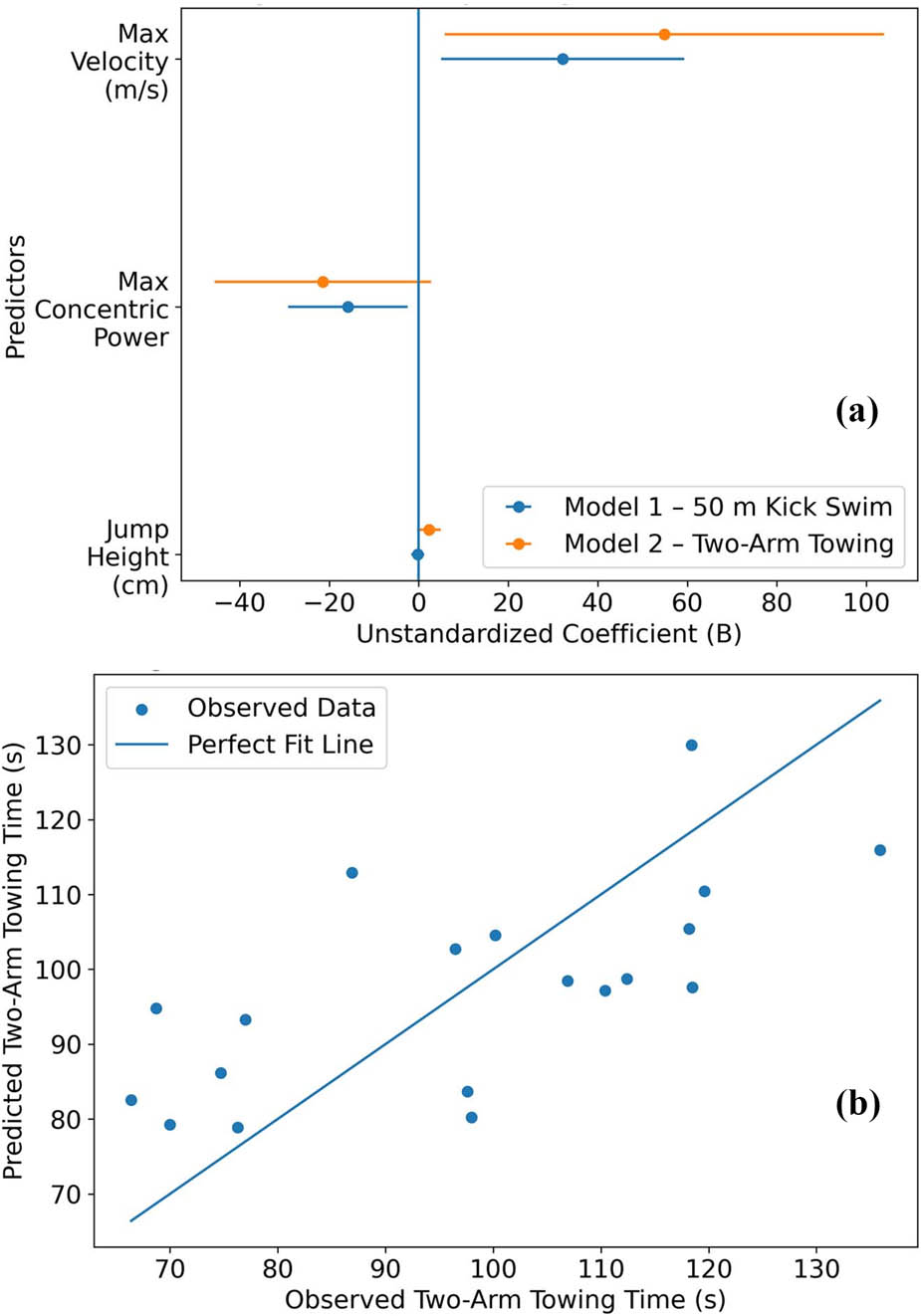
Figure 1
Regression models for aquatic performance. (a) Regression coefficients for the 50 m kick and two-handed towing models. (b) Observed versus predicted values for the two-handed towing model.
Model 1 explained 35.7% of the variance in performance (R 2 = 0.357; R 2 adj = 0.229), but its overall significance was at the trend level (p = 0.077). In this model, maximal concentric power was a significant predictor of time (β = −15.79; p = 0.024), indicating that higher power was associated with shorter task completion time.
Model 2 (two-handed towing) was statistically significant (R 2 = 0.447; R 2 adj = 0.336; p = 0.027) and explained 44.7% of the variance in performance. In this model, MV was a significant predictor (β = 54.90; p = 0.031), whereas JH and concentric power showed only a tendency toward significance.
Panel B presents the relationship between observed and predicted values for Model 2. The distribution of points around the line of perfect fit confirms a moderate prediction accuracy of the model, consistent with the obtained coefficient of determination (R 2 = 0.447).
The obtained results indicate that lower limb power parameters assessed in the CMJ test explain the variability of performance to a greater extent in the towing trial than in the swimming trial performed using leg-only breaststroke kick in the supine position.
To identify different functional profiles, a k-means cluster analysis (k = 2) was performed on standardized POST variables including CMJ parameters (JH, maximal concentric power, MV) and results of special trials (50 m kick, two-handed towing). The results of the analysis are presented in Figure 2. Two clusters were identified: cluster 0 – a “high-power, lower task efficiency” profile (n = 7), and cluster 1 – a “higher aquatic functional performance” profile (n = 12).
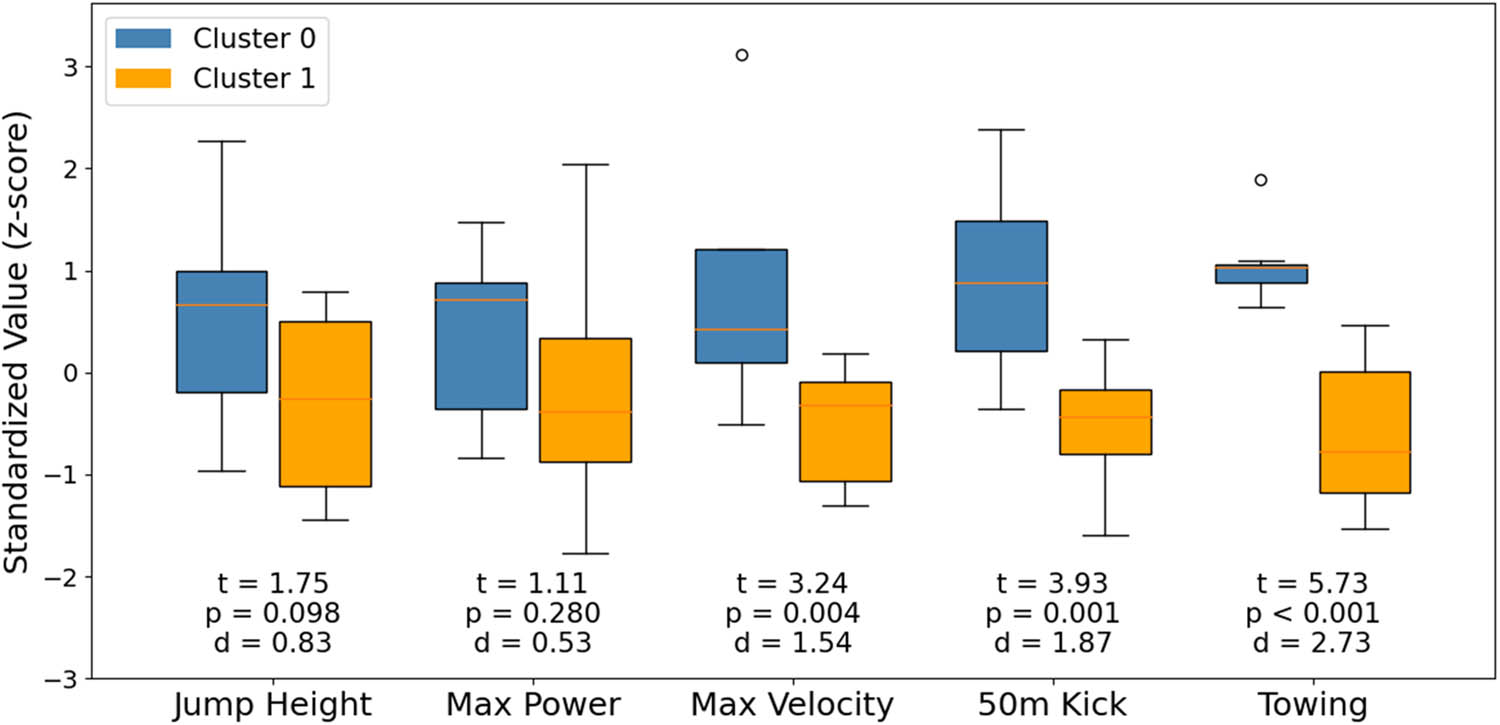
Figure 2
Cluster profiles based on standardized POST variables. Cluster 0 – higher CMJ performance; Cluster 1 – higher aquatic task performance. JH – jump height; MCP – maximal concentric power; MV – maximal velocity.
Cluster 0 was characterized by higher values of explosive lower limb power parameters, including significantly higher MV (p = 0.005; d = 1.54). Differences in JH (p = 0.098; d = 0.83) and maximal concentric power (p = 0.281; d = 0.53) did not reach statistical significance. At the same time, participants in this cluster achieved significantly longer times in the special trials: 50 m kick (p = 0.001; d = 1.87) and two-handed towing (p < 0.001; d = 2.73).
Cluster 1 was characterized by significantly better functional performance in the aquatic environment, reflected by shorter times in the 50 m kick and two-handed towing despite moderately lower CMJ parameters. The largest effect size was observed for the two-handed towing (d = 2.73), indicating that cluster separation was primarily determined by task-specific variables.
The obtained results suggest that, in the studied group, differences between the identified profiles were more strongly related to the efficiency of performing rescue tasks in the aquatic environment than to the level of explosive lower limb power assessed under land-based conditions.
4. Discussion
The obtained results demonstrated significant improvements in power parameters assessed in the CMJ test as well as in the results of special trials, which is consistent with reports describing neuromuscular adaptations in dynamic movements [15]. The greatest changes were observed in tasks requiring a high level of motor coordination and postural control, highlighting the importance of specific functional adaptations in the training process [16].
In the context of water rescue, lower limb power is one of the key motor abilities determining the effectiveness of rescue actions. It enables the execution of dynamic and intensive movements necessary during the approach, rescue, and transport of a drowning person, as well as during rapid movement in the aquatic environment. A high level of lower limb muscle power contributes to shorter action time, improves locomotion efficiency in water, and increases safety for both the rescuer and the victim [17].
The largest changes were recorded in tasks requiring specific coordination and functional force generation (two-handed towing and 50 m kick), accompanied by large and very large effect sizes [6,18]. This indicates the effectiveness of the training program in stimulating adaptations important for rescue performance.
Regression analysis showed a moderate ability of CMJ parameters to explain the variability of special trial results, which is consistent with reports indicating that lower limb power accounts for only part of the variance in sport performance [19]. The predictive model for two-handed towing showed better fit than the model for the 50 m kick trial, suggesting that the ability to generate lower limb power under land conditions may play a greater role in tasks requiring overcoming additional external resistance than in purely locomotor tasks. At the same time, the level of explained variance indicates that power is only one of the factors determining performance in the aquatic environment. Technical skills and propulsion efficiency are also important, which limits the direct transfer of rapid force development ability from land to water conditions [20].
Cluster analysis allowed the identification of two distinct functional profiles, which is consistent with studies using multivariate methods for athlete profiling [21,22]. The largest differences between clusters concerned task-specific trials, which highlights the importance of task specificity and the limited transfer of power to movements with a different motor structure [23]. In the aquatic environment, technical elements and propulsion efficiency play a crucial role [24,25].
The results suggest that the transfer of rapid force development ability to rescue tasks is not linear, which confirms findings indicating a limited relationship between power generated under land conditions and the effectiveness of tasks with a different movement structure [26]. Performance in special trials may be more strongly related to technique, intersegmental coordination, and movement economy in water [20,24,25,27] than to the level of lower limb power measured in the CMJ test.
It should be emphasized that the activity of a water rescuer is primarily focused on protecting human life through preventive actions and effective interventions in emergency situations [28]. An appropriate level of physical fitness, developed through training and practice, increases the probability of successful rescue operations. In the literature, considerable attention is given to the role of prevention and the influence of rescuers on the behavior of people in the aquatic environment. Effective prevention is based on risk assessment and control, as well as the implementation of practices that may prevent drowning incidents [29]. Relatively less attention has been devoted to identifying biomechanical parameters directly related to the effectiveness of rescue actions.
From a practical perspective, this indicates the need to integrate power training with task-specific training directed at rescue activities, which is consistent with the principle of training specificity [30,31]. Task-specific trials, such as two-handed towing, may serve as sensitive indicators of functional readiness and performance monitoring, which is supported by studies showing higher validity of specific tests compared with general indicators in sport performance evaluation [32,33]. Therefore, a comprehensive assessment of lifeguard preparedness should include both land-based tests and tasks specific to the aquatic environment.
4.1. Limitations
The study has several limitations that should be considered when interpreting the results. The relatively small sample size (n = 19) limits the generalizability of the findings and the stability of regression models and cluster analyses. Only women were included in the study, which makes sex comparisons impossible. Lower limb power was assessed under land conditions, which limits direct conclusions about force generation mechanisms in the aquatic environment. The lack of biomechanical measurements in water (e.g., kinematic analysis, propulsion force measurement) makes full interpretation of the observed relationships difficult. In addition, previous swimming experience and individual technical differences were not controlled, which could have influenced the results. The applied k-means analysis had an exploratory character and requires confirmation in larger samples.
Despite these limitations, the study provides important information about the relationship between lower limb power parameters and functional performance in the aquatic environment and indicates directions for further biomechanical analyses.
Funding information
Authors state no funding involved.
Author contributions
Conceptualization: M.K.; methodology: M.K. and P.K.; software: A.K. and J.W.; validation: J.W.; formal analysis: M.K.; investigation: M.K. and P.K.; resources: P.K.; data curation: M.K. and J.W.; writing – original draft preparation: M.K.; writing – review and editing: J.W. and J.K.; visualization: J.K.; supervision: J.W.; project administration: M.K.; funding acquisition: M.K.
Conflict of interest statement
Authors state no conflict of interest.