
1. Introduction
In 1947, Dennis Gabor, a Hungarian-British physicist, laid the groundwork for the modern hologram theory.1 During the 1950s, over 50 publications were written about Gabor’s technique.2 His research enabled a two-stage method for producing optical images. The first step involved illuminating an object with a coherent monochrome wave, and the diffraction pattern caused by the interference of the object’s second coherent wave with the coherent background recorded on a photographic plate. If this processed plate is placed back in its original position and only the coherent background is lit, the object will appear in the original position behind the plate.3 A simpler explanation is that a hologram is a two-dimensional representation of a three-dimensional object. Gabor’s work was an important contribution to the development of holography.4 First invented in 1962 by Russian Scientist Yuri Denisyuk, holographic technology has come a long way in the past 50 years.5 What was once an unbelievable 3D image projection has now evolved into 7D live video projections in full, vivid colour. This ground-breaking technology now has the capability to project the subject with crystal clear audio and visual clarity in real-time.
Ever since their initial experiments, holograms have been a highly beneficial resource in a variety of fields, including medicine and legal matters, such as the drafting of wills. According to Black’s Law Dictionary, a holograph deed or writing is one that is composed and signed entirely by the grantor’s hand.6 This technology provides a unique three-dimensional projection that can be viewed without any special equipment, such as glasses or cameras. Holograms can be either static or animated, allowing multiple people to watch the same sequence from any angle. Furthermore, the use of hologram lenses allows for a more compact system configuration and the magnification of displayed images. These features make holography a highly versatile and useful tool for creating and communicating legal documents.
Similar technology has already been used in a few other jurisdictions. The Federal Court of Australia issued a practice note on 31 March 2020 which opened the possibility of using streaming and other methods to ensure public access to hearings.7 However, some have argued that even if every court hearing was available to the public on Zoom, Teams or Skype, open justice would not be as complete as at a physical court hearing.8 The case of Capic v Ford Motor Company of Australia Limited9 has provided its view that those who can carry on this new practice should do their best to carry on, despite how inconvenient and tedious it may be. This view has been embraced by the Judicial Department of Abu Dhabi, which now offers remote court hearings using video conferencing software such as Meet Me and Webex.10 The Government of Dubai has also taken advantage of this technology, leading to an increase in their IT effectiveness in Dubai Courts. 11 Interestingly, in 2017, a court in China tested out a system that allowed lawyers to present evidence via holograms during a trial.12 The results were promising and could lead to wider adoption of this technology across China’s legal system.
In 2019, a law firm in Nashville, United States of America had its experienced personal injury attorneys selected as one of the first legal teams in the State to test out the cutting-edge 7D Hologram technology at the Nashville courthouse.13 The Hologram Lawyer Program (“HLP”) uses live Holography to simulate the physical manifestation of an attorney appearing before a judge for day-to-day court proceedings.14 While its application in the courtroom has been met with some criticism, this unique combination of virtual and augmented reality offers major reductions in lag times between cases on the docket. It also provides significant savings in terms of security of staffing, as the number of people who visit the courthouse would be drastically reduced with the implementation of this technology.15
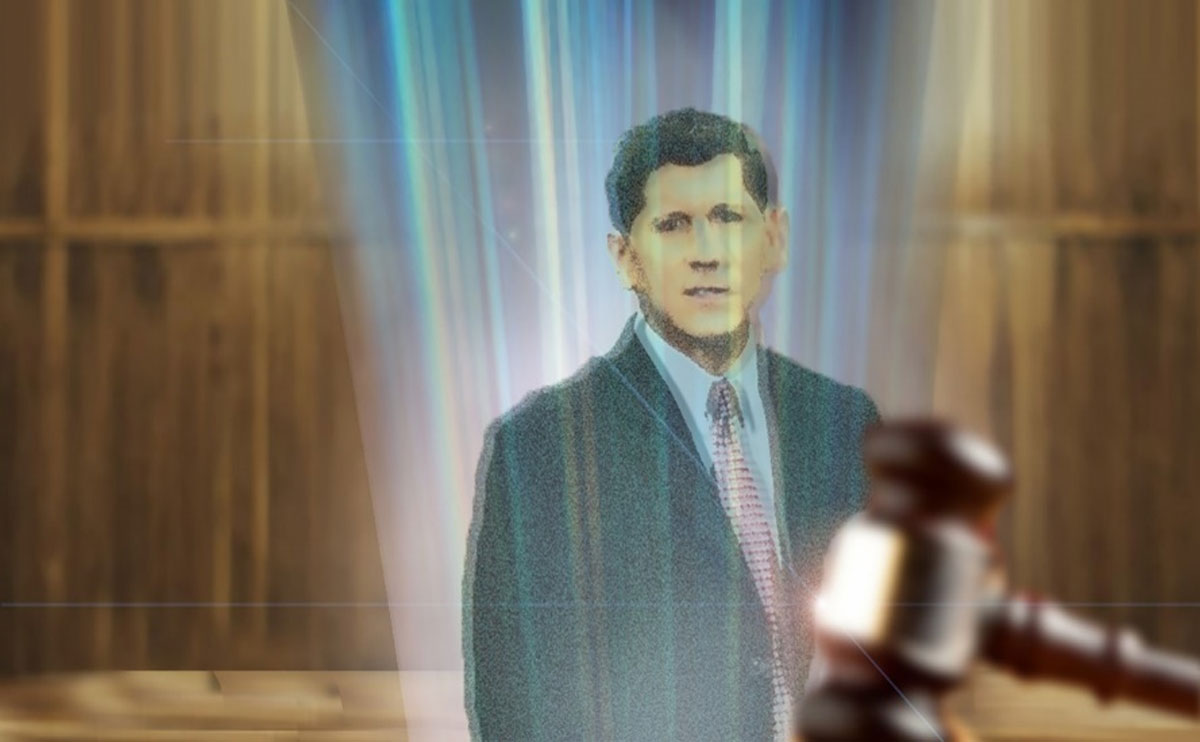
Source: “Hologram Lawyer Program” <https://www.rockylawfirm.com/2019/03/31/rocky-law-firm-selected-to-beta-test-nashvilles-new-hologram-lawyer-program/>.
The process begins with two identical devices, each equipped with 235 nanotech, 360-degree video cameras, and 16 hi-density infrared lasers. These devices are placed on the floor in front of the subject at their law office. At the courthouse, a ¼-inch thick double-walled space-age polymer tube, standing 7 feet tall and 2 feet in circumference, is placed on a motorized base at the podium where a lawyer would typically stand. Once the lawyer at their respective location receives a confirmation of readiness from the courthouse’s location, the transaction becomes similar to video conferencing, except the subject has the capability to step outside of the format and limitations of the flat television screen and bring the image to life.16
The use of holograms in the courtroom has the potential to revolutionise the way evidence is presented and how witnesses are questioned. Holograms offer a wide range of benefits, from providing a more immersive experience to allowing for more efficient communication. Holograms can be used to create 3D images that can be manipulated and interacted with in real time, allowing for a more engaging experience than traditional 2D images. It can also be used to communicate with people in different locations, allowing for more efficient collaboration. Additionally, holograms can be used to create virtual reality experiences, allowing users to explore and interact virtually.
2. Benefits of holograms
More specifically holograms provide the following:
Enhanced Visualisation: Holograms provide a vivid, three-dimensional image that can be manipulated and viewed from any angle. This makes them particularly useful in educational and medical settings, where it can be difficult to explain a concept or visualise a medical procedure especially in cases involving elaborate and technical explanations of procedures that are required to be heard in court proceedings.17
Increased Interactivity and Improved Accessibility: Holograms can be used to create interactive experiences, allowing users to interact with the hologram as if it were a real-life object. Holograms can be used to make complex concepts and ideas more accessible to a wider range of people especially in remote and interior parts of the country. This can be particularly useful in settings, where more complex concepts can be presented in an engaging and interactive way.18
Increased Versatility: Holograms can be used in a variety of different settings and for a variety of different purposes. They can be used for educational purposes, for product demonstrations, for advertising, for entertainment, medical science, and many more.19
Improved Safety: Holograms are designed to be safe to interact with and handle, making them ideal for use in places such as hospitals and research laboratories.20 Presenting evidence is made simpler and more precise with the use of holographic technology. This technology allows medical professionals and other experts to present their findings from their laboratories in a more efficient manner. The technology also helps to improve the process of justice by providing more accurate and reliable evidence resulting in a more reliable and accurate justice system.
2.1 Key technological advancements in the Malaysian judiciary
The Malaysian Judicial system have often received comments for its slowness which caused the backlog of cases.21 The court’s commitment to clearing the backlog and expediting the resolution of cases began when Tun Dato’ Seri Zaki Tun Azmi was appointed Chief Justice in 2008.22 It was in 2009 that reforms to the entire judicial system were introduced and implemented in order to hasten the resolution of cases. The reforms were aimed at improving the administration of justice. To augment the efficiency of the Judiciary at all levels, the Malaysian Judiciary introduced the “e-Court System” in 2009.23 The e-Court system is composed of two phases. Phase I of the e-Court system includes e-filing, the Case Management System (“CMS”), the Queue Management System (“QMS”), and the Court Recording and Transcription System (“CRT”). Phase II of the project has additional modules that are not present in Phase I.24 The e-Court system has revolutionised the adjudication system, allowing the public to reap considerable benefits while modernising and internationalising the Malaysian Judiciary.25
The Malaysian Judiciary has gone through a journey of technological advancement since 2013 with the introduction of the E-Shariah Courts mostly at the Federal Government level.26 The Shariah Court is utilising Information and Communications Technology to enhance its court operations. This includes the use of video conferencing with high-tech video presenters and monitors, recreation of crime scenes, an electronic filing system, electronic case management, electronic court records management, systematic information storage and retrieval systems, and more.
The Malaysian Judiciary has also implemented a number of other innovative measures to enhance judicial administration. They introduced the e-Court Finance system (“E-CFS”) in 2014.27 As of 9th December 2015, the Malaysian Judiciary has implemented e-Jurubahasa (interpreter) to facilitate and accelerate the process of requesting foreign language interpreters in criminal matters.28
A recent notable development related to the use of Artificial Intelligence (“AI”) in Sabah and Sarawak courts in Denis P. Modili v. Public Prosecutor.29 Making history in Malaysian law, this case was the first to apply AI in sentencing. Nevertheless, initiatives and efforts must continue to be implemented periodically to enhance the efficiency of the Judiciary at all levels and to improve the delivery system.
3. Exploring the use of holograms within the existing legislative framework in Malaysia
To address the Covid-19 pandemic, its implications and to surmount the difficulties imposed by the pandemic, various Movement Control Orders in Malaysia adjustments have been made to the way hearings and trials are conducted. These alterations consist of conducting hearings and trials remotely and virtually. Amendments have been made to three relevant Acts – the Courts of Judicature Act 1964,30 the Subordinate Courts Act 1948,31 and the Subordinate Courts Rules Act 195532 to provide more security and clarity regarding online hearings. These amendments add new sections and modify existing provisions to ensure the wellbeing and guidance of Malaysian lawyers and judges.
The question addressed in this discussion is whether holograms could be introduced within the existing parameters provided by the relevant legislative provisions in Malaysia.
(a) Interpretation of “Remote Communication Technology”
The interpretation of “remote communication technology” has been added to the three Acts respectively, in Section 2 of the Subordinate Courts (Amendment) Act 2020;33 section 2 of the Subordinate Courts Rules (Amendment) Act 202034 and Section 3 of Courts of Judicature Act 1964.35 In all these provisions, “‘remote communication technology’ is defined as a ‘live video link, a live television link or any other electronic means of communication.’”
The general understanding of a “live video link” is that of a URL that allows one to watch a live video stream.36 It can be used to watch a live event, a live broadcast, or a live video chat. A “live television link”37 is a connection between two television networks that allows them to broadcast live content from one network to the other. This type of link is often used for news broadcasts, sports events, and other live programming. Furthermore, “any other electronic means of communication includes” telephone, email, text messaging, video conferencing, and social media.38 Given the understanding of how holograms function and upon applying the purposive approach which seeks to give effect to the true purpose of the legislation, it can be concluded that “any other electronic means of communication” includes holographs as well. The challenge, however, lies not in the interpretation of remote communication technology and its coverage of holograms but in the application of Section 15A of the Courts of Judicature Act 1964. This will be examined in the following section.
3.1 Amendments to Courts of Judicature Act 1964 (“CJA”)
One new section has been added into the previous Section 15 of the CJA, namely Section 15A. Section 15A [1] states that the Court may, without limiting to section 15, conduct the hearings or trials of any cause or matter, be it civil or criminal, through a remote communication technology in order to ensure that access to justice is available to the public.
For example, Section 15 provides for the courts to be open and public:
“(1) The place in which any Court is held for the purpose of trying any cause or matter, civil or criminal, shall be deemed an open and public court to which the public generally may have access:
Provided that the Court shall have power to hear any cause or matter or any part thereof in camera if the Court is satisfied that it is expedient in the interests of justice, public safety, public security or propriety, or for other sufficient reason so to do.
(2) A Court may at any time order that no person shall publish the name, address or photograph of any witness in any cause or matter or any part thereof tried or held or to be tried or held before it, or any evidence or any other thing likely to lead to the identification of any such witness; and any person who acts in contravention of any such order shall be guilty of an offence and shall, on conviction, be liable to a fine not exceeding five thousand ringgit or to imprisonment for a term not exceeding three years or to both.”
The added section includes:
Section 15A: Court may conduct proceedings through remote communication technology39
“(1) Without limiting section 15, the Court may, in the interest of justice, conduct the proceedings of any cause or matter, civil or criminal, through a remote communication technology.
(2) In the case of the High Court, the place in which the High Court is held to conduct the proceedings of any cause or matter, civil or criminal, through a remote communication technology shall be deemed to be conducted within the local jurisdiction of such High Court.
(3) Nothing in this section shall affect the operation of section 5 of the Evidence of Child Witness Act 2007 [ Act 676], sections 265A and 272B of the Criminal Procedure Code [ Act 593] and section 32A of the Evidence Act 1950 [ Act 56].
(4) In this section, “place” includes cyberspace, virtual place or virtual space.”
(a) Challenges and Issues
(i) Interest of Justice
Section 15A (1) of the CJA ‘64 states “…the Court may, in the interest of justice, conduct the proceedings of any cause or matter, civil or criminal, through a remote communication technology.” The issue is that it is unclear whether the court has a legal right or is obligated to make a decision in the interest of justice before utilising remote technology. If it is left to the individual judge to determine what constitutes the “interest of justice” in a particular case, this could lead to subjective decisions with varying interpretations resulting in potential inconsistencies in the application of the law.
Thus, it is respectfully put forward that the word “interest of justice” should be removed as the aim of this amendment is to enable the Courts to conduct civil or criminal proceedings through remote communication technology. The phrase “in the interest of justice” is superfluous and does not conform to the purpose of the drafting of the section.
(ii) Matters relating to Child Witnesses
The above amendments, however, do not affect evidence by child witnesses by means of a live link under the Evidence of Child Witness Act 2007 and evidence by a protected witness under the Criminal Procedure Code and the Evidence Act 1950. Which means section 5(1) of the Evidence of Child Witness Act 2007 provides for evidence by live link where a child witness gives evidence by means of a live link from a location other than the courtroom, that location is deemed to be part of the courtroom in which the proceeding is being held for the purposes of this section. Section 5(2) provides that the Court may make an order specifying-
“(a) that a member of the Court staff be present at that location;
(b) the interpreter for the proceedings;
(c) any adult permitted by the Court to accompany the child witness;
(d) the persons in the courtroom who must not be heard, or seen and heard, by the child witness and by the persons accompanying the child witness;
(e) the persons in the courtroom who must be able to see and hear the child witness and the persons accompanying the child witness;
(f) the method of operation of the live link system including compliance with such minimum technical standards as may be determined by the Chief Justice of the Federal Court; and
(g) any other matter as the Court considers necessary in the interest of justice.”
Section 2 of the same Act explains that a “live link” means a live television link or other arrangement whereby a child witness, while being absent from the courtroom or other place where the proceedings are being held, is able to see and hear a person in such courtroom or other place and to be seen and heard by the persons specified in paragraphs 4(2)(a) to (d).
Given the use of holography, it is questionable whether the provisions listed in Section 5(2)(a)–(g) of the Courts of Judicature Act 1964 are necessary, as the issues of location, interpreter, identity, and other surrounding requirements are no longer necessary factors.
(iii) Manner of Recording Evidence
Inquiries and trials under the Criminal Procedure Code before a Magistrate pursuant to Section 265 shall require the witnesses’ evidence to be recorded according to the provisions of this Chapter. Section 272B.(1) permits an individual, other than the accused, to present video or live testimony through a live video or live television link during any trial or inquiry, with the Court’s permission, regardless of other provisions in this Code or the Evidence Act 1950, provided it serves the interests of justice. By virtue of 272B. (2) the Court may make an order on any or all of the matters listed in subsection (2) when exercising its power under subsection (1).
These matters include the persons who may be present at the place where the witness is giving evidence, that a person be excluded from the place while the witness is giving evidence, the persons in the courtroom who must be able to be heard or seen by the witness and by the persons with the witness, the persons in the courtroom who must not be able to be heard or seen and heard by the witness and by the persons with the witness, the persons in the courtroom who must be able to see and hear the witness and the persons with the witness, the stages in the proceedings during which a specified part of the order is to have an effect, the method of operation of the live video or live television link system including compliance with such minimum technical standards as may be determined by the Chief Justice, and any other order the Court considers necessary in the interest of justice. Here a witness gives evidence in accordance with this section shall be deemed to be giving evidence in the presence of the Court, the accused person or his advocate, as the case may be. Additionally, any video or live evidence given under this section that is recorded on any medium, electronic, or otherwise, shall form part of the record.40
Section 16 of the CJA is also amended with the addition of the new paragraph under “(aa) for regulating and prescribing the procedure and the practice to be followed in the High Court, the Court of Appeal and the Federal Court in all causes and matters whatsoever in or with respect to the hearing of any matter or proceeding through a remote communication technology;”
Section 69(1) of the CJA Act has been amended to include the phrase “or through remote communication technology” after the words “in court.”
“(1) Appeals to the Court of Appeal shall be by way of re-hearing, and in relation to such appeals the Court of Appeal shall have all the powers and duties, as to amendment or otherwise, of the High Court, together with full discretionary power to receive further evidence by oral examination in court or through a remote communication technology, by affidavit, or by deposition taken before an examiner or commissioner.
Section 17 B states “the Chief Justice may issue such practice directions as may be necessary for the purpose of carrying into effect the provisions of this Act after consulting the President of the Court of Appeal or the Chief Judge.”
Thus, in analysing this, it is clear that this section does encompass technology in the courtroom. The Chief Justice of Malaysia herself stated: “I wish to make it clear that the Judiciary has always embarked on technological advancements, and online or virtual hearings mark our progress in this direction. The advent of online hearings is not merely a means to cope with the pandemic but a permanent feature of our justice system. There is, therefore, no question of ‘reverting.’”41 By examining the operation of the above sections, it can be inferred that the use of holography in a court proceeding would not have any negative impact on the way evidence is recorded.
(iv) Interpretation of a “place” in section 15A CJA ‘64
Section 15A (2) of CJA also states that for High Court cases, the place in which the High Court is held to conduct the proceedings through a remote communication technology shall be deemed as to be conducting within the local jurisdiction of such High Court.
Section 15A (4) provides that the word “place” includes cyberspace, virtual place, or virtual space. The interpretation of “place” raises an interesting question as to the reason behind the inclusion of three different terms to refer to one “place” in light of conducting proceedings via remote communication technology.
The term “cyberspace” was coined by William Gibson, author of Neuromancer, and is often used when discussing digital technologies and new media.42 It is a broad term that can mean different things to different people, but generally refers to the sphere of activity created by communications technologies, particularly on the Internet. The term “Cyberspace” started to become a de facto synonym for the Internet, and later the World Wide Web, during the 1990s, especially in academic circles and activist communities.43 Although the term “cyberspace” is no longer as popular, the concept of virtual space is still relevant and worth exploring.
It appears that the distinction between “place” and “space” is becoming blurred, as virtual space is discussed more often than virtual place. A “place” is more than just a bounded area of space; it is a space that has been imbued with meaning. What makes a place a place is its specificity, not only in geography but also in networks of meaning and imagination.44 Our homes, schools and offices are places only insofar as they carry with them certain distinctive characters and interactions. Without these associated meanings, a location is simply a portion of space, lacking in any names or meaningful structures. They simply become sections of space.
Transferring this distinction to the realm of the virtual, it is easy to understand what we mean by virtual space, and even by virtual location. Virtual places are areas within the virtual world that are defined by the user. They can be created through the use of URLs, website infrastructures, and other virtual tools. These places can be used to store information, communicate with others, or simply provide a space for users to explore. Virtual place can be thought of in terms of video games and virtual worlds, such as Roblox, Minecraft or Fortnite. These virtual environments attempt to replicate the features of real-world places, like landscapes, buildings, and neighbourhoods. However, if we limit our understanding of virtual place to these digitally rendered environments, we fail to capture the full scope of online experiences. By exploring the distinction between virtual space and virtual place, we can gain a more nuanced understanding of online communities and interactions. Thus, a virtual place can be represented to ourselves and others as either a physical location or an infinite part of cyberspace. Therefore, if “cyberspace” is the digital world of online communication and information and “virtual space” is a simulated environment created by computer software, which can be used to explore, interact with, and create content then “virtual place” would be virtual environment indicating a particular place.
As explained above, holograms and virtual places are both forms of virtual reality. Holograms are three-dimensional images created with the help of lasers, while virtual places are computer-generated environments that can be explored and interacted with. Holograms can be used to create immersive experiences, while virtual places can be used to create virtual worlds and simulations. Therefore, it appears by virtue of section 15A(4) the current law on remote communication technology allows for the use of holograms in court proceedings.
(v) Concept of Open Justice
Section 15 of CJA provides that “a place in which any court is held for the purpose of trying any clause or matter, civil or criminal shall be deemed an open court and public to which the public generally has access.”
Several cases which include Dato’ Seri Mohd. Najib bin Abdul Razak v. Public Prosecutor,45 PP v. Shaharil Said46 and Kanopy Investment Private Limited v. Landmark Holdings Berhad47 have decided on the extent of the application of subsection 15(1) which focuses on the public nature of a court proceeding i.e., the court must be open to the public generally, the public must have access and the trial is required to be held openly and transparently so that justice is not only done but appears to be done. The cases that were decided clearly focused on the public nature of a court proceeding rather than the place and did not limit the place to the physical court building only. In the event that a court proceeding is conducted online, for example through a video conference with the presence of the relevant parties only the video conference does not “block” the case from public access. This is because the public can still access the video conference through live streaming or any method that will be determined by the court.
Therefore, introducing holography would not contravene the concept of open justice as it is also similar to online hearings made through live streaming or broadcast as the parties are not prevented from arguing their case or responding to the opposing party’s arguments. Proceedings that are conducted online only involve a change of venue or place, i.e., from a physical court to a virtual or virtual one. Unless the parties indicate that there will be prejudice to their case, no objection may be made on technical or procedural grounds merely because the hearing of the case is conducted online.
Also, in a proceeding conducted using long-distance communication technology or holograms all the rights and obligations of the parties are unchanged. Matters related to the application of substantive legal provisions, the burden of proof, the right of the parties to be heard and response to a case against them remain and remain unchanged as the hearing of the proceedings conducted in the courtroom.
3.2 Amendment to Subordinate Courts Act 1948 and the Subordinate Courts Rules Act 1955
A new section has been added as well to the Subordinate Courts Act 1948, which is section 101B where it states that the Court may, without limiting to Section 101 of this Act, conduct the hearings and trials or hold any inquiry via a remote communication technology, in the interest of justice.
Section 101B(1) of Subordinate Courts Act 1948: “Without limiting section 101, the court may, in the interest of justice, conduct the proceedings of any cause or matter, civil or criminal, or hold any inquiry, through a remote communication technology.”
(2) the place in which the court conduct the proceedings of any cause or matter, civil or criminal, or hold any inquiry, through a remote communication technology shall be deemed to be conducted within the local limits of jurisdiction assigned to it under section 59 or 76 or, if no such local limits have been assigned, arising in any part of Peninsula Malaysia.
Apart from the added definition of remote communication technology, section 4 introduces a new paragraph (aa) in the Subordinate Courts Rules Act 1955.
Paragraph (aa) of section 4 of Subordinate Courts Rules Act 1955 states, “For regulating and prescribing the procedure and the practice to be followed in Subordinate Courts in all causes and matters whatsoever in or with respect to the hearing of any matter or proceeding through a remote communication technology.”
The observations highlighted on the issue of “interest of justice” and that of the “place” is reiterated in relation to the above sections as well.
Since the Subordinate Courts Act 1948 does not apply to Sabah and Sarawak, 48 the legislation could be amended to extend its reach to the whole of Malaysia. The question remains whether the inclusion of conducting a trial by remote communication technology would actually achieve its purposes with such limitations of jurisdiction, especially since the word “place” includes the cyberspace, virtual place, and virtual space, which do not have any physical jurisdictions or boundaries.
4. Conclusion
In conclusion, the amendments to the three Acts have been made to ensure that access to justice remains available to the public, during the pandemic and beyond, by allowing for the delivery of justice through remote communication technology. As explained above, there does not seem to be any impediment to the introduction of holography in court proceedings in Malaysia, as the current amendments allow for such usage.
The recent rise of holographic technology offers a potential solution for victims of sexual abuse, vulnerable witnesses who may find testifying to be a traumatic experience. Holography can eliminate the need for them to return and face the attacker in person. This could help to reduce the trauma and distress normally experienced by a witness. Holograms with their highest resolutions have been designed to provide a realistic experience for victims and have been described as “indistinguishable from reality.”49 Use of holograms serveas a form of protection for witnesses, as well as allowing judges to assess the demeanour and credibility of the witnesses. For instance, holographic technology, such as SolidLight holograms, the judge can experience the witness in a realistic, three-dimensional setting, allowing for a more accurate assessment of the witness’s credibility.
The recent amendments to the relevant statutory provisions examined above have enabled courts in Malaysia to exercise their discretion in dispensing justice in the most realistic form possible, albeit the issue of “interest of justice” and the remaining challenges highlighted. The use of holography in court proceedings in Malaysia has the potential to provide numerous benefits to the current system. Holography can provide a more realistic and accurate representation of evidence, allowing for a more accurate and reliable justice system while using remote communication technology. It can also reduce the need for physical court proceedings, allowing for more efficient and cost-effective justice delivery. It must be noted that though holograms are captured within the interpretation of remote communication technology, protocols for the use of Holograms must be put in place like that of Protocols for the use of video conferencing (VCF) in civil proceedings in the Dubai International Financial Centre Courts which is also similar to protocol of the Federal Court of Australia.
Notes
[1] No utilizar, ‘History of Holography’ (NEWS BBVA25 November 2015) <https://www.bbva.com/en/history-of-holography/> accessed 31 July 2022; ‘Merriam-Webster Dictionary’ (Merriam-webster.com2022). <https://www.merriam-webster.com/dictionary/hologram> accessed 15 June 2022; OpenMind’ (OpenMind4 June 2015) <https://www.bbvaopenmind.com/en/science/leading-figures/dennis-gabor-father-of-holography/> accessed 24 August 2022.
[2] ‘(PDF) from White Elephant to Nobel Prize: Dennis Gabor’s Wavefront Reconstruction’ [2023] ResearchGate <https://www.researchgate.net/publication/29815178_From_white_elephant_to_Nobel_Prize_Dennis_Gabor’s_wavefront_reconstruction> accessed 16 March 2023.
[3] ‘3D Optical Systems Group’ (Mit.edu2022) <http://web.mit.edu/optics/www/holgraphy.htm> accessed 30 July 2022.
[4] ‘OpenMind’ (OpenMind 4 June 2015) <https://www.bbvaopenmind.com/en/science/leading-figures/dennis-gabor-father-of-holography/> accessed 24 August 2022.
[5] Ivan Tchalakov, The History of Holographic Optical Storage at Both Sides of the Iron 1969—1989, on JSTOR’ (Jstor.org2023) <https://www.jstor.org/stable/23787025> accessed 23 March 2023.
[6] Spaulding WC, ‘Holographic Wills (Aka Handwritten Wills)’ (Thismatter.com2022) <https://thismatter.com/money/wills-estates-trusts/holographic-wills.htm> accessed 29 July 2022.
[7] McIntyre J, Olijnyk A and Pender K, ‘Civil Courts and COVID-19: Challenges and Opportunities in Australia’ (2020) 45 Alternative Law Journal 195 <https://journals.sagepub.com/doi/full/10.1177/1037969X20956787> accessed 24 August 2022.
[8] INFORRM, ‘Covid-19, the UK’s Coronavirus Bill and Emergency “Remote” Court Hearings: What Does It Mean for Open Justice? – Judith Townend’ (Inforrm’s Blog 24 March 2020). <https://inforrm.org/2020/03/24/covid-19-the-uks-coronavirus-bill-and-emergency-remote-court-hearings-what-does-it-mean-for-open-justice-judith-townend/> accessed 24 August 2022.
[10] ‘Remote Court Hearings’ (Adjd.gov.ae 2019) <https://www.adjd.gov.ae/en/Pages/RemoteCourtHearings.aspx> accessed 30 August 2022; Dubai Courts increases IT effectiveness by using assyst’ (IFC.com2021) <https://www.axiossystems.com/hubfs/assyst%20Case%20Studies%20IFS%20branded/IFS_CS_Dubai%20Courts_01_2021.pdf?hsLang=en> accessed 30 August 2022; Jafza and Dubai Courts Launch the 1st Virtual Court in the Middle East to Handle Labour Litigations’ (Zawya.com 26 September 2021). <https://www.zawya.com/en/press-release/jafza-and-dubai-courts-launch-the-1st-virtual-court-in-the-middle-east-to-handle-labour-litigations-rdcnp1y9> accessed 30 August 2022.
[11] ‘Session Details’ (Dc.gov.ae 2022) <https://www.dc.gov.ae/PublicServices/SessionDetails.aspx?area_id=232&session_date=30-08-2022&hall_number=27&lit_code=5> accessed 30 August 2022; Abu Dhabi Global Market Courts: Framework, Procedures and First Judgment Summary | Practical Law’ (Westlaw.com2016) <https://content.next.westlaw.com/practical-law/document/Ieb4d63e22b5911e89bf099c0ee06c731/Abu-Dhabi-Global-Market-courts-framework-procedures-and-first-judgment-summary?viewType=FullText&transitionType=Default&contextData=(sc.Default)> accessed 30 August 2022.
[12] ‘A Close Look at Hangzhou Internet Court: Inside China’s Internet Courts Series -06 - China Justice Observer’ (Chinajusticeobserver.com2019) <https://www.chinajusticeobserver.com/a/a-close-look-at-hangzhou-internet-court> accessed 23 March 2023.
[13] McElhaney R, ‘Soap Box Law Blog for the Rocky McElhaney Law Firm’ (Rocky McElhaney Law Firm 11 June 2019) <https://www.rockylawfirm.com/blog/page/19/> accessed 16 March 2023.
[14] Rocky McElhaney Law Firm is going where no law firm has gone before by making hologram history. <https://www.rockylawfirm.com/2019/03/31/rocky-law-firm-selected-to-beta-test-nashvilles-new-hologram-lawyer-program/> accessed 23 March 2023.
[15] McElhaney R, ‘Rocky Law Firm Selected to Beta Test Nashville’s New Hologram Lawyer Program - Rocky McElhaney Law Firm’ (Rocky McElhaney Law Firm 31 March 2019) <https://www.rockylawfirm.com/2019/03/31/rocky-law-firm-selected-to-beta-test-nashvilles-new-hologram-lawyer-program/> accessed 23 March 2023.
[21] “Malaysia Court Backlog and Delay Reduction Program: A Progress Report,” (World Bank 2019), <https://documents.worldbank.org/en/publication/documents-reports/documentredirects?url=/curated/en> accessed 6 March 2023.
[22] ‘(PDF) Judicial Reforms through the Use of Technology in Malaysia’ (ResearchGate 2017) <https://www.researchgate.net/publication/316124316_Judicial_Reforms_through_the_Use_of_Technology_in_Malaysia#fullTextFileContent> accessed 16 March 2023.
[23] ‘(PDF) Judicial Reforms through the Use of Technology in Malaysia’ (ResearchGate 2017) <https://www.researchgate.net/publication/316124316_Judicial_Reforms_through_the_Use_of_Technology_in_Malaysia#fullTextFileContent> accessed 16 March 2023.
[24] Those modules include online filing for criminal matters and Power of Attorney, appeal module for the Court of Appeal and Federal Court, e-lelong, integration with Bar Council for Practising Certificate Module, and integration with the Royal Malaysian Police, Road Transport Department, Immigration Department, National Registration Department, Insolvency Department and Prison Department (Qishin Tariq,2016) ‘(PDF) Judicial Reforms through the Use of Technology in Malaysia’ (ResearchGate 2017) <https://www.researchgate.net/publication/316124316_Judicial_Reforms_through_the_Use_of_Technology_in_Malaysia#fullTextFileContent> accessed 16 March 2023.
[25] ‘(PDF) Judicial Reforms through the Use of Technology in Malaysia’ (ResearchGate 2017) <https://www.researchgate.net/publication/316124316_Judicial_Reforms_through_the_Use_of_Technology_in_Malaysia#fullTextFileContent> accessed 16 March 2023.
[26] ‘(PDF) E-Shariah: Information and Communication Technologies for Shariah Court Management’ [2013] ResearchGate <https://www.researchgate.net/publication/259433871_E-Shariah_Information_and_Communication_Technologies_for_Shariah_Court_Management> accessed 31 July 2022.
[27] ‘(PDF) Judicial Reforms through the Use of Technology in Malaysia’ (ResearchGate 2017) <https://www.researchgate.net/publication/316124316_Judicial_Reforms_through_the_Use_of_Technology_in_Malaysia#fullTextFileContent> accessed 16 March 2023.
[28] ‘(PDF) Judicial Reforms through the Use of Technology in Malaysia’ (ResearchGate 2017) <https://www.researchgate.net/publication/316124316_Judicial_Reforms_through_the_Use_of_Technology_in_Malaysia#fullTextFileContent> accessed 16 March 2023.
[29] Sanghvi H and others, ‘Digitalisation of Judiciary in Malaysia: Application of Artificial Intelligence in the Sentencing Process’ [2022] Proceedings of the International Conference on Law and Digitalization (ICLD 2022) 91 <https://www.atlantis-press.com/proceedings/icld-22/125979428> accessed 16 March 2023.
[30] ‘(MY) 15A.Court May Conduct Proceedings through Remote Communication Technology’ (Lexis.com2023) <https://advance.lexis.com/document/?pdmfid=1522468&crid=b5cd1ddf-feba-429d-9706-1d945a691a5d&pddocfullpath=%2Fshared%2Fdocument%2Flegislation-my%2Furn%3AcontentItem%3A622D-1RW1-JTNR-M4BD-00000-00&pdcontentcomponentid=500399&pddoctitle=15A.Court+may+conduct+proceedings+through+remote+communication+technology&pdteaserkey=sr1&pdicsfeatureid=521734&pditab=allpods&ecomp=zxsrk&earg=sr1&prid=aa33f24e-20cf-424a-a93b-01b509b1af6> accessed 2 March 2023.
[31] ‘ASM - Subordinate Courts Act 1948 (Act 92) (Revised 1972)’ (Lexis.com 2023) <https://advance.lexis.com/toc/?pdmfid=1522468&crid=fd6d4356-0cdd-4283-937b-e0383884f34e&pdtocfullpath=%2Fshared%2Ftableofcontents%2Furn%3AcontentItem%3A5RFD-V371-FG8G-3000-00000-00&ecomp=zzg4k&prid=ce7fa1f3-1963-4761-aa23-baa9e8fc8db4> accessed 16 March 2023.
[32] ‘Act:MY_FS_ACT_1971_55’ (Openathens.net2020 ) <https://www-cljlaw-com.eu1.proxy.openathens.net/Members/DisplayAct.aspx?ActSectionId=4026695690&SearchId=4mmu1> accessed 16 March 2023.
[33] Subordinate Courts (Amendment) Act 2020 [Act A1622]:
The amendments made to the Subordinate Courts Act 1948 (“SCA 1948”) are to enable the lower courts to conduct the proceedings of any cause or matter, be it civil or criminal, or to hold any inquiry through live video links, live television links or any other medium of electronic communication. After receiving the Royal Assent on 10 October 2020, the Subordinate Courts (Amendment) Act 2020 (“Amended Act”) was gazetted on 22 October 2020.
[34] Subordinate Courts Rules (Amendment) Act 2020 [Act A1623] After receiving the Royal Assent on 10 October 2020, the Subordinate Courts Rules (Amendment) Act 2020 (“Amended Act”) was gazetted on 22 October 2020.
[41] Speech By the Right Honourable the Chief Justice of Malaysia, Tun Tengku Maimun Binti Yuan Mat on the Occasion of the ‘Opening of the Legal Year 2022’ Access to Justice and the New Normal, Friday, 14 January 2022 Palace of Justice, at Putrajaya and Via Zoom.
[42] Gibson W, ‘Neuromancer (Sprawl, #1)’ (Goodreads 2022) <https://www.goodreads.com/book/show/6088007-neuromancer> accessed 16 March 2023.
[43] ‘(PDF) Collective Memory and Cyberspace’ (ResearchGate 2017) <https://www.researchgate.net/publication/319123609_Collective_memory_and_cyberspace> accessed 16 March 2023.
[44] ‘Ethics in Cyberspace’ (Google Books 2023) <https://books.google.com.my/books?id=o2lJgtU2kyYC&pg=PA70&dq=meaning+of+cyberspace&hl=en&sa=X&ved=2ahUKEwiWkrG8q8X9AhXl1zgGHUu9CuUQ6AF6BAgHEAI#v=onepage&q=virtual%20place&f=false> accessed 5 March 2023.
[49] ‘Colombian Court Holds Hearing in the Metaverse’ (Cryptonews.net 17 February 2023) <https://cryptonews.net/news/metaverse/20573125/> accessed 19 February 2023.
Acknowledgements
The authors wish to record their sincere appreciation for the insightful comments and feedback shared by the Former Chief Justice of Malaysia, Tun Dato’ Seri Zaki Tun Azmi who is currently the Chief Justice of the Dubai International Financial Centre Courts, “DIFC” Courts during the course of this research.
Funding Information
This Research is funded by the Multimedia University through the IR Fund (Seeding) 2022.
Competing Interests
The author has no competing interests to declare.