
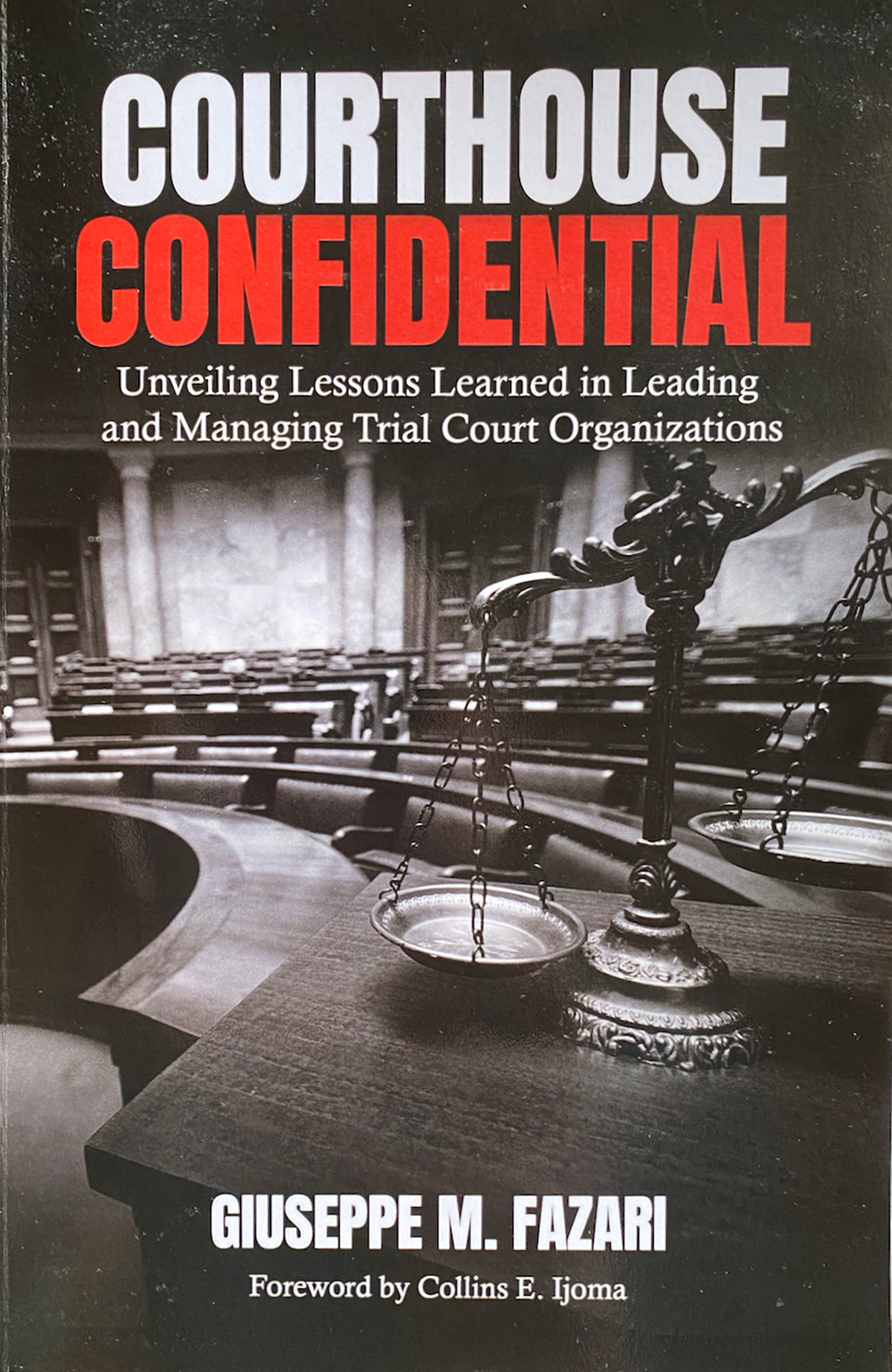
The field of modern court administration is relatively young, with its genesis less than seven decades ago. Over that time there have been relatively few books that addressed court administration in a comprehensive way.1 There is a valuable new addition to this small library: Courthouse Confidential, Unveiling Lessons Learned in Leading and Managing Trial Court Organizations. The author nicely blends his real-world experience as a trial court administrator, faculty member in criminal justice at Seton Hall University and the Institute for Court Management, and his international Rule of Law activities. This diverse background results in a book that uses a series of case studies and corresponding “lessons learned” to cover a wide range of critical topics and issues that confront court administrators and judges in today’s courts, bridging the gap between the real world and organizational management studied in the classroom.
This book is a valuable addition not only because of the dearth of comprehensive books, but also because the field of court of administration has evolved over the decades and needed a modern treatment. In the early years, fundamental issues ruled the day, such as:
What are the optimal judicial system structures?
How are courts best funded – locally or centrally?
In a tradition-bound setting where judges have historically been directly responsible for the administrative functions of the courts, how can the need for professional court administrators be justified?
As court administrators proved their worth in meeting the challenges of rising caseloads, funding crises, the emergence of technologies, etc., the field of court administration advanced to the acceptance and even requirement of trained and experienced administrators.2 Courts also evolved over time to having a governance structure of judicial officers act like a board of directors, a chief judge as chairperson, and a court administrator as chief executive officer – the latter two working as a team. This book reflects the modern status of court administration issues and structure, making the book’s publication very timely. What this book does not particularly address, however, are future trends (in technology, space and facilities, human resources needs, etc.), thus making the book a reflection of current court administration.3
Courthouse Confidential should appeal to a wide variety of people: those new to courts, early-career managers, experienced administrators (and judges), and academics who could use the book in an educational setting as a reference or textbook. The primary focus is on the practical side, however, so the greatest applicability is to those working and managing in the courts. Although the book uses case studies from the author’s experience in the United States, the situations and their ramifications address many universal issues in court administration. Thus, non-U.S. readers will also benefit from the book, keeping in mind that their own jurisdictional characteristics need to be taken into account.
The “lessons learned” sections of the book are practical and actionable, while being rooted in appropriate organizational theory—which are rarely integrated together in books and articles on court administration. As the author states in his preface: “The premise of this text is in consideration of that chasm, to bring to bear an appreciation of outcomes and deliver to those whose interests—be they professional or academic—a candid observation of the variety and range of issues that are incorporated in managing the courts.”4 He concludes the book by stating: “This text is a snapshot. It provides a sample of the kinds of issues that are managed in the courts, but it is not an all-inclusive representation. Some court leaders and judges will never manage the types of issues addressed here; others may have been challenged on matters for which I did not have the benefit of personal experience and exposure while working, teaching, and consulting in the field.”5
Given that approach, readers should first read the book’s introduction/preface, then read the “Concluding Lessons (in brief)” at the end of the book, and after that go back to read the rest of the book. Doing so will help the reader better understand the author’s approach and appreciate its inherent advantages and limitations.
Although the book is not intended to be a totally comprehensive treatment of the breadth of modern court administration, its chapters nevertheless provide a wide range of important topics:
Purposes and responsibilities of courts
Leadership
Court culture
Caseflow management
Information technology management
Community engagement
Stakeholder collaboration
Human resources management and consultation
Operations management
Funding and budget management
Strategic management and long-term planning
Concluding lessons (in such areas as self-management, collaboration with judges and subordinates, change management, and mentorship).
By comparing this list of topics to the Core Competencies identified by the National Association for Court Management (NACM) one can gain informative insights. The NACM competencies are intended to be a comprehensive description of “what court professionals need to know,” along with its companion library of detailed curricula for each competency.6
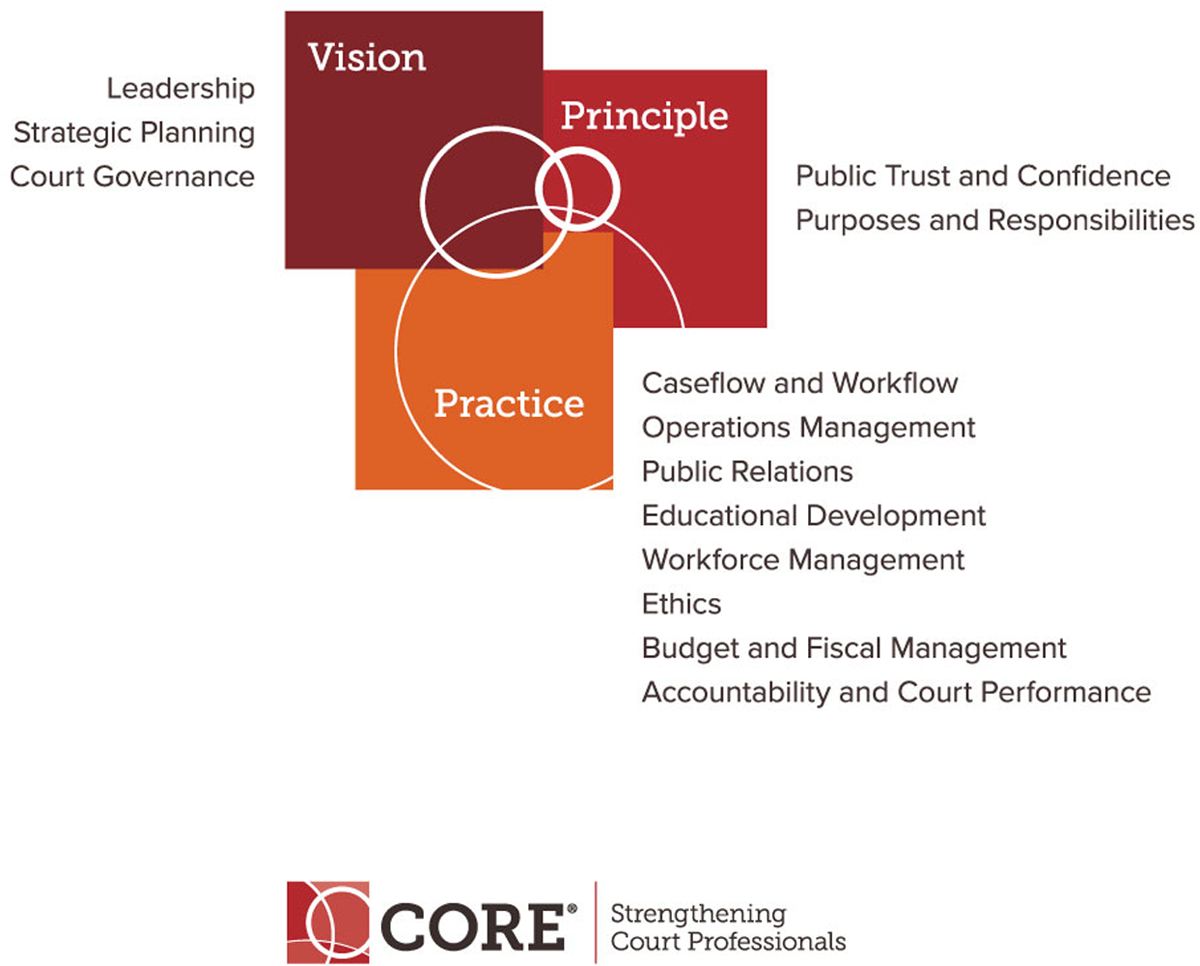
There is obviously a lot of overlap between the Courthouse Confidential topics and the NACM CORE Competencies. In fact, each of these has content that the other does not address (at least in depth), thus readers of Courthouse Confidential who desire a more comprehensive, current treatment of court administration should also avail themselves of the NACM CORE Competencies (among other resources, of course).
A great benefit of the book’s practical approach is the many specific examples of management techniques one can use to address the wide range of issues presented. By including many lists, charts, and colorful graphics the author does a good job of helping explain key points.
As noted above, the book is a singular, personal lens into court administration. This is an advantage and a disadvantage. A benefit is how the book gives the reader a vivid, interesting look into the inner workings of courts, and how the author recommends leaders deal with key issues and problems. On the other hand, the book would benefit from:
Including more direct content in areas that have become critically important: virtual/hybrid work (by staff in general and judges for hearings/trials); Diversity-Equity-Inclusion/DEI (community collaboration, HR, etc.); code of conduct/ethics; information technology (cybersecurity, sophisticated case management, and modern records processing); and procedural justice.
Providing case studies that address more diverse types of courts and court administrative systems, such as smaller courts. The smallest ones in the book had 14 judges/250 employees and 20 judges/400 employees; most of the case studies are set in courts with 40+ judges and 500+ employees with multiple layers of administration (court administrator, several deputies, many mid-managers, etc.). Smaller, more rural courts are in the majority in the United States, and they have distinct differences and challenges that a wide-ranging book like this would benefit by addressing them more fully.
Revising the case studies, which are extremely detailed and long (the author is a wonderful storyteller!). This level of detail paints a rich picture of the inner workings of a court but is overdone. For example, in one chapter the introductory setting-case study-aftermath material was 18 pages long, and the related lessons learned only 12 pages long. Shorter and more focused case studies with just enough detail to raise the issues to be addressed in the lessons learned would be an improvement. In addition, the lessons learned sections would be enhanced by more directly and expressly relating back to the case study issues. As expressed in the book’s subtitle, the lessons learned material is the heart of the book’s message.
Courthouse Confidential is an important addition to the court administration library. The unique case study and lessons learned approach that bridges theory and practice is excellent and is very readable. As stated earlier, the book thus should appeal to both academics and court administration practitioners. Finally, the book is available in both print and electronic versions, which is also nice.7
Notes
[1] Examples include: Managing the Courts, by Ernest Friesen, Edward Gallas, and Nesta Gallas (1971); Managing the State Courts, by Larry Berkson, Steen Hays, and Susan Carbon (1977); and The Art and Practice of Court Administration, by Alexander Aikman (2007).
[3] Mr. Fazari has shared that an additional book is in development (with co-authors Alex Aikman and Marcus Reinkensmeyer), and will discuss current and future trends of modern court management, with a particular focus on technology.
[7] Courthouse Confidential: Unveiling Lessons Learned in Leading and Managing Trial Court Organizations | Higher Education (kendallhunt.com); The print copy costs $90 USD; electronic copy costs $45 USD.
Competing Interests
The author has no competing interests to declare.