
Introduction
…The courts above all institutions have a solemn obligation to ensure that every person who appears before us, and every colleague we work with is treated with equal justice, dignity, and respect….4
From former Chief Judge DiFoiore’s report containing the above quote, it appears New Yorkers are becoming increasingly unsure of judges’ roles in society.5 As I celebrate the New York State Court (NYSC) judges, I also empathize that their social roles regarding racism, discrimination, and implicit bias can be daunting. So, in addressing these social vices, Chief Judge DiFiore commissioned a Diversity Task Force/Equal Justice in the Courts Committee for the 6th Judicial District NYS Unified Court System, and appointed Adviser Johnson6 to review policies, practices, and structures to address bias, fairness, equity, and inclusion.7 This paper contains my presentation to the Task Force.8 My primary objective is to strengthen the Task Force’s efforts to provide equal and meaningful justice for all New Yorkers by explaining the judges’ roles in eradicating implicit bias, racism, and discrimination in NYSCS.
Accordingly, in honoring NYSC judges and their devotions to judicial work while sacrificing their private life, comfort, and health for public service, this paper discusses courts’ roles in society, judges’ roles in eliminating implicit bias and discrimination, and judges’ roles in ensuring inclusion and diversity in NYSCs. This paper will also discuss some relevant points from Johnson’s report, explain two judicial dilemmas courts encounter in solving implicit bias and conclude by proposing this writer’s socio-judicial theory to solving the dilemma.
Bravo! NYS Judges
…. I was reminded over the last four months of the intense pride and dedication that many in and around the New York State Court System–from the Upstate Village justice to the King’s Court Family Court judges– feel for their work.9
The Role of Courts in Society
The court’s role in society has transformed from simple adjudication, but many do not understand that transformation.10 Courts now perform diverse roles amidst constant changes in culture and society.11 The courts’ primary role is to do justice through interpreting the law and applying discretion.12 I categorized the courts’ roles into – real and ideal roles.13 The real roles are the traditional roles/the status quo–settling disputes and interpreting statutes. The ideal roles are the contemporary roles of courts as agents of social change. These roles, as Figure 1 one depicts, apply to different people in diverse ways, depending on the circumstances of the case and the society.
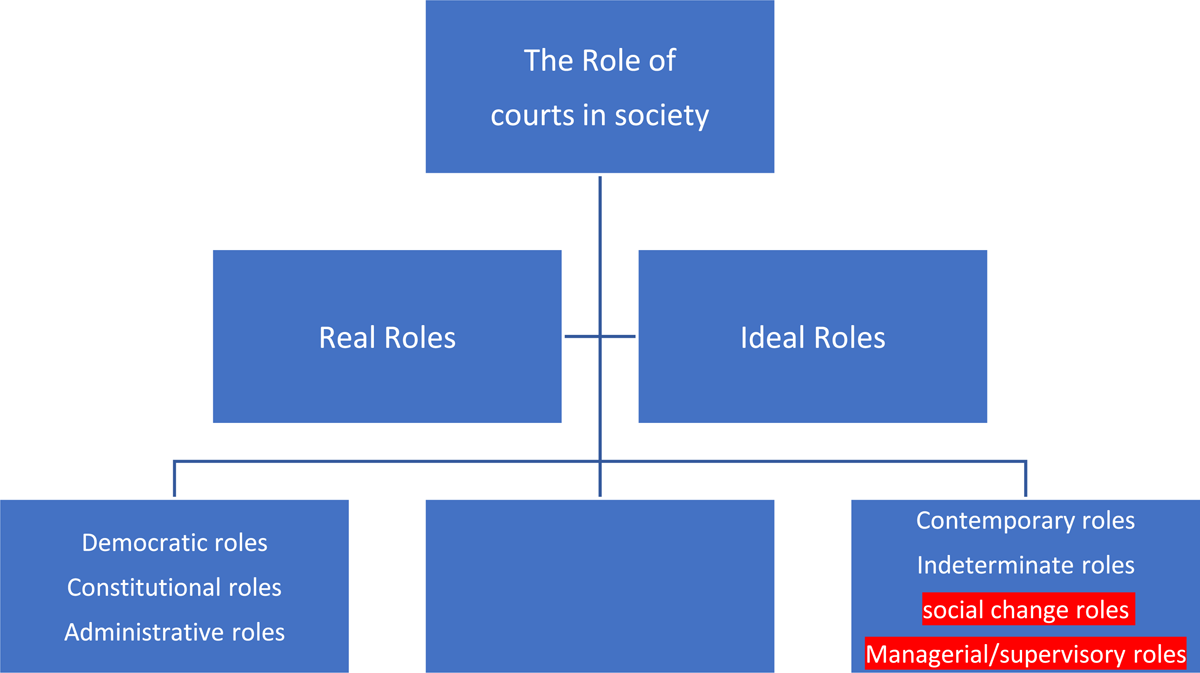
Figure 1
The Court’s Role in Society.
The court’s role relevant to this paper/my presentation is/was the Ideal role, i.e., social change/supervisory role. This role includes the court’s administrative roles to manage policies and supervise practices or structures to enable an equitable balance in relating with diverse groups.
Judges’ Roles in Eliminating Implicit Bias and Discrimination in NYSCS
New York State Court system is the largest and most complex in the nation, serving one of the most populated, complex, diverse, and dynamic states in the nation…. Few practitioners and observers understand the full complexity of the state’s court system and how it got that way…14
Due to the diverse and complex nature of NYS, judges have the indeterminate role of managing their personal biases, the biases of court personnel, and the public. I agree with Johnson that the change starts from the top. Judges can/should lead by example. Through their managerial/supervisory role, judges should ensure that everyone treats each other with equity, respect, dignity, and courtesy–free from discrimination, biases, or stereotypes. Judges can eliminate bias by encouraging cautious language in court and publicly condemning discriminatory language immediately to deter others.
Judges’ Roles in Ensuring Inclusion and Diversity in Courts
The judge’s real role in ensuring justice depicts inclusion and diversity. This role includes democratic roles of inclusion, constitutional roles reiterating the preamble of “We the People,” and administrative roles that depict historical knowledge of the NYSCS.15 This historical context also displays NYS’s cultural diversity, enabling social awareness that judges should display personally or through their court staff. A judge’s language in court demonstrates the judge’s sense of diversity and inclusion.
Some Relevant Comments from Johnson’s Report
“The lack of diversity…leads to perceptions that justice is not fairly administered…”16
“… from the moment they enter the courthouse in the hallways and waiting areas and in the courtroom – court officers should be better trained to deal with the many issues that can arise by these touchpoints.”17
“Racism is at its strongest in Town and Village Courts.”
“…, a disproportionately high percentage of the civil or criminal litigants in the Housing, Family, Civil and Criminal Courts in NYC are people of color.”18
“… the use of racial slurs by white court officers is common and often goes unpunished.”19
“Some attorneys of color also told us that they are “believed less often” when making statements to the judges…. This problem is magnified when an attorney of color represents a litigant of color in court; … the bias manifests itself as disbelief of both attorney and client and the failure to take them seriously.”20
“… there is a palpable, cumulative effect such disparate treatment has on attorneys of color … if a client witnesses this treatment, it lessens the confidence the client has in his or her lawyer and erodes the client’s overall confidence in the ability of the judicial system ….”
“Interviewees acknowledged the inherent difficulties in recruiting diverse candidates –particularly in Upstate communities – where the population is not nearly as diverse as NYC.”21
“… judges, attorneys and court personnel treat litigants of limited English proficiency poorly.”22
“There is a culture in the courts that discourages compassionate treatment.”23
“Transparency, transparency, transparency. If you cannot explain how a process works, there is probably something wrong with that process.”24
“…enhanced training of judges on the nuances of racial and cultural biases in our judgment is a crucial step towards alleviating racial injustice throughout the court system.”25
“Battling systemic racism needs to be perceived as an ongoing goal.”26
Johnson also said these social vices could be addressed only by investing in resources, technology, people, and infrastructure.27 This paper focuses on “investing in people” because people are vital to making the resources, technology, and infrastructure work. From Johnson’s report, most court users already have a stereotype against the NYSCS.28 No degree of investment in resources, technology, or infrastructure can change their mindset unless they commit to change.29 According to a retired black judge – he often had to “check his biases at the door” when evaluating a litigant.30 However, it is critical to note that mandatory implicit bias and cultural sensitivity training, as the report suggests,31 will not change anything if people are unwilling.32 As the English phrase says, “you can lead a horse to the water, but you can’t make it drink.”33
Therefore, enabling courts’ staff to willingly participate in bias training is key to achieving the training objectives. Judges could play a significant role in influencing and enlightening the court personnel/staff.34 Figure 2 shows the court’s key personnel. Judges and clerks/registers are at par because the former represents the court at its “touchpoints,” even though judges are the court.
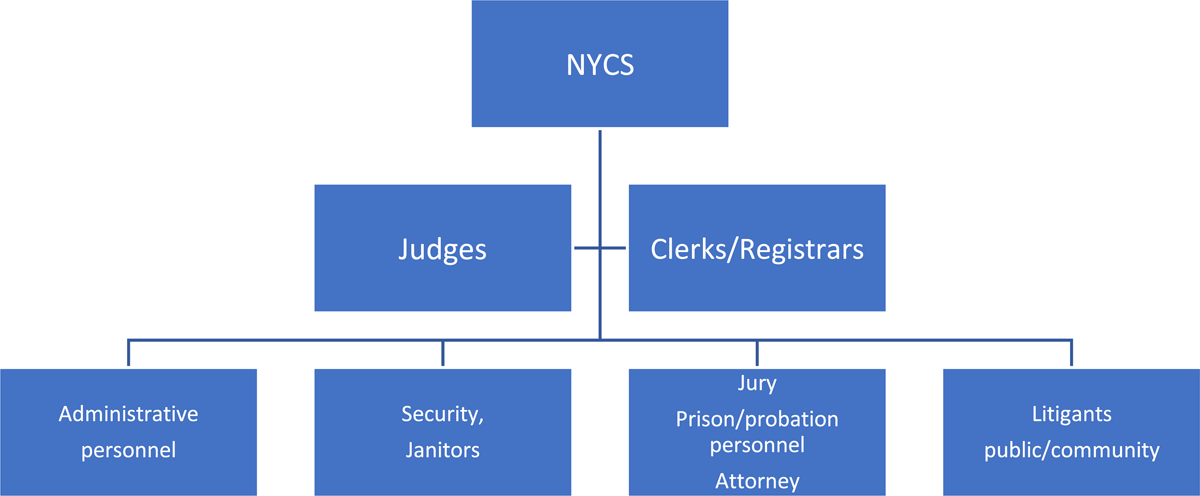
Figure 2
NYSCs key personnel.
Judicial Dilemmas
Judges are not above the reach of implicit racial and cultural biases that pervade our society, yet equality before the law requires them to be.35
Judges encounter judicial dilemmas in their managerial or supervisory roles, which require them to eradicate (or at least attempt to eradicate) implicit bias. These dilemmas could be personal and social.36
Personal Dilemma: judges’ personalities, backgrounds, and idiosyncrasies affect their roles. The duty of judges, primarily, is to adjudicate what is brought before them. Thus, certain factors influence judges’ before they take any decision.37 This underscores the point that not only pure legal issues or considerations influence a judge’s decision.38 The judge’s personal dilemma includes implicit bias and judicial bias. A Nigerian judge argues that “Definitions are definitions because they reflect the idiosyncrasies, prejudices, slants and emotion of the person offering them, while a definer of a word (concept) may pretend to be impartial and unbiased, the final product of his definition will, in a number of situations be a victim of bias.”39 The big question is can judges be free from implicit bias? This question creates a dilemma for judges, as they may become paranoid in performing their roles and apprehensive because of unrealistic public and ethical expectation/requirements.40
Social Dilemma: Culture and societal changes creates social dilemma. From a historical context and based on prevailing social circumstances, social dilemmas include biases in social and historical context that impacts judges’ decisions. Johnson’s report also stated that court officers, attorneys, and judges sometimes lack understanding, empathy, and compassion toward litigants of color.41 These dilemmas impact judicial roles, as judges’ personalities or inadvertent actions may give the public impressions that they are biased, even when they are not.42 Also, equal justice may be a relative term, as people interpret the concepts of equality and justice differently.43 Thus, judges encounter dilemmas in interpreting these concepts as the public understands or as the law dictates.44 The dichotomy between the public’s understanding of justice and what courts interpret as justice creates judicial dilemma.45 An example is the public’s perception in high-profie cases like the Nigerian case of Al Mustapher v. State,46 and the American case of Dobbs v Jackson Women’s Health Organization.47 In both cases, though from different courts and regions, the public criticized the courts of injustice/bias.
Solving Judicial Dilemma
From Johnson’s report, the NYSCS recognizes the need for change and has implemented mechanics to endeavor to eliminate bias, although noting the challenges of implementing the blueprint. So, the next step to eliminate implicit bias, racism, and discrimination to provide equal justice for New Yorkers, is to start from the top, as Johnson recommended.48 More impactful change starts with judges whose ideal roles are to build public confidence and defend the court system’s integrity by interpreting justice from a socio-judicial perspective. The public watches/observes judges’ demeanor and utterances before, during, and after trials, but they rarely give legal interpretations to judges’ demeanors or judicial pronouncements. As most members of the public observing trials are laypeople, they understandably interpret judges’ demeanor from a social/layperson’s perspective. Therefore, judges should apply a socio-judicial concept of justice in court. i.e., judges should interpret justice with social and judicial empathy, using language that the layperson more readily understands as fair or unbiased.
Introducing Socio-Judicialism: A Socio-Judicial Theory/Concept (SJT)
The socio-judicial concept of justice/socio-judicialism is my concept that combines empathy with judging. I propounded this theory to connect/reconnect courts to society by applying judicial and social empathy in decision-making.49 Thus, in redefining the courts’ roles, SJT merges social and judicial roles to interpret justice with empathy. It explains the human face of law/the humanity of judges. If judges have empathy, their staff will empathize. So, judges should lead by example. This theory defines courts as agents of social change and the bridge/intermediary between law and society. So, if the public sees the courts/judges as biased and apathetic to their needs/interests, they lose confidence in the NYSCS.
Therefore, I recommend the following next steps:
NYSC should focus on enhancing the community’s trust in courts.50
NYSCS should educate court staff on their value/impact in building public confidence in courts,
NYSCS should carefully formulate education programs and select the trainers/educators while monitoring the trainers/educators, the programs, and their content, to ensure their impact is essential to the training’s aim.
Juror selection should include male and female black business owners, foster parents, clergy, and regular fastfood workers or waiters of good reputation, despite any possible prior criminal records.
The Chief Judge should review judges’ pre-employment policies/oath of office and non-judicial staff’s employment contracts to include zero tolerance for racism and the possible consequences.
Courts could collaborate with United States Postal Service (USPS) and designate postal boxes with no sender address, just the case title/number, for anonymous complaints,51 which should go through a fairly rigorous process by an independent complaint authority.
NYSCS should establish William Commission52 liaison offices in all county district offices.
NYSCS should adopt quota systems that designate employment positions for all races with equal but alternative employment/appointment requirements.53
NYSCS should employ lawyers as town court judges rather than non-lawyers with no legal training, as some town court judges encourage bias.54
Conclusion
Although the NYSCS/Task Force is taking steps in the right direction, there is still much to do. As part of Newton’s mathematical Law of Motion states, for every action, there is always an equal and opposite reaction; judges’ actions will determine the public’s reactions–confidence in NYSC. In attempting to eliminate implicit bias, racism, and discrimination, judges should focus on building public confidence through applying a socio-judicial approach of empathy to ensure the inclusion of diverse groups.
Notes
[1] Judicial interpretation of justice differs based on the judicial philosophy of the judge. For example, the realist judge will define justice differently from the formalist.
[3] See Tobi-Aiyemo, A (2021) The Role of the Nigerian Judiciary in a Democracy: A Judge’s Dilemma. Dissertation submitted to the University of Nevada, Reno.
[4] Chief Judge Janet DiFiore. Equal Justice in the New York State Court:2020–2021 Year in Review, New York State Unified Court System. at p.2.
[6] Press Release, Hon. Lawrence K. Marks, Aiming to Advance Equal Justice in the Courts, Chief Judge DiFiore Announces Independent Review of Court System Policies, Practices, and Initiatives (June 9, 2020), https://www.nycourts.gov/LegacyPDFS/press/pdfs/PR20_24.pdf.
[32] Dobbin. F and Kalev. A, “Why Diversity Programs Fail: And What Works Better,” Harvard Business Review. July–Aug 2016. Retrieved from https://www.google.com/url?sa=t&rct=j&q=&esrc=s&source=web&cd=&cad=rja&uact=8&ved=2ahUKEwijqPGQq4L9AhUhF1kFHedIARYQFnoECA8QAQ&url=https%3A%2F%2Fhbr.org%2F2016%2F07%2Fwhy-diversity-programs-fail&usg=AOvVaw18rc6KjAKXk-Fz8olaHbQW.
[38] Wigwe.C.C (2016) Judicial Idiosyncrasies and the Place of Religion in Judicial Law Making. British Journal of Advanced Academic Research 5 (1) 21–26.
[43] Justice in American Thoughts. Retrieved from: https://www.google.com/url?sa=t&rct=j&q=&esrc=s&source=web&cd=&ved=2ahUKEwiv3vzV2pL9AhW7jYkEHXpXBVYQFnoECAwQAQ&url=https%3A%2F%2Fwww.encyclopedia.com%2Fhistory%2Fdictionaries-thesauruses-pictures-and-press-releases%2Fjustice-american-thought&usg=AOvVaw2o2qSaoo1-ymaTsGpuYSgD.
[46] Al Mustapher v. State (2013) 17 NWLR (pt. 1383) at p. 350. Mr. Al-Mustapha, a former chief security officer to the late dictator president, Sani Abacha was sentenced to death by hanging for conspiracy and murder of Mrs. Abiola, the late pro-democracy campaigner and wife of the presumed winner of the June 12, 1993 Nigerian presidential election, the late Chief Moshood Kashimawo Abiola. The Court of Appeal overturned the Lagos High Court’s judgment on grounds that the prosecution failed to prove their case beyond reasonable doubt. The Court of Appeal stated that public opinion influenced the trial judge’s decision to secure a conviction by all means.
[47] Dobbs v Jackson Women’s Health Organization, No.19-1392,597 U.S._2022, the U.S Supreme Court’s Landmark decision, which overturned Roe v Wade, where the Court held that the U.S. Constitution does not confer a right to abortion. See also the case of The People of California v O.J.Simpson, where the former football star was acquitted for the murder of his wife.
[52] The Franklin. H. Williams Judicial Commission, otherwise known as the Williams Commission is the New York State Judicial Commission on Minorities created in 1988 to educate and advise decision makers in the New York Court System on issues affecting both employees and litigants of color, and implement recommendations developed to address these issues.
Author Note
*This author presented this paper to the Task Diversity Task Force/Equal Justice in the Courts Committee, The 6th Judicial District New York State Unified Court System (Friday, July 22, 2022.).
Competing Interests
The author has no competing interests to declare.