
1. Introduction
At first glance, adults with declining cognitive abilities (DCA) and children seem like two distinct groups. However, both groups may experience restrictions in their legal capacity due to limits in their decision-making capacity. Legal capacity enables individuals to make legal decisions about their person or property independently and ensures that these decisions are recognized by law.1 The presumption of legal capacity, common in Western jurisdictions, is based on the premise that people generally have decision-making capacity.2 By ‘decision-making capacity’ we refer to the practical ability of individuals to grasp the nature and consequence of a decision and to make choices in that regard, whether legally effective or not.3
Children lack or have limited legal capacity until they reach the age of majority, i.e., adulthood.4 Their decision-making capacity increases over time as they age and mature.5 The legal guardians of children, most often their parents, legally represent their children and therefore have the power to take decisions on their behalf. An opposite trajectory can be observed in the case of adults with DCA. Their decision-making capacity gradually decreases due to cognitive decline, which can range from subtle changes in cognition to the development of Alzheimer’s disease.6 This impaired decision-making capacity may result in a restriction of their legal capacity and/or the appointment of a legal guardian to assist them with decision-making.7
The rights of children and adults with DCA in respect of decision-making are contained in several international human rights instruments.8 For children, the key treaty is the United Nations Convention on the Rights of the Child (CRC).9 Since the CRC’s introduction in 1989 and its almost universal ratification, it has been indispensable in furthering children’s rights in decision-making.10 For adults with DCA, the United Nations Convention on the Rights of Persons with Disabilities (CRPD) is of core importance.11 The CRPD, introduced in 2006, provides rights and freedoms for both children and adults with long-term physical, mental, intellectual or sensory impairments, thereby including adults with DCA in its scope.12 Whereas both the CRC and the CRPD cover the area of decision-making, they each provide different rights and principles in this regard. For instance, whereas the CRC stipulates the right to participation, the principle of the child’s best interests and the principle of evolving capacities,13 the CRPD contains the right to support in the exercise of legal capacity.14 Interestingly, children with disabilities are covered by both the CRC and the CRPD. However, these children do not have a right to legal capacity under Article 12 CRPD, as the CRPD makes clear that these children ought to be treated on an equal basis to other children. According to Article 7 CRPD, both the best interests principle and the right to participation apply equally to children with and without disabilities, reflecting Articles 3 and 12 of the CRC.
This article will compare the decision-making rights and principles of the CRC and CRPD as they apply to children and to adults with disabilities respectively, aiming to explore whether this comparison may provide new insights and lessons for both groups. At present, the scholarly work on children’s rights and the rights of adults with DCA interacts only slightly. Both fields of study use different paradigms and terminology and focus on diverging issues that these groups encounter. Comparisons between the groups do occur, however, especially in research on vulnerable groups,15 on children with disabilities,16 on the potential for a human rights convention for older persons,17 and in the field of medical research and consent.18 In this last field, Dalpé, Thorogood and Knoppers eloquently write that ‘despite many similarities, the life and [decision-making] capacity […] trajectories of these two populations trend in opposite directions, offering a rich opportunity for comparison’.19
Considering the opposite trajectories in decision-making of children and adults with DCA, this article departs from the (legal) reality that children lack legal capacity as legal incapacity is presumed.20 By contrast, in the case of adults with DCA, legal capacity is presumed, and only restricted when their decision-making skills are impaired or when a legal guardian is appointed. With this central distinction in mind, this article will commence with a comparison regarding the main decision-makers (Section 2) and the different types of decisions (Section 3), followed by a comparison of the rights to participation and support (Section 4) and a comparison of the use of the best interests principle (Section 5). Finally, this article will visualize this comparison in a conceptual model (Section 6) and explore the lessons which can be learned for both groups (Section 7).
2. Identifying and comparing the decision-maker
The first key difference between the rights of children and adults with DCA under the CRC and CRPD within decision-making processes has to do with the question: who is the decision-maker?
Children are generally not the decision-makers in decisions affecting them, because they lack legal capacity or have limited decision-making capacity (as discussed above). In both legal and day-to-day decisions, a child’s parents will function as the main decision-maker. Parents, as the holders of parental responsibilities, have the right and duty to care for and protect the child. This typically also includes the administration of a child’s property and the legal representation of the child.21
Within the framework of the CRC, the special role of parents in the upbringing of their children is provided in Article 18 which recognizes parents’ responsibilities in the care and development of their children.22 More importantly, Article 5 CRC addresses the role of parents in decision-making. According to Article 5 CRC, States Parties shall respect the responsibilities, rights and duties of parents, other members of the extended family or community and other persons legally responsible for the child, ‘to provide, in a manner consistent with the evolving capacities of the child, appropriate direction and guidance in the exercise by the child of the rights recognized [in the CRC]’. This phrasing addresses the triangular relationship between child, parents and the state and provides rights or obligations for all three.23 It grants children the right to ‘receive appropriate direction and guidance’ from their parents or other care givers, while at the same time granting parents the right to provide this direction and guidance and obliging states to respect parents’ rights in this regard.24 Article 5 CRC is especially relevant for decisions within the family setting,25 where it can be understood to envision children to gradually become joint decision-makers with their parent(s) or to make decisions individually as their capacities evolve.26 The implementation and enforcement of Article 5 within the family for everyday decisions is difficult, because it concerns the parent-child relationship and parents – unlike states – are not party to the Convention.27 However, one may hope that Article 5 reflects a reality in which the views of children are taken into account within the family environment for everyday decisions.28
By contrast, the CRPD focuses on persons with disabilities as the main decision-making agents. At the heart of this focus lies Article 12(2), which requires States Parties to recognize that all persons with disabilities enjoy legal capacity on an equal basis with others in all aspects of life. According to the CRPD Committee, this term includes the capacity to have rights (‘legal standing’ or ‘passive legal capacity’) and the legal capacity to act on those rights (‘legal agency’ or ‘active legal capacity’).29 The CRPD Committee further describes legal capacity as ‘an inherent right accorded to all people’, which must be upheld at all times in order for individuals to exercise other civil, political, economic, social and cultural rights.30 The emphasis on persons with disabilities as the main decision-making agents is also present in several other provisions of the CRPD. For instance, both the Preamble and Article 3 stipulate the importance for this group to have the freedom to make their own choices.31
The CRPD Committee also promotes the active involvement of persons with disabilities in decision-making by encouraging ‘advance planning mechanisms’.32 These mechanisms enable individuals to anticipate for future times of decision-making incapacity whilst they are still capable of making decisions. Adults with DCA may for instance create a legal document in which they state their preferences regarding certain healthcare or financial matters, and/or appoint a person to represent these preferences for a time when they have limited decision-making capacity.33 Importantly, the creation of these advance planning documents does not result in a restriction of legal capacity.
As explained in Section 1, the CRPD Committee’s strong statement against limiting legal capacity applies only to adults with disabilities. In the case of children with and without disabilities, the starting point of legal incapacity remains, seeing that Article 7 CRPD re-enforces the equal treatment between all children and the interplay between the CRPD and the CRC.34 In light of children’s need for protection (especially in the younger years), parents provide a natural substitute decision-maker. This is even more so as parents are responsible for the care of their children, which includes the upbringing of children as well as providing for the conditions of living for children. What is more, children do not have the possibility to anticipate for future decisions as their decision-making capacity will increase over time. Additionally, whereas adults with DCA may include decisions regarding their own property and means for ensuring an adequate standard of living in advance planning mechanisms, children are dependent on their parents and their means and often have no personal property to decide about in the first place.
3. Comparing the types of decisions: different decisions, different rights?
Another comparison to be made between the decision-making rights provided by the CRC and the CRPD relates to the types of decisions that are concerned. The focus of this article is on private decision-making, as opposed to collective or public decision-making.35 Various types of private decisions exist: there are everyday decisions, such as deciding when and what to eat, common legal decisions, such as buying food or toys, and more specific (legal) decisions, such as medical decisions and decisions in the field of family law.
If they are, in practice, able to, children can take everyday decisions, such as deciding what to wear, although their parents may limit these decisions by virtue of their parental authority. This practical reality is reflected in Article 5 CRC, as discussed above. Article 12 CRC provides children with the right to express their views and for their views to be given due weight in all decisions affecting them, including in everyday decision-making as emphasized by the CRC Committee.36 This is also known as the right to participate.37 With regard to legal decisions, children lack legal capacity. There may be, however, exceptions in national family laws to the presumption of children’s legal incapacity even though this is not provided for by the CRC. In many jurisdictions, for example, it is common that medical laws provide for a framework in which children are afforded increasing participatory rights in their personal medical decisions and where, from a certain age or level of capacity, children are afforded self-determination rights in these medical decisions.38 Children may also be provided explicit rights to initiate certain legal proceedings and make certain legal decisions (often dependent on an age limit or required level of capacity) in domestic family laws.39 However, these rights are commonly very limited in scope and restricted through age limits or capacity standards. For example, in the Netherlands children from the age of 16 have the opportunity to change their legal gender and children from the age of 12 may opt to change their surnames upon certain conditions.40 In legal decisions or proceedings where children lack legal capacity, their right to participate provided in Article 12 CRC provides some solace in the form of having a voice. This is further discussed in Section 4.
For adults with DCA in the context of private decision-making, the right to legal capacity as contained in Article 12 CRPD enables adults with disabilities to make decisions that have legal effect.41 These decisions may include, but are not limited to, the choice to marry, to sign a contract, to request a loan and to consent to medical treatment. In practice, the exercise of legal capacity often exceeds ‘legally relevant’ decisions, as guardians or other caregivers may be involved to assist adults with DCA with making various everyday decisions.42
The comparison shows that the type of decision may impact the rights provided to both children and adults with DCA. For decisions with legal effect, such as those in the field of personal status and family law or medical decisions, the CRPD provides adults with DCA the right to legal capacity and thus the right to decide themselves (potentially with support). In contrast, the CRC does not provide children with a right to legal capacity, nor do most national jurisdictions. Instead, children are granted participation rights in the decision-making process. Everyday decisions are often neither the focus of domestic laws, nor of human rights instruments, although for both children and adults with DCA decision-making rights can be considered to apply equally to these decisions. The difficulty is that because these decisions are taken behind closed doors, states have less power to address them. Instead the state must suffice with encouraging the individuals and third parties involved, through legislation, policy or media, to provide decision-making rights to adults with DCA or children.
4. Comparing participation rights to supported decision-making
Third parties such as parents, partners, guardians or others are often involved in the decision-making processes of children and adults with DCA. In this context, the CRC and the CRPD stipulate certain rights to ensure that children and adults with DCA take part in these processes themselves.
In the case of children, Article 5 CRC provides a framework for the relationship between parents and children which is especially relevant in everyday at-home decision-making. Additionally, Article 12 CRC provides children with the right to participate in any decisions affecting them. This means that children have to be granted the opportunity to express their views and that these views must be given due weight. It does not mean, however, that children have an absolute right to self-determination.43 The decision-maker must give due weight to the child’s views and, following Article 3 CRC, must make a decision in the best interests of the child (as will be discussed more extensively in Section 5). A key factor in determining due weight, according to Article 12 CRC, is the child’s age and maturity.44 In that regard, the relationship with the concept of ‘evolving capacities’ in Article 5 CRC is important.45 This concept refers to ‘the processes of maturation and learning whereby children progressively acquire knowledge, competencies and understanding’.46 The evolving capacities of the child are relevant for the weight granted to a child’s views in establishing their best interests: as a child matures, their views ought to be more influential for this determination.47 When parents act as decision-makers, as they often do for children, they also ought to adhere to the child’s right to participate as emphasized by the CRC Committee, even if the CRC does not address them directly.48 For some legal decisions, for example in the field of family law, national courts will act as (back-up) decision-makers.49 This may be the case when the court has the sole power to make the decision, or when parents are not able to reach decisions in harmony, e.g. following a separation or divorce. Article 12(2) CRC provides children with the right to participate in these proceedings.50 In implementing this right, domestic laws will often provide children with various means of participation in legal proceedings, including direct participation or participation through representation.51
Instead of granting persons with disabilities the right to participate in decision-making processes, the CRPD takes it one step further by stipulating that this group has the right to make independent decisions that have legal effect. On account of Article 12(3) CRPD, States Parties ought to ensure that persons with disabilities can continue exercising this right by providing them with ‘support’ when required.52 The CRPD Committee describes the term ‘support’ as encompassing ‘both informal and formal support arrangements, of varying types and intensity’, which may include, but is not limited to, peer support, advocacy, advance planning, and assistance with communication. The CRPD Committee also states that support in the exercise of legal capacity must always take the form of ‘supported decision-making’ as opposed to ‘substitute decision-making’.53 While supported decision-making respects the own will and preferences of persons, substitute decision-making can be imposed against the will of the individual concerned and often results in a limitation or deprivation of legal capacity.54
These stipulations by the CRPD Committee have been regarded as highly controversial. For instance, many States Parties adopted a stance against the CRPD Committee’s requirement to abolish all forms of substitute decision-making by issuing a reservation or declaration to Article 12 CRPD.55 Similarly, various authors have questioned whether compliance with the CRPD requires abolition of substitute decision-making.56 Richardson for example argues that Article 12(4) seems to tacitly allow for substitute decision-making in exceptional cases, by listing the requirements that normally accompany these regimes, such as the requirement for a time constraint and a regular review.57 Interestingly, the travaux préparatoires of the negotiations for the CRPD show that considerable debate took place on the inclusion of the use of guardianship and substitute decision-making in Article 12(4). Whereas some states proposed that this paragraph should incorporate safeguards on the use of guardianship, others insisted that such language be removed to avoid reinforcing ‘the traditional abusive systems’.58 According to Dhanda, Article 12(4) was ultimately phrased in a way to ensure that ‘each person could see what they desired in the paragraph, and thus provide consent to the proposal’.59
A number of authors have also criticised the CRPD Committee’s interpretation of Article 12 for failing to correspond with the reality of persons with disabilities.60 The CRPD Committee for instance states that one of the aims of support in the exercise of legal capacity is to ‘build confidence and skills of persons with disabilities so that they can exercise their legal capacity with less support in the future’.61 This statement may not correspond with the reality of adults with DCA, who might not require less support in the future, but more.62 Two phenomenological interview studies for instance show that substitute decision-making seems to be used by virtually all family carers of adults with DCA.63
On the whole, the CRC appears to be based on the idea that parents, judges or other third parties are better able to determine what is in the child’s best interests than children themselves. Yet this Convention also emphasises the importance of listening to children for this determination, giving more weight to their views in accordance with their age, maturity and evolving capacities. Conversely, the CRPD notes that the support provided to persons with disabilities, including adults with DCA, who require assistance with exercising legal capacity, must follow the own will and preferences of this group. In other words: the CRPD seems to presume that they themselves ‘know what’s best.’ Section 5 will discuss how these diverging underlying beliefs about involvement in decision-making are reflected in the different use of the ‘best interests principle’ by the CRC and the CRPD.
5. The use of the best interests principle
A final key difference between the decision-making rights of children and adults with DCA can be observed in the interpretation and connotation given by the CRC and the CRPD to the ‘best interests principle’.
Article 3(1) CRC provides that the best interests of the child shall be a primary consideration in all actions or decisions concerning individual children or children collectively. This fundamental principle imposes an obligation on decision-makers, both public and private, to carefully consider the best interests of the child.64 In light of decision-making, the child’s best interests principle is relevant both as a substantive right and rule of procedure in relation to the right provided by Article 12 CRC. As a substantive right, the child’s best interests must be the primary consideration when different interests are considered.65 Additionally, as a rule of procedure Article 3 CRC requires that each decision-making process must include an assessment and determination of the best interests of the child.66 How does this relate to the child’s right to participate in Article 12 CRC? Although many authors note the tension between Article 3 and Article 12 CRC both theoretically and in practice,67 the CRC Committee emphasizes the complementary relationship between the two rights.68 According to the Committee the child’s views should function as an element in determining their best interests, increasingly so as the child matures.69 Both provisions emphasize the necessity of participation in decision-making so that a child’s views may be expressed and taken into account when determining their best interests.
In practice, child participation and the assessment of the child’s best interests are common to legal proceedings, especially those within the area of family law. However, this does not mean that children’s views are consistently heard and included in the assessment of the child’s best interests in legal proceedings. Additionally, one may question whether parents – as a child’s legal representative – are always best suited to represent the child’s best interests in proceedings where there may well be conflicts (of interest) between child and parent or between parents. In contrast, for everyday decisions, parents may not be aware of the procedural decision-making rights of children. While parents may take some daily decisions specifically in the best interests of their child,70 one may question whether they always explicitly consider the child’s views in the decision-making. Additionally, parents may also take many decisions in the interests of the family as a whole – not focusing specifically on the best interests of the child. Again, the nature and relative invisibility of everyday decisions impedes the application of children’s rights to a certain extent.
In line with Article 3 CRC, Article 7(2) CRPD states that in all actions concerning children with disabilities, the best interests of the child shall be a primary consideration. Yet when it comes to adults with disabilities, the CRPD Committee strongly condemns the best interests principle. According to the CRPD Committee, this principle is often used by substitute decision-makers who base their decisions on what is supposedly in the ‘objective’ best interests of the individual concerned, for instance to avoid risks.71 Nonetheless, according to the CRPD Committee, all adults with disabilities have the right to take risks and make mistakes.72 Instead of using the best interests principle, the CRPD Committee notes that all decision-making supporters should respect the own will and preferences of persons. What if it is impossible to determine the will and preferences, for instance when people are in a coma or a vegetative state? In such cases, the CRPD Committee holds that supporters should make a ‘best interpretation’ of an individual’s will and preferences, rather than making a substitute decision, with the best interests of that individual in mind.73 Some authors maintain that this ‘best interpretation approach’ could absolve supporters from accountability since the ultimate responsibility for the decision lies with the adult concerned.74 In addition, the CRPD Committee received criticism for failing to address certain ‘hard cases’, such as the situation where a person has conflicting or dangerous will and preferences.75
Comparing the best interests principle shows a crucial distinction between the two groups. Whereas for children, the best interests principle is a fundamental right and rule of procedure, for adults with DCA the best interests principle is condemned as a paternalistic substitute decision-making approach. This distinction is not treaty specific: while the CRPD Committee condemns its application for adults, it emphasises that the best interests principle should be applied to children with disabilities.76 Instead, the distinction can be explained by the different connotations which the principle has for each group. For adults with DCA (and other adults with disabilities), the best interests principle is criticized as insufficiently respecting the own will and preferences of the involved person, instead providing much room (and power) to third parties, such as guardians, to make a decision on behalf of the adult. In contrast, for children the best interests principle is widely accepted, even if it is also criticised as being paternalistic and difficult to implement due to its indeterminacy.77 The benefit of the child’s best interests principle is that it requires decision-makers to consider and evaluate the impact of decisions on children, rather than overlook children, which was historically often the case.78
6. Conceptualizing decision-making rights of children and adults with DCA
The previous Sections discussed four key differences between the decision-making rights of children and adults with DCA as provided by the CRC and CRPD. This Section will attempt to visualize how these different rights relate by using a conceptual model, shown in Figure 1 below.
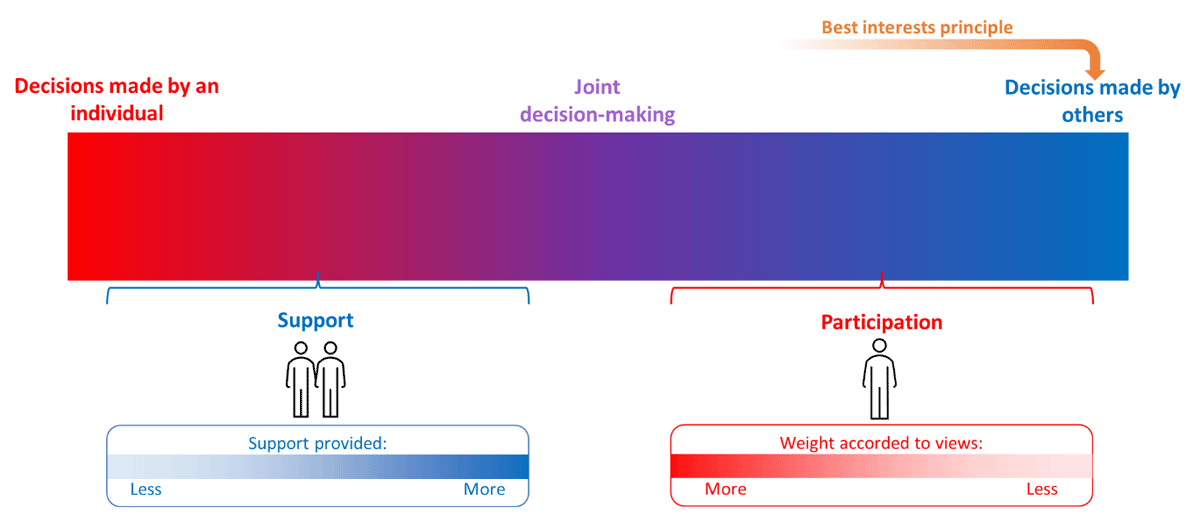
Figure 1
The decision-making rights of children and older persons with DCA.
The centre of our conceptual model focuses on the question: who has the right to make a certain decision? The answer comes in the form of a gradient which signifies the type of decision-making: from decisions made by an individual on the left, to joint decision-making in the middle, to decisions made by others on the right. The reason for choosing a gradient is twofold. First, a gradient signifies that the distinction between decisions made individually, jointly, or by others, is not always black and white. For instance, some persons may not be able to make a decision independently, but can still be involved in a decision-making process. Secondly, our choice of a gradient serves to emphasize that there is no inherent hierarchy in types of decision-making. As mentioned by Hart and Charles and Haines, for children individual decision-making is not inherently better than joint decision-making or decisions made by others.79 Children themselves mentioned that sometimes they may want to make decisions themselves, while at other times they may prefer decisions to be made by others.80 Likewise, some adults with DCA might wish to delegate certain decisions to a spouse or partner.81
The scope of decision-making rights can be dependent on various individual, decisional, and environmental factors. A variety of individual factors may have a bearing on these rights, including the individual’s legal status before the law (i.e. their legal capacity) as discussed in Section 2, a person’s decision-making capabilities, self-confidence, and preferences regarding involvement in decision-making.82 For adults with DCA, a particularly relevant individual factor is their stage of cognitive decline.83 In the case of children, their age and maturity will in all probability strongly influence the rights granted to them. In addition, as explained in Section 3, the type of decision may influence the decision-making rights granted, seeing that everyday decisions may carry different implications from legal decisions.84 Finally, certain environmental factors may also influence decision-making rights. These factors might include a person’s access to information and services, the cultural context and the involvement and influence of third parties, such as legal guardians, family members, parents, medical professionals, and judges.85 Third parties can for example influence a person’s decision-making rights on account of their attitudes towards childhood or dementia.86
The conceptual model also illustrates the two adjacent decision-making rights provided in the CRC and CRPD that were discussed in Section 4: the right to participate in decision-making processes and the right to receive support in the exercise of legal capacity, respectively. We included both ‘Support’ and ‘Participation’ as both may be relevant for children and older persons with DCA. By ‘Support’ we mean the involvement of a third party (e.g. a partner, parent, guardian, or other) who provides support in decision-making. This support can also be provided to children through parents or other trusted adults, i.e. family members, teachers, etc. In a similar vein to Article 5 CRC, for decisions in which children may either individually or jointly make decisions, parents or others could give ‘appropriate direction and guidance’. They may accordingly provide decision-making support to children in so far as they make room for the child’s expressed views. The term ‘Participation’ refers to the opportunity of the individual (e.g. the child or the older person with DCA) to express their views in the decision-making process and for these views to be taken into account, i.e., given due weight by the decision-maker. A unique way in which adults with DCA can participate in decision-making is by creating an advance planning document. As explained previously, adults with DCA may outline their preferences regarding various matters when they are still capable of making decisions. These documents may accordingly guide family members, guardians or others when the decision-making capacity of adults with DCA becomes impaired.
The placement of ‘Support’ and ‘Participation’ under the gradient of decision-making is meant to show their relation to decision-making powers. Support leads to a shift from purely individual decision-making towards more joint decision-making without actually providing the third person with any power or position to take the decision on an equal footing with the individual. The more support provided, the more decision-making will become a joint endeavour. Similarly, participation of an individual in decisions made by others moves the decision from a pure substitute decision (without consideration of the will and preferences of the individual) towards joint decision-making. Specifically, the more weight granted to an individual’s views within the decision-making process, the more the decision moves toward joint decision-making.
Finally, our conceptual model includes the best interests principle. As discussed in Section 5, the best interests principle is fundamental for decision-making affecting children, whereas it is contested for adults with DCA. Nonetheless, we have opted to include it in our model for both groups as we believe that, in practice, when decisions are made by others for children or adults with DCA, the best interests principle provides an obligation for decision-makers to seriously consider the interests of the person concerned. That is not to say that we endorse substitute decision-making over supported decision-making for adults with DCA, rather that we acknowledge the reality that supported decision-making may not always be feasible or fitting in certain circumstances. This issue will be further expanded in Section 7.
7. What lessons can be learned from comparing the decision-making rights of children with those of adults with DCA?
The aim of this article was to compare the decision-making rights of children with those of adults with DCA under the CRC and the CRPD, exploring whether this comparison could provide lessons for both groups. Four key aspects were discussed: the decision-maker, the types of decisions, the right to participation versus the right to support in the exercise of legal capacity, and the best interests principle. This final Section attempts to clarify lessons to be learned from the comparison, relating specifically to the CRC and the CRPD.
To start with, what can children’s rights scholars learn from the decision-making rights of adults with DCA and specifically the CRPD? There are three main points which can be explored: (1) whether the presumption of children’s legal incapacity should be amended to a presumption of capacity, as is the case for adults;87 (2) whether children should be provided with supported decision-making as outlined by the CRPD Committee; and (3) whether this provision of supported decision-making should be limited to children with decision-making capacity, emphasizing the best interests principle for children without decision-making capacity.88 All three points are highly interrelated as they touch upon legal capacity and supported decision-making.
The statements of the CRPD Committee about supported decision-making do not apply to children with disabilities, which can be explained by the fact that it could not provide children with disabilities with more rights than children without disabilities.89 In addition, would providing children with supported decision-making for legal decisions not also require the recognition of children’s legal capacity? If so, that again raises the first point whether a presumption of capacity for children would be desirable, a debate which reaches beyond the scope of this article. However, even if we stick to the status quo – i.e. legal incapacity – one may argue that a limited expansion of legal capacity for children could be advantageous. This could be in the form of a lower age threshold for legal capacity and/or for certain types of decisions. Taking that route would require states to critically contemplate the consequences of expanding legal capacity for children (balancing their protection and autonomy), their parents, and third parties.
What if we limit the question of providing children with supported decision-making to everyday decisions? It can be argued that explicating support in decision-making processes is not necessary as Article 5 CRC already provides grounds for parents to assist and support children in decision-making as they mature. The principle of evolving capacities recognizes that the balance between parents’ authority and children’s autonomy will increasingly shift towards more autonomy for children. Support in joint and individual decision-making can therefore be read into the text of the CRC. What is required, however, is the willingness of adults, especially parents, to increasingly allow children to make their own decisions. There may be valid reasons for parents to keep their decision-making power, in light of the interests of the family as a whole, to protect the child or due to certain limitations (e.g. financial or practical limits). The position of parents as the holders of parental authority and the givers of support may therefore be problematic as conflicts of interest may arise.
In considering whether or not to provide supported decision-making to children, Sandland argues that children with decision-making capacity could be offered supported decision-making, whereas substitute decision-making through the best interests principle is suitable for children without decision-making capacity.90 There is an argument to be made that the best interests principle is too paternalistic and may unreasonably trump a child’s own wishes. As discussed in Section 5, in theory, the best interests principle should be complemented by the right to participate and therefore a child’s views should increasingly form part of the best interests determination as the child matures. However, in practice, the child’s views are sometimes too easily set aside. In decisions where the best interests of the child form the primary consideration and the interests of others play no or only a very limited role, the child’s views may arguably be given more weight. Daly goes one step further and proposes a ‘children’s autonomy principle’ in these types of decisions whereby the child would be granted the opportunity to choose the outcome, unless significant harm would arise from doing so.91 In essence, this would require adults to be more specific about the ‘significant harm’ that would occur to children, were their views to be followed. Whether there are many decisions in which a child’s best interests are the primary consideration rather than a primary consideration can be debated and will depend on national laws; in many decisions the interests and rights of others remain relevant. Additionally, it can be argued that the current rights provided by the CRC, through Articles 3, 5 and 12, already provide sufficient grounds for the serious consideration of the child’s wishes in decision-making by others.92 However, the correct application of these rights may currently be hampered by adults overriding children’s views with their own paternalistic views of what is best.
Moving on, what can disability rights scholars learn from the decision-making rights of children? According to the CRPD Committee, decision-making assistance should not be based on the decision-making capacity of individuals, but rather in terms of their need for support to exercise legal capacity.93 As Bach and Kerzner put it: ‘the question is no longer: does a person have the mental capacity to exercise his/her legal capacity? The question is instead: what types of support are required for the person to exercise his or her legal capacity?’94 The standard of the CRPD in terms of decision-making rights leans towards the left side of the conceptual model (see Figure 1 above). This Convention views persons with disabilities as the possessors of legal capacity, able and willing to make independent decisions that have legal effect, albeit with support. However, as mentioned before, some adults with DCA may require or even wish for joint or substitute decision-making. The CRPD Committee’s approach to decision-making rights fails to sufficiently articulate these needs or wishes. The alternative interpretations of Article 12(4) CRPD that were discussed Section 4 seem to better align with the situation of adults with DCA since they endorse substitute decision-making in exceptional cases.95
By analogy, the CRC’s use of ‘evolving capacities’, may be relevant in this context: the more an older person’s cognitive abilities decline, the less weight might be given to their views.96 Let’s say that Alex, a 65-year-old man, was recently diagnosed with dementia. Alex has now fallen in his home and was badly hurt. He, his doctor and his wife, Sophie, discuss how it might be safer for Alex to move to a nursing home, taking into account the fact that Sophie is physically unable to pick him up after a fall. At this point in time, Alex merely experiences subtle changes in cognition. He accordingly has the ability to decide whether he still wishes to continue living at home, taking into account the risk of another fall. Now suppose that Alex was faced with this choice when his decision-making capacity has become more severely impaired. In that case, Sophie might use joint decision-making approaches such as reducing cognitive overload, for instance by asking which of two potential nursing homes would be his preferred option. Going one step further, Alex has now reached the late stage of dementia and is unable to understand the meaning of the decision as to whether he should move to a nursing home. Sophie may then make this decision for Alex with his best interests in mind. By analogy with the CRC’s evolving capacities, she may give increasingly less weight to Alex’s views about this matter in a manner consistent with his diminishing capacities. This strategy may already be a common practice among family carers of adults with DCA, who seem to gradually use more substitute decision-making over time, while relying on different decision-making strategies along the way.97
Still, these potential lessons cannot be explored without recognising the distinctive characteristics of both groups as well as the diversity within these groups.98 The rights granted to children and adults with DCA and the way in which these rights are interpreted remains specific to each group individually, in part due to the diverging prevailing societal views about these groups. For instance, the CRPD Committee relates the importance of its stipulations about legal capacity and supported decision-making to the way in which persons with disabilities have been treated by society over time.99 Throughout history, states have presumed – and sometimes continue to presume – that the mere existence of a disability is enough reason to assume that individuals lack the ability to make decisions.100 Many states have accordingly provided this group with assistance and protection by means of guardianship measures, resulting in a limitation or deprivation of their legal capacity.101 The CRPD and the CRPD Committee strive to counter this practice by viewing persons with disabilities as ‘subjects’, entitled to full legal capacity – albeit with support – as opposed to ‘objects of pity’, in need of protection by substitute decision-makers.102 Whereas the CRPD’s stipulations may not always be consistent with the practical reality of adults with DCA, they can rightfully be described as a ‘paradigm shift’ in the way we think about persons with disabilities.103 With the introduction of the CRC, authors also spoke of a ‘paradigm shift’ with regard to the recognition of children’s participation rights. Although not going as far as recognizing children’s legal capacity in any form, recognising children’s voices and views was innovative.104 Children were recognized as rights holders rather than solely objects of rights through their rights in decision-making, even if the status quo of children’s legal incapacity has remained.
To conclude, this article has shown that the approaches of the CRC and the CRPD on decision-making seem to represent two ends of the spectrum: the CRC does not offer children a right to legal capacity, yet their views should increasingly be taken into account by means of participation and the child’s best interests principle. Conversely, the CRPD stipulates that the right to legal capacity must be upheld at all times for adults with DCA, possibly combined with the provision of support. However, the reality of many children and adults may be more nuanced. For instance, some children may be able to make independent decisions when provided with the support they require. Similarly, some adults with DCA might prefer participating in a decision-making process, rather than making a decision by themselves. The interpretation and application of the decision-making rights provided by the CRC and CRPD may therefore require a more flexible and tailor-made approach that is dependent on the individual, the type of decision concerned and the environment in which the decision is taken. Perhaps most important is the recognition that children and adults with DCA have rights in decision-making, regardless of their youth or declining cognitive abilities.
Notes
[1] See M W Hesselink, ‘Capacity and Capability in European Contract Law’ (2005) 4 European Review of Private Law, 493–494; C P Sabatino & E Wood, ‘The Conceptualization of Legal Capacity in Older Persons in Western Law’ in I Doron & A M Soden (eds.), Beyond Elder Law: New Directions in Law and Aging (Springer, 2012), 35; B Lewis et al., The Human Rights of Older Persons: A Human Rights-Based Approach to Elder Law (Springer, 2020) 139, 140; A Daly, ‘Assessing Children’s Capacity: Reconceptualising our Understanding through the UN Convention on the Rights of the Child’ (2020) 28 International Journal of Children’s Rights, 474.
[2] Decision-making capacity, also known as ‘mental capacity’, may precede legal capacity, as it can be a requirement for legal capacity, but it can also function as a separate requirement, for example when making medical decisions. See e.g., Purser, Capacity Assessment and the Law: Problems and Solutions (Springer, 2017), 5.
[3] Daly (n 1), 473–474; Purser (n 2), 4; N J Munn, ‘Capacity, Consistency and the Young’ in J Drerup et al. (eds.), Justice, Education and the Politics of Childhood: Challenges and Perspectives (Springer, 2016), 57.
[4] Hesselink (n 1), 494; P Varul et al., ‘Restrictions on Active Legal Capacity’ (2004) IX Juridica International, 100; E K M Tisdall, ‘Challenging Competency and Capacity? Due Weight to Children’s Views in Family Law Proceedings’ (2018) 26 International Journal of Children’s Rights, 163.
[6] The main risk for cognitive decline is old age. N A Bishop et al., ‘Neural Mechanisms of Ageing and Cognitive Decline’ (2010) 464 Nature; I J Deary et al., ‘Age-Associated Cognitive Decline’ (2009) 92 British Medical Bulletin.
[7] European Union Agency for Fundamental Rights, Legal capacity of persons with intellectual disabilities and persons with mental health problems (European Union Agency for Fundamental Rights, 2013), 27–33.
[8] Within Europe, there are several relevant Council of Europe instruments for the decision-making rights of children and adults with DCA, such as the European Convention on Human Rights, the European Convention on the Exercise of Children’s Rights, the Council of Europe Recommendation on the human rights of older persons, and the Recommendation on principles concerning the legal protection of incapable adults. These instruments fall outside the scope of this article.
[9] Convention on the Right of the Child (adopted 20 November 1989, entered into force 2 September 1990) 1577 United Nations Treaty Series 3 (‘CRC’).
[10] See for example regarding family law proceedings, M Bruning et al., ‘Conclusion’ in W Schrama et al. (eds.), International Handbook on Child Participation in Family Law (Intersentia, 2021), 14–15.
[11] Convention on the Rights of Persons with Disabilities (adopted 13 December 2006, entered into force 3 May 2008) UNGA A/Res/61/106 (‘CRPD’).
[12] In the literature, it is generally acknowledged that adults with declining cognitive abilities fall under the scope of the CRPD. See S Cahill, Dementia and Human Rights (Policy Press, 2018); T S Wied et al., ‘The Human Right to Make One’s Own Choices – Implications for Supported Decision-Making in Persons With Dementia’ (2019) 24 European Psychologist.
[13] CRC (n 9), Arts 12, 3 and 5 CRC. As per the CRC Preamble, the Convention departs from the understanding that although children have inherent dignity and rights just as all persons do, children are entitled to special care and assistance, ‘including appropriate legal protection’. The meaning of this phrase is not clear, but it can be understood as having rights, having opportunities to access justice and being subject to protection through the law.
[14] Several other provisions of the CRPD resonate with the focus of Art 12(2) CRPD on legal capacity, including the Preamble and Art. 3 CRPD. For more linkages between the right to legal capacity and other provisions of the CRPD, see UN Committee on the Rights of Persons with Disabilities, ‘General Recommendation No 1 (2014) Article 12: Equal Recognition before the law’ UN Doc CRPD/C/GC/1 (2014), 8. Note however that children with disabilities are not provided with a right to legal capacity, but are instead to be treated equally to all other children (Art. 7 CRPD).
[15] F Ippolita & S Iglesias Sanchez (eds.), Protecting Vulnerable Groups: The European Human Rights Framework (Hart, 2015); J Herring, Vulnerability, Childhood and the Law (Springer Briefs in Law, 2018).
[16] R McCallum & H Martin, ‘Comment: the CRPD and children with disabilities’ (2013) 20 Australian Int’l LJ.
[17] See A–K Habbig et al., ‘What young and old can learn from each other: cross-fertilisation between existing human rights law for children and developing human rights law for older persons’ in E Brems et al. (eds.), Children’s rights law in the global human rights landscape: isolation, inspiration, integration? (Routledge, 2017).
[18] G Dalpé et al., ‘A Tale of Two Capacities: Including Children and Decisionally Vulnerable Adults in Biomedical Research’ (2019) 10 Frontiers in Genetics.
[20] In national laws certain exceptions to this presumption of legal incapacity may apply, for example in medical decision-making regarding informed consent (see e.g. A Moores & N A Pace, ‘Children’s Rights in Europe’ (2005) 22 European Journal of Anaesthesiology) or in personal status law for legal gender recognition (see M van den Brink & P Dunne, Trans and Intersex Equality Rights in Europe: A Comparative Analysis (European Commission, 2018), 66.).
[21] For Europe, see the CEFL Principles of European Family Law Regarding Parental Responsibilities (K Boele-Woelki et al., Principles of European Family Law Regarding Parental Responsibilities (Intersentia, 2007)); for Latin America, see e.g. M Herrera & F Lathrop, ‘Parental Responsibility: A Comparative Study of Latin American Legislation’ (2016) 30 International Journal of Law, Policy and the Family.
[22] J Tobin and F Seow, ‘Art. 18 Parental Responsibilities and State Assistance’ in J Tobin (ed.), The UN Convention on the Rights of the Child: a commentary (OUP, 2019), 662.
[23] EE Sutherland, ‘The Enigma of Article 5 of the United Nations Convention on the Rights of the Child: Central or Peripheral?’ (2020) 28 International Journal of Children’s Rights, 448; S R Varadan, Article 5 of the UN Convention on the Rights of the Child: parental guidance and the evolving capacities of the child (Meijers-Reeks, 2022), 13.
[24] See Sutherland (n 23), 455; J Tobin & S Varadan, ‘Art. 5: The Right to Parental Direction and Guidance Consistent with a Child’s Evolving Capacities’ in J Tobin (ed.), The UN Convention on the Rights of the Child: A Commentary (OUP, 2019), 161.
[25] See Varadan (n 23), 159. See also UN Committee on the Rights of the Child, ‘General comment No 12 (2009) The right of the child to be heard’ UN Doc CRC/C/GC/12 (2009), para 92; UN Committee on the Rights of the Child, ‘General comment No 20 (2016) on the implementation of the rights of the child during adolescence’ UN Doc CRC/C/GC/20 (2016), para 50.
[27] See Varadan (n 23), 13–14 who also discusses other authors’ views on implementation and enforcement.
[31] CRPD (n 11), preamble (o). For more linkages between the right to legal capacity and other provisions of the CRPD, see UN CRPD (n 14), 8.
[33] For more information about these measures, see A D Ward, ‘Enabling Citizens to Plan for Incapacity: A Review of Follow-up Action Taken by Member States of the Council of Europe to Recommendation CM/Rec(2009)11 on Principles Concerning Continuing Powers of Attorney and Advance Directives for Incapacity’ (Council of Europe, 2018), 25.
[34] See also R Sandland, ‘A Clash of Conventions? Participation, Power and the Rights of Disabled Children’ (2017) 5 Social Inclusion, no. 3, 98–99.
[35] This refers for example to local and national policy-making. For children, see R Hinton et al., ‘Introduction: Children’s and Young People’s Participation in Public Decision-Making’ (2008) 16 International Journal of Children’s Rights, 281 and K Herbots & J Put, ‘The Participation Disc’ (2015) 23 International Journal of Children’s Rights, 159; for adults with DCA the CRPD Preamble (o) and Art 4(3) CRPD state that persons with disabilities should be actively involved in the decision-making processes about legislation, policies and programmes regarding issues that relate to them – potentially through their representative organizations.
[37] ibid, para 3; and for example F Ang et al. (eds.), Participation Rights of Children (Intersentia, 2006); R Thorburn Stern, Implementing Article 12 of the UN Convention on the Rights of the Child: Participation, Power and Attitudes (Brill Nijhoff, 2017). There are also authors who criticise the term as being too broad, for example B Milne, Rights of the Child: 25 Years After the Adoption of the UN Convention (Springer, 2015), 88. See also C Mol, The Child’s Right to Participate in Family Law Proceedings: Represented, Heard or Silenced? (Intersentia, 2022), 11–12.
[38] See e.g., England (the concept of ‘Gillick competence’) in P Alderson, ‘Giving Children’s Views “Due Weight” in Medical Law’ (2018) 26 International Journal of Children’s Rights, DOI: 10.1163/15718182-02601001; the Netherlands in F de Kievit, ‘Wie beslist? De autonomie van minderjarigen in het geven van toestemming voor een medische behandeling’ (2018) 3 Tijdschrift voor Familie- en Jeugdrecht; multiple other jurisdictions in I Goold et al. (eds.), Medical Decision-Making on Behalf of Young Children: A Comparative Perspective (Bloomsbury, 2020), including Belgium, p. 20, Switzerland, p. 41, Mexico, pp. 84-85, and South Africa, p. 213; and European Union jurisdictions on the European Union Agency for Fundamental Rights website <https://fra.europa.eu/en/publication/2017/mapping-minimum-age-requirements-concerning-rights-child-eu/consenting-medical-treatment-without-parental-consent> (last 14 September 2023).
[39] See for example Croatia, where children have a similar procedural capacity as adults in family proceedings under certain conditions: B Rešetar & N Lucić, ‘Croatia’ in W Schrama et al. (eds.), International Handbook on Child Participation in Family Law (Intersentia, 2021), 151–152. See also, C Mol, ‘Child Participation in Family Law Proceedings Compared’ in W Schrama et al. (eds.), International Handbook on Child Participation in Family Law (Intersentia, 2021), 346–348.
[40] Art 1:28(1) jo. Art 1:28(4) BW. Other examples include the possibility for minors from the age of 16 years and older to request limited legal capacity to start a business (handlichting, Art 1:235 BW) or to request a declaration of adulthood for mothers aged 16 or 17 (Art. 1:253ha BW).
[41] See CRPD (n 11), Art 12(5); UN CRPD (n 14), 4; C de Bhailís & E Flynn, ‘Recognising Legal Capacity: Commentary and Analysis of Article 12 CRPD’ (2017) 13 International Journal of Law in Context, 13. As mentioned previously, the right to legal capacity does not appear to be granted to children with disabilities.
[42] See for example the practice of the limited guardianship system in Sweden: L Hultman et al., ‘A Limited Guardian Should First and Foremost Get to Know the Person He Helps—Experiences of Having a Limited Guardian from the Perspective of Adults with Intellectual Disability’ (2022) 24 Scandinavian Journal of Disability Research.
[47] UN Committee on the Rights of the Child, ‘General Comment No 14 (2013) on the right of the child to have his or her best interests taken as a primary consideration (art. 3, para. 1)’ UN Doc CRC/C/GC/14 (2013), para 44. See also L Lundy et al., ‘Art. 12: The Right to Respect for the Views of the Child’ in J Tobin (ed.), The UN Convention on the Rights of the Child: A Commentary (OUP, 2019), 413.
[48] UN Committee on the Rights of the Child, ‘General comment No 4 (2003) Adolescent Health and Development in the Context of the Convention on the Rights of the Child’ UN Doc CRC/GC/2003/4 (2003), para 7; UN Committee on the Rights of the Child, ‘General comment No 7 (2005) Implementing child rights in early childhood’ UN Doc CRC/C/GC/7/Rev.1 (2006), para 14(b); and UN CRC General comment No 12 (n 25), para 92, where the Committee notes that ‘States parties should encourage, through legislation and policy, parents, guardians and childminders to listen to children and give due weight to their views in matters that concern them’.
[49] In some jurisdictions administrative bodies may be tasked with decisions regarding personal status or family law, see e.g. Denmark; C G Jeppesen de Boer & A Kronborg, ‘Denmark’ in W Schrama et al. (eds.), International Handbook on Child Participation in Family Law (Intersentia, 2021), 162.
[52] CRPD (n 11), Art 12(3). However, in the context of access to justice, Art 13 CRPD stipulates that States must facilitate the role of persons with disabilities as direct and indirect participants. For a detailed account of the right to participation in the CRPD, see P Weller, ‘Legal capacity and access to justice: The right to participation in the CRPD’ (2016) 5 Laws.
[55] States Parties to the CRPD that entered a declaration or reservation on Art 12 include Australia, Canada, Egypt, Estonia, Georgia, Kuwait, the Netherlands, Norway and the Arab Republic of Syria. Some of these States Parties declared that both substitute decision-making and supported decision-making are permitted according to their interpretation of Art 12 CRPD. See <https://treaties.un.org/pages/ViewDetails.aspx?src=TREATY&mtdsg_no=IV-15&chapter=4> (last visited 28 June 2024).
[56] See for example W Martin et al., The Essex Autonomy Project. Three Jurisdictions Report. Towards Compliance with CRPD Art. 12 in Capacity/Incapacity legislation across the UK (University of Essex, 2016), 11; J Duffy, Mental Capacity, Dignity and the Power of International Human Rights (CUP, 2023), 32–73.
[57] G Richardson, ‘Mental disabilities and the law: From substitute to supported decision-making’ (2012) 65 Current Legal Problems, 346.
[58] <http://www.un.org/esa/socdev/enable/rights/ahc7sum18jan.htm> (last visited 14 September 2023).
[59] A Dhanda, ‘Legal Capacity in the Disability Rights Convention: Stranglehold of the Past or Lodestar for the Future’ (2006) 34 Syracuse Journal of International Law and Commerce, 450.
[60] See, for example, A Ward, ‘Abolition of All Guardianship and Mental Health Laws?’ (2014) The Journal of the Law Society of Scotland, <https://www.lawscot.org.uk/members/journal/issues/vol-59-issue-04/abolition-of-all-guardianship-and-mental-health-laws/> (last visited 28 June 2024); J Dawson, ‘A Realistic Approach to Assessing Mental Health Laws’ Compliance with the UNCRPD’ (2015) 40 International Journal of Law and Psychiatry; M Colin Freeman et al., ‘Reversing Hard Won Victories in the Name of Human Rights: A Critique of the General Comment on Article 12 of the UN Convention on the Rights of Persons with Disabilities’ (2015) 2 The Lancet Psychiatry.
[62] M Donnelly, ‘Deciding in dementia: The possibilities and limits of supported decision-making’ (2019) 66 International Journal of Law and Psychiatry.
[63] K Samsi & J Manthorpe, ‘Everyday Decision-Making in Dementia: Findings from a Longitudinal Interview Study of People with Dementia and Family Carers’ (2013) 25 International Psychogeriatrics, 958.
[64] J Eekelaar & J Tobin, ‘Art. 3 The Best Interests of the Child’ in J Tobin (ed.), The UN Convention on the Rights of the Child: a commentary (OUP, 2019).
[65] UN Committee on the Rights of the Child, ‘General Comment No 14 (2013) on the right of the child to have his or her best interests taken as a primary consideration (art. 3, para. 1)’ UN Doc CRC/C/GC/14 (2013), para 6.
[67] See D Archard & M Skivenes, ‘Balancing a Child’s Best Interests and a Child’s Views’ (2009) 17 International Journal of Children’s Rights; E E Sutherland, ‘Listening to the Voice of the Child: The Evolution of Participation Rights’ (2013) 26 New Zealand Law Review; E K M Tisdall, ‘Children and Young People’s Participation: A Critical Consideration of Article 12’ in W Vandenhole et al. (eds.), Routledge International Handbook of Children’s Rights Studies (Routledge, 2015), 196; L Lundy et al., ‘Art. 12 The Right to Respect for the Views of the Child’ in J Tobin (ed.), The UN Convention on the Rights of the Child: a commentary (OUP, 2019), 413.
[70] This is also required of them in light of Art 18(1) CRC. See also R Ruggiero et al., ‘The Inclusion of “third Parties”: the Status of Parenthood in the Convention on the Rights of the Child’ in E Brems et al. (eds.), Children’s Rights Law in the Global Human Rights Landscape: Isolation, inspiration, integration? (Routledge, 2017), 74.
[71] T Carney, ‘Paternalism to empowerment: all in the eye of the beholder?’ (2021) 38 Disability & Society, 507.
[74] J Duffy, Mental Capacity, Dignity and the Power of International Human Rights (Cambridge Bioethics and Law, 2023), 192; M Scholten & J Gather, ‘Adverse consequences of article 12 of the UN Convention on the Rights of Persons with Disabilities for persons with mental disabilities and an alternative way forward’ (2018) 44 Journal of Medical Ethics, 230.
[75] In this regard, Gooding provides the example of persons with anorexia, who may express a preference not to eat, but a will to live. P Gooding, ‘Navigating the Flashing Amber Lights of the Right to Legal Capacity in the United Nations Convention on the Rights of Persons with Disabilities: Responding to Major Concerns’ (2015) 15 Human Rights Law Review, 57. See also M Donnelly, ‘Best interests in the mental capacity act: time to say goodbye?’ (2016) 24 Medical Law Review, 326–327.
[76] UN Committee on the Rights of Persons with Disabilities, ‘General Comment No. 6 (2018) on equality and non-discrimination’ UN Doc CRPD/C/GC/6 (2018), para 38.
[77] See e.g. Eekelaar & Tobin (n 64); Sandland (n 34); N Peleg, ‘A Children’s Rights Dilemma – Paternalism versus Autonomy’ in R Adami et al. (eds.), The Rights of the Child (Brill Nijhoff, 2023).
[79] R A Hart, ‘Stepping Back from “The Ladder”: Reflections on a Model of Participatory Work with Children’ in A Reid et al. (eds.), Participation and Learning (Springer Netherlands, 2008), 23–24; A Charles & K Haines, ‘Measuring Young People’s Participation in Decision Making’ (2014) 22 International Journal of Children’s Rights, 652, 655.
[81] C Sinclair et al., ‘How Couples with Dementia Experience Healthcare, Lifestyle, and Everyday Decision-Making’ (2018) 30 International Psychogeriatrics, 1642.
[82] See for children, e.g., R Sinclair, ‘Participation in Practice: Making It Meaningful, Effective and Sustainable’ (2004) 18 Children & Society, 109; and for adults with DCA, e.g. Sinclair et al. (n 81), 1642.
[86] Sinclair et al. (n 81), 1642–1643; G Lansdown, The Evolving Capacities of the Child (Innocenti Research Centre, 2005), 27–29.
[87] R Sandland, ‘Lessons for Children’s Rights from Disability Rights?’ in E Brems et al. (eds.), Children’s Rights Law in the Global Human Rights Landscape (Routledge, 2017), 125.
[93] S Beamer & M Brookes, Making Decisions: Best Practice and New Ideas for Supporting People with High Support Needs to Make Decisions (Values Into Action, 2001), 4.
[94] M Bach & L Kerzner, A New Paradigm for Protecting Autonomy and the Right to Legal Capacity: Advancing Substantive Equality for Persons with Disabilities through Law, Policy and Practice (Commissioned by the Law Commission of Ontario, 2010), 58.
[96] W Vandenhole, ‘Distinctive Characteristics of Children’s Human Rights Law’ in E Brems et al. (eds.), Children’s Rights Law in the Global Human Rights Landscape: Isolation, inspiration, integration? (Routledge, 2017), 26.
[97] Samsi & Manthorpe (n 63); Sinclair et al. (n 81). In addition, these findings seem to correspond with two studies on joint decision-making among married couples in later life. See J Askham, ‘Marriage Relationships of Older People’ (1994) 4 Reviews in Clinical Gerontology; C A Padula & M McNatt, ‘Older Married Couples and Health Promotion: Joint Decision-Making Process for Long-Term Spouses’ (2004) 30 Journal of Gerontological Nursing.
[100] R D Dinerstein, ‘Implementing Legal Capacity Under Article 12 of the UN Convention on the Rights of Persons with Disabilities: The Difficult Road From Guardianship to Supported Decision-Making’ (2012) 19 Human Rights Brief ; B F Hofland, ‘Resident Autonomy in Long-Term Care: Paradoxes and Challenges’ in L. M Gamroth et al. (eds.), Enhancing autonomy in long-term care: concepts and strategies (Springer, 1995). See for instance the case of England and Wales: Royal College of Psychiatrists, Mental Capacity Bill: Evidence to the Joint Committee from the Royal College of Psychiatrists (Royal College of Psychiatrists, 2003) <https://publications.parliament.uk/pa/jt200203/jtselect/jtdmi/189/3100807.htm> (last visited 28 June 2024).
[102] <www.ohchr.org/en/statements/2009/10/statement-louise-arbour-un-high-commissioner-human-rights-ad-hoc-committees> (last visited 20 February 2023).
[103] See e.g. P Bartlett, ‘Implementing a Paradigm Shift: Implementing the Convention on the Rights of Persons with Disabilities in the Context of Mental Disability Law’ in Center for Human Rights & Humanitarian Law: Anti-Torture Initiative (ed.), Torture in Healthcare Settings: Reflections on the Special Rapporteur on Torture’s 2013 Thematic Report (American University Washington College of Law, 2014); G Quinn, ‘Personhood and legal capacity: Perspectives on the paradigm shift of Article 12 CRPD’ (Harvard Law School Project on Disability Conference, 20 February 2010).
Competing Interests
The authors have no competing interests to declare.