
1. Introduction
Migrants’ equal access to social benefits is a controversial topic in Europe. While the scholarship is mostly focused on EU citizens’ access to benefits, this article addresses the less explored but yet relevant case of third-country nationals (TCNs).1 As this article will show, the contours of their right to equal treatment are blurred: under EU law, TCNs lack a comprehensive right to be equally treated and their degree of access to benefits depends on a series of conditions such as the type of residence permit they hold and the restrictive clauses enacted by the national legislature.
To be sure, in recent years, EU law has made great steps forwards in the field of equal treatment for legally resident TCNs, especially via the introduction of equal treatment clauses in EU migration directives. However, the field suffers from the lack of a systematic approach and the degree of migrants’ access to social benefits is often unclear and ambiguous. This resulted in a particularly problematic situation in the context of the Covid-19 pandemic, which in the first half of 2020 alone, caused the loss of 155 million jobs worldwide and a social-economic crisis of great magnitude.2
The paper, without arguing for TCN’s full equality, shows that we still lack a clear and coherent criterion for migrants’ equal treatment under EU law; this creates legal uncertainty and dangerous gaps in protection, by leaving migrants more exposed to the risk of poverty and social exclusion. The paper uses Italy during the pandemic as a case study, where migrants have been disproportionately affected by the Covid-related social crisis: compared with Italian citizens, they lost their jobs at a higher rate and a higher percentage of them have been pushed into a situation of absolute poverty.3 Despite this, TCNs in Italy were (and still are) excluded from many important welfare protections, as part of widespread structural discrimination. After tracing the origin of this situation in EU and Italian law and practice, this paper asks whether a mainstreaming approach would help foster migrants’ equal access to benefits.
The paper is structured as follows. First, it will outline the relevant EU legal framework, thus including primary and secondary sources detailing the right to equal treatment for migrants. Such an analysis shows that the EU’s sectoral approach to legal migration created a situation of “by-status fragmentation”: EU law divides migrants into categories according to their residence permit (e.g. seasonal workers, asylum seekers, long-term residents) and gives to each category a different degree of equal treatment with nationals. Then, the paper addresses the second reason for existing problematic gaps in equality – namely, poor enforcement of EU migration law in domestic legal orders – by taking Italy during the pandemic as an example. The case of Italy also shows that national implementation may create even more fragmentation by providing a series of overlapping norms and practices often in conflict with EU law; we named this phenomenon “multilayered fragmentation”. Finally, the paper concludes by assessing whether a mainstreaming approach could remedy the described fragmentation and the illegitimate exclusion of TCNs from social benefits.
2. Equal treatment for migrants in EU secondary law: The emergence of by-status fragmentation
There is no equal treatment right for TCNs in EU primary law. On the one hand, Article 10 TFEU and Article 21(1) of the Charter of Fundamental Rights of the European Union (the Charter) set out a general prohibition of discrimination on the grounds of race and ethnic origins, but these have been interpreted strictly, thus excluding nationality-based discrimination. On the other hand, Article 18 TFEU and Article 21(2) of the Charter prohibit discrimination based on nationality, but they apply only to EU citizens.4 To find equal treatment provisions relevant for TCNs, we need therefore to look into EU secondary law, which determines when and to what extent they enjoy equality. Notably, while the EU lawmaker adopted Directive 2000/43 to target discrimination based on racial and ethnic origin, this does not apply to discrimination based on nationality, which is instead addressed by EU migration law.5
Section 2.1 will briefly trace the evolution of EU secondary legislation on legal migration, showing how a complex negotiation process led to the development of a sectoral and patchwork approach, generating what we call “by-status fragmentation”. Section 2.2 will dig further into fragmentation in EU secondary law, detailing the various degrees of equal access to benefits provided by EU directives and using a table that visualizes and compares the different migrant statuses.
2.1 Negotiating equality for migrants at the EU level
The EU acquired shared competences to comprehensively regulate asylum and migration with the Treaty of Amsterdam in 1997. The political direction in this field was first provided by the European Council at its Tampere meeting in 1999, where it affirmed the importance of principles like social inclusion and equality:
The European Union must ensure fair treatment of third country nationals who reside legally on the territory of its Member States. A more vigorous integration policy should aim at granting them rights and obligations comparable to those of EU citizens. It should also enhance non-discrimination in economic, social and cultural life and develop measures against racism and xenophobia. […]
The legal status of third country nationals should be approximated to that of Member States’ nationals. A person, who has resided legally in a Member State for a period of time to be determined and who holds a long-term residence permit, should be granted in that Member State a set of uniform rights which are as near as possible to those enjoyed by EU citizens; e.g. the right to reside, receive education, and work as an employee or self-employed person, as well as the principle of non-discrimination vis-à-vis the citizens of the State of residence.6
The Tampere conclusions established a straightforward policy direction, aimed at enacting a direct relationship between integration and equality. The underlying idea was clear: having implicitly acknowledged that equality lies at the core of integration, the conclusions recommended that the longer a migrant resides in a Member State, the more his/her status should be approximated to that of its citizens. In line with this rationale, the European Council provided that long-term residents should acquire rights “as near as possible” to those of EU citizens, including the right to equal treatment with Member States’ citizens. The very same rationale, however, is potentially applicable to TCNs other than long-term residents. In fact, the Tampere conclusions stated in broad terms that “the legal status of third country nationals should be approximated to that of Member States’ nationals”. Notably, the EU legislature largely fell short from adhering to this policy indication.
While the Tampere conclusions were initially welcomed with great optimism, as time passed it became clear that their “principles remained, to a large extent, a mere political declaration of intent”.7 Shortly after Tampere, the Commission put forward a proposal for a directive that would regulate the status of all TCN workers, in line with the Tampere conclusions. However, Member States’ governments rejected it as they were reluctant to greenlight EU interventions in the sensitive field of foreigners’ access to national labour markets.8 After this setback, harmonization in the field of regular migration followed a path divergent from that foreseen at Tampere. The Commission changed its strategy and adopted what the literature defined as a “sectoral” or “patchwork” approach:9 it divided migrant workers into different categories and proposed to regulate each of them with a different “sectoral directive”, to be negotiated separately.10 This strategy allowed the Commission to circumvent Member States’ reluctance, as they more easily accepted directives with a limited scope of application rather than comprehensive legislation in the field. However, this piecemeal approach also created a “hierarchical, differentiated and obscure European legal regime on labour immigration”11 that is difficult to overcome since, even today, Member States cannot agree on further harmonization in this field.12
This fragmented approach of the EU legislature becomes evident when we look at the text of the EU Directives regulating the status of legally resident migrants. There are ten main directives in this field, each providing for different residence permits and rights. Five of these regulate the rights of migrant workers: subordinate workers (Single Permit Directive), highly qualified workers (Blue Card Directive), seasonal workers (Seasonal Worker Directive), workers transferred within the same company (Intra-corporate Transfers), and researchers (Researchers Directive).13 Two regulate the status of asylum seekers and holders of international protection (Reception Conditions and Qualification Directives) and one regulates the status of victims of trafficking in human beings (Victims of Trafficking Directive).14 The last two provide a residence permit to migrants who entered as family members (Family Reunification Directive) and migrants residing in the EU for more than five years (Long-term Residents Directive).15 It should be noted that migrants can fall into more than one of the categories identified by the directives – e.g., one can be simultaneously a subordinate worker, an asylum seeker and a family member – but their status and thus their rights will be determined by their residence permit.
Most of these directives contain clauses that impose to the Member States to treat TCNs equally with nationals in respect of specific social assistance and social security provisions. As such, this has been regarded as a positive development. However, as we will see in Section 2.2, the directives differ greatly when it comes to the level of equal treatment that they grant. They range from no equality (as in the case of asylum seekers and migrants who entered as TCNs’ family members, as well as victims of trafficking in human beings) to comprehensive equality with possible exceptions (as in the case of long-term residents). This creates a “by-status fragmentation” which gives rise to puzzling inequalities between migrants on the basis of the residence permit they hold and the directive they fall under. To provide an example, if two workers are employed by the same company, but hold different residence permits, they would have access to different benefits: the single permit holder would have equal access to benefits such as family or invalidity allowances, while the beneficiary of subsidiary protection could be legitimately excluded from all the social benefits that are not considered “core benefits”. By-status fragmentation thus creates differences between migrants that do not necessarily follow coherent criteria, such as the length of migrants’ residence in the Member State, their level of integration, or their employment status. In its policy evaluation, the Commission acknowledged that such fragmentation creates problems in terms of clarity and consistency.16 Against this background, we argue that such an approach creates relevant gaps in the social protection of migrants too.
2.2 By-status fragmentation underlying TCNs’ access to social benefits: A comparative analysis of relevant EU equal treatment provisions
Having briefly framed the context in which the EU sectoral approach to legal migration has been developed, in this subsection we will assess the different degrees of equal treatment afforded by EU law. Granting equal treatment to selected categories of TCNs has been conceived by the ECJ as a pivotal tool “to establish a minimum level playing field within the Union, to recognise that third-country nationals contribute to the EU economy through their work and tax payments, and to serve as a safeguard to reduce unfair competition between a Member State’s own nationals and third-country nationals resulting from the possible exploitation of the latter”.17 To that end, the supranational legislature has included in seven of the ten migration directives mentioned in Section 2.1 a specific clause laying down the conditions under which the relevant TCNs enjoy equal treatment with Member States’ nationals.
These clauses typically grant equality in specific listed fields: employment and working conditions,18 freedom of association, affiliation to and membership of trade unions,19 education and vocational training, recognition of educational or professional qualifications, tax benefits, access to goods and services made available to the public,20 advice services afforded by employment offices and, most importantly, branches of social security as defined in Regulation 883/2004.21 These provisions, however, are always accompanied by one or more additional paragraphs, setting out limitations to the right to equal treatment to be enacted at Member States’ discretion (known as a ‘may clause’).
Table 1 below provides a graphical representation of the consequences of the EU sectoral approach – namely, what we label “by-status fragmentation” – for the main categories of residence permits regulated by EU law.22 As is shown, limitations to the right to equal treatment vary greatly from one Directive to another, with particular emphasis on access to social benefits. The table orders the different TCNs statuses on the basis of the length of their stay, from the shortest one (seasonal workers, who are entitled to work and reside in the Member State’s territory for a period up to nine months) to the longest one (long-term residents, who enjoy a permanent right of residence). According to the rationale of the Tampere conclusions, the extent of the right to equal treatment should intensify in accordance with the longer duration of TCNs’ stay. However, the Table shows that this is not always the case: to provide a striking example, seasonal workers may enjoy a wider right to equal treatment if compared with single permit holders and long-term residents.
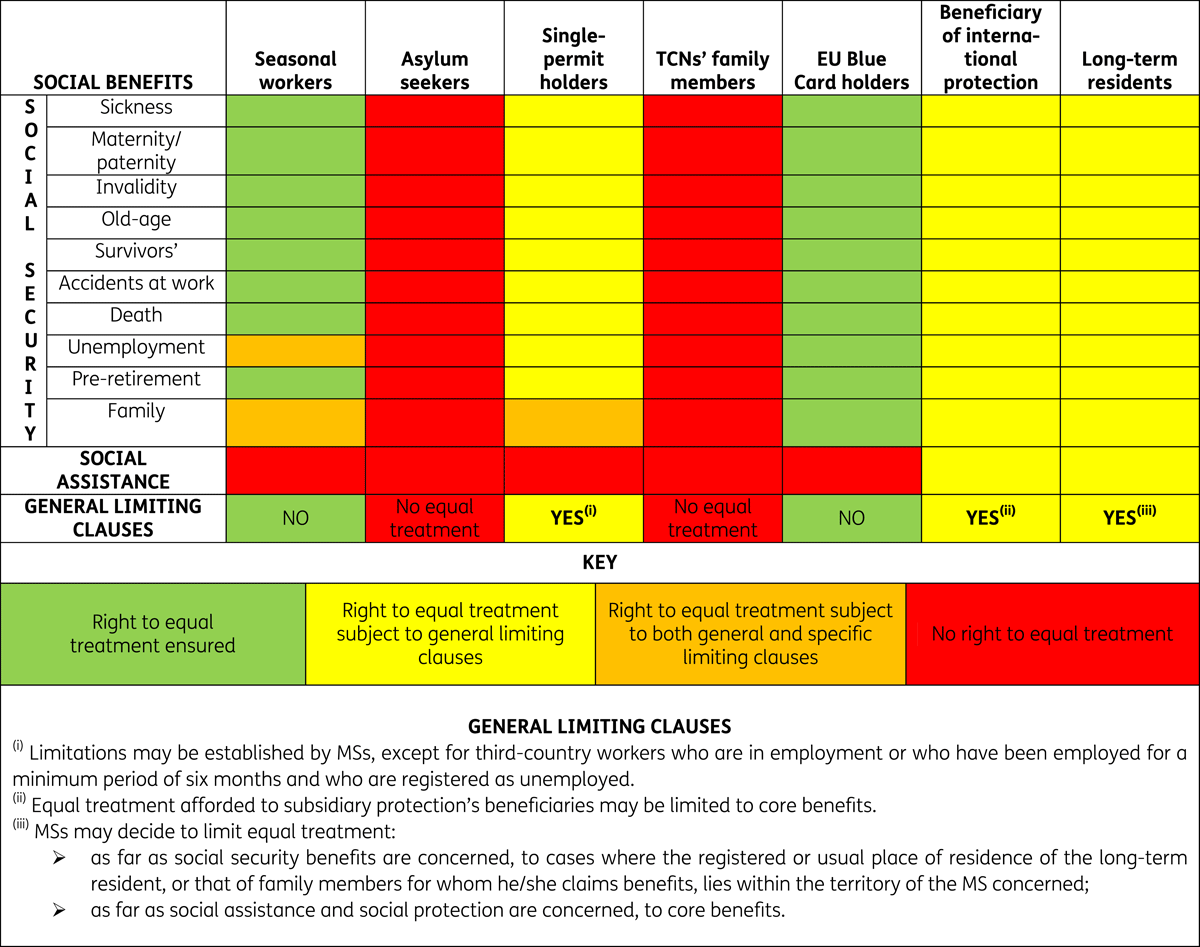
Table 1
Equal treatment clauses in EU migration directives: Comparative analysis.
To assess by-status fragmentation, three different aspects will be considered. First of all, the scope of the right to equal access to social benefits will be analysed. Equal treatment provisions enshrined in the items of legislation under analysis typically include a reference to branches of social security and to social assistance. This dichotomy reflects the distinction drawn by Regulation 883/2004: branches of social security are listed under Article 3 therein and include benefits related to sickness, maternity and paternity, invalidity, old-age, unemployment and pre-retirement as well as survivors’ benefits, benefits in respect of accidents at work and occupational diseases, death grants, and family benefits.23 Building upon this second categorisation, the ECJ has consistently interpreted social security as generally comprising those benefits granted “automatically on the basis of objective criteria, without any individual or discretionary evaluation of personal needs”.24 By contrast, the ECJ construes social assistance as a narrow and residual category, only covering the few benefits not meeting the requirements of social security.
Almost all of the migration Directives under analysis grant TCNs equal access to selected benefits falling under the scope of social security. There are, however, some exceptions in this regard. First, Directive 2003/109/EC on long-term residents25 and Directive 2011/95/EU on beneficiaries of international protection26 extend TCNs’ right to equal treatment to benefits falling under the scope of “social assistance”. Second, Directive 2013/33/EU on asylum seekers and Directive 2003/86/EC on family reunification do not provide any equal access to either social assistance or social security.
The second aspect to consider is the extent to which the Directives subject TCNs’ access to social security to Member States’ discretion via the ‘may clauses’. In particular, two specific branches of social security – namely, unemployment and family benefits – are subject to a complex discipline. In fact, seasonal workers’ access to both categories of allowances under Directive 2014/36/EU may be excluded by Member States.27 Such a restriction has been justified on grounds of the temporary nature of their residence, as seasonal workers are expected to leave Member States’ territory after the expiration of their work contracts. Moreover, access to family benefits can also be excluded with regard to three particular categories of TCNs in possession of a single permit, namely those who have been authorised to work in the territory of a Member State for a maximum period of six months; those who have been admitted for the purpose of study; or those who are allowed to work on the basis of a visa. Again, TCNs’ shorter period of residence seems to represent the underlying rationale of such a limitation.
Finally, the impact of generally applicable may clauses should be considered. Within the legislative instruments under analysis, only the two most recent Directives – namely on seasonal workers and Blue Card-holders – leave equal access to social benefits unfettered by general restrictive provisions. Conversely, Directive 2003/109/EC on long-term residents allows the Member States to exclude equal treatment where the registered or usual place of residence of the TCN, or that of the family members for whom benefits are claimed, does not lie within the territory of the Member State concerned. 28 With respect to beneficiaries of subsidiary protection, Member States may limit the right to equal treatment to ‘core benefits’, a category which must include “at least minimum income support, assistance in case of illness, pregnancy, parental assistance and long-term care”.29 The same limitation may be applied to long-term residents only with respect to the entitlement to social assistance and social protection benefits.30
EU law also allows general restrictions on the right to equal treatment on grounds of TCNs’ employment situation. In fact, Directive 2011/98/EU on single permit holders allows any type of general restriction to the right to equal treatment which, however, must not prejudice TCN workers who are in employment or who have been employed for a minimum period of six months and who are registered as unemployed.
The analysis provided here has shown that EU secondary law applicable to TCNs, with respect to equal access to social benefits, entails noteworthy differences on the grounds of migrants’ residence permits, thus giving rise to by-status fragmentation. Beyond the complexity of the legislative framework at stake, it will be inferred that there is no single criterion capable of justifying by-status fragmentation, and this latter approach is not in line with the Tampere conclusions’ rationale as outlined in Section 2.1. Taking Italy during the pandemic as an example, Section 3 will shed light on the domestic implications of by-status fragmentation in EU migrants’ equality law.
3. From EU by status fragmentation to multilayered fragmentation at the national level: The case of Italy during the Covid-19 pandemic
Section 2 showed that EU migration law features what we called a fragmentation by status: migrants, depending on their residence permit, are granted uneven access to social benefits. However, to understand the concrete impact of such fragmentation, it is important to look at Member States’ practices. In fact, the Member States still retain great discretion to determining the actual extent of TCNs’ right to equal treatment. This discretion depends on three different factors: whether Member States fully apply the Directives and correctly implement them;31 whether they rely on the derogations and ‘may clauses’ contained therein; and, finally, how Member States organize their social security system in respect to migrants. To understand how these factors play out, it is particularly useful to look at the Italian case study: its situation during the pandemic shows that fragmentation can be exacerbated by a multilayered social security system and by poor domestic implementation laws. This section will thus first outline the Italian multilayered welfare law; second, it will show how this constitutes a spawning ground for gaps in social protection for TCNs in breach of EU secondary law.
We have called the Italian system ‘multilayered’, as it is composed of three different categories of legislative sources. The first layer, layer (i), consists of general equal treatment clauses. The second one, layer (ii), includes the national laws implementing the EU migration directives and their equality clauses. Finally, the third one, layer (iii), consists of a complex constellation of allowances, each of them providing different eligibility requirements and exclusionary criteria for migrants.32
Starting from layer (i), the Italian Immigration Consolidated Act enshrines a generally applicable norm providing for equal treatment for migrants.33 According to Article 2(3) therein, each migrant worker should – in principle – be granted “equal treatment and full equality of rights” compared with national workers.34 As far as access to social benefits is concerned, Article 41 therein grants equal treatment to all TCNs that hold a residence permit lasting at least one year. Despite being quite generous, this provision is at odds with Directive 2011/98/EU on single permit holders, which allows restrictions on the right to equal treatment only for single permit holders whose permit lasts less than six months.35 More importantly, this domestic provision’s scope has been significantly downgraded by subsequent laws. Among them, Article 80(19) of the 2000 Budgetary Law represents the most relevant derogation: it horizontally limited TCNs’ equal access to most social benefits, thus granting equal treatment only to long-term residents.36 This legislative limitation is clearly at odds with many EU equal treatment norms, and also for this reason, multiple judgments of the Italian Constitutional Court have declared it partially unconstitutional.37 The scope of the norm is significantly narrower today, but it is still in place.
Moving to layer (ii), which comprises domestic provisions transposing the EU migration directives, the Italian lawmaker has adopted three different normative approaches. The first consists in including equal treatment clauses in the laws transposing the directives. Albeit this is the most straightforward approach, it was adopted only in the case of long-term residents and beneficiaries of international protection.38 The second and most common approach sees the Italian legislature not transposing the EU equal treatment clauses at all, thus leaving undetermined whether migrants are entitled to social benefits or not; this is the case, for instance, with the Single Permit Directive.39 The third approach is the one followed in the transposition of the Seasonal Workers Directive, which represents an exception in this regard.40 In fact, Italian immigration law already contained a general provision regulating seasonal workers’ equal access to social benefits; however, this national provision resulted not in line with the subsequently adopted Directive and yet the Italian legislature did not change it.41 These three different approaches represent an important driver of fragmentation in the normative framework under analysis which, obviously, significantly undermines legal certainty.
The two legislative layers so far analysed, however, only set out the general and residually applicable discipline. The core regulation of migrants’ access to benefits lies, conversely, in the eligibility requirements attached to each social benefit discipline, namely legislative layer (iii). When the Italian lawmaker introduces a new social benefit, usually the relevant law specifies the eligibility requirements for nationals on the one hand, and for different categories of TCNs on the other. Because these norms enjoy a relationship of speciality with respect to the general provisions under layers (i) and (ii), they prevail over the latter (lex specialis derogat legi generali).
To provide a concrete example of layer (iii), we will draw on the case of the pandemic. This is very significant since, as already mentioned in Section 1, migrants in Italy have been disproportionately hit by the socio-economic consequences of the Covid-19 crisis. The risk of them being dismissed or left without a job was higher than that of Italian nationals; and even when working, migrants had more chances of being “working poor” than Italian nationals (25% of TCNs versus 5% of Italian nationals).42 Yet, as we shall see, migrants have been often excluded from social security and assistance.
In Italy, the main welfare measure to combat poverty is the reddito di cittadinanza (literally ‘citizens’ income’), the Italian version of the basic income.43 This is an economic allowance of a maximum of 780 EUR per month introduced in 2019 to “guarantee the right to work, to combat poverty, inequality and social exclusion”.44 During the 2020 pandemic, the reddito di cittadinanza became indispensable for many families: the number of its beneficiaries more than doubled (from 814,000 to 1,800,000), and half of them (46%) were so-called “working poor”, namely people who, despite having a job, could not earn enough for a decent lifestyle.45
Despite it being of vital importance for destitute and working poor Italians, the reddito di cittadinanza remains virtually inaccessible to most migrants. To access it, applicants need to show: a family income below a certain threshold, proof of ten years of uninterrupted residence in Italy, as well as EU/Italian citizenship or a long-term residence permit.46 The Italian Constitutional Court has recently been asked to rule on the legitimacy of these requirements in a case regarding a TCN migrant residing in Italy for more than ten years but without a long-term residence permit. The Court ruled that these requirements are not discriminatory because the reddito di cittadinanza aims primarily at achieving social and work inclusion, and these are objectives that the Italian legislature can legitimately pursue to the advantage of nationals and migrants with permanent residence right only.47 Nevertheless, the Court did not address whether the norm is in conflict with EU law (especially with the Long-Term Resident Directive 2003/109/EC and the Single Permit Directive 2011/98/EU), thus leaving some room for future challenges.48 Currently, this question is pending before the European Court of Justice; in case the preliminary reference is considered admissible, the Court will rule on whether the reddito di cittadinanza shall be regarded as one of the social security or assistance benefits covered by the equality clauses of the migration directives.49
When, as a consequence of the Covid-19 pandemic, many people lost their jobs, the Italian lawmakers knew that the reddito di cittadinanza would have left many families without welfare support. But instead of relaxing the benefit’s eligibility requirement, they decided to temporarily introduce a more inclusive benefit, the reddito di emergenza (emergency income).50 This consisted of an economic allowance of a maximum of 400 EUR per person per month (a maximum of 840 EUR per family), granted for two months in 2020 to individuals and families having an income below a certain threshold, and then extended for two further months.51 By contrast with the reddito di cittadinanza, the emergency income only required proof of residence in Italy (‘residenza anagrafica’). As a result, while only 9% of the beneficiaries of the reddito di cittadinanza were TCNs, the percentage was much higher among the beneficiaries of the emergency income (ranging between 22% and 42%).52 The establishment of the emergency income represented a clear improvement in TCNs’ social protection, although it was a one-off payment and very limited in time. In fact, the Italian policymakers deliberately chose not to transform this more inclusive benefit into a permanent allowance, showing their lack of commitment towards foreign disadvantaged individuals and families.
Our last example of harmful fragmentation in social benefits during the pandemic is the case of buoni spesa, i.e. food vouchers financed by the State budget but distributed by municipalities.53 Although the stated intent of the measure was to help those most in need without any reference to nationality or residence, a number of Italian municipalities introduced different eligibility requirements for migrants, such as the possession of a long-term residence permit or the proof of residence in the municipality. Some of these eligibility requirements were brought to court and declared unlawful.54 This, in a way, also testifies to the confusion among Italian administrators regarding who is entitled to social benefits under Italian and EU law.
While being limited to only a few examples, the analysis made here of Italian domestic provisions on TCNs’ access to social benefits shows a highly fragmented legal framework, compounded with a problematic implementation of EU equality rights. During the Covid-19 pandemic, characterized by health, social and economic crises, welfare instruments represented a crucial tool to protect people from poverty and social exclusion; however, the Italian welfare system left many TCNs behind. The Italian lawmakers systematically failed to correctly transpose and apply the equal treatment clauses contained in the EU migration directives; moreover, the multi-layered fragmentation that affects Italian law undermines legal certainty and complicates enforcement, thus exacerbating migrants’ risk of poverty and social exclusion. Against this background, Section 4 will assess whether mainstreaming may provide a fruitful contribution in this regard.
4. Mainstreaming equal access to social benefits for TCNs
Sections 2 and 3 highlighted how fragmentation and poor implementation deprived migrants of important social protection during the Covid crisis. This Section will assess one of the possible remedies: can the adoption of a mainstreaming approach improve equal treatment for TCNs? Section 4.1 will define the meaning and scope of mainstreaming in the EU migration field, while Section 4.2 will assess the possible advantages of applying it to the concrete sphere of equal access to social benefits.
4.1 Mainstreaming equality in the EU migration field
The concept of mainstreaming came to the fore at the end of the 1990s, when both the Council of Europe and the United Nations Economic and Social Council introduced gender mainstreaming among their stated goals. The core idea was that gender equality should no longer be treated as a separate and sectoral policy field; instead, it would become a principle driving all the fields of policymaking.55 In this light, the Council of Europe in 1998 defined it as: “the (re)organisation, improvement, development and evaluation of policy processes, so that a gender equality perspective is incorporated in all policies at all levels and at all stages, by the actors normally involved in policy-making”.56 In the same vein, the United Nations Economic and Social Council held that:
Mainstreaming a gender perspective is the process of assessing the implications for women and men of any planned action, including legislation, policies or programmes, in any area and at all levels. It is a strategy for making the concerns and experiences of women as well as of men an integral part of the design, implementation, monitoring and evaluation of policies and programmes in all political, economic and societal spheres, so that women and men benefit equally, and inequality is not perpetuated.
Verloo explains the significance of mainstreaming by differentiating it from previous approaches to equality. First, mainstreaming is different from ‘equal treatment in legislation’, since the latter concept is directed only at formal equality between individual citizens. Second, mainstreaming is also different from specific ‘equality policies’ that aim to create equal opportunities and counterbalance unequal starting positions in society. Mainstreaming, for its part, “addresses the problem of gender inequality at a more structural level, identifying gender biases in current policies, and addressing the impact of these gender biases in the reproduction of gender inequality”.57
Therefore, mainstreaming does not directly address formal or substantial inequality between individuals but rather focuses on transforming the policy formation process. It requires policymakers to incorporate equality considerations when conceiving a new policy, thus eliminating their biases, taking into consideration gender and minorities’ perspectives, as well as looking at the world as genderized or structurally unequal. The introduction of impact assessment evaluations in law making, which analyse how specific policy proposals would impact equality, is an example of how such an approach may be put in place.58
Supporters of mainstreaming argue that it is a valid strategy to combat the root cause of inequality and can bring about a substantial transformation in governance. Conversely, critics state that mainstreaming is too vague; moreover, since mainstreaming involves the replacement of specific equal treatment policies with the inclusion of equality objectives in all policy fields, they see the risk of equality being lost or diluted in the service of other policy objectives.59
The EU has partially incorporated the mainstreaming approach into its legal framework. This was done through the “horizontal clauses’ that are aimed at defining ‘prospective goals that are applicable across different policy areas”.60 The list of horizontal clauses was expanded with the Lisbon Treaty, thus covering under Article 10 TFEU a particularly relevant field for the purposes of this contribution, namely, the anti-discrimination policy: “In defining and implementing its policies and activities, the Union shall aim to combat discrimination based on sex, racial or ethnic origin, religion or belief, disability, age or sexual orientation”.
Concretely, this horizontal clause introduces an obligation for the EU legislature to take into account antidiscrimination goals when legislating in any policy field. The main aim of Article 10 is to bind the EU legislature to pursue ”a shift for equality from static prohibition to dynamic activation in policy areas” where the EU has competence.61 The main challenge of the equality horizontal clause consists in its implementation, as the ECJ has never relied on it in its judgments.62 To operationalize it, the Better Regulation Guidelines of the Commission introduced two important strategies: first, during the phase of adoption of legislation, it provides for the undertaking of impact assessments and experts’ consultations; second, after the EU norm is implemented, the Commission conducts a policy evaluation, to assess whether the horizontal goals have been respected.63
However promising this may sound, EU anti-discrimination provisions have a serious shortcoming for TCNs. As mentioned before, the prohibition of discrimination based on race and ethnic origins has been consistently interpreted by the EU legislature and the ECJ as not applying to discrimination based on nationality.64 This narrow interpretation of race and ethnic origins means that TCNs cannot invoke Article 10 TFEU to challenge a provision that excludes them from social benefits because of their status or nationality.
Similar shortcomings apply with respect to another important source of equality mainstreaming: the EU Charter of Fundamental Rights. EU human rights provisions, although not framed as “horizontal clauses”, de facto apply across all EU policy fields and whenever the EU exercises its competencies.65 Therefore, arguably, the EU Charter might play a mainstreaming role, as it provides a ground for assessing the respect of human rights across all policy fields tackled by EU primary and secondary law and national implementing acts.
Several provisions of the Charter can be relevant for increasing the protection against discrimination for TCNs. As briefly mentioned before, the Charter contains a prohibition of discrimination based on nationality (Article 21(2)). Moreover, Article 1 imposes the respect for and the protection of human dignity. Article 34(2) grants to “everyone residing and moving legally within the European Union” the right to social security benefits and advantages “in accordance with Union law and national laws”. Finally, Article 34(3) recognizes the right to social and housing assistance, again in accordance with EU and national laws, for all those who lack sufficient resources.
However, by reading these provisions carefully, we are again confronted with their narrow scope or unclear binding value. Article 21(2) on the prohibition of discrimination based on nationality has been consistently interpreted, in line with the drafters’ original intentions, as only applying to EU citizens.66 The rights protected by Articles 1 and 34, instead, do not oblige Member States to grant equal treatment or any specific level of access to social benefits to migrants. Article 34 only affirms generally that legally residing migrants have the right to access benefits, but such right can be limited by EU and national laws. Article 1 on human dignity can potentially be invoked to require a minimum level of social assistance, but again it leaves undetermined what such an adequate level is. Indeed, so far, when brought before the ECJ for consideration, Articles 1 and 34 have yielded ambiguous or no results.67
This preliminary analysis seems to confirm what was noted by O’Cinneide on European social constitutionalism: “it remains ‘thin’, in the sense that it lacks much in the way of specific normative content. It can be difficult to identify exactly what public authorities should do to give effect to the social state principle, or what constitutes a breach of social rights.”68
4.2 Would a mainstreaming approach remedy fragmentation at the EU and domestic level?
After having detailed the content of mainstreaming in EU law, this subsection addresses the following question: can a mainstreaming approach effectively tackle by-status and multilayered fragmentation in migrants’ equal access to social benefits? The answer will be twofold, focusing – respectively – on the EU and the domestic levels.
The possibility of mainstreaming equality in EU law may encounter some hurdles due to the absence of a binding rule in EU primary law that grants equality to TCNs. As anticipated, the use of impact assessments on legislative proposals represents one of the main instruments to foster mainstreaming in EU law. Indeed, legislative proposals by the European Commission nowadays typically undergo an impact assessment before being adopted: introducing equal treatment for TCN migrants as one of the criteria against which impact should be assessed would represent a legitimate option.69 However, such a criterion would lack a substantive legal basis in the Treaties, as EU primary law falls short of establishing equality or equal access to social benefits as a general principle with respect to TCNs. Therefore, the lack of a comprehensive principle stating the conditions and rights for TCN migrants’ equality in the primary law framework would probably render impracticable an evaluation of EU secondary legislation on equality grounds. Rather than equality, maybe Article 34(2) of the EU Charter, that establishes migrants’ access to social benefits as a fundamental right, would provide a more valid guiding principle for policy making; however, so far, the Court of Justice has been reluctant to employ it. Such an approach may be explained by the fact that this right is subject to conditions established under “Union law and national laws and practices”, making it less effective.70
In the absence of a clear and binding primary norm that imposes equality, the efforts to mainstream equal access to social benefits would be overcome by the same political divisions among the Member States which ultimately led the Commission to adopt a sectoral approach in this context. In fact, Member States had previously opposed a comprehensive approach on regulating TCN migrant workers: while a mainstreaming approach would aim at achieving such an objective, the lack of any reference in EU primary law would deprive such a struggle of the normative groundwork required to overcome national governments’ reluctance. In other words, equality for TCNs needs first to be constitutionalized and then mainstreamed.
However, this does not mean that mainstreaming has no potential to foster TCNs’ equality. One recurrent criticism of EU migration legislation is that it is formulated by the Commission’s Directorate General which deals with migration and home affairs (DG HOME), and which is inclined to give more emphasis to security and border management than to social inclusion concerns.71 The Employment, Social Affairs and Inclusion Directorate (DG EMPL) would be more suitable for adopting policies that are bound to have a huge impact on the social rights of a relevant group of workers and residents in the EU. A mainstreaming approach would challenge such a compartmentalized approach, revisit this division of tasks, and push for incorporating equality and social justice concerns across all policy fields and directorates, including DG HOME.72
After having analysed mainstreaming equality in EU law, what would be its impact at the national level? The analysis of the Italian discipline provided in Section 2 showed that a relevant problem lies in the many inconsistencies between EU secondary law provisions and domestic ones, together with a trend to misuse the ‘may clauses’ included in the former. These inconsistencies are due to the Italian government and legislature’s reluctance to grant equal treatment to TCNs: because of its negative electoral and budgetary implications, they do not want to conform to the EU obligations to grant equality.73
Admittedly mainstreaming offers limited guarantees in terms of solving the problem of non-compliance with EU law at the domestic level. Even assuming that mainstreaming equality at the EU level would remedy fragmentation in EU secondary law, this would have limited effect on Member States’ persistent disregard for EU obligations on TCNs’ equal access to social benefits. Indeed, this is a problem of lack of compliance with EU law, which must be tackled with the relevant enforcement mechanisms. In this respect, it is important that the Commission acts in accordance with its role of guardian of the Treaties, thus monitoring the correct implementation of EU law and bringing Italy to court if necessary. Another crucial means to grant the respect of EU law provisions would be judicial enforcement. This is currently done by Italian civil society organizations, which invoke EU law to challenge the discriminatory allocation of social benefits before Italian courts, often reaching the ECJ.74 However, the Italian multilayered fragmentation also means that each judicial victory leads to a reform of the eligibility requirements of a single social benefit at the time, and no judgment so far could settle this issue once for all.75 These circumstances lead to long judicial battles, the end of which is not in sight, especially since the Italian legislature keeps introducing new social benefits with discriminatory eligibility criteria.76
Finally, and more concretely, the effect of a mainstreaming approach on the discriminatory allocation of benefits during the Covid-19 crisis remains to be assessed. Had the Italian legislature adopted a mainstreaming approach, would TCNs have been treated more equally? Probably yes, as demonstrated by the emergency income that the Italian government adopted during the first months of the crisis, granted to all those in need without restrictions based on nationality or residence permit.77 This income was introduced specifically to fill the gaps left by the citizenship income, thus demonstrating that the Italian legislature can subscribe to mainstreaming approaches but seldom wants to. Indeed, the emergency income lasted only four months, after which the situation went back to discrimination as usual despite the crisis being far from over. Again, we are confronted with the main problem of mainstreaming equality for TCNs: in the lack of a legally binding provision, the legislature can follow a mainstreaming approach or depart from it at its own discretion.
From this analysis, it appears that adopting a mainstreaming approach bears good potential for tackling long-standing problems in EU law-making, but would not represent a silver bullet to solve the discrimination that affects TCNs. At the EU level in particular, incorporating equality and social inclusion concerns when legislating on migrants’ status would improve the quality of EU migration law, fostering awareness of its implications for migrants’ social rights, and increasing coherence within EU legislation. Nevertheless, the potential added value of mainstreaming is severely restricted by the lack of a binding provision on equality for TCNs in the Treaties, which is necessary to grant legal and political enforcement. If introduced, mainstreaming would greatly help not only to fix current national legislation violating EU law but, most importantly, to prevent the introduction of future discriminatory laws.
5. Conclusion and way forward
EU primary law lacks a comprehensive principle that grants TCN migrants equal access to social benefits. Civil society actors usually invoke in courts the scattered equal treatment clauses present in EU secondary law, signally in the migration directives. However, these are highly fragmented and they lack a coherent criterion to prevent equality is granted to some migrants but denied to others. Moreover, at the national level such a fragmentation becomes even more acute: relying on the example of Italy, we showed how migrants’ access to social benefits is regulated by different normative layers, which often provide norms inconsistent with EU law. This fragmentation, in a context like that of the social-economic crisis originating from the Covid-19 pandemic, translated into a lack of social protection and further exposure to poverty for TCN migrants.
There is still a long way to go to achieve equality for TCN migrants in Europe. Even when legally resident for several years, and even when working alongside Member State nationals, TCN migrants can be legally excluded from important social protections. The EU legal origin of this inequality lies in the fact that the Tampere conclusions were not respected, and that EU law fundamentally lacks a horizontal principle that grants equal social protection to TCN migrants. However, the reason for inequality should also be researched at the national level: national provisions are often inconsistent with EU law, and such a circumstance is difficult to remedy without political commitment. Eventually, we concluded that equality mainstreaming is a promising policy tool to tackle structural inequalities but to flourish it needs to rely on a legal system that contains strong legal and political commitments to equality, accompanied by effective enforcement tools. Unfortunately, this still seems not to be the case in the EU.
Notes
[1] There are many contributions in the field of EU citizenship, see for instance F Costamagna and S Giubboni, ‘EU Citizenship and the Welfare State’ in D Kostakopoulou and D Thym (eds.), Research Handbook on European Union Citizenship Law and Policy (Edward Elgar 2022) 225–48; C O’Brien, ‘Civis Capitalist Sum: Class as the New Guiding Principle of EU Free Movement Rights’ (2016) 53 Common Market Law Review 4, 937–77; M Haag, ‘The coup de grâce to the Union citizen’s right to equal treatment: CG v. The Department for Communities in Northern Ireland’ (2022) 59 Common Market Law Review 4, p. 1081–1106.
[2] International Labor Organization, ‘ILO Monitor: COVID-19 and the world of work. Fifth edition’ (ILO, 30 June 2020) <https://www.ilo.org/wcmsp5/groups/public/---dgreports/---dcomm/documents/briefingnote/wcms_749399.pdf> accessed 17 February 2023..
[3] F Paletti, ‘Povertà e immigrazione al tempo della pandemia’ in Dossier Statistico Immigrazione 2021 (IDOS 2021) 201; L Zanfrini, ‘Il Lavoro’ in Ventisettesimo rapporto sulle migrazioni 2021(Fondazione ISMU 2022) 113.
[4] See Cases C-22/08 and C-23/08 Vatsouras and Koupatantze [2009] ECLI:EU:C:2009:344, paras 51–52; Case T-618/15 Voigt v Parliament [2017] ECLI:EU:T:2017:821, paras 80–81; Case T-452/15 Petrov and Others v Parliament and Präsident des Europäischen Parlaments [2017] ECLI:EU:T:2017:822, paras 39–40.
[5] See Council Directive 2000/43/EC of 29 June 2000, implementing the principle of equal treatment between persons irrespective of racial or ethnic origin [2000] OJ L 180. See case C-571/10 Kamberaj [2012] ECLI:EU:C:2012:233, paras 48–49.
[6] European Council, Presidency Conclusions, Tampere European Council, 15 and 16 October 1999, at 21.
[7] S Carrera, ‘Integration of Immigrants in EU Law and Policy: Challenges to Rule of Law, Exceptions to Inclusion’ in L Azoulai and K De Vries (eds) EU Migration Law (OUP 2014) 154.
[8] European Commission, ‘Proposal for a Council Directive on the conditions of entry and residence of third-country nationals for the purpose of paid employment and self-employed economic activities’ COM(2001) 386. On the negotiating position of Germany see G Brinkmann, ‘Opinion of Germany on the Single Permit Proposal’ (2012) 14 European Journal of Migration and Law 4, 351–66.
[9] K Groenendijk, ‘Recent Developments in EU Law on Migration: The Legislative Patchwork and the Court’s Approach’ (2014) 16 European Journal of Migration and Law 3, 313–35; J Hunt, ‘Making the CAP Fit: Responding to the Exploitation of Migrant Agricultural Workers in the EU’, (2014) 30 International Journal of Comparative Labour Law and Industrial Relations 2, 140; A Beduschi, ‘An Empty Shell? The Protection of Social Rights of Third-Country Workers in the Eu after the Single Permit Directive’ (2015) 17 European Journal of Migration and Law 2–3, at 215.
[10] Commission Staff Working Document, Fitness Check on EU Legislation on legal migration, SWD(2019) 1056 final.
[11] S Carrera, A Faure Atger, and E Guild, ‘Labour Immigration Policy in the EU: A Renewed Agenda for Europe 2020’, CEPS Policy Brief [2011] 4.
[12] On current discussions between the Commission, the EU Parliament and the Member States see: P Minderhoud, ‘Regulation of EU Labour Migration: At a Crossroads after the New Pact on Migration and Asylum?’ (2021) 17 Utrecht Law Review 4, 39 et ss.
[13] Directive 2011/98/EU of the European Parliament and of the Council of 13 December 2011 on a single application procedure for a single permit for third-country nationals [2011] OJ L 343; Directive (EU) 2021/1883 of the European Parliament and of the Council of 20 October 2021 on the conditions of entry and residence of third-country nationals for the purpose of highly qualified employment, and repealing Council Directive 2009/50/EC [2021] OJ L 382; Directive 2014/36/EU of the European Parliament and of the Council of 26 February 2014 on the conditions of entry and stay of third-country nationals for the purpose of employment as seasonal workers [2014] OJ L 94; Directive 2014/66/EU of the European Parliament and of the Council of 15 May 2014 on the conditions of entry and residence of third-country nationals in the framework of an intra-corporate transfer [2014] OJ L 157; Directive (EU) 2016/801 of the European Parliament and of the Council of 11 May 2016 on the conditions of entry and residence of third-country nationals for the purpose of research, studies, training, voluntary service, pupil exchange schemes or educational projects and au pairing (recast) [2016] OJ L 132.
[14] Directive 2011/95/EU of the European Parliament and of the Council of 13 December 2011 on standards for the qualification of third-country nationals or stateless persons as beneficiaries of international protection, for a uniform status for refugees or for persons eligible for subsidiary protection, and for the content of the protection granted (recast) [2011] OJ L 337; Directive 2013/33/EU of the European Parliament and of the Council of 26 June 2013 laying down standards for the reception of applicants for international protection (recast) [2013] OJ L 180; Directive 2004/81/EC of 29 April 2004 on the residence permit issued to third-country nationals who are victims of trafficking in human beings or who have been the subject of an action to facilitate illegal immigration, who cooperate with the competent authorities [2004] OJ L 261.
[15] Council Directive 2003/86/EC of 22 September 2003 on the right to family reunification [2003] OJ L 251; Council Directive 2003/109/EC of 25 November 2003 concerning the status of third-country nationals who are long-term residents [2003] OJ L 16.
[16] Commission Staff Working Document, ‘Fitness Check on EU Legislation on legal migration’, SWD(2019) 1056 final, at 39.
[17] This point has been recently affirmed with reference to Directive 2011/98/EU and Directive 2003/109/EC in Case C-302/19, Istituto Nazionale della Previdenza Sociale (Prestations familiales pour les titulaires d’un permis unique) [2020] ECLI:EU:C:2020:957, para 34; Case C-303/19, Istituto Nazionale della Previdenza Sociale (Prestations familiales pour les résidents de longue durée) [2020] ECLI:EU:C:2020:958, para 28. See L Grossio, ‘Who Is Entitled to Family Benefits? Lights and Shadows of the ECJ Rulings in WS and VR’ (2021) 8 Maastricht Journal of European and Comparative Law 4. Some authors have also underlined that granting equal treatment rights with regard to social benefits is instrumental for promoting labour migration from third countries. See, amongst others, H Verschueren, ‘Employment and Social Security Rights of Third-Country Nationals under the EU Labour Migration Directives’ (2018) 20 European Journal of Social Security 2, 100 et ss.
[18] Generally including pay and dismissal as well as working hours, leave, holidays, health and safety at the workplace (Directive 2011/98/EU, Art. 12(1)(a); Directive 2014/36/EU, Art. 23(1)(a); Directive 2021/1883/EU, Art. 16(1)(a)). Directive 2003/109/EC, conversely, makes a reference to ‘conditions regarding dismissal and remuneration’ (Directive 2003/109/EC, Art. 11(1)(a)).
[19] Including also the right to strike and take industrial action under Directive 2014/36/EU on seasonal workers.
[20] With particular emphasis on procedures for obtaining housing as provided by national law, without prejudice to the freedom of contract in accordance with EU and national law (Directive 2003/109/EC, Art. 11(1)(f); Directive 2011/98/EU, Art. 12(1)(g); Directive 2021/1883, Art. 16(1)(f)). Access to housing services is however excluded for seasonal workers under Art. 23(1)(e) of Directive 2014/36/EU.
[21] Regulation (EC) No 883/2004 of the European Parliament and of the Council of 29 April 2004 on the coordination of social security systems [2004] OJ L 166. This paper does not focus on the exportability of those benefits; see instead: H Verschueren, ‘Employment and Social Security Rights of Third-Country Labour Migrants under EU Law: An Incomplete Patchwork of Legal Protection’ [2016] European Journal of Migration and Law 18, 373–408.
[22] Table 1 does not include the Researchers Directive since the related equal treatment clause is identical to the Single Permit Directive. The Intra-Corporate Directive has also not been included either, in light of its more limited relevance to the current practice. Finally, the Directive on victims of trafficking in human beings (2004/81/EC) has been also excluded, both because of its limited scope and because it does not contain any equal treatment provisions. Its Article 7(1) states that ‘Member States shall ensure that the third-country nationals concerned who do not have sufficient resources are granted standards of living capable of ensuring their subsistence and access to emergency medical treatment.’
[23] For an assessment of Regulation No. 883/2004 vis-à-vis migrants’ access to social rights, see: H Verschueren, ‘The Role and Limits of European Social Security Coordination in Guaranteeing Migrants Social Benefits’, 22 European Journal of Social Security (2020), p. 390 et seq.
[26] Directive 2011/95/EU, Art. 29(1). Notwithstanding the distinction between ‘social security’ and ‘social assistance’ outlined above, the ECJ in Ayubi seems to suggest a broader interpretation of the latter concept, thus including social security too (Case C-713/17 Ayubi [2018] ECLI:EU:C:2018:929, para. 21).
[30] The narrow scope of that limiting clause has been confirmed by the ECJ in Kamberaj, where the Court stated that it does not apply to social security and that “the concept of core benefits covers at least minimum income support, assistance in case of illness, pregnancy, parental assistance and long-term care” (Case C-571/10 Kamberaj [2012] ECLI:EU:C:2012:233, paras 83–84). For an analysis of the Kamberaj ruling, see: K De Vries, ‘Towards Integration and Equality for Third-Country Nationals? Reflections on Kamberaj’ (2013) 38 European Law Review 2, 248; S Peers, ‘The Court of Justice lays the foundations for the Long-Term Residents Directive: Kamberaj, Commission v. Netherlands, Mangat Singh’ [2013] 50 Common Market Law Review, 534.
[31] For instance, the EU long-term resident permit is scarcely used in many Member States, which prefer relying on alternative national schemes. P Minderhoud, ‘Regulation of EU Labour Migration: At a Crossroads after the New Pact on Migration and Asylum?’ (2022) 17 Utrecht Law Review 4, 38–39.
[32] The analysis carried out in this paper refers to the status of Italian law up until December 2021.
[34] This provision derives such right to equal treatment from the ILO Convention (No. 143) concerning migrations in abusive conditions and the promotion of equality of opportunity and treatment of migrant workers of 24 June 1975, 1120 UNTS 323. At Art. 10, this ILO Convention provides that the signatory States should promote equal treatment for TCNs in a number of fields, including social security.
[35] See Section 3.2 above and Table 1.
[37] These rulings regarded, in particular, TCNs’ access to invalidity benefits. Italian Constitutional Court, judgment of 29 July 2008, No 306; judgment of 14 January 2009, No 11; judgment of 26 May 2010, No 187; judgment of 12 December 2011, No 329; judgment of 11 March 2013, No 40; judgment of 27 January 2015, No 22; and judgment of 7 October 2015, No 230.
[38] This is the case of Article 9(12)(c) of the Legislative Decree of 25 July 1998, No 286, as amended by Article 1 of the Legislative Decree of 8 January 2007, No 3, in view to transpose Directive 2003/109/EC.
[39] See Legislative Decree of 4 March 2014, n. 40. In that regard, the Commission has open an infringement procedure against Italy (INFR(2019)2100).
[41] Italian law excludes seasonal workers from family and unemployment benefits without expressly relying on the derogation provided by the Seasonal Workers Directive. The ECJ stated in Martinez Silva that derogations from EU law must be explicit (Case C-449/16 Martinez Silva (2017) ECLI:EU:C:2017:485, para. 29).
[42] See L Zanfrini, ‘Il Lavoro’ in Ventisettesimo rapporto sulle migrazioni 2021 (Fondazione ISMU 2022) 113.
[43] Although its denomination can be somehow misleading, the reddito di cittadinanza reproduces the typical structure and objectives of minimum income benefits. In fact, these latter are characterised, in Europe, by the twofold aim of fighting poverty and reintroducing people into the job market. In this regard, see S Giubboni ‘Il reddito di cittadinanza tra diritto e politica’ (2019) 2 La cittadinanza europea, 78 and 94; M Baldini and C Gori, ‘Il reddito di cittadinanza’ (2019) 2 il Mulino, 269. It shall be briefly mentioned here that the 2023 Budgetary Law lays down a profound reform of the reddito di cittadinanza, ultimately intended to replace this latter with a new benefit characterized by a narrower scope of the eligible persons.
[44] Introduced by Art 1(1) of the Italian Law Decree of 28 January 2019, No 4, as transposed into law and amended by the Law of 28 March 2019, No 26. See also the official government website: <https://www.redditodicittadinanza.gov.it/schede/come-si-calcola> accessed 23 February 2023.
[45] See the last communication by INAPP (Institute for Public Policy Analyses): <https://www.inapp.org/it/inapp-comunica/sala-stampa/comunicati-stampa/23022022-inapp-percettori-del-rdc-sono-lavoratori-poveri> accessed 23 February 2023. See also V Martina, ‘Reddito di cittadinanza e contrasto al lavoro povero’ (2022) 1 Rivista del Diritto della Sicurezza Sociale, 30.
[46] Art 2 of the Italian Law Decree of 28 January 2019, No 4, as transposed into law and amended by the Law of 28 March 2019, No 26. TCN family members of Union citizens are also included within the scope of eligible persons for the reddito di cittadinanza.
[47] Italian Constitutional Court, judgment of 25 January 2022, No 19. For an analysis of the judgment, see A Garilli and S Bologna, ‘Migranti e lotta alla povertà. La Corte costituzionale nega il reddito di cittadinanza ai titolari del permesso di soggiorno per ricerca di un’occupazione’ (2022) 1 Rivista del Diritto della Sicurezza Sociale, 75–94.
[48] Another possible profile of incompatibility with EU law emerges in relation to EU migrants residing in Italy for less than ten years, who are also excluded from the reddito di cittadinanza.
[49] Case C-112/22 CU [2022] Request for a preliminary ruling by the Tribunale di Napoli. The Italian association of migration lawyers (ASGI) has also filed a complaint in this sense before the EU Commission (see https://www.asgi.it/discriminazioni/reddito-di-cittadinanza-denuncia-commissione-ue-requisito-10-anni-di-residenza/) which has recently announced that it opened an infringement procedure (INFR(2022)4024).
[51] For further details, see the official website of the Italian national authority for social security (INPS): <https://www.inps.it/prestazioni-servizi/reddito-di-emergenza>.
[52] G Musso, ‘Reddito di Emergenza vs Reddito di Cittadinanza: cosa dicono i dati?’ (2021) Osservatorio sui Conti Pubblici Italiani, available at <https://osservatoriocpi.unicatt.it/cpi-archivio-studi-e-analisi-reddito-di-emergenza-vs-reddito-di-cittadinanza-cosa-dicono-i-dati>.
[53] Ordinanza del Capo Dipartimento della Protezione Civile, No 658 of 29 March 2020. See A Guariso and Servizio Antidiscriminazione ASGI, Stranieri e Accesso alle Prestazioni Sociali e ai Servizi (ASGI 2020).
[54] See for instance Tribunale di Ferrara, ASGI et aa. v Comune di Ferrara, Order of 30 April 2020; Tribunale di Roma, XXX v Comune di Roma, Order of 1 June 2020. The grounds of unlawfulness underlined by Italian courts varied greatly from case to case, and were not always related to EU law. For instance, in the ASGI case, the Tribunale of Ferrara pointed out that, by limiting access to the buoni spesa to long-term residents, the municipality prevented all other categories of TCNs from obtaining a benefit falling under the scope of the “essential core” (“nucleo irriducibile”) of social rights on which Italian constitutional law does not allow any discrimination between Italian citizens and foreigners.
[55] J Shaw, ‘Mainstreaming Equality and Diversity in European Union Law and Policy’ (2005) 58 Current Legal Problems 1, 259.
[56] M Verloo, ‘Another Velvet Revolution? Gender Mainstreaming and the Politics of Implementation’ (2001) 5 IWM Working Paper, at 2.
[60] A Aranguiz, ‘Social Mainstreaming through the European Pillar of Social Rights: Shielding “the Social” from “the Economic” in EU Policymaking’ (2018) 20 European Journal of Social Security 4, 343. Older horizontal clauses are Article 8 TFEU on equality between men and women and Article 11 on environmental protection.
[61] F Ippolito, ‘Mainstreaming equality in the EU legal order. More than a Cinderella provision?’, in F Ippolito, M Bartoloni and M Condinanzi (eds), The EU and the Proliferation of Integration Principles under the Lisbon Treaty (Routledge Research in EU Law 2019), 59.
[62] Shaw (n 55), 289. The ECJ has instead relied on the social mainstreaming provision of Art. 9 TFEU, see for instance Case C-626/18 Republic of Poland v European Parliament and Council of the European Union [2020] ECLI:EU:C:2020:1000, at 51.
[65] See Arts. 6 TEU and 51(1) of the Charter. The EU Charter of Fundamental Rights has the same value as the Treaties.
[66] This is in line with the explanations to the Charter, which state “Paragraph 2 corresponds to the first paragraph of Article 18 of the Treaty on the Functioning of the European Union and must be applied in compliance with that Article”. Art. 18 TFEU contains a prohibition to discriminate against EU citizens on the basis of their nationality.
[67] See Case C-350/20 O.D. and others [2021] ECLI:EU:C:2021:659, where although the referring judge invoked Art. 34(2) of the Charter, the Court relied exclusively on the Single Permit Directive to justify its decision on migrants’ right to equal access to family benefits. Art. 1 of the Charter might be more promising, as recently used in Case C-709/20 CG [2021] ECLI:EU:C:2021:602, where the ECJ said that an EU citizen who does not reside legally under EU law (‘economically inactive citizen’) might nevertheless be accorded the right to a minimum income under human dignity evaluation. The Court, however, left such an evaluation to the national judge.
[68] C O’Cinneide, ‘The Present Limits and Future Potential of European Social Constitutionalism’, in K G Young (ed.), The Future of Economic and Social Rights (CUP 2019), 334.
[69] According to the Commission, impact assessments may take into consideration any policy objective pursued by the initiative. See: Commission (n 63), 32.
[70] See Case C-350/20 (n 68). The opposite approach, however, would have had some potential; in this regard, see: V Passalacqua, ‘Discriminating against families: Italian family benefits before the ECJ’ (EU Law Analysis, 5 June 2021) <http://eulawanalysis.blogspot.com/2021/06/discriminating-against-families-italian.html> (last accessed: 29 October 2021).
[71] For instance, see J Fudge and P Olsson, ‘The EU Seasonal Workers Directive: When Immigration Controls Meet Labour Rights’ 16 European Journal of Migration and Law (2014) 439–466.
[73] This is not only about Italy. The Austrian decision to link the amount of family benefits granted to TCNs to the average cost of life in the country where their household resides is a paramount example in this regard. Indeed, the debate generated by such a decision, ultimately resulting in an infringement procedure (Case C-328/20 Commission v Austria, [2022] ECLI:EU:C:2022:468) underlines the incessant contrast between the right to equal treatment afforded by EU law and the will of national authorities to limit public expenditure in respect of TCNs (in this regard, see: M Blauberger, A Heindlmaier and C Kobler, ‘Free Movement of Workers under Challenge: The Indexation of Family Benefits’ (2020)18 Comparative European Politics 925 et seq.).
[74] ASGI and its discrimination service has been at the forefront of this legal battle, see for instance Case C-462/20 Asgi and others [2021] ECLI:EU:C:2021:894 on a social service called “Carta Famiglia”; or Case C-302/19 (n 17) para 34; or Case C-303/19 (n 17) both brought to court by ASGI lawyers.
[75] For an overview of legal mobilization at national level see V Protopapa, ‘Shaping Equality for Migrants.
Legal Mobilisation in Italy and the Race Equality Directive’ (2019) 1 European Journal of Human Rights, at 3. For legal mobilization at the EU level see V Passalacqua, ‘Advancing EU equality law in Italy: Between unsystematic implementation and decentralized enforcement’, in E Muir, C Kilpatrick, J Miller and B de Witte (eds), How EU Law Shapes Opportunities for Preliminary References on Fundamental Rights: Discrimination, Data Protection and Asylum (2017) 17 EUI Working Paper 75–86.
[76] See A Guariso, ‘Assegno unico universale e nuova Legge europea: novità e contraddizioni’, in Italian Equality Network, 17 January 2022, available at <https://www.italianequalitynetwork.it/assegno-unico-universale-e-nuova-legge-europea-novita-e-contraddizioni/>.
Acknowledgements
The authors are grateful to the editors of this Special Issue, Alexandra Timmer and Frans Pennings, for inviting them and for providing useful comments, to Francesco Costamagna and Paul Minderhoud for their insightful suggestions on the preliminary version of the present article, and to the anonymous reviewers. The paper was submitted to the journal in May 2022. Therefore, it does not reflect later normative developments. All errors remain our own.
Funding Information
This paper draws upon the preliminary results of the research project ‘Covid-19 as an inequality challenge: Testing the EU response’. Funded by the Fondazione Collegio Carlo Alberto (Turin, Italy).
Competing Interests
The authors have no competing interests to declare.
Author Contributions
The paper constitutes the outcome of the authors’ common reflections. However, Sections 2, 2.1, 4 and 4.1 has been drafted by Virginia Passalacqua, while Sections 2.2, 3 and 4.2 shall be attributed to Lorenzo Grossio. Sections 1 and 5 have been jointly drafted by both authors.