
1. Introduction
Informal carers are people in the direct environment of the person in need of help, who provide care without receiving a salary or other form of payment. They could be relatives, neighbours or friends for example. The provision of care follows directly from the social relationship.1 In our paper we deal with the situation of people who are in paid employment and at the same time provide unpaid informal care to their elder relatives or friends. Reconciling work and eldercare creates various tensions that might result in poorer job perspectives, lower participation in the labour market and poorer well-being.2 Moreover, care given to the elderly is usually long-term care which means it is provided to a person with a reduced degree of functional capacity who is consequently dependent for an extended period of time on help with personal care as well as domestic help.3
In order to combine work and care, informal carers need both help with their caring tasks and support at work. In our paper we focus on the legal framework and public policies that shape these types of support. Thus in the case of help with eldercare tasks we focus on access to formal long-term care4 financed or co-financed by the state. In the case of support at work we focus on legal regulations that shape carers’ rights and entitlements in employment. This approach is in line with the concept of ‘fair working conditions in balancing work and life’ introduced by principle 9 of the European Pillar of Social Rights.5 This principle states that people with caring responsibilities have both access to care services as well as the right to suitable leave and flexible working arrangements.6 In our paper we examine the contribution of EU law in facilitating both access to formal long-term care as well as access to care leave and flexible working arrangements for carers.
We keep in mind that EU countries vary in their ideals and approaches to care that are shaped by ‘different traditions and national cultures’.7 That is why we have chosen for our analysis the two countries Poland and the Netherlands which represent different social expectations of care given to the elderly as well as a different approach to long-term care organization. The goal of the paper is thus to assess how and to what extent EU law instruments can contribute to creating and/or facilitating fair working conditions for those workers who are providing informal eldercare in Poland and in the Netherlands.
In order to do so we discuss the basic assumptions of the European Pillar of Social Rights, the Work-Life Balance Directive and the developing European Care Strategy (Section 2) and then we conduct a comparative analysis of long-term care systems in Poland and in the Netherlands (Section 3) as well as making a comparison of working conditions for informal carers in both countries (Section 4) to see how and to what extent EU law facilitates fair working conditions for workers providing informal care for the elderly in both countries (Section 5).
2. Instruments of European Union law regarding fair working conditions in balancing work and eldercare
When a paid job is interlinked with eldercare duties, the risk of many tensions that threaten the work-life balance arises.8 When the intensity of care increases and/or there is not enough support with care duties, the labour participation of a carer might be threatened. He or she might partly or completely withdraw from employment. Moreover, for informal carers with higher or better work status (job position, salary, qualifications etc.) more demanding care might mean higher involvement in paid employment in order to cover the extra costs of care. What is more, a reverse causation effect might also appear when a low status in the labour market makes the person more prone to take on care tasks instead of employment. These persons might be more easily trapped by a poverty gap that limits their future job perspectives.9
Balancing work and eldercare is thus dependent on:
the type and intensity of care that is provided as well as access to and the cost of care given by others (including formal long-term care)10 and
working (employment) conditions that are offered.
The effects of work-care reconciliation are therefore complex and interlinked with both care-related and work-related factors as well as influenced by the socio-demographic characteristics of the carer (e.g. gender, level of education, qualifications) and by the country-specific culture of care (Figure 1).
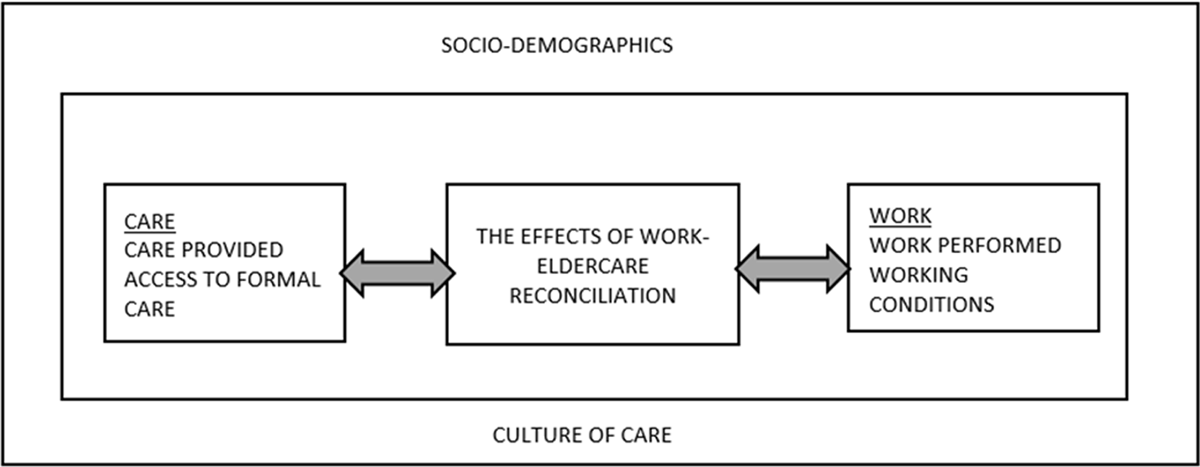
Figure 1
Factors influencing the effect of work and eldercare reconciliation.
Source: Own elaboration based on Andrea Principi and Jolanta Perek-Białas (2011); Michael Fine (2015).
The aforementioned context serves as a framework for the presentation of EU law instruments that refer to fair working conditions in balancing work and eldercare.
In order to promote work-life balance, the EU has introduced a number of tools in recent years. The EU acquis on work-life balance can now be found in the European Pillar of Social Rights and in directives, especially the Work-Life Balance Directive11 with certain parts being especially relevant to informal caregivers. In 2021, a new initiative was started with a European Care Strategy12 which is in a preparatory phase.
2.1. European Pillar of Social Rights
The European Pillar of Social Rights (EPSR) is a political document adopted by the Commission as a Recommendation13 and later by the European Parliament, the Council and the Commission as an ‘Interinstitutional Proclamation’.14 It contains twenty principles spread over three chapters. Important for the topic of this paper are principle 2 on gender equality, principle 9 on work-life balance and principle 18 on long-term care. Principle 2, belonging to Chapter I ‘Equal opportunities and access to the labour market’ reads:
Equality of treatment and opportunities between women and men must be ensured and fostered in all areas, including regarding participation in the labour market, terms and conditions of employment and career progression. Women and men have the right to equal pay for work of equal value.
Principle 9 is a part of Chapter II ‘Fair working conditions’. It specifically addresses the work-life balance of working families and highlights the right of parents and people with caring responsibilities to ‘suitable leave, flexible arrangements and access to care services’. This principle emphasizes and encourages the strengthening of men’s roles as carers by adding the sentence that ‘women and men shall have equal access to special leaves of absence in order to fulfil their caring responsibilities and be encouraged to use them in a balanced way’.
Leave and flexible arrangements are further amplified in the Work-Life Balance Directive (which will be discussed in Section 2.2). The right to access care services for working carers – including long-term care – is interesting in the light of work-life balance as it recognizes that access to such services contributes to the improvement of employment opportunities for the care provider and thereby to the reduction of inequalities, social and labour market exclusion and healthcare needs for informal carers. Principle 18, belonging to Chapter III on ‘Social Protection and Inclusion’ reads as follows: ‘Everyone has the right to affordable long-term care services of good quality, in particular home-care and community- based services’.
The EPSR is a recommendation. That is why it is not possible to derive rights directly from the EPSR’s principles.15 Its influence on secondary legislation is not yet clear; on the one hand, the European Commission uses the EPSR as a basis for taking social policy initiatives. On the other hand, the national courts and tribunals and in particular the Court of Justice of the EU can use the EPSR to interpret other provisions of EU law.16 The Action Plan for the European Pillar of Social Rights translates the principles into concrete actions for citizens.17 In March 2021, the Action Plan for the European Pillar of Social Rights announced, among other things, a long-term care initiative that aims to create a framework for policy reform in EU countries to promote the right to affordable, high-quality long-term care. The action plan is part of an initiative that takes a comprehensive approach to care, from childcare to long-term care for the elderly. In the Commission’s efforts to build an EU of equality, the Commission considers it necessary that adequate work-life balance policies facilitate the conciliation of work and private life and that, in particular, the provision of paid leave can have a positive effect on the employment rate, especially for women.18
2.2. EU Work-Life Balance Directive
The Work-Life Balance Directive for parents and carers dates from June 2019 and is one of the initiatives to implement some of the principles of the EPSR.19 Its legal basis is Article 153(1)(i) TFEU, which allows the EU to support and complement the activities of the Member States in the field of equality between men and women with regard to labour market opportunities and treatment at work. The Directive’s objective is to contribute to the achievement of gender equality regarding women’s labour market opportunities and treatment at work by facilitating the reconciliation of work and family life by promoting equal sharing of caring responsibilities between men and women.20
For informal carers, the Directive contains a number of measures to improve their ability to combine work and care. The term ‘carer’ is defined as ‘a worker providing personal care or support to a relative, or to a person who lives in the same household as the worker and who is in need of care or support for a serious medical reason, as defined by each Member State’.21 The definition of ‘relative’ includes a worker’s son, daughter, mother, father, spouse or, where such partnerships are recognised by national law, partner in civil partnership.22
The measures constitute minimum requirements related to leave schemes for carers and possibilities to attune the obligations of the work – if the work permits – to tasks in the context of informal care. These include absenteeism due to force majeure,23 flexible working arrangements24 and legal protection measures.25 Of course, the Directive gives Member States the option to introduce or maintain more generous schemes for workers.26
The leave scheme of five working days per year27 introduced by the Directive can be taken in order to provide personal care or support to a relative, or to a person who lives in the same household as the worker and who is in need of significant care or support for a medical reason. What this means is to be determined by each Member State. The leave is unpaid, thus without entitlement to payment or benefits.28 Member States are, however, encouraged to introduce a payment or an allowance in order to guarantee the effective take-up of the right by carers, in particular by men.29 Care leave can be taken, for relatives as defined in the Directive. Member States are, however, encouraged to extend the range of persons for whom care leave can be taken to include more relatives.30
Workers have the right to take time off from work on the grounds of force majeure for urgent and unexpected family reasons; it is unpaid.31 Such urgent reasons are illness or an accident that requires the immediate presence of the worker. This time off is without loss of employment rights that have already been acquired or that are in the process of being acquired.32
With the measures that ensure that informal carers can request flexible working arrangements for care purposes, the Directive aims to encourage informal carers to continue participation in the labour market even if they have substantial care responsibilities in addition to their work. ‘Flexible working arrangements’ means the possibility for carers to adjust their working patterns to their personal needs and preferences, including through the use of remote working arrangements, flexible working schedules, or reduced working hours.33 This can be requested from all kinds of employers without further conditions.
Finally, the Directive contains a number of provisions to protect the worker against disadvantages if he or she makes use of the rights conferred on him or her by the Directive or submits an application for such rights. First, rights which the employee has already acquired or which are to be acquired are retained during the leave period.34 Second, there is a right to return to the same or an equivalent position after the leave has expired.35 Third, people are entitled to a possible improvement in working conditions that they would have enjoyed if they had not taken leave.36 Fourth, taking or applying for leave or the right to flexible working arrangements is not a reason for dismissal.37 Finally, an employee may not be treated adversely by the employer after having made a complaint or entered into legal proceedings in order to enforce the rights of the Directive.38
2.3. EU Care Strategy
The European Care Strategy was announced in September 2021 by the Commission President, Ursula von der Leyen, in her State of the Union address, to support women and men in finding the best possible care and work-life balance.39 According to the Commission work programme 2022, the strategy will set a framework for policy reforms to guide the development of sustainable long-term care that ensures better and more affordable access to quality services for all.40 The European Care Strategy is the follow-up to the debate launched in the context of the Green Paper on Ageing and the Gender Equality Strategy.
To sum up, instruments of EU law presented above deal either with both work-related and care-related factors (EPSR), or specifically with work-related factors (Work-Life Balance Directive) and care-related factors (such as access, affordability and quality of care mentioned by the European Care Strategy) (Figure 2).
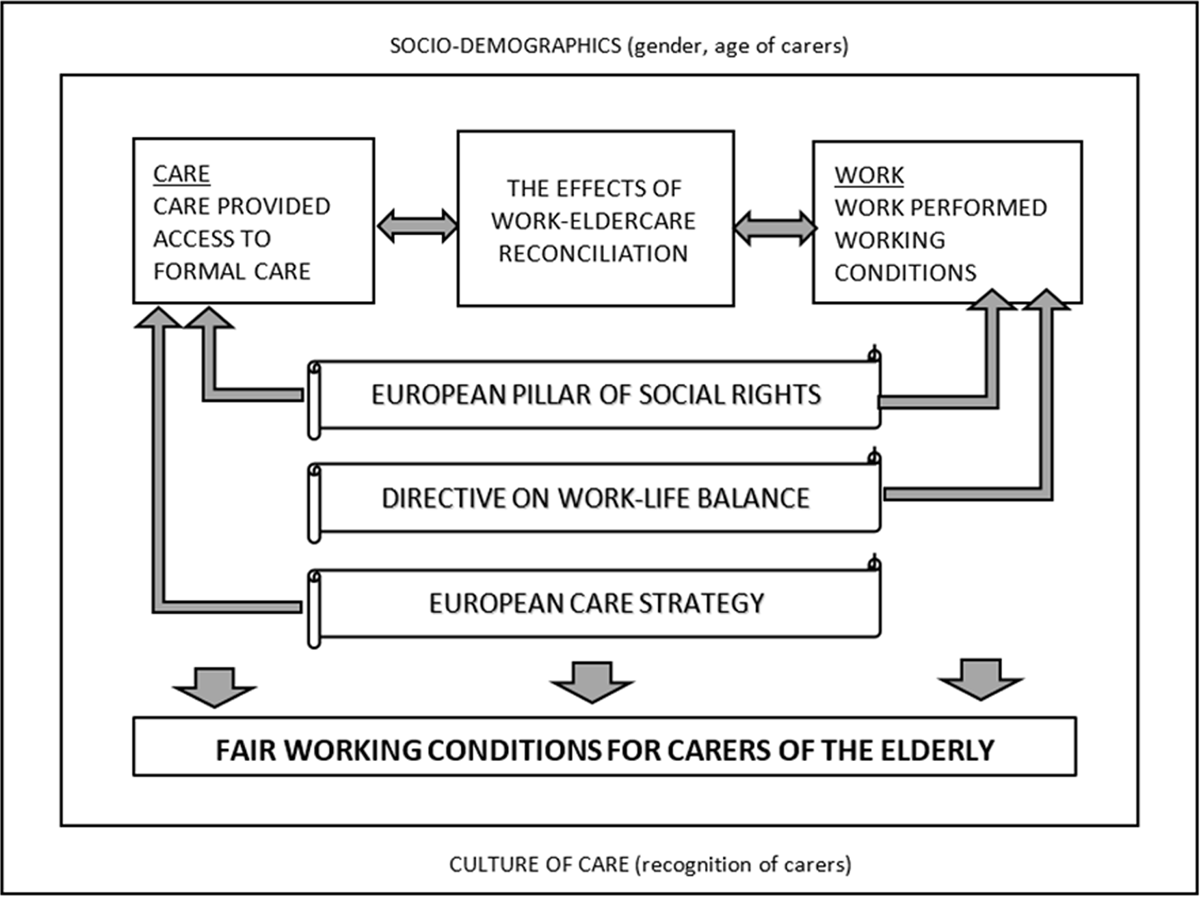
Figure 2
The instruments of EU law creating fair working conditions for informal carers of the elderly.
Source: Own elaboration.
Figure 2 shows that the understanding of fair working conditions in balancing work and life goes beyond the conditions agreed between employer and employees and regulated by labour law and also includes access to formal care; in our case – formal long-term care. That is why, in order to assess the suitability of EU law instruments in facilitating fair working conditions, we first analyse the way in which long-term care is organized and financed by specific countries – in our case by Poland and the Netherlands.
3. Long-term care in Poland and in the Netherlands
Long-term care is provided formally (in the context of formal employment regulations) and informally (outside the context of formal employment regulations).41
Formal long-term care might be delivered in-kind or in-cash. In-kind benefits are provided to long-term care recipients as goods, commodities and services.42 Services are provided either as home care services (to people who mainly reside in their own home) or as care in institutions (that refers to nursing and residential care facilities which provide accommodation and long-term care as a package).43 Cash benefits ‘include cash transfers to the care recipient, the household or the family carers to pay for, purchase or obtain care services. They can also include payments directed to carers’.44
Referring to care and support provided by informal carers (family, relatives, neighbours, etc.), informal long-term care is the counterpart of professional care. Informal carers volunteer to provide care, but they may also somehow be forced to do so as, for the person in need of care, there is no alternative, due to the lack of means to pay for this and the limited access to formal long-term care in their country.
The weight assigned to formal and informal care, respectively, indicates the way long-term care is treated in the social protection system of a given country45 and depends on the extent of the responsibility of family and the state in providing eldercare.
3.1 Formal long-term care in Poland and the Netherlands
In Poland, long-term care is quite a new policy area but not distinctive enough to be treated as a separate system. Formal long-term care services at home and in institutions are provided both in the social and health sectors and are aimed at supporting people with severe disabilities and the elderly. Separate Acts regulate public long-term care provisions in both sectors.46 In 2019 public spending on long-term care in Poland amounted to only 0.8% of GDP and was lower than in many of the other EU27 countries.47
The Dutch long-term care system has a long history. The system is complex and provides extensive rights for people who need care. In 2019 public spending on long-term care in the Netherlands amounted to 3.7% of GDP.48
3.1.1 Financing and management structures
The financing and management structures in the social and health sectors in Poland are different. In the health sector long-term care is provided on the basis of the Act of 27 August 2004 on healthcare services financed from public funds49 and the Act of 15 April 2011 on medical activity.50 Residents of care and nursing homes have to pay for accommodation and catering, but up to no more than 70% of their monthly income. The healthcare services are fully financed from the National Health Insurance. In the social sector long-term care is provided on the basis of the Act on social assistance of 2004. Care services are financed from local government budgets and from payments from care recipients depending on their financial means. Residential care in the social sector is provided on the basis of the regulations of the Minister of Labour and Social Policy (from 2012 on social assistance homes and on family care homes). It is financed by the recipients up to 70% of their income (it may also be paid for by the local government when the care receiver and his/her family are not able to pay). Cash benefits are financed in the social assistance sector via general taxation and from the social security fund (for instance for pensioners).51
In the Netherlands, long-term care can be provided by the Long-term Care Act (Wet langdurige zorg, Wlz), the Social Support Act (Wet maatschappelijke ondersteuning 2015, Wmo 2015) and the Health Insurance Act (Zorgverzekeringswet, Zvw). The Wlz is administered by Wlz institutions on behalf of the national government and financed through an income-related Wlz premium that is collected via income tax; the WMO 2015 is administered by the individual municipalities and financed through taxes and the Zvw is financed by contributions from all residents and income-related contributions from employers and the self-employed. The type of home care that is reimbursed depends on the situation and the legal Act applied in the particular situation.52
3.1.2 Home care
In Poland, nursing homecare services are provided for free (financed from the National Health Insurance) by community nurses or long-term care nurses on the basis of the decision of a primary care physician. The condition for this is that the person concerned is insured and his/her health status has deteriorated to such an extent that he or she needs medical treatment. Homecare services in the social sector are provided to those who require care and assistance at home or help with Activities of Daily Life (ADL) due to age or disability. In the majority of cases these services require co-funding and their cost is often similar to the cost of privately obtained care provided in the so-called grey sector by non-registered carers. These carers can provide care in a more flexible way (both in terms of the number of hours worked and the time of the day they perform their job). Generally, access to formal homecare services is very low. In 2019 only 3.4% of the Polish population aged 65 or over received formal long-term care at home.53
In the Netherlands, home care is a policy priority. It is organised on a local level and provided for a person in need of care in his or her own home for as long as it is possible.54 The interplay between the three Acts previously mentioned is as follows. Citizens who need permanent supervision or 24-hour care can receive long-term care at home by appealing to Wlz authorities. The care may relate to help with the household, supervision and nursing. If a person requiring care is not eligible for care under the Wlz, home care can be reimbursed by the municipality (Wmo 2015) and/or the health insurer (Zvw). The Wmo 2015 comes into play regarding guidance in daily life and domestic help – for example, help with administration, learning to do the household tasks yourself or working together on more social contacts. The aim of this care is that citizens can continue to live at home for as long as possible. The assumption is that citizens, primarily, bear responsibility for their participation in society. If the support by the environment of the claimant proves to be insufficient, it is possible to ask for support from the municipality that has, in terms of the Act, to make a general or customized provision. Nursing and care provided by a district nurse at home in the case of fragile health (due to a medical condition), however, falls under the Zvw – for example help with showering, getting out of bed and eating, dressing a wound, stoma care or giving injections.
Homecare services are therefore more easily accessible in the Netherlands than in Poland. In 2019 they covered 19.1% of the Dutch population aged 65 or over.55
3.1.3 Care in institutions
In Poland, in the health sector, care is provided in chronic care homes and nursing homes on the basis of a medical and functional assessment. Long waiting lists exist for these institutions. Residential care and semi-residential care are also offered in the social sector depending on the care needs and the situation of a family. As in the case of nursing homes, the demand for residential care is higher than the supply and there are also regional disparities in access to the homes: it is estimated that, in 2019, only 2.7% of the population aged 65 or over received care in an institution in Poland.56
In the Netherlands, a person is entitled to residential care if care at home is no longer sufficient. In 2019 residential care covered 5.6% of the Dutch population aged 65 or over.57
There is a huge difference between Poland and the Netherlands in terms of accessibility to long-term care beds in nursing and residential care facilities. In the Netherlands, in 2017, there were 1,370.7 long-term care beds available per 100,000 inhabitants, while in Poland there were only 195.3 long-term care beds per 100,000 inhabitants.58 The Netherlands therefore has marginally more than seven times as many long-term care beds per 100,000 inhabitants as Poland has.
3.1.4 Cash benefits
In 2019, as much as 37.2% of the population aged 65 or over received long-term care cash benefits in Poland in comparison to 1.2% in the Netherlands.59 The broad access to benefits in Poland is related to the fact that all individuals aged 75 and more are entitled to either a nursing supplement (paid from the social security fund) or a nursing allowance (paid from the social assistance sector). These benefits are dedicated to the elderly to cover extra costs of care, but the amount (no more than € 54 per month in 2022) is not sufficient to pay for care that is often required at this stage of life. However, not everyone who receives this kind of benefit is in real need of care.
Cash benefits in the Netherlands are paid in the form of a personal budget (pgb), which enables the person in need of care to choose and pay the care provider of his or her choice.60 The amount of the pgb depends on the level of care, e.g. the number of hours of care for which the care recipient has a need and on the quality of the care provider. Although the informal carer does not provide the assistance to the elder as part of his or her paid job, that does not necessarily mean that informal care is always unpaid. That is why, when determining the amount of the personal budget, a distinction is made between using formal professional care (for which a higher hourly wage applies) and informal care (for which the hourly wage is approximately one-third of that of formal care).
3.2 Informal care in Poland and in the Netherlands
The use of solely informal care is highest in Eastern EU countries including Poland (more than 85%).61 The prevalence of informal care in Poland is noticeable especially for people who needintensive care. In 2016, 34.1% of the Polish population provided more than 20 hours care per week. In the Netherlands, only 3.3% of the Dutch population did this.62 Surprisingly, when we analyse informal care irrespective of its intensity, we can see that more than one-third (36.7%) of the Dutch population reported providing care or assistance to one or more people needing help due to long-term physical or mental health illness, physical weakness or old-age; in Poland this is 10.2% of the population.63 This may be explained by fact that Dutch people are more aware of giving care compared to people in Poland who take informal care for granted.
Although care given by Polish carers is more time-intensive, the support from the formal health and social sectors is poor. In 2017, the possibility of contacting a doctor and providing medical transport for the person cared for were the most common forms of support for informal carers. At the same time, over 70% of informal carers in Poland did not know which institution they could contact to receive care services for the dependent person.64 Polish informal carers lack respite care, training and psychological help. This type of support is occasionally provided by non-governmental organizations in cooperation with local authorities, but it is not always offered.65
In the Netherlands, there are various measures to support informal carers. Which measures these are depends on the legal basis. Based on the WMO 2015, municipalities must offer tailor-made facilities for informal carers who support those in need of care with a right to receive support based on the WMO. The offer depends on municipal policy and therefore differs between municipalities. 66 Examples are respite care (temporary takeover of informal care by another person), tokens of appreciation, information and advice, training and emotional and social assistance. For people living at home with a Wlz classification, respite care is arranged differently. Under the Wlz, they are insured for respite care that creates a ‘breathing space’ for their informal carers.67 In 2019, 29% of the informal carers made use of such provisions.68
The vast majority of informal carers (65.2%) in Poland, despite taking care of an elderly person, do not quit their job – they combine paid work and care. Nevertheless, more than 14% of them admit that their economic situation has worsened due to providing such care.69 In the Netherlands, a quarter of the 16–69 year-olds combine a job of 12 hours a week or more with informal care (almost two million people).70 According to Mezzo’s National Informal Care Panel, in 2015 55% of the informal carers stated that they were short or often short of money.71
In both countries, women are more involved in giving informal care than men. This is especially true in the case of people aged 45–64.72 In the Netherlands 31% of women and almost 23% of men in this age group provide informal care. In Poland the gender difference is higher – 26% of women and only around 14% of men aged 45–64 are involved in caring. The higher gender difference in Poland in comparison to the Netherlands may be related to the difference in retirement ages. In Poland it is 60 for women and 65 for men whereas in the Netherlands it is almost 67 for both men and women.
To sum up, in both countries long-term care constitutes a mixture of health and social care as well as a mixture of formal and informal care. Both in Poland and in the Netherlands informal care plays an important role in supporting the frail elderly but the intensity of care provided by Polish informal carers is higher than that provided by the Dutch. Moreover, Polish informal carers are less supported by the formal health and social sector. In addition, formal long-term care provisions are better developed in the Netherlands than in Poland and give more extensive rights for those in need of care. Looking at the Netherlands, with homecare being the priority, a space for more family and friends’ involvement (re)opens. Despite the fact that the opportunities in residential care in the Netherlands are still greater than in Poland, they have recently decreased, which may create tensions for informal carers. The paper will now turn to the other factor affecting people who combine informal elderly care and paid employment, namely their working conditions.
4. Working conditions for informal carers in Poland and in the Netherlands
Working conditions may be understood narrowly, as the conditions under which employees have to work, e.g. breaks, the state of heating, lighting, ventilation of workplaces, the safety and comfort of equipment, normal manning levels as well as disciplinary procedures.73 They may also be defined broadly, as done by the ILO, as including working time (hours of work, rest periods and work schedules), remuneration, physical conditions and mental demands in the workplace.74 The European Foundation for the Improvement of Living and Working Conditions (Eurofound) mentions the following aspects of working conditions: the organisation of work and work activities, training, skills and employability, health, safety and well-being as well as working time and work-life balance.75 Following Kröger and Yeandle,76 we focus on three elements in the ‘working time and work-life balance’ aspect of the Eurofound approach to working conditions. These are:
services in the workplace regarding eldercare support;77
rights and entitlements of employees with informal care obligations regarding
flexible working arrangements and
job security (dismissal protection, right to return to the same position);
financial support in the event of leave or in the event of a reduction in working hours.
Based on these elements, we map the situation of working informal carers in Poland and the Netherlands.
4.1. Services in the workplace regarding eldercare support
For informal carers a supportive employer plays an important role in work-care reconciliation.78 While considering the work-life balance, employers in business enterprises in Poland mainly chose time and work organization arrangements. They are not very active in the implementation of other solutions enabling employees to reconcile work and care.79
In the Netherlands, employers have to act according to the legal principle of being a good employer, laid down in Article 7:611 of the Dutch Civil Code. This means that an employer must behave well towards his or her employee, implying that he/she not only takes the interests of the business but also those of his or her employee into account in the choices and considerations he/she makes. Moreover, under the Working Conditions Act and the Dutch Civil Code, the employer has a duty of care to organize and maintain a good working environment.80 This requires a proactive attitude from the employer. He/she can offer practical tailor-made solutions; this includes, for example, temporary adjustments to the tasks of the worker and reimbursement of the costs of an informal care broker. An informal care broker is a professional who knows his or her way around ‘care country’ and helps informal carers with all the arranging tasks related to care. The professional has knowledge of care and welfare, housing, income, legislation and regulations and insurances.81 The aim of all this is to reduce or prevent overloading of the informal carer. A reason for reimbursing costs is that employers too benefit from the fact that the employee has arranged the care as well as possible.82
4.2. Rights and entitlements in employment
4.2.1. Flexible working arrangements
In Poland, flexible working arrangements were introduced by the Act of 2013 amending the Act – Labour Code and the Act on Trade Unions;83 these arrangements were not specifically dedicated to carers of the elderly.84
In the Netherlands, flexible working arrangements have been regulated since 2000. Employees in undertakings with more than ten employees have the legal right to adjust (reduce or – provided certain conditions are met85 – extend) their working hours. This was aimed at, among other things, supporting employees’ work-life balance but was not limited to carers.86 It was extended in 2016 when the right to flexible work arrangements was settled under the Flexible Working Act in order to ‘effectively support the combination of work and private life’87 by means of an adjustment of:
working time (agreed time at which the work has to be done);
working hours (number of hours);
the workplace (the place where the work is to be performed,88 mostly involving work in the home office).89
Employers can only reject an employee’s request to adjust his or her working time and working hours if there are compelling business or service interests. It is more difficult for an employee to change the workplace (e.g. to start working from home). Here, the employer only must consult with the employee and, in the event of a rejection of the request, give proper reasons. Recently a broad discussion began on how to make these adjustments equally accessible for all workers.90
Employee-friendly flexible working time plays an important role in reducing the work-life conflict.91 In the Netherlands, when determining the employee’s working time pattern, employers have to consider the employee’s personal circumstances outside his or her work including care for his or her dependent relatives. This obligation, laid down in Article 4:1a of the Working Hours Act, rests on employers insofar as this can reasonably be expected from them. In 2019 more than half of the employed persons in the Netherlands could either fully (20%) or with certain restrictions (30%) decide on their working time.92
In Poland, almost one-third of all employees could either fully (20%) or with certain restrictions (12%) decide on their working time. Both in Poland and in the Netherlands, fewer women (around 17% in both countries) than men (23% in both countries) were able to fully decide on their time at work.93 Even though in Poland working time flexibility is lower than in the Netherlands, it is still the main instrument for supporting working carers.94
Adjustment of working hours can help carers especially when involvement in eldercare becomes more intensive. Part-time work is a very popular way of achieving the work-care balance in the Netherlands.95 In 2020, the Netherlands had the highest proportion of part-time workers among the EU countries – 38% of employees aged 20 to 64. Eurostat estimates that there were 61.7% part-timers among employed women and only 16.7% among employed men.96 The data shows that Dutch employees (mostly women) are more likely to reduce their number of working hours. Working part-time is deeply ingrained in the culture and structure of Dutch society.97 It may be influenced by the long tradition of male breadwinners in this country.98
Polish employees, unlike the Dutch, are more reluctant to reduce their working time. In Poland the proportion of part-timers among employees aged 20 to 64 was much lower. In 2020 it was equal to only 5.7% (8.8% for women and 3.2% for men).99 An important factor in this may be the quite low level of wages in Poland. That is why part-time work has little potential in Poland as a work-care balance instrument.
4.2.2 Job security
In Poland, there are no special measures protecting informal care providers from dismissal; according to the Polish Labour Code, however, older employees who are about to retire are entitled to employment. Given that persons who provide a relatively large amount of informal care are in the age group of the older workers, the fact that four years before their retirement age an employer cannot terminate their contract may support these care providers and reduce their fear of losing their jobs. There is a short-term paid care leave (see Section 4.3) during which an employee cannot be dismissed. In Poland there are no special entitlements for carers giving them the right to return to the same job position after a break caused by care.
In the Netherlands, employees who work under flexible working arrangements or use care leave options (Section 4.3) are protected insofar as the right to flexible working or care leave may not be a reason for less favourable treatment or dismissal. Additionally, the prohibition of dismissal due to long-term care leave is explicitly regulated by law.100
4.3. Leave and financial assistance
In Poland, an insured employee101 is provided with care allowance at the level of 80% of the personal average annual wage for the time of care given to an ill family member.102 Family members are spouses, parents, the parent of a child, stepfather, stepmother, parents-in-law, grandparents, grandchildren, siblings and children over 14 years of age – if they stay in the same household with the insured person during the period of care. The allowance is granted for a period no longer than 14 days in a calendar year and the condition for this is that a medical certificate is presented and there is no other carer in the family.103
In the fourth quarter of 2021, over 388,369 women and around 141,355 men received this type of allowance in total.104 This data unfortunately does not show precisely how much of this care was given to a sick adult family member; nevertheless, it reveals a general huge gender gap in terms of care allowance beneficiaries.105
Under Dutch law, employees with care duties have the possibility of taking up three different forms of leave in different situations: an emergency leave and other short-term absenteeism leave; a short-term care leave; and a long-term care leave. These forms are regulated in the Work and Care Act. Employees are entitled to these three different care leaves if persons belonging to the following group are in need of care: husband or wife, registered partner or life partner cohabiting with the employee; his/her child and the child of the husband or wife, registered partner or life partner cohabiting with the employee; a foster child living at the same address as the employee; a relative in the first and second degree; a person living at the same address as the employee and a person with whom the employee has a social relationship, as far as the care is directly linked to this relationship and should reasonably be provided by the employee.106
Emergency leave and other short-term absenteeism leave is fully paid by the employer for a rather short period of time, mostly just one or two days. It can be taken for personal reasons, which include attendance at medical visits which are urgent, unplanned or cannot be scheduled outside working hours or the sudden illness of a child, partner or a person belonging to the group described above.107
Short-term care leave can be taken for a maximum of twice the weekly working time of the employee in each period of 12 months; it can be taken in several spells. It enables the employee to provide the necessary care in the case of illness of a person belonging to the group described above. An employee working 40 hours a week has thus the right to take short-term care leave for 80 working hours in a year. During that leave the employee is entitled to continued payment of 70% of his or her salary, but not more than 70% of the applicable maximum amount as defined by the Act on financing of social security. If 70% of the salary is less than the minimum wage, the employee will receive the minimum wage.108
Long-term care leave can be taken for a maximum of six times the weekly working time of the employee in each period of 12 months in order to take care of a person suffering from a life-threatening illness or to provide the necessary care for an ill person or a person needing care (in the example of the employee with an employment contract of 40 hours he or she can take up long-term care leave for 240 hours a year). The list of persons in need of care is the same as for the short-term care leave. Long-term care leave is unpaid, unless an employer or the collective labour agreement provide differently.109 During unpaid care leave, the accrual of vacation days continues.110
While short-term absentee leave has always to be permitted, short- and long-term care leave is conditional. The employer has the right to refuse the requested leave due to serious business reasons if these reasonably prevail on the interests of the employee.111
Collective labour agreements can deviate, to the detriment of the employee, from the Law with regard to the continued payment of wages during emergency leave and the scheme for short- and long-term care leave.112
Paid leave is used by one in ten employees who provide informal care, whilst unpaid care leave is used even less often (6%).113 Research by Statistics Netherlands into the non-use of leave when there is a need for it, shows that the most frequently cited reason is that the work did not allow it or that people did not want to burden colleagues. About 4 out of 10 men and women say they have not taken any leave for this reason. In addition, 11% of the men and 14% of the women indicated that it was not financially feasible to take leave or that they did not want to suffer financially.114
To sum up, the role of the employer in supporting work-care balance has been set out in the Dutch law shaping employers’ attitudes towards working informal carers and their working environment. Moreover, all Dutch employees are entitled to flexible working arrangements in order to combine work and private life. Dutch workers, unlike Polish ones, are more likely to reduce their working hours as the way of work-care reconciliation. Working time flexibility (agreed time at which the work has to be done), although lower in Poland than in the Netherlands, is still an important work-life balance instrument for Polish carers. Although in the Netherlands it is possible for a carer to take both a paid short-term and unpaid long-term care leave, the take-up of these measures is not very high, indicating the limitations of these tools in reconciling work and care. Based on the above analysis it is difficult to assess the importance of care allowance (paid up to 14 days off) in the case of care given to a family member in Poland, but judging from the way care allowance is constructed115 there is a risk that it may go unnoticed by some of the carers who are potentially interested in it.
5. Instruments of European Union law creating fair working conditions for carers in Poland and the Netherlands
5.1. The context
Socio-demographic characteristics of informal carers (gender, age) and also the culture of care in Poland and in the Netherlands constitute a context for work-eldercare reconciliation as previously indicated in Section 2.
Both in Poland and in the Netherlands, the characteristics of informal carers according to age and gender are similar. In both countries women are more involved in eldercare than men. Moreover, the most common age to be a carer for elderly people in both countries is between 45–65 years old when carers are usually still actively engaged in employment.116 The differences between Poland and the Netherlands are shown in the approach to eldercare. The relative weight assigned to formal and informal long-term care in the Polish and Dutch social protections systems varies significantly. In Poland, unlike the Netherlands, these are mainly informal carers (usually family members) who provide the great bulk of long-term care with weak support from the formal health and social system. They also receive only weak support in their workplace, especially in terms of their statutory rights. Moreover, working informal carers of the elderly in Poland are not formally recognized. In the Netherlands (unlike in Poland) the process of recognizing carers is formalized and workplace-based eldercare support is more developed.
To sum up, work-care reconciliation is less protected in Poland where the access to formal care is lower than in the Netherlands,117 but there are also differences in work-care reconciliation strategies due to the different situation in the labour market between the two countries. Both in the Polish and the Dutch case, flexible work arrangements play a key role but it is the Dutch (mostly women) who make a greater use of part-time work.
5.2. The assessment of EU law instruments
The Work-Life Balance Directive, the European Pillar of Social Rights (principles 2, 9 and 18) and the developing European Care Strategy have been used for analysis as instruments of EU law potentially facilitating fair working conditions for informal carers of the elderly in Poland and in the Netherlands. While the Directive can be analysed as a form of hard law enforced by the EU to be implemented in all Member States,118 the other two, namely the EPSR and the European Care Strategy, serve and will serve as soft law instruments without legal binding force.119
Having this context in mind, we assess the potential of the Work-Life Balance Directive in Poland and the Netherlands for facilitating fair working conditions for informal carers – mainly middle-aged women. Assessing the potential of the Directive means checking whether working conditions offered to these carers under the national laws and the Directive compensate for the time they devote to caring, help them to continue and develop their career if they so wish and also open the door to men being more involved in care tasks.
According to the Work-Life Balance Directive, carers have the right to adjust working patterns with the use of flexible working schedules, reduced working hours and remote work. In the Netherlands, all these adjustments are possible (in companies with ten or more employees) and used by employees. Working part-time, flexible working hours as well as adjustable workplace enable the Dutch employees to reconcile work and care. The problem is that part-time work is mainly chosen by women; this has a long socio-cultural tradition in the Netherlands making these women economically dependent and negatively affecting their income after retirement age. What is more, working part-time does not give women full possibilities for their career development. Even though flexible work schedules and control over working hours are very useful for obtaining work-care balance, it is not enough to compensate for the greater involvement in care.120 In Poland, flexible working arrangements are limited to the employees’ possibility to set starting and finishing times of their workday individually. Implementation of the Work-Life Balance Directive in Poland means the necessity of a wider use of flexible work organization, including through: remote work, flexible working time schedules and part-time work.121 In practice, Poles are reluctant to work part-time, making much more use of flexible working time schedules.
The right to care leave does not make a great difference in a division of care and work tasks between men and women, especially as it is (according to the Directive) unpaid and does not compensate for time devoted to care. A second obstacle is the duration of the leave. Particularly in the case of informal care, which often has to be provided for a long time, a leave of five working days per calendar year is only rarely sufficient. Although the situation in the Netherlands is much better in comparison with that in Poland so far as the Directive’s requirements (paid short-term care leave and unpaid long-term care leave) are concerned, the low take-up of these kinds of leave in practice may indicate low usefulness of these instruments in building work-care reconciliation. In Poland, the care leave indicated in the Directive may be a proof of carers’ recognition, but as long as it is unpaid we expect that Polish informal carers would continue to make use of the allowance under sickness insurance.
Other instruments introduced in the Work-Life Balance Directive, such as the right to time off on the grounds of force majeure, provisions maintaining employment rights and the introduction of the legal concept of informal carer, are of minor importance for the Dutch carers (women). After all, Dutch law has already provided these measures in a better version than that set out in the Directive.122 Examples are the fully paid time off on the grounds of force majeure and a more comprehensive and inclusive approach to defining informal carers taking into account not only the relative but also social relationship with the person in need of care. The fact that the Work-Life Balance Directive only extends to the domestic sphere, namely to persons who belong to the family of the carer, makes informal care a family affair. This may be regarded as a shortcoming, since the supportive and fair working conditions are not accessible to informal carers who take care of, for example, neighbours and friends.
In Poland these three previously mentioned instruments are of great importance. The necessary amendments have been recently introduced123 in the Polish Labour Code to give carers the right to request leave from work due to force majeure in urgent family matters caused by illness or accident if the employee’s immediate presence is necessary (lasting up to 2 days or 16 hours in a calendar year, paid up to 50% of the remuneration for the duration of the leave).124 Poland also needs to take necessary measures to protect working carers against dismissal and discrimination when they make use of their new rights.125 Moreover, the formal definition of a carer in the Directive opens the door to formal recognition of informal carers in Poland.126
The legislative power of the EPSR regarding the right of everyone to affordable long-term care services of good quality, in particular home care and community-based services is limited.127 The EU can only support and complement the activities of Member States with regard to social security and social protection of workers, but it is Member States that define the fundamental rules of the their security systems.128 Having that in mind, the potential of the EPSR (principle 18) in facilitating fair working conditions for carers for the elderly is still high as it emphasises, at the EU level, the right to long-term care for those in need of care. It is especially important for Poland where the long-term care policy does not form a separate system and needs more attention. The Dutch long-term care system is in line with EPSR recommendations about the access and affordability of care given at home, organized at the local level. In Poland, there is much to be done to increase the access to long-term care services including those provided at home. The access to these services is of major importance for work and eldercare reconciliation.
Principle 9 of the EPSR on work-life balance has been implemented in the Work-Life Balance Directive discussed above. Its main contribution is providing rights for all employees with caring responsibilities including those caring for the elderly.129 This is especially important for Poland where informal carers of the elderly have not yet been formally recognized.
In principle 2, the EPSR focuses on fostering equality between women and men in all areas, including regarding participation in the labour market, terms and conditions of employment and career progression.130 As women both in Poland and in the Netherlands provide the majority of informal care, the significance of this principle for creating fair working conditions for carers for the elderly is of great importance. It is especially true for the Dutch informal carers (mainly women) for whom working part-time is the most common way for work and care reconciliation and who thus suffer from lower income and pensions.
The European Care Strategy, which is under development now, represents a complex approach to long-term care, taking into account not only care services and people who receive them but also those who give care both formally and informally. Taking care of formal carers contributes to improving the quality of services provided by them which is in line with EPSR assumptions. This is a necessary action to take both in the Netherlands and in Poland to avoid staff shortages in the formal long-term care sector.
6. Conclusions
In order to create and develop fair working conditions for workers providing informal care for the elderly in Poland and in the Netherlands, it is crucial to shape both care-related and work-related factors making them more friendly for informal carers. A carer-friendly environment means that carers can organize their work and care duties in a way that matches their needs at a particular stage of informal care given to the elderly.
Both in Poland and in the Netherlands, informal care is a significant element of the long-term care system, but the way it is supported, both from the social and health sectors as well as from the perspective of the workplace, differs significantly. That is why the contribution of EU law instruments in creating fair working conditions for those performing work and eldercare in both countries is also different. Taking into account the EPSR and the European Care Strategy, the most necessary actions to be taken in the Netherlands are related to gender equality and working conditions of informal carers who mainly work part-time. At the same time in Poland, the recommendations coming from these instruments cover different and much broader issues related to access to formal long-term care services as well as support and formal recognition of carers.
The measures in the Work-Life Balance Directive are useful for carers’ recognition and protection at work which opens the door to making carers’ work (in majority performed by women) more visible both for working carers themselves and for others, for example social partners (employers, trade unions, etc.). This applies in particular to Poland, but may be also useful in the Netherlands, where the formalization of informal care is not (yet) generally known among the population. It is important that workers providing informal care are aware of their rights and the contribution they give to society as a whole. Once the contribution is fairly compensated, it could also be an incentive for men to get involved in informal care.
Furthermore, the possibility to apply for a reduction in working hours in Poland and the right to flexible working regardless of the size of the company in the Netherlands, both supported by a right to return, are examples of contributions of the Work-Life Balance Directive to the establishment of fair working conditions for informal carers that were hitherto unknown in both countries.
And last but not least, in order to create fair working conditions for informal carers it is not enough simply to introduce new instruments but it is essential to open the dialogue aimed at fostering work-care reconciliation not only by means of legislation, but also by work rules, collective and individual bargaining, custom and practice at the level of a particular organization, and in the attitudes of people generally. The EU law instruments analysed in this paper are the evidence that such an important dialogue has already begun.
Notes
[1] The definition of informal care (mantelzorg) was extracted from the Dutch National Advisory Council for Public Health (Nationale Raad voor Volksgezondheid).
[2] F Colombo and J Mercier, ‘Help wanted? Providing and Paying for Long-Term Care’, OECD Health Policy Studies, OECD Publishing (2011) 85–102; L Calvano, ‘Balancing eldercare and work’ in Ronald J Burke, Cary L Cooper and Alexandros-Stamatios G Antoniou (eds), The Multigenerational and Ageing Workforce. Challenges and Opportunities (EE Publishing 2015) 164–167.
[4] Which means care services provided in the context of formal employment ‘such as through contracted services, by contracted paid care workers, declared to social security system’: Colombo and Mercier (n 2) 11.
[6] This is a broader definition in comparison to the typical and commonly used legal definition understood as conditions between employer and employees.
[7] M Fine, ‘Cultures of Care’, in Julia Twigg and Wendy Martin (eds) Routledge Handbook of Cultural Gerontology (Routledge 2015) 269–276, 296.
[8] Based on a literature review: A Heitmueller, ‘The chicken or the egg? Endogeneity in labour market participation of informal carers in England’ (2007) 26 Journal of Health Economics 536; F Carmichael and S Charles, ‘The labour market costs of community care’ (1998) 17 Journal of Health Economics 747; F Carmichael and S Charles, ‘The opportunity costs of informal care: Does gender matter?’ (2003) 22 Journal of Health Economics 781; J Jenson and S Jacobzone, ‘Care Allowances for the Frail Elderly and Their Impact on Women Caregivers’, OECD Labour Market and Social Policy Occasional Papers, no 41 (OECD Publishing 2000) <https://doi.org/10.1787/414673405257>.
[10] European Commission and Social Protection Committee, 2021 Long-term care report: trends, challenges and opportunities in an ageing society. Volume I (2021) 83.
[11] Directive (EU) 2019/1158 of the European Parliament and of the Council of 20 June 2019 on work-life balance for parents and carers and repealing Council Directive 2010/18/EU [2019] OJ L188/79.
[12] European Commission, ‘A European Care Strategy for caregivers and care receivers’ (European Commission, 7 September 2022) <https://ec.europa.eu/social/main.jsp?langId=en&catId=89&furtherNews=yes&newsId=10382> accessed 1 June 2023.
[13] Commission Recommendation (EU) 2017/761 on the European Pillar of Social Rights of 26 April 2017 C/2017/2600 [2017] OJ L 113/56.
[14] Interinstitutional Proclamation 2017 on the European Pillar of Social Rights [2017] OJ C 428/10.
[16] SB Lahuerta and A Zbyszewska, ‘EU equality law after a decade of austerity: On the Social Pillar and its transformative potential’ (2018) 18 (2–3) International Journal of Discrimination and the Law, 180–181.
[17] European Commission, ‘The European Pillar of Social Rights Action Plan’ (European Commission, 2021) <https://op.europa.eu/webpub/empl/european-pillar-of-social-rights/en/> accessed 1 May 2023.
[19] As the relaunch of the Directive was linked to the EU’s social policy laid down in the EPSR, the European Pillar of Social Rights provided a crucial political boost to the proposal for the Work-Life Balance Directive.
[28] ibid arts 6, 8(1) and 8(2). The time-off from work on grounds of force majeure already existed under the Parental Leave Directive 2010/18/EU and is maintained in the Work-Life Balance Directive.
[40] European Commission ‘Making Europe stronger’ (Communication) COM(2021) 645 final 8, 19 October 2021.
[45] European Commission, ‘Long-term care in ageing societies – Challenges and policy options’ (Commission staff working document) SWD(2013) 41 final, 20 February 2013, 8.
[46] A Sowa-Kofta, ‘ESPN Thematic Report on Challenges in long-term care. Poland’ (European Commission 2018) 4.
[47] European Commission and Social Protection Committee, 2021 Long-term care report: trends, challenges and opportunities in an ageing society. Volume II, Country profiles (2021) 320.
[49] Act of 27 August 2004 on health care services financed from public funds, Journal of Laws 2004, number 210, item 2135 as amended.
[50] Act of 15 April 2011 on medical activity, Journal of Laws 2011, number 112, item 654, as amended.
[60] The pgb scheme is not intended as an income provision for informal carers. It should mainly be seen as a care provision for those in need of care. Parliamentary Papers II 2020/21, 25 657, 334, 5.
[64] A Czerw (ed), Adekwatność i efektywność udzielanych świadczeń opieki zdrowotnej w odniesieniu do rozpoznanych potrzeb zdrowotnych osób starszych. Raport końcowy, Narodowy Instytut Zdrowia Publicznego – Państwowy Zakład Higieny (2020) 44.
[66] Article 2.1.2 Social Support Act (WMO 2015) obliges the municipal council to periodically adopt a plan with regard to its policy concerning social support. The plan must include the policy intentions to enable the various categories of informal carers to perform their tasks as informal carers as much as possible.
[68] The Netherlands Institute for Social Research, Blijvende bron van zorg. Ontwikkelingen in het geven van informele hulp 2014–2019 (2020) 92.
[71] Movisie, ‘Financiële kwetsbaarheid mantelzorgers’ (2020), https://www.movisie.nl/publicatie/financiele-kwetsbaarheid-mantelzorgers> accessed 1 May 2023, 1.
[76] T Kröger and S Yeandle (eds), Combining Paid Work and Family Care: Policies and Experiences in International Perspective (Policy Press 2013) 24.
[77] Kröger and Yeandle focus on services available to carers in a border context including services provided to informal carers within the framework of a long-term care system. As has already been discussed in Section 3, here we draw attention to services provided to carers in their workplace.
[79] A Furmańska-Maruszak and A Sudolska, ‘Making work sustainable in business and social enterprises’ (2017) 12(3) Olsztyn Economic Journal, 268.
[81] These include informal care itself, as well as how to combine care with work and/or other obligations. Beroepsvereniging mantelzorg makelaars, https://www.bmzm.nl/.
[82] https://www.bmzm.nl/mantelzorgmakelaar/kosten/, accessed 1 June 2023.
[83] Act of 12 July 2013 amending the Act - Labor Code and the Act on Trade Unions, Journal of Laws 2013, item 896.
[84] Act of June 26, 1974 Labor Code, Journal of Laws 2020, item 1320, Journal of Laws 2021, item 1162; A Cybulko, ‘Country report Gender Equality. Poland (European Commission, European network of legal experts in gender equality and non-discrimination 2022) 60.
[85] See for example: M Vegter, Country Report Gender equality. Netherlands (European Commission, European network of legal experts in gender equality and non-discrimination 2022) 51–52.
[88] Remote work has potential, which appeared especially in connection with the coronavirus pandemic, opening new opportunities for informal carers as well. Due to the limitations of the publication, in our paper we focus on the adjustments of working time and working hours.
[92] Eurostat, Employed persons by flexibility to decide on working time in 2019, (2020) https://ec.europa.eu/eurostat/databrowser/view/lfso_19fxwt01/default/table?lang=en, accessed 1 June 2023.
[94] A Sowa and I Topińska, ESPN Thematic Report on work-life balance measures for persons of working age with dependent relatives. Poland (European Commission, 2016) 17.
[95] F van der Woude, K de Vaan and M Blommesteijn, ESPN Thematic Report on work-life balance measures for persons of working age with dependent relatives. The Netherlands, (European Commission, 2016) 17.
[96] Eurostat, Part time employment and temporary contracts – annual data (2023) <https://ec.europa.eu/eurostat/databrowser/view/lfsi_pt_a/default/table?lang=en> accessed 1 May 2023.
[98] M Grunell, ‘Verdeling van arbeid en zorg: Een taai vraagstuk’ (2020) 23(3) Tijdschrift voor Genderstudies, 280.
[101] Employees covered by compulsory or voluntary sickness insurance under the Social Insurance Institution.
[102] M De la Corte-Rodríguez, The transposition of the Work-Life Balance Directive in EU- Member States: A long way ahead (European Commission, European network of legal experts in gender equality and non-discrimination 2022) 108.
[103] Act of 25 June 1999 on cash benefits from social insurance in the event of sickness and maternity, Journal of Laws of 2021 (Ustawa z dnia 25 czerwca 1999 r. o świadczeniach pieniężnych z ubezpieczenia społecznego w razie choroby i macierzyństwa, Dz. U. z 2021 r., poz. 1133, 1621), 1834.
[105] Statistical Portal of the Polish Social Insurance Institution (ZUS), Allowances, Number of recipients of short-term allowances and benefits by gender, voivodeships in the fourth quarter of 2021, https://psz.zus.pl/en/kategorie/zasilki.
[115] Care allowance is paid for the time of care both for children and for other family members and cannot exceed 60 days in a calendar year in total.
[117] In the Netherlands, before the introduction of the Long-term Care Act and the Social Support Act 2015 the access to formal long-term care was much broader.
[119] Z Rasnača, Bridging the gaps or falling short ? The European Pillar of Social Rights and what it can bring to EU-level policymaking (European Trade Union Institute) (2017) 15.
[121] Draft Act amending the Labour Code and some other acts, https://www.gov.pl/web/premier/projekt-ustawy-o-zmianie-ustawy-kodeks-pracy-oraz-niektorych-innych-ustaw, accessed 1 June 2023.
[124] Draft Act amending the Labour Code and some other acts, https://www.gov.pl/web/premier/projekt-ustawy-o-zmianie-ustawy-kodeks-pracy-oraz-niektorych-innych-ustaw2.
[128] European Commission ‘Commission staff working document – Communication from the Commission to the European Parliament, the Council, the European and Social Committee and the Committee of the Regions – Establishing a European Pillar of Social Rights’ SWD (2017) 0201 final.
[130] European Commission, Secretariat General, ‘European pillar of social rights’ (European Commission, 2017) <https://commission.europa.eu/strategy-and-policy/priorities-2019-2024/economy-works-people/jobs-growth-and-investment/european-pillar-social-rights/european-pillar-social-rights-20-principles_en> accessed 1.06.2023.
Competing Interests
The authors have no competing interests to declare.