
1. Introduction
In the past two decades the share of flexible employment has grown considerably in many EU Member States. This is shown in, inter alia, a much larger share of self-employed persons1 in the work force than before. In 2019, in the EU about one in ten workers in the 15–75 years age group was self-employed.2 However, the category of self-employed persons is far from homogenous.3 It includes genuine entrepreneurs, who enjoy the freedom of determining their own work, and are willing and able to bear the risks of entrepreneurship. It may also encompass so-called bogus self-employed persons. These can be workers who have been asked by their former employer to continue to work for him or her on a contract of services. They can be in a quite similar position to employees working in the same enterprise, but have much less labour protection and may receive lower remuneration. There are also categories of self-employed persons who, while not working for a former employer, are economically dependent on one or very few principals.
In this contribution we will analyse why and how collective bargaining and collective agreements have for a long time been a taboo for self-employed persons as a result of EU competition law. Then we will examine how, since some categories of self-employed persons are in a dependent position comparable to that of employees, gradually room has been made for collective labour agreements containing clauses concerning self-employed persons (‘self-employment clauses’).
Competition law is thus increasingly making room for collective agreements, but that is not sufficient for actually starting collective bargaining by or on behalf of solo self-employed persons. Therefore, we want to get insight into the factors relevant to the willingness of employers and trade unions to negotiate and make an agreement. For a first inventory of such factors, we examined experiences in the Netherlands with collective agreements having self-employment provisions, particularly in the theatre and dance sector and in the architects sector.4
We investigated these experiences on the basis of triangulated information from different sources.5 This means that we examined the texts of the collective labour agreements concerned as well as literature and news items on these agreements, and we analysed statistical information on the labour market situation for self-employed persons in the Netherlands. In addition, we had background interviews with four key informants, who have participated in collective bargaining on self-employment clauses, or were involved in societal and political discussions leading up to the first collective labour agreements containing such clauses. Two of them were involved in these negotiations, another interviewee is an expert in collective labour agreement law and the fourth is an official working for the Dutch Competition Authority. The interviews were unstructured and meant as background information for a general outline of the circumstances and context in which self-employment clauses have been established, without striving to give a complete picture.
We will first discuss in which respects there are similarities between employees and self-employed persons (Section 2). Section 3 will describe the room that has been made in EU law to collective labour agreements for employees, from which self-employed persons are excluded. Subsequently, in Section 4 we will describe the development in the policy rules of the Dutch Competition Authority concerning agreements for self-employed persons. In Section 5 we will outline the trends in self-employment and the income earned by self-employed persons in the Netherlands. Next, we will analyse Dutch collective labour agreements with clauses for self-employed persons (Section 6), as well as the increasing room these agreements make for flexibility of employment contracts (Section 7). Section 8 makes an inventory of the factors that were mentioned in the interviews as important for adopting self-employment clauses and the strategies that appear to be used by unions. Section 9 will describe the recently adopted guidelines of the European Commission on the application of competition law to these agreements and Section 10 will draw conclusions.
2. What Could ‘Equal Treatment of Self-employed Persons and Employees’ Mean?
A general characteristic of probably any labour law system is that for self-employed persons the rules for remuneration, the working conditions, including dismissal law, and social security protection are very different from those applicable to employees.6 Generally speaking, self-employed workers have far less protection than employees. This follows, at first sight, automatically from the differences in their situations. After all, self-employed persons can, in principle, determine their own work conditions, bear the economic risks of their activities and can influence their remuneration. However, in practice a considerable number of self-employed persons do not have much influence on these conditions; instead, they have many characteristics in common with employees. This raises the question whether the differences between these categories of self-employed persons and employees are justified.
Equal treatment of persons irrespective of their employment relationship has so far not been laid down in national or international law. Principle 5 of the European Pillar of Social Rights, however, reads: ‘Regardless of the type and duration of the employment relationship, workers have the right to fair and equal treatment regarding working conditions, access to social protection and training’.7 Although the Pillar is not a legally binding instrument, it is of relevance since it expresses the consensus that has been reached at EU level on equal treatment in employment relationships. Even though it can be disputed as to how far the quoted principle includes self-employed persons, it can be seen as a codification of the consensus that there has to be a justification for differences in employment conditions. In other words, it is a provision ‘streamlining’ equality in employment relationships.
How can we, however, translate this equal treatment principle to self-employed persons? The differences between the various categories of self-employed persons themselves, and also between employees and self-employed persons, make a general comparison difficult. It can be held, however, that two particular categories of self-employed workers are largely similar to employees from the point of view of their dependence on their principals:
– the first is that of self-employed persons who work side by side with employees in the same enterprise;
– the second is that of self-employed persons who are, to a large degree, dependent on one counterparty, even if they do not work in the organisation of this counterparty.
As regards the first category, when self-employed persons perform basically the same work as employees, they are cheaper for their principals than employees: labour related costs and social security contributions do not have to be paid. Working as a self-employed person can also be attractive to the workers themselves, as the net income may be higher than if they are employed. However, there may also be disadvantages, leading to precarious situations, for instance, if they have irregular work and/or low fees.
Self-employed persons often do not have the bargaining power to acquire remuneration comparable with that obtained by employees, let alone fees that allow them to make arrangements for social risks for which they are not covered (e.g., disability and old age). This may lead to precariousness. Even when that is not the case, it is a question of justice that they receive the same wage for the same work.
Moreover, the differences in working conditions can also put the social protection of employees under pressure. Employers may be inclined to reduce their wage rates or even to replace employees by self-employed persons. In other words, there is a risk of social dumping; equal treatment is therefore also in the interest of employees.
For the second category of self-employed persons mentioned above, there is a risk of precariousness or injustice as well, since they may have insufficient bargaining power because of their small number of principals.
How can equal treatment be realized? If we focus on equal treatment for precarious self-employed persons and employees, a statutory Act laying down a minimum hourly remuneration for self-employed persons could be an instrument for this purpose. However, this solution could also cause several complications. One is that the employees’ statutory minimum wage is not always adequate for self-employed persons, since the latter may have additional costs that may vary from sector to sector. As a consequence, the question arises as to how the legislature can fix adequate rates. A second is that self-employed persons can decide on their own working times and the way they do their work. This may lead to problems with implementation of the minimum fee rules: does the self-employed person really work the working hours for which he or she claims the minimum remuneration (‘hours dumping instead of price dumping’8)? These problems led to fierce discussions when, in 2019, the Dutch government proposed to introduce minimum hourly tariffs for self-employed persons9 and the fear of a huge bureaucratic control system to prevent hours dumping was a main reason for withdrawing the proposal. Another problem with this approach is that it only gives a minimum protection without solving the problem that differences in remuneration that result from weak bargaining powers are problematic.
An alternative way to improve the remuneration of self-employed persons is to have the employment conditions fixed by means of collective bargaining. Collective bargaining on employment conditions for self-employed persons is, however, problematic, due to, in particular, EU competition law. We will discuss this law and the more recent developments in the following section.
3. The Room for Collective Bargaining according to EU Law
In the 1990s, in procedures before Dutch courts, it was claimed that collective labour agreements for employees infringe competition law.10 After all, these agreements are price arrangements and restrict competition between employers. These cases finally led to the Albany, Drijvende Bokken and Brentjes judgments of the ECJ.11 In these the Court ruled that collective labour agreements are, under some conditions, exempted from competition law, provided that they are the result of negotiations between employers’ and employees’ organisations and have as their objective the improvement of working conditions of workers. Consequently, the exemption of collective labour agreements from competition law is restricted to employees.
This restriction was confirmed in the FNV Kiem judgment.12 This case concerned a provision in a collective labour agreement on orchestra players that also covered self-employed substitute orchestra players. This provision was included in the collective agreement at the request of the trade union, following the policy of the Dutch Confederation of Trade Unions (FNV) to demand minimum pay provisions for self-employed persons who were working under similar conditions to employees.13 The underlying argument was that such provisions were necessary in order to protect the position of employees. If self-employed persons are less expensive than employees, the FNV argued, the system of employees’ protection and wage negotiations would be undermined, since for work providers it would be more attractive to engage self-employed persons. The initiative for the clause on self-employed persons was, it follows, not an initiative of self-employed organisations, but of employees’ trade unions.
The collective labour agreement disputed in FNV Kiem was made in 2006 by FNV Kiem, a sectoral FNV union representing workers in the artistic and media sectors, and the Nederlandse Toonkunstenaarsbond (Ntb), as employees’ organisations, and an employers’ association. The agreement laid down minimum fees, not only for substitutes hired under an employment contract, but also for self-employed substitutes. Self-employed substitutes were to receive at least the rehearsal and concert fees negotiated for employed substitutes, plus sixteen percent.
However, in 2007, shortly after the agreement was made, the Netherlands Competition Authority published a ‘Reflection Document’, in which it stated that a provision of a collective labour agreement laying down minimum fees for self-employed substitutes was not excluded from the Dutch and EU competition provisions.
In reaction to this, the employers’ organisation and the Ntb union terminated the collective labour agreement’s provision on the substitutes for fear of fines that could be imposed by the Competition Authority. They refused to conclude any new agreement which included a provision relating to self-employed substitutes.
Subsequently, FNV Kiem asked a Dutch court to declare the position taken in the Reflection Document to be unlawful.14 When the court denied the request, the FNV appealed, and the Court of Appeal of the Hague asked preliminary questions of the ECJ.15 These led to the FNV Kiem judgment, in which the Court ruled that the immunity of collective agreements from competition law does not extend to anyone other than ‘workers’, such as self-employed persons. However, the Court continued, as it had argued in earlier case law16 the term ‘worker’ has, for the application of provisions of the Treaty on the Functioning of the EU (TFEU), an EU meaning, which is broader than just those persons who qualify as ‘employees’ under national law. Consequently, persons in the following situation can also be considered as ‘workers’ if they:
– act under the direction of an employer as regards, in particular, their freedom to choose the time, place and content of their work;
– do not share in the employer’s commercial risks; and
– form, for the duration of that relationship, an integral part of that employer’s undertaking, thus forming an economic unit with that undertaking.
It follows that a person who has, under national law, been hired as a self-employed person, e.g., for tax, administrative or organisational reasons, but satisfies these three conditions, can also be a worker for the purpose of exemption from competition law, in other words a false or bogus self-employed person. In the national follow-up decision, the referring Dutch court, applying the criteria of the Court of Justice, came to the (unsurprising) decision that the self-employed substitutes were ‘false self-employed’.17
4. Guidelines of the Dutch Competition Authority
As we saw in the previous section, in 2007 the Dutch Competition Authority made clear that it considered collective agreement clauses containing provisions on fees for self-employed persons as infringing EU law. The FNV Kiem decision was reason for this Authority to stress, in its Leidraad Tariefafspraken voor zzp’ers in cao’s of 2017 (Guidelines on fee arrangements for self-employed in collective labour agreements),18 that tariff clauses in collective labour agreements for self-employed persons were not allowed.19 In other words, it did not present FNV Kiem as an opening for covering self-employed persons by collective labour agreements, but stressed the prohibition on making self-employment clauses. Although the guidelines discussed the criteria for ‘false self-employed’ following on from FNV Kiem and mentioned some criteria that are decisive for distinguishing self-employed and employed persons, they did not provide help in making such decisions: they stressed that compliance with the competition rules is the responsibility of the signatory partners to collective labour agreements.
Gradually, however, awareness grew in society that the position of particular groups of self-employed persons had become precarious. Canoy and Hellingman, employees of the Competition Authority, wrote an article acknowledging that not only did the vulnerable position of self-employed workers raise concerns, but so also acknowledging the undermining effects of the self-employed persons’ working arrangements on the social rights applicable to employees.20
The Competition Authority began to realise that strict application of competition rules was not the answer to the problem21 and it published a revised version of the Leidraad Tariefafspraken zzp’ers in 2019 that replaced the 2017 Guidelines.22 The 2019 Guidelines still do not allow fee arrangements for self-employed persons who perform economic activities independently. However, the tone of the document differs considerably from the 2017 version. The Competition Authority now acknowledges that there are concerns about the vulnerable position of some categories of self-employed persons and also writes that the growth of self-employment can threaten the rights of employees.
The Guidelines set out criteria and examples to determine when agreements can be made for self-employed persons, taking FNV Kiem into account. The main criterion is whether the working situation of self-employed persons is comparable to that of employed persons. The Guidelines’ version of 2020 specifies, in particular, how this criterion is to be applied.
As a rule of thumb for deciding whether persons are in a situation comparable to employed persons, the Guidelines say that it is relevant whether they actually work side by side with one or more employed persons and that, by the way the work is actually performed, they cannot be distinguished from employees. The Guidelines add that workers can also be in a comparable situation as employees when they do not work for the same work provider, but for different enterprises in the same sector. For instance, persons delivering meals for a platform can be compared with meals deliverers employed by, for instance, a pizzeria. Thus, the situation of a self-employed person working for an online platform has to be compared with that of employed persons of enterprises in the same sector.23
This broad interpretation of FNV Kiem is beneficial for platform workers and some other categories of employed persons, when a comparison with employed persons in the organisation of their own work provider cannot be made.
The Guidelines thus leave room for making price arrangements for some types of self-employed persons. Whether this room exists, depends on the facts of the case and can still be quite complicated to determine. However, the Competition Authority remarked that, in the case of bona fide agreements, based on the criteria of its Guidelines and made public, it will not impose fines, even if the agreement appears to infringe competition law, provided that the parties swiftly revise their agreement when so requested. It is also possible to consult the Authority in the case of uncertainty, which makes it much less risky to experiment with self-employment clauses.
For including clauses for self-employed persons in collective labour agreements, all our interviewees remarked that the changes in the Guidelines of the Competition Authority were of key relevance, in particular those of 2019 and later. They are a conditio sine qua non for making collective agreements also covering self-employed persons.
5. Trends in Self-employment and Income in the Netherlands
Before we examine the collective labour agreements with provisions on self-employed persons in the Netherlands, we will first outline their position. In the Netherlands, the share of self-employed persons in the working population is high; in 2021 about 12% of workers had self-employment as their main employment status, which amounts to 1.1 million persons.24
In this contribution we will examine the collective labour agreements in the theatre and dance sector and in the architects’ sector. Figure 1 shows the number of architects according to type of employment relationship. In recent years in particular, the open-ended employment contract has become dominant among architects and overall employment has been growing. However, during the last economic crisis the permanent employment contract was a bit less dominant and, in particular, self-employed workers were engaged.
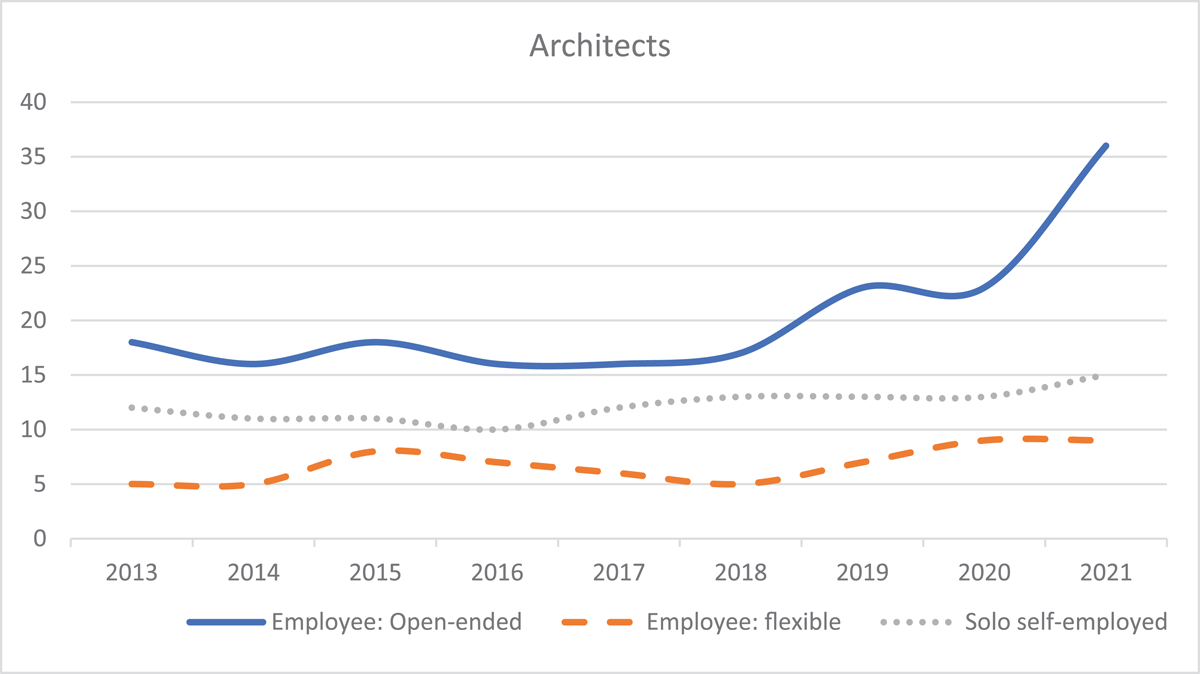
Figure 1
Number of workers with the profession of architect according to employment relationship, the Netherlands, 2013–2021 (*1000).
Source: Statistics Netherlands; * 1000 means that the numbers on the y-axis should be multiplied by 1000.
Among the performing artists, self-employment has been by far been the most frequently used employment relationship (see Figure 2). Moreover, self-employment keeps growing, whereas permanent and flexible employment contracts seem less popular. In recent years the number of people with the profession of performing artist has been shrinking, probably due to the Covid-19 pandemic and the lockdown in theatres. These findings match the trends of labour market flexibilization described elsewhere for the entire Dutch cultural and creative industries. However subsectors, such as ‘advertising agencies’ or ‘photography’ show different degrees of and trends in flexibility.25
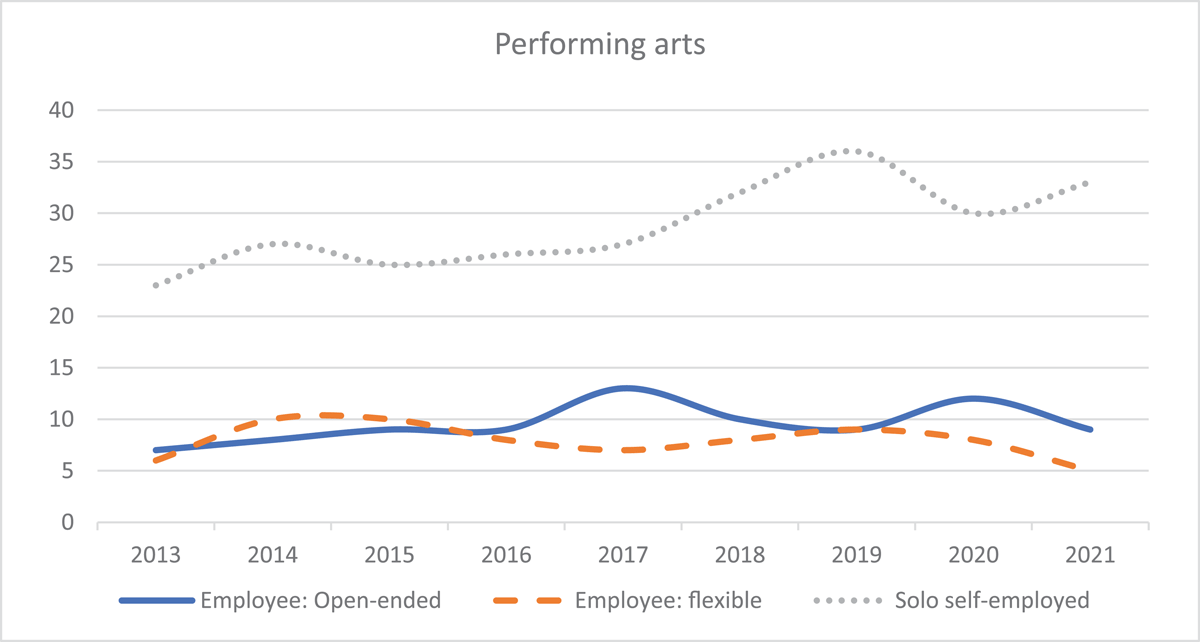
Figure 2
Number of workers with the profession of performing artist according to employment relationship, the Netherlands, 2013–2021 (*1000).
Source: Statistics Netherlands * 1000 means that the numbers on the y-axis should be multiplied by 1000.
Self-employed persons are the group with the highest risk of in-work poverty in the Netherlands.26 In the performing arts sector, the annual median income generated per person from self-employment is quite low: about €13,000 in 2019. This is well below the median income generated from self-employment in general, which was €21,100. In the architects sector, the median income from self-employment is close to the Dutch median income for self-employed persons: €19,000 in 2019 (data Statistics Netherlands).
In the Netherlands, around 7% of the self-employed report having only one client, and 13% have more than one client, but earn at least 75% of their income from the main client.27 These figures on persons largely dependent on a few principals give an indication of the scale of bogus self-employment.
The trend of flexibilization of the labour market has been relevant in discussions leading up to the first collective labour agreements covering the working conditions of self-employed persons. The persons we interviewed mentioned the influence of discussions in society on growing labour market flexibility, particularly on its negative side-effects in certain professions and economic sectors.28 They pointed to reports by advisory committees to the government, including the Borstlap Committee on flexible employment,29 the problems the government had in making a conclusive regulation for distinguishing between employed and self-employed persons for social security contributions, and the report of the Dutch Social and Economic Council on the labour market in the arts sector.30 Some also mentioned the commitment of some stakeholders to promoting equal treatment of self-employed workers and reducing precarious employment conditions.31 Additionally, the interviewee from the theatre and dance sector explained that the issue of making provisions for self-employed workers arose in a period when the creative and arts sector was heavily affected by subsidy cuts, due to the austerity policy of the government. In response to budget cuts, employers had to economise on expenditure; one way was to replace employees by self-employed workers. Employees were dismissed and immediately engaged again as self-employed persons.
6. Self-employment Clauses in Collective Labour Agreements in the Netherlands
In the theatre and dance sector, the first collective labour agreement with a provision on self-employed workers was the Cao Theater en Dans (Collective labour agreement Theatre and Dance) in force from 1 January 2014 to 30 June 2016, made by FNV Kiem and the Nederlandse Associatie voor Podiumkunsten, an employers’ organisation.
In Annex 8 of this agreement, it was laid down that social partners recommended that self-employed persons and their principals explicitly include in the fees the necessary means for protection in the case of disability and of old age; they mention as a starting point for calculating the fees, the wage of the employee with comparable tasks, plus 30% of this wage. In the collective labour agreement in force from 1 January 2020 to 31 December 2021, Article 14(5) provides that when a self-employed person is engaged for a job type covered by the collective agreement for incidentally occurring activities, and/or activities of a very short duration or activities that require special qualities, and for whom the working situation is (almost) identical to that of an employed person, the system and basis of the remuneration system of this collective agreement are the basis for the remuneration for the self-employed person concerned. In that case, the hourly rate had to be at least that of the corresponding remuneration of the comparable employee, plus at least 40%. This collective labour agreement was declared generally binding by the Minister of Social Affairs, which was a novelty. In its successor, the collective labour agreement for 2021-2023, the minimum tariff provision is retained, but the increase for the self-employed was raised to 50%.
In this way the level of the minimum tariff has risen in the consecutive collective agreements for the theatre and dance sector; according to the interviewee (who is from the trade union side), the union’s policy is to try to raise it to 60% in future collective agreements.
For the negotiations on this and other collective labour agreements in the cultural sector with self-employment clauses, a relevant factor was, according to this interviewee, the adoption of the ‘fair practice code’. This was drawn up after a report of the Social Economic Council on the labour market agenda for the cultural and creative sector.32 One of the assignments following on from the agenda was to make a sector-wide fair practice code. The code provides for a general framework for sustainable, fair and transparent entrepreneurship in the cultural and creative sector, which became generally accepted in the sector.33 It contributed to the acknowledgment by employers’ organisations that fair remuneration is essential and paved the way for accepting self-employment clauses in collective agreements. The code was subscribed to by the government as well; as a result, it became relevant to subsidy conditions, as subsidy levels should make fair working conditions possible.
In other collective agreements in the cultural sector minimum tariffs for self-employed persons were included as well. The trade union Kunstenbond (successor of FNV Kiem) was a signatory party to all these agreements. For instance, the collective labour agreement for Pop Podia 2021 (pop music on stage) (extended in 2022) has a provision on self-employed persons, similar to that in the theatre and dance collective labour agreement (Article 19(9)). The Pop podia agreement set the minimum tariff for self-employed workers at that of the comparable employees’ remuneration, plus 40%.
The collective labour agreement on Muziekensembles (Music Ensembles) 2022 also has a provision on self-employed workers. Article 14 incorporates a similar rule to the theatre and dance agreement clause, fixing the increase compared to employees’ rates at 50%. In addition, it provides that the definition of the duration of the assignment and the breaks are to be similar for self-employed and employed workers. Thus, a minimum duration of three hours per call applies, both for employees and self-employed persons. As a result, working time provisions as well have been extended to self-employed persons.
In the media sector it appeared impossible to come to an agreement to include provisions on self-employed persons in a collective labour agreement for publishers, despite negotiations on the topic.34
Another development was that a code, rather than a collective labour agreement, was concluded. In 2020, public broadcasting companies adopted a fair practice code, according to which for self-employed persons working for these companies a fee of 150% of the collective agreement wage is paid.35 More recently, in June 2022, the Dutch association for journalists reached an agreement with a large company, DPG Media, on an ‘employment code’ (werkcode) for freelance journalists and photographers, including basic tariffs.36 The agreement sets the minimum tariff at 167% of collective labour agreement wages, including a minimum hourly fee of €30 for starting journalists. Moreover, the basic tariffs for photographers in Dutch regions will be increased to €65 per assignment.
Thus, in these cases, it is a code rather than a collective labour agreement that includes self-employment provisions. However, for codes as well the exemption from competition law is necessary since, after all, they are price arrangements. Codes do not have the same legal effect as collective labour agreements; for instance, they cannot be invoked by self-employed persons themselves in legal procedures, (whereas this could be done if the self-employed persons are members of the contracting party to a collective labour agreement) and in addition codes cannot be declared generally binding. Instead, they are a form of ‘self-binding’ by the participating employers. Codes have, however, advantages over collective labour agreements. One is that their timeframe is not limited. Moreover, they have a broader scope, in the sense that third parties, such as public bodies, can also be involved. In this way, a code can influence the level of subsidy since from the involvement of public bodies it should follow that the subsidies are high enough to pay the rates as defined in the code. However, as we saw in this section, a combination of code and collective agreement is also possible, eg, in the cultural sector.
A second sector in which it was attempted to make provisions on self-employed persons was the architects sector. The first attempt was the collective labour agreement covering the period from 1 March 2015 to 28 February 2017. The interviewee working in this sector clarified that the first discussions preparing this collective agreement took place in the context of an economic crisis, due to which hourly tariffs decreased significantly (see also Section 5 above). Therefore, an important objective of the agreement was to strive for a level playing field, as was declared in the Preamble to the collective agreement. The need for a level playing field was also emphasised by the Stichting Fonds Architectenbureaus (SFA), the organisation of the social partners in the architects’ sector, which intensively supported and promoted the negotiations on the self-employment clauses. This organisation stated that ‘No one, including the employers, was happy with price dumping and “social dumping”’.37 We can see that the fear that by making use of cheap self-employed persons the employment conditions of employees deteriorated, was relevant to including tariffs for self-employed persons.
The innovation of this agreement was that, in addition to the provisions applicable to employed persons, one provision defined the minimum fees which architect offices had to pay to persons working on a contract of services. For these fees the salary levels linked to the job categories laid down in the Handbook for Architect Offices for employed architects were used as a reference. This clause applied to all persons working on a contract for services, thus not only for the so-called false self-employed.
However, as we saw in Section 4, before 2019 the Competition Authority was opposed to collective labour agreements incorporating self-employment provisions. This opposition led to the withdrawal of such a clause in the 2015–2017 collective agreement for architects. The succeeding collective agreement, 2017–2019, did not have a provision on self-employed persons either. In this way, the first initiatives were blocked by the policy of the Competition Authority.
However, after the publication of the Competition Authority’s 2019 Guidelines, the SFA undertook a new attempt to include a self-employment clause in the collective labour agreement. This time it was successful. The Collective Labour Agreement for Architect Offices of 2019 stated, in its Preamble, that the architects’ offices acknowledged that there is a large downward pressure on prices in their sector. They agreed that low tariffs for self-employment must not become a means to respond to this development.38
The self-employment clause in the agreement provided that:
In order to take away doubts on the status of the worker – whether he or she is false self-employed or really a self-employed person – a tariff is applied of 150% of the gross wage plus 8% holiday pay for comparable activities with comparable experience for employees. If less than this rate is paid, the person is presumed to be an employee (Article 18).
This presumption has to be reported to the arbitration committee under the collective agreement, which has to take a binding decision (Article 9). Consequently, this provision does not apply the FNV Kiem criteria and does not fix a rate directly applicable to self-employed persons, but introduces a presumption that when less than a certain tariff is paid, the person is an employee; this presumption can be rebutted. The interviewee from the architects’ sector explained that making a sharp distinction between self-employed and employed persons is hard, or even impossible to make. Setting the minimum at 150% gives a market-based tariff that should cover the costs of buying insurance for contingencies which could interrupt employment, such as illness.
Since it did not meet any further objections from the Competition Authority, the Collective Labour Agreement for Architect Offices of 2019 was declared universally binding.39 However, the Minister of Social Affairs and Employment made a reservation (dictum V) in the decision on this declaration: the presumption that a person is an employee applies only in case of false self-employed persons as defined in the FNV Kiem judgment.40 The provision of the collective agreement has therefore to be interpreted in light of that judgment, since otherwise there might be an infringement of competition law.41
Two of the interviewees explained the willingness of all parties in the architects’ sector to create a level playing field out of the characteristics of this sector, namely that architects’ offices are often small or medium sized, where workers are seen as ‘part of the family’ and where people are inclined to make concessions to each other in order to facilitate the working process. Moreover, certain skills needed in this sector are relatively scarce, making it important to retain workers.
One of the interviewees remarked that economic cycles have a large impact on the architects’ sector and also on the construction sector, to which the work of architects is closely connected. Architects and their workers go from project to project and since this creates uncertainty, the offices need a certain degree of flexibility. Engaging self-employed persons is a solution that contributes to this, whilst the requirement on minimum tariffs should give an adequate protection against social dumping.
7. Clauses for Self-employed Persons Alongside Further Flexibilization of Employment Contracts in Collective Labour Agreements
The trade union interviewee from the theatre and dance sector stated that in this sector the collective labour agreements have increased the possibilities for fixed-term contracts. This made it easier and more attractive for employers to employ persons as employees. According to him, the trade union preferred employment contracts, even flexible ones, to self-employment, since the former have the benefit of falling within the scope of a collective agreement and related rights attached to being an employee.
When analysing the applicable rules in the collective labour agreement for theatre and dance, it appeared that the area for fixed-term contracts has increased, in particular by exempting some specified types of jobs, such as dancers, from the statutory restrictions on renewal of fixed-term employment contracts. This was made possible since, by ministerial decree, jobs of, inter alia, dancers, actors and concert substitutes were exempted from the statutory restrictions on the renewal of fixed-term contracts.42 The ministerial scheme does not impose any restrictions on the renewal of fixed-term contracts for these specified jobs at all.43 The collective labour agreement for theatre and dance made use of this flexibility, although the renewal of contracts was restricted to a maximum.44 The ministerial scheme itself did not mention that it was meant to reduce self-employment, but by providing this flexibility to sectors notorious for the uncertainty of available work, it can be used to stimulate the employing of employees instead of self-employed persons while maintaining the necessary flexibility.
A similar increased flexibilization of employment contracts in order to reduce self-employment can be seen in the collective labour agreement for concert substitutes April–December 2020, whose predecessor was the subject of the FNV Kiem judgment. It does not have provisions on self-employed persons, but instead provides for a full exemption from the limits on renewal of fixed-term contracts, which was made possible by the ministerial scheme mentioned in the preceding paragraph. This collective labour agreement does not set any limits on the renewal of fixed-term contracts. Consequently, for these jobs, employment relationships never have to turn into contracts for an indefinite period.45
The collective labour agreement for Pop Podia allows, in the case of some specified types of jobs, a chain of a maximum of six fixed-term contracts within a period of 48 months, which is more flexible than under the general rules of the Civil Code.
The jobs of musicians, singers and other stage artists, covered by the collective labour agreement on Muziekensembles (Music Ensembles) 2022, fall under the ministerial decree mentioned above. Consequently, as the collective labour agreement acknowledges, there is no restriction as regards renewal of fixed-term contracts. However, the collective labour agreement provides that the use of the exemption is to be further amplified by the ensemble concerned. The employer and the ensemble commission have to discuss the use of this exemption and the extent to which fixed-term contracts are desirable, and the employer has to take the outcome of these consultations into account when making decisions. The collective labour agreement states that this policy will be reconsidered, one year after it has entered into force and then at leastonce every three years. Here we also see a considerable degree of flexibility, but the policy to make use of it is left to the individual work place.
The interviewee from the architects’ sector remarked that, according to him, temporary employment contracts, even with increased flexibility, do not really suit the demands of architects’ offices, given the economic fluctuations in the sector. Therefore, according to him, in this sector the offices often prefer self-employed workers to temporary employees for work for which they are unsure that they require permanent workers, though with a remuneration above the set minimum tariffs.
8. Analysis of the Strategies to Include Self-employment Clauses
In the literature, the FNV Kiem criteria for categories of workers for whom it is possible to include a provision in a collective labour agreement – briefly mentioned in Section 3 – have been extensively discussed.46 Our examination makes a first analysis of how the scope created by FNV Kiem is actually used. These experiences are limited in number, but relevant as a first inventory of circumstances that facilitate the actual adoption of self-employment clauses.
At present, even with a much more relaxed regime than prior to 2017, the number of collective labour agreements with provisions on self-employed persons in the Netherlands is still small. They are mainly in the creative and arts sector, initiated by the same trade union, the Kunstenbond, and for architects, which is also a relatively small sector.
From our examination it appears that, firstly, the 2019 Guidelines of the Competition Authority on fee arrangements for self-employed persons in collective labour agreements were a conditio sine qua non for self-employment provisions in the previously mentioned agreements. The fear of fines imposed by the Authority prior to 2017 as a result of the guidelines then in force was an insurmountable barrier for making the clauses.
Secondly, the interviewees mentioned the relevance of the awareness of all stakeholders of the negative aspects of labour market flexibility, including the income of employees, as well as the wider societal and political debate on this. The interviewee in the arts sector remarked that the Fair Practice Code paved the way for self-employment clauses.
Thirdly, we saw that, for the collective labour agreements that were made, only the willingness of the counterparties to negotiate was mentioned by the interviewees, as unions cannot really exert pressure to start and continue negotiations. Self-employed persons generally are not organised or their organisations are not willing to organise collective actions. Moreover, since the right to collective bargaining exists only for employees, self-employed persons and their organisations participating in a collective action run the risk of infringing competition law. Some courts even deny the right to strike to self-employed workers.47
Been and Keune48 mention three strategies for trade unions to address flexible and marginal work: the first is rejecting marginal work altogether; the second is ‘bridging the divide between precarious and regular employees by improving the conditions of the marginal workers’; and the third is ‘addressing “third parties” that directly or indirectly influence employment conditions, such as the government’.
In the discussion on the collective agreements examined by them, it appears that they mainly focus on self-employment as forms of marginal work; these collective labour agreements broadly overlap with those of our study, although Been and Keune do not cover the years after 2019, in which there were several developments as we have seen.
It is interesting to confront the strategies with our findings. We did not examine the first strategy, that of rejection of marginal work, since we focused on self-employment clauses. The second strategy – ‘bridging the divide’ – concerns self-employment clauses. From our legal analysis of case law and relevant regulations, collective labour agreements and the interviews, it appears that although a minimum remuneration for self-employed persons is included, the main purpose of the clauses is to protect against social dumping. This is done by distinguishing better between employees and self-employed persons. The collective labour agreement for architects introduced a legal presumption for this purpose and the self-employment clauses in the cultural sector agreements appeared to be accompanied by provisions allowing more flexibility for fixed-term contracts, in order to make it more attractive to provide workers with a contract of employment. According to the interviewee from the theatre and dance sector, the trade union preferred contracts of employment, even if they provide less security than under the general statutory rules, to contracts of service, as employees have the benefit of falling within the scope of a collective agreement and related rights attached to being an employee. ‘Bridging the divide’ appears in this case rather more like ‘stressing the divide’.
The third strategy mentioned by Been and Keune was to address third parties, such as public bodies that have a direct or indirect influence on employment conditions, for example the government which determines much of the institutional context in which work takes place. Indeed, we have seen that the impact of the Competition Authority’s Guidelines was decisive for making self-employment provisions. The involvement of public authorities in codes of practice, which encouraged the making of self-employment clauses, was also mentioned; an advantage was that this influenced indirectly the subsidy levels and thus made decent fees possible. The scope for flexible employment contracts in the sectors concerned provided by legislation can be used to try to reduce self-employment.
From our description of the circumstances in which self-employment clauses were adopted, it follows that addressing third parties is not really a separate strategy, but supports the other ones.
9. The Guidelines on the Application of European Union Competition Law
In September 2022 the European Commission published a communication entitled ‘Guidelines on the application of Union competition law to collective agreements regarding the working conditions of solo self-employed persons’.49 These guidelines address the problem of legal uncertainty that may exist for self-employed persons: a false self-employed person does not have the legal certainty that the Albany exception will apply, until a court or administrative authority has decided that he or she is a worker. We saw an example of this uncertainty in the wording of the decision on declaring the Architects Offices’ collective labour agreement universally applicable (see Section 6). The guidelines also make it clear that the Commission will not intervene in collective agreements of self-employed persons who experience an imbalance in bargaining power vis-à-vis their counterparties. In such a case there is no exemption from competition law; competition law remains applicable, but the Commission has published its non-intervention policy.
It has to be kept in mind that the guidelines have only a limited meaning, and cannot take away legal uncertainty completely. After all, national authorities can still apply their own competition rules and national courts may apply the FNV Kiem criteria and ignore the guidelines. However, in the situations described in the guidelines, the European Commission will not interfere when collective agreements concerning self-employed persons are adopted.
The guidelines make it clear that the exemptions or non-interventions do not only concern the collective agreements themselves, but also the negotiations and the coordination between the parties on each negotiating side prior to the negotiations and conclusion of the collective agreement. This should include the collective actions supporting the collective bargaining activities. After all, collective actions were forbidden if they were intended to realize agreements that infringe competition law, and if such agreements are no longer forbidden, then the actions should also be allowed.
The guidelines define a ‘collective agreement’ for the purpose of the guidelines as an agreement that is negotiated and concluded between self-employed persons or their representatives and their counterparties to the extent that it, by its nature and purpose, concerns the working conditions of such self-employed persons. This reminds us of the Albany formula, but now covering self-employed persons as well. The guidelines apply to all forms of collective negotiations, ranging from bargaining through social partners or other associations to direct negotiations by a group of self-employed persons or their representatives with their counterparty. They also cover cases where self-employed persons, either individually or as a group, wish to be covered by an existing collective agreement (‘opt-in’) concluded between their counterparty and a group of workers and/or self-employed persons.50
The working conditions of self-employed persons which can be regulated include matters such as remuneration, working time and working patterns, holiday, leave, physical spaces where work takes place, health and safety, insurance and social security, and conditions under which self-employed persons are entitled to cease providing their services or under which the counterparty is entitled to cease using their services. The following situations are exempted from competition law, according to the guidelines. The first main situation concerns self-employed persons who are in a situation comparable to that of employees. Collective agreements applicable to them fall outside the scope of competition law. Thus, it is not required that they fulfil the criteria for false self-employed persons or that they are in a precarious position. This first main situation includes the following categories:
Category a is that of economically dependent self-employed persons. Self-employed persons who provide their services exclusively or predominantly to one counterparty are likely to be in a situation of economic dependence vis-à-vis that counterparty, the Commission argues. The Commission considers that a self-employed person is in a situation of economic dependence where that person earns, on average, at least 50% of total work-related income from a single counterparty, over a period of either one or two years.51
The guidelines mention as an example of this category self-employed architects who earn 90% of their income from one company. Therefore, the dictum in the decision on declaring the Dutch collective agreement for architects to be universally binding (see Section 6) is no longer necessary, as least from the EU point of view.
Category b is that of self-employed persons who perform the same or similar tasks ‘side-by-side’ with workers for the same counterparty.
These persons include the false self-employed that were identified in the FNV Kiem judgment. However, the description of this category in the guidelines gives room to self-employed persons whose contractual relationship has not been reclassified as an employment relationship; it thus gives more legal certainty. As an example, the guidelines mention the Dutch theatre and dance collective labour agreement.
Category c is that of self-employed persons working through digital labour platforms. Section 3 stated that the Dutch Competition Authority applies the side-by-side criteria for platform workers by comparing them to comparable sectors of workers. The guidelines now define this category directly as falling outside the scope of competition law.
The second main situation concerns situations where the Commission will not enforce the competition rules.
– Category A is that of collective agreements concluded by the self-employed with counterparties that have a certain level of economic strength. These self-employed persons may have, according to the guidelines, insufficient bargaining power to influence their working conditions. Collective agreements can be a legitimate means to correct the imbalance in bargaining power. In such cases the Commission will not intervene.
Such imbalance is to be presumed in either of the following cases, the guidelines continue:
where self-employed persons negotiate or conclude collective agreements with one or more counterparties which represent the whole of a sector or industry;
where self-employed persons negotiate or conclude collective agreements with a counterparty whose aggregate annual turnover and/or annual balance sheet total exceeds €2 million or whose staff headcount is equal to or more than 10 persons, or with several counterparties which jointly exceed one of those thresholds.
As an example of (b), the guidelines mention the case of three companies with the same type of business, of which Company X’s turnover is €700,000, that of Company Y is €1 million and that of Company Z is €500,000. The presumption of an imbalance in bargaining power would not apply if Company X, Y or Z were to negotiate independently, as none of them meets the €2 million turnover threshold. However, the presumption does apply if the three companies negotiate collectively, since the aggregate turnover of the three companies exceeds the €2 million turnover threshold. In that case, the Commission will not intervene in collective negotiations and agreements relating to working conditions between the self-employed technicians and these three companies.
– Category B is that of collective agreements for certain professions that have been excluded by national competition law. Where such national legislation pursues social objectives, the Commission will not intervene in collective agreements relating to working conditions that involve categories of self-employed persons to which the national legislation applies.
Consequently, the guidelines of the Commission give more room to collective bargaining on behalf of the self-employed than follows from FNV Kiem. They introduce the criterion of ‘economic dependence’ for the exemption, which may be easier to apply than the comparison that has to be made on the basis of FNV Kiem. As mentioned in Section 6, the Dutch Minister of Social Affairs doubted that the provision of the 2019 architects’ collective labour agreement is always consistent with the case law, and the economic dependence clause in the guidelines gives more certainty. The exclusion of self-employed persons working through digital platforms from competition law is also an extension of the FNV Kiem criteria; although the guidelines of the Dutch Competition Authority already gave room to this, its approach is now confirmed and broadened, since it no longer requires a comparison to be made.
The Commission guidelines state additional areas where the Commission will not enforce competition law, thus giving Member States the room to exempt collective agreements for particular professions from competition law. As a result, the guidelines create more legal certainty and allow the room for collective bargaining on behalf of self-employed persons to be increased.
These guidelines do not take all uncertainty away for contracting partners since, inter alia, Member States may enforce their own competition law. For this reason, the revision by the Dutch Competition Authority of its guidelines52 to incorporate the Commission’s rules can be seen as good practice, since it shows how the Dutch Competition Authority implements the rules and makes clear its policy on imposing fines.
10. Conclusion
In this contribution we focused on two situations in which self-employed persons are in a comparable position to employees: when they work side-by-side with employees, and when there is no good bargaining balance with the counterpart.
Because of the differences between self-employed and employed persons, advocating equal treatment cannot mean that all workers must have the same employment conditions. Hence, we examined the developments allowing self-employment clauses in collective agreements. We concluded that it was important that the national competition authority makes clear what is allowed and what is not allowed, and that it should not be left to the parties themselves to bear the risk. The possibility to consult the competition authority in case of doubt is important. Therefore, it is important that the European Commission published guidelines that contribute to reducing legal uncertainty, although it is not completely removed. They cover several issues about which it remained uncertain after the FNV Kiem judgment as to whether they are exempted from competition law. In particular the extension of FNV Kiem to situations where workers are considered to work side-by-side with employees, even if these employees do not work in the company concerned or even in the same sector (like some platforms), gives more certainty. The reservation regarding the architects’ collective labour agreement (made by the Minister, discussed in Section 6) is no longer necessary in the present form and can be much more clearly formulated.
Secondly, we noted that, within a sector where collective agreements are desired, it is essential that awareness grows among all stakeholders that fair tariffs are important. We mentioned, in Section 6, the fair practice code as a milestone for such awareness. Collective bargaining is a process that has to be supported by public authorities where possible and necessary. It may also be good to involve the organisations of self-employed persons themselves in this process.
In examining the self-employment clauses that have been adopted so far, we saw that these were mainly meant to cover persons who are in comparable positions with employees. Their main purpose was to avoid social dumping and the initiative was most often from the trade unions. This restriction to particular groups of self-employed persons followed not only from the trade unions’ strategies, but also from the room left for these provisions by competition law provisions. The guidelines from the European Commission, however, allow agreements to be made for other groups of self-employed as well. This may have an impact on the contents of these provisions. When the interests of employees are much less involved when making provisions for these categories, trade unions will be less inclined or not inclined at all to take the initiative for securing them.
Organisations of self-employed persons or ad hoc groups of self-employed persons will have to take the lead. This raises the question as to how parties involved in such sectors can be persuaded and facilitated to start bargaining proceedings. We saw that Dutch public institutions subscribed to fair practice codes, which promoted self-employment clauses. This could be done as well in areas where initiatives to improve working conditions are made. A further step could be that public bodies engage only companies which have subscribed to a fair practice code and/or an agreement with fair self-employed clauses. A more forceful measure would be to announce that a statutory minimum fee applies for self-employed work in situations mentioned by the European Commission guidelines, unless self-employment clauses are laid down by a collective labour agreement.
To conclude: in this contribution we have discussed the possibilities for equal treatment of self-employed and employed persons. It appeared that the policies in this area are not aimed at realizing equal treatment as such, but at increasing the room for collective bargaining on behalf of self-employed persons. We saw that these policies were, to a large extent, instigated by the wish to avoid deterioration of the employment conditions of employees, and that the legal possibilities for doing so were restricted to the false self-employed. However, gradually, the possibilities to realize decent working conditions for other groups of the self-employed have also increased. To what developments this will lead remains to be seen; from the Dutch experiences, however, we can begin to deduce some elements for developing support to collective bargaining for self-employed persons.
Notes
[2] Eurofound, Labour market change: Trends and policy approaches towards flexibilisation, Challenges and prospects in the EU series (Publications Office of the European Union 2020).
[3] L Kösters and W Smits, ‘“Genuine” or “Quasi” Self-Employment: Who Can Tell?’ (2022) 161 Soc Indic Res 191–224.
[4] That these are relevant to this topic appears from the fact that they are mentioned as examples (of which there are only very few) of such agreements in the recent Communication of the European Commission on this topic, see Section 9 below.
[5] FL Leeuw and H Schmeets, Empirical legal research: A guidance book for lawyers, legislators and regulators (Edward Elgar 2016).
[6] European Commission, Access to social protection for workers and the self-employed (European Commission 2020).
[7] The Pillar, adopted in 2017, is a recommendation of the European Commission, the Council and Parliament, which sets out 20 principles, to be elaborated in various forms (recommendations, directives, action plans) at distinct levels (EU, Member States, social partners) [2017] OJ L 113/56.
[8] M Canoy and K Hellingman, ‘De Mededingingswet en de onderkant van de arbeidsmarkt’ (2018) 5 Markt en Mededinging 184–193.
[9] Proposal for Wet minimumtarief zelfstandigen en zelfstandigenverklaring (Act on minimum tariff for self-employed and self-employment certificate), which was withdrawn later.
[10] This was also argued by economists and politicians such as G Zalm (who would later be a Dutch minister of finance) in his article ‘Betekenis en toekomst van de algemeenverbindendverklaring’, 1992 ESB, 60–64.
[11] Case C-67/96 Albany ECLI:EU:C:1999:430; Cases C-115-117/97 Brentjens ECLI:EU:C:1999:434; Case C-219/97 Drijvende Bokken ECLI:EU:C:1999:437. The cases concerned compulsory affiliation by a collective agreement to pension funds, but are also relevant to collective labour agreements in general.
[12] Case C-413/13 FNV Kiem ECLI:EU:C:2014:2411. See, on competition law and collective bargaining, T Jaspers, ‘Collective bargaining in EU law’ in T Jaspers, F Pennings and S Peters (eds), European Labour Law (Intersentia 2019) 245-308; G Monti, ‘Collective labour agreements and EU competition law: Five reconfigurations’ (2021) 17(3) European Competition Journal 714-744, and literature referred to in these publications.
[13] We will use the term ‘employed persons’ for persons who have, under national law, a contract of employment and the term ‘worker’ where the ECJ uses this term for persons for whom collective agreements are exempted from competition law.
[18] <www.acm.nl/nl/publicaties/publicatie/16978/Leidraad-tariefafspraken-voor-zzpers-in-caos>, accessed 2 February 2023. The Competition Authority was called Nederlandse Mededingingsautoriteit (NMa) at the time of FNV Kiem; currently it is the Autoriteit Consument & Markt (ACM).
[19] This was also how the press interpreted the guidelines; see Financieele Dagblad of 27 February 2017: ‘ACM verbiedt een minimumtarief voor zelfstandigen in cao’s’ (ACM prohibits a minimum tariff for self-employed in collective labour agreements).
[22] The 2019 Guidelines were updated in July 2020. In 2023 the Guidelines were updated again after the publication of the Guidelines of the European Commission (see Section 9 below). The Guidelines can be found (in Dutch) on the website of the ACM (<www.acm.nl>).
[24] CBS, Dossier zzp, Ontwikkelingen zzp <www.cbs.nl/nl-nl/dossier/dossier-zzp/ontwikkelingen-zzp> accessed 28 November 2022.
[25] W Been and M Keune, ‘Bringing labour market flexibilization under control? Marginal work and collective regulation in the creative industries in the Netherlands’ (2022) European Journal of Industrial Relations (DOI 010.1177/09596801221127109).
[26] MS Houwerzijl, N Zekić, S Bekker and M Evers, ‘In-work poverty in the Netherlands’ in L Ratti (ed), In-Work Poverty in Europe: Vulnerable and Under-Represented Persons in a Comparative Perspective (Kluwer Law International 2022), 193–239.
[28] This aligns with Been and Keune (n 25) who add that the architects sector struggled with declining demand whereas the theatre and dance sector was dealing with overcrowding due to too high labour supply.
[29] Commissie Regulering werk, In wat voor land willen wij werken? (Commissie Regulering werk 2020).
[31] See e.g. the historical accounts in H de Graaff and E Koot-van der Putte, ‘Architectenbranche heeft eerste caoo in Nederland’ in M van der Meer, E Smit and L Harteveld (eds), Het poldermodel – een kat met negen levens (NVA 2019, 93–98); see also Canoy and Hellingman (n 8).
[33] <fairpracticecode.nl/sites/default/files/2021-06/publicatie-fairpracticecode-def-digiversie.pdf> (accessed 13 October 2022).
[34] <auteursbond.nl/nieuwe-cao-voor-het-uitgeverijbedrijf> (accessed 13 October 2022).
[35] <www.fnv.nl/cao-sector/media-cultuur/audiovisueel/blijf-op-de-hoogte/minimumtarief-voor-zzp-ers-bij-de-publieke-omroep> (accessed 13 October 2022). There were also individual cases, in which a solo self-employed journalist was successful in his claim that the tariffs paid by the publishing company were too low, and the judge took inter alia the collective agreement rates into account in order to fix a higher remuneration, <www.villamedia.nl/artikel/britt-van-uem-en-ruud-rogier-over-wat-een-rechtszaak-tegen-je-opdrachtgever-kan-losmaken/32602416-1589fe69> (accessed 4 November 2022).
[36] <www.nvj.nl/nieuws/nvj-en-dpg-media-bereiken-overeenstemming-over-werkcode-freelancers> (accessed 4 November 2022).
[37] Editorial, ‘SFA: “Iedereen profiteert van minimumtarief zzp’ers”’ De architect (21 July 2015) <www.dearchitect.nl/101808/sfa-iedereen-profiteert-van-minimumtarief-zzpers> (accessed 4 November 2022).
[38] This was also picked up by the press; see ‘Voor het eerst een minimumtarief in cao voor architecten, óók voor zzp’ers’ (‘For the first time a minimum tariff in collective agreement for architects, and for self-employed persons as well’) Financieele Dagblad (21 November 2019).
[40] This reservation was also made in the universally binding declarations of later collective agreements for architects.
[41] The subsequent Collective Labour Agreement for Architects Offices, for 2021–2023, has the same provision on self-employment.
[42] Decree of the Minister of Social Affairs and Employment of 24 June 2015, 2015-0000159867, Stcrt. 17972 of 30 June 2015.
[43] Although it is an issue outside the discussion of setting minimum tariffs for self-employed workers, we cannot refrain from remarking that it is disputable whether this is in line with EU law (Directive 1999/70 on fixed-term work, [1999] OJ L 175). See also Case C-331/17, Sciotto, ECLI:EU:C:2018:859, where the ECJ ruled that national legislation that excluded the provisions on automatic transformation of fixed-term contracts into contracts of indefinite duration after a certain duration in the sector of activity of operatic and orchestral foundations, where there is no other effective measure in the domestic legal system penalising abuses identified in that sector, is contrary to the Directive. However, the collective labour agreement for theatre and dance sets a limit on the extension, which may mean that the system for this sector is in line with the Directive.
[44] It allows a chain of fifteen contracts or renewal of the contracts until 48 months have expired before the last contract becomes one for an indefinite period (Article 8).
[45] This agreement gives even more room for renewal of fixed-term contracts than the collective labour agreement on theatre and dance. However, it may be justified as a legitimate aim since substitutes are by definition filling a temporary need of the employer, and that is an objective reason which is acceptable under the Directive.
Competing Interests
The authors have no competing interests to declare.