
1. Introduction
This paper focuses on the interface between social psychology and law, and especially the relationship between some under-investigated conditions of people’s trust in law and how social psychological research methods may help to start understanding these conditions. We argue that studying these issues is important, in part because trust in law is necessary for the effective functioning of societies.1 After all, the law can be defined as a system of rules that is enforced through social institutions to establish and maintain social order by regulating public behaviour.2 Trust in legal authorities such as judges is often seen as essential for why people are willing to obey these authorities, accept their legal decisions, and cooperate with these authorities.3 People’s trust in the judges in a country is also a central element of the perceived institutional legitimacy of the judiciary.4 Citizens’ trust in judges can, therefore, be seen as an important indicator of the state of democracy in a given society.5 Trust in the judiciary and other state institutions also influences whether people trust each other.6 And trust in law may even be important for economic growth and development.7 It has been argued accordingly that trust in judges and the judiciary is necessary for the functioning of institutions, societies, social order and social cohesion in modern democracies.8 In sum, citizens’ trust and distrust in law is an important topic and deserves our attention.9
We argue in this paper that citizens with lower education may be under-investigated in research studies on trust in law, and that interviewer effects may play an important role among these participants. We will then consider how experimentally varying the ways in which interviewers and research questionnaires are presented to participants may reveal important, nuanced insight into trust in law. An important contribution of the current paper is that we expand modern-day calls to consider the background of research participants10 to also consider the background of interviewers in trust research. In the discussion we point out how insight into this issue may help to broaden the relevance of social psychology in applied contexts and may be conducive to a more precise understanding of an important indicator of the state of democracy in societies: trust in law.
1.1 Studying Trust in Judges
The issue of trust in law serves a prominent role in many interview studies, surveys, and other research projects.11 Here, we note that these studies on trust in law typically begin with researchers introducing themselves with their affiliation. For example, when a questionnaire is used to measure people’s trust in law, the introduction page mentions the organization responsible for the research. In this paper we are especially interested in research done by university researchers on trust in law. Quite often, this research is being conducted by researchers affiliated with law schools. Thus, these studies often begin by researchers introducing themselves as coming from university law schools, interested in how people trust judges.12 In the current paper we propose that the results of interviewers introducing themselves in this manner may have systematic effects on how respondents with lower educational backgrounds may respond to trust questionnaires.
We start the investigation of this proposition by noting that in the sociology of law and in literature on legal education it has been observed that, from the start of law school, students are being socialized in the legal domain.13 Law can be seen as a social construction, indicating that it is people and their beliefs that make the law.14 More specifically, law is the construct of people who participate in making laws. This group of people, who make the law and thus are affiliated with making the law and explaining its workings, should be distinguished from those who are assumed to follow the law. Among legal scholars it has been recognized that what counts here is the consensus of elites, that is, of those who hold the power to participate in the construction of the law or who explain the law to students and others.15 Hence, working for law schools can be seen as being socialized to becoming part of that social construction of law, while the targets of the law in the wider population do not participate in this social construction. Thus, people educated in law schools are being trained and socialized in this separate social system of the law.16 Accordingly, ordinary citizens can be expected to perceive interviewers from law schools as being from another social category, that is, a system in which ordinary citizens who hold no positions of power are not represented and do not participate.
We further argue that these aspects of who does and does not belong to the legal elites may especially play out when surveying lower educated respondents about their trust in law. We can learn from political science that formal education is a very important variable that affects how citizens think about government and societal authorities associated with that government. For example, lower educated citizens tend to be less trustful and more cynical about government and societal institutions, whereas higher educated citizens tend to be more positive about government and societal institutions.17 And it has been noted in political science that more systematic empirical investigation into the consequences for governments of educational differences is needed, yet largely missing from the literature.18 We further note that studies on trust in law typically do not systematically incorporate, let alone systematically vary, the affiliation of the interviewer in the research designs of the studies involved, and hence, the influence of interviewers on the trust ratings obtained cannot be assessed reliably.
Therefore, we propose to vary experimentally whether interviewers in our studies on trust in lawcome from university law schools or clearly do not come from institutions affiliated with university law schools. The primary aim of this paper is to explore whether the way in which researchers in studies on trust present themselves to research participants influences the degree reported of trust in law, especially among lower educated participants.
1.2 Participants with Lower Educational Backgrounds
In the three studies that we present, we study reactions from demographically diverse samples that include participants with lower educational backgrounds. These are types of people who participate less frequently in trust studies and other social scientific research.19 We argue that it is important to study whether and how trust and confidence in the law and courts differs among lower educated citizens.20
We think that studying how citizens with lower educational backgrounds trust the law is especially important against the backdrop of the following broader societal developments. In many Western societies, including the Netherlands, polarization has developed between groups of mostly higher educated people who are reasonably positive about globalization issues (such as open borders, other cultures and admitting immigrants), who tend to have high political trust, and who are internationally oriented and frequently live in cities, and groups consisting of often lower educated people who tend to focus on the disadvantages of open borders and immigration, have low political trust, are more locally oriented, and more often live outside cities.21 Thus, higher and lower educated people have divergent social-cultural orientations and they also increasingly tend to live in separate social environments.22 Moreover, the issue of trust in judges and the judiciary among lower educated citizens will become even more urgent following the rise of right-wing populist political movements which, in a number of Eastern European countries, have already successfully tried to restrict the independence of the judiciary.23 We suggest that these types of political movements may feed on any potential outgroup-based distrust in judges by further framing judges as distant from and adversarial towards ordinary people.
Thus, building on various reasons, we propose that understanding trust in law among lower educated citizens is an important issue and that examining interviewer effects in experiments on trust may help to obtain more insight into this issue. While interviewer effects have been observed before,24 we not only pay attention to the background of research participants in our research, but also systematically vary the background of interviewers in our experimental research designs. Systematically incorporating interviewers’ organizational affiliations in research studies may reveal more nuanced insight into pivotal issues related to trust in law. In this paper we present three field experiments that were specifically designed to test this combination of ideas.
1.3 The Current Research
In our experiments we interviewed participants about their trust in judges. We conducted all three experiments in field settings. That is, participants were approached at indoor shopping malls and train stations in the Netherlands. These are places that are visited by people from different social demographic backgrounds. In all studies, interviewers used standard, pre-scripted communication in their interaction with participants. Sampling procedures were the same across interviewer conditions. We interviewed the participants thus obtained by means of paper-and-pencil questionnaires that participants completed on their own in anonymous ways. In all studies, interviewers used standard, pre-scripted communication in their interaction with participants. Sampling procedures were the same across interviewer conditions and various measures were taken to minimize possible experimenter demand in our studies.25
In some conditions of our field experiments, the interviewers introduced themselves to the participants as coming from a university law school. We contrasted this with conditions in which the same interviewers presented themselves as coming from a regional community college. Regional community colleges in the Netherlands offer lower secondary education.26 This education level aligns with the education level of the lower educated participants in our studies. The type of education offered at these regional community colleges fits within the lowest of three official, qualitatively different educational categories in the Netherlands as defined by the official Dutch Central Bureau of Statistics, while the education offered in universities fits within the highest educational category in the Netherlands.
Study 2 also included a condition in which the interviewer presented herself as coming from a university psychology department. This educational category is similar to that of law schools, but without the legal and high-status connection which law schools tend to have.
Study 3 held constant the appearance of the interviewer and varied only the questionnaire that was given to participants. Specifically, while the interviewers of Studies 1 and 2 presented themselves both in terms of appearance and in the questionnaires as coming from a particular type of educational institution, the only thing which varied in Study 3 was whether in the questionnaire the study was presented as coming from Utrecht University Law School or the Utrecht Regional Community College.
In all three studies, we tested for interaction effects27 between the interviewers’ manipulations and participants’ educational levels as defined by the official Dutch Central Bureau of Statistics.28 The CBS distinguishes three categories of educational levels that in the Netherlands are qualitatively different from each other. Thus, following this official classification, we distinguished between participants with lower, intermediate, and higher educational levels in our studies and examined what happens when the university law school interviewer versus the regional community college interviewer (and the university psychology department interviewer in Study 2) asks participants with lower, intermediate, and higher educational levels to respond to a scale assessing their trust in Dutch judges.
For the reasons mentioned earlier, we think it is reasonable to assume that participants will expect that interviewers from the legal world themselves have a higher trust in law. After all, it has consistently been found that people with higher educatational levels tend to have more trust in government and societal institutions than lower educated people.29 Thus, based on observations of interviewer effects on reporting in survey research in previous literature, we hypothesize that when interviewers come from the legal world this can influence reactions of participants with lower educational backgrounds to report higher trust in judges, an issue that is related to the affiliation of the interviewer or research study. Thus, in all three studies the core prediction was that when the trust survey was presented as coming from a university law school, participants with lower educational backgrounds would report higher degrees of trust in judges compared with when the interviewer was presented as coming from a regional community college. We exploratively examined whether those with intermediate or higher educational levels would also respond differently toward the interviewer from the regional community college, or whether interviewer effects predominantly would be found among those participants with lower educational backgrounds.
2. Study 1
In Study 1 we examined whether participants report different levels of trust in Dutch judges, assessed by paper-and-pencil questionnaires, when the questionnaire was given to them by an interviewer who presented herself as coming from Utrecht University Law School, compared with when the same person presented herself as coming from (the non-university) Utrecht Regional Community College. In Study 1, we crossed the interviewer manipulation with three categories of educational levels (high, medium, low) that are qualitatively different in the Netherlands, thereby following official definitions of the Dutch Central Bureau of Statistics.30
2.1 Method
2.1.1 Participants and design
One hundred and twenty-six participants took part in Study 1. Participants were interviewed by the same person presenting herself as coming from Utrecht University Law School (N = 62) or Utrecht Regional Community College (N = 64). There were 40 participants with low educational levels (highest degree in elementary school, LBO, MAVO, or MBO1), 32 with intermediate educational levels (MBO 2–4, or HAVO, VWO), and 54 with high educational levels (HBO or university). A total of 52 men and 74 women participated voluntarily in the study. Participants had an average age of 46.3 years (SD = 14.8; range: 18–83 years).
The key prediction in this study was an interaction effect between the interviewer manipulation and educational level. A G-power analysis31 indicated that with α = .05 the sample of Study 1 has a statistical power of .80 to detect a medium-sized effect (f = .25 or ηp2 = .057) of the predicted interactive effect of the interviewer manipulation and participants’ educational level. This is a sufficient amount of power for the current purposes.32
2.1.2 Interviewer manipulation
In the law school condition of Study 1 the interviewer introduced herself as Marie-Claire, a student from Utrecht University Law School. As can be seen in the left part of Figure 1, the interviewer in this condition dressed accordingly as a law student who is conducting interviews. She wore clothing, including a jacket, skirt, and shoes with small heels. In the regional community college condition, the same interviewer introduced herself as Priscilla, a student from Utrecht Regional Community College. As can be seen in the right part of Figure 1, in this condition the interviewer dressed informally, as most students from regional community colleges do, wearing casual clothing like jeans, a track jacket, and trainers.
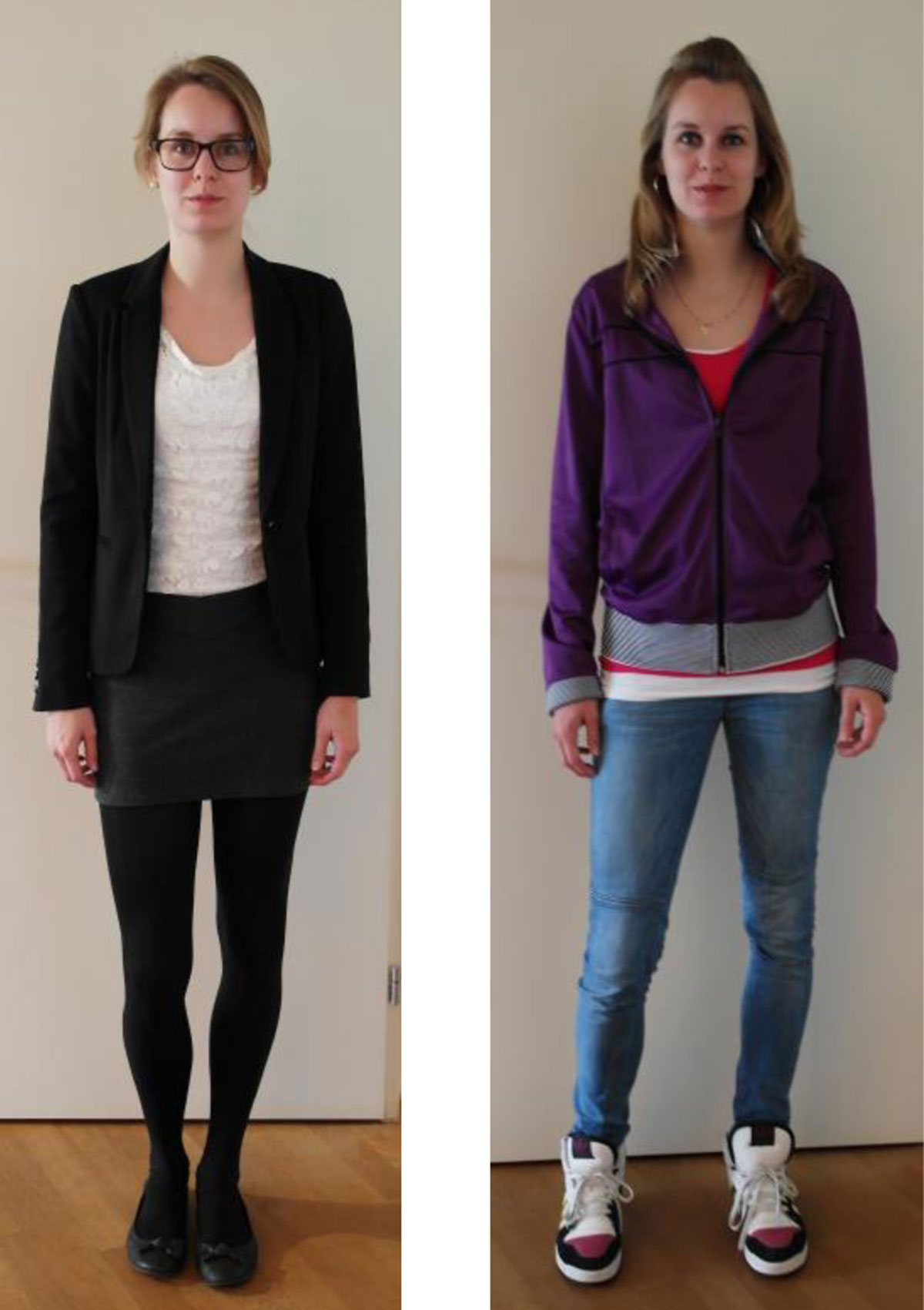
Figure 1
The interviewer manipulation of Study 1 illustrated: the interviewer introduced as coming from Utrecht University Law School (left) or Utrecht Regional Community College (right).
2.1.3 Procedure
Our experimenter went out to a shopping mall in Utrecht and asked people from various backgrounds and with different educational levels to complete a questionnaire about their trust in judges. People from different social demographic backgrounds visited the mall.
One interviewer condition was used per day and conditions alternated each day. To reduce selection bias, sampling procedures were kept similar between interviewer conditions and the types of days and hours at which the interviewer visited the mall were the same across interviewer conditions. Importantly, the experimenter asked every third person who passed by to participate in the study, without distinguishing on the apparent educational level, age, or gender of the passers-by. Response rates did not differ between interviewer conditions.
The experimenter interviewed the participants thus obtained by means of structured, paper-and-pencil questionnaires that participants could complete in anonymous ways. The experimenter made sure that participants were free to fill the questionnaires on their own, without the experimenter being in their immediate presence. The experimenter stood several metres away after handing out the questionnaires and remained at this distance while participants completed their questionnaires.
Furthermore, the experimenter gave participants envelopes with the questionnaires inside. Participants were asked when they had filled out the questionnaires to put the questionnaires back into the envelopes, seal the envelopes, and only then give the materials back to the experimenter. The experimenter used standard pre-scripted communication in the interaction with participants to reduce the potential influence of experimenter demand.33 We chose not to automatically debrief our participants in this field experiment because for many of them experimental social science methods are not something they know or think about and we did not want to make them feel caught up in an experiment in their everyday lives. Participants could fill out their email address if they wanted to receive more information about the research, in which case they received a written debriefing (setting out that we were interested in interviewer effects on participants’ responses and that the interviewer presented herself as coming from different backgrounds). If participants initiated a conversation about the research after completing the questionnaire, they were debriefed orally and asked for the experiences and feedback if the nature of the conversation allowed for it. The interviewer also asked about twenty participants in each condition for their experiences and feedback on the research. Not a single subject raised suspicions about the authenticity of the interview. From these conversations, we got the impression that our interviewer manipulation was perceived as authentic. In sum, we found no indication of suspicions that undermined the perceptions of the experimental situation which subjects were intended to receive.
Trust in judges. Our main dependent variable was a measure of trust in the judges in the Netherlands, which we based on our analysis of literature on trust,34 including trust in legal authorities and the specific context of public trust we are studying here.35 Specifically, we assessed trust in judges in the Netherlands by asking participants to what extent they agreed with the following statements: ‘I have trust in the Dutch legal system’, ‘I have the feeling that the judges in the Netherlands can be trusted’, ‘I am happy with the judges in the Netherlands’, ‘Dutch judges protect the interests of common people’, and ‘Dutch judges understand the problems of common people’.36 Ratings were made on 7-point Likert-type scales (1 = not at all, 7 = very much). Participants’ answers to these items were internally consistent (α = .92) and average scores were used for interpretation, with higher scores indicating higher levels of trust in judges. Thus, we study trust in the judiciary by asking about the judges in the Netherlands.
2.2 Results
2.2.1 Preliminary analyses
Randomization checks on level of education, gender and age showed that conditions were balanced across these variables. For level of education, a Pearson’s chi-squared test of contingencies was not statistically significant, χ2(2, N = 126) = 2.64, p = .268, suggesting that education did not differ across conditions. For gender, this test was also not statistically significant, χ2(1, N = 126) = .26, p = .609, indicating that gender did not differ across conditions. For age, an analysis of variance (ANOVA) yielded no statistically significant effect, F(50, 125) = 1.31, p = .142, providing evidence that age did not differ across conditions.
Furthermore, simple linear regression analyses were carried out to test if gender and age significantly predicted our main dependent variable, trust in judges. These analyses showed that there was no statistically significant relationship between gender and trust in judges, β = .05, t (124) = 0.59, p = .555. Between age and trust in judges as well no significant relationship was found, β = .05, t (135) = 0.57, p = .567. Therefore, age and gender were not included in the main analyses.
2.2.2 Main analyses
To test our predictions, we performed a 2 (interviewer manipulation: university law school, regional community college) × 3 (educational level: low, intermediate, high) ANOVA on participants’ trust in judges. This analysis revealed: a significant main effect of the interviewer manipulation, F(1, 120) = 7.71, p = .006, ηp2 = .060; a significant main effect of educational level, F(2, 120) = 10.13, p < .001, ηp2 = .144; and a significant interaction effect between the interviewer manipulation and participants’ educational levels, F(1, 120) = 6.97, p = .001, ηp2 = .104. To interpret these effects, we performed a post-hoc Tukey-b test for multiple comparisons between the means (p = .05) with the six cells of our design serving as the independent variable.37 Table 1 shows the results of this test, and the means and standard deviations of participants’ trust in judges.
Table 1
Trust in judges as a function of the interviewer being introduced as coming from Utrecht University Law School or Utrecht Regional Community College and participants’ educational level (Study 1).
| EDUCATIONAL LEVEL | ||||||
|---|---|---|---|---|---|---|
| LOW | INTERMEDIATE | HIGH | ||||
| INTERVIEWER | M | SD | M | SD | M | SD |
| Law school | 4.69a,b | 1.33 | 3.80a | 1.06 | 5.03b | 1.34 |
| Regional community college | 2.72c | 1.50 | 4.03a,b | 1.34 | 4.72a,b | 1.27 |
[i] Note: Trust ratings are on 7-point scales with higher values indicating higher levels of trust in Dutch judges. Means with no subscript in common differ significantly (p < .05), as indicated by a Tukey-b post-hoc test for multiple comparisons between means among the six cells of our design.
As can be seen in Table 1, the Tukey-b test showed that, when interviewed by the law school interviewer, trust in judges among participants with lower educational backgrounds was as high as among participants with intermediate or high educational levels. However, when the same interviewer presented herself as coming from the regional community college, trust in judges among participants with lower educational backgrounds was significantly lower compared with both the trust levels among participants with lower educational backgrounds who were interviewed by the law school interviewer, and with the trust levels among intermediate and higher educated participants. Participants with intermediate and higher education did not indicate different trust levels as a function of whether the interviewer presented herself as coming from the law school or the regional community college. Thus, while trust in judges indicated to the law school interviewer was relatively high for participants with all educational levels, trust in judges among participants with lower educational backgrounds was significantly lower when interviewed by the regional community college interviewer.
2.3 Discussion
In summary, while participants with intermediate and high levels of education did not respond differently depending on the presentation of the interviewer, a reliable effect of our interviewer manipulation was observed among participants with lower educational levels. That is, the trust levels that participants with lower educational backgrounds indicated to the law school interviewer were as high as trust levels among participants with intermediate and high education. However, when participants with lower educational backgrounds were interviewed by the non-law interviewer from the regional community college, these participants indicated significantly lower levels of trust in judges.
3. Study 2
To get an indication of the robustness of the effects studied here, we had a different interviewer compared with Study 1 and we used different law and non-law affiliations. In Study 2 we also added an extra interviewer condition to explore how participants would react to an interviewer who introduced herself as coming from a university psychology department.
The main aim of Study 2 was to examine whether, in particular, lower educated participants would again respond differently in terms of trust in judges towards an interviewer who presented herself as coming from a law school compared with when the same interviewer presented herself as coming from a regional community college. We also assessed exploratively how participants would respond to the same interviewer when she presented herself as coming from a psychology department.
3.1 Method
3.1.1 Participants and design
One hundred and forty-three participants took part in Study 2. Participants were interviewed by the same interviewer presenting herself as coming from Leiden University Law School (N = 48), Leiden University Psychology Department (N = 47), or Leiden Regional Community College (N = 48). In the sample, there were 41 individuals with lower educational levels, 45 with intermediate educational levels, and 53 with higher educational levels, again using definitions by CBS.38 A total of 68 men and 75 women participated voluntarily in the study. Participants had an average age of 37.36 years (SD = 15.19; range: 16–74 years).
The key prediction in this study was an interaction effect between the interviewer manipulation and educational level. The sample size was based on a G-power analysis with ηp2 = .10 based on the interaction effect from Study 1, α = .05, and high statistical power of .90.
3.1.2 Interviewer manipulation
In Study 2, the interviewer manipulation had three conditions. The law school and regional community college conditions were similar to Study 1. Thus, in the law school condition, the interviewer introduced herself as Marie-Claire, a student from Leiden University Law School. As can be seen in the left part of Figure 2, the interviewer dressed in accordance with how most female law students in the Netherlands dress on occasions such as when conducting interviews, wearing neat clothing like a jacket, skirt, and shoes with small heels.
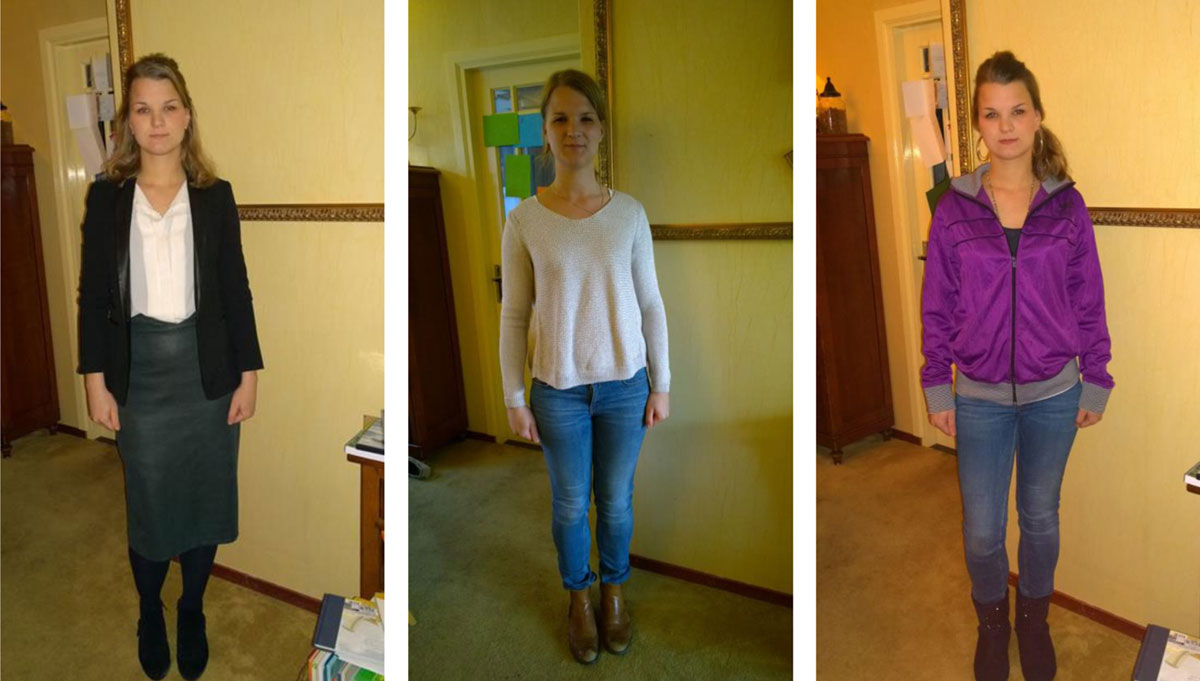
Figure 2
The interviewer manipulation of Study 2 illustrated: the interviewer introduced as coming from Leiden University Law School (left), Leiden University Psychology Department (middle), or Leiden Regional Community College (right).
Also similar to Study 1, in the non-law condition, the same interviewer presented herself as Priscilla, a student from Leiden Regional Community College. As can be seen in the right part of Figure 1, she dressed informally wearing casual clothing like jeans, a track jacket, and trainers. The interviewer visited the same train stations in all interviewer conditions.
We also included a non-law university condition in Study 2. In this psychology condition the interviewer introduced herself as Inge, a student from Leiden University Psychology Department. As can be seen in the middle part of Figure 2, the interviewer dressed more informally than in the law school condition and more formally than in the regional community college condition, in accordance with how most female psychology students dress in The Netherlands, wearing a pair of neat jeans, a plain sweater, and neutral shoes.
3.1.3 Procedure
The interviewer went to two train stations (Leiden and Utrecht Central Stations) and at these stations interviewed people from various backgrounds and with different educational levels about their trust in judges. These train stations are major hubs of the Dutch railway system through which people from different social demographic backgrounds pass. The location of data collection did not affect the results reported.
The interviewer visited both stations in all three interviewer conditions. The experimental procedure and sampling procedures were the same as in Study 1. Response rates were again similar across interviewer conditions. Participants who left their email address on the questionnaire received a written debriefing note afterwards.
3.1.4 Trust in judges
Our main dependent variable was a measure of trust in the judges in the Netherlands. We slightly varied how we operationalized this construct compared with Study 1 and kept two items of the trust scale used in Study 1, this time focusing only on the level to which participants feel that judges represent and understand what is important to common citizens.39 Specifically, the trust measure consisted of the following items: ‘Dutch judges protect the interests of common people’, ‘Dutch judges understand the problems of common people’, and ‘Dutch judges understand what common people find important’. Ratings were again made on 7-point Likert-type scales (1 = not at all, 7 = very much). Participants’ answers to these items were internally consistent (α = .88) and average scores were used for interpretation, with higher scores indicating higher levels of trust in judges.
3.2 Results
3.2.1 Preliminary analyses
Randomization checks on level of education, gender and age showed that conditions were balanced across these variables. Level of education was not statistically significant across conditions, χ2(4, N = 150) = 6.48, p = .166. Gender also turned out to be not statistically significant across conditions, χ2(2, N = 150) = 5.09, p = .078.40 Age did not significantly differ across conditions, F(47, 146) = .56, p = .985.
Furthermore, there was no statistically significant relationship between gender and trust in judges, β = .04, t (138) = 0.51, p = .610. Between age and trust in judges no significant relationship was found, β = .02, t (135) = 0.17, p = .865. Therefore, gender and age were not included in the main analyses.
3.2.2 Main analyses
To test our predictions, we performed a 3 (interviewer manipulation: university law school, university psychology department, regional community college) × 3 (educational level: low, intermediate, high) ANOVA on participants’ ratings of trust in judges. This analysis revealed a significant main effect of the interviewer manipulation, F(2, 127) = 3.13, p = .047, ηp2 = .047, a significant main effect of educational level, F(2, 127) = 8.56, p < .001, ηp2 = .119, and a significant interaction effect between the interviewer manipulation and educational level, F(4, 127) = 2.62, p = 0.38, ηp2 = .076. To interpret these effects, we performed a post-hoc Tukey-b test for multiple comparisons between the means (p = .05) with the nine cells of our design serving as the independent variable. The subscripts reported in Table 2 show the results of this test. Table 2 also presents the means and standard deviations of participants’ ratings of trust in judges.
Table 2
Trust in judges as a function of the interviewer being introduced as coming from Leiden University Law School, Leiden University Psychology Department, or Leiden Regional Community College and participants’ educational level (Study 2).
| EDUCATIONAL LEVEL | ||||||
|---|---|---|---|---|---|---|
| LOW | INTERMEDIATE | HIGH | ||||
| INTERVIEWER | M | SD | M | SD | M | SD |
| Law school | x4.16a | 1.18 | 4.93a | 0.90 | 4.12a | 0.86 |
| Psychology department | x3.93a,b | 0.28 | 4.61a | 0.74 | 4.86a | 0.92 |
| Regional community college | y2.97b | 0.85 | 4.43a | 1.20 | 4.38a | 1.19 |
[i] Note: Trust ratings are on 7-point scales with higher values indicating higher levels of trust in Dutch judges. Means with no subscript in common differ significantly (p < .05), as indicated by a Tukey-b post-hoc test for multiple comparisons between means among the nine cells of our design. The cells with different superscripts differ significantly (p < .001), as shown in direct contrast tests performed against the overall error term in our 3 × 3 design.
As can be seen in Table 2, the Tukey-b test showed that, when interviewed by the law school or psychology department university interviewers, trust in judges among participants with lower educational backgrounds was as high as among the participants with intermediate or higher educational levels. However, comparable with Study 1, participants with lower educational levels indicated significantly lower levels of trust in judges to the regional community college interviewer than to the law school interviewer.
Table 2 further reveals that the trust ratings that participants with lower educational backgrounds reported when interviewed by the person from the psychology department were much closer to those obtained with the law school interviewer than with the regional community college interviewer. We explicitly note, however, that the difference between the psychology department and regional community college conditions was not statistically significant among the participants with lower educational backgrounds. We think this aspect of our findings may be caused in part by the fact that, although the Tukey-b post-hoc test that we report has nice qualities in that it allowed us to examine with one test how the interaction pattern in our 3 × 3 design looked, the post hoc quality of the test also had the potential drawback of testing our predictions in a conservative and a-directional manner. We therefore complemented the Tukey-b test with a contrast test that directly tested the difference between the two noted non-law cells (the psychology and regional community college cells) among the lower educated participants. We tested this contrast against the overall error term in our 3 × 3 design. This contrast test yielded a significant effect, F(1, 134) = 12.60, p < .001, ηp2 = .09, indicating that, according to this test, participants with lower educational backgrounds responded with significantly less trust in judges to the interviewer from the (non-university) regional community college than to the (university) psychology department interviewer. Another contrast test showed lower educated participants did not respond differently in terms of trust in judges to the university (law school and psychology department) interviewers, F(1, 134) = 0.14, p = .71, ηp2 = .00. The superscripts in Table 2 report the results of these contrast tests.
3.3 Discussion
In sum, as in Study 1, the interviewer manipulation had statistically significant effects among participants with lower educational backgrounds. As in Study 1, for participants with intermediate and higher educational backgrounds, trust in judges was not significantly different depending on how the interviewer presented herself. In further accordance with Study 1, when interviewed by the law school interviewer, participants with lower educational backgrounds indicated levels of trust in judges that were as high as among participants with intermediate or higher education, while lower educated participants again indicated significantly lower levels of trust in judges when interviewed by the regional community college interviewer.
Trust ratings given by participants with lower educational backgrounds to the (non-law, university) psychology interviewer fell in between the ratings obtained from the law school and regional community college interviewers. This aligns with the notion that, although university psychology departments in the Netherlands belong to the highest educational category just like university law schools, psychology departments lack the legal world connection with the research topic of interest. In both Studies 1 and 2, participants with lower educational backgrounds reported significantly higher trust in the country’s judges when the interviewer came from the law school rather than from the regional community college. In Study 3, we therefore continue to systematically study this difference, using a more minimal manipulation.
4. Study 3
In order to focus on what we think was an important aspect of the interviewer manipulation in Studies 1 and 2, we held the appearance of the interviewer of Study 3 constant across experimental conditions, and we varied in the questionnaire only whether the study was presented as coming from Utrecht University Law School or the Utrecht Regional Community College. Our aim was to examine whether using this minimal interviewer manipulation would again influence participants with lower education to report different levels of trust in judges depending on whether the questionnaire came from Utrecht University Law School or the Utrecht Regional Community College.
4.1 Method
4.1.1 Participants and design
Two hundred and forty-five participants took part in Study 3. In Study 3 there were 35 individuals with low educational levels, 80 with intermediate educational levels, and 130 with high educational levels. A total of 99 men and 145 women participated voluntarily in the study (one participant’s gender is unknown). Participants had an average age of 37.38 years (SD = 18.93; range: 15–91 years).
The key prediction in this study was an interaction effect between the institutional affiliation stated in the questionnaire and participants’ educational level. A G-power analysis with α = .05 and ηp2 = .10 based on the interaction effect in Study 1, indicated that a sample size of 90 participants was needed to detect the predicted interaction effect with sufficiently high statistical power of .80 (Cohen, 1992).
4.1.2 Procedure
The procedure of Study 3 was the same as the procedures used in Studies 1 and 2, with the following exceptions. In Study 3, we kept the appearance of the interviewer identical across conditions. We used a male interviewer called ‘Thijs’ who was dressed in jeans, sweatshirt, and a leisure jacket. The interviewer in Study 3 was blind to experimental conditions. The script used by the interviewer to approach participants was identical across conditions. Study 3 was conducted at Utrecht Central Railway Station.
When participants agreed to participate, they were randomly given a neutral envelope, which contained one of the two variations of the questionnaire. Before starting the field work, the questionnaires had been arranged in random order (as specified by an online randomizer) and then put in identical envelopes. At the site, the blank envelopes were handed out from the top of the stack.
4.1.3 Interviewer manipulation
On the first page of the questionnaire that participants found inside this envelope, the organizational affiliation of the interviewer was varied. Specifically, the interviewer was introduced on that page as coming from either Utrecht University Law School or Utrecht Regional Community College, Department of Public Service. The questionnaire showed the logo and name of Utrecht University Law School (see left part of Figure 3) or the logo and name of Utrecht Regional Community College (see right part of Figure 3).
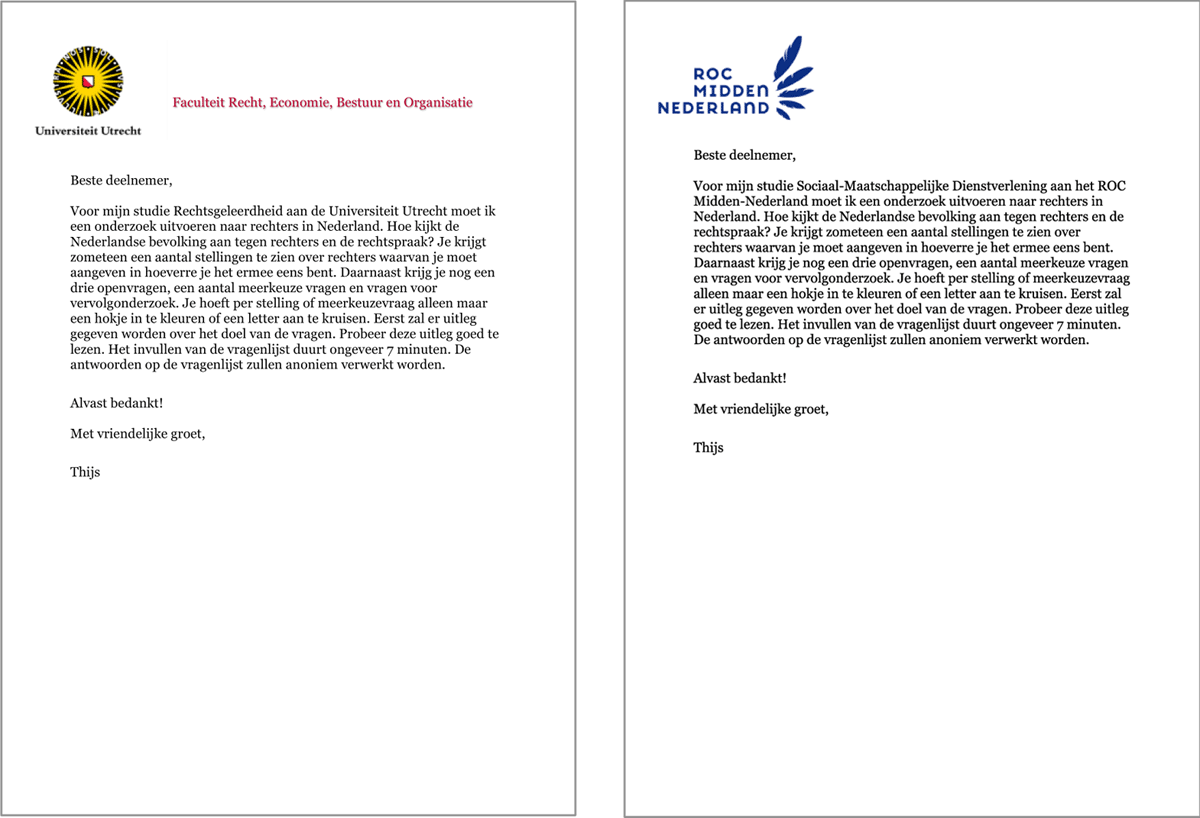
Figure 3
The interviewer manipulation of Study 3 illustrated: The questionnaire as coming from Utrecht University Law School (left) or Utrecht Regional Community College (right).
4.1.4 Trust in judges
Our main dependent variable was the same measure of trust in Dutch judges as used in Study 2. Participants’ answers to these items were internally consistent (α = .84) and average scores were used for interpretation, with higher scores indicating higher levels of trust in judges.
4.2 Results
4.2.1 Preliminary analyses
Randomization checks on level of education, gender and age showed that conditions were balanced across these variables. Level of education was not statistically significant across conditions, χ2(2, N = 245) = 4.76, p = .093.41 Gender also turned out to be not statistically significant across conditions, χ2(1, N = 245) = 0.14, p = .704. Age also did not significantly differ across conditions, F(59, 243) = 0.94, p = .631.
Furthermore, there was no significant relationship between gender and trust in judges, β = .01, t (243) = 0.12, p = .906. Also, age did not significantly predict trust in judges, β = .11, t (243) = 1.70, p = .090. Gender and age were, therefore, not included in the main analyses.
4.2.2 Main analyses
Table 3 presents the means and standard deviations of participants’ ratings of trust in judges. To test our predictions, we performed a 2 (interviewer manipulation: university law school, regional community college) × 3 (participants’ educational level: low, intermediate, higher) ANOVA on participants’ scores on trust in judges. This analysis revealed a significant main effect of the interviewer manipulation, F(1, 239) = 7.29, p =.007, ηp2 = .030. There was no significant main effect of educational level, F(1, 239) = 0.20, p = .822, ηp2 = .002. The analysis further showed the predicted interaction between the interviewer manipulation and educational level, F(2, 239) = 5.49, p = .005, ηp2 = .044. To interpret these effects, we performed a post-hoc Tukey-b test for multiple comparisons between the means (p = .05) with the six cells of our design serving as the independent variable (Kirk, 2013). The subscripts reported in Table 3 show the results of this test.
Table 3
Trust in judges, as a function of the questionnaire coming from Utrecht University Law School or Utrecht Regional Community College and participants’ educational level (Study 3).
| EDUCATIONAL LEVEL | ||||||
|---|---|---|---|---|---|---|
| LOW | INTERMEDIATE | HIGH | ||||
| INTERVIEWER | M | SD | M | SD | M | SD |
| Law school | 5.60a | 1.10 | 4.79b | 1.22 | 4.86b | 1.13 |
| Regional community college | 4.29b | 0.83 | 4.89b | 0.83 | 4.77b | 1.14 |
[i] Note: Trust ratings are on 7-point scales with higher values indicating higher levels of trust in Dutch judges. Means with no subscript in common differ significantly (p < .05), as indicated by a Tukey-b post-hoc test for multiple comparisons between means among the six cells of the design.
As can be seen in Table 3, the Tukey-b test showed that trust in judges among lower educated participants in the law school condition was significantly higher compared to trust in judges among lower educated participants in the regional community college condition, and also compared to trust in judges among intermediate and higher educated participants. As in Studies 1 and 2, participants with intermediate and higher educational levels did not report different levels of trust in judges depending on whether the questionnaire was presented as coming from the law school or the regional community college. Thus, the interviewer manipulation reliably affected a group of participants that currently participates less often in trust and other social science research. In line with Studies 1 and 2, when the questionnaire came from a university law school, participants with lower educational backgrounds reported higher levels of trust compared with when the questionnaire came from a regional community college.
4.3 Discussion
The pattern of results in Study 3 is supportive for our predictions that when the questionnaire emanates from a university law school the degree of trust is higher than when the questionnaire emanates from a regional community college. These effects were found in Study 3 while only varying the interviewer’s affiliation in the questionnaire handed out to participants. In fact, the effect observed in Study 3 was so strong that we found in this study that lower educated participants responded with trust ratings to the law school interviewer that were more positive than the ratings given by the participants with intermediate and higher education. The minimal manipulation used in Study 3 attests to the robustness and potential importance of interviewer effects on trust in the legal system. The neutral appearance of the interviewer that was held constant across conditions helped to rule out differential selection or participation effects in our study, although we acknowledge that noise is present in field settings, such as the settings studied here. This brings us to the discussion of the implications, limitations, and suggestions for future research.
4.4 General Discussion
Citizens’ trust in the law is vital for their willingness to comply with the law and, therefore, a core issue in democratic states.42 Thus, how various types of respondents trust the law is, and should be, an important topic in law school research. In this paper we used an experimental approach to examine interviewer effects in law school research studies on trust in law. Building on literature on law as a social construction,43 and on the role of formal education in citizens’ views on government44 in the legal and political science disciplines respectively, as well as literature on interviewer effects,45 we argued that participants with lower educational backgrounds will respond with higher trust ratings in (self-administered) trust surveys when these are given to them by interviewers affiliated with law schools (as opposed to not affiliated with the legal system and thus socially closer to them), on issues that are related to the interviewer’s affiliation such as trust in the judiciary. The findings of our three field experiments support this line of reasoning.
Study 1 observed that participants with lower educational levels reported higher trust in Dutch judges in questionnaires they filled out on their own, when the questionnaire was handed to them by an interviewer who presented herself (in appearance and in the questionnaire) as coming from Utrecht University Law School compared to when the same person presented herself as coming from Utrecht Regional Community College. Among participants with intermediate and higher education no interviewer effects were found.
Study 2 replicated the effects with a different interviewer from Leiden University Law School versus Leiden Regional Community College. Additionally, when this interviewer presented herself with a university non-legal affiliation, namely Leiden University Psychology Department, trust ratings among lower educated respondents approached the higher level of trust in the other university condition, but did not significantly differ from the other two conditions in the overall test.
Study 3 continued to systematically study the difference between the law school and the regional community college interviewer, using a more minimal manipulation. Thus, while the interviewers of Studies 1 and 2 presented themselves both in terms of appearance and in the questionnaires as coming from a particular type of educational institution, in Study 3 we held constant the appearance of a male interviewer and varied only in the questionnaire whether the study was presented as coming from Utrecht University Law School orUtrecht Regional Community College. Results of Study 3 revealed that respondents with lower educational backgrounds again responded with higher trust in judges when the questionnaire was presented as affiliated with the law school versus the regional community college.
Taken together, findings of our three field experiments supported our reasoning that lower educated participants systematically respond with higher trust in judges when they responded to questionnaires from interviewers affiliated with law schools as opposed to interviewers affiliated with organizations oriented toward vocational education. In all three studies, participants with intermediate and higher educational levels were not affected reliably by our interviewer manipulations. For example, we did not find evidence that intermediate or higher educated participants responded with significantly lower trust ratings to the interviewer from the regional community college in any of the studies. Thus, most of the action of our interviewer manipulations took place among groups of participants that are currently under-investigated in most behavioural science studies.46 The fact that we found these effects using both female (Studies 1 and 2) and male (Study 3) interviewers further attests to the robustness of these effects.
4.4.1 Limitations and Suggestions for Future Research
The robust phenomenon of interviewer effects on participants with lower education that we observed in our three studies warrants future research. Indeed, a big issue with the current paper is the specification of the psychological processes that underlie the effects we presented here. Thus, we argue that it is important that future research will start looking into the exact psychological processes that underlie the effects observed in the current studies. Future research should examine these processes in more detail, using manipulation checks and other measures to assess in more detail how participants viewed the interviewers.
Future studies should also sort out whether the effects are mainly due to legal/non-legal, in/outgroup, and/or high/low status differences between some interviewers and some participants. For example, future research can examine whether it is the perceived shared legal connection between the law school affiliation and the research topic of trust in judges driving these effects. This can reveal why this predominantly affected lower educated respondents, and not intermediate or higher educated respondents (who also may not be part of the legal world themselves).
Another issue is whether the different trust ratings that lower educated respondents give can be explained by outgroup (law school interviewers) versus ingroup (community college interviewers) effects. Perhaps lower educated respondents feel socially closer to the latter than to the former interviewer. For example, it could be interesting to investigate participants’ responses to issues that are not related to the interviewer’s organization.
Future research might also want to study whether social status – related to the hierarchical rank ordering in society47 – can account for these interviewer effects. Future studies could also systematically vary both topics of trust in the societal system and topics with a more mundane or low status character on which participants are interviewed in questionnaire and other studies.
Future studies could also examine whether, under some conditions, higher educated participants are also susceptible to interviewer effects in studies on trust in law. For example, perhaps higher educated participants respond to differences in how interviewers present themselves or how questionnaire studies are introduced when the research explores other types of topics than trust in the societal system. Our higher educated Dutch participants may be used to ‘speaking up’ or may have learned to do this and indicate their trust responses irrespective of who is interviewing them or who is conducting the study in which they are participating. Other studies using participants from other cultures, with different types of interviewers, other operationalizations of trust in law, and other types of independent variables are needed to examine the scope and possible limitations of the current findings.
The current findings will hopefully inspire researchers to study whether some respondents, such as those with lower education, also respond differently when surveys and opinion polls come from (large) market research organizations compared with from organizations that are less strongly related to the societal status quo and hence socially closer to them, on topics related to trust in the judiciary (and broader societal institutions), particularly when these polls and surveys have some relevance for possible discontent with the status quo among at least some respondents. If that were to be the case, the insights that follow from our experimental studies on trust in law might also have implications for the methodology of such opinion polls and non-academic trust surveys, and the conclusions based on those studies.
Future research could also investigate the issue of interviewer effects in studies about support for anti-establishment or populist political parties and for social movements that are not part of the societal status quo, such as extreme right-wing political parties, anti-globalization movements, or terrorist organizations. If the issue of interviewer effects were to turn out to be important in other research domains, then this could also imply that opinion researchers might easily miss how under-represented citizens will vote for anti-establishment politicians or movements outside the status quo. In the current studies we made sure that our participants completed the questionnaires on their own without the experimenter being in their immediate presence. Furthermore, participants received the questionnaires in envelopes and, after filling out the questionnaires, put them back into the envelopes, sealed the envelopes, and only then gave the materials back to the experimenter. Response rates were similar across interviewer conditions, suggesting that we were successful in minimizing selection effects. Debriefing interviews suggested that we were successful in our aim to reduce experimenter demands. Furthermore, in Study 3 the interviewer presented himself in a neutral way to participants and we kept the appearance and presentation of the interviewer identical across conditions and varied only the affiliation on the introduction page of the questionnaire, keeping the interviewer blind to experimental conditions. Here again, we found that participants with lower educational levels reported different levels of trust in judges merely depending on whether the trust questionnaire came from a law school or a regional community college.
The results of Study 3 indicate that variation of affiliation only can yield reliable effects on participants’ trust ratings. It seems unlikely that selection processes alone are responsible for these effects. Nevertheless, we explicitly put forward that selection processes can never be fully excluded in field experiments like the studies we conducted here. For example, perhaps people with very low levels of education, who truly isolate themselves from society, will try to ensure that they are not approached by research interviewers or are not often present in public spaces such as train stations or shopping malls. If this were to be the case, it could suggest that interviewer effects in studies on trust in law are even more important than the current studies have concluded. For now, our working hypothesis is that if future research projects were to show robust selection effects, the practical implications of our studies could still be the same: studies on trust in law may be missing crucial patterns in degree of trust among lower educated participants who are already the subject of insufficient study, especially when these studies employ interviewers affiliated with the legal world.
We also note explicitly that the present research was designed to test whether trust ratings varied depending on the interviewer, and did not examine the concealment of ‘true’ opinions. For example, it might be that negative views only become salient to respondents when they meet someone (e.g., an interviewer) whom they perceive to be from their own group.48
4.4.2 Implications
Whatever the precise processes might be that might affect interviewer effects on trust in law responses, the three pioneering field experiments presented here suggest a twofold contribution of this paper, that is, in terms of methodology and theory. After all, on the one hand, it is relevant to study interviewer effects and manipulate the researcher’s affiliation because of the methodological implications (i.e., how to empirically study trust in law and more broadly how to do research as law school staff). On the other hand, it is relevant to study lower educated citizens to better understand trust in law on a conceptual level.
All in all, we hope to have shown that systematically varying the interviewer affiliation may help to obtain more insight in trust in law. We also think this is the case because the effects we observed among lower educated participants illustrate the opportunities of using social psychological experimental techniques among samples that are diverse in terms of education, socioeconomic status, age, and other important variables. As such, our interdisciplinary field research projects are responsive to calls for working toward ways in which findings in the behavioural sciences field can become more generalizable, and even more relevant for various groups of research participants.49
We acknowledge that there are important challenges when trying to increase the diversity of research samples. For example, in these kinds of field experiments it is more difficult to identify and test underlying psychological mechanisms in a strictly controlled way compared with when studying more convenient samples and using laboratory settings. Having said that, complementing experimental social psychology with the kinds of field experiments that we put forward here, may yield a more balanced treatment of research methodology in modern social psychology. For now, our findings that only lower educated participants are systematically influenced by their interaction with academic research staff may be something to keep in mind when trying to study under-investigated types of participants, at least until we know more about what is driving these effects.
As such, the current research may have implications for the methodology of law school research on trust in law, and the conceptual conclusions that are based on these studies. For example, a potentially important implication of the current paper is the suggestion that when interviewers and studies on trust in law are affiliated with law schools, potential distrust and lower levels of trust in law among lower educated respondents may be systematically overlooked.
The current findings imply there is good reason to systematically evaluate law school research designs considering the background of respondents. At least in the Netherlands, interviewers who carry out academic research studies on trust in law are quite often affiliated with law schools.50 Even when not all interviewers in research studies are affiliated with a school of law, this background variable is not systematically addressed in the research design of the trust studies involved.
The current findings suggest that common practices in academic research of how interviewers on trust in law present themselves can have robust effects on levels of trust in law among lower educated respondents. That is, the organization from which the study emanates is typically stated on the introduction page of trust surveys or mentioned to participants when interviewed about this issue. And we as university researchers often introduce ourselves with our university affiliation. We are not suggesting abandoning these practices altogether, but our findings do imply that the legal world affiliations of interviewers and organizations should be systematically addressed in the research design of studies on trust in law.
Furthermore, although the interviewer in our studies was present while participants were filling out the questionnaire, the interviewer stood a few metres away and participants were told to return the questionnaire in a closed envelope, so that the interviewer would not see their answers. The results thus add to the limited evidence that interviewer effects do not only take place when interviewers administer the survey (i.e., face-to-face interviews), but also in a self-administered mode.51 Thus, although interviewer effects have been observed before, especially in correlational survey studies,52 we hope that the current paper may contribute to a realization that, for lower educated participants who (in fact) are under-investigated in many scientific and other research studies, systematically incorporating interviewers’ affiliation in law school research studies on trust in law may reveal a more nuanced insight into their degree of trust and distrust in the law.
4.4.3 Conclusions
Public trust in law is a key indicator for the state of democracy in societies and, therefore, an important topic for law school research.53 With our field experiments we aimed to examine whether the degree of trust reported by lower educated respondents is influenced by the manner in which law school research studies on trust in law are typically conducted. In doing so, we hope to refine the understanding of how lower educated respondents trust the law – a subpopulation that is, in fact, under-represented in most trust and other research studies. Results from three studies support our reasoning that, when tested by law school affiliated interviewers, this influences participant reactions, such that the degree of trust in law among lower educated respondents is higher (compared with when those participants are tested by interviewers or organizations not affiliated with the legal world). A potentially important implication of the current paper is the suggestion that lower levels of trust in law among lower educated participants are systematically overlooked because of the way in which trust in law is typically studied in law school research.
Our findings fit with classic studies on interviewer effects in survey research, where race and gender of interviewers, for example, have been observed to correlate with respondent responses.54 Recent reviews have argued for the importance of sociological and social psychological research on survey methodology, suggest that systematic experiments on interviewer effects have been rather limited to date, and indicate that interviewer characteristics, such as organizational affiliation of the interviewer on which we focus here, have received relatively less attention in the literature on interviewer effects.55 Viewed in this way, the current research offers a novel and field-experimental approach to research on interviewer effects, a phenomenon that has been attracting attention from survey researchers for some time now.
Besides implications for research methodology for academic trust research, these findings can be linked, we think, to developments of social polarization between groups of mostly higher educated people and groups of mostly lower educated people in our and many other Western societies. These groups have divergent social-cultural orientations and increasingly tend to live in separate social environments.56 Moreover, the rise of populist political movements – whose actions typically involve targeting and systematically discrediting the judiciary as part and parcel of the ‘elite’57 – makes the issue of obtaining a precise understanding of how lower educated citizens trust judges and the judiciary even more urgent.
Here we suggest that there may be important issues of social distance58 between higher and lower educated people in the Netherlands andin some other Western countries. The way in which law school affiliated interviewers on trust in law often present themselves may, for some participants, activate the impression that the interviewer belongs to the system about which they are being surveyed. And the way in which interviewers present themselves may, for lower educated participants, cause those participants to experience social distance between the interviewer and themselves. For example, on a mere anecdotal note, lower educated participants in our studies repeatedly spontaneously told the regional community college interviewer when handing back their questionnaires: ‘you know, judges are really different people from you and me’.
Speculation aside, the current field experiments supported our reasoning that the law school affiliation of interviewers influences trust in law reporting among participants with lower educational backgrounds. Thus, we can conclude that the issue of interviewer effects on trust reporting among under-investigated respondents is a crucial topic when we, as law school researchers, study trust in law. The current research offers a promising proposition for how trust in law can be studied in controlled ways. Our findings suggest that it is important to experimentally investigate the critical role that interviewers play in studies of trust in law and how often it goes unnoticed that different participants may respond differently under some conditions.
Notes
[4] Tyler and Huo, Trust in the law: Encouraging public cooperation with the police and courts (2002).
[5] CJM Schuyt, Recht en samenleving: Centrale problemen, alternatieven en overzichten (Assen, Van Gorcum 1983).
[6] TR Tyler v J Jackson, “Popular legitimacy and the exercise of legal authority: Motivating compliance, cooperation, and engagement” (2014) 20 Psychology, Public Policy, and Law 78–95.
[9] KM Sønderskov v PM Dinesen, “Trusting the state, trusting each other? The effect of institutional trust on social trust” (2016) 38 Political Behavior 179–202.
[10] S Haggard v L Tiede, “The rule of law and economic growth: Where are we?” (2011) 39 World Development 673–685.
[11] A Dohmen, E Verbakel v G Kraaykamp, “Sociaal vertrouwen in de Europese context: Een multiniveau-analyse met achttien landen” (2010) 85 Mens en Maatschappij 154–178.
[13] J Henrich, SJ Heine v A Norenzayan, “The weirdest people in the world?” (2010) 33 Behavioral and Brain Sciences 61–83.
[14] J Jackson, M Hough, B Bradford, TM Pooler, K Hohl, J Kuha, “Trust in justice: Topline results from round 5 of the European Social Survey” (2011) 1 ESS Topline Results Series 1–12.
[15] LFM Ansems, K van den Bos & E Mak, “Speaking of justice: A qualitative interview study on perceived procedural justice among defendants in criminal cases” (2020) 54 Law and Society Review 643–679.
[16] CJM Schuyt, “De rol van rechtspraak en rechterlijke macht in een democratische samenleving. (Preadvies over de positie van de rechterlijke macht in de samenleving)” in Handelingen der Nederlandse Juristenvereniging, vol 1 (Zwolle, Tjeenk Willink 1975).
[17] HLA Hart, The concept of law (New York, Oxford University Press 2012); see also L Green, “The concept of law revisited” (1996) 94 Michigan Law Review 1687–1717; J Raz, The concept of a legal system: An introduction to the theory of legal system (Oxford University Press 1980); S Shapiro, “Law, plans, and practical reason” (2002) 8 Legal Theory 387–441.
[20] M Bovens, P Dekker v W Tiemeijer, (eds), Gescheiden werelden? Een verkenning van sociaal-culturele tegenstellingen in Nederland (The Hague: Sociaal en Cultureel Planbureau/Wetenschappelijke Raad voor het Regeringsbeleid 2014); Kriesi 2008, 2012.
[23] DB Rottman & A Tomkins, “Public trust and confidence in the courts: What public opinion surveys mean to judges” (1999) 36 Court Review 24–31.
[24] Bovens, Dekker v Tiemeijer (n 17); HE Kriesi, E Grande, M Dolezal, M Helbling, D Höglinger, S Hutter & B Wüest, “Political conflict in Western Europe” (Cambridge University Press 2012),;R Stubager, “The development of the education cleavage, Denmark as a critical case” (2010).
[25] Bovens, Dekker v Tiemeijer (n 17); R Stubager, “The development of the education cleavage: Denmark as a critical case”(2010).
[26] Strasbourg, France, Council of Europe, European Commission for Democracy through Law (Venice Commission), https://www.venice.coe.int/webforms/documents/?pdf=CDL-PI(2019)008-e.
[27] RE Davis, MP Couper, NK Janz, CH Caldwell & K Resnicow, “Interviewer effects in public health surveys” (2010); S Hatchett & H Schuman, “White respondents and race-of-interviewer effects” (1975) 39 The Public Opinion Quarterly 523–528; BT West & AG Blom, “Explaining interviewer effects: A research synthesis” (2017) 5 Journal of Survey Statistics and Methodology 175–211.
[28] MT Orne, “On the social psychology of the psychological experiment: With particular reference to demand characteristics and their implications” (1962) 17 American Psychologist 776–783.
[29] Centraal Bureau voor de Statistiek, Toelichting: Bijna evenveel hoogopgeleide als laagopgeleide Nederlanders (The Hague/Heerlen, the Netherlands: Centraal Bureau voor de Statistiek 2008); Nuffic, “Education system in the Netherlands” (The Hague, Nuffic 2017).)
[32] “Flash Eurobarometer 385 (Justice in the EU)” (Brussels, Belgium: European Commission 2014), <ec.europa.eu/public_opinion/flash/fl_385_en.pdf>.
[34] F Faul, E Erdfelder, A-G Lang & A Buchner, “G*Power 3: a flexible statistical power analysis program for the social, behavioral, and biomedical sciences” (2007) 39 Behavior Research Methods 175–191.
[36] The exact scripts that the interviewer in this study and the subsequent studies used are available on request.
[37] JB Rotter, “A new scale for the measurement of interpersonal trust” (1967) 35 Journal of Personality 651–665.
DM Rousseau, SB Sitkin, RS Burt & C Camerer, “Not so different after all: A cross-discipline view of trust” (1998) 23 Academy of Management Review 393–404; FD Schoorman, RC Mayer & JH Davis, “An integrative model of organizational trust: Past, present, and future” (2007) 32 Academy of Management Review 344–354.
[39] We report all manipulations, all data exclusions, and all measures in our studies, so we note that we focused the current studies on trust. After the assessment of trust in our studies, we also measured other types of reactions. These additional items were included for exploratory purposes and are available on request. Although outside the scope of our current hypothesis, we also included as an exploratory element in Study 1 (and not Studies 2 and 3) an additional variable in the design by asking participants (versus not asking) to recall past disinhibited behaviour (in line with earlier work; see Van den Bos, Müller, & Van Bussel, 2009; Van den Bos, Van Lange et al., 2011). There was no significant main effect or significant interaction effect of this manipulation on participants’ trust judgments. This variable was therefore dropped from the analyses reported here so that in all studies reported in this paper we focus on comparing trust in law between interviewer conditions. Complete details and results are available on request.
[40] RE Kirk, Experimental design: Procedures for the behavioral sciences (4th edn, Thousand Oaks, CA, Sage 2013).
[43] The law school and regional community college conditions were balanced on gender. In the psychology department condition, there were 35 women and 15 men.
[44] The numbers of both lower educated and higher educated participants were similar across interviewer conditions. There were 51 participants with intermediate education in the regional community college condition and 29 in the law school condition.
[45] ‘Compilation of Venice Commission opinions and reports concerning courts and judges’ (11 December 2019) (Report CDL-PI(2019)008); European Commission (n 23).
[47] Bovens, Dekker v Tiemeijer (n 17); Kriesi, Grande, Dolezal, Helbling, Höglinger, Hutter & Wüest (n 21).
[48] PS Brenner, “Toward a social psychology of survey methodology: An application of the approach and directions for the future” (2017) 11 Sociology Compass e12491; Davis 3 West European Politics (2010) 505–533.??? West & Blom (n 24).
[50] C Schooler, “A working conceptualization of social structure: Mertonian roots and psychological and sociocultural relationships” (1994) 57 Social Psychology Quarterly 262–273; T Waters & D Waters, “The distribution of power within the Gemeinschaft: Classes, Stände, parties” (New York, Palgrave Macmillan 2015).
[51] J Greene, Moral tribes: Emotion, reason, and the gap between us and them (New York, Penguin Press 2013), N Ellemers & K van den Bos, “Morality in groups: On the social-regulatory functions of right and wrong” (2013) 6 Social and Personality Psychology Compass 878–889.
[52] ML Cooper, SJ Heine, Y Shoda, V Benet-Martinez & RE Lucas, Toward a more broadly generalizable science of psychology: Issues, challenges and opportunities (Presidential plenary session at the Nineteenth Meeting of the Society for Personality and Social Psychology, Atlanta, Georgia, March 2018); Henrich, Heine & Norenzayan (n 10).
[54] M Liu & Y Wang, “Race-of-interviewer effect in the computer-assisted self-interview module in a face-to-face survey” (2016) 28 International Journal of Public Opinion Research 292–305.
[55] Davis, Couper, Janz, Caldwell v Resnicow (n 24).; Hatchett & Schuman (n 24); West & Blom (n 24).
[59] Bovens, Dekker v Tiemeijer (n 17); Kriesi, Grande, Dolezal, Helbling, Höglinger, Hutter & Wüest (n 21).
[60] Council of Europe, 2017; J Müller, What is populism? (Philadelphia, University of Pennsylvania Press 2016).
[61] Y Bar-Anan, N Liberman, Y Trope & D Algom, “Automatic processing of psychological distance: Evidence from a Stroop task” (2007) 136 Journal of Experimental Psychology: General 610–622.
TW Schubert & S Otten, “Overlap of self, ingroup, and outgroup: Pictorial measures of self-categorization” (2002) 1 Self and Identity 353–376.
Competing Interests
The authors have no competing interests to declare.