
Table 1
Legal and institutional design principles for adaptive governance by DeCaro and others. The second column provides a description of what the principles entail; the third column shows an operationalisation of the principles in the form of key concepts used to assess the DDP and MDP.
| LEGAL DESIGN PRINCIPLES | DEFINITION | KEY CONCEPTS USED TO ASSESS DELTA PLANS |
|---|---|---|
| 1. Reflexive law | Laws should not rely on static rules when flexibility is needed; legal systems need to emphasise standards and general principles instead of specific rules about final solutions so that decision-makers have legal guidance but also flexibility when they need to make decisions | Minimum requirements (floors), maximum thresholds (ceilings), general guidelines (principles) |
| 2. Legal sunsets | Laws include planned periods of evaluation in which environmental policies and agreements can be re-examined, renegotiated and modified if needed; this allows for safeguarding security and stability without jeopardising flexibility | Incremental revisions after specific time-periods, planned windows of opportunity, distinction between short- and long-term measures |
| 3. Legally binding authority | The authority of stakeholders to make decisions, implement solutions and carry out plans is institutionalised in binding legislation, to ensure decision-making latitude for stakeholders | Laws or formal rules legitimising decision-making latitude for stakeholders |
| 4. Legally binding responsibility | The devolution of responsibility to resolve or contribute to a resolution or dilemma needs to be formally defined and assigned, to motivate stakeholders to help resolve environmental dilemmas | Laws or formal rules defining and assigning responsibility |
| 5. Tangible support | Devolution of responsibility may be overwhelming without technical and financial support; for stakeholders to meet their responsibilities and pursue their authority, support from the central and local governments is required | Support in the form of funds, technology, information, or training |
| INSTITUTIONAL DESIGN PRINCIPLES | DEFINITION | KEY CONCEPTS USED TO ASSESS DELTA PLANS |
| 1. Well-defined boundaries | Socio-political and ecosystem boundaries of environmental dilemmas are well-defined, which aids in clarifying the legal and institutional jurisdiction of stakeholders | Compacts or agreements about socio-political and ecosystem boundaries |
| 2. Participatory decision-making | Affected stakeholders can influence the design and implementation of strategies through participatory decision-making, which allows for the inclusion of a variety of stakeholders | Processes or methods enabling and stimulating stakeholder participation |
| 3. Internal enforcement | Organisations and collectives have internal mechanisms to monitor and enforce compliance, in addition to external monitoring, enforcement and graduated sanctioning to safeguard rules | Monitoring mechanisms such as periodic check-ups or mandatory progress reporting, and enforcement mechanisms such as financial incentives |
| 4. Internal conflict resolution | Internal mechanisms for neutral and transparent conflict resolution | Communication, internal ‘quasi-formal’ courts to resolve disputes |
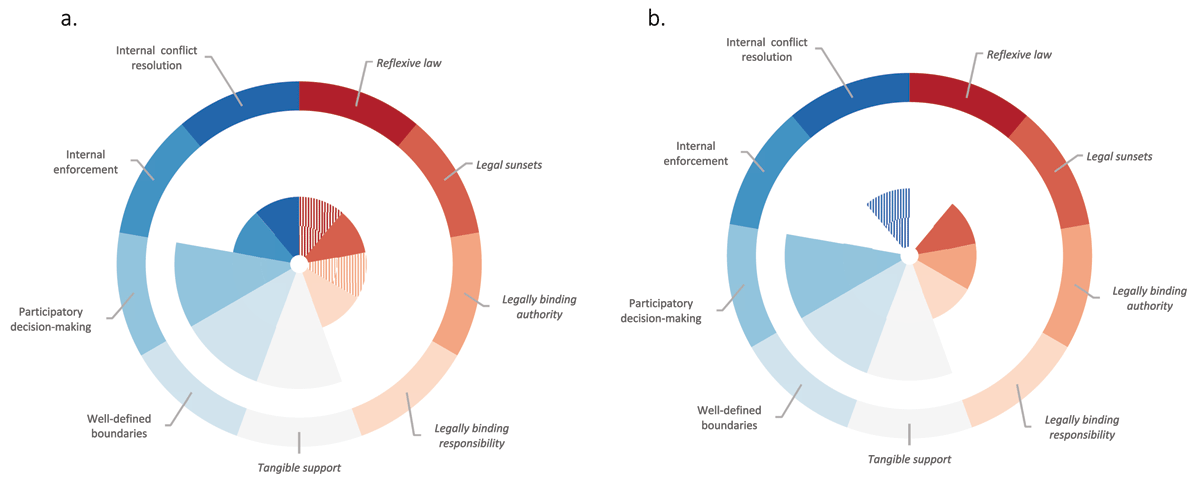
Figure 1
Overview of the results of the DDP (a) and MDP (b) analyses. Radiating bars indicate the frequency with which the legal (in italics and red shades) and institutional design principles (in normal text and blue shades) for adaptive governance were present in the documents. The absence of bars indicates the absence of a principle, short bars indicate a low frequency (< five times) and long bars indicate a high frequency (> five times). Principles explicitly present in the documents are represented by uniform-coloured bars whereas principles implicitly present are represented by striped bars.
Table 2
Overview of the adaptive governance principles by DeCaro and others present in the DDP and MDP, including examples illustrating how the principles are formulated in the documents. This is not an exhaustive list of all references to the principles that can be found in the delta plans.
| LEGAL DESIGN PRINCIPLES | DUTCH DELTA PROGRAMME (DDP) | MEKONG DELTA PLAN (MDP) |
|---|---|---|
| 1. Reflexive law | Reflexive law is implicitly present in the DDP. The DDP distinguishes between broad Delta Decisions, region-specific preferred strategies, and local projects. Delta Decisions provide a general vision for the future of the Rhine delta, preferred strategies are region-specific applications of Delta Decisions and projects tackle issues at the local level. In other words, Delta Decisions provide overall goals and general guidelines whereas preferred strategies and projects fill in detailed policy lines. This aligns with the principle of reflexive law, although key concepts were not specifically mentioned in the DDP. Furthermore, government websites had to be consulted to understand the difference between Delta Decisions, region-specific preferred strategies, and local projects. | N/A |
| 2. Legal sunsets | The DDP explicitly states that strategies and measures can be adapted to new developments, illustrating revisions after specific time periods. ‘The choice was made for an adaptive approach: new developments and insights can be a reason to adjust previously established preferred strategies and (delta) decisions. This can be done every year if required by new developments. The steering group of the delta plan decided in 2017 to also carry out a systematic reassessment every six years.’78 | The MDP explicitly distinguishes between short-, mid- and long-term measures to be implemented. This ensures that long-term strategies can be left relatively open, so that they can be adapted if socio-ecological conditions change. ‘A primary focus is given to no-regret and priority measures that should be taken in the short- to mid-term (2050). […] For the mid- to long-term (2100), additional measures are presented that are specifically designed to prepare the delta to cope with, and adapt to, the more extreme impacts of climate change.’79 This aims to ensure flexible adaptation to unforeseen events. |
| 3. Legally binding authority | The DDP is legally grounded in the Dutch Delta Act and the Water Act. These laws legitimise the decision-making latitude of stakeholders involved in the implementation of the policies and strategies proposed in the DDP. Although the Delta Act and Water Act are mentioned in the DDP, the laws had to be consulted to find out which governmental levels and stakeholders are allocated the authority to make decisions and implement solutions. The principle is therefore implicitly present. | Legally binding authority is illustrated in the MDP by the recommendation to establish a legally mandated entity, the Mekong Delta Planning Commission, that should have sufficient decision-making latitude to manage land and water issues effectively and sustainably in the Mekong delta. The document proposes to institutionalise the authority of the Commission in binding laws. Legally binding authority is therefore explicitly present in the MDP. |
| 4. Legally binding responsibility | The DDP, on multiple occasions, explicitly discusses responsibilities of different stakeholders involved in the DDP and refers to the Water Act where responsibilities are further stipulated. | The MDP explicitly provides illustrations of laws that define and assign responsibilities to various stakeholders, e.g., the Law on Water Resources, which assigns responsibilities regarding water resource management. |
| 5. Tangible support | Multiple explicit references to tangible support are found in the DDP. For example, the document explains that the DDP is financially supported by the Delta Fund, which aims to fund measures and strategies essential for protecting the Netherlands against flooding and water scarcity. ‘The Delta Fund holds the financial resources to finance investments in water safety, freshwater, and water quality […]. A subsidy can be granted from the Delta Fund to finance measures for water safety, freshwater, and water quality for other governmental authorities.’80 This illustrates how regional and local governments can be financially supported. Furthermore, an amendment to the Water Act in 2019 ‘makes it possible to provide financial contributions from the Delta Fund to decentralised authorities for taking measures to tackle flood risks.’81 | The MDP provides multiple explicit references to tangible support. Similar to the DDP, most illustrations of tangible support are in the form of funds. For example, it is argued that the ‘predominantly rural economy of the delta has been well established and developed over the last three decades, primarily as a result of the dedicated investment and support by the Government of Vietnam’.82 To stimulate further development of the delta, an agriculture development fund is proposed. It is argued that the Vietnamese government should be active and supportive in stimulating development ‘by investing in, and providing for, direct services – notably in research and development, state operated breeding and hatcheries, and trade regulation and certification support services’,83 which needs to be combined with ‘investments in favourable infrastructural developments, in particular waterways and management, that account for sustainable water quality intake, disposal and treatment requirements […] as well as transport and energy services’.84 |
| INSTITUTIONAL DESIGN PRINCIPLES | DUTCH DELTA PROGRAMME (DDP) | MEKONG DELTA PLAN (MDP) |
| 1. Well-defined boundaries | The DDP frequently and explicitly provides illustrations of well-defined boundaries. For example, the international character of the Rhine, Meuse and Scheldt rivers is acknowledged in the DDP, and compacts or agreements have been made to govern these international river systems more effectively. For example, ‘Flanders and the Netherlands work together in the Flemish-Dutch Scheldt Commission on an agenda for the future’85 and ‘the Netherlands and North Rhine-Westphalia have conducted research together in the Working Group High Water on flood risks in the border area’.86 Furthermore, to ‘improve flood risk management and coordinate efforts’ the Netherlands has been divided into 25 safety regions which clarifies the jurisdiction of each region.87 | The principle of well-defined boundaries is explicitly present in the MDP. For example, chapter 7 of the MDP proposes land and water management measures. Some of these measures are proposed for the entire delta, others specifically for the upper, middle and lower delta regions. It is underlined that measures ‘for flood control, securing adequate freshwater supplies in the dry season, salinity intrusion, regulation, and management of an adequate and healthy brackish water zone for aquaculture, coastal defense, etc. are all typically measures that need to be considered at the delta level, but in their impact and influences they go beyond the boundaries of local governance and policy jurisdiction’.88 This illustrates a recognition that measures transcend the local level and that measures taken in one part of the delta impact other areas too. Furthermore, the MDP also calls for an international organisation to stimulate collaboration with upstream countries, as upstream developments have significant impacts on the downstream Mekong delta. ‘Institutional arrangements that facilitate cross-border decision-making and true integration of planning and measures’89 are therefore required. |
| 2. Participatory decision-making | It is explicitly mentioned that the DDP is the product of the collaboration between stakeholders. Although the DDP is a national programme, ‘the central government, provinces, municipalities, and regional water authorities work together in an innovative way, based on input from civil society organisations, knowledge institutes, citizens, and businesses.’90 The ambition is, where possible, to stimulate ‘the participation of local governments, businesses, and citizens in the preparation of plans and measures’.91 The DDP distinguishes between five levels of stakeholder participation, including ‘informing, consulting, advising, co-producing, and (co-)decision-making’.92 Additional examples of participatory decision-making can be found in the DDP relating to the implementation of specific projects. | The MDP includes explicit references to participatory decision-making. In the preparatory phase of establishing the MDP, various knowledge institutes were included. In the process of formulating the actual strategies to be included in the MDP, a number of stakeholders and experts, regional and national were involved. These include ‘experts and specialists from different sectors […], decision-makers of local, provincial, and national authorities, [and] representatives from organisations for, e.g., industry, fishery, transport, agri- and aquaculture.93 Additionally, the MDP underlines that ‘international organisations like the World Bank, ADB, UNDP and different non-governmental organisations are stakeholders in the sense that they have a good understanding of integrated development and are capable of influencing projects in the delta in conformity with a delta plan approach.94 |
| 3. Internal enforcement | The DDP explicitly states that stakeholders are obliged to report on their progress to higher authorities. For example, the Netherlands is divided into 42 working regions to realise the ambitions formulated in the plan for spatial adaptation. These working regions ‘monitor the progress in their area and report on the progress. Based on this, the bodies of consultation report progress made back to the delta commissioner’.95 | N/A |
| 4. Internal conflict resolution | An explicit example is provided of internal conflict resolution related to a specific project for water safety. Within this project, several guiding principles were established. One of these principles is transparency, i.e., ‘we are open to each other; if our individual interest conflicts with the collective interest, we further discuss it’.96 Another principle focuses on predictability, i.e., ‘we discuss risks and issues at an early stage, so that we can consider them and make deliberate decisions’.97 Lastly, reliability is underlined, i.e., ‘we make clear agreements with each other and honour them’.98 This illustrates how agreements are made that stimulate open communication to resolve disputes, and with which stakeholders should comply. | Internal conflict resolution is implicitly present in the MDP. The MDP underlines the importance of equal access to information as a way to reduce conflict. Joint fact-finding is stimulated, which requires the establishment of one team, consisting of experts and decision-makers representing all relevant stakeholders in the Mekong delta, that gathers relevant information about the delta. By gathering information in one place and including representatives from different stakeholder groups, this team would be well equipped to resolve disputes, and this may ensure that ‘relevant authorities become more capable to effectively manage, operate, maintain and enforce rules and policies for land and water management in the Mekong delta’.99 This could function as a mechanism of internal conflict resolution. |