
1 Introduction
Google’s online platforms have been long scrutinised by competition law academics, policymakers, and enforcers,1 with authorities trying a variety of approaches to bring the firm to heel.2 Among the latest of these developments is a Statement of Objections regarding Google’s abusive practices in the display advertising market, which the European Commission (the Commission) filed in June 2023 after opening an investigation in 2021.3
In its Statement of Objections, the Commission found Google to have a dominant position in the EEA for both ad publisher tools and ad buying tools in the market for display advertising.4 That is to say, the side of the market where website owners (‘publishers’) sell their advertising space, and the side of the market where advertisers buy space on websites to show their ads. According to the Commission, Google has a dominant position in both the market for ad publisher tools (known as Supply Side Platforms, or SSPs) and the market for ad buying tools (known as Demand Side Platforms, or DSPs). As shown in Figure 1, these two sides of the market are mediated through an ad exchange, which matches the supply of ad space from publishers against the demand from advertisers.
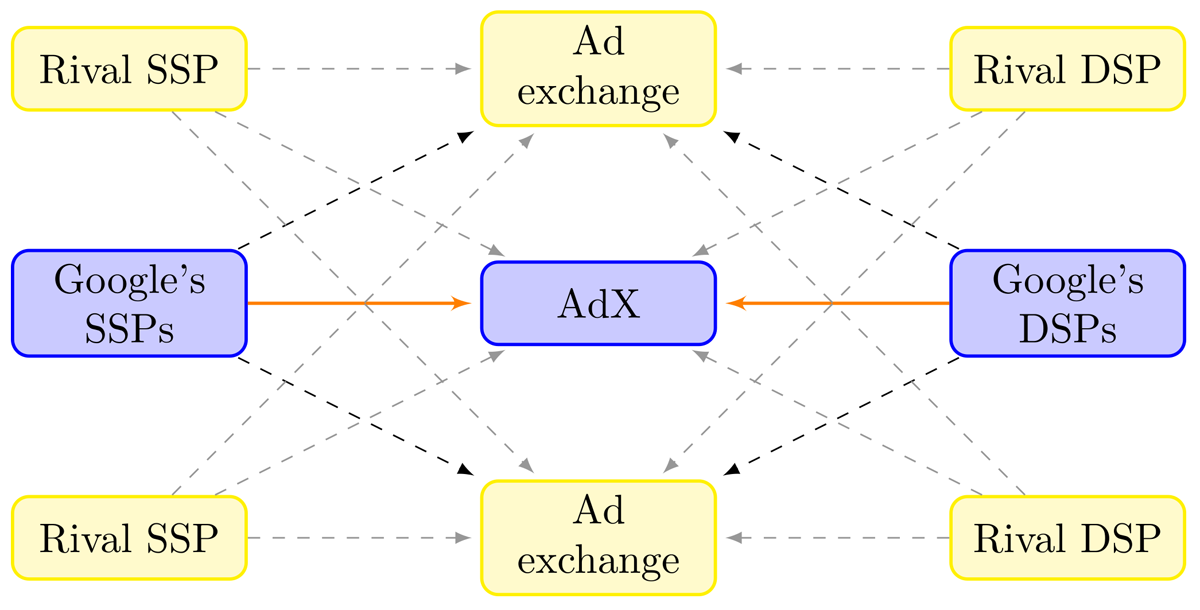
Figure 1
The scope of the EU Commission’s Statement of Objections. The orange arrows show the direction of self-preferencing from Google’s SSP and DSP products to Google’s advertising exchange AdX.6
The Commission has preliminarily found that Google has abused its dominant position by having its SSPs and DSPs favour its own ad exchange (‘AdX’) over those of rivals, as shown in Figure 1. In doing so, Google has been able to charge supra-competitive fees for AdX and is in violation of Article 102 of the Treaty on the Functioning of the European Union (TFEU).5
Finally, the Commission contemplates a structural separation as a remedy for the above-described anticompetitive conduct, which would see Google divest part of its AdTech services, but does not yet specify exactly what form the break up would take. That said, a diagram supplied in the Commission’s Statement of Objections hints that it would seek to separate the firm’s ‘demand side’ and ‘supply side’ properties into two separate entities. From this, we infer that the Commission seeks to ensure that any divestiture would result in Google being present only on one side of the AdTech market, even if we do not yet know the side of the market on which the firm would be permitted to remain. We refer to this outcome as a break up of Google’s AdTech business.
This paper makes two claims. First, that the Commission’s proposed remedy will not prevent Google’s anti-competitive behaviour in the long run because it does not address an important source of Google’s market power in online advertising markets – Google’s other platform services (Section 2). Second, that the Commission should also consider breaking out Google’s advertising business from its other online platforms, a remedy we refer to as marketised monetisation. We explore how that remedy could be implemented either as an ex-post competition law intervention, or under the Digital Markets Act (DMA) (Section 3).
2 The Source of Google’s market power in ADTECH
The Commission’s remedy aims to ‘prevent the risk that Google continues such self-preferencing conducts or engages in new ones’.7 If the Commission’s intention is limited to preventing Google from self-preferencing strictly on the display advertising market, then its remedy is appropriate. Yet display ads are just one part of Google’s online ecosystem, which also includes its popular zero-priced online platforms and its search advertising business. We think that the Commission should look beyond the display advertising market and consider how Google could leverage its dominant position from adjacent markets, if it is to appreciate the scope for future anti-competitive conduct.8 Such broader concerns translate into wider theories of anticompetitive harm, and a broader palette of remedies. Although proposals for structural remedies on two-sided digital markets already exist,9 these ideas have so far been received with trepidation by EU courts and authorities. This is to be expected, given the preference for behavioural remedies enshrined in Article 7(1) of Regulation 1/2003 and established in case law.10
The current investigation presents an ideal opportunity to holistically address competition concerns relating to Google’s business model, thinking not just about specific harms, but also about systemic factors that enable dominance, and its abuse. Hence, in this Section, we start by asking why Google has a dominant position in the first place.
2.1 An ecosystems view
EU competition law tends to define markets narrowly,11 an approach which does not necessarily work well in digital markets characterised by ‘ecosystems’, rather than individual markets.12 The Commission’s current Statement of Objections appears to limit its scope to Google having violated competition law by ‘distorting competition in the advertising technology industry’, specifically in the display advertising market. As such, it appears that the Commission is using a multi-sided market definition,13 with the ad buying side and the ad selling side being the two sides of the market.
Such a view overlooks how Google’s dominance in adjacent markets contributes to its ability to self-preference within the display ad market.14 By defining the market so narrowly, the Commission keeps the case neat and makes its task of establishing a dominant position rather straightforward. Yet, it also takes the existing structure of Google’s ecosystem for granted and misses abusive behaviour which occurs over a wider scope than that captured by the investigation. In particular, the Statement of Objections focuses on how Google’s conduct harms rival ad exchanges and allows it to charge higher prices to advertisers, but does not appear to consider harm to end users of Google’s products, nor any harm to the process or structure of competition, which are also protected by Article 102 TFEU.15
The Commission’s recently updated Market Definition Notice creates the possibility of defining an (eco) ‘system market’ which may be an alternate avenue for this case,16 by allowing the Commission to take ‘into account the competitive constraints imposed [in] connected markets.’17 Along those lines, we characterise Google’s zero-priced platforms as having two components: the user-facing platform (like Search or Maps), and the advertising network used to fund them.
The term ‘monetisation’ typically refers to a firm’s strategy for generating revenue, often by selling products and services. On zero-priced platforms, however, monetisation primarily occurs via behavioural advertising, where consumers are shown tailored advertisements while using the service.18 This revenue model funds the provision of free services for consumers, who accept it on the condition that it funds the provision of services at zero monetary cost.19 We think that an analysis of Google’s conduct in the AdTech industry should also cover the advertising-funded online platforms, which Google offers to consumers free of charge.20 We argue that Google’s dominance in AdTech is significantly strengthened by the billion-user, zero-priced services it runs in adjacent markets such as Google Search, Google Maps and YouTube.21 Our argument is that these other products should be considered explicitly in the Commission’s investigation, since Google is able to channel huge amounts of internet traffic from these products into its advertising platforms, thereby all but guaranteeing itself a dominant position in the AdTech market. Our suggestion is therefore to look beyond two-sidedness and instead draw on an ecosystem-inspired market definition and theory of harm. As such, Google’s platforms and its ad services should be considered together when analysing the firm’s potentially anti-competitive conduct, as discussed in Section 2.2. These considerations also lead to the main contribution of this paper, namely the remedy we propose in Section 3 – marketised monetisation.
2.2 The right to coordinate
We begin by asking how Google has organised the (infra-)structure of its platforms to preclude competition in AdTech. In this regard, one salient feature of the status quo is how Google has built its online platforms in such a way that when consumers use its popular, zero-priced online services, they must be subject to monetisation through its own advertising network.22 Specifically, when using Google’s popular products and services, consumers are always monetised by Google’s SSPs; when end-consumers use Google’s online search or watch videos on YouTube, it is Google that serves them ads. We may then ask whether it is legitimate for Google to funnel massive amounts of internet traffic from its online platforms – often monopolies in their respective markets – into the supply side of its advertising network. Indeed, by designing its products in such a manner, Google ensures that the huge pool of consumers that use its zero-priced platforms are monetised by its own SSPs, and not by those of rival advertising networks, as shown in Figure 2.
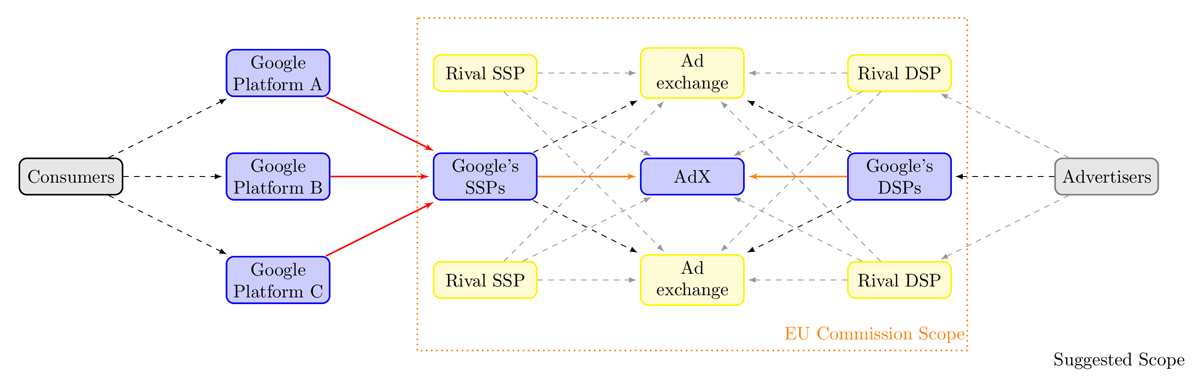
Figure 2
A wider view of Google’s AdTech business, which we suggest as an expanded scope for the European Commission’s investigation. Our suggested scope includes Google’s platforms (A, B, and C), like its search engine, Maps product, or YouTube. Orange lines show alleged self-preferencing by Google, red lines indicate traffic directed from its dominant platforms to its ad network, blue boxes represent Google-owned entities, grey boxes are consumers, and yellow boxes are rivals in the AdTech market.
The design of Google’s ecosystem therefore allows it to leverage its dominant positions in markets such as online search, online mapping, and online video – each boasting billions of users – into the online advertising market. We theorise that as long as Google can monetise consumers on its popular zero-priced platforms using its own advertising properties, it will bolster its dominant position in the supply side of the online advertising market by de facto capturing a large portion of internet traffic. Furthermore, by funnelling traffic from its popular zero-priced services into the supply side of its advertising network, Google forecloses rivals on the supply side of the advertising market from accessing consumers on those services.23 Despite there being many rival SSPs, it is only possible for consumers to use Google’s popular zero-priced platforms while being monetised by Google’s own SSPs.
Our ecosystem-oriented analytical approach considers the display and search advertising markets together.24 This is deliberate, because our focus, especially regarding the remedy, is on the end consumer who, we argue, does not differentiate between search and display advertising. To an end consumer, advertising is not a service to be consumed independently, but instead fulfils the role of monetising the usage of zero-priced products, which are ends in themselves. While the distinction between search and display advertising is of course relevant for firms involved in the AdTech stack, the competition issue that we articulate, as well as the remedy we propose, applies equally to both.
The vertical integration between Google’s consumer-facing platforms and its SSPs has two detrimental effects on competition. First, Google has made it impossible to use its platforms without also using its advertising services. By bundling its advertising network into its zero-priced services, Google has denied consumers the choice of which advertising network to use alongside Google’s zero-priced services, akin to how they might choose which mobile network to use with their mobile phone. Second, from the point of view of rival SSPs, Google has foreclosed the market for providing advertising services to consumers on its dominant platforms, imposing a significant barrier to entry into the AdTech market.
The question then arises as to whether this market structure could be considered as technical tying.25 Given that there exists a market for SSPs, and many exist that are not tied into a single user-facing platform, it may be possible to argue that user platforms and SSPs are two distinct products markets.26 However, this line of reasoning is difficult, since in the status quo consumers are not able to choose an SSP in the same way that they might choose a mobile network on their phone, and hence there is no distinct product market for SSPs from the perspective of consumers.
Despite the difficulty of a tying case, we can still consider the economic effects of the vertical integration between Google’s user-facing platforms and its SSPs. These effects were recognised in competition law cases such as Microsoft I.27 When products are always consumed together, the ability of consumers to freely discriminate between the competing offerings of firms when making consumption decisions is degraded, harming the ability of consumer choice to act as a feedback loop ensuring that innovation is directed by the wants of consumers, rather than at the convenience of dominant firms.28 Even assuming the Commission’s proposed remedy works, and Google is prevented from self-preferencing within the display ad market, we expect that Google will retain a structurally significant market position, at least on the supply side of the advertising market, on account of it being able to leverage its market power from its zero-priced platforms through vertical integration. That market power could then be exercised in ways not considered by the Commission’s Statement of Objections, such as by following the conventional playbook of a monopolist, i.e. artificially reducing the supply of advertising to drive up its price. Furthermore, any tie between Google’s online platforms and the supply-side of its advertising network would present a formidable barrier to entry in the online advertising market, regardless of whether subsequent layers of the market were more contestable. We therefore suspect that the Commission’s proposed remedy would be only marginally effective at tackling competition issues in the AdTech industry because it would fail to address an important structural factor – Google leveraging its market power from its zero-priced platforms into its SSPs.
An important goal of competition law remedies is to prevent future infringements, especially if such infringements stem from structural features of the economic context which make recurrence likely.29 Indeed, a desire to prevent repeat infringements is what motivates the Commission’s current choice of remedy.30 Given that the current structure of the market directly contributes to the ability of Google to maintain its dominant position on the supply side of the AdTech market, and Google’s proclivity to infringe competition law,31 the Commission should consider remedies which address these wider structural problems in the AdTech ecosystem – a simple break up remedy will not suffice.
One problem with this reasoning is that under existing competition law, the remedies may only serve a preventative aim with respect to the same conduct.32 The Commission’s existing remedy – a break up of Google’s AdTech business – would serve that aim by preventing Google from self-preferencing within the AdTech market. Going beyond such a remedy, as we will advocate for, would require the Commission to expand its theory of harm beyond that articulated in its current Statement of Objections in order to ensure proportionality.33 Our intention here is not to craft such a theory of harm.34 Rather, in the spirit of remedies driving and justifying theories of harm, we see our contribution as offering a remedy, which can motivate the Commission to widen its Statement of Objections, or prompt it to consider additional legal action under the DMA as will be considered in the following section.
To durably address anti-competitive harm in the AdTech industry, the Commission must seek to exercise the same kind of ‘architectural’ power that Google has used when constructing its ecosystem.35 By building its advertising network into its popular online platforms, Google has defined the architecture of the AdTech industry as to foreclose large parts of it to competition. Consequently, the Commission should look to re-structure the architecture of Google’s zero-priced platforms to prevent it from integrating the supply side of its advertising network into its consumer-facing online platforms. The aim should be to allow other advertising networks to participate in the chain of production, as mediated by the preferences of consumers. The following Section outlines a remedy designed to do that.
3 Marketised monetisation – breaking out the advertising market
The Commission should seek to break Google’s AdTech business out from its other online platforms. This would entail end users having a choice of which firm should monetise their usage of Google’s platforms. To facilitate this, Google would be required to make its popular online platforms interoperable with third-party advertising networks, which would prevent the firm from leveraging its dominant position in adjacent markets into the AdTech industry. Section 3.1 describes our proposed remedy, which we term marketised monetisation (marketisation).36 We then discuss, in Section 3.2, the expected effects of marketisation and consider, in Section 3.3, how it could be implemented in practice from a legal and technical standpoint. Finally, in Section 3.4, we consider its potential drawbacks.
3.1 The marketisation remedy
When consumers use a firm’s zero-priced online services, they see targeted advertising from that same firm’s SSP. There is no option to be monetised by a third party. As a competition remedy, marketised monetisation stems from a simple question: ‘Why can’t consumers choose which advertising network they would like to use with online platforms?’. Returning to the case at hand, we therefore propose that the Commission should seek to restructure Google’s platforms, such that internet users should have a choice over how, and by whom, they are monetised. The remedy would seek to decouple Google’s online platforms from its advertising properties and create a market for monetisation services such that rival advertising networks can compete on the merits to monetise consumers. Rather than seeking to break up Google’s advertising business, marketisation seeks to break it out of Google’s other platforms.
To facilitate this, Google’s monetised services, such as its search engine, would charge an up-front fee to consumers. To maintain zero-prices, consumers would then be able to delegate the payment of that fee to a monetisation provider of their choice, which would be interoperable with Google’s platforms via an open API. That monetisation provider would then monetise the consumer’s use of Google’s services, for instance through behavioural advertising, and pay the usage fee of Google’s platforms on their behalf. We refer to this remedy as ‘marketised monetisation’, or marketisation for short, since it creates a consumer-facing market for the monetisation of online platforms. Figures 3a and 3b provide a visualisation of marketisation.
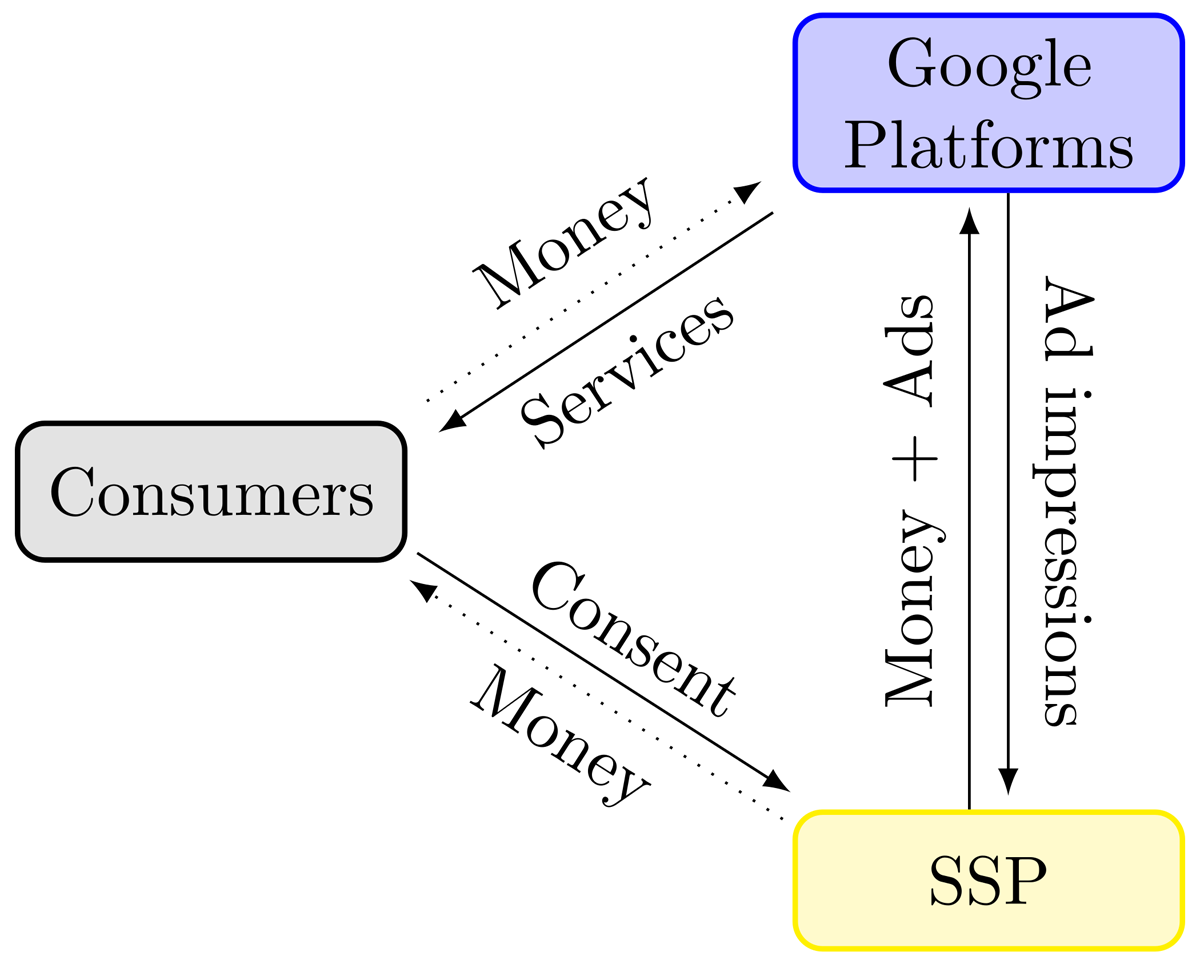
Figure 3a
A per-consumer view of marketised monetisation (marketisation). Consumers use Google’s platforms, but separately choose an interoperable supply-side platform (SSP) which they consent to monetise their usage of Google’s platforms. Google charges the consumer, and the consumer is subsequently reimbursed by the SSP. The SSP then serves the consumer ads on Google’s platforms.
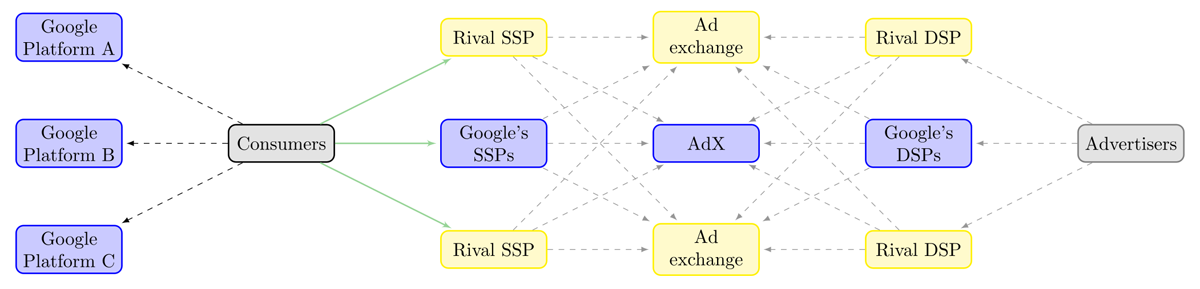
Figure 3b
A view of Google’s ecosystem post-marketised monetisation (marketisation). Consumers participate in two markets. They choose to use Google’s platforms, but also choose from a competitive market of SSPs to fund their usage, as denoted by the green arrows. Rival SSPs compete to attract consumers.
The aim of marketisation as an ex post competition law remedy, is to restart the competitive process in online advertising markets by opening up Google’s lucrative advertising business to entry by third parties.37 Marketisation is therefore a restorative remedy, which seeks to re-establish an effective competitive process on the AdTech market by addressing structural barriers to entry to the market.38
The idea of marketisation is to give consumers two independent choices when they use zero-priced platforms; which platform to use, and by whom should they be monetised. Marketisation facilitates this choice by ‘unbundling’ advertising from zero-priced services by mandating interoperability between Google’s online platforms and the monetisation ‘layer’ of the market.39 In doing so, it aims to facilitate competition ‘in’ the supply side of the online advertising market by letting consumers use rival firms which also offer an equivalent monetisation service.40 Many such firms exist, including Big Tech rivals like Facebook or Microsoft, as well many smaller advertising networks.41
3.2 The effect of marketisation
Marketisation opens up Google’s vertically integrated business model by facilitating interoperability between its two ‘layers’: the online platform that consumers wish to use, and the monetisation service which funds it. In doing so, it facilitates a greater degree of consumer choice because consumers can mix-and-match which services they would like to use, safeguarding the process of competition that keeps markets responsive to the preferences of consumers.42 Yet competition law remedies in vertical integration and tying cases have not historically been very successful. The theories of harm in Microsoft I and Microsoft II are both related to tying,43 but their remedies were notoriously ineffective.44 Likewise, the remedy imposed in Google Shopping also failed in a restorative sense.45 Although marketisation is an ex post remedy which addresses a long-standing competition issue, unlike these past cases it is also forward looking in that it takes a restorative market shaping approach46 to change the way in which zero-priced markets work and facilitate the competitive process ex ante. It does so in two ways.
First, it re-introduces the price mechanism to zero-priced markets. Post-marketisation, the consumption of Google’s consumer products would technically involve payment, albeit with consumers having the option of delegating payment to a monetisation provider. While Google’s current business model fixes prices at zero, marketisation would allow the possibility of positive or negative prices depending on the price charged by Google relative to the compensation offered by the monetisation provider. Re-introducing the possibility of payment would facilitate entry by rival platforms aiming to undercut Google’s offering on price, whereas now they can only attempt to beat it on quality. Likewise, rival advertising networks could decide to compensate consumers to a higher degree than Google’s own advertising network would, or compete on other dimensions such as ad relevance or privacy. In either case, consumers gain the possibility of paying more to see fewer ads and have a more private experience of the internet, or being ‘paid for their data’, a long-standing demand in ad-funded markets.47 Marketisation thus preserves monetisation as a market institution, while preventing Google from foreclosing the consumers of its internet platforms to other advertising firms.
Introducing the price mechanism would also prevent similar outcomes to the unbundling remedies in the Microsoft cases. For example, in Microsoft I, consumers had no incentive to purchase a copy of Windows without Windows Media Player, when they could purchase an identical copy of the operating system for the same price with the additional functionality installed. Marketisation would ensure that if Google wanted to exercise market power on its consumer-facing platforms, it would have to increase the price of those platforms and thereby expose itself to the threat of competitive entry. Likewise, to exercise monopoly power through its advertising network, it would have to reduce the payments to consumers, increase the number of ads, or increase the price it charges to advertisers.48 In each of those situations, Google would make itself vulnerable to competitive entry by an interoperable firm.
Second, in the status quo, consumers do not face a meaningful choice regarding which advertising networks they are monetised by. Since advertising networks are typically tied into zero-priced online platforms, consumers only express a meaningful choice regarding which advertising network they use when their preference for a particular advertising network overrides their preference for the consumer-facing platform itself. As such, the preferences for most consumers regarding online advertising are not expressed in the market, except for a minority who feel strongly about privacy and use privacy-focused competitors like Duck Duck Go. To the extent that there exists a privacy-quality trade-off when choosing a platform, this logic can go some way to explaining the privacy paradox:49 even if consumers care about online privacy, they may not express that preference by choosing privacy-focused platforms when they care about service quality more.
Thus, the current structure of zero-priced markets bundles different parameters of competition together, such that the heterogeneity and nuance of consumer preferences cannot be fully expressed through their consumption choices. As such, contemporary zero-priced markets may tip towards whichever platform most consumers prefer, considering service quality and advertising disutility in aggregate. This effect is illustrated by evidence from the United States v Google trial,50 which featured exhibits showing employees describing ‘search advertising [as] one of the world’s greatest business models ever created’ such that the firm had no ‘need to worry about supply and demand’.51 We understand this to mean that Google’s dominant platform(s) guaranteed a stable amount of demand for Google’s tied-in advertising service(s), irrespective of the quality of the advertising, since consumers’ interest in using its free platform services far outweighed their interest in which advertising network they were monetised by.
Marketisation introduces a layer of interoperability which allows consumers to mix-and-match the platform with the way in which it is monetised to best suit their preferences. Each consumer would have their own preference for the quality of the online service, the price they are willing to pay for it, and the quality of advertising they receive.52 We expect that consumers would seek to find the best combination of services, which would suit their individual preferences. Because consumers could choose a combination of products, the number of possible ways to use these zero-priced services would be greater than in the status quo, where only bundles are available.
Such a vision for monetised markets stands in stark contrast with the status quo. For instance, choice in the ad-funded online search market today is limited to just a few pre-bundled options: Google Search, Microsoft Bing, Duck Duck Go, and a few smaller players. The lack of options is problematic, since consumer choice is the engine that drives the competitive process, and the competitive process is what makes markets responsive to consumer preferences,53 and incentivises firms to innovate.54 While zero-priced markets often tip towards the best product in the status quo, at least to the degree that consumers have similar preferences for which product bundle is best, we think that marketisation, by re-introducing the price mechanism and permitting a more nuanced set of choices, would attenuate that effect.
We suspect that the set of post-marketisation monetisation choices would drive innovation in the online advertising space. Consumers would have an incentive to choose a monetisation service which is pleasant, private and makes economical use of their attention. One can imagine advertising networks competing on privacy, or the quality of their ads. Likewise, increased competition among advertising networks could drive down the prices of online advertising for businesses. Google’s enormous profits suggest that there is room for prices to fall.55
Finally, it is worth noting that marketisation addresses competition problems in zero-priced markets durably and flexibly. Not only does it address the root cause of the problem – insufficiently nuanced choice resulting as a result of bundling – but it does so in a manner synergistic with the other polycentric goals of competition law,56 such as consumer privacy57 and the support of economic democracy through consumer choice.58
3.3 How marketisation might be implemented
Our proposed marketisation remedy goes further than the Commission’s Statement of Objections, pushing the boundaries of what is possible under competition law.59 Nevertheless, we believe that the remedy is prudent, and possible to implement in both a legal and a technical sense.
3.3.1 Implementing marketisation: the law
This section illustrates, first, that marketisation falls within the scope of the Commission’s ongoing investigation into Google’s behaviour in the online advertising sector and should be considered under an expanded theory of harm. Second, it considers how marketisation could be implemented under the DMA.
The Commission’s investigation into Google was launched in June 2021,60 and limited in scope to the display advertising market when it was announced. However, when compared to the Commission’s Statement of Objections, the initial investigation was far more expansive in the list of harms it described. Six harms were identified; two related to tying between YouTube and Google’s display advertising business, Google favouring its own ad exchange (‘AdX’) by its demand-side advertising properties, and three restrictions that Google had put in place to prevent third parties from accessing data related to user identity or behaviour. Only the third harm, Google’s conduct relating to its ad exchange, is addressed in the recent Statement of Objections.61 The other five harms are not discussed, and would not be affected by the Commission’s proposed break up. Marketisation, on the other hand, is relevant to them all. It is aimed squarely at preventing Google from leveraging its dominance from its consumer-facing online platforms into its advertising platforms, making it relevant to the first two harms. It also lets consumers interface directly with third-party advertising networks, thereby allowing Google’s rivals in the advertising sector direct access to end-consumers, making it relevant to the last three harms.
Competition law remedies must have a clear link with the abuse in question, so as to ensure that they are justified and can plausibly prevent similar conduct from occurring in the future.62 Providing they are necessary, proportionate and effective, remedies can also go beyond directly fixing the original infringement, and can address more systemic issues, which led to the infringement in the first place.63 Indeed, they may also try to ‘ensure that there remain no practices likely to result in distortions of competition and infringements in the future’, not least by ‘reduc[ing the] ability [of infringers] to commit illegal practices’.64 We believe that a remedy such as marketisation could be considered within the scope of the Commission’s investigation, albeit with a re-worked and expanded theory of harm beyond the current Statement of Objections, as discussed in Section 2. Of course, one might also argue that the relationship between theories of harm and remedies does not only flow one way; a compelling remedy can also motivate and justify theories of harm. The possibility of marketisation may therefore justify such an expanded theory of harm.65
That said, one way for the Commission to expand the remedy to include marketisation under the existing theory of harm while maintaining proportionality could be to include a review clause.66 Such clauses permit the Commission to amend the remedies in its infringement or commitment decisions after a certain amount of time, if certain conditions are met. This would allow their ‘modification or substitution’, potentially as to facilitate marketised monetisation in the case that the currently proposed break up turns out to be ineffective.67
Within the framework of Article 102 TFEU, marketisation could be enacted through an ex post structural remedy involving a separation of Google’s advertising business from its other platforms. Such a remedy would see Google divested of its entire ad-funded business model, and unbundle Google’s advertising services from its zero-priced platforms. In doing so, it would prevent Google from foreclosing consumers of its platforms from different SSPs through the imposition of interoperability obligations. A remedy along those lines would target a competition issue originating from the ‘very structure of the undertaking’, and thus aligns well with the circumstances under which structural remedies are justified under Article 7 of Regulation 1/2003, as explained in Section 2 above.68
Naturally, the remedy would entail legal risks; for instance, Google may be able to mount a successful efficiencies defence.69 Yet even outside the current investigation, marketisation may also be feasible under the DMA,70 not least because Google has been designated as a gatekeeper since September 2023.71 Indeed, the DMA is a promising avenue for implementing a remedy like marketisation, given its focus on enabling consumer choice and interoperability.
Although marketisation seeks to restructure the architecture of zero-priced platforms, it could be implemented either through a ‘purely’ structural remedy, or through a quasi-structural (behavioural) remedy. Following the structure of the DMA, which confers behavioural obligations on gatekeepers and only resorts to structural intervention in cases of systemic non-compliance,72 we will examine how Articles in the DMA could be used to facilitate marketisation through behavioural means, before turning to how a structural remedy could be justified.73
A behavioural approach to implementing marketisation would entail facilitating inter-platform interoperability so that consumers could choose which SSP to use alongside Google’s services but would not see the firm have to divest any of its advertising properties. If one is to take literally the idea that monetisation funds consumers’ usage of zero-priced services, then Article 5(7) DMA may be of note because it prohibits gatekeepers from requiring end users to use ‘payment services […] of that gatekeeper in the context of services provided by the business users using that gatekeeper’s core platform services’. By requiring that end-users ‘pay for’ its zero-priced services via its own SSP, Google could be found to be contravening Article 5(7). In such a case, the Commission would have to establish that monetisation services such as advertising networks fall under the definition of a ‘payment service’ under the DMA. Yet it seems unlikely that, in the status quo, advertising networks could be categorised as such.74
Similarly, Article 5(8) DMA prohibits gatekeepers from making the use of one core platform service conditional on the end user registering for another of its core platform services. Google’s online search, online mapping, online video and online advertising platforms are all designated as core platform services.75 Given that there is, as at the time of writing, no way to use Google’s user-facing core platform services without receiving ads from Google’s own advertising network,76 the Commission could frame Google’s vertically integrated business model as a violation of Article 5(8), providing it could show that receiving ads from Google would satisfy the requirement of users being ‘registered’ under the DMA. A common thread that transpires when examining the obligations of Article 5 DMA is that none can achieve marketisation directly (but possibly a combination of provisions could come close). Thus, we now turn to an analysis of the Article 6 obligations.
Several provisions in Article 6 DMA could be of interest, particularly those which seek to safeguard fair competition and prevent self-preferencing. Yet, like the Article 5 obligations, their ability to enact a marketisation style remedy appears limited by a narrow drafting.77 For instance, Article 6(6) obliges gatekeepers to ‘not restrict technically or otherwise the ability of end users to switch between [different] services that are accessed using the core platform services of the gatekeeper’. It is somewhat unclear as to whether the DMA will be interpreted such that Google’s tie between its core platforms and its SSPs constitutes a restriction which prevents end users from switching to another monetisation firm, but such an interpretation is not unthinkable. Article 6(7) aims to facilitate interoperability between different products, yet applies only to hardware and software services, which are controlled via the operating systems and virtual assistants. Similarly, although Article 6(8) imposes data access obligations on gatekeepers, it would not obligate Google to allow consumers to choose which third-party SSP they want to use.
To implement marketisation, it might therefore be advisable to introduce an additional provision under either Article 5 or Article 6 DMA that expressly aims to open up the digital advertising marketplace. Such a provision could be modelled on the findings of the currently ongoing Google AdTech investigation by the Commission78 and implemented on the basis of Articles 19(1) and 19(3) DMA. Opening up an interface for rival SSPs to ‘plug in’ to would be in line with the principle, commonly held among technical audiences, that data-sharing remedies alone are unlikely to fix competition issues, but rather should be combined with remedies addressing and enabling infrastructural access too.79
If these behavioural obligations were applied and found to be ineffective, the DMA also includes a path towards structural remedies in cases of systemic non-compliance.80 These remedies are intended to fix the causes of non-compliance in cases where the de facto behavioural approach of the DMA could not ensure adherence to the law. If access and interoperability obligations failed to work, then a structural approach entailing Google to be forced to divest (parts of) its advertising business may be necessary.81 Article 18 DMA allows for the Commission to commence a market investigation with an eye to exploring structural intervention and divestiture as a last resort in cases of systematic non-compliance.82 However, this provision can notably be triggered only when there is repeated recidivism.83 Additionally, once this provision is triggered, strict proportionality requirements apply regarding the type of remedy that will be chosen,84 with a structural separation being the harshest option and different forms of behavioural commitments providing in-between measures. Marketisation could thus be implemented under Article 18, with different degrees of severity as explained in the next paragraph. It is also important to acknowledge that marketisation can be proposed as a commitment by the gatekeeper itself (under Article 25 DMA)85 or – if an Article 18 procedure is not triggered – under a participative negotiation dialogue with the Commission as available under Article 8(3) DMA.86 In all of the scenarios mapped out above, there are different degrees of business separation that can be envisioned by the respective parties. We start the discussion from the most intrusive measure and then work to the least intrusive measure.
Beyond the most interventionist measure – structural separation – marketisation can also be achieved with the so-called ‘functional/operational’ separation that encompasses different levels of business segmentation ranging from legal separation to accounting separation.87 While accounting separation entails creating separate balance sheets for different company divisions in order to better monitor their transactions, legal separation is one step short of a divestiture as it mandates the creation of completely independent legal entities under the same ownership.88 In between these two extremes lies ‘business separation with localized incentives’, which is characterised by separation of processes, support systems, management information systems, labour forces and brands. Additionally, management incentives are changed by tying managers’ remuneration to divisional (as opposed to corporate) performance.89 While the literature maintains that accounting and even legal separation on their own are too weak to curb the market-distorting incentives which vertical market power can create,90 the opinions are divided regarding the other tools. Some scholars maintain that anything short of outright ownership separation91 does not sufficiently target the issues at stake, while others believe that ‘business separation with localized incentives’ has worked in specific sectors, such as the UK telecoms market.92 Additionally, the French experience in the energy sector teaches that even accounting separation could work, provided that there are ‘Chinese walls’ built around the monopoly segment of an incumbent provider.93 However, to the extent that digital and AdTech markets are rather opaque and it is difficult to determine which is their ‘core’ monopoly segment,94 accounting separation with ‘Chinese walls’ might not be suitable, which leaves the rather intrusive measures listed above as potential avenues.
3.3.2 Implementing marketisation: the technology
Although specifying a detailed design for how marketisation could be implemented on a technical level is beyond the scope of this paper, we wish to indicate why we think such a remedy is technically feasible. First, we highlight that vast parts of the internet are already monetised by third party advertising networks. Only the largest websites such as Google or Facebook can build and run their own SSP, and most firms delegate the provision of ads to a third-party network.95 Marketisation would simply be putting Google on a par with an ‘ordinary’ website in this regard. The innovative part of the marketisation remedy, both in an institutional and a technical sense, is to let the consumer (not the website) decide which advertising network should be used.
We envisage marketisation being implemented through an open and standardised API, which would enable third-party advertising networks to interoperate with Google’s zero-priced services. Any third-party advertising network would be able to access (consenting) consumers using Google’s online platforms, and hence access the same data that Google currently uses to serve them advertising. In practice, this would work by having consumers sign up to a third-party advertising network, then consensually ‘link’ it to the account they use with Google’s online services. The third-party advertising network would then be used to serve advertising to the consumer and pay for that consumer’s use of Google’s services.
Such APIs are commonplace throughout the internet and can allow essentially seamless integration between digital products and services built by different firms. In terms of implementing marketisation, Google could first switch both its zero-priced platforms and its SSPs over to using the public interoperable API, and then begin offering consumers a choice of which SSP to use. From a consumer’s perspective, nothing would change until the day that they would be able to switch SSPs.
3.4 The limits of marketisation
This Section discusses potential drawbacks of the marketisation remedy and considers whether they can be overcome in practice. These include efficiency concerns, information asymmetry, and privacy concerns.
3.4.1 Efficiency concerns
An obvious issue with structural remedies is the possibility of introducing inefficiencies, which competition law endeavours to avoid. Here, we outline why we think that marketisation would be an important source of efficiencies relative to the status quo. One concern may be that marketisation would reduce the amount of data that an advertising firm would be able to collect on consumers. The argument goes that since the SSP would be separate from the online platform, it might not be able to gather the same level of data, and profile consumers as effectively. Alternately, the SSP may have fewer consumers signed up than Google’s SSP does in the status quo, which may result in lower quality matches between consumers and advertisements, leading to less value generation through network effects for both sides of the market. We think these concerns are misplaced for several reasons.
First, advertising networks currently face a formidable challenge when gathering data on consumers. To satisfy demanding legal and technical requirements, the AdTech industry has constructed elaborate mechanisms to track and profile consumers based on cookies, fingerprinting, and inference.96 Marketisation could offer a path to rendering such mechanisms unnecessary, since it would allow advertising networks to rely on purpose-built, above-board mechanisms for profiling consumers rather than the ‘hacky’ methods used today. If the marketisation remedy was successful, it could be adopted by other platforms either voluntarily or through competition law remedies, opening the door for consumers to use a single SSP across every compatible website. This SSP would then generate efficiencies by monetising the user on multiple platforms. Likewise, the consumer would have a closer relationship with the SSP, more akin to that of a mobile phone provider, which would in turn allow for a far better-informed consent than typically occurs in the status quo.97 Rather than being monetised by many different advertising networks and data brokers across the whole internet,98 consumers could be monetised by just one, of their choice.
Second, when advertising networks are bundled into digital platforms, data relevant to the service and data relevant to advertising overlap.99 Although marketisation splits these two services into different functions, it does not preclude the sharing of useful data from the online platform to the advertising network via the API which allows the two services to interoperate, with informed consumer consent. Indeed, marketisation would allow for consumers to share data with the platform, but not necessarily with the SSP.100 We envisage that information sharing between platform and monetiser would be built into the mechanism by which the two services interoperate, thereby mitigating any information inefficiencies.
3.4.2 Information asymmetries
Marketisation requires that consumers select from several different monetisation firms, each with a competing offer regarding how much compensation they will pay to the consumer, the level of privacy offered by the firm, the quality of monetisation they expect to receive, etc. An alternative framing of the decision might involve the consumer asking ‘how much money is my data worth?’ Putting a price on data and privacy has been found to be challenging in practice. Empirical studies have found that consumers’ valuation of their privacy depends heavily on the context,101 and that stated preferences are often remarkably different from what they are revealed to be in practice.102 Thus, it is plausible to think that marketisation would result in consumers failing to know how to price their privacy and their data if they had to choose a third-party monetisation provider.
We believe that marketised zero-price platforms would not suffer from such a market failure in practice. While consumers have a reasonable understanding of the worth of some products, they cannot be expected to possess some faculty for estimating a reasonable price for most products. Indeed, a key premise of market economies is that prices are an emergent phenomenon,103 and one of the virtues of economic competition is to help ensure that prices do not greatly exceed the cost of production.104 Behavioural economics has long since identified mechanisms by which consumers effectively make such decisions in real-world situations.105 We see no reason why such mechanisms could not work with regards to marketised monetisation. Indeed, EU law assumes that the ‘average’ consumer is ‘reasonably well informed and reasonably observant and circumspect’106 and operates as such in other complex markets such as energy and telecoms.107 As such, we expect that consumers will subjectively choose a marketisation provider that seems to offer the ‘best deal’ from their perspective, and that competing providers will invest in marketing themselves to consumers to win their business, just like in other markets.
3.4.3 Privacy concerns
Marketisation subjects consumer privacy to a market logic. In doing so, it could potentially expose the privacy of consumers to the problems that a market logic can bring about.108 These include structural inequality, since markets ration goods according to consumers’ ability to pay.109 One may therefore ask if marketisation could lead to a situation where wealthy consumers buy themselves out of advertising and poorer consumers have their privacy exploited. We acknowledge such an outcome to be a potential drawback of marketisation, although many market systems suffer from the same fundamental issue; hence, we point to sector-specific regulation of SSPs as a potential response. We also identify two structural factors for why marketisation may improve consumer privacy overall.
First, the real-time bidding system used by advertising networks has evolved since the 2010s to profile consumers and value ad slots in real time, amid tightening privacy laws. However, the current market structure often clashes with European privacy and data protection law.110 Marketisation enables consent-based tracking while aligning firms’ incentives with privacy protection.111 Post-marketisation, advertising networks would collect only data needed for ad targeting, and platforms would only gather data essential to their services. The interoperability layer of marketisation could be designed to fully comply with EU data protection and privacy law, contrary to current user experience, which often involves facing a consent form laden with dark patterns asking for permission to process data for both essential services and ad targeting,112 leading to personal data being sent to hundreds of data brokers. Marketisation reimagines online monetisation, as detailed in Section 3.4.1, such that consumers could choose a single advertising network for all zero-priced services across the internet, fostering explicit, enforceable one-to-one relationships under the GDPR.
Second, marketisation would see rival advertising networks compete to be able to monetise consumers. It is plausible that one of the parameters of that competition will be the degree to which these firms are able to protect the privacy of consumers. Thus, under marketisation, privacy could become a more relevant parameter of competition in zero-priced markets.
4. Conclusion
The Commission’s Statement of Objections regarding Google’s self-preferencing conduct in the AdTech industry is surprisingly narrow in scope given the breadth of its initial investigation. In this paper, we took a broader look at Google’s ecosystem of interrelated platforms and proposed a novel diagnosis. By making the usage of its popular zero-priced platforms conditional on using its own advertising services, Google has leveraged its market power from its dominant user-facing platforms into the supply side of the AdTech market, and funnelled vast amounts of internet traffic from its hugely successful zero-priced services into its own advertising business. In doing so, it has gained durable market power on the supply side of the AdTech market, and foreclosed other advertising firms from the billions of end-users who consume Google’s products and services. Our remedy, marketised monetisation, would force Google to give end-users a choice of which firm they would like to monetise their usage of Google’s platforms. In practice, this would entail requiring Google to create an open API for third-party monetisation on its online platforms. Marketisation could be enacted under Article 102 TFEU, or through the Digital Markets Act, and could be implemented either using a purely behavioural obligations-oriented approach or through a structural remedy. Although a remedy such as marketised monetisation is among the most invasive options available under competition law, we believe that it should be considered given the long-standing and structural nature of competition issues in the AdTech sector and repeated violations by Google across its ecosystem of product offerings.
Notes
[1] R Hahn & H Singer, ‘An Antitrust Analysis of Google’s Proposed Acquisition of DoubleClick’ (1 February 2008) <https://papers.ssrn.com/abstract=1016189> (accessed 12 July 2023); K Laudadio Devine, ‘Preserving Competition in Multi-Sided Innovative Markets: How Do You Solve a Problem Like Google’ (2008) 10 North Carolina Journal of Law and Technology 59.
[2] Case C-48/22 P, Google Shopping [2024] ECLI:EU:C:2024:726; Case T-604/18, Google Android [2022] ECLI:EU:T:2022:541; Case T-334/19 Google AdSense for Search [2024] ECLI:EU:T:2024:634.
[3] European Commission, ‘Antitrust: Commission Opens Investigation into Possible Anticompetitive Conduct by Google in the Online Advertising Technology Sector’ (European Commission, 22 June 2021) <https://ec.europa.eu/commission/presscorner/detail/en/ip_21_3143> (accessed 24 July 2023). See also Competition and Markets Authority, ‘CMA Objects to Google’s Ad Tech Practices in Bid to Help UK Advertisers and Publishers’ (GOV.UK) <https://www.gov.uk/government/news/cma-objects-to-googles-ad-tech-practices-in-bid-to-help-uk-advertisers-and-publishers> (accessed 4 October 2024).
[4] European Commission, ‘Commission Sends Statement of Objections to Google’ (European Commission, 14 June 2023) <https://ec.europa.eu/commission/presscorner/detail/en/ip_23_3207> (accessed 13 July 2023). For a commentary, see C. Bergqvist, ‘DG COMP’s Google AdTech investigation (2023), SSRN research paper <https://papers.ssrn.com/sol3/papers.cfm?abstract_id=4574812> (accessed 20 May 2024).
[6] Figure adapted from the Commission’s statement of Objections. The UK’s Competition and Markets Authority recently found Google to have market shares of over 50% in both sides of the ad market. Competition and Markets Authority, ‘Online Platforms and Digital Advertising Market Study’ (2019) <https://www.gov.uk/cma-cases/online-platforms-and-digital-advertising-market-study> (accessed 13 December 2022) para 63.
[9] See, for instance, L Kahn, ’The Separation of Platforms and Commerce’ (2019) Columbia Law School Scholarship Archive, <https://scholarship.law.columbia.edu/cgi/viewcontent.cgi?article=3794&context=faculty_scholarship> (accessed 17 October 2024).
[10] Case T-93/18, International Skating Union v Commission, [2020] ECLI:EU:T:2020:610, paras 167–168.
[11] Typically based on whether goods are substitutable and are sold in a homogenous geographic product market. Case T-177/04 EasyJet Airline Co Ltd v Commission of the European Communities [2006] ECLI:EU:T:2006:187, para 99; R Whish & D Bailey, Competition Law (Oxford University Press, 2021), 26, 36.
[12] M Jacobides & I Lianos, ‘Ecosystems and Competition Law in Theory and Practice’ (2021) 30 Industrial and Corporate Change, 1199.
[13] European Commission, ‘Commission Notice on the Definition of the Relevant Market for the Purposes of Union Competition Law’ (22 February 2024) paras 94–98 <https://eur-lex.europa.eu/eli/C/2024/1645/oj> (accessed 28 March 2024).
[14] Although the Statement of Objections acknowledges Google’s other platforms, it does not causally connect them to the abuse. European Commission (n 4).
[15] Case C-95/04 P British Airways plc v Commission of the European Communities [2007] ECLI:EU:C:2007:166, para 106.
[16] European Commission, ‘Commission Notice on the Definition of the Relevant Market for the Purposes of Union Competition Law’ (n 13), para 99–101.
[18] Our definition of monetisation would also include display advertising on recipe websites, print advertising in newspapers, offering a free service which is funded by selling consumers’ data for a profit and, as described, or simply the act of selling a product or service for cash.
[19] Indeed, this observation has led some to question whether Google’s ad-funded search engine operates as a two-sided market at all. G Luchetta, ‘Is the Google Platform a Two-Sided Market?’ (2014) 10 Journal of Competition Law & Economics, 185, Section 3.
[20] As occurred in the Microsoft/Yahoo! merger decision. Commission Decision Microsoft/ Yahoo! Search Business COMP/M5727/2010.
[21] Loosely following Franck & Peitz, who emphasise how effects on one side of the market impact other sides of the market, therefore all sides of the market must be considered. J-U Franck & M Peitz, ‘Market Definition in the Platform Economy’ (2021) 23 Cambridge Yearbook of European Legal Studies, 91, 122–123.
[22] Though Google’s advertising business consists of many different products, it is almost always the case that advertising on one of Google’s popular online platforms necessitates buying the ad through one of Google’s own advertising products, a practice highlighted when the Commission opened its initial investigation. EU Commission (n 3).
[23] Note that the Single Monopoly Profit theorem does not apply to two-sided markets. E Iacobucci & F Ducci, ‘The Google Search Case in Europe: Tying and the Single Monopoly Profit Theorem in Two-Sided Markets’ (2019) 47 European Journal of Law and Economics 15 <https://doi.org/10.1007/s10657-018-9602-y> (accessed 27 July 2023), Section 5.
[24] Digital advertising markets are divided into search, display, and classified ads. This paper focuses on search ads, tied to specific queries, and display ads, shown alongside unrelated content like recipes or videos. Competition and Markets Authority (n 5), 213.
[25] The risk of foreclosure is particularly high with technical tying due to its durability. Communication from the Commission — Guidance on the Commission’s enforcement priorities in applying Art 82 of the EC Treaty to abusive exclusionary conduct by dominant undertakings 2009/C 45/02.
[26] European Commission, ‘Draft Guidelines on the Application of Art 102 of the Treaty on the Functioning of the European Union to Abusive Exclusionary Conduct by Dominant Undertakings’ para. 90 <https://competition-policy.ec.europa.eu/public-consultations/2024-article-102-guidelines_en> (accessed 26 November 2024).
[28] A McLean, ‘Innovation against Change’ [2024] Journal of Antitrust Enforcement jnae002, 14 <https://doi.org/10.1093/jaenfo/jnae002> (accessed 7 May 2024); F Hayek, ‘Competition as a Discovery Procedure’ (2002) 5 Quarterly Journal of Austrian Economics, 9.
[29] Case C-6/73 Istituto Chemioterapico Italiano SpA and Commercial Solvents Corporation v Commission of the European Communities [1974] ECLI:EU:C:1974:18, para 46; F Bostoen and D van Wamel, ‘Antitrust Remedies: From Caution to Creativity’ (2023) 14 Journal of European Competition Law & Practice 540 <https://doi.org/10.1093/jeclap/lpad051> accessed 1 October 2024, 541.
[30] European Commission, ‘Commission Sends Statement of Objections to Google’ (n 6); F Bostoen and D van Wamel (n 29), 541.
[31] See Case T-612/17 Google Shopping [2021] ECLI:EU:T:2021:763; Case T-604/18 Google Android [2022] ECLI:EU:T:2022:541; Case T-334/19 Google and Alphabet v Commission (Google AdSense for Search) [2024] ECLI:EU:T:2024:634, among others.
[32] Case T-65/98 Van den Bergh Foods Ltd v Commission of the European Communities [2003] ECLI:EU:T:2003:281, para 205; F Bostoen and D van Wamel (n 29), 542.
[33] The Commission must select the least burdensome effective remedy. A more interventionist remedy than the proposed break-up would require justification as being more effective, which would imply adopting a broader theory of harm. F Bostoen and D van Wamel (n 29), 544; Case T-814/17 Lietuvos geležinkeliai AB v European Commission [2020] ECLI:EU:T:2020:545, para 310.
[34] That would be best undertaken with access to more specific information on the firm’s business model, for instance, that from an investigation or market study, which we do not have.
[35] I Lianos & B Carballa-Smichowski, ‘A Coat of Many Colours – New Concepts and Metrics of Economic Power in Competition Law and Economics’ (2022) Journal of Competition Law & Economics, 816.
[36] While marketisation, in a competition law context, typically refers to the liberalisation of a sector dominated by a public monopoly, we use the term in a more general sense to refer to the ‘processes through which market competition is [created] in the real world, [including] by governments looking to reform public services’. I Greer, Marketisation (Bloomsbury Publishing, 2022), 3.
[37] To our knowledge, no remedies addressing the tie between Google’s zero-priced products and its advertising network have been proposed, despite well-established theories that Google employs anti-competitive tying between its other products like online maps or shopping. B Edelman, ‘Does Google Leverage Market Power through Tying and Bundling?’ (2015) 11 Journal of Competition Law & Economics 365 <https://doi.org/10.1093/joclec/nhv016> (accessed 17 July 2023).
[38] Mandrescu writes how remedies must address both the immediate harm to competition, and also attempt to restore the competitive process going forward. D Mandrescu, ‘Designing (Restorative) Remedies for Abuses of Dominance by Online Platforms’ (2024) Journal of Antitrust Enforcement, 17–18 <https://doi.org/10.1093/jaenfo/jnae040> (accessed 2 October 2024).
[39] Stasi makes a similar ‘unbundling’ proposal for content moderation. M Stasi, ‘Unbundling Hosting and Content Curation on Social Media Platforms: Between Opportunities and Challenges’ (2023) 28 UCLA JL & Tech. 138 <https://heinonline.org/hol-cgi-bin/get_pdf.cgi?handle=hein.journals/ujlt28§ion=11> (accessed 26 November 2024).
[40] This kind of intervention has been framed as a ‘supertool’ by leading competition economists. F Scott Morton and others, ‘Equitable Interoperability: The “Supertool” of Digital Platform Governance’ (2023) 40 Yale Journal on Regulation 1013 <https://heinonline.org/HOL/P?h=hein.journals/yjor40&i=1021> (accessed 19 March 2024).
[41] One may wonder why marketised monetisation has not been proposed for other ad-funded industries, such as newspapers or television. The simple answer is that marketisation is possible in digital markets, unlike broadcast media, because they are highly personalisable. KJ Strandburg, ‘Free Fall: The Online Market’s Consumer Preference Disconnect’ [2013] University of Chicago Legal Forum 95, 116.
[42] ‘Competition on the merits may, by definition, lead to the departure from the market or the marginalisation of competitors that are […] less attractive to consumers’ Case C-413/14 P Intel Corp v European Commission [2017] ECLI:EU:C:2017:632, para 413.
[43] N Petit & N Neyrinck, ‘Back to Microsoft I and II: Tying and the Art of Secret Magic’ (2011) 2 Journal of European Competition Law & Practice, 117.
[45] P Marsden, ‘Google Shopping for the Empress’s New Clothes –When a Remedy Isn’t a Remedy (and How to Fix It)’ (2020) 11 Journal of European Competition Law & Practice, 553, 553 <https://doi.org/10.1093/jeclap/lpaa050> (accessed 29 September 2024).
[46] M Mazzucato & J Ryan-Collins, ‘Putting Value Creation Back into “Public Value”: From Market-Fixing to Market-Shaping’ (2022) 25 Journal of Economic Policy Reform, 345 <https://doi.org/10.1080/17487870.2022.2053537> (accessed 26 November 2024).
[47] J Lanier & G Weyl, ‘A Blueprint for a Better Digital Society’ (2018) 26 Harvard Business Review, 2.
[48] Since prices are set through an auction mechanism it could do this by decreasing the number of ad spots it sells.
[49] S Kokolakis, ‘Privacy Attitudes and Privacy Behaviour: A Review of Current Research on the Privacy Paradox Phenomenon’ (2017) 64 Computers & Security, 122 <https://www.sciencedirect.com/science/article/pii/S0167404815001017> (accessed 18 July 2023).
[51] Exposition number UPX0038, available at <https://www.justice.gov/d9/2023-09/416692.pdf> (accessed 17 October 2024).
[52] For simplicity, we bundle several possible concerns together here, such as privacy, ad relevance, etc.
[53] E Fox, ‘Modernization of Antitrust: A New Equilibrium’ (1981) 66 Cornell Law Review, 1140, 1169.
[54] House Judiciary Committee, ‘Investigation of Competition in Digital Markets’ (2022) 230. <https://judiciary.house.gov/news/documentsingle.aspx?DocumentID=5025> (accessed 16 October 2022), 46.
[55] 74.8 billion dollars in 2022, primarily from its online advertising business. Alphabet Inc., ‘Alphabet Announces Fourth Quarter and Fiscal Year 2022 Results’ <https://abc.xyz/assets/c4/d3/fb142c0f4a78a278d96ad5597ad9/2022q4-alphabet-earnings-release.pdf> (accessed 17 October 2024).
[57] W Kerber, ‘Taming Tech Giants: The Neglected Interplay Between Competition Law and Data Protection (Privacy) Law’ (2022) 67 The Antitrust Bulletin, 280 <https://doi.org/10.1177/0003603X221084145> (accessed 7 July 2024).
[58] Case T-604/18 Google Android [2022] ECLI:EU:T:2022:541, para 1028; T Davies & S Cohen, ‘Error Costs, Platform Regulation, and Democracy’ <https://papers.ssrn.com/abstract=4888631> (accessed 8 July 2024).
[59] Structural remedies are typically seen as a last resort and are not commonly applied in abuse of dominance cases. F Maier-Rigaud, ‘Behavioural versus Structural Remedies in EU Competition Law’ in P Lowe et al. (eds.) European Competition Law Annual – Effective and Legitimate Enforcement of Competition Law (Hart Publishing, 2013), 207.
[62] N Economides & I Lianos, ‘The Quest for Appropriate Remedies in the Microsoft Antitrust EU Cases: A Comparative Appraisal’ (11 November 2009), 397, 399, 407 <https://papers.ssrn.com/abstract=1464505> (accessed 8 February 2024); Case C-6/73 (n 29), para 45.
[64] I Lianos, ‘Competition Law Remedies in Europe’ in I Lianos and D Geradin, Handbook on European Competition Law (Edward Elgar Publishing, 2013), 379–380 <https://www.elgaronline.com/edcollchap/edcoll/9781782546092/9781782546092.00015.xml> (accessed 17 October 2024)., 379–380.
[65] Lianos describes this as the ‘if you cannot fix it, it isn’t broken’ argument. I Lianos, ‘Competition Law Remedies: In Search of a Theory’ in I Lianos & D Sokol (eds.), The Global Limits of Competition Law (Stanford University Press, 2012), 178 <https://www.jstor.org/stable/j.ctvqsdqbd.17> (accessed 30 September 2024).
[68] Council Regulation (EC) No 1/2003 of 16 December 2002 on the implementation of the rules on competition laid down in Arts 81 and 82 of the Treaty (Text with EEA relevance), Art. 7(1).
[70] Regulation (EU) 2022/1925 on contestable and fair markets in the digital sector and amending Directives (EU) 2019/1937 and (EU) 2020/1828 (Digital Markets Act) 2022 OJ L265/1.
[71] ‘Digital Markets Act: Commission Designates Six Gatekeepers’ (European Commission) <https://ec.europa.eu/commission/presscorner/detail/en/ip_23_4328> (accessed 4 January 2024).
[72] T Knapstad, ‘Breakups of Digital Gatekeepers under the Digital Markets Act: Three Strikes and You’re Out?’ (2023) 14 Journal of European Competition Law & Practice, 394.
[73] ibid. For a discussion of the relevant DMA provisions, see Part III.C of T Knapstad. See also F Bostoen, ‘Understanding the DMA’ (2023) 68(2) Antitrust Bulletin, 20–21.
[74] Ironically the Commission might find it easier to frame advertising networks as ‘payment services’ if marketisation were already implemented since the role of advertising networks would then be to fund the use of another internet service, which would otherwise be paid for directly by the consumer.
[76] It is unclear whether the passive use of an advertising network constitutes ‘registration’ under the DMA. However, the current notice-and-consent framework under which Google operates requires that explicit consent is given by the consumer for personalised advertising, which could be seen as akin to registration.
[77] T Knapstad (n 72), 15: ‘[…] the DMA obligations do not directly open the digital advertising marketspace, so Google may still be able to discriminate’.
[79] M Veale, ‘Some Commonly-Held but Shaky Assumptions about Data, Privacy and Power’ (OSF, 8 August 2023) 7 <https://osf.io/z8tw6> (accessed 2 October 2024).
[81] See T Knapstad (n 72) 402–3. For the same conclusion in the context of Art 102 TFEU, see A Ganesh, ‘Effective remedies in digital market abuse of dominance cases’ CCP Working Paper 24–01, 36<https://competitionpolicy.ac.uk/publications/effective-remedies-in-digital-market-abuse-of-dominance-cases/> (accessed 20 May 2024).
[83] G Monti, ‘Procedures and Institutions in the DMA’ (2022) CERRE Issue Paper 18 <https://cerre.eu/publications/procedures-and-institutions-in-the-dma/> (accessed 20 May 2024).
[85] CERRE, ‘Implementing the DMA: substantive and procedural principles’ <https://cerre.eu/publications/implementing-the-dma-substantive-and-procedural-principles/>, 117(accessed 20 May 2024).
[86] V Kathuria, ‘The rise of participative regulation in digital markets’ (2022) 13 (8) Journal of Competition Law and Practice, 537–548.
[87] M Cave, ‘Six degrees of separation: operational separation as a remedy in European telecommunications regulation’ (2006) 64(4) Communications and Strategies, 94.
[90] C Pike, ‘Line of business restrictions’ (2020) OECD Background Note, <https://ssrn.com/abstract=3594412>, para 19 (accessed 20 May 2024).
[91] OECD, ‘Restructuring public utilities for competition’ (2001), 18 <https://www.oecd.org/competition/sectors/19635977.pdf> (accessed 20 May 2024).
[95] M Veale & F Zuiderveen Borgesius, ‘Adtech and Real-Time Bidding under European Data Protection Law’ (2022) 23 German Law Journal, 226, 228.
[97] See e.g. Case C-252/21 Meta Platforms Inc, anciennement Facebook Inc and Others v Bundeskartellamt [2023] ECLI:EU:C:2023:537.
[100] Marketisation therefore adheres to the ‘decoupling principle’. P Schmitt et al., ‘The Decoupling Principle: A Practical Privacy Framework’, Proceedings of the 21st ACM Workshop on Hot Topics in Networks (2022), 213–220 (accessed 26 November 2024).
[101] A Winegar & C Sunstein, ‘How Much Is Data Privacy Worth? A Preliminary Investigation’ (2019) 42 Journal of Consumer Policy 425.
[102] S Kokolakis, ‘Privacy Attitudes and Privacy Behaviour: A Review of Current Research on the Privacy Paradox Phenomenon’ (2017) 64 Computers & Security, 122 <https://www.sciencedirect.com/science/article/pii/S0167404815001017> (accessed 18 July 2023).
[105] Such as satisficing and meliorating. See N Goodwin et al., Macroeconomics in Context (Routledge, 2018), Chapter 7.
[106] Case C-210/96 Gut Springenheide GmbH and Rudolf Tusky v Oberkreisdirektor des Kreises Steinfurt – Amt für Lebensmittelüberwachung [1998] ECLI:EU:C:1998:369, paras 31, 32; K Cseres, ‘The Active Energy Consumer in EU Law’ (2018) 9 European Journal of Risk Regulation, 227, 229.
[107] Note that both of these markets also went through a transition from centralised control (in that case, through state owned monopolies) to market control through liberalisation.
[108] I Graef et al., ‘Conceptualizing Autonomy in an Era of Collective Data Processing: From Theory to Practice’ (2023) Digital Society, 2(19) <https://doi.org/10.1007/s44206-023-00045-3> (accessed 13 January 2024), 13–14. See also F Bostoen (n 73) at footnote 256.
[109] J Britton-Purdy et al., ‘Building a Law-and-Political-Economy Framework: Beyond the Twentieth-Century Synthesis’ (2019) 129 Yale LJ, 1784, 1790.
[110] M Veale et al., ‘Impossible Asks: Can the Transparency and Consent Framework Ever Authorise Real-Time Bidding After the Belgian DPA Decision?’ (2022) Technology and Regulation, 12 <https://techreg.org/article/view/11594> (accessed 17 July 2023).
Ethics and Consent
According to the ASCOLA declaration of ethics, Todd Davies discloses that he was employed at Google as a software engineer between 2016 and 2022. All relations with the firm ended in March 2022. No non-public information was used in the production of this article, and the firm had no influence over its content.
According to the ASCOLA declaration of ethics, Zlatina Georgieva has nothing to disclose.
Acknowledgements
The authors thank participants of the 16th ASCOLA Conference, the Centre for Competition Policy (UEA), the UCL–Cambridge Research Forum, and staff at Privacy International, OFCOM, and the CMA for their feedback and advice.
Competing Interests
Todd Davies has no competing interests to declare, other than those included in the above ethics declaration. Zlatina Georgieva has no competing interests to declare.