
Table 1.
Research algorithms.
| Number of the Algorithm | Database | Search Algorithm | Research Question |
|---|---|---|---|
| 1. | PubMed / Medline και BioMed Central | (“birth” OR “labor” OR “labour” OR “delivery” OR “vaginal-birth” OR “vaginal-birthing” OR “vaginal-birth-after-caesarean” OR “VBAC” OR “c-section” OR “home birth” OR “water birth” OR “waterbirthing” OR “homebirthing” OR “childbirth” OR “parturition” OR “giving-birth” OR “natural-delivery” OR “natural-birth” OR “accouchement” OR “natural-childbirth” OR “birthing” OR “Caesarean-section” OR “confinement”) AND (“deaf-mothers” OR “deaf-mother” OR “hearing-loss-mothers” OR “deafness-mothers” OR “hearing-loss-mother” OR “deafness-mother” OR “Deaf-women” OR “hearing-loss-women” OR “deafness-women” OR “Deaf-woman “hearing-loss-woman” OR “deafness-woman” OR “sensory-disabilities-mothers” OR “sensory-disabilities-mother” OR “blind-mothers” OR “blind-mother” OR “blind-women” OR “sensory-disabilities-women”) | Type of childbirth for women with sensory disability (deaf or / and blind). |
| 2. | Scopus and Cochrane Library | (“birth” OR “labor” OR “delivery” OR “vaginal birth” OR “vaginal birthing” OR “vaginal birth after caesarean” OR “VBAC” OR “c section” OR “home birth” OR “water birth” OR “waterbirthing” OR “homebirthing” OR “childbirth” OR “parturition” OR “giving birth” OR “natural delivery” OR “natural birth” OR “accouchement” OR “natural childbirth” OR “birthing” OR “Caesarean section” OR “confinement” OR “csection”) AND (“deaf mothers” OR “deaf mother” OR “hearing loss mothers” OR “deafness mothers” OR “hearing loss mother” OR “deafness mother” OR “Deaf women” OR “hearing loss women” OR “deafness women” OR “Deaf woman” OR “hearing loss woman” OR “deafness woman” OR “sensory disabilities mothers” OR “sensory disabilities mother” OR “blind mothers” OR “blind mother” OR “blind women” OR “sensory disabilities women”) | Type of childbirth for women with sensory disability (deaf or / and blind). |
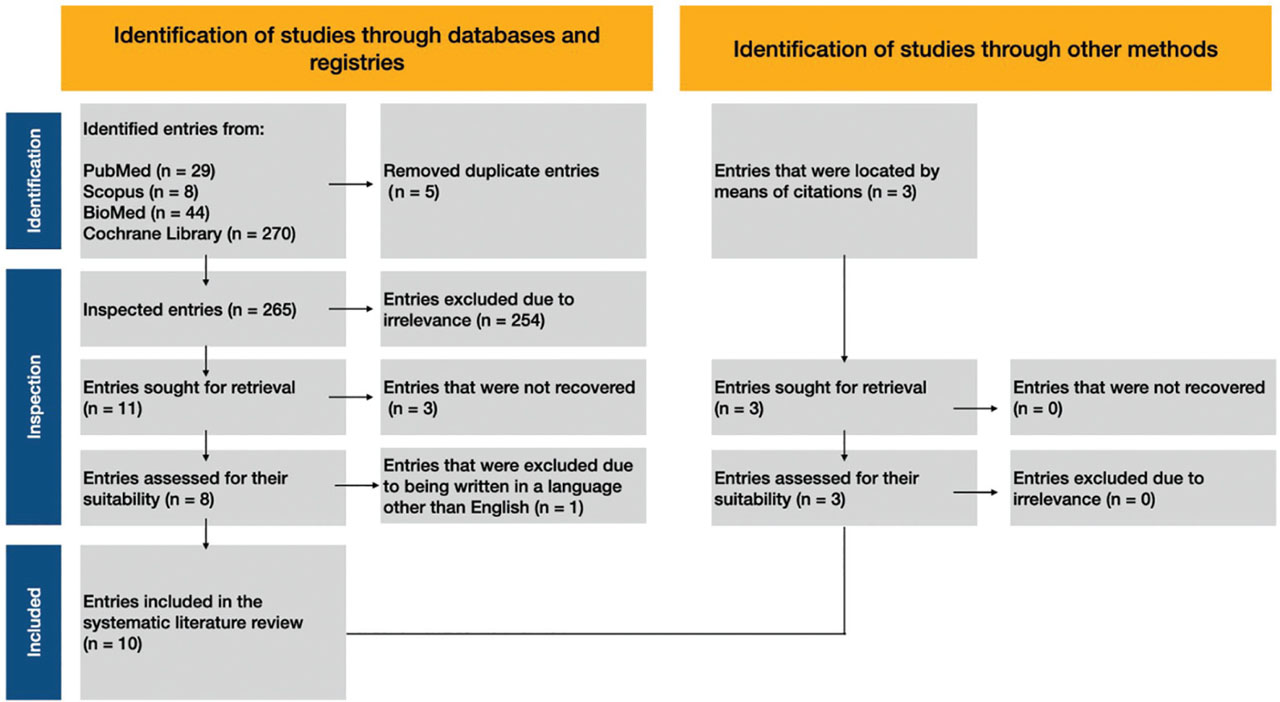
Figure 1.
Study selection process.
Table 2.
Summary of key points from the reviewed studies.
| No. | First Author | Title | Year of publication | Country | Type of Research | Sample Size | Targeted Sample Size | Measurement | Control Group | Measured Outcome | Key Findings | Specific Percentages for Labor (Natural or C-Section) | Follow up | Limitation of the Study |
|---|---|---|---|---|---|---|---|---|---|---|---|---|---|---|
| 1. | Redshaw Maggie | Women with disability: the experience of maternity care during pregnancy, labour and birth and the postnatal period (10) | 2013 | United Kingdom | Secondary quantitative analysis. | A total of 24,155 women participated to the study. | Women with disabilities constituted 6.14% of the sample. Among them, 197 had sensory disabilities. | A questionnaire was distributed, covering various sections related to prenatal care, childbirth, postpartum care, accessibility, information, communication, and birth choices. | The control group consisted of 22,313 women without any disabilities. | The study assessed knowledge, beliefs, and medical outcomes among mothers with and without disabilities, focusing on the availability of services, communication, participation in decision-making, satisfaction, and breastfeeding rates. | In general, women with disabilities had similar access to healthcare during the early stages of their pregnancy compared to those without disabilities. However, they experienced more prenatal check-ups, ultrasounds, cesarean sections, and longer hospital stays, while being less likely to breastfeed. Despite these minor disparities, women with disabilities were often more dissatisfied with the communication and support they received. | Regarding the type of delivery, 24.4% of deaf women underwent a cesarean section. It is noteworthy that women with sensory impairments were equally likely to have a spontaneous vaginal delivery (54.3%) compared to women without disabilities. | Follow-up with the sample 3 months postpartum. | The study’s limitations include its reliance on self-reported data and the fact that no data was collected on socioeconomic status. |
| 2. | Werner Heron | Maternal-fetal attachment in blind women using physical model from three-dimensional ultrasound and magnetic resonance scan data: six serious cases (11) | 2015 | Brazil | Qualitative study. | A total of 6 blind women participated to the study. | A total of 6 blind women participated to the study. | A 3-question questionnaire was distributed to assess the mother-fetus relationship. | No control group. | The connection between the mother and fetus (MFA) was investigated in six blind pregnant women using physical models derived from three-dimensional (3D) ultrasound and magnetic resonance imaging (MRI) data. | The study’s conclusions suggest that cesarean deliveries are predominant, likely due to the structure of private maternity clinics. This implies that the choice of cesarean section is not always driven by medical necessity. | All six women in the sample delivered via cesarean section. | There was no follow-up with the sample. | The limitations of the study include the small sample size and the lack of ability to compare the experiences of the sample. |
| 3. | Darney G Blair | Primary cesarean delivery patterns among women with physical, sensory, or intellectual disabilities (5) | 2017 | United States of America | Quantitative retrospective cohort study of all births in California from 2000 to 2010 using linked birth certificates and hospital discharge data. | The sample included 4,610,955 births. According to the study’s definitions and criteria for the International Classification of Diseases, 9th Revision (ICD-9) codes, 20,894 births (0.45% of the total) were associated with women having a diagnosis code related to potential disability. | The specific sample size included 1,772 deaf women and 1,128 blind women. | Diagnostic codes from the International Classification of Diseases, 9th Revision (ICD-9) were used to identify women with physical, sensory, and intellectual/developmental issues at the time of birth. The diagnoses were derived from hospital discharge data and linked with birth certificate data. | The comparison sample consisted of 4,590,061 births from women without any disabilities.- | The aim of the study was to examine how disabilities affect pregnancy outcomes and to provide information for improving healthcare for women with disabilities during pregnancy and childbirth. | In general, women with disabilities had a primary cesarean section rate of 32.7%, nearly double that of women without disabilities, who had a rate of 16.3%. | Specifically, approximately 22% of the deaf women in the sample of 1,772 underwent cesarean sections. On the other hand, about 43% of the sample of 1,128 women with sensory disabilities had cesarean sections. | The study did not include any follow-up component with the sample. | The limitations of the study include the use of administrative data and, more specifically, the possibility of errors or omissions in the coding of women’s disabilities, as well as the lack of follow-up or re-contact with the sample. |
| 4. | Malouf Reem | Access and quality of maternity care for disabled women during pregnancy, birth and the postnatal period in England: data from a national surveυ. (12) | 2017 | England | This is a secondary analysis and constitutes quantitative research | The sample consisted of 20,094 women who participated in the study. Of these, 1,958 women self-identified as individuals with disabilities, which is approximately 9.5% of the total sample. The remaining 18,136 women did not report having a disability | From the total sample, 174 women had a sensory disability. | The research tool consisted of a structured questionnaire designed to collect national data on postpartum care experiences in England | The control group concerned 18,136 women without disabilities. | The study assessed the childbirth and caregiving experiences of women with disabilities compared to those of women without disabilities in England. | Women with physical disabilities had a lower rate of vaginal deliveries (47.7%) compared to women without disabilities (59.6%). Women with physical disabilities were more likely to undergo a planned cesarean section (18.4%) compared to women without disabilities (11.0%). Women with physical disabilities also had a higher rate of emergency cesarean sections (18.6%) compared to women without disabilities (14.4%). | In general, women with disabilities had a primary cesarean section rate of 32.7%, nearly twice that of women without disabilities, who had a rate of 16.3%. | The study did not include any component of recontacting the sample. | The limitations of the study include reliance on self-reported data, which may affect accuracy due to recall bias. |
| 5. | Schiff A. Mellisa | Pregnancy Outcomes Among Deaf Women in Washington State, 1987–2012 (13) | 2017 | United States of America | It is a retrospective cohort study. It is quantitative research, although it includes qualitative aspects such as comments and analyses. | The study focused on 645 deaf women. | The total sample consisted of 645 deaf women | The data for the study originated from the examination and analysis of official birth and fetal death records in the state of Washington and their subsequent linkage with hospital discharge records. Further analysis was conducted using Poisson regression. | The control group of the study consisted of 6,453 women with no hearing problems. This group was randomly selected to provide a comparison with the 645 deaf women included in the study. | The aim of the study was to evaluate births and overall outcomes for deaf women in the state of Washington. | Deaf women had a slightly increased risk of cesarean section compared to non-deaf women. The relative risk (RR) for cesarean section among deaf women was 1.15. The majority of deaf women (70.1%) had vaginal deliveries, as did non-deaf women (74.4%), but deaf women had longer hospital stays. | Specifically, 29.9% of deaf women delivered via cesarean section, compared to 25.6% of non-deaf women. | The study did not include any component of recontacting the sample | The study’s limitations included potential underestimation and inaccuracies in the diagnosis of deafness, a small sample size, lack of information regarding the severity of hearing loss, unmeasured factors affecting the risk of cesarean section, potential impact of communication difficulties, and the effect of changes over a long data collection period. |
| 6. | Mitra Monika | Pregnancy, Birth, and Infant Outcomes Among Women Who Are Deaf or Hard of Hearing (14) | 2020 | United States of America | It is a retrospective cohort study. It is quantitative research, | The total sample size of the study is 1,188,676 deliveries. | The sample size of deaf or hard-of-hearing women in the study was 1,385. | The data were obtained from the Massachusetts PELL (Pregnancy to Early Life Longitudinal) system. The data were subjected to quantitative analysis. The authors specifically used Chi-square tests and t-tests to compare categorical and continuous variables, respectively, and Poisson and multinomial logistic regressions to compare the risk of adverse pregnancy and birth outcomes between deliveries in deaf and non-deaf women. | The control group consisted of 1,187,291 deliveries from women without any disabilities. | The study compared the outcomes of chronic health conditions, pregnancy-related complications, labor complications, and birth outcomes for deaf or hard-of-hearing women with those of hearing women, while taking into account various demographic and socioeconomic factors. | In general, it was found that deaf or hard-of-hearing women are at increased risk for chronic conditions, pregnancy-related complications, and adverse birth outcomes. | Regarding deliveries, the study found that 32.1% of deaf or hard-of-hearing women had cesarean sections, compared to 28.7% of women without disabilities, while 67.9% of deaf women had vaginal deliveries, compared to 71.3% of women without disabilities. However, the higher likelihood of cesarean section among deaf women was not statistically significant after adjusting for the model. | The study did not include any component of recontacting the sample | The study’s limitations include the lack of clinical and audiometric confirmation of the deaf women’s condition and the absence of data on the communication methods between healthcare providers and deaf women. |
| 7. | Mitra Monika | Pregnancy and Neonatal Outcomes Among Deaf and Hard of Hearing Women (15) | 2021 | United States of America | It is a retrospective cohort study. It is quantitative research, | The total sample size regarded 8,027,938 deliveries | The sample of deaf women consisted of 5,258 individuals. | The study used data from the National Inpatient Sample (NIS) of the Healthcare Cost and Utilization Project (HCUP). It employed weighted Poisson regression models and multivariable regression models within the STATA computing environment. | The control group consisted of 8,022,680 women without disabilities. | The aim of the study was to compare pregnancy complications and neonatal outcomes between deliveries in women with and without deafness based on national hospital discharge data. | Deaf women had a higher likelihood of delivering via cesarean section compared to non-deaf women. Additionally, deaf women exhibited an increased risk of adverse pregnancy outcomes and chronic medical conditions. | It was found that 35.4% of deliveries among deaf or hard-of-hearing women involved cesarean sections, compared to 32.7% of women in the control sample. The proportion of vaginal deliveries for deaf women was 64.6%, while for women without disabilities it was 67.3%. | The study did not include any component of recontacting the sample | The study’s limitations include potential conservative bias due to incomplete identification of deaf and hard-of-hearing women in hospital records, limited accuracy of coded diagnoses and procedures, lack of detailed reproductive health characteristics in the HCUP-NIS data, inability to establish causation due to its cross-sectional nature, and inability to link maternal and infant hospital records. |
| 8. | Wudneh Aregahegn | Obstetric violence and disability overlaps: obstetric violence during child birth among womens with disabilities: a qualitative study (16) | 2022 | Ethiopia | This is a qualitative descriptive phenomenological study. | The total sample size of this study was 22 women with disabilities. | The study included 2 women with disabilities related to deafness. Additionally, it comprised 8 women with sensory disabilities, specifically blindness or partial vision. | The study used in-depth, semi-structured interviews. The interviews were recorded, transcribed verbatim, and analyzed using NVivo software. | The study did not include a control group. | The aim of the study was to document and analyze experiences of obstetric violence among women with disabilities during childbirth. These experiences were categorized into five main themes: physical abuse, verbal abuse, stigma and discrimination, neglect and abandonment, and violations of privacy. | Almost all participants experienced physical abuse, such as slaps and pinches, while a significant number reported verbal abuse, including yelling and insults. Neglect and abandonment were common, with many being left alone during labor. Stigma and discrimination were also widespread, including instances of isolation. Reports also noted extensive breaches of privacy, exposing many participants to onlookers during delivery. Lastly, one woman was forced to undergo sterilization during a cesarean section. | Out of the 22 women in the sample, 16 delivered via cesarean section, which corresponds to 72.72%. | The study did not include any component of recontacting the sample | The study’s limitations include the small sample size and the limited geographic area, as well as the qualitative nature of the data, which restricts the generalizability of the findings. |
| 9. | McKee S. Kimberly | Postpartum Hospital Readmissions Among Massachusetts Women Who are Deaf or Hard of Hearing (17) | 2023 | United States of America | This is a retrospective cohort study. It involves quantitative research | The total sample of the study was 1,385,003 women. | The study included 3,564 deaf women. | The authors analyzed data from the Massachusetts Pregnancy to Early Life Longitudinal Data System from 1998–2017 using Cox proportional hazards models. | The study used a comparison sample of 1,381,439 women without disabilities. | The aim of the study was to compare the risk of postpartum hospitalization and the main indications for postpartum admissions between deaf or hard-of-hearing women and women without disabilities. | Deaf women had a significantly higher risk of hospital admission during all postpartum periods compared to women without disabilities. They also had nearly seven times the risk of repeated hospital admissions within 43–90 days postpartum and nearly four times the risk within 91–365 days postpartum. The most frequent causes of readmission among deaf women were complications of the puerperium/hemorrhage and soft tissue disorders. | Specifically, about 70% of deaf women had a vaginal delivery. This rate is comparable to that of women without disabilities, which is approximately 71%. This means that 30% of women with hearing impairments underwent a cesarean section, a rate that is roughly the same as the 29% of women without disabilities. | There was follow-up with the sample within a year to determine if the women in the sample were admitted to the hospital during the postpartum period. | The study’s limitations related to sample selection. Specifically, these included the focus on broad postpartum care rather than specific visits, the limited inclusion of participants with various disabilities, the under-representation of those requiring extensive accommodations, and a sample that was biased towards white, educated, urban residents. |
| 10. | Tarasoff A. Lesley | Unmet needs, limited access: A qualitative study of postpartum health care experiences of people with disabilities (2) | 2023 | Canada | This is an empirical research study that uses qualitative methods (semi-structured interviews) | The general sample of the study consisted of 31 individuals with disabilities who had recently given birth. | From the sample size, 2 women were blind and 5 were deaf. | The study used semi-structured interviews for data collection. These interviews were guided by a specific set of questions but allowed participants to discuss their experiences in depth. The interviews covered the chronological sequence of the participants’ most recent experiences with perinatal care, from pregnancy to the postpartum period, focusing on the types of services they accessed, whether the services met their needs, and recommendations for improving care. The data were analyzed using thematic analysis. | The study did not include a control group. | The study focused on the experiences and perceptions of women with disabilities regarding the care they received postpartum. The components of the study included (i) the adequacy of postpartum care, (ii) the accommodations provided for the women’s disabilities, (iii) whether they experienced fear of being judged and discrimination, and (iv) the accessibility and overall quality of formal services. | The key findings of the study are that the majority of participants reported inadequate physical recovery care postpartum and encountered significant gaps in postpartum care, accommodations for people with disabilities, and mental health support. | 48.38% of the participants had delivered by cesarean section. | The study did not include any component of recontacting the sample | The study’s limitations include the absence of a control group, reliance on self-reported data, limited diversity within the sample, underrepresentation of certain disabilities, focus solely on formal services, lack of long-term follow-up, broad focus of the interview guide, and limited ability to generalize regarding intersections with other forms of discrimination and the impact of poverty. |