
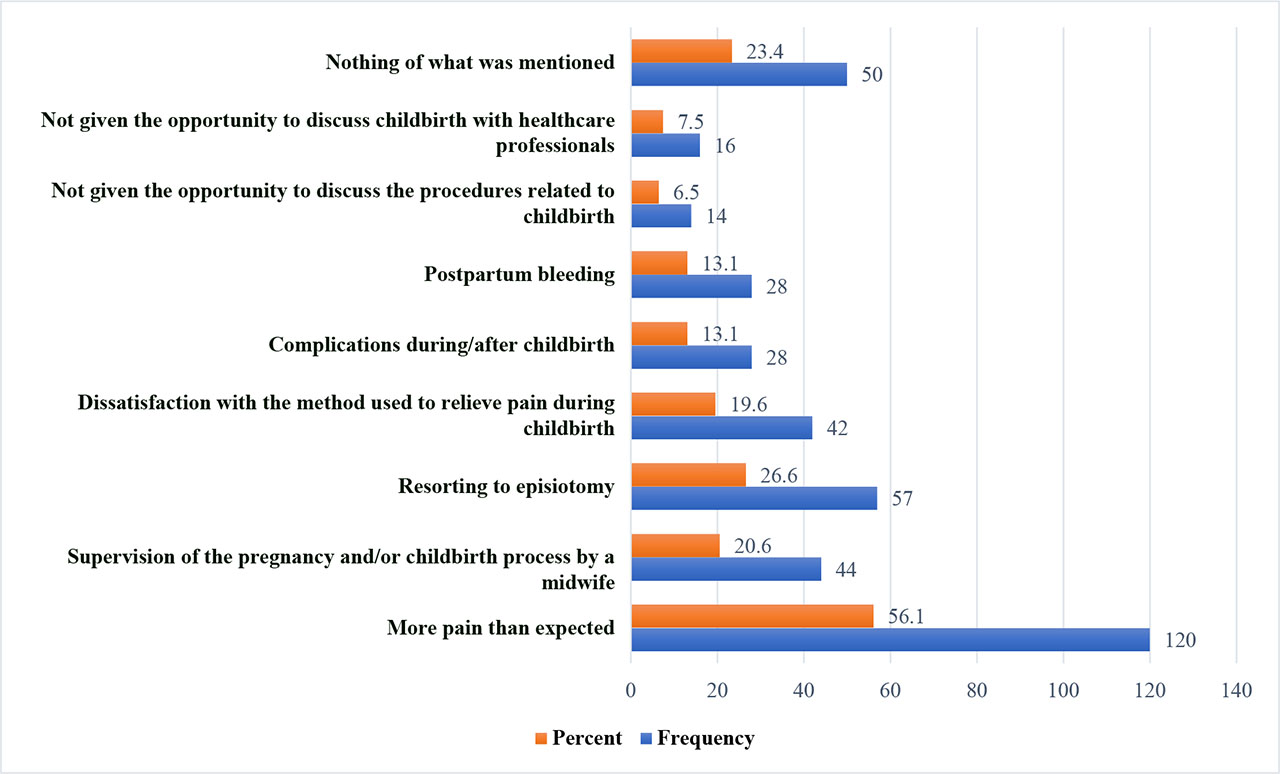
Figure 1.
The experience of pregnancy and childbirth.
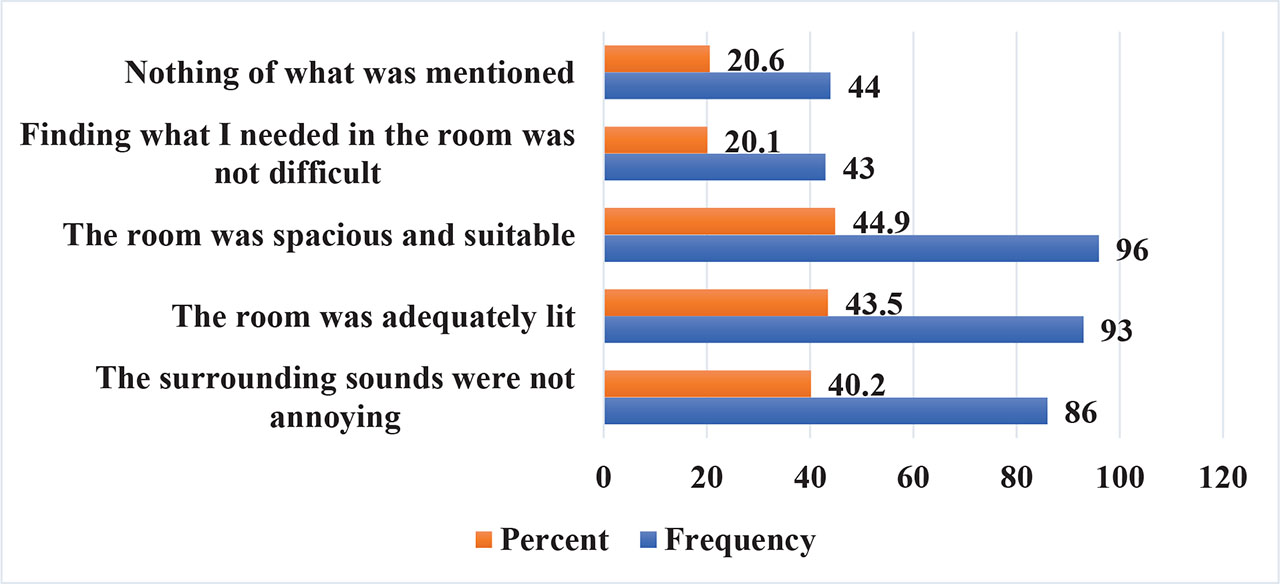
Figure 2.
Room experience and comfort assessment.
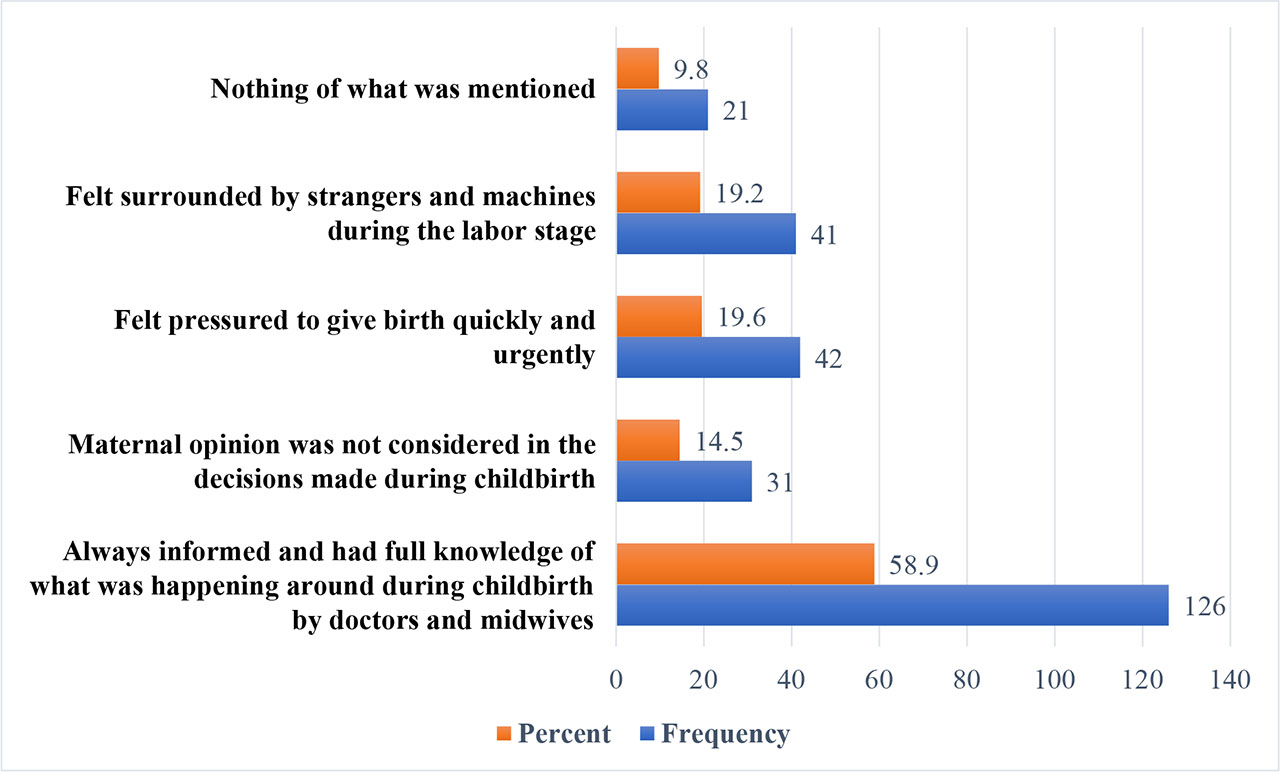
Figure 3.
Decision making and pressures in the delivery room.
Table 1.
Demographic and maternal pregnancy experience. (n = 214)
| Item | Frequency (%) |
|---|---|
| Maternal age | |
| Less than 18 years | 4 (1.9) |
| 18–25 years | 62 (29.0) |
| 25–35 years | 111 (51.9) |
| More than 35 years | 37 (17.2) |
| Education level | |
| Primary | 13 (6.1) |
| High school | 57 (26.6) |
| Diploma | 28 (13.1) |
| Bachelor | 99 (46.3) |
| Higher grades | 17 (7.9) |
| Family monthly income | |
| Less than 400 JDs | 58 (27.1) |
| 400 – 1000 JDs | 120 (56.1) |
| More than 1000 JDs | 36 (16.8) |
| Job status | |
| Employed | 79 (36.9) |
| Not employed | 135 (63.1) |
| Current pregnancy status | |
| First pregnancy | 89 (41.6) |
| Second or more | 125 (58.4) |
| Place of birth | |
| Jordan University Hospital (JUH) | 167 (78.0) |
| Other hospitals | 47 (22.0) |
| Type of current pregnancy | |
| Vaginal delivery | 111 (51.9) |
| Caesarean section | 103 (48.1) |
| There was a need for an episiotomy during childbirth for those who done vaginal delivery | |
| Yes | 71 (64.0) |
| No | 40 (36.0) |
| Bringing a companion into the delivery room was allowed | |
| Yes | 34 (15.9) |
| No | 176 (82.2) |
| Did not ask | 4 (1.9) |
| Encouragement and support were received from the supervising doctor, midwives, and medical staff | |
| Yes | 162 (75.7) |
| No | 52 (24.3) |
| Satisfaction was felt with the care provided during the childbirth process | |
| Yes | 152 (71.0) |
| No | 62 (29.0) |
| The financial crisis had been experienced recently | |
| Yes | 79 (36.9) |
| No | 135 (63.1) |
| The pregnancy was planned | |
| Yes | 121 (56.5) |
| No | 93 (43.5) |
| The pregnancy was desired | |
| Yes | 172 (80.4) |
| No | 42 (19.6) |
| Health complications were experienced during pregnancy | |
| Yes | 71 (33.2) |
| No | 143 (66.8) |
| Among individuals who disclosed experiencing health complications during pregnancy, there is a consideration of the potential impact of these health issues on the infant’s well-being | |
| Yes | 25 (35.2) |
| No | 46 (64.8) |
| The child suffers from health problems (such as congenital deformities or genetic diseases) | |
| Yes | 39 (18.2) |
| No | 175 (81.8) |
| Problems related to body image during pregnancy were experienced | |
| Yes | 78 (36.4) |
| No | 136 (63.6) |
| Currently experiencing problems related to body image after childbirth | |
| Yes | 81 (37.9) |
| No | 133 (62.1) |
| Thinking about the motherhood stage caused feelings of anxiety or doubt | |
| Yes | 127 (59.3) |
| No | 87 (40.7) |
| The use of any type of addictive substances (drugs, alcohol, or others) was acknowledged | |
| Yes | 6 (2.8) |
| No | 208 (97.2) |
Table 2.
Current mental health status and background. (n = 214)
| Item | Frequency (%) |
|---|---|
| Diagnosis of depression by a specialist doctor has been experienced | |
| Yes | 19 (8.9) |
| No | 195 (91.1) |
| Consultation with a specialist in the field of mental health has taken place | |
| Yes | 23 (10.7) |
| No | 191 (89.3) |
| The reason for the consultation is explored among those who consulted specialist before | |
| Depression | 15 (65.2) |
| Anxiety | 3 (13.0) |
| Seeking help | 2 (8.7) |
| No specific reasons | 3 (13.0) |
| There is someone in the family suffering from mental illnesses | |
| Yes | 12 (5.6) |
| No | 202 (94.4) |
| The specific illness is identified in the family among those who had positive family history | |
| OCD | 4 (33.3) |
| Bipolar | 3 (25.0) |
| PTSD | 1 (8.3) |
| Depression | 2 (16.7) |
| Can not recall | 2 (16.7) |
| Recent situations have been experienced that increased stress | |
| Yes | 108 (50.5) |
| No | 106 (49.5) |
| Recent problems have been faced in the relationship with a spouse or family members | |
| Yes | 74 (34.6) |
| No | 140 (65.4) |
| Lack of emotional support from family and friends during pregnancy was felt | |
| Yes | 49 (22.9) |
| No | 165 (77.1) |
| There is a sense of insufficient psychological support from family and friends after childbirth | |
| Yes | 57 (26.6) |
| No | 157 (73.4) |
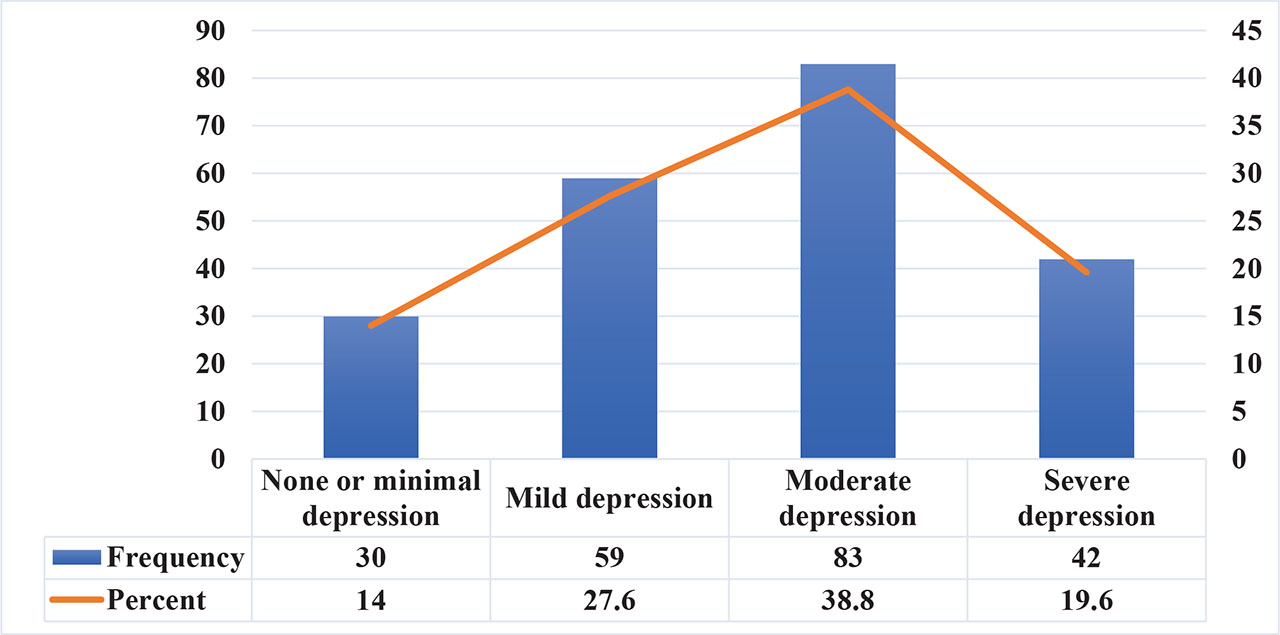
Figure 4.
The frequency of EPDS severity.
Table 3.
Association between the EPDS score and maternal demographics, pregnancy experiences, and mental health status
| Item | Mean ± SD | P – value |
|---|---|---|
| Maternal ageA | 0.028 | |
| Less than 18 years | 18.75 ± 2.22 | |
| 18–25 years | 15.23 ± 6.05 | |
| 25–35 years | 14.09 ± 6.28 | |
| More than 35 years | 12.05 ± 6.91 | |
| Education levelA | 0.463 | |
| Primary | 15.85 ± 5.60 | |
| High school | 13.68 ± 6.33 | |
| Diploma | 15.64 ± 6.73 | |
| Bachelor | 13.91 ± 6.41 | |
| Higher grades | 13.41 ± 6.25 | |
| Family monthly incomeA | 0.538 | |
| Less than 400 JDs | 14.29 ± 7.07 | |
| 400 – 1000 JDs | 14.36 ± 5.91 | |
| More than 1000 JDs | 13.25 ± 6.69 | |
| Job statusB | 0.372 | |
| Employed | 14.61 ± 6.42 | |
| Not employed | 13.89 ± 6.34 | |
| Current pregnancy statusB | 0.132 | |
| First pregnancy | 14.78 ± 6.22 | |
| Second or more | 13.71 ± 6.45 | |
| Place of birthB | 0.435 | |
| Jordan University Hospital | 14.01 ± 6.49 | |
| Other hospitals | 14.66 ± 5.92 | |
| Type of current pregnancyB | 0.008 | |
| Vaginal delivery | 15.12 ± 6.20 | |
| Caesarean section | 13.12 ± 6.40 | |
| There was a need for an episiotomy during childbirth for those who did vaginal deliveryB | 0.023 | |
| Yes | 15.92 ± 6.67 | |
| No | 13.70 ± 5.04 | |
| Bringing a companion into the delivery room was allowedB | 0.352 | |
| Yes | 14.85 ± 6.07 | |
| No | 13.90 ± 6.42 | |
| Encouragement and support were received from the supervising doctor, midwives, and medical staffB | <0.001 | |
| Yes | 13.21 ± 6.30 | |
| No | 17.10 ± 5.67 | |
| Satisfaction was felt with the care provided during the childbirth processB | < 0.001 | |
| Yes | 12.98 ± 6.29 | |
| No | 17.03 ± 5.61 | |
| The financial crisis was experienced recentlyB | < 0.001 | |
| Yes | 16.08 ± 5.84 | |
| No | 13.03 ± 6.41 | |
| The pregnancy was plannedB | 0.140 | |
| Yes | 13.55 ±6.53 | |
| No | 14.94 ± 6.08 | |
| The pregnancy was desiredB | 0.101 | |
| Yes | 13.83 ± 6.47 | |
| No | 15.48 ± 5.79 | |
| Health complications were experienced during pregnancyB | 0.054 | |
| Yes | 15.38 ± 5.79 | |
| No | 13.55 ± 6.56 | |
| Among individuals who disclosed experiencing health complications during pregnancy, there is a consideration of the potential impact of these health issues on the infant’s well-beingB | 0.382 | |
| Yes | 16.32 ± 4.77 | |
| No | 14.87 ± 6.27 | |
| The child suffers from health problems (such as congenital deformities or genetic diseases)B | 0.134 | |
| Yes | 15.72 ± 5.34 | |
| No | 13.81 ± 6.53 | |
| Problems related to body image during pregnancy were experiencedB | 0.008 | |
| Yes | 15.74 ± 6.23 | |
| No | 13.24 ± 6.28 | |
| Currently experiencing problems related to body image after childbirthB | 0.001 | |
| Yes | 16.11 ± 6.30 | |
| No | 12.96 ± 6.12 | |
| Thinking about the motherhood stage causes feelings of anxiety or doubtB | < 0.001 | |
| Yes | 15.88 ± 6.04 | |
| No | 11.63 ± 5.99 | |
| The use of any type of addictive substances (drugs, alcohol, or others) is acknowledgedB | 0.053 | |
| Yes | 18.67 ± 3.88 | |
| No | 14.02 ± 6.38 | |
| Diagnosis of depression by a specialist doctor has been experiencedB | 0.163 | |
| Yes | 15.89 ± 7.02 | |
| No | 13.98 ± 6.29 | |
| Consultation with a specialist in the field of mental health has taken placeB | 0.037 | |
| Yes | 16.61 ± 6.30 | |
| No | 13.86 ± 6.32 | |
| The reason for the consultation is explored among those who consulted specialist beforeA | 0.973 | |
| Depression | 16.53 ± 7.29 | |
| Anxiety | 15.67 ± 6.43 | |
| Seeking help | 17.50 ± 4.95 | |
| No specific reasons | 17.33 ± 2.89 | |
| There is someone in the family suffering from mental illnessesB | 0.327 | |
| Yes | 15.83 ± 5.56 | |
| No | 14.05 ± 6.41 | |
| The specific illness is identified in the family among those who had positive family historyA | 0.760 | |
| OCD | 15.00 ± 5.42 | |
| Bipolar | 16.33 ± 5.69 | |
| PTSD | 18.00 ± 0.00 | |
| Depression | 19.50 ± 4.95 | |
| Recent situations have been experienced that increased stressB | < 0.001 | |
| Yes | 16.19 ± 5.29 | |
| No | 12.08 ± 6.71 | |
| Recent problems have been faced in the relationship with a spouse or family membersB | < 0.001 | |
| Yes | 16.85 ± 5.22 | |
| No | 12.73 ± 6.47 | |
| Lack of emotional support from family and friends during pregnancy was feltB | < 0.001 | |
| Yes | 17.49 ± 5.97 | |
| No | 13.16 ± 6.15 | |
| There is a sense of insufficient psychological support from family and friends after childbirthB | < 0.001 | |
| Yes | 17.00 ± 6.53 | |
| No | 13.12 ± 6.00 |