
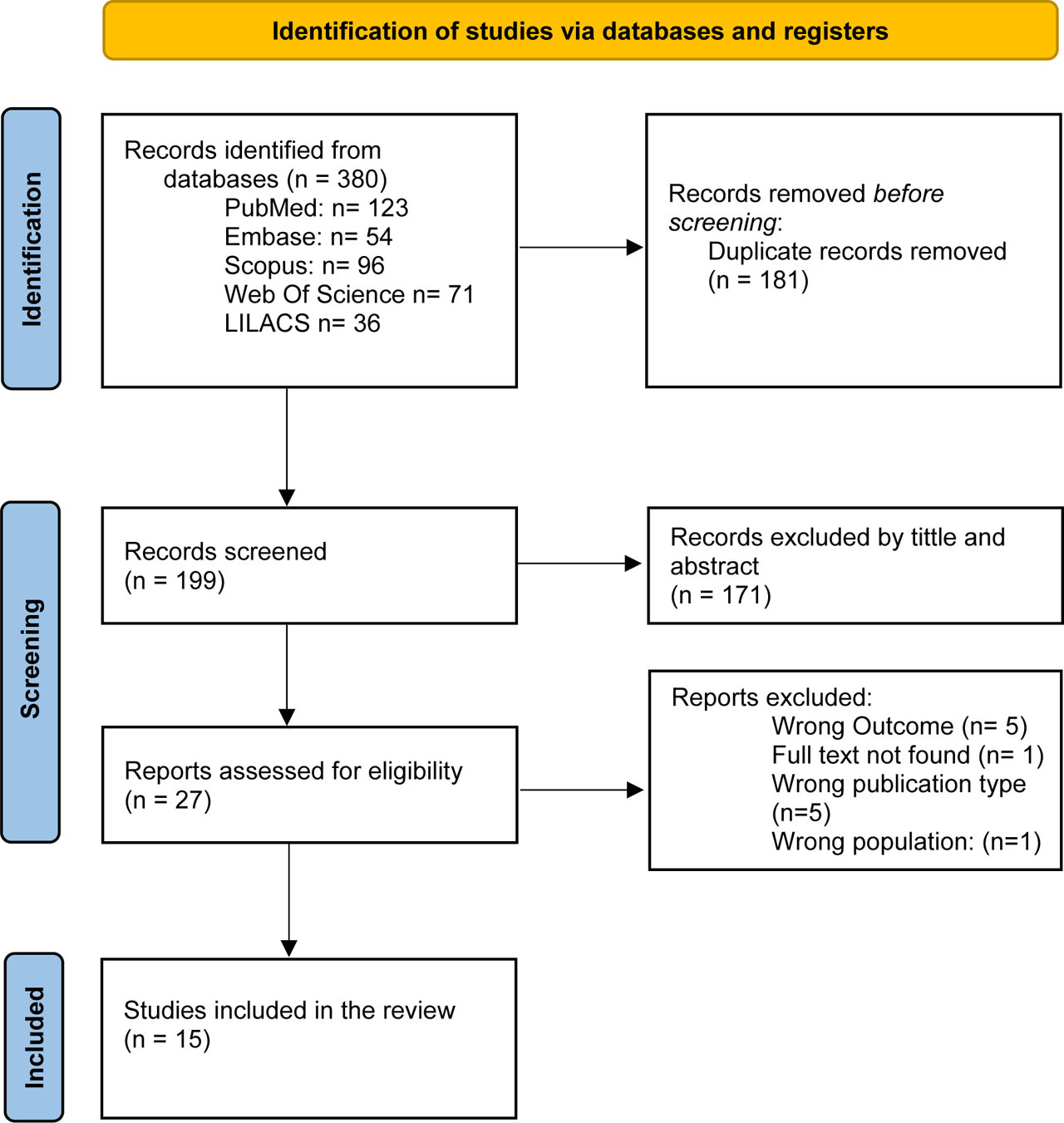
Figure 1.
Flowchart of the study.
Table 1.
Characteristics of included studies.
| BIBLIOGRAPHIC DATA | Population | Type of study | Neurological outcome | NIRS measurement | Cut-off value | Outcome |
|---|---|---|---|---|---|---|
| Niezen, C et al. 2018 | Term and near-term newborns n = 39 | Retrospective cohort |
| Left or right frontoparietal | rScO2 >90% at 48 and 72 hrs and in rewarming | rScO2 has no predictive value in the initial phase of HT treatment. After 48 hours its predictive value increases. After rewarming, rScO2 is an even better predictor of outcome than aEEG. |
| Oliveira Pereira C et al. 2021 | Term newborns n=28 | Retrospective cohort |
| Left or right Frontal | rScO2 >82% at 48 hrs and in rewarming | Comparison of rScO2 between the different neurodevelopmental groups revealed statistically significant differences at 48 hours of life between the moderately impaired and severely impaired groups (p = 0.019), and the severely disabled and normal neurodevelopmental groups (p = 0.013). |
| Szakmar E et al. 2021 | Term and near-term newborns n = 49 | Retrospective cohort |
| frontoparietal | rScO2>84% in rewarming | The rScO2 value during hypothermia was not statistically significant. The rScO2 during rewarming was higher in infants with brain damage. |
| Ancora G et al. 2013 | Term newborns n=16 | Retrospective cohort |
| Bifrontal TOI at 6,12, 24 hrs | - | TOI (Tissue Oxygenation Index) values at 12 hours were significantly higher in infants with adverse events (n-4) vs. those without adverse outcomes (n-8) (79.7 +/− 9.4% vs. 67.1+/− 7.9 p=0.034). |
| Goeral K et al. 2017 | Term and near-term newborns n = 32 | Retrospective cohort |
| frontoparietal | - | Values of rScO2 and cFTOE were not significantly different between the two groups (normal and abnormal MRI). A trend of decreased rScO2 and increased cFTOE was observed in patients with normal MRI. |
| Arriaga-Redondo M et al. 2019 | Term and near-term newborns n = 23 | Retrospective cohort |
| left Frontal | rScO2 >90% | rScO2 values >90% and lack of variability in infants with IHD during cooling provide useful information on the severity of neurological status. |
| Toet M et al. 2006 | Term newborns n=18 | Retrospective cohort |
| Left Parietal FTOE 24 hrs | rScO2 >70% at 24 hrs | rScO2 values increased to supranormal values after 24 h in infants with an adverse outcome. At 24 hr, FTOE values of infants with an adverse outcome were significantly lower compared to those with a favorable outcome. |
| Wintermark P et al. 2014 | Term newborns n=7 | Retrospective cohort |
| Bifrontal | - | In the group with adverse outcomes, rScO2 values were significantly higher at 24 hr of life. |
| Lemmers P et al. 2013 | Term and near-term newborns n = 39 | Retrospective cohort |
| Bilateral frontoparietal FTOEI | - | The mean cFTOE value reflected the rScO2 patterns of both groups and became very low after 24 h of age in the adverse outcome group. |
| Shellhaas R et al. 2013 | Term and near-term newborns n = 21 | Retrospective cohort |
| Biparietal Thigh (systemic) | - | Absolute values and variability of rScO2 was independent of short-term outcome. Systemic rSO2 variability was the best single predictor of short-term outcome scores. |
| Peng S et al. 2015 | Term and near-term newborns n = 18 | Retrospective cohort |
| Bifrontal | rScO2 >75.5% in first 10 hours of hypothermia | The rScO2 was higher in asphyxiated neonates who developed subsequent brain injury. This difference was especially prominent during the first 10 hours of hypothermia treatment. |
| Jain S et al. 2017 | Term and near-term newborns n = 21 | Retrospective cohort |
| Medial frontal | rScO2>80% at 30 hours of life | The rScO2 increased more rapidly in infants with greater lesion seen on MRI. On average, rScO2increased by 0.20 % per hour when MRI scores 0 or 1, by 0.48 % per hour scores of 2, and by 0.68 % per hour scores of 3. Higher rScO2 beyond 24 h correlated with higher odds of worse BSID scores. |
| Mitra S et al. 2020 | Term newborns n=14 | Retrospective cohort |
| Medial frontal | - | The relationship between brain metabolism and oxygenation measured during rewarming after TH in a group of infants with HIE strengthened with increasing degree of brain injury. |
| Burton V et al. 2015 | Term and near-term newborns n = 19 | Retrospective cohort |
| Bifrontal | - | mean rScO2 in any period (hypothermia, rewarming or normothermia) was not associated with future impairment or Mullen score. |
| Shellhaas R et al. 2015 | Term newborns n=18 | Retrospective cohort |
| Biparietal | - | There was no relationship between rScO2 and outcome (p>0.05 at all-time points |
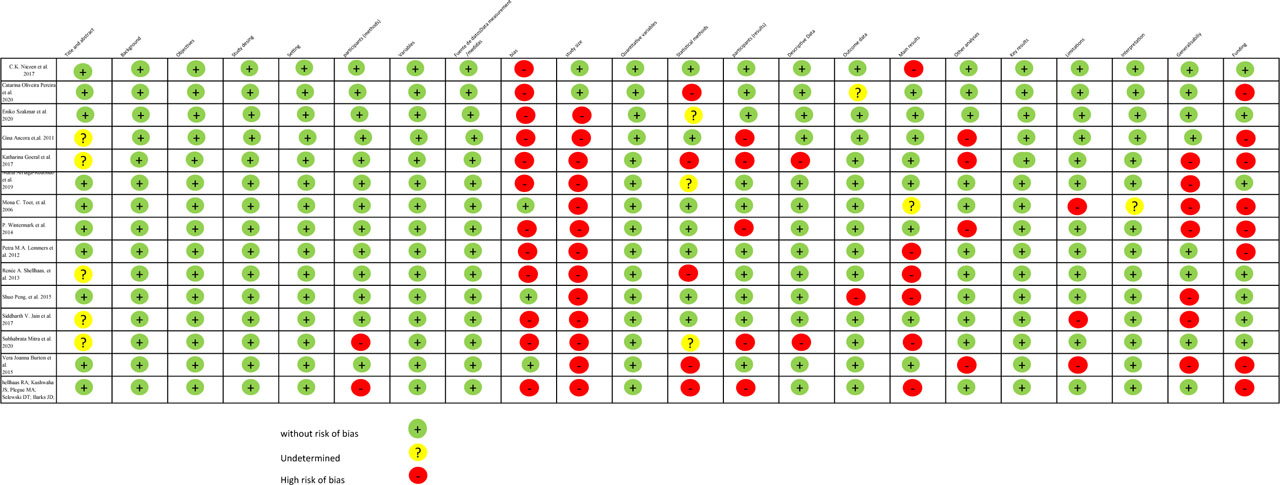
Figure 2.
Quality of the selected articles, using STROBE: cohort studies.