
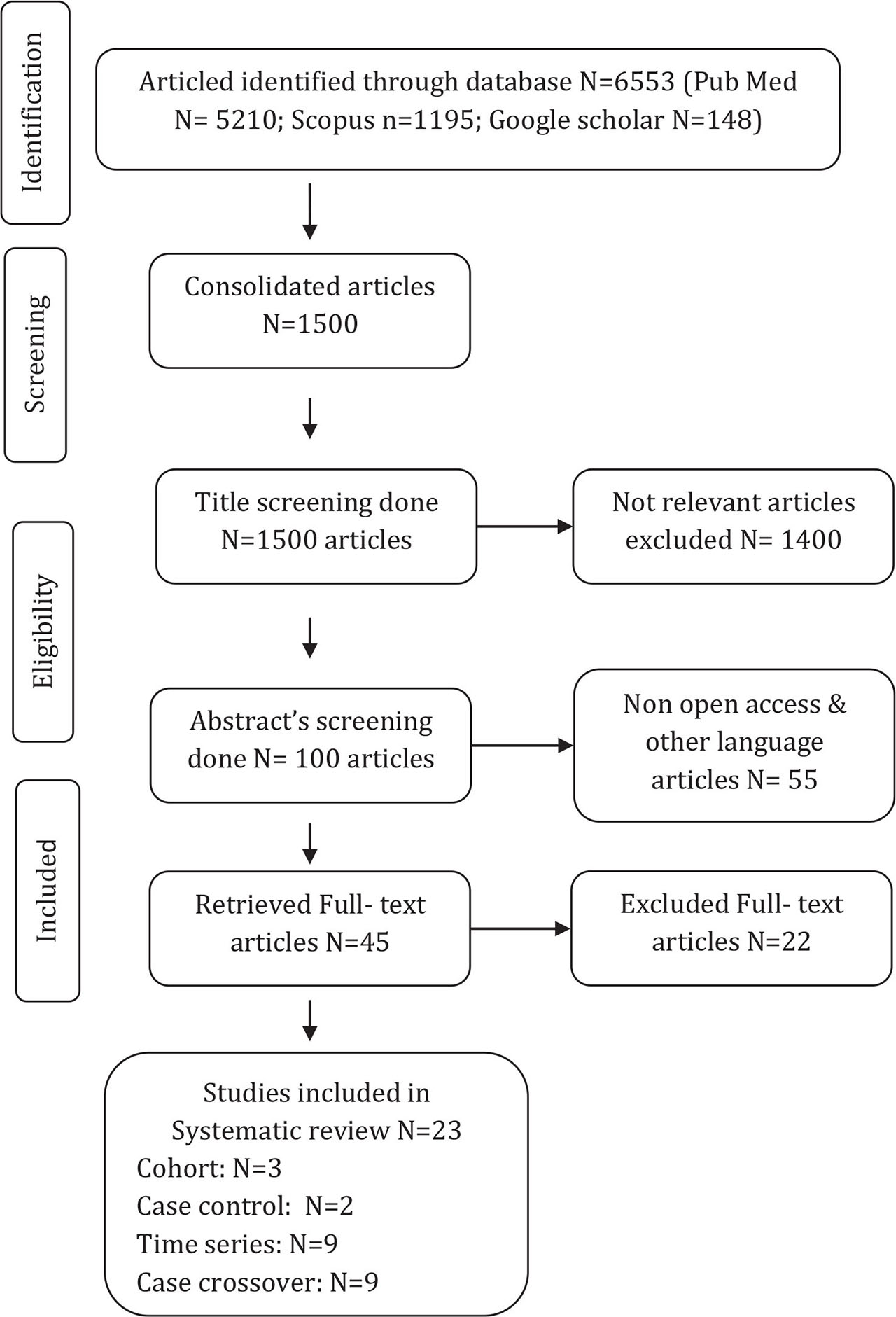
Figure 1.
PRISMA flow diagram of the study selection process.
Table 1:
Summary of study characteristics, significance within individual study findings
| S.No. | Author, Year | Location | Study Design | Causal factor | Maternal outcome | Fetal outcome | Exposure window | Concluding remarks |
|---|---|---|---|---|---|---|---|---|
| Studies conducted among non-working pregnant women | ||||||||
| 1. | Sun et al., 2019 [83] | United States (403 countries) | Retrospective cohort study | Extreme heat | - | PTB | 35 Weeks | Higher number of heat days associated with higher risk of PTB. |
| 2. | Shashar, et al., 2020 [48] | Unites States | Cohort study | Temperature | Preeclampsia | - | 1 or 3 rd trimester | Warm seasons are associated with an increased risk of preeclampsia. |
| 3. | Van Zutphen et al., 2012 [38] | United States | case–control study | Heat exposure | Multiple birth | LBW, PTB | Weeks 4–7 | Multiple ambient heat exposure indicates occurrence of LBW, PTB & congenital cataracts. |
| 4. | Zhang et al., 2019 [64] | United States | case–control study | Heat exposure | - | Fetal malformations, Congenital heart diseases | 3–8 weeks post conception | Summer may see an increase in the burden of Congenital Heart Disease (CHD). |
| 5. | Auger et al. 2014 [8] | Montreal, Canada | Retrospective cohort study | Hot ambient temperature | - | Early birth | 1 week prior to delivery | Exposure to very high ambient temperatures may decrease the gestational duration of warmer months pregnancies. |
| 6. | Basu et al. 2010 [84] | California, USA | Case crossover | Ambient temperature | Chronic infections and hypertension | PTB | 1 week prior to delivery | The apparent temperature and premature delivery rates are higher during the warm season. |
| 7. | Kent et al. 2014 [85] | Alabama, USA | Case crossover | Heat wave | - | PTB | 1 week prior to delivery | Heat wave days were associated with PTB. |
| 8. | Kloog et al. 2015 [86] | Massachusetts, USA | Time series | Air Temperature | - | PTB, LBW | Full gestation | Increases in ambient temperature were linked with a reduction in gestational age. |
| 9. | Kloog et al. 2018 [74] | Southern Israel | Time series | Temperature | - | PTB | Full gestation | Temperatures as predicted by predictive modelling and risk is high (PTB) |
| 10. | Basu et al., 2017 [87] | Northern California, USA | Case crossover | increased heat percent change per 10°F (5.6°C) increase in apparent temperature | - | PTB | Full gestation | Warm season has a higher risk than the cold season. |
| 11. | Basu et al., 2018 [88] | California, USA | Time series | Extreme temperature | - | LBW | First and third trimester | All results are shown as a percentage change in the OR of LBW with a temperature rise of 10°F. |
| 12. | He et al. 2016 [89] | Guangzhou, China | Time series | Ambient Temperature | - | PTB | Full gestation | Pregnancy-related exposure to both low and high temperatures was linked with an increased risk of PTB. |
| 13. | Dadvandet al. 2011 [90] | Barcelona, Spain | Time series | Extreme heat | - | Early birth | 1 week prior to delivery | Average gestational age of birth reduces after maternal exposure to severe HI episodes. |
| 14. | Dadvand et al. 2014 [75] | Barcelona, Spain | Time series | heat exposures | - | LBW | Full gestation | Increased risk of term LBW associated with heat exposure. |
| 15. | Vicedo-Cabrera et al. 2015 [91] | Stockholm, Sweden | Time series | Heat | - | PTB | 4 weeks prior to delivery | Exposure to moderate heat during the last month of pregnancy increases the chance of PTB. |
| 16. | Strand et al. 2012 [9] | Brisbane, Australia | Time series | High temperatures | Maternal hyperthermia | Early birth, PTB, still birth, abortion | 4 weeks prior to delivery | The risk of stillbirth was similarly increased when the past four weeks of temperature exposure were used instead of the most recent week. |
| 17. | Mathew et al. 2017 [92] | Alice Springs, Australia, Brandenburg and Saxony | Time series | Ambient Temperature | - | PTB | 3 weeks prior to delivery | Temperature values have an impact on the consequences and risks of preterm birth at both the lowest and maximum temperatures. |
| 18. | Asamoah et al., 2018 [30] | Multi-country representative survey | A cross-sectional study | High ambient temperature | Miscarriage | Still birth, Congenital abnormalities | Yearly average and monthly average for second month of pregnancy | Environmental heat exposures may be associated with APOs. |
| 19. | Lyndsay A. Avalos [93] | Northern California | case-crossover study | Warmer season | - | Pre-Term birth | Full gestation | Evidence for an increase in the odds of spontaneous PTD associated with increases in apparent temperature. |
| 20. | Jeroen de Bont et al., 2022 [94] | Sweden | Case-crossover, | Ambient temperature d | - | preterm birth | Full gestation | Higher ambient temperature demonstrated increased risk of extremely preterm birth |
| Studies conducted among working pregnant women | ||||||||
| 21. | Flocks et al., 2013 [95] | Hispanic and Haitian nursery | Cross sectional study | Heat | Dizziness, Pre-Existing high and low blood pressure, Nausea, Vomiting, sun stroke, Feverish, Dehydration | Fetus become agitated, increased fetal heart rates, Increased fetal movement | - | Heat exposure can adversely affect pregnancy and fetal health. |
| 22. | Rahman et al., 2016 [10] | Bangladesh | Cross sectional study | Heat stress | Increase body temperature | Fetal destruction or Anomaly | - | Outdoor work during pregnancy in hot, increasing body temperature up to levels that could induce fetal destruction or anomaly. |
| 23. | Banerjee, 2009 [37] | - | Continuing Medical education (CME) | Heat stress | Dehydration | - | - | Women in various occupations have been found to be at an increased risk of experiencing a fetal death. |