
Table 1
National guidance based on earlier research and recommendations by the AAP:
| Primary recommendations for immunization | Score | *Individual risk factors | Score |
|---|---|---|---|
| Preterm infants with a gestational age (GA) < 29 weeks in the RSV season | 4 | Neurological disorders | 1 |
| Infants with bronchopulmonary dysplasia (BPD) < 2 years of age if they were undergoing therapy for BPD in the RSV season | 4 | Birth weight less than 1500 g | 1 |
| Infants with a congenital heart defect (HS-CHD) < 2 years of age in the RSV season | 4 | Mechanical ventilation for a period of 48 hours prior to the commencement of the RSV season; | 1 |
| Preterm infants with a GA >29<32 weeks (< 6 months of the RSV season with *individual risk factors | 2 | Discharged in the period from November 1 to March 31 | 1 |
| Immunodeficiency | 4 | Low social status | 0.5 |
| Visits to kindergarten | 0.5 | ||
| Twins | 0.5 | ||
| Exposure to smoke | 0.5 |
Table 2
Demographic characteristics of children who received passive immunization during the study period 2008–2022 in Clinic of Child Disease UHC Mostar.
| Children with CHD n=69 | Preterm infants n=124 | Children with other diagnosis n=29 | Total n=222 | |||||
|---|---|---|---|---|---|---|---|---|
| Male | 39 | 56.5% | 69 | 55.6% | 20 | 69.0% | 128 | 57.7% |
| Female | 30 | 43.5% | 55 | 44.4% | 9 | 31.0% | 94 | 42.3% |
| Gestational age (weeks+days) | ||||||||
| < 29 +6d | 0 | 0.0% | 47 | 37.9% | 1 | 3.4% | 48 | 21.6% |
| 30-32 +6d | 2 | 2.9% | 64 | 51.6% | 2 | 6.9% | 68 | 30.6% |
| 33-37 +6d | 9 | 13.0% | 13 | 10.5% | 12 | 41.4% | 34 | 15.3% |
| 38-41 +6d | 58 | 84.1% | 0 | 0.0% | 14 | 48.3% | 72 | 32.4% |
| Birthweight (g) | ||||||||
| <1000 | 0 | 0.0% | 21 | 16.9% | 0 | 0.0% | 21 | 9.5% |
| 1001-1500 | 1 | 1.4% | 65 | 52.4% | 0 | 0.0% | 66 | 29.7% |
| 1501-2500 | 11 | 15.9% | 37 | 29.8% | 10 | 34.5% | 58 | 26.1% |
| >2500 | 57 | 82.6% | 1 | 0.8% | 19 | 65.5% | 77 | 34.7% |
| Mechanicalventilation | ||||||||
| Yes | 26 | 37.7% | 97 | 78.2% | 22 | 75.9% | 145 | 65.3% |
| No | 43 | 62.3% | 27 | 21.8% | 7 | 24.1% | 77 | 34.7% |
| Parityofmother | ||||||||
| Primiparous | 31 | 44.9% | 75 | 60.5% | 14 | 48.3% | 120 | 54.1% |
| Multiparous | 38 | 55.1% | 49 | 39.5% | 15 | 51.7% | 102 | 45.9% |
| Pregnancy | 0.0% | |||||||
| Singletones | 65 | 94.2% | 81 | 65.3% | 26 | 89.7% | 172 | 77.5% |
| Multiplepregnancy | 4 | 5.8% | 43 | 34.7% | 3 | 10.3% | 50 | 22.5% |
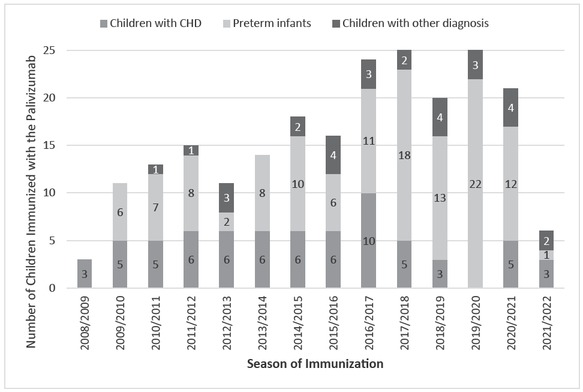
Figure 1
The distribution of the total number of immunized children during the period of study 2008–2022 in Clinic of Child Disease UHC Mostar.
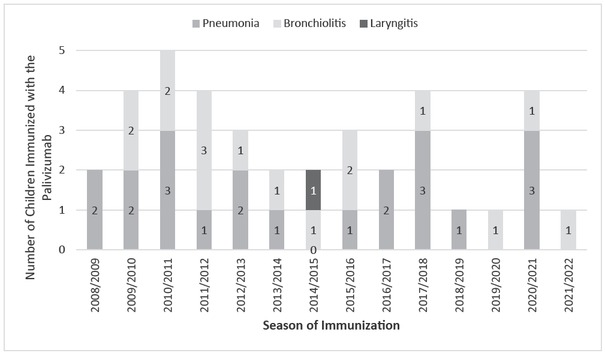
Figure 2
The number of immunized children readmitted for infections of the lower respiratory system during the study period 2008–2022 in Clinic of Child Disease UHC Mostar.