
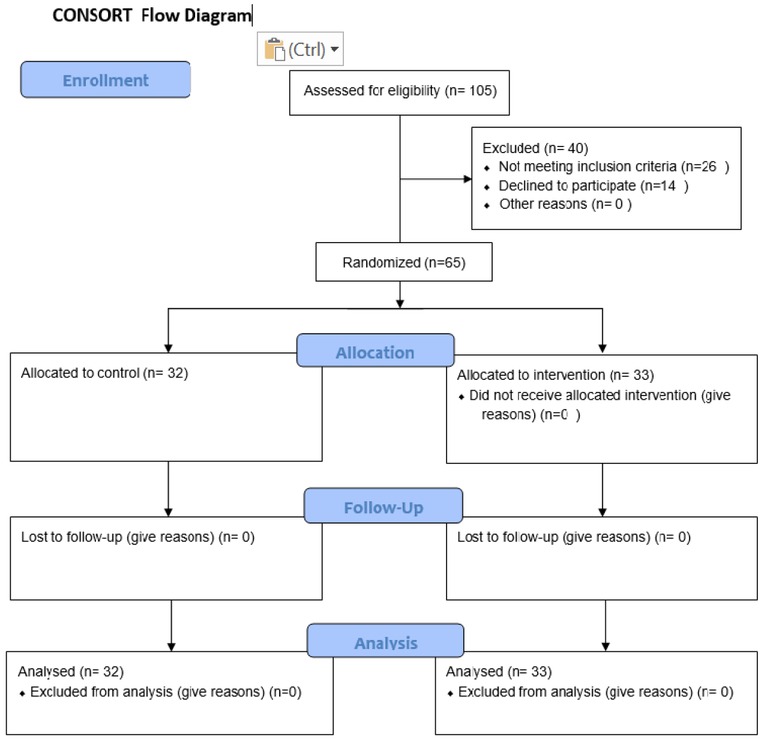
Figure 1
Flowchart of sampling and procedure
Table 1
The content of the counselling in terms of each session
| The first session was conducted face to face at discharge time, and the rest of the sessions were conducted by telephone daily for 14 days. | |
|---|---|
| First session (face to face) | Welcome Aims and objectives Pre-test with Dennis Breastfeeding Self-Efficacy Observing the infant sucking power (latch) and mother–infant relationship during lactation Discussing the concept of breastfeeding self-efficacy, factors affecting breastfeeding, and breastfeeding self-efficacy |
| The second session | Discussing the baby’s general condition, jaundice, and respiratory, urinary, and faecal pattern. Discussing how to determine the adequacy of breastfeeding, hours, and frequency of breastfeeding Regular hand washing and personal hygiene in baby care and breastfeeding Mentioning the warning signs and the need to go to the relevant specialists |
| Third session | Repeating the content of the second session Encourage skin-to-skin contact between mother and baby and kangaroo mother care as well as exercise to enhance sucking in preterm infants Non-nutritious sucking, how to feed the baby with breast milk |
| Fourth session | Discussing the women’s beliefs and attitudes about breastfeeding, the importance of breast milk in the growth, and development of premature babies Discussing the role of the mother’s effort and cooperation in improving the breastfeeding process |
| Fifth session | Strengthening mothers’ self-confidence, encouraging them to increase their individual skills in baby care, and receiving help from others Follow-up for routine neonatal care, neonatal screening |
| Sixth session | Repeating the content of the second to fifth sessions. Discussing how to determine the adequacy of breastfeeding, hours, and frequency of breastfeeding Encourage skin-to-skin contact between mother and baby and kangaroo mother care as well as exercise to enhance sucking in preterm infants Mentioning the warning signs and the need to go to the relevant specialists |
| Seventh up to Fourteenth sessions | Encouraging mothers to express their feelings, needs, and desires to counsellors and others Reviewing the second to sixth session topics Discussing the baby’s general condition, mothers’ self-confidence and coping with baby care Discussing the women’s beliefs and attitudes about breastfeeding, the importance of breast milk in the growth and development of premature babies Discussing factors affecting breastfeeding and breastfeeding self-efficacy The counselling was with maximum flexibility for the participants |
Table 2
Comparison of the frequency distribution of individual-social characteristics of participants between the two groups Intervention and control
| Variable | Intervention | Control | P-value* | |||
|---|---|---|---|---|---|---|
| Percentage | Frequency | Percentage | Frequency | |||
| Education | Illiterate bondage | 15.2 | 5 | 21.9 | 7 | 0.244* |
| Middle–high school | 21.2 | 7 | 31.3 | 10 | ||
| Diploma | 30.3 | 10 | 34.4 | 11 | ||
| University | 33.3 | 11 | 12.5 | 4 | ||
| Female occupation | Housewife | 97 | 32 | 93.8 | 30 | 0.613** |
| Employed | 3 | 1 | 6.3 | 2 | ||
| Spouse job | Free | 66.7 | 22 | 71.9 | 23 | 0.649* |
| Employee | 33.3 | 11 | 28.1 | 9 | ||
| Residence | City | 81.8 | 27 | 96.9 | 31 | 0.050* |
| Village | 18.2 | 6 | 3.1 | 1 | ||
| Gender of the baby | Girl | 60.6 | 20 | 43.8 | 14 | 0.174* |
| Boy | 39.4 | 13 | 56.3 | 18 | ||
| Type of delivery | Normal | 27.3 | 9 | 12.5 | 4 | 0.137* |
| Cesarean section | 72.7 | 24 | 87.5 | 28 | ||
| Monthly income | Less than enough | 39.4 | 13 | 40.6 | 13 | 0. 919* |
| It is enough | 60.6 | 20 | 59.4 | 19 | ||
| Parity | Primiparous | 34.4 | 12 | 50 | 16 | |
| Multiparous | 63.6 | 21 | 50 | 16 | ||
| Sex of baby | Female | 60.6 | 20 | 43.8 | 14 | 0.174* |
| Male | 39.4 | 13 | 56.3 | 18 | ||
Table 3
Comparison of breastfeeding self-efficacy scores between intervention and control groups in five time periods (before intervention and monthly up to 4 months after delivery
| Variable | Time | Control | Intervention | P-value* |
|---|---|---|---|---|
| Mean±SD | Mean±SD | |||
| Breastfeeding self-efficacy | Before | 31.71±4.28 | 33.18±4.63 | 0.479 |
| The first month | 32.59±7.36 | 44.69±9.51 | 0.001 | |
| The second month | 32.75±8.86 | 48.45±9.26 | 0.001 | |
| Third month | 30.56±9.86 | 51.18±10.8 | 0.001 | |
| The fourth month | 28.56 ±10.71 | 53.48±10.13 | 0.001 | |
| Paired t-test (P-value) | 0.129** | 0.001** | - |
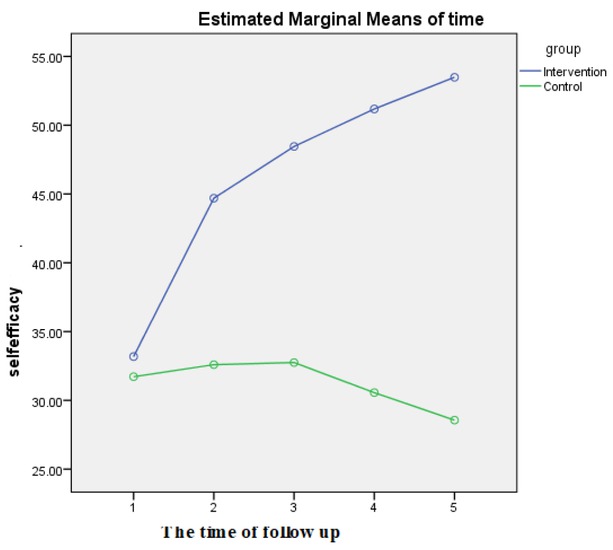
Figure 2
The variation of the self-efficacy score in five time periods