
Table 1
Characteristic changes in acute and chronic atopic dermatitis (AD)
| Characteristic | Exacerbation AD | Chronic form AD |
|---|---|---|
| Th2 type activation pathway and related cytokines/chemokines | Increased activity of IL-4, IL-13, IL-31 | Increased activity of IL-5, IL-13, IL-31, IL-10, CCL5, CCL13, CCL18. Equivocal results for IL-4 |
| Th22 type activation pathway and related cytokines | Increased IL-22 activity | Increased activity of IL-22, IL-32 |
| Th1 type activation pathway and related cytokines/chemokines | A slight increase in IFN-g, MX1, IL-1b, CXCL9-11, but not in all phenotypes | Significant increase in IFNg, MX1 (markers associated with Th-1 cytokine), IL-1b, CXCL9-11 |
| Th17 type activation pathway and related cytokines | A slight increase in the level of IL-17, IL-23p19, IL-23p40 | The level of activation is similar to that of acute AD |
| Infiltration of immune cells | Infiltration of immune cells | Intensification of changes as in the exacerbation |
| Epidermal changes | Increased hyperplasia, epidermal thickening, marker proliferation (Ki67, K16, IL-22); reduction in the level of epidermal barrier proteins (involucrine, loricrin, filaggrin) | Intensification of changes as in the exacerbation |
| Reduced expression of final protein and lipid differentiation | Decreased expression of FLG, LOR, PPL and other differentiation proteins; significant lipid disorders | Intensification of changes as in the exacerbation |
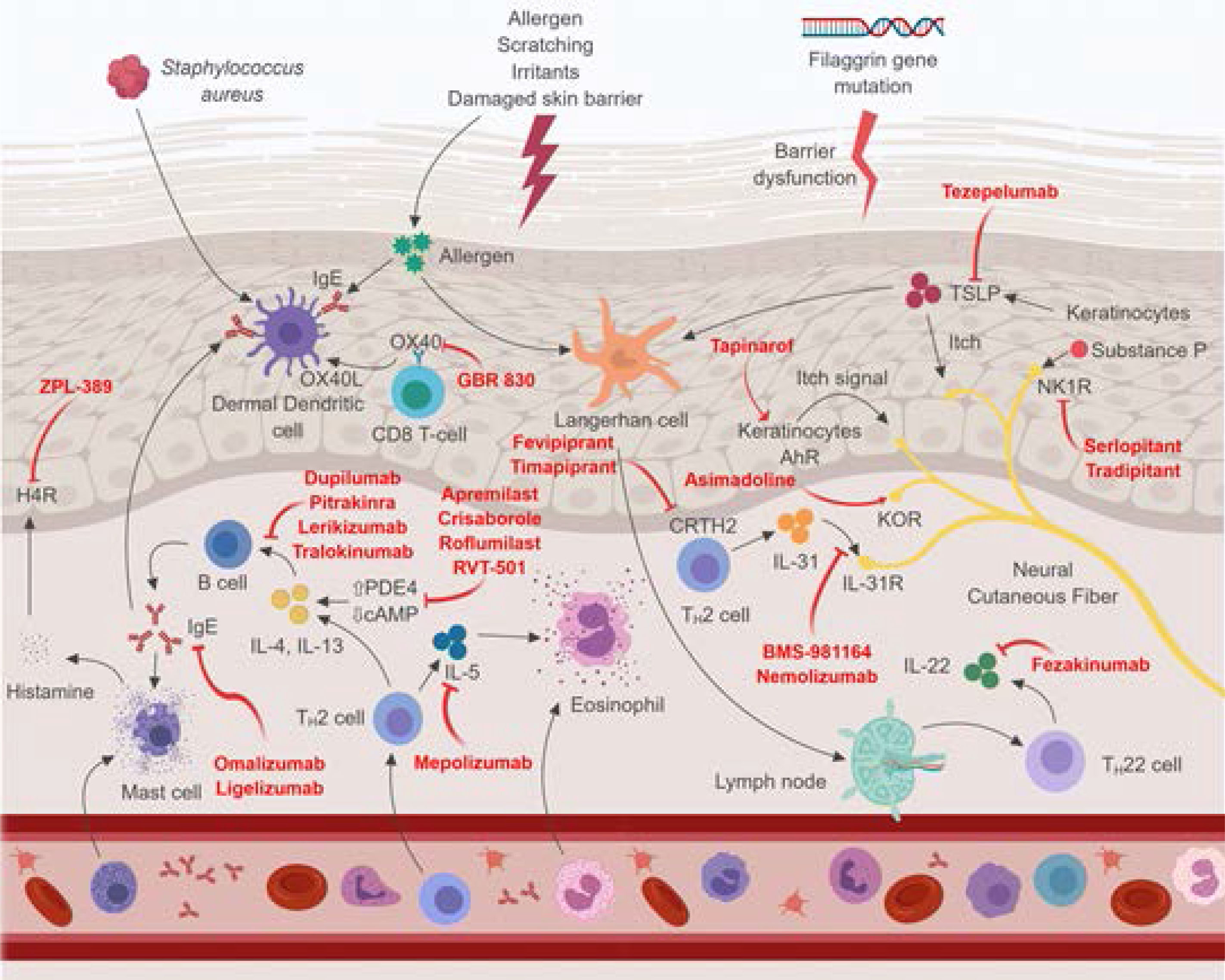
Figure 1
The pathomechanism of inflammation and current research directions for biological treatment of AD (courtesy of HL Nguyen, MM Tollefson, with permission from the Springer Nature publishing house) [10]
Table 2
Strategy for gradual treatment of atopic dermatitis (AD)
| Chronic treatment | Treatment of exacerbations (often recommended in a hospital setting) | |
|---|---|---|
| Severity III SCORAD3 50 |
|
|
| Severity II SCORAD3 25–49 |
| |
| Severity I SCORAD < 25 |
| |
| Basic treatment for all levels of severity AD |
| |
Table 3
Treatment depending on the severity of atopic dermatitis (AD)
| Medication | Mechanism of action | Characteristics |
|---|---|---|
| AD: mild and moderate form | ||
| PDE-4 inhibitors | ||
| Crisaborole | Inhibits the degradation of PDE4-dependent cyclic adenosine monophosphate, which in turn regulates T-cell signalling pathways, enhancing cellular control of inflammation. Topical drug – 2% ointment | Phase IV studies in children between 3 and 24 months of age have been completed |
| RVT-501 | Phosphodiesterase 4 Inhibitors (PDE4i). Topical drug – 0.5% ointment | Phase II studies in children aged between 2 and 17 years have been completed. |
| Inhibitors JAK-STAT | ||
| Tofacitinib | Blocking the cell signal transduction pathway inhibits pro-inflammatory cytokines | In the treatment of AD, it has so far only been tested in adults |
| AD: moderate and severe form | ||
| Inhibitors JAK-STAT | ||
| Baricitinib | Inhibitor JAK1/JAK2 – oral drug | All patients included in this study used local GCS 1 month before starting baricitinib therapy, therefore the efficacy of baricitinib monotherapy is unknown |
| Upadacitinib | Inhibitor JAK1 – oral drug | Currently in the research phase in children aged from 2 to 17 years and adults with AD. |
| Abrocitinib (Pf-04965842) | Inhibitor JAK1 – oral drug | Currently in phase III studies assessing the effectiveness of the drug in adolescents aged >12 years |
| Ruxolitinib | Inhibitor JAK1/JAK2 – topical drug | Initially used to treat myelofibrosis and true polycythaemia, it is currently studied in children aged between 12 and 17 years and adults with AD |
| ASN002 | Inhibitor JAK/TYK2/SYK – oral drug | Phase IIa studies in adults aged between 18 and 75 years have been completed. |
| Delegocitinib | Inhibitor JAK/TYK2 – topical drug | Examined in children aged from 12 to 17 years and adults with AD. |
| Phosphodiesterase 4 Inhibitors (PDE4i) | ||
| Roflumilast | Inhibitor PDE4 – topical drug | Until present, tested only in adults – phase IIa studies showed no improvement after using 0.5% cream Roflumilast |
| Apremilast | Inhibitor PDE4 – oral drug | Positive results in the treatment of children and adults with refractory AD. High frequency of undesirable activities in the form of cellulitis. No further studies are planned due to the risk and benefit analysis |
| CRTH2 receptor antagonists | ||
| Fevipiprant/Timapiprant | The antagonism on the CRTH2 receptor suppresses the formation of the inflammatory process | Clinical studies have not demonstrated efficacy of the drug relative to placebo (NCT01785602, NCT02002208) |
| Thymus stromal lymphopoietin (TSLP) and OX40 inhibitors | ||
| GBR-830 | Inhibitor TSLP (TSLP induces immune cells to produce pro-inflammatory cytokines). Anti-OX40 monoclonal antibody | Phase II is completed in adults |
| Tezepelumab | Inhibitor TSLP. Anti-TSLP monoclonal antibody | To date, studies only in adults – phase IIa studies lack satisfactory results |
| (TAMA) therapeutic aryl hydrocarbon receptor modulating agent (AhR) | ||
| Tapinarof | TAMA | Tested in children aged 12–17 years and adults. Phase III research scheduled for 2019 |
| Inhibitors IL-4/IL-13 | ||
| Dupilumab | Human monoclonal antibody blocking a subunit, common to IL-4 (IL-4Ra) and IL-13 receptors | To date, dupilumab (Dupixent) has been studied in >7,000 patients aged >12 years, in >30 clinical trials giving very good treatment results (description in the text) |
| Pitrakinra | IL-4 mutein – binds the IL-4Ra receptor by inhibiting the production of IL-4 and IL-13 | Phase II clinical trials in adults have been completed |
| Tralokinumab/Lebrikizumab | Anti-IL-13 monoclonal antibody | Lebrikizumab and tralokinumab are undergoing phase III studies |
| Inhibitors IL-5 | ||
| Mepolizumab | Anti-IL-5 monoclonal antibody inhibits eosinophil activity | Two clinical trials in adults with AD have been unsuccessful |
| Inhibitors IL-22 | ||
| Fezakinumab | Anti-IL-22 monoclonal antibody | Phase IIa studies have shown that this medicine has little potential to treat AD |
| Inhibitors IL-12/IL-23 Ustekinumab | Anti-IL-12/IL-23 monoclonal antibody | The results of phase IIa studies are not convincing |
| Inhibitors IL-31/IL-31Ra | ||
| Nemolizumab | IL-31Ra monoclonal antibody | Phase I studies showed a significant reduction of pruritus and phase II studies evaluated the safety and tolerability of the drug. These studies showed that treatment with nemolizumab is well tolerated and it reduces the severity of pruritus, dermatitis and sleep disorders compared with placebo |
| BMS-981164 | Monoclonal antibody IL-31 | Phase I studies in 2015 – no results have been published so far |
| Neurokinin-1 Receptor Antagonists (NK1RA) | ||
| Serlopitant | NK1R antagonist – oral drug | Effective in the treatment of chronic pruritus in adults; however, phase II drug research in patients with AD did not bring satisfactory results |
| Tradipitant | NK1R antagonist – oral drug | Phase III drug research is currently underway |
| K-Opioid Receptor Agonists (KOR) | ||
| Asimadoline | Agonist KOR – oral drug | Phase II drug studies have been completed. Effective in reducing itching at night |
| Histamin Receptor Antagonists-4 (H4R) | ||
| ZPL-389 | Antagonist H4R | Studies in adults only. The advantage over placebo has not been demonstrated. Phase IIB study is currently underway |
| Immunoglobulin E (IgE) inhibitors | ||
| Omalizumab | Anti-IgE monoclonal antibody | There are no satisfactory treatment effects in patients with AD. A drug used to treat asthma |
| Ligelizumab | Anti-IgE monoclonal antibody | Higher affinity for IgE than omalizumab. Phase II RCT completed |
[i] Source: Seo et al. (11).
Table 4
List of clinical trials conducted for biological drugs in atopic dermatitis (AD)
| Medication | Target | Study phase | Manufacturer | www.ClinicalTrials.gov | Target endotype | AD phenotype |
|---|---|---|---|---|---|---|
| Dupilumab Dupixent | IL-4Ra | Approved by FDA 2017 – adults, FDA 2019 – adolescents EMA – 2019 | Sanofi-Aventis Groupe, Paris | NCT01949311 Phase III in progress – patients >18 years old NCT02407756 Phase II completed – in children 12–18 years old, moderate and severe AD NCT02612454 Phase III in progress – in children 36 months–18 years old NCT03054428 Phase III completed – patients >12–18 years old NCT02407756 Phase II completed Patients 36 to <18 years old NCT02612454 Phase III Patients 36 months old–<18 years old NCT03411837 Phase IV Patients 312 years old NCT03428646 Observation of patients receiving Dupixent Patients 312 years old NCT03549416 New systemic treatment options in patients with AD, including dupilumab (conjunctivitis during dupilumab treatment) Patients: children, adults | Th2/Tc2 | All AD phenotypes |
| Pitakinra/Aeroderm | IL-4 | Phase II completed | Aerovance, Berkeley, CA | NCT00676884 Patients >18 years old | Th2/Tc2 | All AD phenotypes |
| Mepolizumab | IL-5 | Phase II completed | Glaxo SmithKline, Research Triangle Park, NC | NCT03055195 Patients >18 years old | Th2/Tc2 | AD with elevated eosinophils |
| Tralokinumab | IL-13 | Phase II completed | MedImmune, Gaithersburg, MD | NCT02347176 Patients >18 years old | Th2/Tc2 | All AD phenotypes |
| Lebrikizumab | IL-13 | Phase II completed Phase III | Hoffman-LaRoche, Basel, Switzerland | NCT02340234 NCT02465606 NCT03443024 Patients >18 years old NCT04250337, NCT04250350 Patients 12–17 years old active | Th2/Tc2 | All AD phenotypes |
| QAW039/Fevipiprant | CRTH2 | Phase II completed (drug development programme stopped) | Novartis, Basel, Switzerland | NCT01785602 Patients >18 years old | Th2/Tc2 | All AD phenotypes |
| OC000459 | CRTH2 | Phase II completed (drug development programme stopped) | Atopix, Carlsbad, CA | NCT02002208 Patients >18 years old | Th2/Tc2 | All AD phenotypes |
| AMG157/tezepelumab | TSLP | Phase I completed | Amgen, Newbury Park, CA | NCT00757042 Patients >18 years old | Th2/Tc2, Th17 | All AD phenotypes, prevention of allergic march |
| MK-8226 | TSLPR | Phase I completed | Merck, White-house Station, NJ | NCT01732510 Patients >18 years old | Th2/Tc2, Th17 | All AD phenotypes, prevention of allergic march |
| GBR830 | OX40 | Phase I completed | Glenmark, Mumbai, India | NCT02683928 Patients >18 years old | Th2/Tc2 | All AD phenotypes |
| KHK4083 | OX40 | Phase I completed | Kyowa HAkko Kirin, Otemachu, Japan | NCT03096223 Patients >18 years old | Th2/Tc2 | All AD phenotypes |
| QGE031 | IgE | Phase II completed | Novartis | NCT01552629 Patients >18 years old | Allergic sensitization | Extrinsic AD, AD in African Americans, AD in Asians, childhood AD |
| Tofacitinib | JAK1/3 | Phase II completed | Innovaderm, Montreal, Quebec, Canada | NCT02001181 Patients >18 years old | Th1, Th2, Th22, IFN-a, IgE class – keratinocyte modulation pruritus differentiation | All AD phenotypes |
| Baricitinib (LY3009104) | JAK1/2 | Phase II completed | Eli Lilly, India-napolis, IN | NCT02576938 Patients >18 years old | Th1, Th2, Th22, IFN-a, IgE class – keratinocyte modulation pruritus differentiation | All AD phenotypes |
| Upadacitinib (ABT-494) | JAK1 | Phase II completed | AbbVie, Lake Bluff, IL | NCT02925117 Patients >18 years old | Th1, Th2, Th22, IFN-a, IgE class – keratinocyte modulation pruritus differentiation | All AD phenotypes |
| ASN002 | JAK/SYK | Phase II completed | Asana BioSciences, Lawrenceville, NJ | NCT03531957 Patients >18 years old | Th1, Th2, Th22, IFN-a, IgE class – keratinocyte modulation pruritus differentiation + Th17 | All AD phenotypes |
| PF-04965842 | JAK1 | Phase III completed | Pfizer, New York, NY | NCT03349060 Patients >12 years old | Th1, Th2, Th22, IFN-a, IgE class – keratinocyte modulation pruritus differentiation | All AD phenotypes |
| Crisaborole/Eucrisa Staquis | PDE4 | Approved by FDA 2016 >2 years FDA 2020 >3 months EMA 2020 >2 years | Pfizer Labs, NY; Pfizer Europe, MA EEIG | NCT02118766 NCT02118792 Phase II completed in children >2 years old | Anti-inflammatory drugs (NSAIDs) | All AD phenotypes |
| Roflumilast | PDE4 | Phase II completed | AstraZeneca, Cambridge, UK | NCT01856764 Patients >18 years old | Anti-inflammatory drugs (NSAIDs) | All AD phenotypes |
| RVT-501 | PDE4 | Active phase I | Dermavant Sciences, Phoenix, AZ | NCT03415282 Patients >2–11 years old | Anti-inflammatory drugs (NSAIDs) | All AD phenotypes |
| Apremilast/Otezla | PDE4 | Phase II completed (drug development programme stopped) | Celgene, Summit, NJ | NCT02087943 Patients >18 years old | Anti-inflammatory drugs (NSAIDs) | All AD phenotypes |
| Ustekinumab/Stelara | IL-12/23p40 | Phase II completed | Janssen, Beerse, Belgium | NCT01806662 Patients >18 years old | Th17, Th1, Th22 | Intrinsic AD, AD in Asians, childhood AD, EA in patients with chronic AD |
| CIM331/nemolizumab | IL-31R | Phase II completed | Chugai, Tokyo, Japan | NCT01986933 Patients >18 years old | Pruritus/Th2 | All AD phenotypes |
| BMS-981164 | IL-31 | Phase I completed | Bristol-Myers Squibb, New York, NY | NCT01614756 Patients >18 years old | Pruritus/Th2 | All AD phenotypes |
| ILV-094/Fezakinumab | IL-22 | Phase II completed | Pfizer | NCT01941537 Patients >18 years old | Th22, Th17 | Intrinsic AD, AD in Asians, adult EA patients with AD, African American |
| Secukinumab/Cosentyx | IL-17A | Phase II completed | Novartis | NCT02594098 Patients >18 years old | Th17 (and IL-22) | Intrinsic AD, AD in Asians, children and young adults from AD |
| MOR106 | IL-17C | Active phase II | Galapagos NV, Mechelen, Belgium | NCT03568071 Patients >18 years old | Th17 | Intrinsic AD, AD in Asians, children and young adults from AD |
[i] Source: Czarnowicki et al. (40).