
Fig. 1
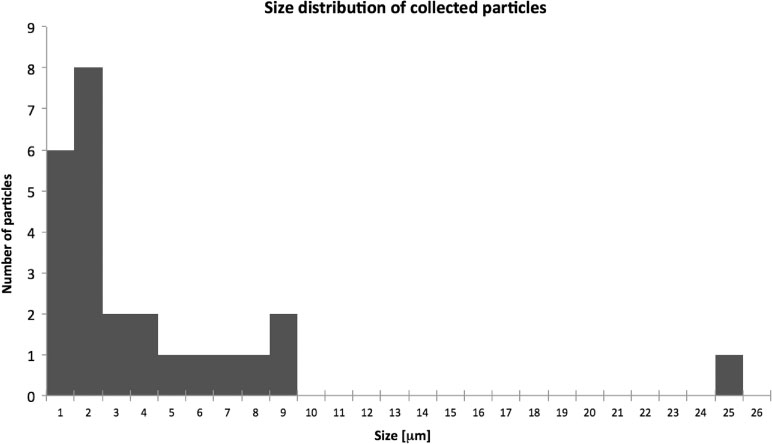
Size distribution (microns) of the particles collected between 37 and 38.5 km during June 21–24, 2008 between ~72oN and ~78oN (modified after Della Corte et al., 2012).
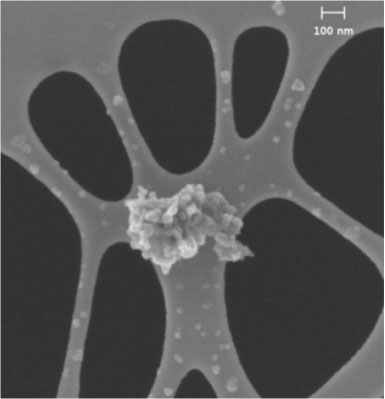
Fig. 2
A FESEM image of pure carbon aggregate of numerous nanograins (D08_033) supported on the holey carbon film used for dust collection. The aggregate is about 300 nm in size. It is surrounded by a spray zone of smaller carbon nanograins.
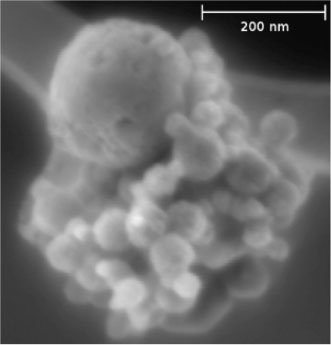
Fig. 3
A FESEM image showing porous aggregate (D08_031) consisting of condensed Ca[O] nanograins that are accreted onto a larger melted aggregate of tiny carbonate grains. Small pores are visible in the largest sphere. The entire cluster is about 425 nm in size. The background is the holey carbon thin-film collection substrate.
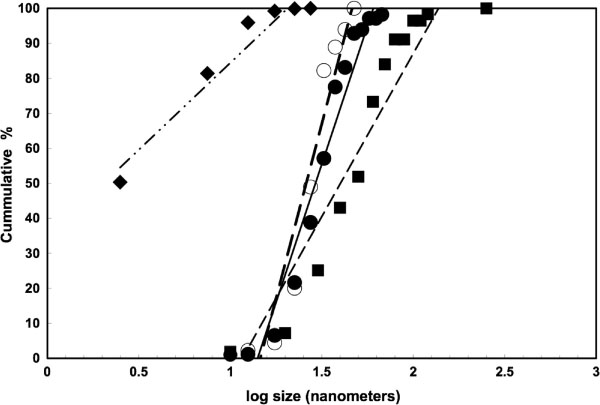
Fig. 4
Lognormal size distributions for the condensed Ca[O] nanograins in aggregate particle D08_031 (Fig. 3) (solid squares) and the pure carbon nanograins in the aggregate smoke particle D08_033) (dots) and deposited on the support film (open circles) (Fig. 2) compared to the size distribution of Fe(Ni) nanometeorites collected in the lower stratosphere (diamonds) (Hemenway et al., 1961). All linear correlation coefficients (r 2) are ≥0.9.
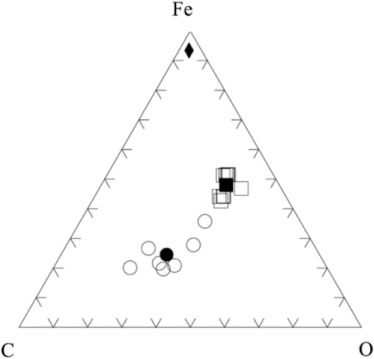
Fig. 5
The Fe–C–O (at %) ternary diagram showing the composition of the porous smoke aggregate particle D08_031 (squares) and ‘in-hole’ analyses (circles) when the electron beam was placed across a hole in the holey carbon support film of the collector. These analyses represent a collector background composition. Iron in this diagram (diamond) results from a steel pin that is located directly below the actual collector (Ciucci, 2011; Ciucci et al., 2011). The open symbols are individual analyses; solid symbols are average compositions.
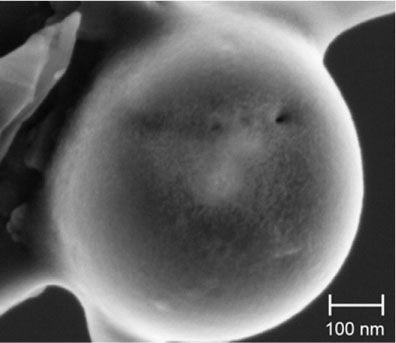
Fig. 6
A 610-nm nanosphere extracted from the dolomite decomposition experiment viewed in the FESEM used for this study to determine the collected grain compositions. The pores in this nanosphere are reminiscent of the outgassing pores in the largest sphere of porous aggregate particle (D08_031).
Table 1
Range of calcite grain sizes (microns) in selected CM meteorites
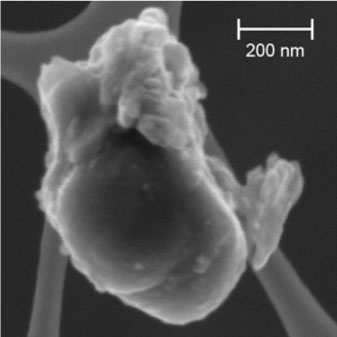
Fig. 7
FESEM image of a composite pure carbon nanoparticle of a sphere resting on a platy substrate (D08-029) collected by DUSTER.