
{ label needed for table-wrap[@id='T0001'] }
Table 1. DARE/SE and DARE/DA dynamics scaling
DARE/SERa/γΩγgL/γ/γHUWγrγDARE/DARaΩgγgLH/γgUW/γgr/γg
[i] γ is the DARE factor (Kuang et al., 2005) and γg=γ−1 is the gravity scaling factor.
{ label needed for table-wrap[@id='T0002'] }
Table 2. DARE/SE and DARE/DA scaling of the radiation (RAD) and surface heat (HEAT) fluxes, the microphysical time-scales (), the precipitation fall speed (V), as well as the turbulent length scale (Lturb ) and the entrainment (E) and detrainment (D) rates in the convection parametrisation
DARE/SERADγHEATγVγL turb EDDARE/DAV/γ g L turb /γgEγgDγg
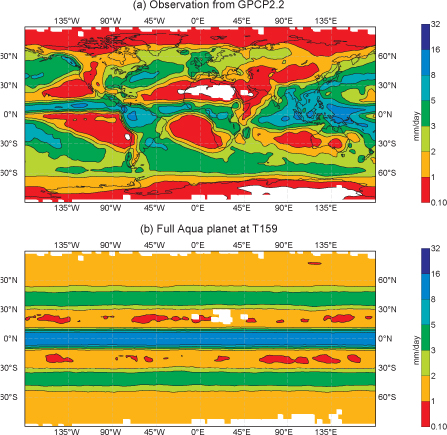
Fig. 1
Annual mean daily global precipitation (mm day−1). (a) Observations from the GPCP2.2 precipitation climatology dataset. (b) A 1-yr integration at T159 of a four-member ensemble with deep convection parametrisation using the full Aqua planet with γR=γΩ=γg=1.
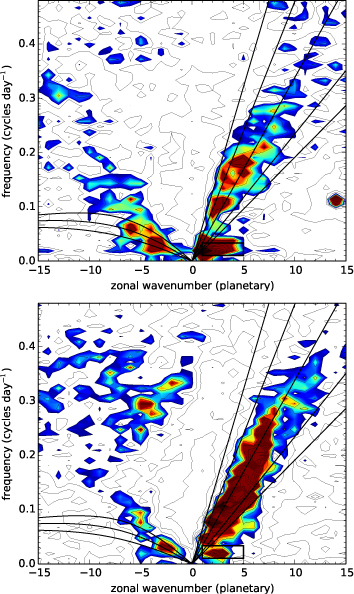
Fig. 2
Same as Fig. 1, but for the wavenumber frequency spectra of the outgoing longwave radiation with observations from the NOAA satellites. The data has been averaged between 10°S and 10°N, a background spectrum has been subtracted, and only the symmetric part of the spectrum is displayed. Spectra include the theoretical dispersion relations with external gravity wave phase speed as a function of scale height H. The characteristic tropical wave types include the eastward propagating Kelvin waves, the westward propagating equatorial Rossby (ER) waves, and the inertia gravity (IG) waves.
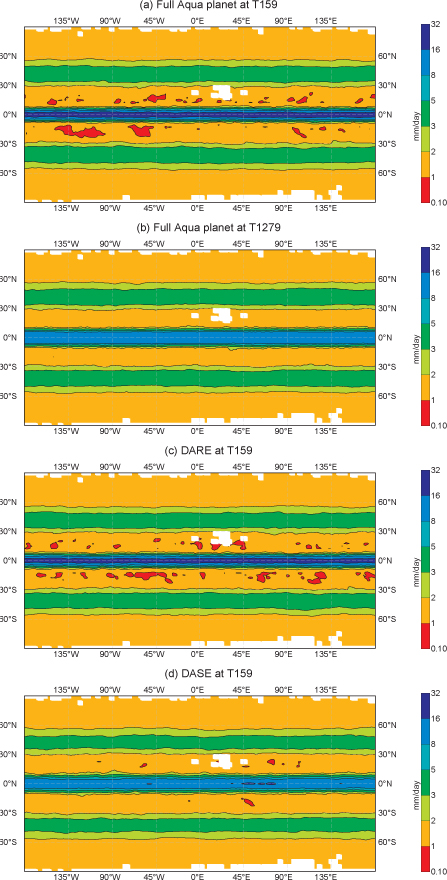
Fig. 3
Snapshots of 500 hPa geopotential (isolines) and horizontal wind (arrows), as well as daily mean total precipitation (mm) (colour shading) after 300 d (Earth rotations) for an area covering a large part of the northern hemisphere: (a) reference Aqua planet system at truncation T159 with deep convection parametrisation, (b) same as (a) but at T1279, (c) Small Planet (SP) system based on (a) but with γR=γΩ=8, (d) Small Planet Shallow Atmosphere (SPSA) system based on (a) but with γR=γΩ=γg=8. Simulations without deep convection parametrisation include unscaled reference runs at (e) T159 and (f) T1279, as well as at T159 with (g) DARE/SE (γR=γΩ=γ = 8 and γg=1) and (h) DARE/DA (γR=γΩ=1 and ). The precipitation fluxes are rescaled proportionally to γ−1.
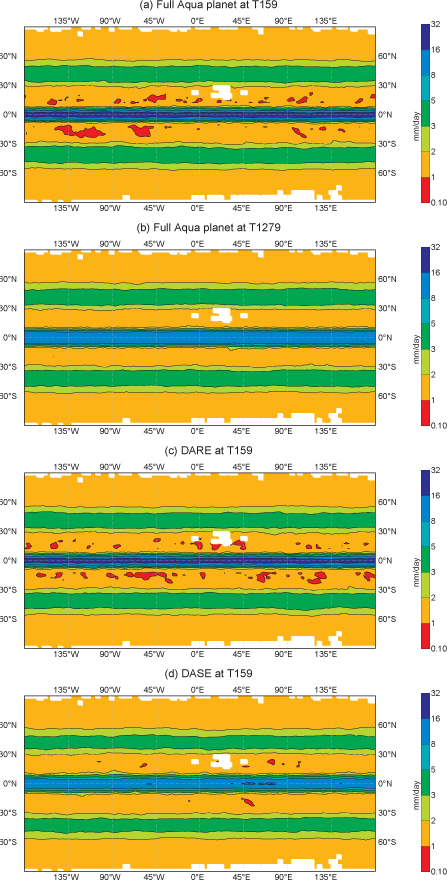
Fig. 4
Annual mean daily global precipitation (mm day−1) for hydrostatic integrations without deep convection parametrisation for the full Aqua planet (γR=γΩ=γg=1) at (a) T159, (b) T1279, and the scaled Aqua planet at T159 with (c) DARE/SE (γR=γΩ=γ = 8 and γg=1) and (d) DARE/DA (γR=γΩ=1 and ). The precipitation fluxes are rescaled proportionally to γ−1.
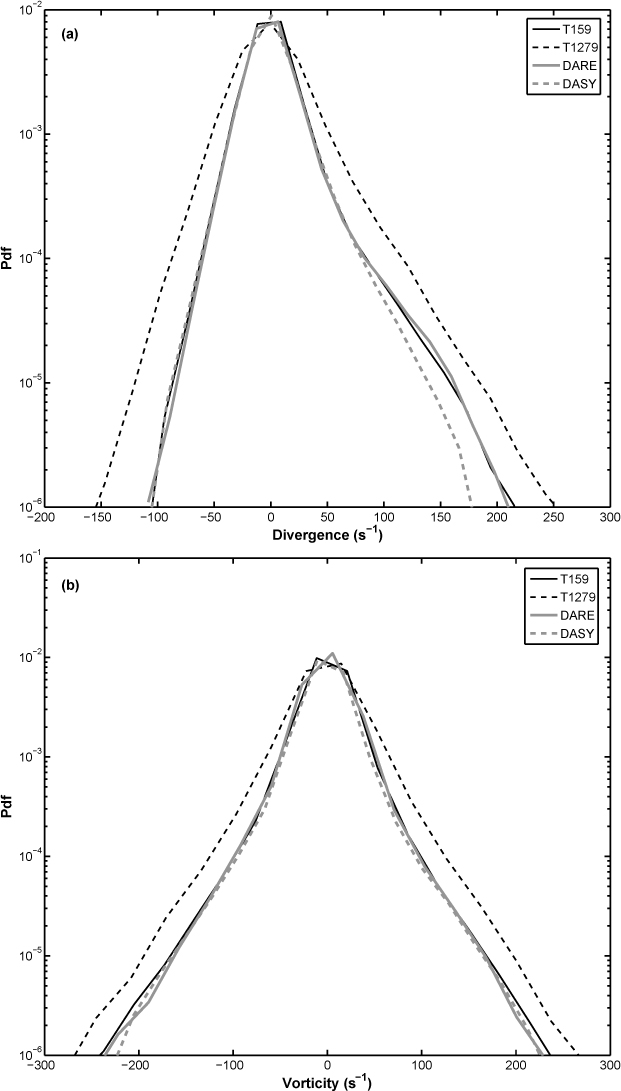
Fig. 5
Wavenumber frequency spectra corresponding to the simulations in Fig. 4.
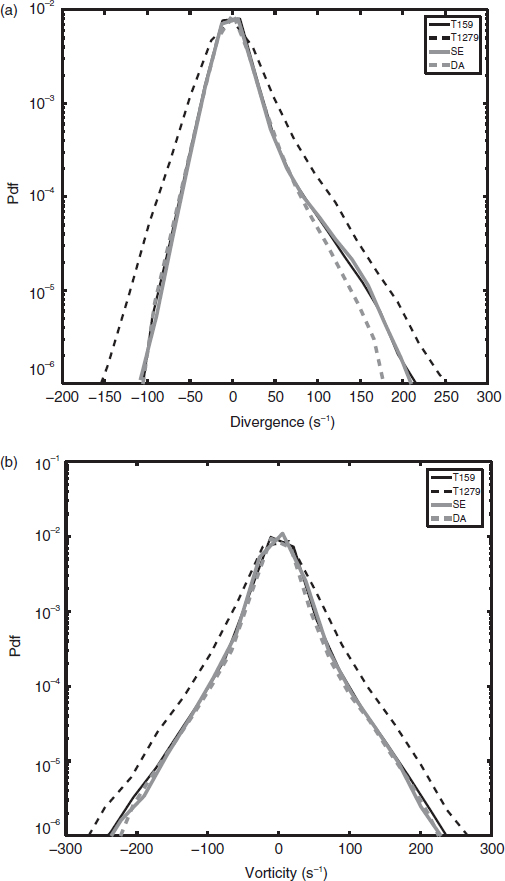
Fig. 6
Pdf of (a) divergence (s−1) at 250 hPa and (b) vorticity (s−1) at 500 hPa over the tropical band for the four experiments without deep convection in Figs. 4 and 5. All data are truncated to T159 and for DARE/SE the divergence and vorticity are scaled by a factor γ−1.