

Fig. 1
a) Location of Lake Valkea-Kotinen (red cross) in Northern Europe. b) Bathymetry map of the lake with depth contours (m, black lines; enhanced from Kankaala et al., 2006), longitudinal size 440 m (blue dashed line), water temperature profile measurements (red circle), measurement raft (red square) and directions with acceptable flux measurements (grey transparent sectors). c) Aerial photograph of the lake also showing the raft (red arrow; Photo by Ilpo Hakala). The map of the lake catchment is given in Rasilo et al., 2012, Fig. 1 therein.
Table 1. The meteorological forcing measured at the Lake Valkea-Kotinen
Air temperature–0.00Davis Vantage Pro 20.5°CWind speed–0.27Metek USA10.05 m s−1Wind direction–0.29Metek USA1–Specific humidityRelative humidity (Iso-Evo, 5 km from the lake)6.79Licor LI70001%Air pressure–6.79Davis Vantage Pro 21.0 hPaDownward shortwave radiation–4.73Davis Vantage Pro 225 W/m2Downward longwave radiation–30.02*Derived using net radiation (MB-1, Astrodata), shortwave radiation, surface temperature, water emissivity 0.98 and albedo 0.06–
Table 2. The summary on lake models participating in the Valkea-Kotinen experiment. See also Table A1.1 for details on parameters of k-ɛ models
FLake, Mironov, 2008; Mironov et al., 2010; Kirillin et al., 2011Parameterised temperature profile/2 (top mixed layer and thermocline)3600Monin-Oboukhov similarity theory accounting for specific features of the surface air layer over lakesHomogeneous temperature profile in mixed-layer and self-similarity concept in thermoclineParameterisation of temperature profile in bottom sediments (soil) using self-similarity hypothesisCLM4-LISSS, Hostetler and Bartlein, 1990; Subin et al., 2012; Oleson et al., 2010Multilayer/25 layers600An extended scheme from CLM4 model (Oleson et al., 2010; Subin et al., 2012)Henderson-Sellers parameterisation of eddy diffusivity, buoyant convection (Hostetler and Bartlein, 1990)Heat conductance in bottom sediments (soil)LAKE, Stepanenko et al., 2011Multilayer/2030Monin-Oboukhov similarity theory with universal functions for stable boundary layer from (Esau and Zilitinkevich, 2006)K-ɛ with Canuto stability functionsHeat conductance in bottom sediments (soil)SimStrat, Goudsmit et al., 2002; Perroud et al., 2009Multilayer/40/0.05 m600Empirical equations (Livingstone and Imboden, 1989; Kuhn, 1978; Dingman et al., 1968)K-ɛ with Galperin stability functionsZero heat fluxLAKEoneD, Jöhnk and Umlauf, 2001; Jöhnk et al., 2008Multilayer/20/0.1 m198(Jöhnk, 2005)K-ɛ with standard coefficientsZero heat flux
Table 3. The model parameters and experiments
Depth3 m or 6 mExtinction coefficient in water3 m−1Albedo of water0.06Reflectivity of water for longwave radiation (‘longwave albedo’)0Emissivity of water0.98Geothermal heat flux0 W/m2Lake morphometryBasic experiment: excluded; additional experiment: included (only for k-ɛ models)
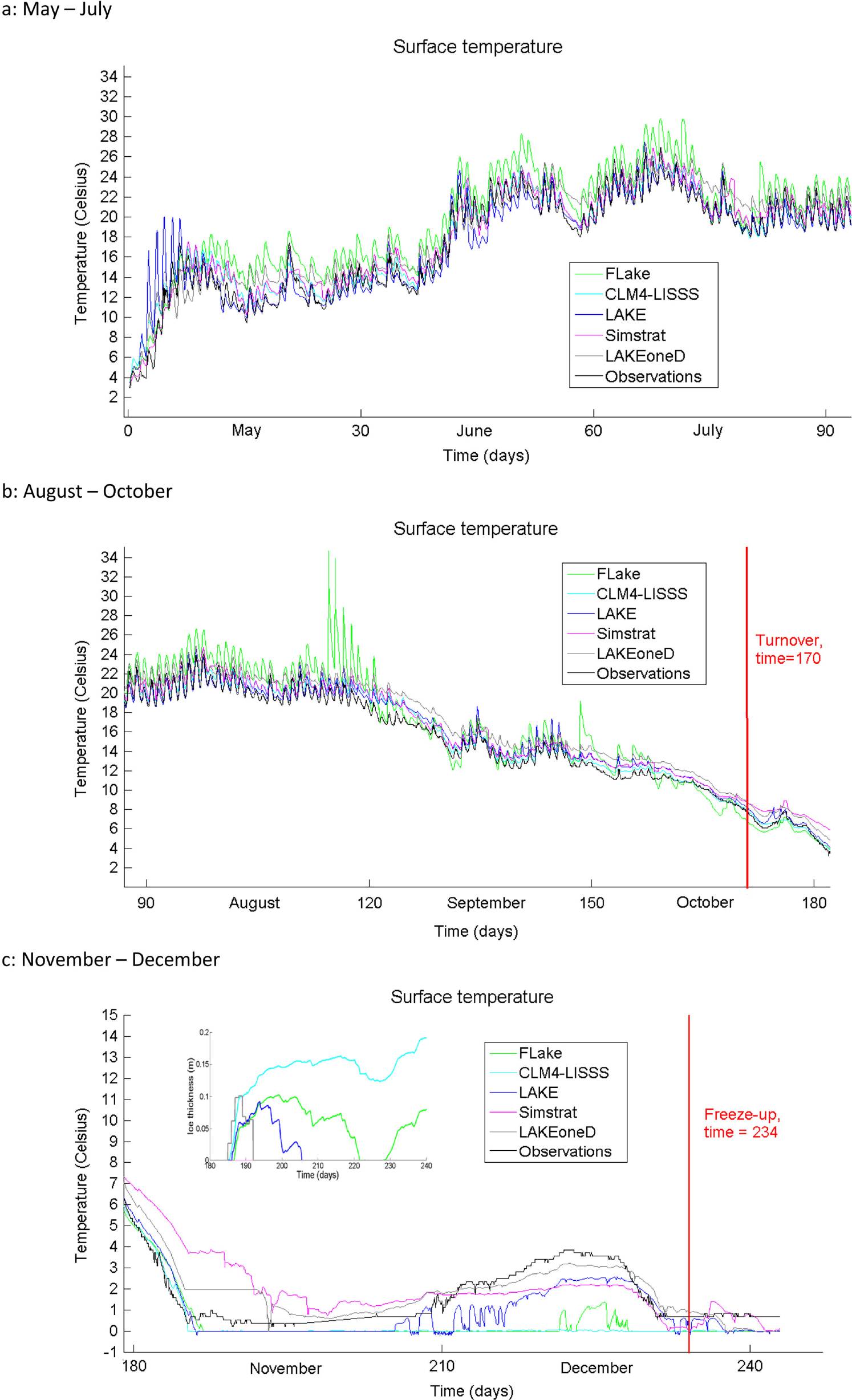
Fig. 2
Time series of surface temperature as modelled (baseline experiment) and measured at Valkea-Kotinen Lake (2 May–31 December 2006; panel a: May–July; b: August–October; panel c: November–December). Time=0 at abscissa axis corresponds to 00:30 local time 2 May 2006. Inset at panel c presents ice thickness evolution in models for the same time period.
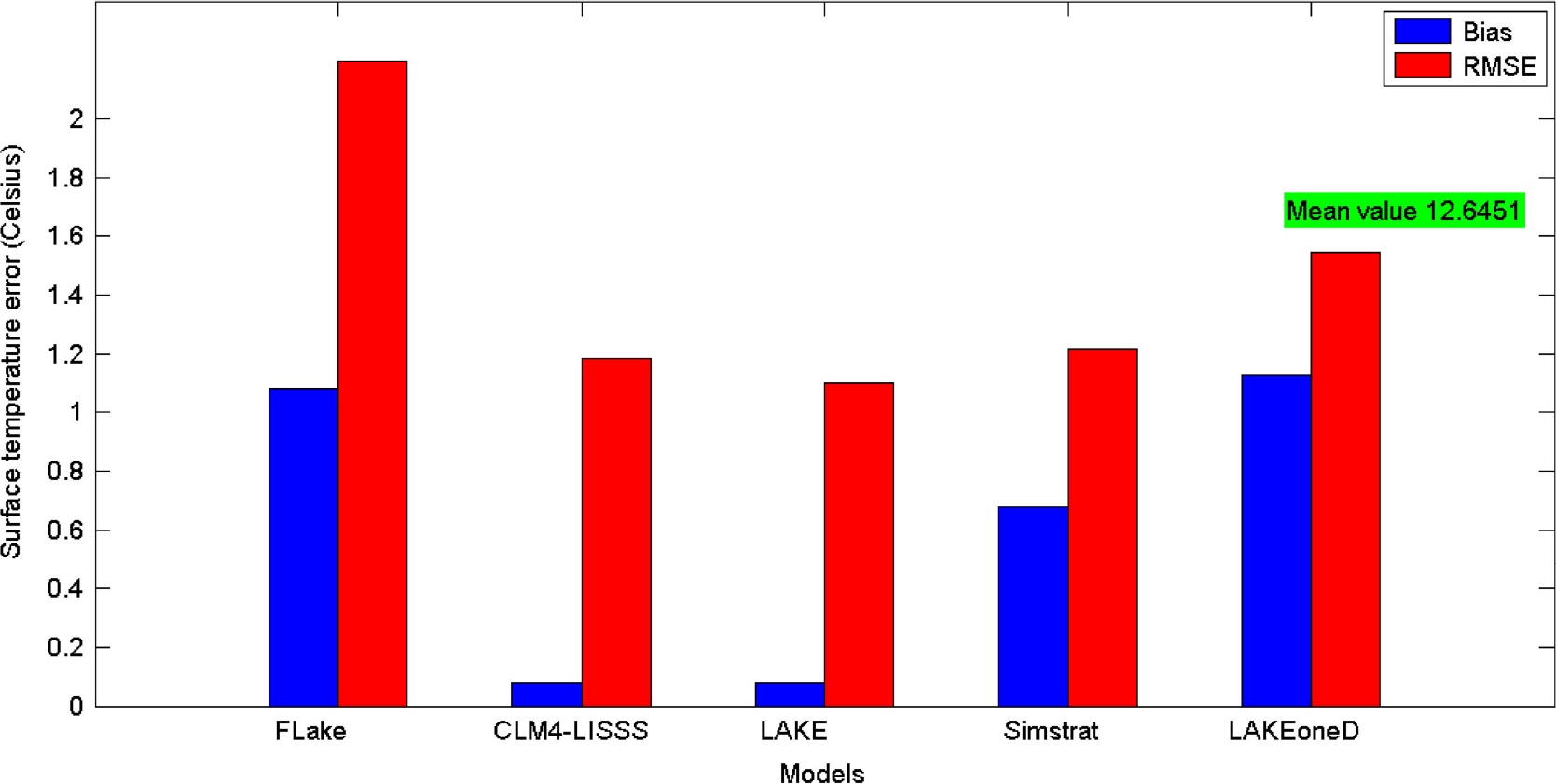
Fig. 3
Surface temperature errors of lake models in a baseline experiment (blue columns – difference of means, or bias; red – RMSE). The mean temperature is indicated in a green box.
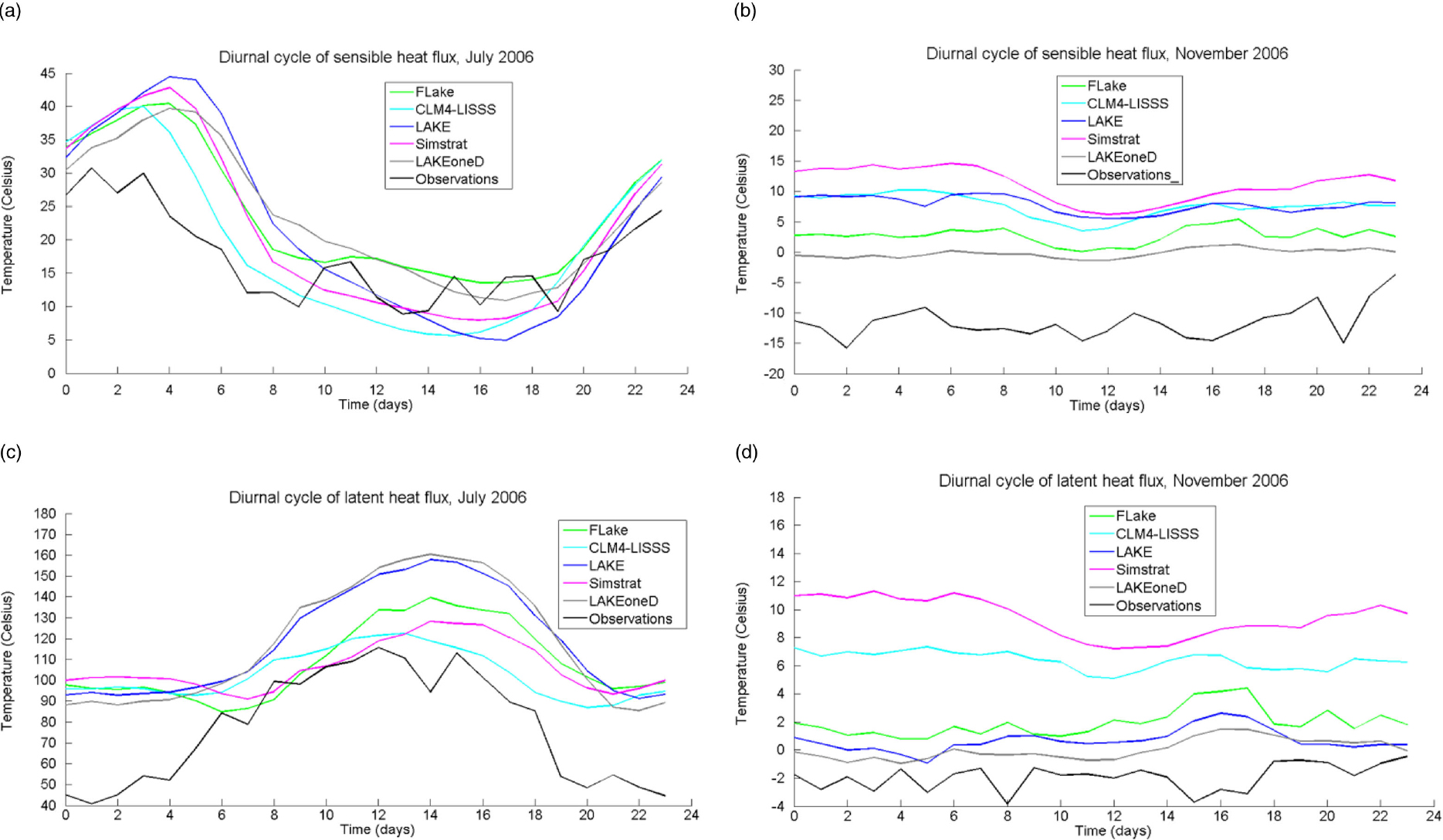
Fig. 4
The monthly mean diurnal cycle of sensible and latent heat flux for July and November 2006, modelled in a baseline experiment: (a) sensible heat flux, July, (b) sensible heat flux, November, (c) latent heat flux, July, and (d) latent heat flux, November.
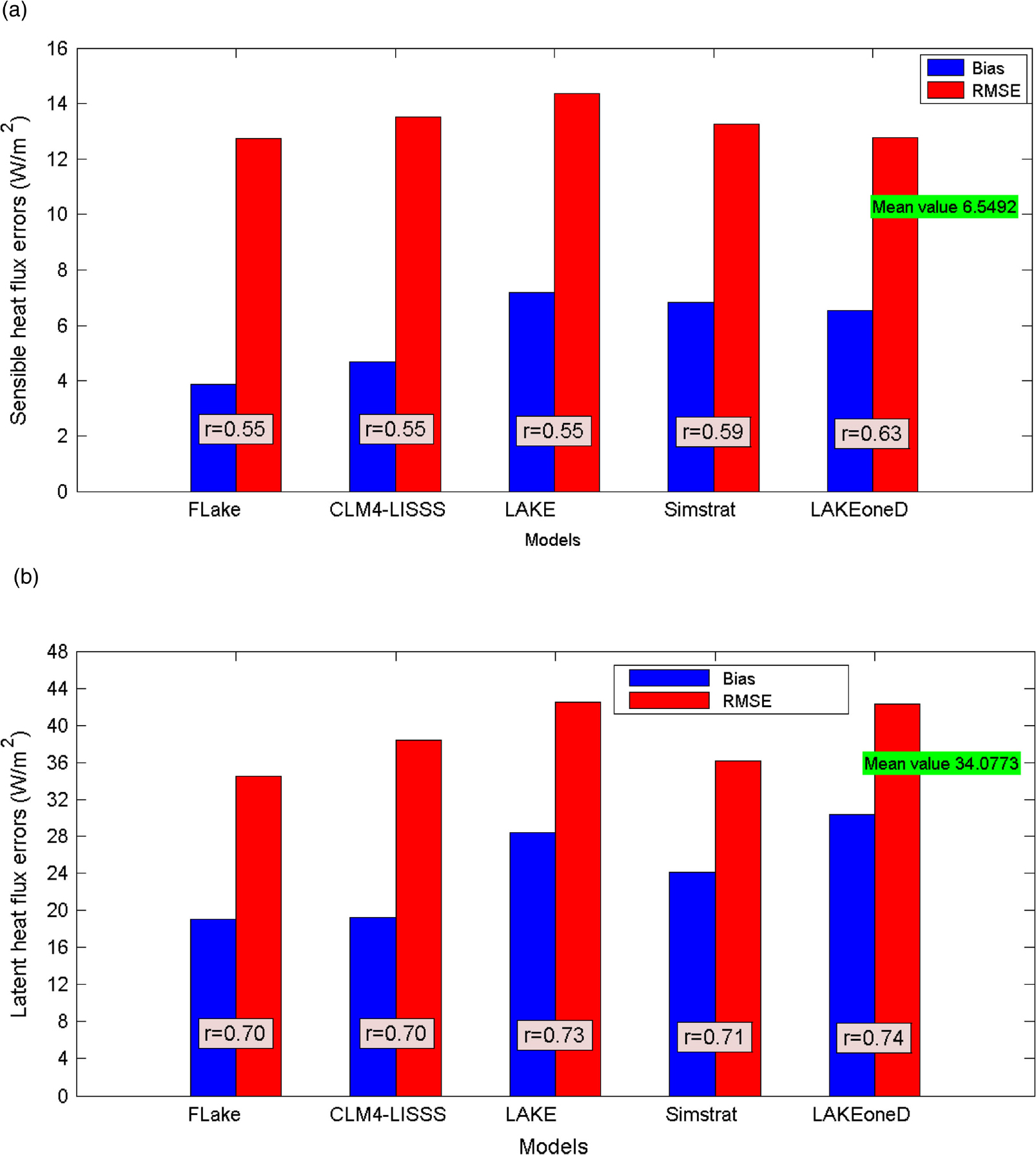
Fig. 5
Sensible heat (a) and latent heat (b) flux errors of lake models in a baseline experiment (blue columns – difference of means, or bias; red columns – RMSE; pink boxes – correlation coefficient). The mean sensible and latent heat fluxes are indicated in green boxes at (a) and (b), respectively.
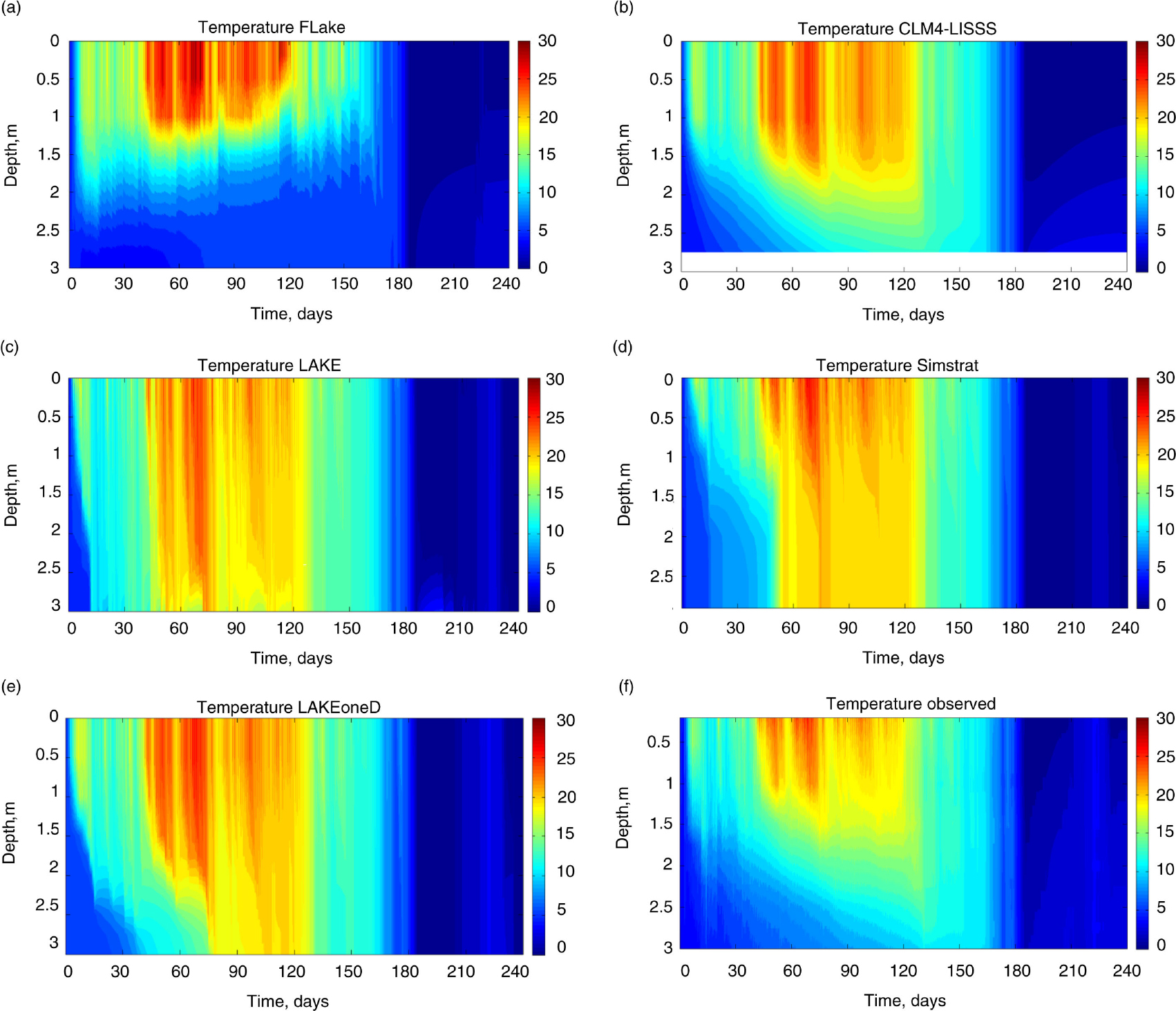
Fig. 6
The time evolution of temperature profiles in Valkea-Kotinen Lake according to models in a baseline experiment (a – FLake, b – CLM4-LISSS, c – LAKE, d – Simstrat, e – LAKEoneD) and observations (panel f). The temperature is given in °C, time=0 corresponds to 0:30 2 May 2006.
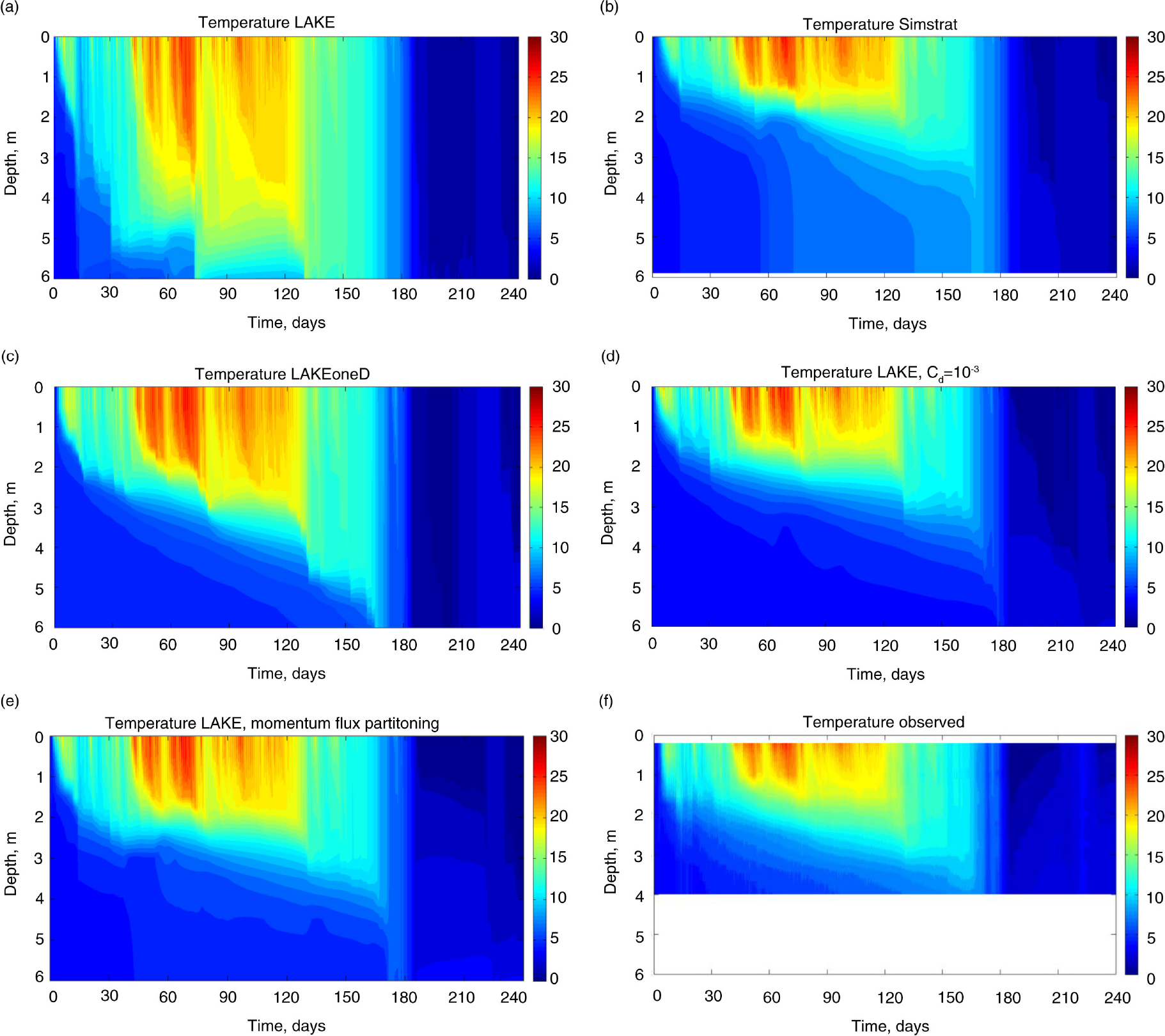
Fig. 7
The time evolution of temperature profiles in Valkea-Kotinen Lake according to k-ɛ models in an experiment with 6 m depth neglecting morphometry (a – LAKE, b – Simstrat, c – LAKEoneD, d – LAKE with C d =10−3, e – LAKE with momentum flux partitioning), and observations (panel f, the same as Fig. 8f but with different vertical scale). The temperature is given in °C, time=0 corresponds to 0:30 2 May 2006.
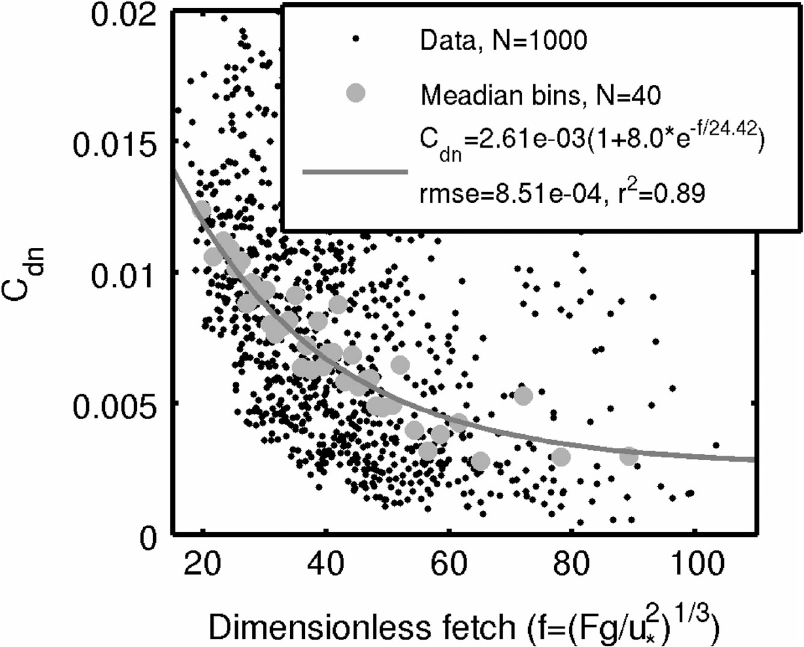
Fig. 8
The surface drag coefficient for neutral stratification (C dn ) as a function of dimensionless wind fetch, according to EC measurements at the Lake Valkea-Kotinen. Number of data points (N) and a fit to median values are given in the legend. The 90% confidence limits of the fitting coefficients are 0.0013–0.0040, 4.8–11.3 and 16.2–32.6.
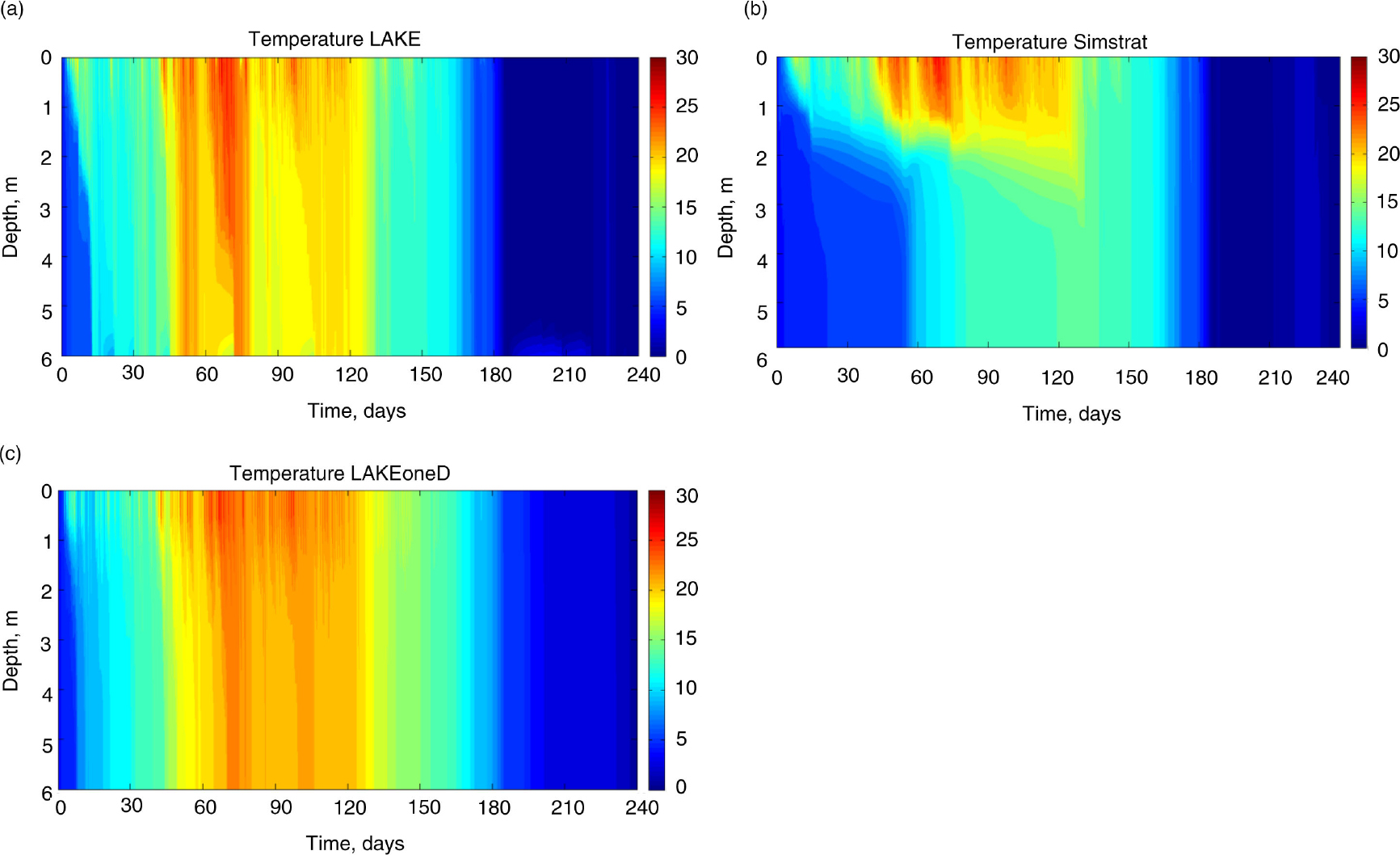
Fig. 9
The time evolution of temperature profiles in Valkea-Kotinen Lake according to k-ɛ models in an experiment with 6 m depth including morphometry (a – LAKE, b – Simstrat, c – LAKEoneD). The temperature is given in °C, time=0 corresponds to 0:30 2 May 2006.
Table A1.1. The parameters of k-ɛ models
σ k 111σ ɛ 1.111 (fulfilling the law of the wall, Burchard, 2002)1.31.3σ1ɛ 1.441.441.44σ2ɛ 1.921.921.92σ3ɛ 1.14 if B>0 −0.4 if B<00.81 if B>0 −0.4 if B<0C t Stability function for momentum (Canuto et al., 2001)0.090.09 (C constant, Galperin et al. (1988))C t,ρ Stability function for scalars (Canuto et al., 2001)0.090.11 (C constant, Galperin et al. (1988))Boundary conditions at the water–air interfaceFor TKE, the no-flux condition (Burchard et al., 1998), for dissipation the flux boundary condition of Burchard and Petersen (1999)Dirichlet boundary conditions assuming local equilibrium (Svensson, 1978; Rodi, 1993)For TKE, the no-flux condition (Burchard et al., 1998), for dissipation the flux boundary condition of Burchard and Petersen (1999)Boundary conditions at the lake bottomAs aboveAs aboveAs above