
Center for Social Impact
College campuses house a variety of valuable resources, including dedicated faculty who teach and conduct research as well as students who are eager to gain practice-based and scholarship experience. Communities are also a storehouse for vital resources. These assets include but are not limited to familial history, long-standing connections and ties to entities throughout the community such as schools and faith-based organizations, and a deep investment in the community’s wellbeing. Therefore, campus-community partnerships afford college and university faculty, as well as administrators, the ability to partner in meaningful ways. According to Bringle and Hatcher (2002), these partnerships take place between campus administrators, faculty, staff, and students alongside community leaders, agency personnel, and other members. The value-add of these partnerships are limitless. At a minimum, they allow key stakeholders to place a value and priority on relationships; participate in ongoing conversations about program and research development, implementation and evaluation; engage faculty in direct ways to work alongside community members; and position colleges and universities in building local social capital (Sandy & Holland, 2006).
Founded in 2020, the Center for Social Impact (CSI) at the University of North Carolina Wilmington (UNCW) is an interdisciplinary research center that investigates community-defined research questions and produces actionable insights for policymakers and practitioners in our region. CSI’s vision is “a community that uses data, evidence, and best practices to collaboratively produce innovative solutions to our region’s most pressing needs” (CSI, n.d.). “The Center’s faculty and staff conduct interdisciplinary research with community partners; consult with local organizations to improve service delivery, cross-sector collaboration, and philanthropic engagement; produce evidence-based policy proposals in support of community-defined goals; and educate students through applied learning experiences in collective pursuit of healthier and more equitable communities” (CSI, n.d.). Faculty from nursing, public health, sociology, data science, economics, nonprofit management, supply chain management, and political science work together to produce reports, interactive data visualizations, or other useful deliverables for community partners and later academic manuscripts for publication in peer-reviewed outlets.
CSI was founded in cooperation with local partners who expressed the need for a center at UNCW that could work hand in hand with local entities for mutual benefit. Funding to support early efforts came from anchor organizations in the business and nonprofit communities. Ongoing operational support (revenue and in-kind support) for CSI is secured through a mix of internal and external sources. The Center is located in UNCW’s Office of Community Engagement and Applied Learning (OCEAL), a multifaceted division in Academic Affairs with a direct reporting line to the provost. This central positioning ensures CSI’s independence from any single academic school or college and preserves the rich diversity of academic expertise instrumental to its success. For example, being centrally located affords CSI faculty and staff the opportunity to productively engage other centers on campus to produce synergies. CSI works closely with two service centers at UNCW: 1) Quality Enhancement for Nonprofit Organizations, an entity that works with local nonprofit organizations to help them build capacity (also situated in OCEAL); and 2) the Center for Healthy Communities, a unit that seeks to create healthier communities by facilitating engagement and collaboration among regional partners (located in UNCW’s College of Health and Human Services).
Finally, CSI is exploring the initiation of a collaborative research program with the Center for Marine Science, a research center that conducts basic and applied research in the fields of oceanography, coastal and wetland studies, marine biomedical and environmental physiology, and marine biotechnology and aquaculture. This collaborative research program aims to produce insights to improve environmental, health, and economic outcomes in the region. As further evidence of CSI’s commitment to interdisciplinarity and reach across the institution, the Center for Marine Science is located in UNCW’s College of Arts and Sciences.
CSI’s interdisciplinary approach affords faculty myriad of opportunities for engaging and supporting the community. CSI leads numerous ongoing initiatives with community partners in the areas of health, economic and workforce development, food access and equity, and asset mapping and ecosystem analysis. Research engagements begin with interest (and occasionally funding) from community partners who seek answers to fundamental questions influencing this region or their organization more specifically. For example, our regional health system sought insights regarding the extent to which the COVID-19 pandemic affected cancer screenings and diagnoses in our region. With data from our region’s health information exchange—the entity that facilitates the sharing of electronic health records across medical providers in the region— CSI’s interdisciplinary team of faculty fellows offered insights into how cancer screening and diagnoses trends were affected by statewide stay-at-home orders in 2020.
We offer two additional examples to illustrate this community-engaged work. First, the Center’s Rural Health Research and Innovation Lab facilitates community-academic partnership in rural health research and evidence-based practice, innovation, and workforce development that addresses current and future regional system performance and population health goals. This work includes facilitating rural health collaborative forums, coordinating a rural mobile health clinic, and conducting research to understand farmworker perceptions of and access to mental health care. Second, CSI Faculty Fellows with expertise in ecosystem analysis, local food systems, and supply chain and transportation engineering are facilitating work with nonprofit and for-profit community partners to identify issues pertaining to food access and food equity in Wilmington, NC, and designing actionable solutions to address these dual issues. Another recent effort that delivered benefits to UNCW, and the community in which it is situated, entailed research and analysis for a local network of providers concerned with improving resiliency in their organizations and for their clients (Cherry & Prentice, 2020). This initiative and the lessons learned through this engagement serve as the focus of this case study.
Case Study: New Hanover County Resiliency Task Force
The New Hanover County Resiliency Task Force (NHCRTF) is based in Wilmington, NC and is a collective of over 700 members with the vision to “build a resilient and compassionate community” (NHCRTF, 2020). The NHCRTF was established in 2018 as a collaborative effort between New Hanover Regional Medical Center and Communities in Schools, and with an initial planning grant from the Duke Endowment. The Task Force has grown to include eight subcommittees: Healthcare; First Responders & Justice; Ages 0–8; 4th–12th Grades; Family, Faith, and Community; Art; and Data. The Task Force’s Steering Committee and subcommittees take the lead on issuing guidance to support Task Force decision-making. General NHCRTF meetings are open to members and the general public, and subcommittee meetings are scheduled monthly. In their effort to fundamentally change the way we see ourselves and other people, NHCRTF provides trainings such as the Community Resiliency Model (CRM; Trauma Resource Institute, 2022) and Reconnect for Resilience (R4R; Resources for Resilience, 2022), conducts movie screenings such as Resilience: The Biology of Stress & The Science of Hope (Redford, 2016), and offers other resources to its members. As an indicator of its reach in the local community, the NHCRTF has had over 100 organizational partners attend meetings, serve on subcommittees, and/or participate in their offerings. Many of these organizational partners have signed onto NHCRTF’s Belief Statement, which entails a commitment to implementing trauma-informed policies and procedures, as well as community interventions to address Adverse Childhood Experiences (ACES) and childhood and historical trauma in the region. The Task Force is modeled after best practices identified in a seminal paper on community coalitions that identifies the need for “an organization of individuals representing diverse organizations, factions or constituencies who agree to work together in order to achieve a common goal” (Feighery & Rogers, 1989, p. 1). These collaboratives require “an organization of diverse interest groups that combine their human and material resources to effect a specific change the members are unable to bring about independently” (Brown, 1984, p. 4). These early definitions focus on the synergies of community resources toward a common goal and even more specifically, a health focus (Butterfoss et al., 1993). New frameworks for building community resilience (BCR) include models incorporating concepts of shared understanding, state of readiness, community, and cross-sector partners (Ellis & Dietz, 2017). We believe this contextualization of community coalitions and related efforts toward change apply to the mission and structure of NHCRTF.
One of the Task Force’s current efforts—and the focus of this manuscript—is their work to establish a baseline understanding of current resiliency- and trauma-informed policies and practices that already exist across NHCRTF’s public and nonprofit members (NHCRTF, 2020). As a collective, the authors of this manuscript have been involved with the NHCRTF as members and as consultants who provided survey development, conducted data analysis, and presented notable findings and recommendations for future implementation.
Individual and Organizational Resilience
There are rich data that detail the impact of trauma on the individual, much of which stemmed from early work on ACEs, also known as childhood trauma (Felitti, 1998). This research set the foundation for understanding the prevalence of childhood trauma and household dysfunction, and its pervasive impact on physical and emotional health and ultimately, its link to mortality. Since that time, much work has focused on the nuances of childhood trauma and the use of prevention models to mitigate its impact. Community trauma is a collective impact of traumatic experience that many researchers regard as systemic trauma (Mihelicova et al., 2018). When trauma affects a community as a whole by way of natural disasters, man-made tragedies, chronic unemployment, crime, drugs, homelessness, hunger, abuse, poverty, and radical isolation, the entire community suffers tremendously, causing the ripple effects of chronic trauma (Garrett, 2016). This collective trauma becomes the foundation upon which the community worldview forms and can cause many barriers to wellness and health promotion initiatives among populations. Public health policy and initiatives aimed at mitigating the effects of trauma among communities and populations have fallen short by ignoring systematic barriers that oftentimes add to collective traumas (Phillips, 2018).
Resilience, most simply defined as the ability to bounce back from adversity, is critical for buffering traumatic experiences and serves as a protective factor against psychopathology (Davidson, 2020). Stainton et al. (2019) defined individual resilience as the ability to return to baseline in the aftermath of adversity. Researchers observe that extraneous variables can either contribute to or limit the resilience of individuals and communities (Peterson et al., 2019; Seiler & Jenewein, 2019). Community resilience is shown to be associated with factors that respond positively to a range of risks, including shocks, extreme events, and other changes (Faulkner et al., 2018).
Alternatively, there are some who challenge this view of resilience and argue that it is used for popular political perspectives rather than accurately describing the issues at hand, thus ignoring barriers to transformative adaptation in many under-resourced communities while causing more hardship than recovery and growth (Suarez, 2020). Cafer et al. (2019) note four concerns in the resilience literature for those directly working in communities. The first suggests greater flexibility in the approach to account for a wide variety of stakeholders within systems. The second notes an overly minute focus in a few domains: nutrition and food security, environmental sustainability, and economic security, thereby ignoring other important system-level capacities. The third pertains to normative discourse with respect to the term resilience. And lastly, the overemphasis on specific resilience rather than general resilience (Cafer et al., 2019). Faulkner (2018) contends there is no one-size-fits all approach to recovery, growth, and resilience. Our work in compiling data to inform the needs of New Hanover County through the work of the Task Force will begin to address such limitations in the resilience literature. We took a holistic approach in our information gathering efforts to meet the overall needs of a coastal community that has experienced rapid population growth while lacking sustainable resources to many at-risk populations, especially during adversity related to extreme weather events. Acknowledging communal trauma and fostering community-wide resilience are advantageous opportunities for campus and community partners. Hurricane Florence in 2018 served as the catalyst for the collaboration between the University and the NHCRTF, and has since fostered a long-lasting partnership in collective pursuit of community resilience, recovery, and growth.
The overarching goal of the NHCRTF is to foster resilience on an individual and community level by addressing systemic traumatic events such as systemic racism, natural disasters, unstable housing, and effects of the current opioid crisis in an effort to mitigate the long-term effects of such traumas (NHCRTF, 2020). As the Task Force strategized its formation, tenants from resilience literature (Faulkner, 2018) pertaining to community leadership and community voice were a priority. The Task Force took a direct approach to mitigating the negative consequence of ignoring key stakeholders by ensuring voice in a holistic approach towards community resilience. As the Task Force began its journey toward understanding and assessing the needs of the community, members turned to UNCW faculty to develop and distribute a survey to Task Force members. The information gleaned from the survey and the lessons learned from the engagement are the focus of the following sections. We begin with a description of our methods and data analysis, followed by the insights gleaned from the survey, and finally the process of presenting those findings to members of the Task Force. This case study offers a useful demonstration of community engagement that may be replicated by other universities and colleges interested in creating and maintaining a more resilient community.
Methods
In this section, we not only detail our methods and study results, but also provide a brief summary of the lead researchers for this project.
Researcher Reflexivity
The first author identifies as an African-American woman. She has over twenty years of experience in public health and community-based initiatives. She has advanced degrees in public health and theology. Her commitment to community-based participatory has continued to guide her research and service endeavors, including participating in this initiative. Finally, she is a qualitative researcher who sees great value in collecting and sharing the stories of others, as well as engaging community members in data sharing.
The second author identifies as a white male of Arabic and Western European heritage. He is a nonprofit scholar that values interdisciplinary and multi-sector approaches to solving wicked public service problems. Motivated by his public service ethos, he founded UNCW’s Center for Social Impact as a vehicle for bridging disciplinary silos on campus and connecting this wealth of expertise with the community in hopes of collectively producing real and lasting positive change in the region.
The third author is a first-generation Croatian-American with over twenty years as a nurse both at the bedside and in communities across the east coast as a public health nurse. She is invested in fostering resilience among those who have been traumatized. She is an eye movement desensitization and reprocessing (EMDR) certified psychiatric mental health nurse practitioner, practicing for over six years with clients who have trauma-related diagnoses. She has advanced degrees in nursing and public health and has been involved in trauma and resilience community-engaged work for over 10 years.
The fourth author identifies as an African-American woman. She has an education and background in the fields of social work and public health with over 15 years of community-engaged research experience. She is also engaged in assessment and evaluation efforts within academia and in the community; these efforts are inspired by hope for positive social change for vulnerable groups. Her primary professional interests include mental health, health disparities, trauma and resilience, and mentorship. She currently practices as an associate-level clinical therapist working primarily with clients of color. She is committed to the improvement of health and mental health as well as resilience in individuals and for minoritized communities via research, service, and practice.
Survey Instrument
The 51-item survey was created by two UNCW professors actively involved with NHCRTF’s Data Subcommittee. Both scholars are resilience and trauma researchers intent on creating an agency profile capturing the work of the organizations represented on the Task Force (Best & de Alwis, 2017). The Data Subcommittee was charged with learning more about the trauma-informed work done in the County and identifying gaps in community services to improve resiliency. Thus, the survey development was informed by the need and also fulfilled the purpose of conducting a needs assessment. The instrument included questions across five areas. First, we asked about the demographics of the 500 Task Force members (membership has grown to over 700 members since time of survey), with questions mirroring those used by the U.S. Census Bureau. Demographics were sought for the organizational leaders being surveyed and for the populations they serve. Second, we sought to learn more about the organization and its services. Third, we asked whether the organization had resilience and trauma-informed practices prior to and after the Task Force was created and began offering member services. Fourth, we asked about member participation in trauma and resilience-related trainings. And finally, we asked questions about potential barriers to participation in trainings, how the Task Force might sustain current initiatives, and whether the respondent had any suggestions for future operations.
Data Analysis
Quantitative data from the survey were analyzed using the automated survey features in Qualtrics. These data included demographic information, organizational-level data about community partners, trauma and resiliency initiatives, and engagement with the Task Force. Qualitative data were analyzed using MAXQDA 2020 Analytics Pro.
Results
40 respondents initiated the survey and 38 completed it in its entirety. 84% of respondents were in leadership or executive roles. The top three professional sectors represented by Task Force members were education; mental or behavioral health; and health care. 18–20% of populations served by the organizations were between the ages of 25–44, 45–64, 18–24, and 6–17, respectively. The remaining organizations served children ages 0–5 and adults over the age of 65. 90% of respondents identified as active members of the Task Force, but only 27% served on a subcommittee. 68% of respondents indicated they had not participated in a comprehensive organizational assessment on trauma or resiliency-informed practices and 50% of organizations had policies or practices in place to support trauma and resilience approaches. Table 1 provides an overview of what was happening before and after the creation of the Task Force.
Table 1
Number of organizations that reported employees participating in trainings or attending screenings.
| RESILIENCY TASK FORCE TRAININGS | |||
|---|---|---|---|
| JULY TO DECEMBER 2018 | 2019 | ||
| Community Resilience Trainings | Community Resilience Model (CRM) ½ or Full Day | 16 | 19 |
| Community Resilience Model (CRM) 90-minute | 7 | 10 | |
| Reconnect for Resilience (R4R) | 2 | 9 | |
| Connections Matter | 3 | 4 | |
| Other | 3 | 3 | |
| Total | 31 | 45 | |
| School-Based & Children-Based Trainings | Sanford Harmony | 2 | 2 |
| Life is Good Playmakers | 0 | 1 | |
| Safe Parenting after Trauma | 4 | 5 | |
| Second Step | 2 | 1 | |
| Other | 5 | 4 | |
| Total | 13 | 13 | |
| Racial Equity Trainings | Ground Water | 3 | 6 |
| Be the Bridge | 3 | 3 | |
| Racial Equity Institute, Phase 1 | 3 | 6 | |
| Racial Equity Institute, Phase 2 | 1 | 2 | |
| Historical and Racial Trauma Workshop | 4 | 10 | |
| Implicit Bias Training | 3 | 7 | |
| Other | 6 | 5 | |
| Total | 23 | 39 | |
| Movie Screenings | Resilience | 15 | 24 |
| Paper Tigers | 6 | 14 | |
| Broken Places | 4 | 4 | |
| Other | 2 | 2 | |
| Total | 27 | 44 | |
Screening for Trauma and Resilience
Although organizations asserted they had trauma or resiliency-informed practices in place, the majority did not assess for ACEs or resiliency (74% and 79% respectively). For organizations that did have formalized assessment processes in place, the Child PTSD Symptom Scale (CPSS) and the UCLA Traumatic Stress Reaction Index were the most commonly used. The Scholarcentric and the Developmental Assets were the preferred screening tools for resilience. Similar to screening for trauma, some respondents specified that no formalized screening tools were used to screen for resilience so questions on intake forms and structured interviews were used to gauge resiliency.
Operational Definitions
Participants defined trauma-informed using a wide range of terminology. The overwhelming majority of Task Force members stated that being trauma-informed was understanding or being able to define trauma. This understanding included acknowledging trauma and accepting it as a part of one’s reality. However, others extended their definitions to include policies and practices that address trauma, as well as taking actions to prevent further trauma. Finally, some respondents noted the importance of not only understanding trauma and having policies and practices in place to address trauma but being keenly aware of the impact of experiencing trauma. Responses that addressed the impact of trauma integrated the ways communities are influenced by trauma (i.e., violence) and wide-scale outcomes related to trauma (i.e., health disparities). Overall, the data revealed organizations who responded to the survey had varying understandings of what it means to be trauma informed.
There was less variance in the terminology used to define resiliency informed. Although some respondents identified resilience as having a basic understanding or awareness of resilience, others described it as including acting and responding in ways to foster resilience. These responses highlighted the need for Task Force members to have a shared understanding of trauma-sensitive, trauma-informed, and resiliency-informed care.
Policies and Procedures Related to Trauma and Resilience
When asked about trauma-informed and resilience policies or practices, the majority of the organizations provided examples that were parallel to or synonymous with employee wellness programs, such as employee assistance programs, peer support, and maintaining work-life balance. As there were separate questions about employee wellness programs, it was unclear if the organizational policies and practices identified specifically aligned with trauma and resiliency-informed practices.
Barriers to Sustaining Practices
Respondents were asked to identify barriers to providing trauma and resilience-informed trainings or movie screenings for their organization and to explain what they needed to sustain their ongoing work. The most commonly noted barrier was time. Members also listed staff (lack of adequate staff to provide coverage), buy-in and support, technology, and funding as additional barriers. Not surprisingly, funding and time were the top needs for sustaining the trauma- and resiliency-informed work they are doing.
General Recommendations and Considerations
The final component of our report comprised a summary and general recommendations to the Task Force based on our findings. These included but are not limited to: discuss how organizations can continue—and possibly expand, based on capacity—work with the Task Force (see Table 1); consider using an executive or consolidated version of the survey for quarterly or biannual updates; and create measurable outcomes.
Re-presenting to the Community
To maintain the integrity of our partnership, we wanted to not only package the findings in a report but also have an opportunity to present the findings to our community partners and address any questions or concerns. Our process mirrored the recommendations of McDavitt et al. (2016) related to research design and dissemination. During our first meeting, we presented an executive summary with some of the preliminary data. The larger group discussion was followed by convening small group conversations.
The larger group discussion included members commenting on various portions of the data that was helpful to see. One insight that received feedback pertained to the Task Force’s outreach success with resiliency trainings and screenings. Other comments included a focus on future data collection with the goal of reaching a wider audience and greater number of Task Force respondents. As this was the first assessment process undertaken by the Task Force, members expressed an appreciation of the data shared, as well as an interest in wanting to know more. The research team met to discuss the feedback and create an outline for the final report. Together, we reassessed the qualitative data to answer questions posed by community members and provide salient recommendations. Our final report presentation included an elaboration on data presented during our initial presentation, as well as a suggested tiered approach to organizing and prescribing trauma and resiliency engagement for Task Force members (Figure 1). Although the survey response rate was low, our follow-up discussion confirmed that the findings were representative of the breadth, as well as depth, of organizational knowledge, capacity to implement programs and policies, and interest in doing trauma-informed work. The Task Force Data subcommittee met to review the final report and presentation before the full Task Force met again. Our last step in this process included a presentation to the Task Force with time for questions and answers. Members expressed appreciation of an awareness of their varying knowledge, capacity, as well as interest, with resilience and trauma-informed work.
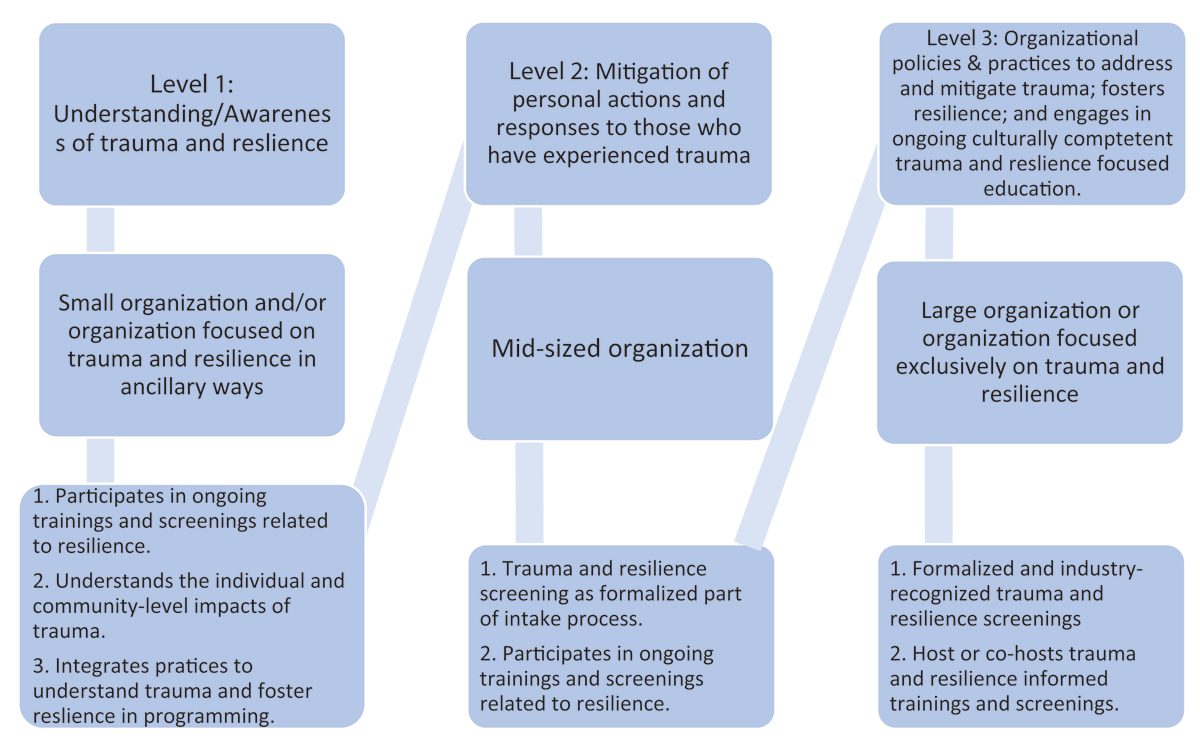
Figure 1
Example of three-tiered approach to trauma and resiliency-informed practices.
Next Steps
The research team has also continued to share the process and outcomes, including discussing our project via professional presentations and publications. This publication supports existing literature on the importance of campus and community partnerships, and our hope is that it also provides the essential steps for replicating similar projects in other communities. The partnership between University researchers and the Task Force exemplifies the importance of measuring outcome data for organization sustainability. Prior to this project, the Task Force had a limited understanding of how to develop a survey tool, collect data, and analyze the information to produce useful insights. Subsequent to this project, the Task Force formalized a data collection plan with the Positive and Adverse Childhood Experiences’ Network (PACES) tracking system, a national repository that tracks data in demographic sectors. Two members of the research team also continue as members of the Task Force, including service on the Task Force’s Data Subcommittee.
Recommendations
Campus-community partnerships are essential for addressing community challenges and leveraging university assets. UNCW’s Center for Social Impact joins other programs and institutes across the country who focus on academic partnerships with community experts. For example, the University of Georgia’s Archway program has been central in determining the needs of rural hospitals (Cherry et al., 2017; Robinson et al., 2016). Emory University’s Prevention Research Center (EPRC) has worked alongside faith-based organizations to address environmental changes (Emory, n.d.). These partnerships privilege the role of the community in identifying their needs and relying on local universities to lend their expertise related to scholarship. Campuses and communities who want to partner in addressing social ills can invest time and human resources in cultivating partnerships. These relationships can be advantageous for the community, students, researchers, and administrators. Strategizing the dissection of a stand-alone Data subcommittee into each population-focused subcommittee would be beneficial as the Task Force moves forward in collecting outcome data for sustainability of the mission of NHRTF. Continued partnership, communication, and collaboration between UNCW and the NHRTF can be mutually beneficial to the University and local community.
Limitations
One researcher conducted the coding of the qualitative responses. While a second researcher reviewed the findings, the team neither double-coded nor tested for interrater reliability. The research team did not have consistent overlap until after the presentation of the preliminary report. Initially, two researchers created and helped to administer the survey. A second set of researchers analyzed the findings and presented the preliminary research to the team. The instrument was intended to be used to survey a representative (ideally someone in leadership from each organization represented on the RTF). However, given the low response rate and the overlap of some respondents from some organizations, we do not believe these data are an accurate representation of all community partners the Task Force engages. This limitation suggests a need for better communication regarding the importance of data to inform future community initiatives and practice. A stand-alone inclusive data subcommittee may be the reason for such siloed thought processes.
Conclusion
Longstanding and intentional community partnerships are ever evolving in many neighborhoods. Additionally, universities and colleges are increasing their community linkages and marshalling resources to positively impact the communities where they are situated. This case study demonstrates how intellectual capital once cloistered on campuses and reserved for generating academic insights can be productively deployed to facilitate community change. The success of this engagement hinged on one simple premise: the community was in charge. This process started with a community-defined research question, and the subsequent investigation produced feasible and actionable recommendations for implementation. Universities and colleges can continue to play important roles as servant leaders by engaging communities as partners and equals in collective pursuit of an outcome-based common purpose.
Competing Interests
The authors have no competing interests to declare.