
Introduction
Community engagement (CE) has been defined as “the process of working collaboratively with and through groups of people affiliated by geographic proximity, special interest, or similar situations to address issues affecting the well-being of those people” (Clinical and Translational Science Awards Consortium et al., 2011, p. 3). CE recognizes that people should be at the center of efforts to improve health because they are the foundation of resilient communities and health systems (WHO, 2020). This concept of people and communities being at the center of health improvement initiatives is not new. The Alma Alta Declaration of 1978 asserts “people have the right and duty to participate individually and collectively in the planning and implementation of their health care” (Pan American Health Organization/WHO, 1978). However, health improvement initiatives and research have historically failed to apply this principle. The Patient Centered Outcomes Research Institute (PCORI), which was created by Congress in 2010, is the largest public research funder that focuses primarily on Community Engaged Research (CEnR) (Our Story, n.d.). With the creation of this funding stream, there has been renewed attention on the importance of engaging people and patients in health care initiatives.
Several research models have been used to apply the principle of community engagement. Patient Centered Outcomes Research (PCOR) and Community Based Participatory Research (CBPR) have common principles of involving the subjects of research, or stakeholders, throughout the research process and should be thought of as complementary approaches (Kwon et al., 2018; Sofolahan-Oladeinde et al., 2015). CBPR is one of the most well-known models of CEnR and focuses more broadly on a community’s health; while PCOR, which is a more recently proposed framework, focuses more on patients and medical problems (Deverka et al., 2013). Both share similar goals of community engagement and stakeholder involvement. The level of stakeholder involvement may be conceptualized as occurring along a continuum (Burlew et al., 2018; Michalak et al., 2016). Traditional research often includes little to no involvement of the community being studied and is driven solely by the investigator. As community involvement increases, community members may perform limited roles, or they may share equally in decision making power with academic partners (Burlew et al., 2018). Community engagement has been shown to be positively associated with the perception of both personal and community-level partnership outcomes (Khodyakov et al., 2011). However, involving the public in a meaningful way has also been recognized to take a significant amount of time and effort to avoid being merely tokenistic (Paul & Holt, 2017).
Community engagement strategies have been employed successfully in a variety of mental health research. A mixed-methods evaluation of 21 mental health research studies demonstrated that community engagement in mental health research is positively associated with perceived professional development, as well as political and community impact (Khodyakov et al., 2011). A comparison of a community-engaged approach versus a more traditional technical assistance approach to depression care for low-income minority women showed statistically significant positive effects for mental health quality of life, barriers to care, and depression self-efficacy measures at 12 months post-intervention. This finding supports the hypothesis that compared to more traditional approaches, community-engaged approaches may lead to outcomes that result in a better quality of life, service, access, and resiliency among patients (Ngo et al., 2016). Establishing a lasting community and academic partnership to address mental health issues is not easy. Barriers to establishing a successful partnership have been previously identified as including trepidation of community stakeholders, complex research methods, uncertainty among academic partners, and unclear partnership decision-making principles (Delman et al., 2019). Despite this difficulty, mental health research has sustained successful community partnerships for years (Dobransky-Fasiska et al., 2009). One way in which the communities can be engaged in mental health initiatives is through the establishment of mental health community advisory boards (CABs) (Dossett et al., 2018). CABs have been found to make a difference in conducting culturally appropriate and successful research in rural communities (Isler et al., 2015). A CAB was used to study factors influencing attitudes about HIV and HIV/AIDS research. The CAB was made up of community leaders, providers, and people living with HIV/AIDS in six rural counties in the Southeast. Rurality has also been identified as a significant challenge of community engaged research in rural communities (Cramer et al., 2018). In a self-evaluation of a rural CAB that partnered with an academic medical center on a research study to address rural preterm birth, rurality was found to be the greatest challenge to participation in the CAB. Travel time created a hardship and efforts to address this with video conferencing were not always successful with unreliable functioning in rural areas with unpredictable Internet coverage.
Community engagement, and particularly CBPR approaches, have been proposed as ideal for addressing stigma in mental illness (Michalak et al., 2016). The Collaborative RESearch Team to study psychosocial issues in bipolar disorder (CREST.BD) has utilized focus groups and a group of researchers, health care providers and community members in guiding several projects related to stigma and mental illness (Suto M et al., 2012). One of these projects included the development of a theater performance given by an individual with the lived experience of bipolar disorder.
Stigmatizing views of mental illness can result in difficulties accessing mental health care (Kular et al., 2019; Ostrow et al. 2014) and is often cited as a particularly significant barrier for those living in rural areas (Polaha et al., 2015; Robinson et al., 2012). However, the literature is scarce when it comes to using a community-engaged approach to address mental health and associated stigma in rural communities. One study used a mental health community advisory board in rural Florida. The advisory board was made up of eight community leaders from different service organizations, including church members, a public school teacher, and public health department staff. Academic partners included a psychiatric nurse, a child psychologist, and an educator. One member had a double role as a clinical university faculty member and a nurse practitioner at the public health department. Community members or individuals with mental health issues themselves only participated sporadically by occasionally attending advisory board meetings and participating in decision making (Stacciarini et al., 2011). While those who work for organizations that serve those with mental health issues do have expertise, they cannot fully represent the perspective of the community members themselves.
In this paper we will share the process of developing a mental health research advisory committee, outline lessons learned from the community and academic partnership, and share focus group summaries created by the community partners themselves as an example of the quality of work that can be created through successful partnerships.
Approach
This report focuses on implementation of a Tier I PCORI award entitled “Building a pipeline to improve mental health care, self-management, and outcomes in rural communities.” Tier I awards aim to develop research capacity, create partnerships, and build infrastructure to conduct research (Pipeline to Proposal Awards, 2014). The nine core overlapping CBPR principles and PCOR strategies as previously described by Kwon et al. were used in the development and implementation of the project (Kwon et al., 2018). Stakeholders were equal decision makers and integral throughout the development and implementation of the project. The Tier I work plan and timeline for this community engagement project is outlined in Figure 1.
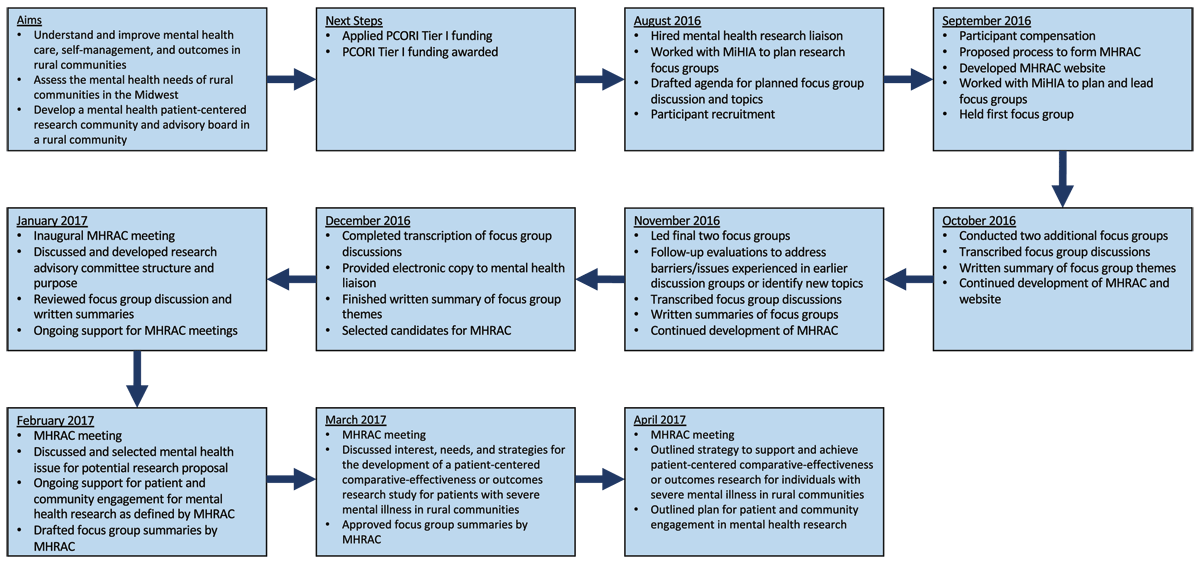
Figure 1
PCORI Tier I Work Plan and Timeline.
Reflexivity
For this project, the community health researcher aimed to develop a mental health patient-centered research community and advisory board for a rural region in the Midwest with the long-term goal of improving mental health care, self-management, and outcomes in these communities. The community health researcher was a new member of the physical community and acquired funding to understand the mental health needs within the region. All of the authors reside in the state and identify as female Caucasians with advanced educational degrees working in medical fields or as academic researchers with professional experiences associated with mental health stories. While the community engagement involved a major academic institution, the institution’s role was minimal and primarily due to the community health researcher’s and authors’ affiliations. Community members were integral to all stages of the project.
Focus Group (FG) Recruitment
Five FGs were conducted in a rural region (94% white based on the 2020 US census) in the Midwest from September–November 2016. Adults (n = 38; 28 females and 10 males) participated in five 90-minute FGs to identify unmet behavioral health needs as well as available mental resources in rural communities. We aimed to enroll 12 participants in each FG.
Participants were recruited using fliers, social media, networking, and word of mouth. The flyers advertised for direct care providers and community members, defined as anyone who interacts with and serves individuals with mental illness as part of their career, such as EMTs, firefighters, pastors, pharmacists, volunteers, transport drivers, police officers, librarians, hairdressers, bartenders, small business owners, and farmers. Fliers were distributed throughout the region, posted on hospital bulletin boards, and given to human resource personnel for dissemination within mental health care facilities. The Michigan Health Improvement Alliance, Inc. (MiHIA) provided an email list consisting of mental health professionals and stakeholders within the region so that fliers could be circulated electronically. Aligning with the county’s Mental Health Services & Gap Committee for the Community Health Improvement Plan helped to establish our credibility in the community and offered partnership opportunities with patients, stakeholders, and researchers.
FG composition was the following: FG1 (N = eight) targeted direct care providers and included providers of mental health services and primary care, including social workers, nurses, psychiatrists, psychologist, home health care coordinators; FG2 (N = nine) and FG3 (N = 12) targeted community members and included first responders, community organization members, rural health care network managers, non-healthcare employees, social workers, health department employees, community hospital educators, psychiatrists, therapists, early childhood educators, local college faculty, and users of mental health services; FG4 (N = four) and FG5 (N = five) targeted mental health users and primarily included patients and family members with the addition of a therapist and mental health professional in FG5. We reached FG saturation of targeted direct care providers and community members [67% saturation in FG1 (N = eight; seven females, one male), 75% in FG2 (N = nine; six females, three males), and 100% in FG3 (N = 12; nine females, three males)]. FGs that targeted mental health users were smaller [FG4 (33%; N = four; three females, one male) and FG5 (42%; N = five; three females, two males)]. FGs were audio recorded and all participants were compensated with a $25 visa gift card and a meal during the session.
Question Development
FG questions were developed beginning in August 2016 with assistance from MiHIA. Patient and community feedback identified the following discussion topics: mental health stigma, self-management and mental health care, access to care, financial education, emergency room care, and first responder issues. Questions were initially generated by the FG moderator hired by MiHIA. The community health researcher (CAJ) supplemented questions extensively and collaborated with academic researchers with expertise in financial education (ET) and stigma (J. Zhuang). The questions were compiled and ranked based on importance within each theme (stigma, financial education, emergency room care, etc.) and selected specifically for the participants of each FG (Table 1). Questions were asked in a consistent manner to all groups and projected as a PowerPoint presentation during the FG sessions so that participants could refer to the question during the discussion. Each FG discussion started by asking participants about stigma associated with mental illness/health that was experienced in their communities as well as firsthand. For example, each FG was asked “How do people talk about mental illness/health in this community?”
Table 1
Abbreviated questions asked at focus group discussions.
| 1. | What do you see as the critical issues surrounding mental health in this community? |
| 2. | How do people talk about mental illness/health in this community? |
| 3. | Are there other self-management tools used to manage mental health?* |
| 4. | Are there other barriers to managing your mental health?* |
| 5. | What resources, people, and/or activities are currently available to support family/friends who care for those with a mental illness? |
| 6. | What resources, people, and/or activities are currently available to individuals with mental illness? |
| 7. | What frustrates you when seeking mental health care from primary care providers? |
| 8. | When do you go to the Emergency Room (ER) for help? |
| 9. | What financial issues do individuals in your community struggle with? |
| 10. | Are there different or additional financial stressors for individuals with mental health issues? |
| 11. | Many individuals with mental illness may self-medicate to alleviate their symptoms. In this region, what are common ways that people self-medicate and for what? |
| 12. | Who do you contact first for help? |
| 13. | What happens if you contact first responders (police, firefighters, EMT) for help? Would you prefer to contact someone else? |
| 14. | If you could change one thing to improve your mental health care within this community, what would it be? |
| 15. | If there was one message you wanted to share or be heard today related to mental health, what is it? |
[i] * List of common self-management techniques was provided to focus groups (Janney, 2022).
Mental Health Research Advisory Committee (MHRAC) Development
The Mental Health Research Advisory Committee (MHRAC) served between December 2016–April 2017 and was composed of 30 adult volunteers (21 females, nine males). MHRAC was formed with the intention of involving patients, significant others, and community members throughout the research process. As a community-engagement project, it was imperative that the needs and concerns identified throughout the project came from members of the community, rather than the academic partners. MHRAC provided an opportunity for participants to interface with mental health professionals, patients, family members, stakeholders, and community members so that the challenges to mental health care facing the community could be understood by all.
Individuals were recruited for MHRAC from FGs and the community using fliers, announcements, and word of mouth. Although individuals often represented more than one role within the community, each MHRAC member selected one of the following six roles to represent during the initial meeting: patients (N = seven), family members (N = four), community members (N = seven), researchers (N = four), clinicians (N = three), and stakeholders (N = five). We allowed individuals to self-identify their roles and choose language to describe their experiences with emotional and mental distress that felt appropriate to them; for this reason, participants chose to refer to themselves as “individuals with mental illness” to create a comfortable and confidential environment. We did not verify participants’ positions within the community or mental health status to further facilitate their anonymity. Meetings were held monthly for two hours in the evening to accommodate the work schedules of the participants, reduce practical barriers such as the need for childcare, and increase attendance.
MHRAC members established the governance structure; reviewed, summarized, and de-identified the FG transcripts; and discussed viable PCOR ideas. MHRAC decisions were determined by a majority of votes from the six governance groups [adults with mental health issues (two votes); family members or adults supporting person(s) with mental health issues (one vote); researchers (one vote); stakeholders (one vote); mental health clinicians (one vote); and community members (one vote)]. Adults with mental health issues were given two votes while all other governance groups were given one vote. This voting structure allowed the perspectives of individuals with mental health issues to have a slightly greater impact than other governance groups, which was a priority as the issues discussed directly affected this population. Weighted votes also prevented ties during decision-making.
One aim of MHRAC was to summarize the findings from the FG discussion and to identify key mental health themes and issues expressed by FG participants. Initially, each MHRAC member volunteered to read one of the five deidentified FG transcripts and to work in small subgroups to prepare summaries for each FG. To facilitate the FG summaries, an undergraduate student who identified as a community member wrote draft summaries for each of the five FGs based on the FG transcripts. These draft summaries were shared with the subgroups along with general instructions regarding how to summarize and edit the draft summaries to reflect the tone and intent of the FG transcripts. Subgroups deliberated amongst themselves on how to summarize themes and what to emphasize from the transcripts. When subgroups reached a consensus, a summary draft was submitted to the community health researcher for review. Final summaries were presented and approved by the entire MHRAC and distributed throughout the community (Janney, 2022).
In addition, MHRAC members engaged in various exercises to identify and prioritize the key mental health research issues for the community. Smaller workgroups refined specific ideas, which were presented to MHRAC membership for further discussion with the intention of applying for a Tier II PCORI award. Finally, MHRAC determined ongoing research priorities within the community and aided in future grant applications.
Lessons Learned
Establishing University-Community Partnerships
This project originated out of a satellite medical campus of a large university in the Midwest. The newly hired community health researcher (CAJ) made the first attempt at engaging the mental health community in research at the satellite campus. Thus, the project established new partnerships between the university and the community. The communities surrounding the campus were rural, which created additional challenges in identifying resources and community partners. As outlined in the approach section, relationships were formed with key partner organizations, including the Mental Health Services & Gap Committee for the Community Health Improvement Plan (GAP) and the National Alliance on Mental Illness (NAMI).
Community Engagement Principles
Kwon et al. outline how CBPR principles can be applied to PCOR projects to facilitate meaningful engagement and develop sustainable projects that address “patient community” needs. The project applied the nine core CBPR principles and PCOR strategies previously outlined in their research (Kwon et al., 2018).
Shared control is foundational to community engagement. This concept is highlighted by the PCOR strategy of having researcher and patient stakeholders sharing control equally. The CBPR principle of having collaborative, equitable partnership in all phases of research also reflects the importance of shared control. Shared control was emphasized in the fact that MHRAC members established the governance structure themselves, deciding to give more weight to votes of individuals with mental health issues. Stakeholders were involved throughout the process including question development for the FGs and in developing the FG summaries. In PCOR, people are the participants and collaborators. Likewise, in CBPR the focus is on the community. These approaches were reflected in this project by the creation of the mental health research advisory committee to represent various community perspectives. The creation of the mental health research advisory committee also served to increase community capacity which is a focus of both PCOR and CBPR. Both PCOR and CBPR frameworks encourage building upon existing assets in the community. We worked with several community assets that represented individuals with mental health issues (NAMI) and professionals that worked with individuals with mental health issues (GAP). In this way, we built upon existing strengths and resources in the community. A key overarching theme to both CBPR and PCOR is the importance of the benefit to the community, which is reflected in how the project was designed not as research, but as a community engagement project aimed at identifying the community’s priorities.
Both PCOR and CBPR encourage continued evaluation of the project with input from community members. In PCOR, the goal of the research is not only the advancement of knowledge, but also includes a process that is reflective and involves actions related to improving engagement and sustainability with ongoing assessments of success and challenges. The corresponding CBPR principle is the concept that CBPR occurs through an iterative and cyclical process. The development of the summaries, which were one of the primary outputs of this project, were developed in this manner. They were drafted by small groups of community members and then reviewed by members of MHRAC. The final summaries were distributed to all partners who participated and throughout the community in keeping with best practices of community engagement. PCOR principles hold that data should be shared, and researchers and patient stakeholders should decide its use and dissemination. CBPR disseminates the results of research to all partners, involving them in the wider dissemination of results.
Sustainability is the goal for PCOR projects and CBPR involves a commitment to sustainability. Sustainability can be difficult to achieve but, according to PCOR principles, should be strived for. The project addressed sustainability by contributing to community momentum within GAP and phasing out oversight of the university partner.
Focus Group Summary Discrepancies
MHRAC was responsible for preparing written summaries to identify key mental health themes and issues expressed by participants in FGs. When comparing the original transcript to the FG summaries compiled by MHRAC, these authors determined differences between the reports. While the perspectives of participants in FG1 (comprised of direct care providers) and FG2 (community members) were accurately represented within the summaries, discrepancies arose during the translation from transcript into summary for groups that had a more heterogeneous composition as seen in FG3, FG4, and FG5. FG3 consisted of community members, such as patients, researchers, stakeholders, and providers; FG4 consisted of mental health users, including patients and family members; and FG5 targeted mental health users, including patients, stakeholders, and mental health providers.
Participants in FG3 emphasized themes such as stigma, lack of substance use treatment options, and inadequate physician education in areas such as the opioid epidemic. Participants made impactful statements about stigma which were understated in the summary. The transcript for FG3 intensively discussed the risk of disclosing mental illness. For example, individuals felt that divulging their mental illness to others might result in restrictions on their lifestyle, such as hunting and infringement on their right to own guns.
A primary concern expressed by FG4 participants focused on the shortage and poor quality of psychiatrists and other mental health providers in their respective communities. This point was mentioned briefly in the summary but was not supported by the participants’ personal anecdotes describing the consequences of mental health users not receiving immediate care. Participants also disclosed personal experiences, including interactions with law enforcement officers and struggles navigating the mental health care system, which were conveyed better in the transcript than depicted in the summaries.
Participants in FG5 indicated a plethora of issues between physicians and patients, specifically in an emergency room (ER) setting. Participants felt that ER providers were ill-equipped to handle mental health crises and did not have adequate training in this area. The transcript exposed the negative effects that this lack of mental health training and communication had on the physician-patient relationship; however, this theme was not portrayed to the same extent in the summary. Participants also discussed the need for additional mental health training for law enforcement officers, although the summary omits the powerful personal experiences shared by mental health users in the transcript.
Discussion
Establishing University-Community Partnerships
After the completion of the project, the funding for the community researcher overseeing the project was not renewed. While the relational bonds that were established during the project were not broken, the same amount of energy and engagement devoted to this relationship is no longer present. For others looking to replicate the project, funding may be a limitation, as establishing new relationships between the university and community takes a significant amount of time and effort and is easier with dedicated staff.
While there is no longer a community health researcher position for the satellite medical campus, this project built a foundation of trust between the university and community, and the relationship has continued through the medical students who engage in various projects in the local community.
Community Engagement Principles
Community engagement exists on a spectrum, from projects completely driven by academics with no involvement of the community to projects that involve the community starting from the design to the dissemination of the findings. The degree of community engagement was a strength of this project. Per our literature review, no other projects were identified addressing both mental health in rural communities and involving the community members in the actual creation of the end product (final FG summaries). While we believe community engagement to be a strength of the project, it is something that can always be improved. Upon reflection, community members could have been more engaged in the development of the study design. Feedback could also have been gathered from the FGs. From a research perspective, we would suggest a more systematic approach to networking with community agencies. Since CBPR and PCOR principles were successful in engaging rural communities, we believe these same principles could be successfully implemented in a variety of communities, both urban and rural.
Recruitment
According to Tang and Davis (1995) there are four factors that are used to determine the optimal FG size, which include “the number of questions asked, the allotted time for each question, the format of the FG session and the duration of the session” (p. 474). Above all, FG size is determined by the study aims with the ideal group size being four to 12 participants (Tang & Davis, 1995). A maximum of 12 participants was determined to be manageable, financially feasible, and reflective of the two communities in this project. Smaller FGs contributed to a comfortable environment for participants to disclose potentially sensitive information during the discussions.
While we were satisfied with the saturation of FG1–3, we would have preferred to have more participants in FG4 and FG5, which represented mental health users. We hypothesize that saturation was lower in these groups due to stigma, risk of disclosure of mental health status, and the community health researcher being a new entity with no established associations in these communities. Although increasing participants in FG4–5 may have resulted in more diverse perspectives from mental health users, the saturation achieved (N = four and N = five, respectively) remains acceptable according to Tang and Davis (1995). Overall, the high quality of the interviews suggested that the major theme of improved access to mental health care emerged regardless of group size.
Through our partnership with MiHIA, an established entity in these communities, we were able to target mental health professionals and stakeholders (FG1–3) via an email list provided by MiHIA. However, networks of adults diagnosed with mental illness (FG4–5) were not readily available. Hence, recruitment of adults with mental health issues relied on fliers and/or word of mouth. Delman et al. (2019) suggests that building trust is especially important in the beginning phase of a partnership, stating “partners are likely to have not worked together previously, there may be mutual mistrust, and community stakeholders often face power and resource imbalances when attempting to assert themselves equally” (p. 392). As new researchers to the community, the FGs were used as an initial means to develop trusting relationships between the institution and the community. The FGs were successful as measured by the unexpected number of individuals who volunteered for MHRAC and the additional research opportunities that arose following the focus groups.
Stigma and risk of disclosure was a challenge to overcome during the recruitment process, as these factors may have discouraged mental health users from participating in FGs. In a study of 386 white and Asian college students, Pedersen and Paves (2014) assessed the discrepancies between perceived public stigma, defined as “how an individual believed others would view and treat them if they sought treatment,” and personal stigma or “how the individual him/herself would view and treats others who seek treatment” (p. 143, p. 145). Results showed participants reported greater perceived public stigma than personal stigma with the greatest effect on women and those with mental health symptoms (Pedersen & Paves, 2014). This finding could explain the low saturation in FG 4–5, as individuals who identify as mental health users with active symptoms may have refrained from participating for fear of perceived public stigma. We believe personal or internal stigma also contributed to a lack of participation due to an individual’s “wish to avoid potentially unpleasant scenarios” (Kular et al., 2018, p. 1211). Mental health users who participated in our FGs identified many possible unpleasant scenarios that may have resulted from disclosing their illness, such as loss of jobs, significant relationships, and hobbies.
In an effort to reduce the threat of stigma and consequences of disclosure, the researchers encouraged individuals and family members to choose the terminology to best refer to themselves throughout FG sessions. While there has been much debate regarding the usefulness of the term “mental illness” in the field of mental health, Pies argues that this term adequately depicts the impairment of a multitude of one’s abilities in a way that draws upon ancient and transcultural beliefs and “classifies a form of human suffering and incapacity as one involving disordered emotion, cognition, reasoning, and behavior” (Pies, 2015). Ultimately, participants agreed with this all-encompassing term and, in a lengthy discussion between MHRAC and community members, participants determined the appropriate language to be “individuals with mental illness.” This thoughtful discussion occurred without tension, as participants were appreciative that researchers sought their perspective and respected their relationship and experiences with mental health care.
Focus Group Summary Discrepancies
Through the process of creating FG summaries, MHRAC was able to identify met and unmet behavioral and mental health needs and resources available in the targeted communities. Information was used by MHRAC to create a patient-centered agenda that was meaningful for these patients and rural communities and had the potential to significantly improve mental health care, self-management, and outcomes in these communities. The use of MHRAC participants in the FG summary process allowed us to engage the community, involve participants in reflection, and solidify the partnership between our researchers and community members. Previous studies have demonstrated the effectiveness of our community-engagement approach. According to Sofolahan-Oladeinde, Mullins, & Baquet (2015), patient-engagement has been successful in eradicating health care disparities due to building trust and community partnerships, which facilitates participation in the research and makes the research more meaningful to those involved. The relationship we established proved to be invaluable; it provided insight into mental health care grievances that were identified by participants who have experienced these issues first-hand.
However, we acknowledge limitations to our partnership that are embodied in the discrepancies between FG summaries and transcripts. It is possible that a conflict of interest was introduced by allowing MHRAC members to write the FG summaries. While this approach offered a unique perspective to ongoing issues in mental health care, individuals may have been apprehensive when using harsh language to portray their feelings due to a need to preserve the reputation of the community to which they belong and the healthcare services offered. Additionally, stigma may have limited information that participants were willing to disclose. It has been reported that disclosure is a form of internal stigma and “an individual may not want to disclose their illness to others due to internalized negative feelings such as fear and shame, and a wish to avoid potentially unpleasant scenarios’’ (Kular et al., 2019). Participants belonged to small, integrated communities; therefore, stigma may have prevented individuals from disclosing their feelings in FGs while surrounded by their peers. Stigmas may have also hindered participants from depicting their feelings to the fullest extent in the summaries. This possibility is most apparent in FG4 and FG5 summaries, as these groups specifically targeted mental health users.
Feasibly, FG summaries may downplay or exaggerate issues expressed by the focus groups. Downplaying mental health care issues has the potential to compromise mental health care reform by inviting policyholders and health care providers to overlook severe grievances that are presented as minor. Alternatively, exaggerating issues has the potential to misallocate time and resources for minor rather than major issues. In this project, down- or up-playing of issues may have been avoided due to MHRAC members being actively engaged in the drafting and reviewing of the focus group discussions and summaries. Briefly, all MHRAC members had access to the de-identified focus group discussions. Initially, a draft summary was provided to the smaller workgroups for their editing and approval. Workgroups were diligent in editing these reviews. Healthy discussions occurred with respect to identifying themes and appropriate tone and/or verbiage to deliver the diversity of messages expressed during the FG discussions. Although some FG summaries may have omitted details that were discussed in the transcript, we believe these details did not distract from the overarching themes that were presented in both the summaries and transcript. The need for improved access to mental health care was uniformly reinforced throughout FG transcripts and summaries. From our perspective, individuals and organizations who received the FG summaries understood the message and, hopefully, utilized this resource to initiate mental health care reform.
Conclusion
Our project was successful in forming a partnership between a university and two rural communities to identify major mental health care issues facing this population. Throughout the process, we acknowledged the importance of building and maintaining a relationship between researchers and community members. This relationship allowed us to foster trust and create a comfortable, respectful environment for community engagement. By establishing a partnership within the community, we were able to connect with participants in our project on a personal level. As a result, we obtained invaluable insight into mental health care grievances identified by participants through the lens of community members who are directly impacted by these issues.
MHRAC’s contributions to these rural communities included the development of a website for local mental health resources, identification and contributions to ongoing research initiatives within the communities and distributing FG summaries. FG summaries were dispersed throughout the community and provided at the county’s annual health meeting. Disseminating information is essential to elicit change; thus, publications regarding community engagement processes are necessary for both researchers, communities, and policymakers. Additional effort to distribute the FG summaries is advisable to assist with improving access to mental health care.
As evident throughout the FG sessions, stigma was a driving force in participants’ hesitancy to disclose a mental illness. Therefore, collaborative partnerships are key to disseminating our findings in a way that honors our participants and highlights the mental health care issues that they have identified, including barriers to substance abuse rehabilitation, psychiatric care, and emergency room treatment. We hope this project continues to guide policy and reform in rural communities throughout the United States in which individuals suffer from mental illnesses without adequate access to mental health care.
Additional File
The additional file for this article can be found as follows:
Appendix
Focus Group Summaries by the Mental Health Research Advisory Council (MHRAC). DOI: https://doi.org/10.33596/coll.97.s1
Acknowledgements
We are grateful for Kattie Trotter’s excellent moderator skills that contributed significantly to the quality of the FG discussions and to building a trusting research environment. We are also thankful to Erin Peterson for transcribing the FG discussions; and Brooke McKeon and Murphy Stadelmaier for de-identifying the transcripts.
CAJ designed and conducted this project. FG questions were developed by CAJ, Kattie Trotter at MiHIA, Jie (Jackie) Zhuang, PhD, and ET. AK and KS equally drafted the initial manuscript. All authors edited and approved the final version of the manuscript. MHRAC membership included Jenni Behrens, Marisa Boulton, Kathy Dollard, Carol Janney, Heidi Knizacky, Morgan Monte, Camille Nitschky, Marissa Palmer, Juliette Perzhinsky, Bill Schueneman, Barb Smith, Christine Tanzani, and others who preferred not to be named.
Competing Interests
Partial funding provided by the Patient Centered Outcome Research Initiative (PCORI) Tier I Award, “Building a pipeline to improve mental health care, self-management, and outcomes in rural communities” to Carol Janney, PhD at Michigan State University College of Human Medicine. 2016. Contract number: 5136946. The authors have no competing interests.