
One of the joys of teaching in higher education is the opportunity to work with students who aspire to change the world. In some academic fields, this enthusiasm can be harnessed directly through hands-on projects but it is difficult to offer students the experience of providing a tangible solution to a larger social problem in social science courses. Community-engaged courses in the social sciences run the risk of dampening students’ enthusiasm for work that addresses social problems by exposing them to the full complexity of an issue without the corresponding lesson that their work can make a difference. In our experiences both as idealistic students in the past and instructors of community-engaged courses in the present, this situation can leave students disappointed when they have not made an impact on the social problem that a course addresses. Yet, when an academic course engages an intractable issue in a community-based project, rather than purely in the classroom, student empowerment and place-based change can result (Lake, 2017). In this case study, we explore how course design can help students avoid the disempowerment that results from disappointment at the end of a community-engaged course.
Community-based research can unite teaching, scholarship, and service while also developing students’ critical thinking, active citizenship skills, and overall knowledge through experience (Gnagey, 2020; Rodriguez & McDaniel, 2019). Additionally, it situates students, faculty, and community members in the position of problem solver, resulting in unique learning opportunities (Gnagey, 2020). However, community-based research often involves intractable or wicked problems (Dearnaley, 2018). These are problems that have connections to other issues, are socially complex, and often are challenging to define (Adams et al., 2019).
One approach to studying intractable problems is a classroom-based discussion but “in the isolation of the classroom, it is easy to lay blame at others’ feet and to sidestep real-world complexities” (Lake, 2017, p. 694). Another approach is to engage the issues directly in a community-based project focused on creating solutions, rather than just discussion. The challenge of this latter approach is that it creates the potential for student disappointment because intractable problems are not solved quickly but student work engages these issues in a one or two semester setting. This in turn may dampen students’ enthusiasm for addressing social issues in their professional careers. Scholars have observed similar declines in student idealism in medicine (e.g., Griffith & Wilson, 2001; Morley et al., 2013), teaching (e.g., Shkedi & Laron, 2004), and law (e.g., Erlanger et al., 1996). We have observed this challenge in our own teaching and in discussions with other social science instructors who grapple with wicked problems in community-engaged courses at the undergraduate and graduate level.
The project discussed here brought undergraduate and graduate students together in the 2019–2020 academic year in a community-based research project focused on affordable housing in Navassa, North Carolina, a gentrifying town with a majority African American population near Wilmington, North Carolina in the United States (Figure 1). This article focuses on student experiences in a two-semester undergraduate capstone for sociology and criminology majors and a one-semester land use planning course in a Master of Public Administration program. In the case study, we explore the techniques that we incorporated into the courses to support students’ nascent desire to become change agents in their communities after graduation.
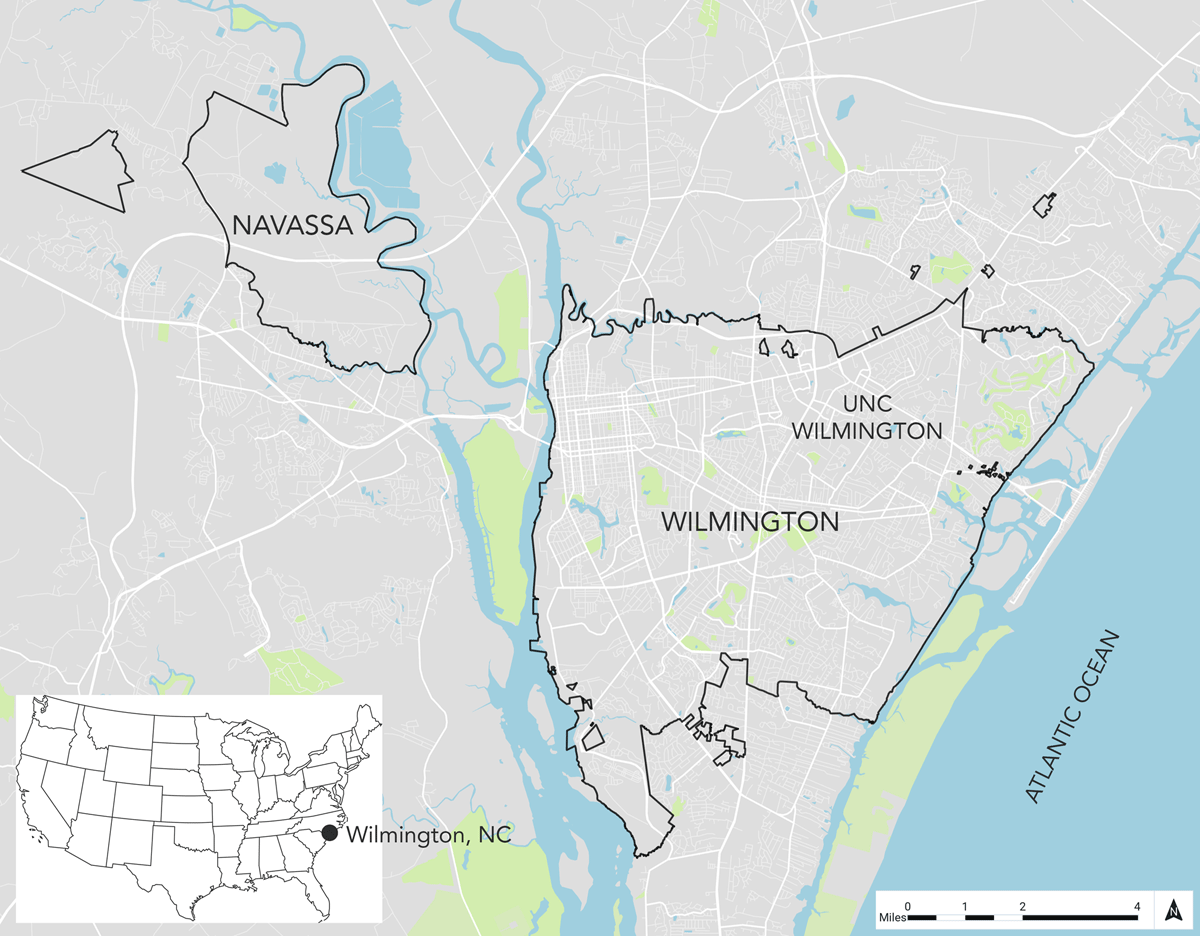
Figure 1
Map of the project location.
Our data source is student reflections written before, during, and at the completion of their work. Combining service-learning with reflection is a best practice in community-engaged research involving students (Ananth et al., 2019; Bott-Knutson et al., 2019). We used information from the reflections to assess the impacts of the course and the community partnership on the students. In the next section we present background information on the course and the community partner. We then analyze the student reflections and conclude with recommendations for similar community-based research projects.
Case study background
Affordable housing is an intractable problem in Navassa, North Carolina due to gaps between wages and the cost to rent or purchase a home, population growth, gentrification, and the environmental and social history of the town. Navassa is located in Brunswick County where 52% of renters and 27% of homeowners struggle to afford their homes (NCHC, 2019). Rent in Brunswick County is $866 on average when the average resident can only afford $563 towards rent expenses (NCHC, 2019). Regional population growth is placing significant pressure on the town’s housing market. Navassa is located in close proximity to two rapidly gentrifying cities, Wilmington and Leland, and within Brunswick County, one of the fastest growing counties in the state (Pratts, 2018). Navassa is also beginning to experience gentrification which will accelerate with the construction of two large housing developments, projected to total to 5,000 homes (Nunn, 2019). Today, Navassa’s population is 1,750 residents, 73% of whom are African American (U.S. Census Bureau, 2019) and many of whom identify as Gullah Geechee. Population growth in the town will not only raise housing prices but it will likely change the town’s cultural identity as well (B. Sutton, personal communication September 12, 2019).
Navassa’s environmental history further complicates its future. The town was historically home to fertilizer factories and other industrial facilities that employed large portions of the community and left behind five inactive hazardous waste sites and the Keer McGee Superfund site which is currently undergoing remediation (DUSRC, 2018). Natural disasters have also impacted the town. Hurricane Florence, a Category 4 hurricane, caused significant damage to the area in 2018 (Figure 2). Lower income residents are impacted disproportionately by hurricanes because they are more likely to live in a mobile home, the most physically vulnerable form of housing, and repairs cost a larger percentage of their income (B. Sutton, personal communication September 12, 2019).
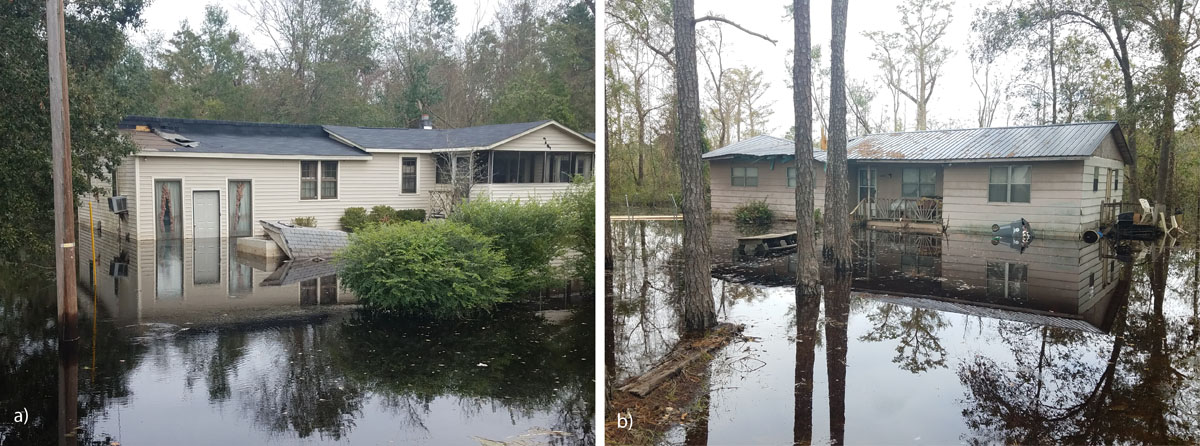
Figure 2
Flooded housing in Navassa following Hurricane Florence, 2018.
Considering the town’s environmental history complicates solutions to the affordable housing crisis because it raises difficult questions. For example, mobile homes are the main form of affordable housing in Navassa but are unsafe in hurricanes. Most mobile homeowners can’t afford to upgrade but can sell their property to a developer and make a profit that is large enough to purchase a home somewhere else, but not in Navassa. While this transition would result in a safer housing unit, it would also result in a net loss of affordable housing. Should the town provide an incentive or loan program to mobile homeowners or should it leave these decisions to the private market? In relation to the Superfund site, do residents who have suffered for years from the impacts of abandoned industrial sites on their health and property values have a right to new housing on the remediated Superfund site? Or should this waterfront property be sold to the highest bidder, generating public funds that can be used for another socially positive purpose? These complex issues provided rich fodder for class discussions.
Course structure
The courses discussed in this case study are part of an ongoing relationship between the University of North Carolina Wilmington (UNCW) and the Town of Navassa involving multiple courses that have engaged residents. These courses initially focused on the clean-up of the Kerr McGee Superfund site and public health concerns related to the site. Beginning in the 2016–17 academic year, UNCW course projects in environmental studies, public health, English, and public administration focused on Navassa, including two courses taught by one of the study authors. This created an environment in which residents of the town felt “studied” and we were careful to design the affordable housing-focused courses to provide a clear benefit to residents.
The project examined in this article was executed by students in two courses: public sociology and criminology undergraduate students in a capstone course spanning the fall 2019 and spring 2020 semesters and public administration graduate students studying land use planning in the fall 2019 semester. Seventeen students participated in these courses in total, nine undergraduates and eight graduate students. While both courses covered other topics within their curriculum, much of the class material was easily relatable to their work with Navassa. This resulted in community-based research and applied projects as students could apply content learned in the classroom to real world issues facing Navassa.
The goal of the sociology and criminology course was to collect and analyze data on attitudes and the need for affordable housing in Navassa to help inform policy decisions by town staff and elected officials. The undergraduate students were divided into three groups based on the data they utilized to explore the problem: preexisting data, qualitative data, and quantitative data. Research design was the primary focus of the fall semester and data collection and analysis took place in the spring. The preexisting data group explored affordable housing in Navassa and the region through sources such as the United States Census Bureau. The qualitative group developed interview and focus group questions related to affordable housing in order to learn more about the attitudes of Navassa residents toward affordable housing. Finally, the quantitative group developed an affordable housing survey that was sent out in Navassa residents’ water bills. Once data was collected, the undergraduates analyzed it and shared their findings with Navassa town officials.
The graduate course aimed to recommend affordable housing policies and programs and to communicate these alternatives in a way that would continue to be useful to town officials after the class ended. The graduate students began the semester by identifying a short list of affordable housing programs or policies that have been successful elsewhere and might also succeed in Navassa. They then worked with the community partner to select the policies and programs with the most potential for Navassa, such as employer assisted housing and accessory dwelling units. Each student wrote a case study on their selected topic. In the second half of the semester, the students developed recommendations for how to implement their case study topic in the town and presented their recommendations at a public meeting in Navassa. The students also completed written recommendations which we compiled with the case studies into a document that is currently informing discussions of the town’s Comprehensive Land Use Plan. Portions of the student work will ultimately be included in the Affordable Housing Chapter of the Comprehensive Plan (B. Sutton personal communication, Nov. 27, 2021).
Dealing with Disappointment Through Course Structure
Student disempowerment is an inherent risk of academic courses focused on major social issues due to course design and the intractable problems typically explored (Lake, 2017). Our goal was to empower students in the courses to pursue professional work on social issues after graduation by limiting the degree to which they experienced disappointment in the impact of their work in the course. Although fully eliminating disappointment is not possible, we aimed to reduce it by providing positive experiences to counteract the inevitable realization that a student project is very unlikely to have a measurable impact on an intractable problem. We designed this project to address the potential for student disappointment in several ways. The courses included integration between the undergraduate and graduate classes, a two-semester undergraduate project, a strong community partnership, and opportunities for professional and intellectual growth that exceed the traditional lecture and discussion-based course.
The collaboration between an undergraduate course and a graduate course was a key design decision. The graduate students attended an undergraduate class session in which students workshopped their survey and focus group questions and undergraduate students attended graduate student presentations. The collaboration provided an opportunity for students in different programs studying different disciplines to view their contributions to the project as part of a whole and to learn from each other (Shostak et al., 2010). Interdisciplinary collaboration is also important as it provides different training and perspectives on an issue which is critical because most intractable problems cannot be solved with a single discipline’s approach (Tobi & Kampen, 2018; Walsh et al., 1975). Additionally, collaboration, imagination, and a variety of knowledge types are important parts of public policy responses to intractable problems (Bott-Knutson et al, 2019). We hoped these interdisciplinary experiences would buffer against disappointment with the course project.
The constraints of a one semester course can lead to disappointment when the results that students are striving to achieve are not realized. The undergraduate course was structured to span two semesters so students would have the opportunity to design and then execute a community-based research project. During this time, we were able to help students consider a variety of ways they could analyze the issue of affordable housing. The goal was for students to discover through the process of developing the project that housing affordability is complex and is determined by a number of factors. Students read materials related to affordable housing and how it connects to other social issues and then discussed the relationship between the material and Navassa. This two-semester format was not possible with the graduate course due to the Master of Public Administration course schedule but given its success with the undergraduates, we are considering this format for future graduate courses.
The community partnership design was a critical component of the project. The project was initiated by the community partner, a Navassa staff member, and we integrated him directly into both classes. He participated in several class sessions to present on the history of Navassa and share community challenges, answer student questions, and give feedback on presentations. Additionally, he led the undergraduate students on a windshield survey tour of Navassa so students could physically experience the housing opportunities and challenges discussed in class. The graduate students also engaged directly with the Navassa Planning Board by attending and reflecting on a public meeting and presenting their final recommendations to Planning Board members. Beyond these formal meetings, the community partner also worked with individual students and groups by email as questions arose throughout the course. This relationship not only developed student knowledge and research skills but also connected the community partner with the research process as it unfolded rather than simply receiving suggestions on potential solutions to the problem.
Engagement with the topic of affordable housing in a physical place, rather than only in classroom discussion of course readings, allowed us to integrate opportunities for both intellectual and professional growth into the course. Students were encouraged to apply what they learned from readings and discussions to their experiences and observations in Navassa. We anticipated that applied learning would lead to intellectual growth by deepening their understanding of who struggles to find affordable housing and why. By incorporating professional skill-building into the courses we also created the opportunity for professional growth. The undergraduate course incorporated skills such as survey design and geographic information system (GIS) mapping. The graduate course incorporated professional skills relevant to future public servants, including writing a staff memo, making a policy recommendation to a local government board, and presenting at a public meeting. It was our hope that intellectual and professional growth would also buffer disappointment and empower students to keep working on similar issues after graduation.
Research Methods
The data source for this qualitative study was reflections written by the students during the courses. Students in both the undergraduate and graduate courses completed writing assignments designed to encourage reflection on how the course impacted them academically, personally, and professionally as well as their hopes for the project’s impact on Navassa. The undergraduate students wrote reflections at the beginning, middle, and end of their second semester in the course with the first written before they began their work in the community. The graduate students wrote two reflections, the first after attending a public meeting of the town Planning Board and a second reflection after they presented their final projects in Navassa. These reflections were designed to function simultaneously as a pedagogical tool to deepen the student’s experience in the course and to collect data for future analysis. The study was approved by the University of North Carolina Wilmington’s Institutional Review Board (IRB #19-0260).
Self-selection into the courses by students who are interested in affordable housing is a possible source of bias in our data, but, to the best of our knowledge, no students selected the undergraduate or graduate courses specifically because the focus for the semester was affordable housing. Undergraduates in the sociology/criminology major are required to take a capstone course or complete a thesis. If students select the public sociology major, they take the two-semester public sociology capstone, but they do not know before the course begins what the topic will be. The graduate course, Land Use Planning, is a core requirement for the urban planning concentration in the MPA program and the focus on affordable housing in the fall 2019 term was not publicized in advance.
The reflections were coded in two cycles. In the first cycle, we read the reflections and used descriptive codes to capture the students’ experiences (Saldaña, 2019). These codes were not pre-determined but emerged as we read. For example, many students discussed changes in their understanding of affordable housing and others described their interactions with the community partner. These passages were coded as such. Two pre-determined codes were also used in the first coding cycle: expectations for the course and feelings about the outcome. In the second coding cycle, we clustered the descriptive codes under pattern codes to identify the major themes that cut across the students’ reflections (Miles & Huberman, 1994; Saldaña, 2019). The analysis that follows is structured around the pattern codes.
Analysis
From the comparison of the graduate and undergraduate courses, we conclude that the two-semester course structure, collaboration between the undergraduate and graduate courses, opportunities for intellectual and professional growth, and the strong community partnership were sufficient to overcome disappointment and empower students to continue working on intractable problems in the future. The main source of disappointment for the undergraduate students was the shut-down in response to the COVID-19 pandemic, while the graduate students did not mention disappointment in their reflections. In addition, students from both groups mentioned a desire to work on affordable housing issues in their future careers, indicating that the courses did not disempower these students and suggesting that the courses may have empowered them. We stop short of claiming causality because the study design precludes this claim. In this section we discuss the student reflections that support these conclusions first in relation to the individual course design decisions, followed by a discussion of student disappointment and empowerment at the end of the course.
Impact of the Two-Semester Course Structure
The undergraduate reflections from the beginning of the second semester highlight the impact of spreading the course over a full academic year. While the undergraduates had enthusiasm for community-based research, they did not start the academic year with a nuanced understanding of the need for affordable housing or the impact on individuals who can’t access it. One student described her intellectual evolution:
Initially, I had allowed myself to believe in common misconceptions about affordable housing. It was primarily based around everyday stereotypes about who lives in affordable housing and the mannerisms that go along with it. But I found throughout the semester that there are so many factors and incidents that contribute to someone living in affordable housing.
Another wrote:
Affordable housing was a topic I had heard of through my sociology classes, but never knew the extent to how relevant, impactful, and present it was…The biggest realization I had in the Fall semester was how a lack of affordable housing causes a trickle effect to other instabilities in life. For example, lack of affordable housing can impact a child’s education which then effects their future.
The knowledge that the undergraduates gained in the classroom during the fall semester helped them understand the barriers to creating affordable housing that they experienced in the field. In only one semester, the literature review would not be possible, leaving students more likely to experience disappointment because their approach to the issue would be based in the stereotypes and misconceptions they brought into the class.
The two-semester time frame also gave the undergraduates enough time to fully consider the challenges they were likely to face completing their research in Navassa. Had the semester unfolded as planned (i.e. without the emergence of COVID-19), these students were likely well prepared for the typical setbacks any community-based research project faces.
Impact of the Collaboration Between Undergraduate and Graduate Students
We did not ask a specific question in the reflections about experiences working with the other class, but some undergraduate students mentioned this topic in their reflections and students in both classes raised the topic in class discussions. Students enjoyed the collaboration because it was different from previous courses and provided unique learning opportunities. An undergraduate discussed how the graduate students provided a learning opportunity in his reflection, writing, “another way my knowledge of affordable housing has changed was listening to the graduate students present different ways communities can address affordable housing through a variety of avenues. I enjoyed the presentations a lot.” The graduate students mentioned in class that they enjoyed helping the undergraduates develop their survey and focus group questions and having them in the audience for the mid-semester presentations. These experiences demonstrated to the graduate students that they have professional knowledge that is valuable to others. While we did not directly measure the magnitude of this confidence boost, we see it as supportive of the professional presentations that the graduate students gave in Navassa at the end of the course.
Impact of Opportunities for Professional and Intellectual Growth
All the undergraduate and graduate students reported growth in their understanding of affordable housing. For example, one undergraduate reported that “my knowledge of affordable housing has changed drastically over the past two semesters and with the applied learning project. Reading Evicted, researching Navassa, researching affordable housing (or the lack thereof) all over the country has opened my eyes.” Intellectual growth also got equal coverage in the graduate students’ final reflections.
Professional growth was mentioned in reflections written by students in both courses. Undergraduate students were grateful for the experience of engaging in research which they felt would be a marketable skill on the job market and in graduate school applications. For example:
This experience has taught me a great deal about research and how important it truly is. Research is not boring. It is actually exciting to get into a community or a bunch of data in an attempt to help solve societal problems. I think this will help my future career goals because a lot of employers look for a solid research background. They also look to people who have been involved in the community.
The graduate students had similar feelings on professional growth related to presenting to the Planning Board members and making policy recommendations: “this type of skill set is not always provided in academic courses and was something that I was very thankful to be able to obtain during this course.” The students were satisfied by the intellectual and professional growth they experienced in the class, thereby decreasing the possibility for disappointment with the course overall.
Impact of the Partnership
It was important for students to directly engage with Navassa to learn about the community and have a deeper understanding of it. This familiarity with the town and the community can help students to understand why a problem like affordable housing may not be easily solved (historical discrimination, exclusionary zoning, environmental history, etc.). Having this strong partnership can also help students understand what may or may not be feasible when it comes to solutions and prevent disappointment when a solution they think is ideal is not feasible.
Students engaged with the town of Navassa and the community partner in a variety of different ways. This engagement both supported intellectual growth and helped the student’s see their work as useful to the town, even if it will not measurably impact housing affordability. The physical experience of Navassa was eye-opening for the undergraduates who “knew very little about life outside of New Hanover County and some of Pender County before learning more about Navassa; I just knew it as an exit marker.” The driving tour of Navassa was particularly impactful:
I think I considered affordable housing an almost taboo topic beforehand. I never really thought to talk about what it is was and the implications that came with it. Now that I have been able to learn more about it, I realize that it is all around us. I think what specifically changed my knowledge was the tour of Navassa. It is one thing to read about something on paper, but it is completely different when you are able to see it in person. The housing in Navassa ranged from literal mansions to water-damaged townhouses. The scope of affordable housing seemed very broad, yet constrictive at the same time. Having been able to see these neighborhoods and areas in person allowed for me to expand my knowledge of affordable housing.
The undergraduate students also described their direct experience in Navassa as pivotal to their understanding of gentrification. For example, a student worked directly with the community partner to craft the focus group questions and this exchange guided him to ask participants about their experience of gentrification instead of assuming that all impacts are negative. In his final reflection he observed that “while an academic article would tell us that gentrification creates divides and reduces collective efficacy, the perception of a resident could be that gentrification created a reinvestment in their neighborhood and brought the community together.” This nuanced understanding of gentrification more fully captures the struggles of Navassa residents to balance much desired economic development with cultural preservation.
Attending a public meeting in Navassa opened the graduate students’ eyes to the challenge of relying on for-profit housing development to provide affordable options. This tension is captured in one student’s observation of an exchange between the Planning Board, made-up of town residents, and a developer seeking approval of a major new housing development:
The median home value currently in Navassa is $110,000 and the cheapest home that would be built in the Lakes at River Bend would start at about $250,000…The developers stated that their price points are based on market value and keeping with the trends seen in Wilmington. Another major concern from the board was that these proposed developments are “gated communities without the gates” as the amenities that will be coming along with these developments are not for the existing residents. For example, only homeowners in the neighborhood will be permitted to utilize the clubhouse and pool.
Although the Planning Board would ultimately have no regulatory option but to approve this proposal, a potentially disappointing outcome, a second student astutely observed that “the possibility to put new ordinances in place to protect the rest of the town from redevelopment and future development is what is at stake now.” Direct observation of the need for long range housing policy was a stronger learning experience than any class reading can provide.
For the graduate students, the community partner’s involvement transformed the project. One student wrote:
I think one of the important aspects of the affordable housing project was that [the community partner] and the Town of Navassa were actually invested in the project. Working with [the community partner] to deliver a finished product for the town was enjoyable and rewarding.
Several students recognized the importance of feedback on their projects from residents and staff “who could give us a reality check about what could possibly work in the town.” A similar course project could have been completed without a personal connection to the town but without a strong partnership, the project would have been significantly more abstract and therefore more disappointing to the students.
Undergraduate Student Disappointment and Empowerment
With a few exceptions, the undergraduate students maintained tempered optimism about the impact of their work in their final reflections. This is illustrated by a comparison of the first reflection and a reflection written at the end of the semester. A student who hoped to “make the most positive impact possible for the individuals in the community of Navassa” in her first reflection stated in her final reflection that:
I have hopes that this project encouraged Navassa to look into more solutions for their affordable housing needs. We can see that there are officials who recognize the needs but also acknowledge the issues that can come from some of the solutions already proposed.
Another student optimistically said in their final reflection that “even a little research can go a long way – I hope citizens or the town planner uses our findings to educate future planning on the town.” Others voiced their optimism for their work in terms of policy change: “I hope our research can be used to inspire or create a policy that may lead to further legislation on affordable housing mandates for developers wishing to expand within the town.”
One student was less positive at the conclusion of the class about the potential for policy solutions to housing issues, writing that: “This project has left me feeling a bit pessimistic about affordable housing, even though I hate to say it. It appears that no matter what research is done, money will prevail, and it does not matter who needs affordable housing, they will get bumped around.” Similar to the other students in the undergraduate course, this student began the project with high hopes that she would “impact others who may have never thought twice about Navassa and affordable housing in general.”
COVID-19 created a major disruption in the second semester of the undergraduate course, a disappointment that was not anticipated when we created this project. While we hope to never deal with a global pandemic again, unexpected issues do arise that can have major consequences on courses (such as Hurricane Florence did several years ago). When the university shut down in March of 2020, the undergraduate students were about to collect their data. Students were still able to distribute surveys through the mail but no in person survey distribution or focus groups were allowed. Working directly with the community partner buffered some of the disappointment undergraduate students experienced as a result of COVID-19. As explained by one undergraduate:
While this project did not go as planned due to COVID-19, it was eye opening to see some of what goes into town planning, including some of the politics. Being able to see the work that [the community partner] is putting into the town while trying to help the delicate balance of assisting in town growth and protecting its residents and historical and cultural landmarks, was humbling.
Although the project did not have the impact many of the undergraduates hoped for, it still encouraged some students to continue tackling “wicked problems” in their professional careers. One such student wrote:
This project has simply proved to me that there is definitely still a need for public sociologists who are truly passionate about the work they do and have the need to make the world a better place through not only providing research but also advocating for the people who are the subject of said research. It has also ensured me that I still really do want to work with disadvantaged and disenfranchised groups to make their life better. It has also helped me to understand that I do want to continue my education in the future so I can gain more knowledge to help people.
Others were less verbose but remained positive about the impact of the project on their future trajectory. For example one student simply stated “I am grateful to have felt a part of and better understand the Lower Cape Fear Region. I hope to continue learning and involving myself!”
As these quotations illustrate, the undergraduate students experienced a shift from idealistic optimism to a more nuanced and tempered view of both the solutions to affordable housing and the potential for one individual’s work to quickly create change. Despite this tempering, many students voiced an interest in continuing to work on social issues in their professional careers and therefore, we see this evolution as a positive outcome of the course. These students will enter their future professional roles with a more realistic understanding of the slow pace of change and are therefore less likely to experience the cognitive dissonance that often results when the idealism of youth collides with the reality of the challenges facing anyone who aims to create social change through community-engaged research (Smith et al, 2010) or in another professional role.
Graduate Student Disappointment and Empowerment
The graduate students did not voice any disappointment at the end of the course and several students felt professionally empowered to continue working on affordable housing issues after graduation. In the words of one graduate student:
The project became more than just an academic exercise to be completed for a grade. The project had real-world implications and was so much more than a grade. Not every class is like that which made it a unique and highly valuable experience.
Another student commented:
It was also rewarding to know that the time we put into the projects could actually be useful to an actual town down the road and not just done as an assignment that wouldn’t have any bearing after the class concluded.
In turn, the graduate students seemed excited to continue working on housing issues in their professional careers and in at least one case, expanded their career goals to encompass housing issues: “My end career goal is still to be a Planning Director, but I would like to specialize in housing and transportation. The Navassa project showed me how I am interested in both subjects.” We credit this in part to the course structure, to the fact that the graduate students concluded their work before the pandemic began, and to the fact that the graduate students have more life experience and therefore did not begin the course with the same level of idealism as the undergraduates.
In summary, the course design decisions we made when structuring the courses appeared to successfully mitigate student disappointment. Working in close partnership with a community partner was also critical technique for dealing with disappointment in the graduate course. This close relationship between the graduate students and the community partner supported the student’s professional and intellectual growth and made the students feel that their work would have an impact.
The undergraduate students experienced extreme disappointment in the transformation of their final semester of college as a result of the pandemic. Yet, they generally remained positive about their projects and several reported a desire to either continue working in similar communities or to keep doing community-engaged research in graduate school. We attribute this to engagement with the community partner and two additional factors: first, due to the two-semester course structure, the students experienced intellectual growth despite disappointing research outcomes due to COVID-19 preventing them from interacting with Navassa residents to collect data. And second, the students also experienced intellectual growth through research skill-building that they saw as useful to their careers and future academic pursuits. Building these components into any course focused on a community-based research project will decrease the level of disappointment that the students experience if the project does not move in the anticipated direction, whether due to a future pandemic, a natural disaster interrupting the semester, or a community partnership that doesn’t go as planned.
Recommendations
For instructors who teach community-engaged courses dealing with intractable problems, we recommend two main ways to design such projects to avoid disappointment which may in turn disempower students from tackling complex social issues in their future careers. First, consider the ways that course structure can be leveraged. For us, this meant creating an interdisciplinary collaboration between an undergraduate and graduate course and creating opportunities for intellectual and professional growth that did not rely directly on the success or failure of the course project. Students were also able to select the topic and methodology they used for the project that best fit their interests and experiences with input from the community partner, which led to projects that were more useful to the town. This student-centered focus enabled them to more deeply understand the problem and potential solutions. Other ways to leverage the course structure that we did not incorporate into the courses discussed in this case study include bringing in advanced students as mentors, creating multi-year projects, and collaborations among more than two courses.
Second, find multiple ways to collaborate with the community partner. In our case, this meant a research idea provided by the community partner and ongoing feedback throughout the process to ensure that the project met their needs. We fostered student engagement through periodic meetings and presentations with the community partner, as well as a presentation to the town Planning Board. Other ideas for building community collaboration into the course structure include: a community member as a co-facilitator of the course, student internships with the community partner, scheduled check-ins with a community resident, and “member-checks” with research participants as the final phase of the student research project.
Conclusion
We conclude with a final quote from an undergraduate student’s reflection:
While you can read an abundance of ethnographies, statistics, essays, scholarly articles and the like, there is nothing quite like getting a hands-on experience. Doctors cannot become good doctors if all they did was read textbooks; they must get hands on experience.
But not all experience is equivalent. If students have a positive experience, they may be empowered to continue on the professional path of a change agent. A disappointing experience addressing a social issue in an academic course may have the opposite effect. The student may instead be disempowered to seek a professional role that is focused on the issues addressed in the course. In this case study, we explored these possible outcomes of a community-engaged course focused on an intractable social problem and the ways in which course design can mitigate and reduce disappointment with student expectations that do not align with the course outcomes.
In their final reflections, the undergraduate students voiced disappointment only related to the impact of COVID-19 on the second semester and the graduate students did not report disappointment. Rather, both groups reported feelings of empowerment and an interest in continuing to work on affordable housing and social change issues in their future careers. We argue that the course design choices, including the two-semester undergraduate course, the collaboration between the undergraduate and graduate students, the focus on intellectual and professional growth, and the strong community partnership, led to this outcome.
This study encompasses only a single case that took place under the unique circumstances of a global pandemic, but it still offers lessons that apply to community-engaged courses more broadly. Periodic disruptions to the semester are inevitable in both traditional and community-engaged courses. While they may never take the exact form of the spring 2020 semester again, climate change induced extreme weather and future pandemics are likely to interrupt courses in the future. In addition, community partnerships are central to a successful community-engaged course but do not always unfold as planned. Incorporating opportunities for professional and intellectual growth into the course design is one way that instructors can proactively address the uncertainty that is inherent in both community-engaged teaching and higher education more broadly in the era of COVID-19 and climate change.
With this study, we join Lake (2017) in arguing that it is possible to structure an academic course to empower students to work toward social change in their professional careers. Our concern that students can be disappointed, and therefore disempowered, by the outcomes of community-engaged courses grew out of our personal experience as idealistic students in the past and instructors of the community-engaged courses that proceeded this case study. We are heartened by the outcomes of this study and are hopeful that it inspires others to also think deeply about how choices in course design can support idealistic students as they evolve into professionals prepared to do the hard work of making social change.
Competing Interests
The authors have no competing interests to declare.