
Strategies to end youth homelessness are needed in the United States. In 2019, 35,038 unaccompanied youth were homeless on a single night, with 89% of those youth aged 18 to 24 years old (HUD, 2020). Although unsheltered homelessness declined among children and young adults between 2018 and 2019 (HUD, 2020), recent estimates suggest one in 10 young adults ages 18 to 25 and one in 30 adolescents ages 13 to 17 experienced some form of homelessness in a single year (Morton et al., 2017). Risk of homelessness is higher for some subpopulations, including young parents; Black and Hispanic youth; lesbian, gay, bisexual, or transgender (LGBT) youth; and youth who did not complete high school (Morton et al., 2018). Child welfare involvement is also a risk factor for future homelessness. More than double the proportion of youth who “aged out” of child welfare move two or more times within a 12-month period compared to other youth with no child welfare history, and the risk for homelessness is even greater for youth who did not reunify with family members after placement (Fowler et al., 2017). The lack of a reliable social support network during and after child welfare placement was further reflected in the landmark Midwest Study of youth who aged out of foster care, which found that 31% to 46% of the study youth were homeless at least once by 26 years old (Courtney et al., 2011; Dworsky et al., 2013).
The Youth At-Risk of Homelessness (YARH) grant program sponsored by the Children’s Bureau within the Administration for Children and Families (U.S. Department of Health and Human Services) is a direct response to the call for policy and practice changes to prevent homelessness among youth and young adults involved with child welfare. YARH is among several federal initiatives aimed at ending youth homelessness by utilizing the strategy recommendations outlined in the Framework to End Youth Homelessness developed by the United States Interagency Council on Homelessness (2012). The purpose of YARH is to build the evidence base on comprehensive service models that prevent homelessness among youth and young adults who have been involved with the child welfare system.
In 2013, Lighthouse Youth and Family Services (Lighthouse) was awarded a YARH Planning Grant to examine the risk of homelessness among Hamilton County, Ohio youth currently or formerly involved in the child welfare system. Lighthouse is a non-profit organization that offers an integrated system of care for individuals ages 0 to 24 through mental health services, community juvenile justice services, residential treatment, early intervention, foster care and adoption, youth housing, and emergency shelter for young adults (the “youth shelter”). Lighthouse partnered with researchers at the University of Cincinnati Institute for Policy Research (UCIPR) to conduct the needs assessment for the planning grant. UCIPR is an academic research center that conducts applied research in partnership with community organizations, foundations, and policymakers in order to inform their policies, programs, and practices. The needs assessment led to Lighthouse being selected as one of six grantees in 2015 to proceed to the second phase of YARH. The second phase focused on the development, implementation, and formative evaluation of comprehensive service models to prevent homelessness among youth and young adults with a child welfare history.
This reflective paper describes the community-university collaboration between Lighthouse and UCIPR throughout the YARH grant program (2013–2020) and how this partnership incorporated a peer interviewer as a co-researcher in a longitudinal formative evaluation study of the comprehensive service model. We discuss why a peer interviewer approach was used with a “hard to reach” youth population, how the approach was developed and supported through the partnership and selected intervention, and the outcome of this approach by comparing study response rates before and after a peer interviewer was added. We also discuss lessons learned from the peer interviewer approach for future studies of youth and young adults, and provide methodological insights that address the benefits of involving youth as co-researchers.
Research Setting
Lighthouse headquarters are in Cincinnati, Ohio, USA, which is located in Hamilton County and borders Indiana and Kentucky. U.S. Census Bureau (2019) estimates show that 68% of Hamilton County residents are White alone, 27% are Black alone, and 6% are classified in another racial category. The County’s Hispanic or Latino population proportion is under 4%. Hamilton County poverty rates are largely impacted by the high poverty rates in the City of Cincinnati, which have ranged between 25% and 34% during the past 10 years (U.S. Census Bureau, 2019). Local homelessness data indicate this high poverty rate continues to disproportionately affect young people. In 2018, about 36% of the Hamilton County homeless population was youth under the age of 25, which is much higher than national estimates (HUD, 2020).
Data analyzed during the YARH Planning Grant (2013–2015) indicated an overlap in youth homelessness and child welfare involvement among Hamilton County youth. In 2014, 26% (n = 130) of the 491 youth served by the county’s homeless system self-reported a child welfare history. Furthermore, 45% of the 130 youth spent more than five years in child welfare custody and 44% aged out of the child welfare system. Matched administrative data from the county’s homeless management information system and child welfare systems for 2010–2015 (n = 328) also indicated that 51% (n = 166) of the county’s youth with a child welfare history were homeless at least once since emancipating from child welfare.
The high rates of local homelessness combined with increased child welfare custody cases from the surging opioid epidemic (Crowley et al., 2019) and limited local housing options for emerging adults highlighted the need for a comprehensive approach to prevent future homelessness for youth with a child welfare history. Additionally, interviews conducted during the planning grant with youth who experienced child welfare and homelessness indicated youth were skeptical of service systems as a result of their experiences. Interview youth suggested that young people with similar experiences would benefit from services that help them establish connections with formal and natural supports who can provide hands-on learning and resource navigation, including peers who can relate to their experiences.
Service Model Overview
Lighthouse uses a positive youth development theoretical framework in the provision of services. Positive youth development focuses on youth strengths, especially their ability to develop their own competencies and contribute to society (Lerner et al., 2009). The increased use of this framework in community-based organizations has shown youth can benefit from programs that not only build social and problem-solving skills, but also foster supportive connections with caring adults, increase access to information and resources, and promote youth decision-making (Pittman et al., 2011). This orientation to service provision combined with findings from the planning grant led Lighthouse to use High Fidelity Wraparound (Wraparound) with homeless young adults ages 18–24 during the program implementation phase of YARH. Wraparound was also being considered for statewide usage with youth aging out of foster care in order to prevent homelessness and improve youth outcomes.
Wraparound is an evidence-based care coordination process driven by individualized plans that are supported by a team-based approach to help youth with complex needs (Walker, Bruns, & Penn, 2008). Wraparound principles are strengths-based, centered on youth voice and choice, and incorporate each youth’s individual values, beliefs, and culture into the coordination process (Bruns et al., 2004). It is designed for youth who have intensive needs that span multiple systems (Suter & Bruns, 2009). For example, in mental health systems Wraparound has been used to keep youth in their homes or least restrictive settings, in child welfare it has been used to stabilize placements, and in juvenile justice it has been used to prevent juvenile detention placements or recidivism (Suter & Bruns, 2009). Although Wraparound has been used with youth involved in child welfare (Ferguson, 2012) and with older youth and young adults (Walker & Baird, 2019), it has rarely been used with youth who are homeless and have a child welfare history. Lighthouse implemented Wraparound to help youth who were homeless develop a sense of connected autonomy in order to prevent recurring homelessness. The aim of connected autonomy is to honor every youth’s right to self-determination while fostering relationships and social connections that support the youth’s goal achievement (Goodkind et al. 2011; Henig, 2010).
Lighthouse implemented Wraparound through a program called Watch Me Rise (WMR). WMR served homeless youth (ages 18 to 24) with a child welfare history. Youth were primarily identified and referred through the Lighthouse youth shelter when they entered as shelter residents. However, the county’s aftercare program for youth who emancipated from child welfare also made several referrals to WMR. Once a youth enrolled in WMR, they were able to continue with the program until they completed it regardless of whether they were still receiving shelter or aftercare services because WMR activities were conducted within the community setting. The four main phases of Wraparound—Engagement, Plan Development, Plan Implementation, and Transition (Walker, Bruns, & The National Wraparound Initiative Advisory Group, 2008)—were used in WMR. A WMR Facilitator was the main point of contact for the youth and was primarily responsible for helping the youth progress through the program. The WMR Facilitator helped each youth develop and convene their own team of supports, which was comprised of formal supports from systems with which youth were involved and natural supports that typically included family members and friends. WMR also integrated peer supports into the care coordination process and called this position Youth Support Advocate (YSA). The YSA functioned similarly to other peer supports described in intervention literature (Barker & Maguire, 2017; Miyamoto & Sono, 2012) and mainly provided program youth with emotional support, help with independent living skills, and help with learning how to advocate for their needs. YSA’s were selected for the position based on life experiences similar to WMR youth.
The Community-University Partnership
Developmental Evaluation Framework
Lighthouse and UCIPR partnered throughout the entire YARH grant program (2013–2020). Although the two entities had previously worked together on data collection during the evaluation of a mental health grant sponsored by a separate county agency, YARH was the first time Lighthouse and UCIPR had directly partnered to conduct research. Lighthouse and UCIPR were the primary partners responsible for the management and assessment of the YARH project activities, but other system partners from child welfare, homeless services, juvenile justice, workforce development, and public education served on the project steering committee to inform the intervention and data sharing protocols.
A developmental evaluation approach was the cornerstone of the partnership due to the YARH initiative’s focus on the development and evaluation of new comprehensive service models. Compared to traditional positivistic evaluation approaches centered on independence and objectivity, developmental evaluation requires researchers to be program insiders versus outsiders, focused on pragmatic data utilization, methodologically flexible, and aligned with the values associated with the innovation (Patton, 2006). Patton (2016; p. 306) notes that this approach requires that community-university partnerships “develop the innovation and evaluation together—interwoven, interdependent, iterative, and co-created—such that the developmental evaluation becomes part of the change process.” As such, the university partners serve as a resource to the community partners as they develop, test, and refine their interventions in service to the target population. And community partners’ insights inform the evaluation so that it is more relevant to the program.
Intersection of Developmental Evaluation and Participatory Research
The reciprocity developed through the developmental evaluation approach mimicked the positive youth development values integrated within Lighthouse’s services. It also cultivated an environment of innovation and adaptation at the partnership-level similar to what was promoted with youth at the service-level. The federal staff and technical assistance providers working on YARH also contributed to this environment through the promotion of iterative cycles of development, testing, and refining during the project. As a result, new needs were identified and creative problem-solving flourished throughout the project. This provided a foundation for Lighthouse and UCIPR to incorporate participatory research approaches within the developmental evaluation when the need for improved data collection and interpretation was identified.
Participatory research approaches are increasingly used to address disparities and issues affecting underserved populations (Israel et al., 2013; Minkler & Wallerstein, 2008). These approaches aim to address complex problems while simultaneously building the capacity for the individuals affected by the problem to inform, engage in, and make use of the research (Roman Isler & Corbie-Smith, 2012). Some potential benefits to youth community members who engage as co-researchers include improved perceptions of empowerment and self-efficacy (Berg et al., 2009; Suleiman et al., 2006), motivation to improve schools and communities (Ozer & Douglas, 2013), and perceived ability to affect change (Lindquist-Grantz & Abraczinskas, 2020). Youth have also benefitted in a number of emotional, interpersonal, and cognitive outcome domains through their engagement as co-researchers—for example improved symptomology, emotional regulation, communication skills, problem-solving, and decision-making (Anyon et al., 2018).
Active community participation is also critical for maintaining scientific integrity (Kraemer Diaz et al., 2015), conducting research that is relevant to the target population’s lived experience (Balazs & Morello-Frosch, 2013), and utilizing research in policy and practice (Ozer, 2016). Community participation can also increase participant comfort in the research and improve response rates (Chang et al., 2013; Croft et al., 2016), especially among populations that may be difficult to reach through conventional research approaches (Vaughn et al., 2017). Despite initial attempts to prove how the scientific enterprise benefits from participatory approaches, there is still a need for more explicit evidence of the benefits of peer models (Vaughn et al., 2018).
Lighthouse and UCIPR first engaged youth as co-researchers during the YARH Planning Grant through the Lighthouse Youth Advisory Council (LYAC). The LYAC was established prior to YARH in order to engage young people as leaders in a variety of Lighthouse programs and initiatives. During the YARH Planning Grant, LYAC members served on the project steering committee, advocated for youth-centered practices, and provided input on the service model. LYAC members also assisted UCIPR with scoring and interpretation of readiness assessment interviews conducted with professional stakeholders. UCIPR trained four LYAC members on the scoring methodology and worked with the youth to interpret the scoring results. Lighthouse provided monetary and transportation support for their involvement.
The involvement of LYAC members in this initial phase of research and program development provided an important testing ground for intersecting participatory research and developmental evaluation. It also expanded the community-university partnership beyond adult professional staff and further embedded a commitment to youth development in every aspect of the project. Furthermore, the principles of Wraparound required a youth-centered, strengths-based approach among staff serving youth in WMR and the university partners closely involved in the development of outcome indicators for evaluation of the service model.
Peer Interviewer in Practice
Development of Peer Interviewer Approach
The partnership established between Lighthouse and UCIPR promoted transparency and open discussion of complex issues related to integrating the formative evaluation into the service model implementation. This was particularly evident in the monitoring of the evaluation longitudinal study and conversations about study response rates. Longitudinal research designs involve data collected from individuals or groups over two or more periods of time using the same measures so that comparisons can be made between the different time periods (Menard, 2002). The WMR formative evaluation included longitudinal data collected at baseline within 30 days of a youth enrolling in WMR and at 6-month, 12-month, and 18-month follow-up time points as well as upon exit from the program. Individuals’ follow-up target dates were calculated from each youth’s WMR enrollment date. Questionnaires were administered no earlier than six weeks prior to the target date and no later than six weeks after the target date; therefore, the follow-up window for each youth at each time point was 12 weeks. Exit interviews that were conducted within 30 days of these time points were included and coded as a 6-month or 12-month follow-up. Response rates were based on youth who were eligible for each follow-up time point and whose follow-up window had fully closed at the end of the calendar quarter. Youth who still had an open window for being interviewed were left out of response rate calculations until their window closed during the next quarter.
Outcomes questionnaires collected quantitative data about each youth in five outcome domains: housing stability, social connectedness, social emotional functioning, education and employment, and transition to adulthood. The questionnaires were administered by WMR Facilitators when the evaluation period started because they were already collecting other administrative data for the agency. Additionally, WMR Facilitators reported the baseline data collected in the questionnaires provided essential information about each youth’s history and aided the development of their unique Plan of Care. Despite the WMR Facilitators’ desire to administer the questionnaires at every time point, they struggled with managing competing service delivery and evaluation needs due to increasing caseloads, program fidelity requirements, and overlapping longitudinal data collection timepoints. WMR Facilitators were unable to manage these competing needs within their normal working hours, which meant they often focused on their service delivery tasks rather than trying to locate youth for follow-up data collection. As a result, Lighthouse and UCIPR observed study attrition early in the evaluation period. Moreover, as strategies were considered for a potential summative evaluation of WMR, which would involve participants randomized into intervention and control groups, it was determined that using WMR Facilitators as data collectors would not be feasible because control group members would not be enrolled in WMR and, therefore, would not have WMR Facilitators.
The partners leaned into positive youth development principles that maximize youths’ competence and capacity to lead, and developmental evaluation principles that promote creativity and adaptability to address the identified dilemmas. The previous positive experience with engaging LYAC members in project-related research and the university partners’ own experience with participatory research contributed to the decision to incorporate a peer interviewer. These experiences were also vital for understanding how to support a peer interviewer and data collection processes. Thus, the peer interviewer was employed by Lighthouse rather than UCIPR because peer support supervision was already established and the existing research protocol approved by the Institutional Review Board included outcomes questionnaires being collected as administrative data by Lighthouse employees.
Implementation of Peer Interviewer Approach
The peer interviewer was gradually introduced because WMR implementation and the evaluation were already underway. WMR Facilitators also thought they should continue to administer the baseline questionnaires in order to build rapport with program youth and directly obtain background information for service delivery. Thus, the peer interviewer was only responsible for follow-up data collection and the approach was initially piloted with a young adult who served as the project Data Coordinator. The Data Coordinator was a Lighthouse administrative support position that was partly responsible for monitoring data collection time points for WMR youth. The position was held by a young adult with lived experience similar to youth served in WMR. After several months, the peer interviewer role was transferred to a YSA when the Data Coordinator left the agency since the YSA position was also a peer-based position. Lighthouse was also already considering making the YSA a full-time position; therefore, adding the peer interviewer role made full-time status possible. Although there were two YSA’s, only one served as a peer interviewer.
UCIPR conducted initial training on data collection and the research protocol with the peer interviewer and WMR supervisors (Figure 1). The training included an overview of the research protocol, consistent administration of questionnaires, and steps for checking completed questionnaires for data quality purposes. UCIPR also provided technical assistance as questions arose about the questionnaires, contacting participants, or adhering to data collection timeframes. WMR leaders provided onsite coaching and support for the peer interviewer. This included monitoring of completed questionnaires for accuracy and brainstorming ways to locate study youth.
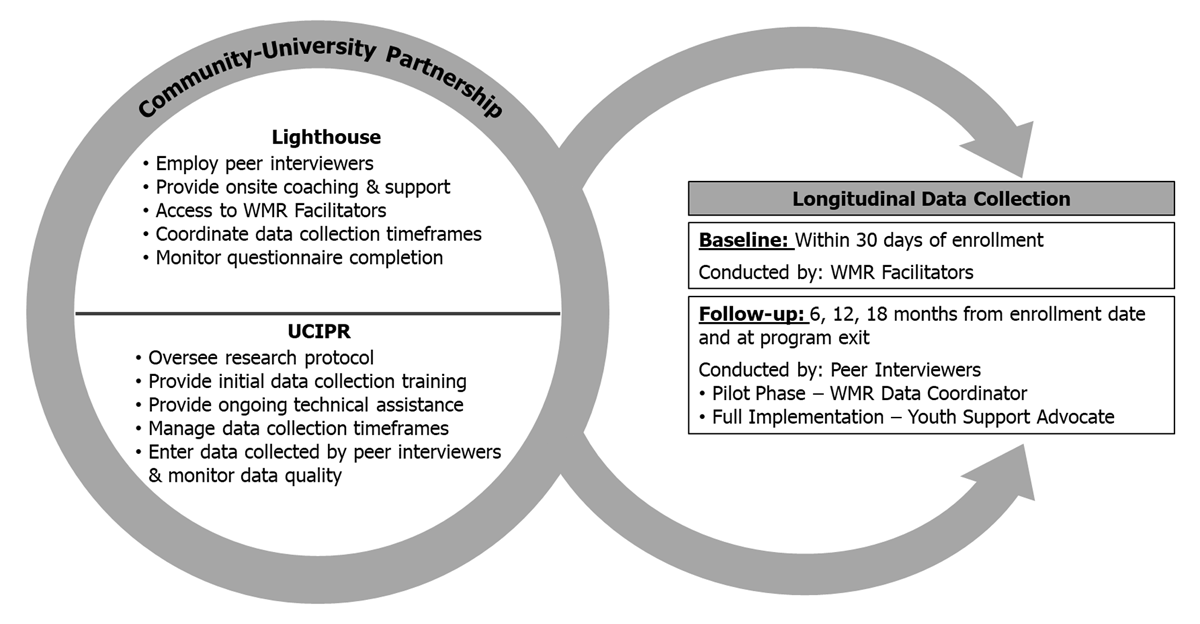
Figure 1
Community and University Partner Roles in the Peer Interviewer Approach.
Impact on Longitudinal Data Collection
The WMR formative evaluation was conducted October 2017 to December 2019 with 87 youth enrolled during that time. A continuous quality improvement process was established during the evaluation period to monitor program activities, youth outcomes, and data collection. Although Lighthouse and UCIPR met twice per month to discuss project implementation and grant requirements, data collection progress was monitored quarterly starting in December 2018. The response rate findings are based on WMR youth who were eligible for 6-month and 12-month follow-up time points. Very few participants were eligible for the 18-month time point due to the limited length of the evaluation period and staggered enrollments; therefore, it is not included here.
December 2018 response rates represent questionnaires administered by WMR Facilitators prior to the start of the peer interviewer approach. Despite a limited number of youth eligible for 6-month follow-up (n = 9) and 12-month follow-up (n = 7), the response rates were low at 11% and 14%, respectively. The pilot phase of the peer interviewer approach started in January 2019 and by the end of March 2019 the response rates for eligible youth increased to 42% at the 6-month point (n = 33) and 50% at the 12-month point (n = 12). These rates further increased in June 2019 and while the 6-month response rate remained stable during the full implementation phase with the YSA, the 12-month response rates decreased after June 2019 but remained similar to rates during March 2019 (Figure 2).
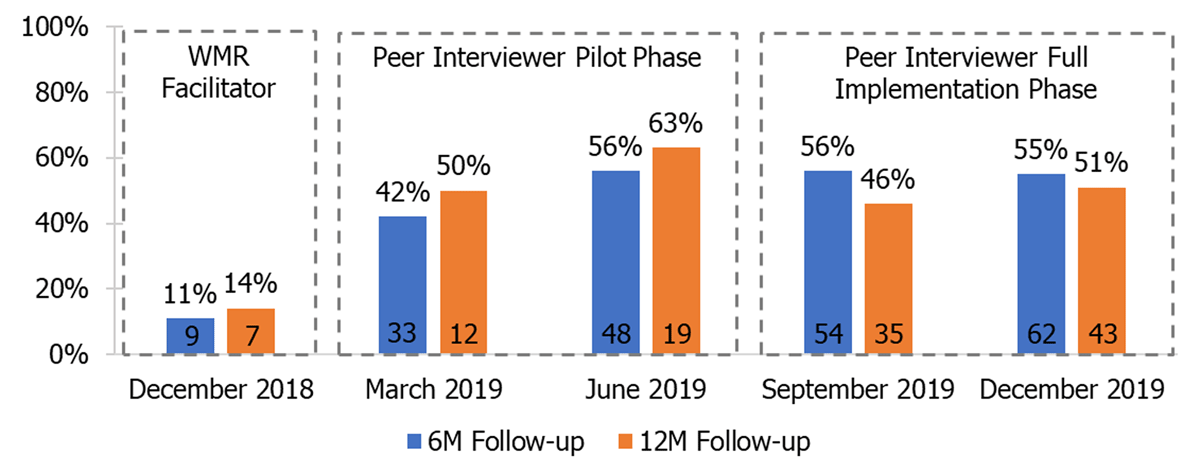
Figure 2
Responses Rates Before and After Peer Interviewer.
Note: Number of eligible youth listed at the bottom of every column.
It is possible the 12-month increase in June 2019 may not have been fully a result of the peer interviewer model. Or it may be that the Data Coordinator was able to devote more time to data collection as the peer interviewer during this period. The decrease after June 2019 may also be due to more participants being eligible for follow-up and that the amount of participants combined with overlapping time points. This may have been more than one peer interviewer could handle, especially because the YSA was serving as peer interviewer during this time and was juggling activities related to both roles. Staffing transitions and plans for WMR closure in December 2019 also affected the program during this time.
Peer Interviewer Lessons Learned
Peer models are receiving increased attention in programs and research. The community-university partnership presented here provides details about how a peer interviewer approach was developed and used with homeless youth with a child welfare history. It also provides a preliminary look into longitudinal study response rates before and after a peer interviewer was implemented in this setting. The results showed the response rates improved overall after the peer interviewer approach started.
Successful implementation of peer interviewers in longitudinal research requires thoughtful planning and a combination of supports from both the community and university partners. By itself, lived experience is not enough to prepare community members for this role. A great deal has been written about strategies for community member participation as co-researchers, but this article explicitly focuses on using a peer interviewer in longitudinal studies involving in-person quantitative interviews with youth that have experienced homelessness and multiple service systems. These experiences can make youth especially hesitant to engage in programs and research; therefore, a detailed understanding of co-researcher strategies that improve participation among youth with these experiences are needed.
Interviews with the WMR peer interviewers and staff were conducted during the evaluation to better understand the peer interviewer approach. The university partner also wrote internal research memos to document how the approach was implemented and adjusted during the project. The interviews and memos informed the development of lessons learned described in this article. These lessons are especially relevant to longitudinal evaluation studies conducted with young people.
The Peer Interviewer Approach Should Be Collaboratively Developed, Monitored, and Supported Through the Community-University Partnership
In WMR, conversations within the partnership kept the unique needs and experiences of homeless youth with a child welfare history at the forefront. These conversations helped the university partner maintain a trauma-informed lens so that data collection was sensitive to the youths’ experiences and potential hesitation, and considered the peer interviewer’s needs in the field. Prior to initiating a peer interviewer approach, the partners should clearly outline a plan for data collection training, strategies for ongoing support and communication, and opportunities for the peer interviewer to provide feedback on the data collection process.
Integrate Peer Interviewers into Intervention Peer Support Roles
In WMR, the peer interviewer and YSA roles were mutually beneficial and allowed youth to develop well-rounded professional skills. The peer interviewer role benefitted from the extensive training, knowledge of youth needs, and boundary-setting learned through the YSA role. The YSA role benefitted from understanding outcomes evaluation research and how to use it to understand the impact of services. Despite the success of this approach in WMR, it should be noted that participant willingness to respond could potentially be negatively impacted depending on youths’ prior relationship, or lack thereof, with the YSA. Negative effects may be mitigated with a larger pool of peer interviewers so that participants would not be interviewed by an individual who also served as their YSA. It is also important that participants be reminded at each interview time point that their responses will not be shared with other team members.
Full-time Employment Provides Consistency
Models that involve peers in research or community-based services may not always be full-time positions. Combining the YSA and peer interviewer roles, as well as providing wages comparable to entry-level direct service workers, helped to prevent the WMR peer interviewers from having to manage multiple jobs. Full-time employment also provides health insurance and other benefits that can support emerging leaders within professional fields that have served them. It may also help to prevent staff turnover, which can be disruptive to services and related evaluation studies.
Support and Supervision from Agency Staff is Key
Employing and locating peer interviewers with the community partner offers an additional support to help peers successfully navigate their role. Peer interviewers who have experienced child welfare or homelessness may be overwhelmed with the information shared by a study participant and need to debrief with someone trained in trauma-informed care. They may also need to brainstorm ways to locate youth with staff who are familiar with the population and have the most recent contact information for clients. Staff supervisors can help peer interviewers manage their workload, maintain boundaries between peer interviewer and peer support roles, and monitor data collection timeframes. Supervisors should perform data quality checks, especially when longitudinal data is part of existing agency administrative data collection and protocols.
Ongoing Training and Technical Support is Essential
Even if peer interviewers are located at the community partner’s agency, the university partner should work closely with both agency staff and peer interviewers at the start of the study and throughout it. This includes detailed initial training on data collection protocols, research ethics, and participant privacy and confidentiality. Ongoing technical assistance and check-ins are also necessary to ensure data quality and research integrity. University partners should also anticipate the need to repeat trainings if new peer interviewers are hired, help brainstorm strategies that improve participant response rates, and be able to quickly respond to peer interviewer questions.
Trust Peer Interviewers’ Ability to Locate and Schedule Participants
Maintaining contact with individuals who are currently or have previously experienced housing instability can be challenging. Peers know where young people socialize and the communication methods that they are mostly likely to respond to. The freedom to use unconventional methods to connect with participants—such as texting, social media private messaging, and known youth hangouts—can be helpful. That said, these seemingly informal methods should still be used in a way that maintains participant confidentiality and safety, and adheres data collection timeframes. Notably, these are often similar to service practices taught to peers serving in intervention support roles so it may be helpful to highlight how research and intervention practice ethics overlap.
The University Partner Should Manage the Data Collection Schedule and Data Entry
Longitudinal studies that include panels of individuals entering services at different times can be complicated when overlapping follow-up time points begin. To ensure timely data collection while benefitting from unique skills of peer interviewers, the university partner should manage the data collection time points and work with the community partner to develop a notification system. In the WMR project, UCIPR tracked and provided a list of eligible study participants to Lighthouse on a monthly basis, which helped the peer interviewer focus on scheduling interviews and completing questionnaires according to data collection protocols. The university partner also completed electronic data entry from paper forms completed by the peer interviewer in order to provide an extra layer of checks that prompted improvements in data quality.
Conclusion
The community-university partnership described in this paper provided a strong foundation for the development and support of peer interviewers in a longitudinal formative evaluation study of homeless youth with a child welfare history. Although the gold standard in participatory research may be to incorporate community members in all phases of the research from beginning to end, the post-hoc implementation of a peer interviewer in this project provided an opportunity to compare response rates with and without peer involvement. These findings have important implications for developmental evaluation and participatory research approaches. The findings suggest that longitudinal studies focused on target populations that may be hard to reach for academic researchers could benefit by the involvement of peers as co-researchers. Careful planning for peer participation and a strong combination of community and university supports make it more likely that individuals can be successful in the co-researcher role and personally benefit from the experience.
Competing Interests
The authors have no competing interests to declare.