
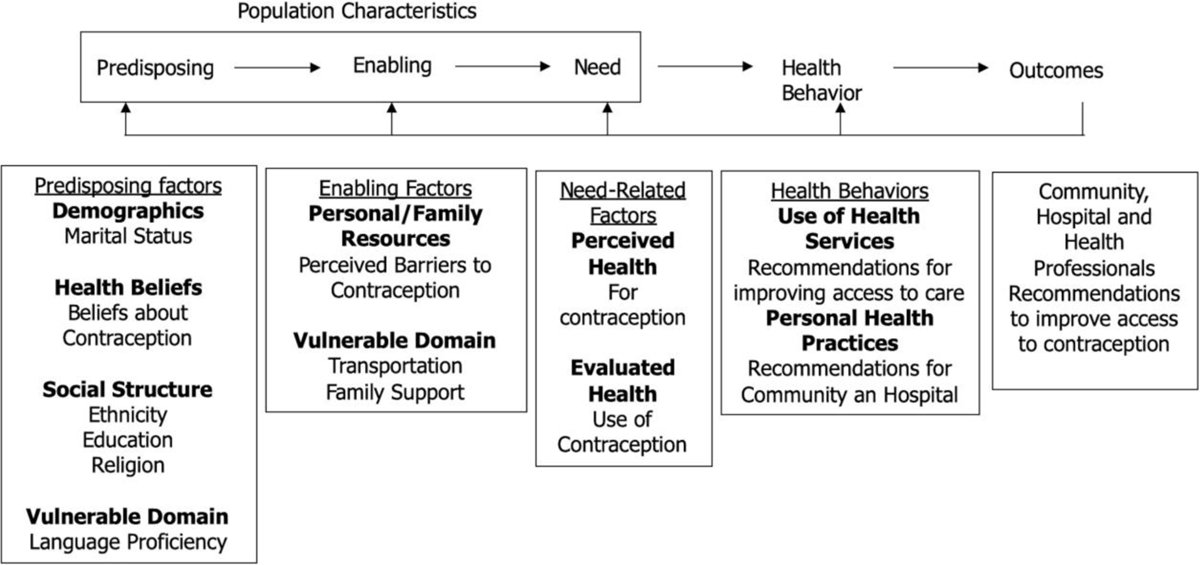
Figure 1
Factors Retained from Andersen’s Behavioral Model of Health Adapted for Vulnerable Populations by Gelberg et al. (1999).
Table 1
Socio-demographic characteristics of the women participants.
| Participant characteristics | n (%) |
|---|---|
| Language spoken | |
| Quichua | 3 (8.6) |
| Spanish | 9 (25.7) |
| Spanish and Quichua | 23 (65.7) |
| Schooling | |
| None or primary incomplete | 12 (34.3) |
| Primary completed | 13 (37.1) |
| High school or college (complete or incomplete) | 10 (28.6) |
| Marital status | |
| Single | 5 (14.3) |
| Married or in a relationship | 30 (85.7) |
| Ethnic background | 25 (71.4) |
| Indigenous | |
| Mestiza | 10 (28.6) |
| Contraception method currently or most commonly used | 18 (51.4) |
| None | |
| Injections | 5 (14.3) |
| Pills | 4 (11.4) |
| Tubal ligation | 6 (17.1) |
| Intra-Uterine Device | 2 (5.7) |
[i] Notes: a N = 35 participants; b Mean age of participants: 32 years; c Mean number of children per participant: 3.2.
Table 2
Results of thematic analysis and fit with theoretical framework.
| Themes Identified from Focus Groups/Interviews | Fit with Andersen’s Behavioural Model (Themes: Sub-themes) | Implication Access/Use of Modern Contraception |
|---|---|---|
| Misconceptions about modern contraception methods | Predisposing Factor: Health Beliefs | Several misconceptions decreasing likelihood of use |
| Mistrust about the effectiveness of modern contraceptives | Predisposing Factor: Health Beliefs | Incorrect information decreasing likelihood of use |
| Knowledge about sexually transmitted diseases (STD) | Predisposing Factor: Health Beliefs | Insufficient knowledge decreasing likelihood of use |
| Role of Male Partners | Enabling Factor: Social Support | Male views decreasing likelihood of use |
| Role of family income on use of family planning | Enabling Factor: Personal Resources | Belief that increased access would improve family income increasing likelihood of use |
| Accessibility of family planning | Enabling Factor: Community Resources | Poor accessibility decreasing likelihood of use |
| Access to family planning information | Enabling Factor: Community Resources | Difficult access decreasing likelihood of use |
| Potential solutions to the current barriers to modern contraceptives | Health Behaviours: Personal Health Practices | Establish trust with use of mobile teams to increase access/use |