
Introduction
A current trend in higher education has been to increase “high-impact educational practices” by many groups. According to the Association for American Colleges & Universities (2008), these “high-impact educational practices” are characterized as practices that incorporate active learning and have “been widely tested and are beneficial for college students from many backgrounds” (Kinzie, 2012, p.1). Based on this article, some of the eleven suggested practices include specific activities such as first-year experiences, internships, diversity/global learning, undergraduate research, and service/community-based learning, which are active parts of learning for students. These practices are said to aid in student learning and engagement and help to create a positive learning environment to help retention rates. Implementing these practices constitutes active learning on campus and has encouraged universities to incorporate one or more into the undergraduate experience.
The project described here was at a small, private midwestern institution in a large urban city of close to one million people. In early 2019, the university’s Center for Citizenship and Community (CCC), in partnership with the university’s library and the English department, were awarded a grant from the Council of Independent Colleges (CIC) that incorporated the three high-impact practices of community-based learning, undergraduate research, and diversity education. The grant was for work during the 2019–2020 academic year. The goals of the grant project were to aid in undergraduate student learning and create a reciprocal relationship with the community, as well as educate others about the relevance of the humanities in education outside academia. This project was granted IRB acceptance at the university.
Literature Review
Most articles surrounding the notion of service learning and community-engaged learning are written from the perspective of faculty members working on classroom projects and concentrate on student or faculty learning outcomes. Although there are documented public humanities studies, as well as projects with community-engaged learning for undergraduates, there were few studies or projects that combined both efforts. There were, however, past public humanities projects and works from poetry that provided insight into specific community projects and the learning potential.
Public Humanities
A significant part of community-engaged learning is the aspect of public humanities or humanities work that has outreach and benefit to the broader local community rather than just academia or those inside an institution, such as a university. Although the public humanities are broadly classified in academia, there is agreement that there is a need for institutions to share humanities research and projects widely with others outside of scholars on the subject, making sure that what is presented is relevant and of interest in the public sphere (Wickman, 2016).
Public humanities projects take on different forms but have the commonality of actively engaging with the humanities and seeking to reach out to a broader audience for the public good (Wickman, 2016). Although the public benefit is often seen through a financial lens, Gibbs (2016) insists that public humanities “cannot, and should not, be contained by the economistic assumptions” (p. 3). Gibbs defines the importance of humanities to search for truth and enhance life through “civic transformation” (p. 3), or the ability to change society. This is echoed in Benneworth (2015), who similarly rejects the notion of measuring research only by economic output and states, “humanities research drives societal value creation” (p. 45). Greenfield (2013) also confirms the importance of humanities in defining value, writing the relevance of public humanities in informing public policy and “confronting social problems at their roots” (p. 53). Mullen (2016) explains the potential for public humanities in helping to understand public value by focusing on the public’s idea of culture rather than institutional definitions.
The public humanities are also seen to bring public dialogue and discussion on important issues, which helps drive social change. Benneworth (2015) and Mitchell (2016) discuss the benefits of public humanities to creating discussion and dialogue among those from different backgrounds and how that can benefit others’ understanding and lead to intercultural and interdisciplinary gains. Mitchell (2016) states that “A further role of the humanities is to highlight and even to improvise, with those narratives that already provoke questions about what is to be valued” (p. 19), demonstrating that these themes are not only already in the public discourse, but can be brought out in a reframed and accessible way to the public through humanities projects. By bringing out the study of former artists’ work and history and including the public and institutions in these discussions, the worldview is broadened, and society and culture are shaped through gaining more knowledge.
As universities work to create reciprocal meaningful partnerships, the understanding of learning and teaching from both the public and the institution is often factored into defining relationships for public humanities projects. Mullen (2016) emphasizes the need for the public to be involved and, on the same level, define needs in projects or otherwise risk reinforcing hierarchical structures with the institution being the sole authority on what qualifies as art or essential in the public. This is similarly demonstrated in Krmpotich’s (2016) project with meaning-making and archival collections, where the institution and community partners work together to define what makes museum archival pieces important to both parties. In her work, she focuses on the new space of “we” that she was able to create while working on the project and discussing museum artifacts with aboriginal seniors and university colleagues researching the items (Krmpotich, 2016).
Poetry and Community
Poetry is considered beneficial in creating a community ethos, as well as beneficial for individuals in finding ways to express themselves. Zhang (2016) explains that poetry can express a collective identity through common themes and experiences in the Asian American community, helping to create a communal identity. Likewise, Rigell and Banack (2019) note similar findings in their work with Appalachian eighth-grade students, having them read and relate to poems from other authors in Appalachia and write their own poems to help understand their physical community identity. Sjollema and Hanley (2014) also note the benefits of poetry as a community development tool, with geographical areas feeling an increased sense of community and facilitators noting an increased understanding of the community through workshops. Alvarez and Mearns (2014) note the benefits of spoken word poetry in creating a community ethos, stating that sharing and reading poetry aloud makes the usually solitary art a communal activity, helping to relieve loneliness and depression often found in creative fields. Rangel (2016) also supports this idea of creating community, stating that the creation and sharing of the work in a poetry group helped to build a community of trust (p. 546).
Poetry has been used in bridging communities with authors of different backgrounds and reaching different demographics. Rigell and Banack (2019) specifically chose poetry to create community as they wanted students to be able to both see themselves and see the world of others in the same community while defining their community identity (p. 39). Sjollema and Hanley (2014) noted that facilitators from the poetry communities recorded “an increase in understanding of different cultures, an increased insight into poverty and mental health issues” (p. 63). Their study also found that participants made gains in feeling empowered from sharing their stories (Sjollema & Hanley, 2014). Mazza (2018) also noted poetry as a tool for social justice and empowerment with the ability to help the disenfranchised find and share their voice. This theme was similarly explored in Rangel’s (2016) work, noting that sharing and examining poetry helps to heal those with generational trauma by having students “reflect, create, share, witness and transform previous ways of seeing and being” (p. 543).
Although the benefits of poetry are well documented, most projects concentrating on community poetry are focused on the benefits of writing and expression of poetic voice rather than on reading and studying others’ work. Rigell and Banack (2019) are the closest in the study of creating a community ethos through poetry with their project, as they discussed both the importance of analyzing existing poetry and emphasized learning gains and the importance of including the student writing portion of the project. Similar studies such as Reyes (2013) briefly mentioned analysis of existing authors in their poetry project, but the poets only served as a vehicle to learn how to model the structure of a poem rather than learning from others’ poetry.
Poet Etheridge Knight
Etheridge Knight, a Veteran of the Korean War, was born in Mississippi and struggled with drug addiction and the law after his service. While spending eight years in jail in the Midwest, he became enamored with poetry and received visits from Black literary luminaries such as Gwendolyn Brooks, a highly regarded and influential poet who was the first Black author to win a Pulitzer Prize. Knight’s first collection, Poetry from Prison (Knight, 1968), was immediately acclaimed due to his focus on the idea of “imprisonment as a form of contemporary enslavement”. The idea that Knight used poetry to merge his personal awareness with the consciousness of Black people gave him instant credibility in the US. Both his style of poetry and his reminders that “every man is the master of his own destiny and comes to grips with the society by his own efforts” (Poetry Foundation, 2022) connected him to the Midwestern community where he earned a degree in Poetry as a 6o-year old man (Poets.org, n.d.). Knight’s work, along with others surrounding racial equity and civil rights, led to an era called the “Black Arts Movement” in the 1960s and ’70s (Poets.org, n.d.). He received honors for his oral and written work from the Poetry Society of America, the Guggenheim Foundation, and the National Endowment for the Arts.
Methodology
This paper outlines the learning outcomes from a project centered on the poetry of Etheridge Knight that included community-engaged learning at a private university. This case study utilized predominantly qualitative analysis with some survey data to reach conclusions regarding learning outcomes and the project’s success. Notes taken before, during, and after events and responses from participants were studied to see results, such as what learning outcomes occurred from the faculty, students, staff, and community members who participated in the project. Measurements such as attendance, engagement, and interaction, as well as observation and reflections from others, were used to determine “effectiveness” if goals were completed. The goals based on attendance, engagement, and interaction during the event were measured for “effectiveness” to determine if the goal was complete, as well as if the goals of the grant distributer were met. After each virtual event took place, data was collected through surveys.
Also analyzed were the artifacts from the works created, such as the submission form for the poetry contest, reflections and assignments from university students during class integration, presentation materials from student workers, flyers, student worker blog posts, and grant materials such as reports and applications. The overall engagement on social media in comments and numbers in the analytic system was studied. Lastly, a valuable source of data came from the weekly meeting with student workers as well as the feedback from the advisory members.
Categories emerged from the analysis. Topics were marked every time themes reemerged in the different data sources, such as how many students wrote about the “universality of feeling” or family. All sources of data from the statistics through the surveys to the categorical analysis were triangulated to find the patterns and to validate the final outcomes.
Etheridge Knight Project
Setting
This study was conducted at a private university in a large metropolitan city in the Midwest. The research comes from the university’s Center for Citizenship and Community’s (CCC) Office of Academic Community Engagement, which is tasked with connecting the university’s Academic Affairs with the larger community in a meaningful way. The CCC assists faculty in integrating purposeful community engagement into their courses and collaborating with community partners to find ways for the university to serve and engage with its mission. The primary goals are to advocate for sustainable long-term community partnerships through reciprocal relationships and to teach undergraduate students about others and themselves through the community.
The demographic of the campus is vital to note. Undergraduate enrollment at the university is approximately 4,500 students, and is a predominantly white institution, with approximately 82% of the student body identifying as white/Caucasian (Butler University, 2021). There are 887,642 residents of the city, where 60.9% of the population identify as white (United States Census Bureau, 2020). The economic realities of a private institution vs. the city are also important. The cost of attending the university is nearly $62,000 per academic year, with the average need-based aid student paying a net price of $37,904 (“US News and World Report,” 2020) while the median income for local residents is calculated at $29,572 per individual and $48,316 per household (US Census Bureau, 2020). This dichotomy of race and class between residents and the university body created a primary focus on getting students more in touch with the city so they could learn more about the realities of their community.
Although the university was founded under the legacy of an abolitionist, the school has struggled with diversity in several key areas. In a letter from the university’s accrediting body, the university was instructed to act on diversity issues on campus, including adding programming to “raise awareness and sensitivity to issues of diversity” (HLC Letter to the University President, August 15th, 2013). Due in part to this report, there has been a recommitment to diversity, equity, and inclusion (DEI) in the institution in outreach to students, faculty, and staff, as well as with general university programming. The goals for this project aligned with the university’s mission to increase DEI objectives, as well as highlight the university and other public institutions’ missions to give back and serve the community.
Research Questions
From the beginning of this project, the primary focus of this research has been to understand better the outcomes of community engagement projects, both for the university students as well as for the community. Specifically, the two questions include the following:
What are some of the benefits of this project to student learning and self-learning and
What impact did the project have on the local community?
Process
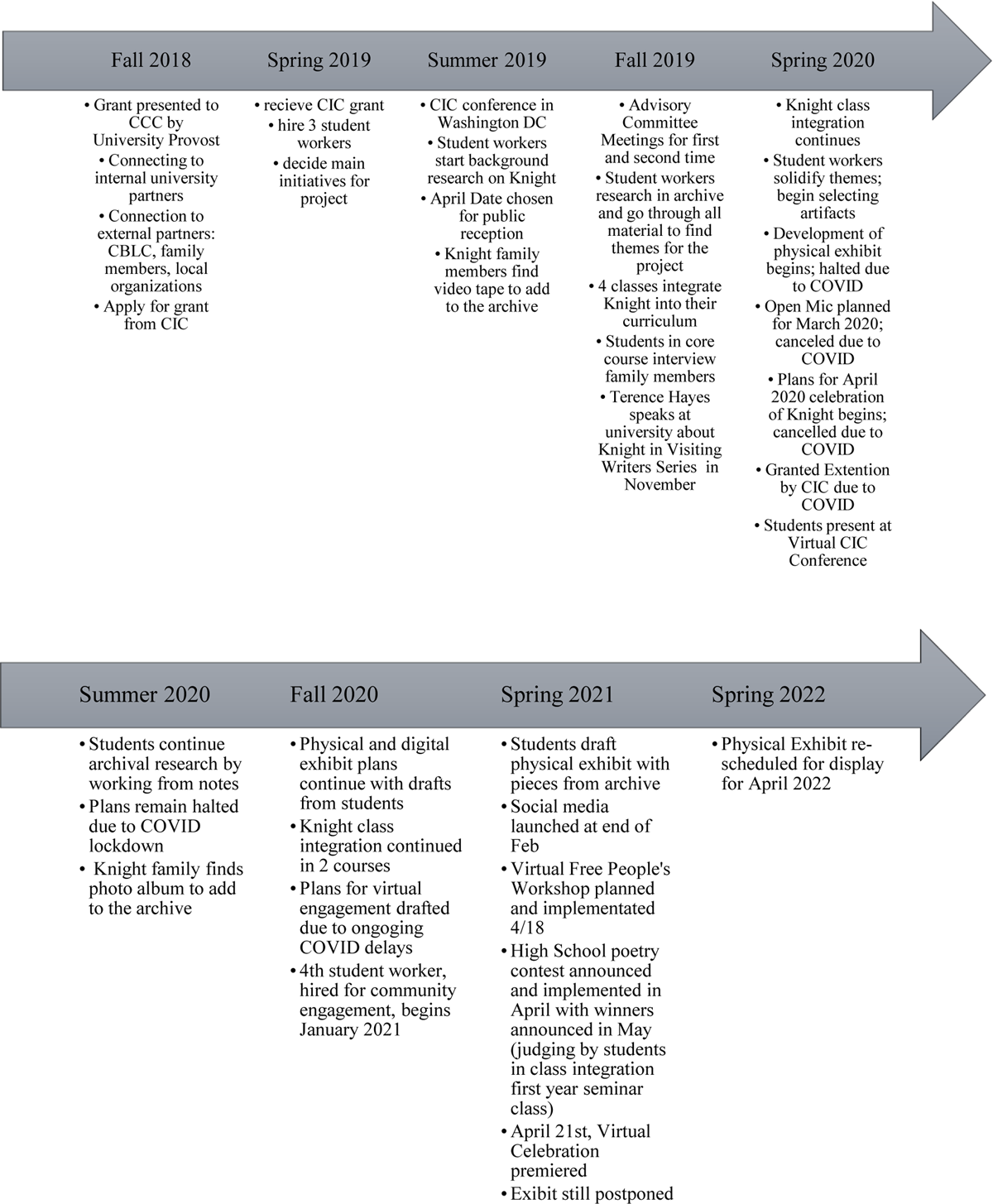
The Etheridge Knight, Jr. project officially started with a Public Humanities Grant from the Council of Independent Colleges (CIC). The timeline of the project can be found in Appendix A. The grant period was originally from summer 2019 to summer 2020 but was extended until summer 2021 due to the COVID-19 pandemic. The grant required colleges to create initiatives that brought archival materials at the hosting university or college to the public in a collaborative way. As one of the recipients of the grant, the university was required to incorporate undergraduate students in a meaningful way into the project and to have an external community partner to help develop the project. The core planning team, labeled as the “working committee,” needed to consist of a university/college library staff member, an administrator, and a humanities faculty member. The CCC office acted as administrator for the grant due to the academic community connection, with the university special collections archivist as the library staff, an English professor as the humanities faculty, and the Public Library’s Center for Black Literature and Culture (CBLC) as the primary external community partner.
The core working committee chose to highlight Etheridge Knight Jr. for several reasons. Not only did the university already have an Etheridge Knight special collection, but Knight was connected to the university as the first recorded poet in residence. He participated in the university’s first Visiting Writers Series in 1990 and was well-known personally and professionally by several faculty members on campus. Knight had connections to the local and global poetry community for his work and his ability to connect with others. The topics of his writing are both personal and universal, connecting themes across a multitude of subjects. His writing and experience have been known to capture people’s hearts and attention while also exposing them to a new reality (C. Knight, personal communication, 2018). The project also seemed to come at the right time, mainly due to the content of Knight’s writing and the timeliness of the themes of his work with racial justice. The university’s more personal goal for this project was to continue his spirit by creating spaces and sharing his legacy with those who never met him.
To fulfill the obligation of involving undergraduate students in working on the project, student researchers were an integral part of shaping the outcomes. Several professors from the English department who were admirers of Knight also decided to include a unit about him in their courses. In one course, students were assigned to interview existing family members of Knight as part of a class assignment and had the completed interviews added to the archive.
The community events and outreach activities created for the project revolved around two central ideas. The first was to inform and educate the public about Knight and his legacy. The second idea was to keep his legacy alive by creating open community spaces to share creative endeavors such as poetry and short stories. The main inspiration for the community engagement piece came from Knight’s philosophy of poetry being an art for the people (Collins, 2012) and his work with the Free People’s Poetry Workshops. The workshops that Knight led from the early 1970s until his death in 1991 were a space for people to craft and share their work at any point in the creative process. The group expanded to an advisory committee, which consisted of the initial “working committee” (university members included in writing the grant), undergraduate students, additional university faculty who had a vested interest in the project, Knight’s family members, poets, and members of other organizations that had an interest in being a part of the project.
There were two main projects to complete with the grant funding. The first was to have student workers create an exhibit utilizing the archival materials in the university’s special collections. The second was to use the information from the extraordinary collections to create community engagement activities to revitalize the legacy of Knight. The three students hired for this grant project were all in different graduating classes and came in with different skill sets. The work was divided between the students based on their skills and interest in the project, and all came up with specific themes for the physical exhibit. One student was hired with federal work-study funds rather than grant money and was given the additional task of imagining and implementing community engagement activities based on what she saw in the archives.
Two other students were hired with grant funds as archival material specialists. They had the task of dividing and going through the entire archive to find the content of what was collected. The library collection had an itemized list of all archival materials describing the artifact (such as a letter to Knight from his mother, Belzora), but the material list did not have information on the contents of the letter and what themes were in each piece. With only an itemized list, these two students had to sort through every piece in the archive to find themes and pieces for the physical exhibit. All students were also assigned as part of their work hours to keep a blog, helping them to reflect on and process the material.
Additionally, students were assigned to explain their theme for the public exhibit and start to mark pieces they would like to focus on to create the exhibit. The work-study student was also required to write community engagement event proposals to present to the committee due to her role as a community engagement specialist. The community partners determined which archival materials were most essential and what should be exhibited.
One student initially chose the theme “Knight from a feminist perspective” but altered her theme over time to include the Black experience. She saw how there were so many strong women in Etheridge’s life who encouraged him and how that was reflected in his work, both in writing and in the community. This student’s biggest inspiration for community engagement came from her discovery of Knight’s original Free People’s Poetry Workshop flyer (advisory committee presentation, 2019). This led to her wanting to bring the model of a Community Poetry Sharing workshop and creative space to Butler students and back into the community. Within the community, she prioritized studying the connection to compulsory school-aged children due to community partner interest in using Knight’s unique story to inspire youth.
One student focused on Knight’s work from his time in prison. He found evidence in the archive regarding how much Knights embraced, rejected, and grew beyond his label as a prison poet. Knight was inspired by his experience and often advocated in various ways for those in the community while still writing and facing other issues in his life. This student found archival pieces highlighting Knight’s time and origins as a prison writer, but also pieces highlighting Knight’s style and influence from other aspects of his life, including oral tradition and traditional toast telling. He chose to emphasize Knight’s devotion and desire to stay connected to and help the incarcerated community, as well as Knight’s involvement in projects designed to prevent others from going down the same path.
The final student asked complex questions, including “Is there a separation between art and the artist?” and “What is Knight’s aesthetic?” Ultimately, he chose to focus on the community influence and influencer piece of Knight’s legacy for the exhibit theme. The student was fascinated and humbled by Knight’s support in the community and how much people cared about him.
Community Engagement Initiatives
Four community events were created in preparation for premiering the student’s exhibit work: a public opening/celebration, an open mic series, a summer workshop, and a space to contribute and share Knight’s work. The public opening of the exhibit and an overall celebration of Knight were planned for April 2020. The main goal was to pay tribute to Knight while highlighting poets and artists in the local community. An open mic series was scheduled to be hosted at the university after spring break of 2020, where local artists and student artists could share their work and speak briefly about the inspiration of Knight and his legacy. The summer workshop series was modeled after the Free Peoples Poetry Workshop, where participants would learn from a writer about poetry, including themes, techniques, and incorporation of their own vision. They would then work on creating their own poems in this setting.
To have a space for people to contribute and share memories of Knight, the committee decided on having a memory book for people to contribute with stories, poems, or art inspired by Knight. The book would be added to the archive after the celebration event and uploaded online for the digital exhibit. Social media and a public blog were also planned.
In March 2020, the COVID-19 pandemic caused the lockdown of the university. Progress on grant initiatives was postponed, with plans to reengage in the fall. Due to the ongoing pandemic in the fall of 2020, all plans were re-evaluated, and community engagement activities were reimagined to a digital format. Additionally, a new student worker was hired for the project with unspent funds for in-person events. The new hire focused on the new digital outreach implementation and creating a social media presence for the project.
With the change to a digital platform for community outreach, engagement initiatives were reimagined into three community initiatives, and the physical exhibit was finalized despite the display date being pushed back until April 2022. The Etheridge Knight Jr. Celebration at the CBLC was altered to a virtual prerecorded celebration that premiered in April 2021. The open mic at the university was changed to a series of poetry workshops led by a poet, with the first of the events taking place in April 2021. Social media became a bigger priority, and the high school workshops were changed to a writing contest.
Community Partner’s Contributions
The Community Partners were the driving force in the direction of what to do with the archival material collected by the students and what ultimately should be included in the final exhibit. All events that were held were initially suggested by community partners that were then shaped, created, and implemented by researchers, university staff, and partnering community members. For example, The Center for Black Literature and Culture asked for the Knight Exhibit. Researchers searched the archives and presented the advisory committee with findings. The advisory committee and community partners worked together until the project was complete. The advisory committee told them elements they were missing or parts that were unclear. Students revised, and the process continued until completed.
Outcomes
The committee felt the outcomes were achieved despite the challenges. Initiatives assisted with educating both the campus community and the broader metropolitan community about Knight, and benefits were found for all involved. The following information breaks down the information that emanated from the analysis.
Events
Outreach efforts to help educate the community occurred for three significant events: a poetry reading workshop for university students, a high school writing contest for local area high schoolers, and a virtual celebration of Etheridge Knight Jr. The first of the proceedings were two sessions of the Free People’s Poetry Readings, initially taken from the idea of an Open Mic Night and reworked to better fit a digital platform. The idea was an inspiration from the Free People’s Poetry Workshops that Etheridge Knight was known for in the city and was a result of a partnership with a previous member of the workshop who continues the legacy abroad. The first session was aimed at the university undergraduate community and included university faculty, the writer’s studio, and the student workers’ social network to find participants. The feedback from the first session was encouraging, with participants giving positive reviews, showing an increase in knowledge of Knight and interest in the humanities. The participants commented that they liked the event’s structure and would like to have it continue as-is. The organizers gave additional feedback, noticing that students started to comment and ask questions as the event went on (observation journal, April 18, 2021).
The second event during April was a high school writing contest suggested by an advisory committee member. The contest was announced on social media and shared with the advisory committee and several university service-learning sites. Two students on the committee developed the entry form and wrote prompts for the contest, and a final draft was approved. One university faculty member agreed to have himself and students in his first-year writing course judge the contest. The contest had a total of five participants from two different public high schools, with eight poems submitted. Before entry, contest participants were asked to fill out a form that included permission to post their poems on social media and questions about their works and why they entered the contest.
As an inaugural contest, participation numbers were expected. The university student judges commented on the extraordinary skill of the young participants. Contestant feedback from the submission form expressed enthusiasm about the contest, and their poems reflected a deep understanding of the themes in Knight’s writing and related his writing to their own experiences. One student spoke about learning from the technical aspects of Knight and trying out a new style of writing and poetry, while the other four wrote about the feelings and themes in his poems, such as family, perception, race, class, and gender (contest submission form, 2021).
The final event was a virtual celebration, the reimagined opening of the exhibit developed by the advisory committee. Instead of the original plan to have several speakers and performers celebrating Knight through their work, the new format included switching to prerecorded videos edited together by the work-study student. Each student made a video explaining their role in the project and what they have learned through the process. The director of the CBLC and the CBLC poet laureate gave introductory addresses, speaking of the significance of Knight and why he should be celebrated in the city. The rest of the program was clips of people performing poems either by Knight or their own original pieces. Knight family video clips were integrated into the celebration as well.
The video garnered over 600 views on Facebook and YouTube as of June 2021. The post-event survey received 14 responses with positive reviews and interest in hearing more of Knight’s poetry. A majority of those who filled out the survey for this event knew Knight in some capacity, either personally or through his works, but learned different aspects of his life, such as his work in the community or ties to other well-known poets and black artists such as Gwendolyn Brooks or Amiri Baraka. Respondents also marked that they were more interested in learning more about Knight and his work and the humanities after the event. After each of the virtual events took place, the CCC collected data through surveys. There was a low response rate overall (28%); however, within the post-experience survey, submitted responses were detailed and thoughtful.
Social Media Outreach
A new part of the project due to the pandemic was the use of social media for outreach, community building, and awareness. One student created the angle for the social media presence. From the start, the Etheridge Knight Festival Facebook Group and the extended Knight family’s Facebook group were connected to this project to keep everyone informed and possibly ask for assistance and participation. The idea was that the social media presence was not only a source of project updates and reflection on Knight but a space for the creation and sharing of new art. Taking inspiration from Free People’s Poetry Workshops and Knight’s legacy of bringing people together, an initiative was started where anyone could share their art in whatever state. The platform was created to be one of learning, sharing the archival research such as the writings and video clips and for people to share their memories or feelings about Knight and his work, as well as one inspired by the ethos of the Free People’s Poetry Workshop.
Social media engagement on Facebook and Instagram was steady, mostly following social media posts. The active Etheridge Knight Festival of the Arts Facebook group often comments on posts and engages in dialogue when reposted on their page. The Instagram account, which was geared toward a newer and younger audience, did not have as many original works submitted and posted as expected.
Partnership Continuation
The faculty and instructor who incorporated class integration of Knight into their courses have kept Knight in their syllabi. The family member interview project and its transcripts will be added to the university archives for others to use. From community feedback in surveys and social media, community members want to see the programming grow and have asked for more events highlighting Knight’s works. There have been requests for a republishing of his older out-of-print works, as well as for a reimagining and continuation of the Etheridge Knight Festival of the Arts. Plans continue for a high school writer’s workshop with heavy involvement of the local writing community, continuation, and building of the writing contest, as well as more workshops and presentations at the university and in the city. Interested organizations and individuals plan to improve and continue the Free People’s Poetry Workshops for the public and university community. The CCC plans to continue the initiatives in several ways. More funding and partnership opportunities have been sought. Student employees have been retained as budgeted employees. The university working committee was able to learn more and do more for the outreach efforts in the project by listening and speaking with community members and figuring out ways they could be a part of the project.
Class Integration
One of the primary purposes of the grant was to aid in undergraduate learning. University professors integrated Knight and the project into their course syllabus where it made sense, creating more community connections. Four faculty members in the university’s English department and one other faculty member in a service-learning course integrated Knight and his works into their course- all citing positive results (Butler University Center for Citizenship and Community, 2021).
In one university course, students read one of Etheridge Knight’s poems, “A WASP Woman Visits a Black Junkie in Prison,” at the beginning of the class, and then after midterms, sat in interviews with four of Knight’s family members. Of the 14 students in the course, only one had previously heard of Knight. Students did not discuss Knight’s background or legacy before the interviews with family members, so besides the poem and brief introduction before the class discussion, they had no prior knowledge of Knight. Eleven students wrote about relating to Knight or understanding and appreciating him in their reflections despite not being prompted to do so and were able to express why these themes were important using their experience, course readings, and discussions. They picked out themes of familial love and bond, the duality of his personality, and his ability to connect across differences and relate to his story, despite having little demographic or experiential similarities to Knight.
In another first-year writing course, students similarly found ways to connect to Knight, although at first, believing they were too different from him in experience and upbringing to find any relevance to his work. One student connected particularly deeply to Knight and his familial bond, while all students cited his ability to use language to convey universal feelings and emotions and relate across differences.
Student Learning
As is often the goal with public humanities and service learning, the primary goal was not only to teach the students with the institution or professors being the gatekeepers of knowledge but also to have a relationship of learning centered on the subject, like Palmer’s (2017) model of education. In the post-experience surveys of the events, 60% of respondents stated they knew something about Knight, 100% marked an increase in awareness about Knight after their experience in the program, with 40% indicating they learned “very much” about Knight after the experience. Additionally, 100% of respondents stated they wanted to know more about Knight’s legacy after their experience.
Students who contributed to the project learned about Knight and key themes through archival research, teaching others, developing projects, talking to community members, and reading his works. Although they never met him, the student workers noted in weekly meetings, blog reflections, and the student grant report that they felt that doing archival research made them feel an intimate connection to him. The students in both the project and the class integration learned about Knight and community through the act of public humanities and engaged in learning while reflecting on their experiences through writing, conversation, and creating. The four student workers stated that they made remarkable growth in their thinking, especially as they were put in the role of teaching others the importance and relevance of the project. The students were empowered by their role in the project and gained confidence through the project. Students involved in the class integration attempts and working on the project through archival and community engagement stated similar conclusions regarding what they learned about Knight and were able to grow personally and academically.
The main themes that reoccurred for students were Knight’s ability to connect to community, words, and feelings as universal and connecting, the importance of family, and the complex identity that made him relatable and accessible to the students. Students learned about community and what it means to be in a community by being involved in the project. One member’s submission for the grant report discussed the shift in thinking from writing as an individual activity to one that includes others. Another focused on the theme of community, highlighting Knight and his community ethos with the Free Peoples Poetry Workshop and social media outreach. Those in the university English course reflected on Knight’s ability to create community with others based on stories and personal accounts of Knight.
Students reported that they connected to Knight through what they called “universality of feeling” and found commonalities in his narrative. Students across all groups noted that they felt personally connected to Knight and his humanity despite coming from different backgrounds, with one of the university students noting that his writing about his life, identity, and realities contained “a special kind of urgency and beauty” (student artifact, 2021). All four student workers also reflected on this universality in their projects and wanted to highlight this to the public with their chosen materials. This step of the universality of feelings helped them connect across differences and see common humanity and the importance of studying humanities and bringing it to others.
One of the most straightforward entry points for students to relate with Knight was through family and familial struggle. Students across all engagement activities selected this theme as a way of relating to Knight and an essential theme to him personally and through his artwork. The theme of familial bonds was especially evident with students in the class integration initiatives, with eight of the 14 students in a university course reflecting on Knight’s love for his family and one of the students writing her paper on this. This was also a theme for student workers, as when developing the high school writing contest, they wanted to include Knight’s famous poem, “Idea of Ancestry.” One student worker analyzed his relationship with women in his family through her project theme, reflecting on the connection of the strong female influence in African American families from her point of view. This ability to find commonality and relate to others across differences helped students better understand themselves in relation to others and apply the knowledge in an academic and personal context.
Both the students working on this project and those who were in the class integration initiatives often found the reoccurring theme of the duality and complexity of Knight as an individual, which allowed Knight to be more accessible to them as he became a natural person. One person wrote in her blog that Etheridge Knight Jr. was “fundamentally flawed but still amazing!” (Blog post, December 12, 2019) and wanted to be able to convey that message to the public in her part of the project. To support this theme, she highlighted the relationship she saw in the letters to Knight with poet Deta Galloway, and she wanted to display those in the exhibit. One prompt for the high school contest was to use Knight’s poem “Various Protestations from Various People” to demonstrate this theme of Knight’s myriad of identities, feeling powerful and relatable to others (writing contest draft, 2021). Students noted this duality and complex identity in themes more than any other they noticed.
Community Benefit
In the post-experience survey, participants were asked why they wanted to learn more about Etheridge Knight as a poet. Responses varied, but of the 28 written responses, four mentioned explicitly that they thought he was “cool” for being a poet, five wrote about him being a local artist that people needed to know more about, three wrote about his imprisonment and the impact that had on the community, and four specifically mentioned that individuals deserved to be heard. One participant stated:
It is important for us to hear voices from our community. Sometimes we forget that there are so many outstanding and diverse people with lives and opinions that need to be heard. Our minds are often so narrow when it comes to knowing the different people in our community (post experience survey participant, 2021).
Another participant stated, “There are so many incredibly talented people who don’t always get a chance to become widely known, and I think it’s very important to work to support people making courageous, bold art” (post experience survey participant, 2021). A third participant wrote, “Knowing about our local artist helps strengthen our community through a shared culture and helps us support one another” (post experience survey participant, 2021). A fourth respondent stated, “I think knowing of local artists makes our involvement with the community more personal and really engages/connects us with other works and people we may have not known of previously” (post experience survey participant, 2021).
Conclusion
The Etheridge Knight, Jr. project was able to integrate community-based educational efforts into work at the university as well as increase public awareness of the local artist, Etheridge Knight Jr. Themes from Knight’s life and the current social atmosphere regarding conversations about systemic racism, policing, the criminal justice system, and the opioid crisis helped to propel this project forward. One of the pieces chosen for the exhibit was a draft of the poem “Things Awfully Quiet in America,” which was found relevant, as stated by one committee member, “Like it was written yesterday” (exhibit draft, 2021). When answering a post-experience survey question asking why one should learn about Knight, a participant answered, “His life and poetry are beautiful and important to present-day struggles- we can use them to inspire ourselves and others to advocate for a change to greater equity for minoritized groups” (post-experience survey results, 2021).
Students working on the project were able to see gains in their personal, professional, and academic lives, stated their better understanding and appreciation of the local community, and an understanding of their own sense of community. In general, this strategy was crucial for success and speaks to choosing the right subject for the project and topics relevant to the current realities of the public. These outcomes were the primary goal of this work with community engagement and one of the goals of the public humanities. The initiatives for the public were designed with them in mind, but as significant contributors in the creation of the projects and initiatives. Listening and involving others was critical in making the partnership and public humanities more of a holistic experience for all involved versus a top-down hierarchical structure with the institution telling the people what is essential, as Mullen (2016) warned. This community involvement strategy led to the creation and sustainability of new partnership opportunities for the office and the university.
The community impact was very positive in that people from the university, as well as the greater community, mingled and learned together about Knight. This is one of the benefits of community-based learning, where symbiotic learning occurs in several instances. One participant stated, “The virtual celebration made it more personable about the subject but also people who are part of this project.” This type of reciprocal learning helps the community become stronger.
Appendices
Appendix A
Timeline of Project
Competing Interests
The authors have no competing interests to declare.