
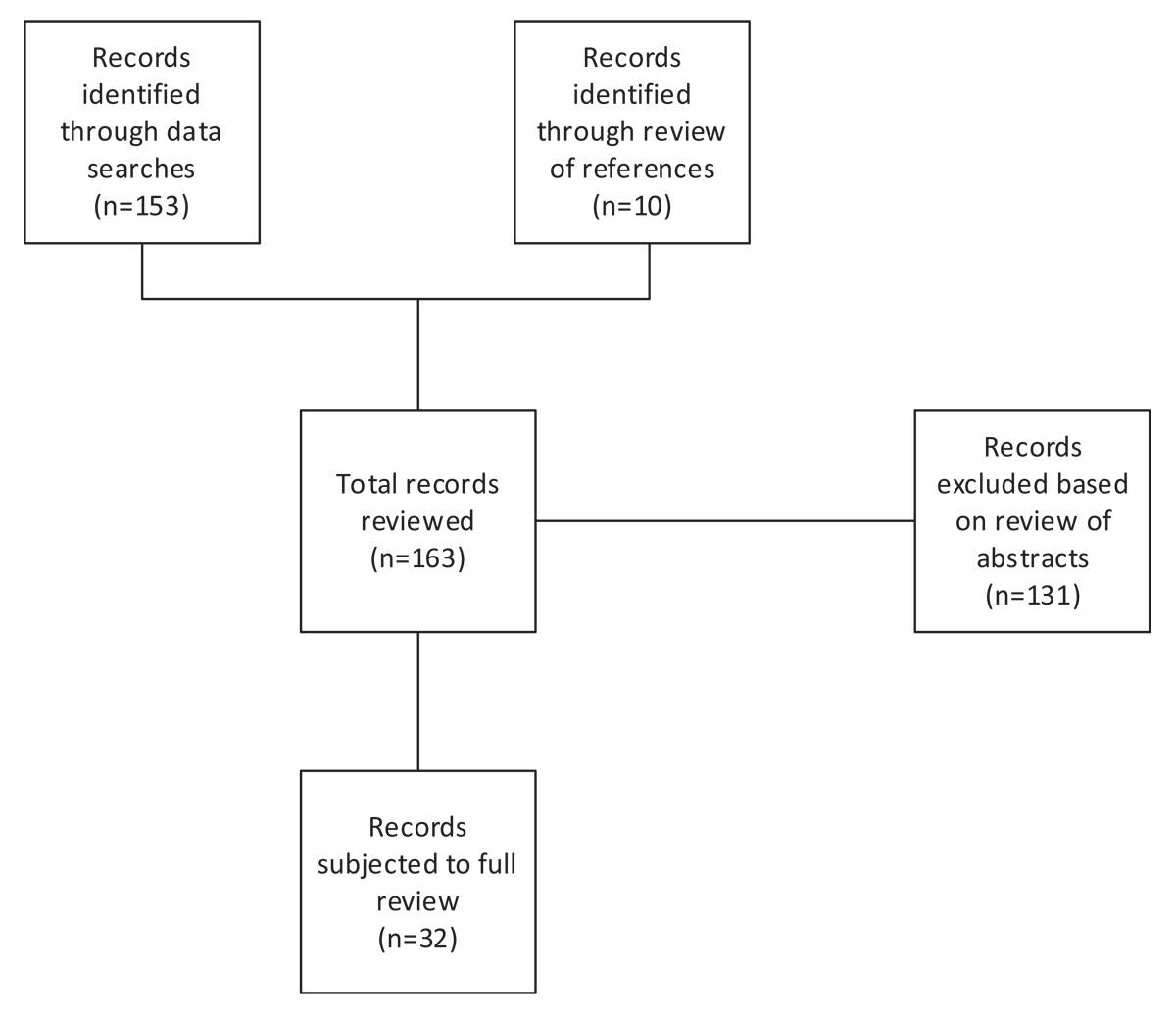
Figure 1
Summary of literature review process.
Table 1
Key Literature Reviewed Related to Translational Research Process.
| AUTHOR(S) | DEFINITION OF COLLABORATION | PROBLEM-SOLVING STRATEGY | KEY ACTORS AND ROLES |
|---|---|---|---|
| Aarons et al. (2011) | Alignment of stakeholders; Extensive and on-going partnerships between researchers, organizations and consumers | Implementation of interventions in public sector environment | Knowledge generators built evidence based practices. Practitioners trained through facilitated process. |
| Adebayo et al. (2017) | Attention to need, partnership dynamics, resources and outcomes | Establishment of a formal partnership between community-based organizations and scientific or academic institutions | Researchers and community formed partnership to meet needs and improve health among target population. |
| Akin et al. (2015) | Frequent and in-depth communication and collaboration | Development and testing of social-emotional well-being and placement stability for children in foster care | University-based researchers, agency-based administrators, supervisors, practitioners and government-based staff engaged in cultural exchange. |
| Armour (2017) | Two-way communication | Pedagogical cases-Professional learning mechanism for practitioners | Researchers and practitioners (Coaches and Physical Education teachers) formed partnership and established two-way communication. |
| Bamberg et al. (2010) | Shared ownership and responsibility for outcomes | Building evaluation capacity internal to organizations | Evaluators and organizational staff formed partnership. Evaluators built capacity of organizational staff. |
| Bogenschneider et al. (2019) | High level of trust | Policy-making process | Stakeholders focused on dissemination of information. |
| Burns et al. (2019) | Community leadership | Four phase adaptation of EPIS process/CBPR process | Researchers were partners and supporters of process. |
| Castillo et al. (2016) | No specific definition | Defining and developing five phase intervention to support school social workers in their work | Stakeholders formed partnership. |
| Cheung & Duan (2014) | Information exchange | Application of quality assurance information to support decision-making related to health care | Evaluators supported decision-making among local service providers. |
| Craven et al. (2016) | Recognition of contribution of others and consequences of research; Accountability for doing no harm; Production of benefit to the community; Attention to community decisions; Recognition of different values | Use of positive psychology and indigenous worldview as a basis for an inclusive research process | Researchers and indigenous community formed partnership. |
| Cremades et al. (2014) | Creation, learning and knowledge transfer | Understanding management as it relates to translational research | Participants created and transferred knowledge. |
| Dave et al. (2018) | Mutually respectful and reciprocal relationships; Quality and bi-directional relationships | Developing trust in community-academic research partnerships | Knowledge generators and other stakeholders formed equal partnership. |
| Davis et al. (2014) | Strengthening existing infrastructure and relationships; Balancing research and action; Beginning with topic of interest to the community and fostering boundary spanning and continuity positions | Turning community health coalitions into receptive and effective partners for collaborative research | Researchers appeared to fill leadership role with focus on partnership. Researchers also filled bridging function. |
| Escoffery et al. (2018) | Capacity building, involvement and documentation | Developing adaptations to evidence-based practices | Stakeholders partnered to develop appropriate adaptations. |
| Frerichs et al. (2017) | Mutually respectful and reciprocal relationships; Quality and bi-directional relationships | Developing trust in community-academic research partnerships | Knowledge generators and other stakeholders formed equal partnership. |
| Gouillart & Billings (2013) | Inviting constituencies to collectively solve problems and exploit opportunities | General model for co-creation of knowledge | Participants identified a problem, located external and internal stakeholders who could help solve problem, created initial platforms such as workshops and/or on-line resources and generated insights from data. |
| Griffin et al. (2010) | Not explicit definition | Evaluation as a mechanism for developing recommendations for how to implement physical activity programs | Stakeholders formed partnership. |
| Horowitz et al. (2009) | Engagement and participation; Recognition of strengths and what each partner brings to the process | Community-based participatory research (CBPR) process | Community based participatory research engaged multiple stakeholders, including the public and community providers, who affected and are affected by a problem of concern. This collaborative approach to research involved all partners in the research process and recognized the unique strengths that each brought. CBPR began with a research topic of importance to the community and aimed to combine knowledge with taking actions, including social change to improve health. |
| Lyon et al. (2018) | Connection and collaboration | Description of future study of inter-organizational alignment across multiple organizations involved in integrated care (e.g., school mental health) | Clinicians and school personnel formed partnership. |
| Maggin et al. (2010) | Equally contribute to and gain from collaboration; Emphasis on communication | Using science to support policy-making relative to emotional and behavioral disorder and school | Researchers, practitioners and policymakers formed partnership. Process held significant implications for policy making. |
| Martinez et al. (2012) | Exploitation and lack of mutual respect counter to effective collaboration | Effort to understand diverse perspectives regarding translational research | Stakeholders promoted participation and representation of diverse perspectives. |
| McKenna & Main (2013) | Involving stakeholders’ perspectives and priorities from project conceptualization to completion | Use of key informants as a source of information in research | Researcher recommendations issued for engaging community members. |
| Mold & Peterman (2005) | Consistent with principles of learning communities; Shared mission and values; Collective inquiry; Collaborative teams; Action orientation including experimentation; Continuous improvement; Results orientation | Establishment of practice-based research networks in primary care settings | Researchers and practitioners engaged as partners. Explicit roles defined for bridging efforts. |
| Milat et al. (2015) | No explicit definition | Process for scaling up public health interventions | Researchers establish monitoring and evaluation systems, modeled intervention approach, engaged implementers and target community, tailored scale-up approach to the local context, used evidence for program improvement, created infrastructure to support implementation and provided strong leadership. |
| Nadeem et al. (2018) | Thoughtfulness that went into decision-making; Time taken to make decisions; Inclusiveness and collaboration | Evaluation as potential tool | Researchers lead efforts. |
| Provenzano-Hass (2017) | No explicit definition | Translational research through an Industrial/Organizational Psychology lens; Interventions defined as mechanism for improving how organization operates | Researchers and/or practitioners managed process. |
| Romich & Fentress (2019) | Practitioners and scholars working together with explicitly described roles and public recognition | Policy roundtable | Policymakers positioned to use results of policy roundtables. Knowledge generators functioned as facilitators. |
| Sedlar et al. (2017) | Engagement and communication with relevant stakeholders | Quality assurance partnership | Knowledge generators provided framework and technical assistance to child welfare officials who provided services. |
| Seely et al. (2015) | Formal interactions designed to support knowledge generation role | Mentoring network | Researcher and team of mentors engaged in mentored relationship. |
| Sullivan et al. (2017) | Supportive interactions | Computer modeling as a means of addressing scale-up of programming | Knowledge generators created models that had utility to policymakers. |
| Westfall et al. (2012) | Process of combining efforts and resources | Formal conference | Knowledge generators and broad range of other partners including representatives of community or service agencies planned and participated in conference. |
| Younie et al. (2018) | Engagement of partners throughout process; Quality assurance and democratic participation | MESH (Mapping Educational Specialist Know-How System)-Digital tools bringing international networks of educators together to construct new knowledge related to research informed teaching | Knowledge generators and/or practitioners created case-studies that informed practice. |
Table 2
Issue(s) on Which Translational Research Process was Focused.
| ISSUE | SELECTED EXAMPLES |
|---|---|
| Evaluation | Bamburg et al. (2010); Cheung & Duan (2014); Nadeem et al. (2018) |
| Theory | Provenzano-Hass (2017); Dave et al. (2018); Frerichs et al. (2017) |
| Case Review | Armour (2017); Younie et al. (2018) |
| Policy Development | Romich& Fentress, 2019; Maggin et al. (2010); Bogenschneider et al. (2019); Sullivan et al. (2017) |
| Computer Modeling | Sullivan et al. (2017) |
| Conference Engagement | Westfall et al. (2012) |
| Research Capacity/Promotion | Seely et al. (2015); McKenna & Main (2013) |
| Community-Academic Partnership | Mold & Peterman (2005); Craven et al. (2016); Martinez et al. (2012); Akin et al. (2015); Lyon et al. (2018); Davis et al. (2014) |
| Generic Problem-solving Process | Milat et al. (2015); Aarons et al. (2011); Gouillant & Billings (2013); Horowitz et al. (2009); Escoffery et al. (2018); Cremades et al. (2014); Burns et al. (2019) |
Table 3
Professional Roles in the Translational Research Process.
| ROLE | EXAMPLES |
|---|---|
| Evaluation | Bamburg et al. (2010); Cheung & Duan (2014); Nadeem et al. (2018) |
| Translation/Implementation | Romich & Fentress (2019) |
| Mentoring | Seely et al. (2015) |
| Policy Development | Romich & Fentress (2019); Maggin et al. (2010); Bogenschneider et al. (2019) |
| Research/Knowledge Generation | Seely et al. (2015); Westfall et al. (2012); Sedlar et al. (2017); McKenna & Main (2013); Craven et al. (2016); Provenzano-Hass (2017); Martinez et al. (2012); Akin et al. (2015); Lyon et al. (2018); Dave et al. (2018); Nadeem et al. (2018) |
| Planning/Problem-solving | Armour (2017); Romich & Fentress (2019); Mold & Peterman (2005); Milat et al. (2015); Adebayo et al. (2017); Aarons et al. (2011); Gouillant & Billings (2013); Horowitz et al. (2009); Escoffery et al. (2018); Cremades et al. (2014); Burns et al. (2019); Castillo et al. (2016); Younie et al. (2018) |