
Introduction
‘Democracy’ has become such a positively evaluated word after the Second World War that it has made the concept utterly flexible and stretched both regarding its content and its application. ‘Democracy’ has been taken as a normative standard, and at the same time, it can mean almost anything (Conway 2020; Gallie 1956; Hidalgo 2008; Müller 2011; Skinner 1973). Although there are normative and institutional patterns that have come to define what democracy ought to mean, it is symptomatic that several scholars have attempted to capture the variety of democracy with their analytical criteria by creating, for instance, an analytical list of ‘democracy with adjectives,’ or to tackle the ‘ontological pluralism’ of democracy by creating a catalogue of descriptions of democracy (Collier & Levitsky 1997; Gagnon 2018).
The inherent tension between the attempts to define democracy and the everyday practices that stretch its meaning is present in various demands for ‘more democracy,’ ‘better democracy’ or ‘real democracy,’ as well as in various claims of ‘too little democracy.’ These kinds of arguments are often linked with the notion of the crisis of democracy. We have become familiar with expressions such as ‘illiberal democracy’ (Zakaria 1997), the ‘unravelling’ of the democratic order, and, most of all, ‘populism’ challenging democracy (Krastev 2016, 88–98; Müller 2016). As Margaret Canovan (1999, 2005) has noted, the relationship between populism and democracy deals to a great extent with how one understands the meanings and the relationship between the two words that make up the word democracy: demos and kratos, that is, ‘people’ and ‘rule.’ Democracy is often discussed by using both ‘democracy’ and a vernacular version of it, such as ‘rule by the people,’ ‘government by the people,’1 folkvälde and folkstyre in Swedish, folkestyre and folkeherredøme in Danish, and Volksherrschaft in German (Nevers 2011, 119–44; Nevers & Lundsby Skov 2019; Torstendahl 1969, 95–118; Voβkuhle 2018, 126). The vernacularised version is often built on the word ‘people,’ but because ‘people’ is a concept as contested as ‘democracy,’ it can have diverse connotations. The different yet often mixed meanings of ‘people’ and ‘the people’ in English are perhaps the best-known example of this, yet hardly the only one.
The Finnish case provides an excellent possibility to investigate democracy in two vocabularies because both demokratia (democracy) and kansanvalta (power of the people) have a prominent place in discussing democracy in Finnish. The translation of ‘democracy’ in Finnish as kansanvalta presents possibilities for different emphases in the use of the concept, since the word kansa not only means both ‘people’ and ‘the people’ but is also the root word of ‘nation’ (kansakunta) and ‘citizen’ (kansalainen). Accordingly, kansanvalta connotes the power of the people from below (the common people, the mass of the people) as well as the power of the people as the unity of the people, the sovereignty of the people, and even as the power of the nation (Hyvärinen 2003; Kurunmäki 2008; Stenius 2004). Hence, it is also consistent with and partly supports interpretations of democracy as direct or participatory democracy.
In this paper, we consider the existence of dual terms for the same concept as a linguistic affordance proffering language users additional possibilities to display divergent ideas by resorting to the alternative term. By examining how demokratia and kansanvalta have been used by the Finnish parliamentarians between 1980 and 2021, we contribute to the study of the language of democracy in Finland during a period that was marked by major political transformations: from the Finnish Cold War-era dependence on the Soviet Union through the Agreement of Friendship, Cooperation, and Mutual Assistance (FCMA) between 1948 and 1992 to the membership in the Council of Europe (1989) and the European Union (1995). Previous research has also pointed out a considerable change from a quasi-presidential democracy to parliamentarism in Finland since the 1980s (Arter 2008, 229–30; Nousiainen 2006). In other words, we investigate whether the language based on the concept of the people, such as kansanvalta, spells out the boundaries of democracy differently than the use of demokratia.
Furthermore, we examine whether using kansanvalta implies a direct participation of (the) people or some kind of non-mediated presence of the people beyond and in addition to the forms and processes of representative democracy.
To answer these questions, we first outline our research methodology from conceptual history to rhetorical analysis. Next, we introduce the research material and its arrangement into machine-readable form. The third chapter begins with a quantitative analysis of the frequencies of kansanvalta and demokratia in parliamentary records from 1907 to 2021. The quantitative analysis continues by recording the most typical words attached to these terms and showing how different their profiles are. Since the quantitative analysis documents the high relevance of some attributes, we next proceed to investigate qualitatively such idioms as ‘representative’ and ‘real’ demokratia and kansanvalta. A similar comparative analysis is carried out with the attributes ‘functioning,’ ‘mature’ and ‘healthy.’ Since demokratia and kansanvalta have different profiles with geographical adjectives, we explore the use of the adjectives ‘Finnish,’ ‘western,’ ‘Nordic’ and ‘European’ in connection with these terms.
Methodology of the Article
Conceptual history and rhetoric
To study the conceptual stretching of democracy in everyday political language, we investigate the similarities and differences in the ways in which demokratia and kansanvalta have been spoken about by Finnish parliamentarians. In so doing, we are drawing on an emerging field of study of the conceptual history and rhetoric of democracy (Ihalainen 2017; Innes & Philp 2013; Kärrylä 2021; Kurunmäki, Nevers & te Velde 2018). Methodologically, we also want to contribute to the computational analysis of digital parliamentary data (Jarlbrink & Norén 2023).
We study what kind of ‘semantic fields’ (Ifversen 2011; Koselleck 1972) emerge around demokratia and kansanvalta by analysing which other words occur jointly with them and how. This includes an analysis of what terms have been used as contrasting concepts to the investigated ones, something Reinhart Koselleck called the analysis of ‘asymmetric counter concepts’ (Koselleck 1972), but what we approach as an analysis of a ‘dissociative’ rhetoric (Perelman & Olbrechts-Tyteca 1969, 411–49).
While reading the material, we keep asking where the words demokratia and kansanvalta can be applied. This is a matter of disputes between institutions (e.g. political parties, economy, trade unions), but most evidently between different countries and political systems. This highlights the relevance of geographical adjectives as defining attributes of democracy. In addition to the range of reference we also investigate the range of possible evaluations given to these concepts and their versions (Skinner 1989). Besides asking the range of application of a concept, we further study which forms are the most prototypical. For example, just three statements indicate that Europe can be attached to kansanvalta, while a broad consensus prevails in understanding municipalities as the prototypical location of kansanvalta.
Data and processing
Two datasets used in this study were gathered from the Finnish parliament. One of them is a collection of extensive interviews with former Finnish Members of Parliament (MPs) between 1988 and 2018, with 378 interviews (about 11.9 million words) released for research use. The other consists of transcripts of the Finnish parliament’s plenary sessions, openly available and aggregated from February 1980 till September 2021. This period involves roughly 5,200 sessions, and the records contain over 80 million words. To outline the history of the terms before 1980, we have obtained machine readable files of the speeches for the years 1907–1979 (Hyvönen et al. 2023).
All our primary textual materials were processed with the Finnish dependency parser (Haverinen et al. 2014), which extended individual sentences with word-by-word annotations storing each word’s basic form, word class, grammatical properties (such as verb tense) and syntactic function. These annotations allowed highly flexible searches to be performed over the dataset and, most importantly, enabled the retrieval of keywords regardless of their inflection in the text. (Andrushchenko et al. 2021.)
In the analysis, we searched not only for the occurrences of demokratia and kansanvalta, but all the other words used in connection with them. We did not decide in advance which words to study more closely but based our investigation on the empirical observations from the quantitative analysis. Relevant adjectives were located by looking for words marked by the parser as adjectives, positioned before the keyword in the same sentence, and having the same grammatical case and number. The next step was to analyse which kind of words were most typically attached to either demokratia or kansanvalta and to compare these relative prominences. This way, we were able to attest that these apparent synonyms have different conceptual environments and connotations.
In what follows, we conjoin quantitative and qualitative analyses of the studied material. The amount of data is far too extensive for systematic qualitative analysis, whereas exclusively quantitative analysis would run the risk of being blind to the political meanings of the discovered trends.
Demokratia and Kansanvalta in Parliamentary Debates and Interviews of Former MPs
The quantitative trends of demokratia and kansanvalta
The frequency analysis indicates that the relation between demokratia and kansanvalta has changed considerably over time. The first mentions of demokratia appeared in the Finnish-language press during the 1870s (“Jesuitat” 1870; “Ranskan” 1874; “Ulkomaalaisen” 1872), whereas the Finnicised version kansanvalta had already been used in the first ever Finnish-language journal Mehiläinen in 1837 (“Muinaisajan” 1837, 27, 304). However, the dominant language of administration, education, and politics in Finland until the 1880s was Swedish. Therefore, the first occurrences of Finnish terms denoting democracy should not be understood as much more than incidental. Unlike the Swedish term demokrati that had steadily appeared in the Swedish-language press from the 1820s onwards (“Om nationalkarakterer” 1823; “Tidningar” 1820; “Utländsk” 1824), the Finnish terms demokratia and kansanvalta were relatively rare in the nineteenth-century press. They both peaked only in 1907, the year of the first parliamentary elections based on universal suffrage.2
These long-term trajectories of demokratia and kansanvalta can be illuminated further with the help of machine-readable parliamentary debates from 1907 to 2018. Figure 1 shows that, depending on the historical situation, demokratia and kansanvalta have occasionally risen together (e.g. in 1917, in the 1960s and 2014), they have declined simultaneously (e.g. during the Second World War), and there have been moments when one has clearly dominated the other. Kansanvalta prospered in 1929–1930 in the context of far-right extremism and anti-communist laws, when especially the Social Democratic Party (SDP) defended freedom of the press, of association and of assembly in the name of kansanvalta.3 However, according to the major trend visible in Figure 1, demokratia surpassed kansanvalta after the Second World War. The left-leaning conceptualisation of democracy framed the war as the victory of western democracy over fascist dictatorship, and it was especially targeted at those ‘reactionary’ forces in Finland that had been pro-German during the war.4 The joint rise of demokratia and kansanvalta in the 1960s was caused by two different phenomena: the former word was linked to the rise of progressive social movements that tried to expand the range of democracy from the parliament to the university, school and workplace, whereas the latter was extensively used by the agrarian populist Finnish Rural Party (Rural).5
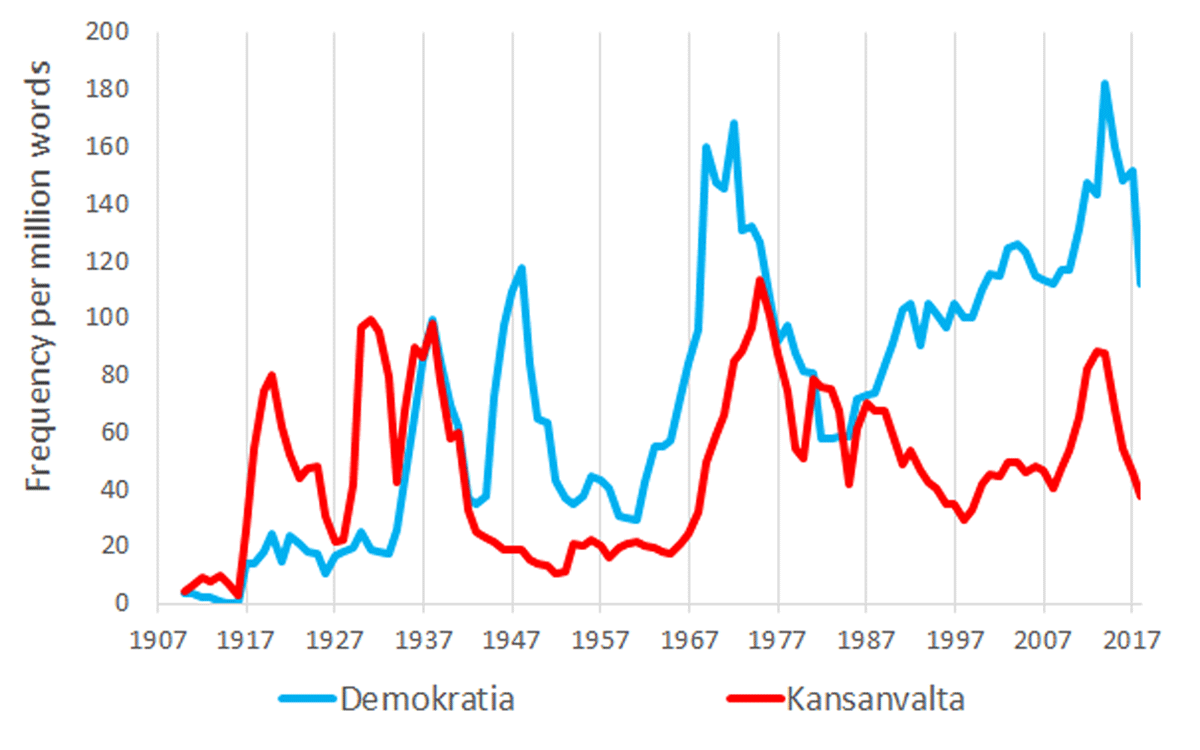
Figure 1
Democracy (demokratia) and people’s power (kansanvalta) in Finnish parliamentary debates, four-year moving average, 1907–2018.
Our primary timeframe of 1980–2021 covers the last period when kansanvalta was able to overtake demokratia in individual years (1981, 1982, 1986 and 1987). These outbursts of kansanvalta can be pinpointed to Veikko Vennamo (Rural), who criticised the President Urho Kekkonen (1956–1981) and other parties for not advocating the true people’s power, and the left-wing Social Democrat Paula Eenilä, who was the most active user of the term between 1985–1987. From 1988 onwards, demokratia has been more popular than kansanvalta every year. A similar trend can be observed in the use of the adjectives demokraattinen and kansanvaltainen, which had been almost equally common until 1985, but since then the former has outnumbered the latter. In addition to word frequencies, the change can be seen in the number of speakers: the yearly number of MPs using kansanvalta stays relatively stable over time (max. 57 in 2011, min. 15 in 1982, average 31.1), whereas the use of demokratia spreads over time (max. 137 in 2021, min. 29 in 1982, average 83.1). The relation between the two terms is not as complex in the Swedish-language parliamentary debates in Finland, in which folkstyre or folkvälde simply cannot challenge demokrati.
To better understand the differences between demokratia and kansanvalta, we next counted all the adjectives directly preceding the two words in the parliamentary debates of 1980–2021. It turned out that there is more frequently an adjective preceding demokratia (34%) than kansanvalta (21%). This finding could be explained by demokratia having a broader semantic range than kansanvalta, which leads to increased use of attributes specifying the intended meaning of demokratia. Furthermore, the adjectives before kansanvalta are more clearly dominated by one word, ‘Finnish’ (suomalainen), which constitutes 28% of all cases, whereas the frequency distribution of adjectives before demokratia is more scattered. In the case of demokratia, the top adjective ‘representative’ (edustuksellinen) makes up 19% of all cases. In short, demokratia has a wide range of well-established sub-categories to choose from, but in the case of kansanvalta, the choice is between Finnish kansanvalta and a long tail of rarely used adjectives.
The focus on preceding adjectives only offered a limited view on the semantic fields of demokratia and kansanvalta, neglecting their relation to other nouns and verbs. Thus, we expanded the linguistic context to one sentence to the left and right from demokratia and kansanvalta. Four central differences were identified in their conceptual profiles. First, there is a remarkable temporal trend in the joint appearances of demokratia and kansanvalta. The co-occurrence analysis shows that independent use of kansanvalta decreases over time, and it is used more frequently together with demokratia, while demokratia does not need the company of kansanvalta any more than previously.6 This trend seems to indicate some qualitative changes in how kansanvalta has been used in the last four decades.
Second, the comparison between Tables 1 and 2 highlights the relevance of the qualifier ‘representative,’ which is repeatedly attached to demokratia and only occasionally to kansanvalta.
Table 1
The top 20 words and hand-picked words that appear more frequently near demokratia than kansanvalta in the Finnish parliamentary debates, 1980–2018. The size of the window is one sentence to the left and right of the sentences that include the search term.7
| WORD | TRANSLATION | RANK | ABS. FREQ. | KEYNESS VALUE | RATIO OF REL. FREQ. |
|---|---|---|---|---|---|
| demokratia | democracy | 1 | 10,337 | 3195.5 | 8.0 |
| ihmisoikeus | human right | 2 | 809 | 171.9 | 4.5 |
| eurooppa | Europe | 3 | 706 | 99.9 | 3.0 |
| neuvosto | council | 4 | 323 | 95.6 | 7.7 |
| länsimainen | western | 5 | 230 | 74.0 | 9.4 |
| venäjä | Russia | 6 | 177 | 62.9 | 12.7 |
| edustuksellinen | representative | 7 | 661 | 33.7 | 1.8 |
| siellä | there | 8 | 237 | 31.3 | 2.8 |
| oikeusvaltioperiaate | rule of law | 9 | 111 | 29.8 | 6.4 |
| kansainvälinen | international | 10 | 196 | 29.4 | 3.1 |
| maa | country, land | 11 | 696 | 29.1 | 1.7 |
| edistää | to advance, to promote | 12 | 411 | 25.0 | 1.9 |
| afganistan | Afghanistan | 13 | 58 | 22.1 | 16.6 |
| parlamentaarinen | parliamentary | 14 | 268 | 22.1 | 2.1 |
| jäsenmaa | member country | 15 | 106 | 22.0 | 4.3 |
| myöskin | also | 16 | 389 | 21.3 | 1.8 |
| maailma | world | 17 | 158 | 20.9 | 2.8 |
| läntinen | western | 18 | 55 | 20.7 | 15.8 |
| kansalaisyhteiskunta | civil society | 19 | 95 | 20.4 | 4.5 |
| korruptio | corruption | 20 | 40 | 20.2 | 22.9 |
| kehitys | progress, development | 26 | 276 | 18.2 | 1.9 |
| puute | lack, shortage | 27 | 66 | 17.6 | 6.3 |
| kehittyä | to progress, to develop | 32 | 143 | 16.4 | 2.6 |
| toimia | to act | 38 | 851 | 14.3 | 1.3 |
| juurruttaa | to implant | 120 | 14 | 7.1 | 8.0 |
Table 2
The top 20 words and hand-picked words that appear more frequently in close proximity to kansanvalta than to demokratia; same window size.
| WORD | TRANSLATION | RANK | ABS. FREQ. | KEYNESS VALUE | RATIO OF REL. FREQ. |
|---|---|---|---|---|---|
| kansanvalta | people’s power | 1 | 3,070 | 7193.3 | 29.2 |
| eduskunta | parliament | 2 | 431 | 232.8 | 2.8 |
| smp | Finnish Rural Party | 3 | 62 | 163.4 | 72.0 |
| presidentti | president | 4 | 100 | 63.5 | 3.1 |
| rappeuttaa | to corrupt, to degenerate | 6 | 19 | 57.0 | 132.5 |
| kansa | the people, nation | 7 | 185 | 54.2 | 2.0 |
| valta | power | 8 | 139 | 52.5 | 2.3 |
| puolue | party | 9 | 148 | 46.5 | 2.1 |
| terve | healthy | 10 | 44 | 44.8 | 4.8 |
| hallitusmuoto | form of government | 11 | 40 | 44.7 | 5.4 |
| todellinen | real | 12 | 92 | 39.5 | 2.4 |
| vaalitapa | electoral system | 13 | 23 | 37.7 | 10.0 |
| rahavalta | plutocracy, power of money | 14 | 16 | 36.5 | 27.9 |
| budjettivalta | budgetary authority | 15 | 24 | 35.9 | 8.4 |
| perustuslaki | constitution | 16 | 85 | 33.2 | 2.3 |
| milj | million | 17 | 11 | 33.0 | 76.7 |
| puoluevalta | party hegemony, party power | 18 | 13 | 32.3 | 45.3 |
| valitsijamies | elector | 20 | 9 | 27.0 | 62.7 |
| häväistä | to degrade, to disgrace | 24 | 8 | 24.0 | 55.8 |
| murtaa | to break | 35 | 13 | 18.4 | 7.6 |
| halventaa | to degrade, to defame | 44 | 20 | 16.6 | 3.9 |
| kaventaa | to narrow | 46 | 44 | 15.4 | 2.2 |
| rehellinen | honest | 49 | 15 | 15.2 | 4.8 |
| hauta | grave | 52 | 5 | 15.0 | 34.9 |
| kuopata | to bury | 54 | 5 | 15.0 | 34.9 |
| totuus | truth | 66 | 16 | 12.7 | 3.7 |
| hajottaa | to break, to dissolve | 70 | 7 | 12.5 | 12.2 |
| halveksinta | contempt | 75 | 4 | 12.0 | 27.9 |
| halveksia | to scorn, to despise | 90 | 16 | 10.9 | 3.3 |
| kotimainen | domestic | 97 | 7 | 10.3 | 8.1 |
| rappio | decay, corruption | 98 | 7 | 10.3 | 8.1 |
Third, the tables indicate that geography was a crucial aspect in differentiating the profiles of these terms. Demokratia invited relatively more international terms, such as Europe, western, Russia and Afghanistan (see Table 1). Kansanvalta, instead, focused relatively more often on the attributes ‘Finnish’ and ‘domestic’ (see Table 2). Tellingly, the most distinctive adverb indicating location is ‘there’ (siellä), used nearly three times more frequently with demokratia than with kansanvalta. Demokratia is thus more strongly connected to places outside Finland, whereas kansanvalta is primarily used in the context of the nation state.
Fourth, in terms of the perspective of the future, the results were equally different. While demokratia invited more often such terms as advance, progress, develop, act and deficiency, the terms that appeared relatively more often in connection with kansanvalta were such as break, narrow down, bury, grave, widen, change and decay. The properties connected to demokratia seem more universal than those of kansanvalta: the former is relatively more attached to terms like human rights and the rule of law, while the latter is associated with national democracy (parliament, president, domestic), one specific party (Rural), and criticism of those in power in Finland (plutocracy, party hegemony). These observable differences, while not absolute, indicate that demokratia was primarily attached to the rhetoric of progress and kansanvalta often to the rhetoric of decay. Kansanvalta more often invited such moral and judgemental vocabulary as real, healthy, correct, shame, despise, honest and truth.
To shed more light on these quantitative findings, we move next on to qualitative readings of the selected parts of the material. The difference between representative demokratia and kansanvalta emerged in quantitative analysis; thus, we begin with this issue.
Representative demokratia and kansanvalta
The adjective ‘representative’ occurred much more frequently in connection with demokratia than kansanvalta. It is a word that describes how democracy works and how decisions are made, not primarily the content of the policies. Since it focuses on procedures, the idiom is often used in the context of other forms of participation. As the term participatory democracy is not common in our material, the primary alternative for representative democracy is direct democracy (suora demokratia).
Three discussions suggested direct democracy and challenged representative democracy over the examined period. The first discussion, beginning in the mid-1980s, invokes the emergent role of the new social movements and sinking voter turnout as signs of ‘the crisis’ of representative democracy (Liisa Jaakonsaari, SDP, 19 June 1984). The second discussion is generated by the issue of consultative or binding referenda in the Finnish constitution. As Seppo Pelttari (Centre Party [Centre], 21 February 1989) maintains, ‘the purpose of these laws has been that the consultative referendum would constitute a supplementary channel of direct kansanvalta to representative democracy.’ The law on consultative referenda on the national level came into force in 1987, on the municipal level in 1990. Even after that, several MPs specifically demanded binding referenda (e.g. Hannele Pokka, Centre, 25 May 1990; Heidi Hautala, Green Party [Greens], 17 May 1994). Since the only national referendum was held in October 1994 on joining the EU, the lamentation about ‘regrettably’ small number of referenda has been a recurrent topic. After 2010, demands for further and even binding referenda have been put forward by the current and former MPs of the Finns Party (Finns)8 (e.g. Olli Immonen, 19 November 2014). However, the general enthusiasm for referenda begins to wane after 2000. Since then, increasingly, the idea of participatory democracy has been supported by advocating popular initiatives, which constitutes the third discussion of ideas complementing representative democracy. The law on popular initiatives took effect in 2012, and the consequent surge of initiatives has kept the theme topical. All these discussions challenge the representative democracy, either by discussants who want to supplement it with forms of participatory democracy, or more radical speakers wanting to replace it with direct democracy.
These new forms of participation are supported by two different arguments. The more oppositional MPs argue for a ‘crisis’ or ‘decay’ of representative democracy (Urpo Leppänen, Rural, 06 November 1981). This crisis was asserted in the 1980s and 1990s by younger Social Democrats (Arja Alho, 14 December 1993). According to Heidi Hautala (Greens, 17 May 1994), ‘the situation in Finland is extremely dangerous in terms of the credibility of the political system,’ since ‘representative democracy has become more and more clearly a democracy of political parties.’ In the 2010s, the rhetoric of crises and decay in representative democracy emerges from both ends of the political spectrum. According to Jyrki Yrttiaho (Left Alliance [Left], 12 May 2010), a ‘crisis of the decay of representative democracy’ reigns. James Hirvisaari (Muutos 2011,9 18 March 2014) sees that ‘representative democracy has badly betrayed the concept of democracy,’ and Jussi Halla-aho (Finns, 27 March 2014) consider representative democracy to be oligarchy, maintaining that ‘demokratia literally means kansanvalta, that is, that the majority decides.’ Without referenda, argues Vesa-Matti Saarakkala (Finns, 22 May 2014), parliamentarism is ‘at a risk of collapse,’ and ‘the outraged people’ may seek solutions on the streets.
However, most of the parties from National Coalition Party (Coalition) to the Greens and Social Democrats turn to support representative democracy more unconditionally. While the ‘direct democracy’ of referenda was expected to activate the passive voters, the Irish referendum on ratifying the EU’s Treaty of Nice in 2001 had a turnout of only 46.1% (Kiljunen, SDP, 18 June 2001). Several MPs kept repeating that the foundation of the Finnish constitution rests on the principle of representative democracy.
It is characteristic for this debate that the idiom ‘representative kansanvalta’ appears only occasionally and exclusively in a positive sense. The critique of the functioning of the political system is directed at representative demokratia on behalf of kansanvalta, which remains the highest yardstick for the functioning of the system. New political groups from the Greens to right-wing populists have begun their career by criticising representative democracy in the name of direct democracy and referenda. The most crucial conclusion of this development is that the principle of kansanvalta cannot be attacked or criticised, and it cannot have such unsatisfactory or deficient applications as representative demokratia can.
Genuine and real demokratia and kansanvalta
Chaïm Perelman and Lucie Olbrechts-Tyteca (1969, 411–49) suggest that writers who want to challenge ideas often resort to the conceptual pair apparent/real. Thus, instead of attacking the idea of democracy directly, speakers can discuss ‘real,’ ‘true’ or ‘genuine’ democracy in contrast to the deficient apparent democracy prevailing in the discussed country. One of the first observations after locating the adjectives most often attached to the words demokratia and kansanvalta was indeed the prevalence of terms that can be understood as rhetorical equivalents of ‘real.’
The dissociative rhetoric was widely used in parliamentary debates, but only exceptionally in the interviews. For example, there are 56 cases of ‘real demokratia’ in the parliamentary records, but no corresponding cases in the interviews. ‘Genuine demokratia’ was mentioned only twice in the interviews and 47 times in the records. Kansanvalta only received the attributes ‘healthy’ (3 times) and ‘real’ (2) – and most of these cases belong to one MP, Veikko Vennamo (Rural). These terms seem to be nearly exclusively used in the debating, and not in the reflective-descriptive context of the interviews. Different communicative environments invite different rhetorical styles, rendering dissociative terms too oppositional in the intimate context of the interviews.
In the parliamentary records, ‘real’ gathered 56 cases both with demokratia and kansanvalta, indicating that it was somewhat more probable in connection with kansanvalta, because this word is generally much less frequent than demokratia. The most relevant difference between real kansanvalta and real demokratia concerns the object of evaluation. In the domestic context, real kansanvalta was employed as an argument for the use of referenda (e.g. V. Vennamo, Rural, 05 May 1981, and several MPs from the Finns in the 2010s). Anneli Jäätteenmäki, Centre, actively defended the role of the parliament (vs the role of the president) in the nomination of the prime minister from the perspective of real kansanvalta (23 February 1990).
The rhetoric of real kansanvalta brings about several sharp and totalizing statements about other agents and the state of democracy. ‘You Social democrats have always promoted red fascism, never have supported real kansanvalta, always the concentration of power,’ says Veikko Vennamo (16 February 1983). ‘This kind of politics would not be possible … if we lived in a real kansanvalta, in a majority power,’ exclaims Paula Eenilä (SDP, 15 May 1986). It is possible to maintain that the peoples of Eastern Europe struggled for real kansanvalta (Esko Helle, Finnish People’s Democratic League [SKDL],10 13 February 1990), while no foreign country itself is evaluated in these terms. Arguably, real demokratia can prevail in foreign countries, while real kansanvalta cannot.
If real kansanvalta was particularly favoured by MPs from the Rural Party and its follower, the Finns Party, real demokratia is a more generally shared idiom. It enables such radical leftist arguments as ‘The nature of the capitalist system and the mechanisms created to protect its immunity prevent the realisation of real demokratia’ (Ensio Laine, SKDL, 03 June 1986). Another prominent feature of real demokratia was its active use in criticising countries that do not meet the criteria of the concept. Turkey, Belarus, and Afghanistan were mentioned as countries without real demokratia. Ben Zyskowicz (Coalition, 07 April 1992) suggests even the counter-concept ‘play democracy’ (näytelmädemokratia) to describe the situation within the Soviet bloc. Real demokratia also plays a role in the criticism of the European Union since the MPs of the Finns repeat that real democracy can only prevail within nation states (e.g. Timo Soini, 11 February 2009). Eva Biaudet, the Swedish People’s Party (Swedish), politicises the term differently by maintaining, while discussing the African refugee crisis, that ‘real democracies do not wage wars against each other’ (17 February 2016).
The epithet ‘functioning’ is attached to demokratia 52 times, in contrast to eleven cases of functioning kansanvalta. Obviously, a non-functioning kansanvalta is understood as a contradiction in terms. A roughly similar division of labour concerns the epithet ‘mature.’ It is attached to kansanvalta only once, in the context of debating constitutional reform (Olli Rehn, Centre, 29 November 1994), in comparison with 19 instances of ‘mature demokratia.’ More than half of these expressions belong to Kimmo Kiljunen, SDP, who also makes the distinction between mature and new democracies (26 May 2000). In doing so, he outlines a scale of the maturity of democracy, pointing out Finland’s progress (03 December 1999) and partial lateness (18 December 2002). Rather than being a tool to inspect Finnish democracy critically, ‘mature’ seems to be a term for appraising and celebrating its condition in Finland.
Metaphorically, ‘mature’ belongs to the language of natural, biological growth and progress, while the medical epithet ‘healthy,’ in contrast, invites strong moral arguments concerning kansanvalta. Characteristically, 21 of the 27 cases are voiced by Veikko Vennamo. He often summarises debates with statements such as: ‘This does not represent healthy kansanvalta, this represents serious decay’ (16 May 1980). However, ‘healthy democracy,’ with only 13 cases, has a more balanced use. Even though there are ‘threats’ to healthy democracy, several MPs attest to the state of Finland’s ‘healthy and progressive democracy’ (Kimmo Kivelä, Finns, 19 November 2014).
Genuine kansanvalta (21 instances in the records) is mostly used as an intensifier to emphasise aspects of kansanvalta. Liisa Jaakonsaari (SDP, 17 May 1985) asserts that ‘despite all the problems, municipal administration represents the most genuine, nearest to the people Finnish kansanvalta.’ Local organs are near people, thus the genuine kansanvalta. Occasionally, the idiom is used in a celebratory sense, expressing the beneficial historical development in Finland. The term has had most recent uses by the Finns and the MPs expelled from the party.11 According to James Hirvisaari (07 November 2013), only direct democracy signifies genuine kansanvalta. Ano Turtiainen (06 May 2021) agrees, saying that only ‘binding referenda’ mean genuine kansanvalta. As mentioned, referenda and direct democracy became popular among the Finns during the 2010s as challengers of representative and parliamentary democracy.
Genuine demokratia (47 mentions) departs from this picture because of its international emphasis and explicit opposites. Ben Zyskowicz (Coalition) defends genuine democracy against the models of the Soviet Union, East Germany (07 April 1992) and Belarus as countries without genuine demokratia (08 February 2008). In short, the principle of genuine demokratia is applicable worldwide and in various sectors of society, while genuine kansanvalta can only be used within the national and municipal context.
Finnish demokratia and kansanvalta
The dissociative contrasting of versions of democracy intensifies when we move on to the geographical epithets of demokratia and kansanvalta. In the interview corpus, the idiom ‘Finnish kansanvalta’ seems, at first, to be much more frequent (52 cases) than ‘Finnish demokratia’ (25 cases). A closer look at the data reveals an entirely different picture, since only 7 mentions belong to the MPs, while interviewers employ the term 45 times. The result is compelling since only a few of the interviewees take the term kansanvalta from the interviewer’s question and continue its use in their response.12 In the interview situation, Finnish kansanvalta is unequivocally a dispreferred choice of idiom. One possible interpretation is that even though most of the MPs may agree that democratic principles are generally observed, it might still be too grandiose to speak about Finnish kansanvalta. Furthermore, while the idiom is dispreferred within the reflective genre of oral history interview, it appears 170 times in the parliamentary records, within the debating context.
‘Finnish demokratia’ (412) and ‘Finnish kansanvalta’ (170) have largely similar profiles in the parliamentary records. In the beginning of the examined period, both idioms were actively used to criticise the shortcomings and even decay of the Finnish political system during the long term of President Urho Kekkonen (1956–1981). The rhetoric of decay was in active use by the populist Rural Party in the early 1980s, and later again by the Finns, from 2006 onward. Representatives of moderate and centrist parties, instead, emphasised the development and the long, dignified history of kansanvalta. In both roles, the terms are used almost as loci communes,13 as the self-evidently highest norms of political life. This kind of speech is evident when MPs reinforce their argument by listing all the greatest values of the community, often to advance a controversial point. Esko Seppänen (Left) suggests that ‘from the perspective of the Finnish independence, Finnish kansanvalta, Finnish parliamentarism, Finnish demokratia, there are reasons to consider critically the hurry [to join the EC/EU]’ (16 January 1992).
Gradually, both Finnish demokratia and kansanvalta seem to receive a spatial connotation of the Finnish polity, suggesting that political debates take place within the space of Finnish demokratia or Finnish kansanvalta. Occasionally, the terms even become synonyms for the parliament itself. This version is aptly expressed in the debate about the planned new annex for the parliament building by Risto Kuisma (SDP), who suggests that ‘Finnish kansanvalta needs office premises that correspond to its dignity’ (13 December 2000).
The abundant use of the epithet ‘Finnish’ raises the question about its functions. It is seldom used as a term of direct comparison, even though in a few cases ‘people’s democracies’ or other less democratic countries are mentioned. Nevertheless, it may be legitimate to talk about a ‘hidden dissociation’ as regards several kinds of nominal democracies, such as the Soviet Union or the German Democratic Republic. Expressions such as ‘western democracy’ rest on a more explicit comparison between the right (western) and wrong (eastern) versions of democracy and run the risk of generating political controversy instead of national self-complacency. The hidden dissociation coheres well with the idea of a long national history of democracy and the attached national pride. The democratic roots of Finnish society and political culture have been emphasised since the 1930s as part of a rhetorical attempt to defend the then-existing parliamentary democracy against Soviet communism and German National Socialism. This ‘historicization’ of democracy was closely linked with an increased emphasis being placed on the Nordic character of the political tradition of Finland (Kurunmäki 2019).
When it comes to the qualitative differences between Finnish demokratia and Finnish kansanvalta, there is first of all the difference between the high-flown register of kansanvalta and the more matter-of-fact registers of demokratia. Finnish kansanvalta receives more often such dramatising qualifiers as ‘decay,’ ‘shame’ and ‘honour.’ This is aptly expressed by Timo Soini (Finns): ‘It is gravedigging for Finnish kansanvalta’ (30 November 2006); ‘Sad is the state of Finnish kansanvalta, not to say downright the state of decay’ (04 December 2006), stated when the parliament discussed the ratification of changes to the EU’s constitution.
However, our initial hypothesis that the linguistic form of kansanvalta would activate issues of power received only partial corroboration. In contrast, the connection between ‘the people’ (including the Finnish terms for the people, folk, citizen, and nation) and Finnish kansanvalta is evident. ‘Why Finnish, representative kansanvalta does not consent to listen to the people,’ laments Paula Eenilä (SDP, 15 May 1986). In this statement, ‘representative kansanvalta’ is an agent and a pseudonym for the parliament. The new political issues concerning the role of popular movements (kansanliikkeet), popular initiatives (kansalaisaloitteet) and referenda (kansanäänestykset) all activated the vocabulary of Finnish kansanvalta. ‘To the shame of Finnish kansanvalta, referenda have so far been organised only twice in our country’ (Olli Immonen, Finns, 27 March 2014). Kari Rajamäki (SDP) suggests in 2016 in his interview that ‘in fact, kansanvalta should be also defined by realisation of the will of the people in the decisions of the parliament and the state.’ Social Democrats often conjoin kansanvalta and the activities of civil society in their interviews. Ilkka Taipale (SDP, 2016) provides a list of ‘political parties, trade unions, NGOs, municipal organs, and the parliament as aspects of kansanvalta. That is, the parliament alone would not mean kansanvalta.’ A common feature of all these comments is that kansanvalta does not concern the due procedures of the parliamentary organs but always foregrounds the interaction between the parliament and civil society.
This close connection between popular movements, initiatives and referenda was occasionally challenged from the perspective of representative democracy. But how to do it without undermining the absolute value of Finnish kansanvalta? Ben Zyskowicz solves this dilemma by severing the connection between kansanvalta and referenda:
‘The parliamentary group of the Coalition Party considers that Finnish kansanvalta must even in the future be based on representative democracy. Therefore, referenda cannot be the model by which issues will generally be solved in problematic situations’ (14 November 1994). Similar arguments are advanced by representatives of the Centre and Social Democrats. In contrast, the right-wing Finns are the most eager to promote referenda in the name of kansanvalta.
If the representatives of the Rural Party and the Finns prefer using kansanvalta, often in a grand style, the representatives of the Left Alliance prefer the language of democracy. Heli Astala (SKDL, 28 September 1983) points out how ‘economic demokratia is missing and with it a very essential part of the necessary building elements of Finnish demokratia.’ Esko-Juhani Tennilä (Left, 20 November 1990) adds that ‘when we speak about banks and their position, we speak, at the same time, about Finnish demokratia.’ It is easy to find such critical comments by leftist MPs lamenting the shortcomings of Finnish demokratia.
Tellingly, legislative issues concerning transparency, conscience, publicity and property rights are discussed in terms of Finnish demokratia. ‘Nothing is more essential in the realisation of demokratia than the transparency and publicity of decision-making,’ maintains Tuija Brax (Greens, 13 May 2003). ‘To my mind, the respect for the freedom of conscience must be included in Finnish demokratia and the tradition of the civilised state,’ considers Olli Rehn (Centre, 13 December 1991). In line with these observations are the findings that such relatively new issues as human rights and such new subjects as women and children appear more often in the vicinity of demokratia than kansanvalta.
In contrast, political issues concerning the relationship between the Finnish state and international organisations such as the EC/EU and NATO invite more often the vocabulary of Finnish kansanvalta than demokratia. It was employed in a critical manner before Finnish membership in the EC/EU in the 1990s, and again from the 2000s onward. On 15 May 2022, when President Sauli Niinistö officially announced that Finland would apply for NATO membership, he emphasised that in the defence political decision-making policy after the Russian invasion of Ukraine, Finns have shown both patience and haste, and in doing so, ‘Finnish kansanvalta has shown its unique power’ (Niinistö 2022). This statement further attests the particularly high register and argumentative value of the term on great national issues.
Nordic demokratia
Against the backdrop of the idea of a historically rooted Nordic democratic tradition, it is noteworthy that Nordic kansanvalta is mentioned only once in the interview data in the context of Nordic cooperation (Ralf Friberg, SDP, 31 August 2001). Rainer Lemström (Rural, 07 August 1992) describes an election campaign in his interview by saying that ‘it was about inciting the [party] field to the struggle for kansanvalta and Nordic demokratia.’ Demokratia, as an abstract principle, can be Nordic in its pure form, but kansanvalta remains a domestic phenomenon. In the studied parliamentary records, there were 13 instances of Nordic kansanvalta, in comparison with 62 instances of Nordic demokratia. With three exceptions (two Social Democrats and one MP of the Finns), all of the mentions of Nordic kansanvalta belong to Veikko Vennamo (Rural). In his colourful rhetoric, Vennamo employs all the most valuable terms to foster his point. He attacks supermarkets, pointing out that ‘Ordinary, smaller shops mean Nordic, Finnish kansanvalta and demokratia’ (22 April 1980). His verbal acrobatics grows even more complicated when he declares:
We all know that municipal work is the foundation of Nordic, Finnish kansanvalta. But the big parties, in their urge for power, have gradually, under the guise of the word demokratia, tried to extinguish this municipal kansanvalta by concentrating power, cutting the roots of kansanvalta, by using party power, so that municipal kansanvalta is soon merely quasi-kansanvalta, that is, quasi-demokratia (19 May 1981).
Vennamo suggests that some parties use the word democracy as a pretext for making perilous decisions. He cannot, for obvious reasons, attack demokratia as such, yet he manages to condemn political agents who use the language of demokratia for quasi-democratic purposes. Arguably, Nordic functions here as another element of dissociative rhetoric. Without directly challenging Finland as a democracy, Nordic demokratia is set above it as a standard.
The attribute ‘Nordic’ brings in more explicit national comparisons than ‘Finnish.’ National comparisons came up in a debate between MP Tuure Junnila (Coalition) and his leftist opponent from the Democratic Alternative.14 Junnila points out that
… there is no point, MP Laine, in starting to debate here whether the Soviet Union and South Africa are undemocratic countries or not, but if we look at both of them from the perspective of our ordinary Nordic demokratia, then indeed they are both undemocratic countries, the Soviet Union too, MP Laine (19 December 1986).
Marjatta Stenius-Kaukonen responds by stating that while ‘MP Junnila regards Nordic demokratia as the ideal of demokratia it can be said that the Soviet Union surely departs from this, but Nordic demokratia is indeed mostly quasi-demokratia’ (19 December 1986). Another leftist MP, Pirkko Turpeinen-Saari, enquires about ways of ‘developing and extending Nordic demokratia, which is only bourgeois demokratia in all countries’ (SKDL, 01 March 1985). As late as in 1986, it was possible to defend the demokratia of the Soviet Union in comparison with the deficient Nordic demokratia. These two speeches are the only instances in which a critical flavour is attached to Nordic, including Finnish, demokratia.
Direct comparisons with other Nordic countries played a visible role during the long process of reforming the Finnish constitution and the strong presidential system after the end of President Kekkonen’s era. Jacob Söderman warns against the mere adoption of direct popular vote in the election of the president, ‘who in Finland has singularly strong powers both in foreign and domestic politics, including powers concerning the parliament […] it would in practice also mean that Finland would move one step further away from the so-called Nordic demokratia …’ (Söderman, SDP, 06 November 1981). However, since Nordic demokratia gradually achieves an unchallenged position as a locus communis, it can be added to arguments beyond any actual Nordic reference. Raimo Vistbacka (Finns, 02 February 1999) criticises the proposal of the Constitutional Law Committee to limit the president’s rights to engage in the formation of the new government. This decision, contends Vistbacka, would make the president a mere master of ceremonies, a solution that ‘verges on ridiculing the Nordic demokratia.’ Here, the principle of Nordic democracy is freed from any comparison with the other Nordic countries, since none of them has a president, queen or king entitled to control the process of government formation. In Vistbacka’s use, the term is purely a moral and political intensifier.
Nordic demokratia often has a connection with aspects of welfare and the Nordic welfare state. Anna-Maja Henriksson, Swedish, voices this principle aptly: ‘Fortunately we live in a Nordic demokratia where we have also taken care of having a functioning social security system […] We have basic social security, and we have housing allowances and so on’ (01 December 2020).
Nordic demokratia has lost much of its polemical power since the collapse of the Soviet system and the adoption of the new Finnish constitution in 1999. For several speakers, Finland already is a Nordic demokratia and the critical potential of the concept wanes. Markku Rossi (Centre) expresses the conceptual connection between demokratia and kansanvalta by saying that ‘Nordic demokratia has a strong basis in kansanvalta. Government proposals, initiatives of the MPs, the referendum and now the popular initiative belong to the same series, continuum, by which specifically the Finnish society and Nordic demokratia are advanced’ (25 April 2013). Referenda and popular initiatives activate the role of the people and kansanvalta within the larger, constitutional process of Nordic demokratia.
Western demokratia
The attribute ‘western’ exhibits the most dramatic difference between the terms demokratia and kansanvalta. While the parliamentary records contain 270 and the interviews 53 instances of western demokratia, kansanvalta only has 2 and 1 case, respectively. Even with the three mentions of European kansanvalta, the term turns out to refer to an essentially Finnish and Nordic phenomenon. While western demokratia is able to be the standard that Finland must pursue, fail or succeed to achieve, no corresponding standard of western kansanvalta exists. This alludes to a spatial image, where municipalities can have deficits in democracy but still stand for kansanvalta, while some western countries can be examples of democracy but do not qualify as sites of kansanvalta. Kansanvalta needs to function near ordinary people, locally, and in small units.
It is remarkable that western demokratia is never directly challenged, although the Finnish Communist Party15 still existed in the 1980s and had representatives in the parliament. Only two indirect critical comments can be found. Mauri Peltokangas (Finns, 19 September 2019) suggests that conflicts in countries like Iraq and Afghanistan cannot be solved ‘by means of western demokratia.’ Markus Mustajärvi (Left, 29 May 2012), in turn, suggests that China and Vietnam can introduce wage and price controls at any time, and it is ‘such a competitive advantage that western democracies do not have.’ In all other comments, either western demokratia was set as a standard or the critical MPs refrained from using the term. Under this shared umbrella, the contest of interpretations continues. Even though the attribute ‘western’ itself is geographical, only a few of the contrasts are directly geographical. Considering the political history of the 1980s and the collapse of the Soviet system, the exiguity of direct east–west comparisons is notable, as is their timing. Esko Almgren, Christian Democrats (Christian), argues that ‘Poland has never feigned [to be a western democracy] since its system is based on the dictatorship of the proletariat’ (16 April 1985). In 1990, Tuure Junnila (Coalition, 12 June 1990) notices that ‘the so-called people’s democracies are, one after another, renouncing the whole socialism and drifting towards the western demokratia and market economy …’ The contrast between the Soviet Union and western demokratia was explicitly pronounced as late as in 2006, after a controversial vote in the European Council about condemning Soviet communism, the way the dictatorship of Hitler had previously been condemned. Mikko Elo (SDP) had abstained from the vote, and in the consequent debate, Ben Zyskowicz (Coalition) pointed out that
I maintain […] one more time that I do not approve of the Chinese communist dictatorship. As I support multi-party democracy, human rights, freedom of speech, freedom of enterprise and in general the western demokratia, it is quite clear that I don’t accept the communist dictatorship in China, North Korea or even in the hero states of the 1970s, Cuba and Vietnam. Likewise, I don’t approve of other dictatorships … (14 February 2006).
During the 1990s, it becomes possible to discuss the difference between the Russian system and western demokratia (Mikko Elo, SDP, 28 April 1998). Since that time, Russia and its development have been characterised as a contrast and deviation from western democracy. At the same time, the Cold War antagonism between western demokratia and the Soviet camp starts to move partly to the background while countries such as Turkey, Iraq and Afghanistan become more prominent contrasts to western democracy. ‘Planting the western demokratia’ in Afghanistan and Iraq is an idiom used by Hannu Hoskonen (Centre, 18 February 2010; 27 June 2018). Most recently, Poland and Hungary have surfaced as counterexamples of western democracy (Petteri Orpo, Coalition, 01 December 2020).
In debates, western demokratia is typically used as an abstract principle without explicit, geographical footing. Instead of individual countries, the rhetorical role of ideal is often given to ‘other’ or ‘ordinary’ western democracies. ‘In other western democracies, the respect for the rule of law is noticeably deeper,’ claims Kirsi Ojansuu (Greens, 11 February 2003). The constitutional reform was defended in terms of becoming a genuine western demokratia. Esko Helle, Left, argues against the presidential system by saying that ‘one person’s great power is a very Byzantine construct, and it is far from western demokratia and parliamentarism’ (02 February 1999). For obvious reasons, such presidential systems as the United States or France cannot stand here as examples of western demokratia. The implicit opposite of the term is expressed by Matti Vähänäkki (SDP, 10 February 1999), who defends the constitutional reform by saying ‘We really need to go, MP Aittoniemi, to western demokratia, to walk with the others. We don’t need a tsar.’
The shared idea of western democracy is often specified by underlining some of its aspects as a cornerstone, foundational pillar or central meaning. ‘Equality of people, equal rights, freedom of speech and opinion are the fundamental pillars of western democracy,’ argues Sari Tanus (Christian, 16 February 2017). This status of cornerstone is given either to free media (Pentti Mäki-Hakola, Coalition, 22 June 1982), freedom of speech (Sami Savio, Finns, 05 October 2016), free and honest elections (Annika Lapintie, Left, 10 December 2015), the right to non-military service (Toimi Kankaanniemi, Christian, 03 December 2007), or extra-parliamentary action including strikes (Anna Kontula, Left, 16 October 2018).
While the MPs welcome the advance towards western democracy, the political debate also nurtures ideas about its crises. Ville Niinistö, former chair of the Greens, maintains that western demokratia ‘is in crisis since the liberation of market forces has turned to generate new problems and attacks on freedom’ (12 December 2018). However critical these comments may be, they do not challenge the undisputable high value of western democracy. As Anna-Maja Henriksson (Swedish, 18 March 2014) explicitly points out, ‘Finnish people value demokratia, but criticise its functionality.’
In the parliamentary records, we found 3 cases of European kansanvalta versus 30 cases of European demokratia (but, as we earlier mentioned, no such cases in the interview material). This underlines, once again, the highly national nature of kansanvalta. European demokratia was introduced into the parliamentary debates in December 1989, which connects the term closely to Finland’s relationship with the European Community/Union. Without the European Union and Finland’s decision to join it (the referendum in October 1994 and the membership on 01 January 1995), there would hardly be much need for the idiom. Since European demokratia predominantly refers to democracy within the EU and not the abstract, positive idea of western democracy, its appreciation is more conditional. Timo Soini, chair of the Finns Party, voices the opposite sentiment while criticising the decision to ratify the suggested changes to the EU’s constitution by maintaining that ‘this is the direction where European demokratia is now heading. The individual loses the belief in the power of their vote, when the units become too big. The European Union will not survive, it is already clear even structurally’ (04 December 2006).
Discussion
Our analysis reveals nuanced differentiation and historical changes in the use of the apparently synonymous Finnish words for democracy. The most evident difference concerns the geographic applicability of these terms: demokratia is a term to be applied in international contexts and in evaluating other countries. Inside Finland, it also prevails in appraising various social and political organisations, be they political parties, trade unions, schools or business organisations.
Kansanvalta, in turn, has two privileged sites of application: Finland as a nation and municipalities. Municipalities can represent prototypical kansanvalta regardless and without any consideration about how democratic their processes are. In such a use, kansanvalta receives the connotation of ‘the ordinary people’s power,’ in contrast to the parliamentary democracy, which is run by a more select group of politicians who make decisions in Helsinki. Therefore, kansanvalta has a strong geographic footing, rendering talk about kansanvalta within the EU or other international organisations nearly impossible. Kansanvalta seems to be an undivisible entity, while demokratia can be distributed, partial, or divided.
The studied period, 1980–2021, witnesses the undeniable victory of demokratia since 1990. While the number of users and uses of the term demokratia has grown steadily in parliament, the case with kansanvalta is different. Increasingly, it is only used in the near vicinity of demokratia, while demokratia does not need its native version. Arguably, the term kansanvalta is moving from argumentative to celebratory rhetoric, to present itself within lists of such indubitable terms as demokratia, parliamentarism, and Finnish independence. A corresponding observation was made after comparing the interviews with ex-parliamentarians and the parliamentary records. Even though the interviewers actively prompted former MPs to evaluate the state of ‘Finnish kansanvalta,’ the MPs refrained from using the term (even though it could be used in the parliamentary debates). One explanation of this refusal is that the term’s recent solemn, celebratory register tallies poorly with the reflective genre of interview. In political and cultural debates, MPs prefer demokratia, while kansanvalta increasingly appears in celebratory uses.
One factor explaining the triumph of demokratia is the growing international interaction since joining the European Council (1989) and the EU (1995). Because the other European languages do not support the use of kansanvalta, translated documents and imported discussions resort to the vocabulary of demokratia. Of course, this was not the first impulse of international discussions arriving in Finland. One could mention at least the appearance of American political science in Finland after World War II and the various social movements of the 1960s. Vennamo’s abundant use of kansanvalta in the 1980s can be understood as an attempt to mobilise native, rural, and archaic resistance against the ‘foreign’ and left-oriented talk about demokratia. Currently, no major political party privileges kansanvalta.
The originally foreign demokratia and the native language kansanvalta (the people’s power) provide different linguistic affordances and therefore invite different other terms and discussions. While demokratia has become an abstract, general, and fundamentally procedural concept, kansanvalta as the people’s power has been less flexible. Democracy in schools, churches or businesses cannot easily be expressed in terms of kansanvalta, since how are the people to come and have power within these institutions? However, economic kansanvalta used to be a viable idiom among the leftist MPs. The question is not about how democratically a company works but about who has the power to govern the whole economy of the country. Kansanvalta still has these connotations of power and the people, inviting more talk about power than demokratia does. Politically significant is the way kansanvalta is attached to and inviting discussions about popular activism. In the Finnish language, there are several compounds for popular activism with the beginning of kansan (the people’s), supporting the use of kansanvalta. And vice versa: the exceptionally high relevance of the alternative term for democracy in Finnish is supported by this broad vocabulary of kansa-related terms. However, over the last three decades, kansanvalta has lost ground to demokratia and become a slightly archaic word.
The idea of ‘direct’ people’s power has given way to ideas of participatory forms of politics supplementing representative democracy. Representative democracy has gradually achieved a hegemonic position in parliamentary debates. This means that direct confrontation with this principle has become more difficult. In the 1980s, representative democracy was resisted by individual communist speakers by characterising Nordic democracy as merely bourgeois democracy in comparison with the more mature Soviet democracy. Beginning in the 1980s, the debates on new social movements, referenda and popular initiatives challenged the role of representative democracy from the perspective of people’s power. The active use of kansanvalta in connection with these new themes has been characteristic of oppositional political forces, from left-wing Social Democrats and Greens to the right-wing populist Finns Party. Despite the recurrent talk about problems and crises in representative democracy, most of the critics saw the new forms of participation as supplements to the procedures of representative democracy. Towards the end of the studied period, its principles were widely shared, while the radical posing of referenda against representative democracy became generally adopted by the Finns, who often presented kansanvalta as the original form of democracy, in contrast to the defective form of representative democracy.
Data Accessibility Statement
Raw data for the parliamentary debates used in this article can be downloaded from https://vode.uta.fi/data/. For more information on the dataset, see Andrushchenko et al. 2021.
Notes
[1] The online Oxford English Dictionary (OED) provides ‘government by the people’ as the definition of the word democracy. No competing translations are provided, as the following meanings deal with the different contexts of the application of the word. See the search word at https://www.oed.com. For the translation of democracy as the rule of the people, see, for example, Hansen (2005).
[2] In the years 1820–1889, demokratia appeared 153 times and kansanvalta 19 times. In the year 1907, demokratia appeared 451 times and kansanvalta 864 times. Based on searching the terms ‘demokratia’ and ‘kansanvalta’ in the Finnish press in the KORP interface of the Language Bank of Finland, https://korp.csc.fi/.
[3] Based on ParliamentSampo (https://parlamenttisampo.fi/fi/), there were 137 speeches in the Finnish parliament that mentioned kansanvalta in 1929–1930, and 36.5% of them were produced by the SDP.
[4] Based on ParliamentSampo, there were 199 speeches in the parliament that mentioned demokratia in 1945–1948, and 44.2% of them were produced by SKDL (see note 10).
[5] Based on ParliamentSampo, there were 257 speeches in the parliament that mentioned demokratia in 1965–1969. The most active parties to use the term were the SDP (22.6%), National Coalition Party (20.2%), and the Liberal People’s Party (14.0%). At the same time, there were 160 speeches in the parliament that mentioned kansanvalta, and 27.5% of them were produced by the Rural Party.
[6] We quantified how often ‘demokratia’ is mentioned in a window of one sentence to the left or right from sentences including ‘kansanvalta’ in the Finnish parliament. The percentage rose from 16.2 in 1980–1991 to 29.1 in 2010–2021.
[7] ‘Rank’ shows the order of most distinctive words. ‘Abs. freq.’ shows how many times the term appeared in the window of one sentence to the left or right from the term ‘demokratia.’ ‘Keyness value’ is based on log likelihood: the higher the value, the more statistically significant the finding is. ‘Ratio of rel. freq.’ measures how many times more often the word was used in close proximity to ‘demokratia’ compared to ‘kansanvalta.’
[8] Two MPs who were expelled from the Finns Party for their exceedingly radical talks and behaviour endorse this vocabulary even more powerfully. James Hirvisaari, in his interview, was the most eager supporter of referenda. Ano Turtiainen established a new party called ‘The Power Belongs to the People.’ By 2023, both Hirvisaari and Turtiainen have lost their seats.
[10] Finnish People’s Democratic League was established in 1944 as the front organisation of the Finnish Communist Party in elections and the parliament.
[12] This is partly due to a problematic interview practice. The interviewers frequently posed several questions in a row, making it tempting to forget the first and most abstract one and respond to the more concrete questions. The interviewers followed an interview protocol, which included one item on ‘Finnish kansanvalta.’
[13] For Perelman and Olbrechts-Tyteca (1969, 83–99), loci communes are general and unchallenged values (such as quantity or quality) that could be used in all kinds of argumentation. In our use, these terms refer to unchallenged political points of departure.
[14] Democratic Alternative (1986–1990) was a short-lived party, formed after the Finnish Communist Party had expelled its members belonging to its inner, leftist opposition in 1985. In 1990, the party members were accepted into the newly established Left Union.
[15] The Finnish Communist Party was established in Moscow in 1918. Since the legalisation of the party, in 1944, it was one of the biggest communist parties in Western Europe. SKDL (Finnish People’s Democratic League) was the parliamentary umbrella party that included both the Communist Party and the non-Communist left-wing Socialists. The party ceased its functioning in 1990.
Funding Information
The research work for this article was funded by the Academy of Finland research projects ‘Voices of democracy’ (308792) and ‘Political temporalities’ (348744).
Competing Interests
The authors have no competing interests to declare.