
Introduction
Refugees have a higher prevalence of mental health disorders as compared to other migrant groups and the general populations of recipient societies (Lindert et al. 2018; Morina et al. 2018; Turrini et al. 2017). Good mental health, intricately linked to somatic health, is considered both a prerequisite for and an outcome of successful participation in society (Rechel et al. 2013). Syrian refugees constitute one of Norway’s largest refugee groups, with settlement trajectories shaped by contemporary integration policies (Olsen 2024) and a documented high burden of disease. Syrian refugees in the Nordic region, including Norway, have a disproportionately high prevalence of mental health issues (Nissen et al. 2021; Ojha, Thapa & Thapa 2024; Peconga & Thøgersen 2020). Refugees may face post‑migratory challenges such as unrecognized qualifications, language barriers, and systemic discrimination that can contribute to poor mental health (Bruhn et al. 2018; Dadras and Diaz 2024; Solberg et al. 2020). Additionally, chronic pain is widespread in this group, often associated with psychological distress (Nissen et al. 2022; Strømme et al. 2020; Strømme et al. 2021). Musculoskeletal pain and headaches remain prevalent but under‑treated after resettlement (Strømme et al. 2020). These findings highlight the important role of healthcare systems in post‑resettlement integration, a multifaceted process involving health, social ties, and service access (Strang and Ager 2010).
In Norway, integration is highly regulated by state policy. Under the Integration Act (Norwegian Integration Act. 2020), newly arrived refugees participate in an obligatory introduction programme designed to facilitate language learning and societal integration (Djuve et al. 2017). Welfare support tied to this programme is conditional on attendance, and sickness is considered a valid reason for absence if documented by a physician (Norwegian Integration Act 2020).
In this landscape, the primary healthcare system plays a pivotal role. Norway provides universal healthcare access to all legal residents, including asylum‑seekers and refugees (Ringard et al. 2013). Individuals are assigned a regular general practitioner (GP) with the statutory right to switch GPs if desired (Saunes, Karanikolos & Sagan 2020), similar to Denmark (Pedersen, Andersen & Søndergaard 2012). In contrast, Finland and Sweden primarily organise care through health centres, with less emphasis on continuity with a specific doctor (Glenngård 2005; Keskimaki et al. 2019). In Norway, a co‑payment applies to each consultation, up to an annual cap. GPs function as gatekeepers to secondary care, making primary care the first and most frequent point of contact within the health system (Ringard et al. 2013). Out‑of‑hours emergency primary health care services (EPHCs) offer emergency care when the assigned GPs are unavailable (Ringard et al. 2013). Refugees have the same entitlements to these services as the general population (Saunes, Karanikolos & Sagan 2020) and do not have specialized health services. However, labour migrants with shorter stays are not entitled a GP, and migrants generally use EPHCs more than the majority population (Sandvik, Hunskaar & Diaz 2012).
When functioning well, strong primary care systems are associated with improved health equity and cost‑effectiveness (De Maeseneer et al. 2003). Key elements, such as first‑contact accessibility, continuity of care, comprehensiveness, and coordination, are central to this function (Starfield 2012). GPs can serve as coordinators in patients’ navigation of the healthcare system (De Maeseneer et al. 2007) and provide preventive, person‑centred care that promotes health and agency (Lyhne, Bjerrum & Jørgensen 2022; Peckham et al. 2015). GPs can play a key role in fostering a sense of agency in their patients (Dowrick 2016, 2019).
Yet, little is known about how health, healthcare access, and integration intersect from the perspective of refugees themselves. Existing research has focused primarily on service delivery on health outcomes, but little is known about the patient–provider relationship and how it might support integration. This paper addresses that gap by asking the following questions:
How do GPs support Syrian refugees’ ability to navigate and negotiate in Norway as a receiving society?
How does the patient–GP relationship foster participants’ personal agency?
Theoretical Framework
This study draws on resilience theory to understand how GPs support refugees in managing health and navigating complex systems in a new country. Resilience was defined by some scholars as a personal trait that conferred invulnerability to adversity (Garmezy, Masten & Tellegen 1984; Werner and Smith 1982), while others have emphasized adaptive processes involving individual coping skills and access to external resources (Masten et al. 1999; Rutter 1987). More recent perspectives conceptualize resilience as a dynamic interaction between individuals and their environments, shaped by both personal agency and social context (Luthar, Cicchetti & Becker 2000; Ungar 2010). To apply this understanding of resilience within a healthcare context, we draw on Ungar’s ecological framework (Ungar 2010). According to Ungar, resilience is shaped by two interrelated processes: navigation to, and negotiation for, health‑sustaining resources (Ungar 2005). Navigation refers to an individual’s capacity to seek support and the actual availability of support systems (Ungar 2006). Personal agency is defined as the belief in one’s ability to influence life outcomes (Atak and Taştan 2012) and plays a central role in supporting navigational capacity (Ungar 2006).
Negotiation is a process that occurs ‘between individuals and their environments to maintain a self‑definition as healthy’ (Ungar 2004). This process often involves unequal relationships shaped by differences in power, resources, and status (Greer and Bendersky 2013). Navigated and negotiated resources may include education, adequate housing, and access to healthcare (Güngör and Strohmeier 2020; Ungar 2010). Individuals navigating toward a personally meaningful goal must often negotiate their path with institutions and different actors. To further enrich this framework, we draw on van Breda and Theron’s (2018) systematic review, which conceptualises resilience as operating across four interrelated levels: personal, relational, structural, and spiritual/cultural. For example, relational support includes emotional bonds, structural resilience may be constrained in under‑resourced communities, and spiritual beliefs can support positive meaning‑making (van Breda and Theron 2018).
Finally, we adopt a holistic understanding of health that encompasses physical, mental, and social well‑being, aligning with the World Health Organization’s broader definition (World Health Organization 1948). This perspective is particularly relevant for analysing how Syrian refugees interact with health and welfare systems in ways that go beyond illness treatment.
Methods
Participants and recruitment
This study included 20 adult Syrian refugees aged between 22 and 65 years. Participants were recruited through snowball sampling via professional and community networks in Oslo and Bergen. Purposeful sampling was then used to ensure variations in gender (11 women, 9 men), age, education, and occupational background (Naderifar, Goli & Ghaljaie 2017). Eligible participants were adults who arrived in Norway between 2015 and 2017 or through family reunification shortly thereafter. At the time of the interviews (February to May 2023), all had resided in Norway for 6–8 years, providing them with substantial experience of navigating the welfare system and potentially dealing with postmigratory stressors. In the presentation, all participant names and some demographics have been changed to ensure their anonymity. An overview of the study sample is presented in Table 1.
Table 1
Informant demographics (N = 20).
| CHARACTERISTICS | CATEGORY | NUMBER OF PARTICIPANTS |
|---|---|---|
| Gender | Male | 9 |
| Female | 11 | |
| Marital status | Married | 12 |
| Widowed/divorced/single | 8 | |
| Migration route | Asylum‑seeker | 12 |
| Quota refugee | 6 | |
| Family reunification | 2 | |
| Employment/education status | Employed | 5 |
| Homemaker | 2 | |
| Long‑term sick leave | 4 | |
| Disability benefits/retired | 3 | |
| Student | 6 |
Data collection
We conducted individual semi‑structured interviews lasting between 50 and 150 minutes, with an average length of one hour. The interview guide (see Appendix) was structured around broad themes: Daily Life in Norway, Social Networks, Health/Integration, and Health Functions. This allowed us to capture participants’ lived experiences while also enabling the development of inductive insights.
Twelve interviews were conducted with an Arabic interpreter, one with an Arabic‑speaking colleague, and seven in Norwegian. In two interviews, the primary interpreter was unavailable, and a substitute was engaged. Both interpreters fostered a trusting environment where participants could share sensitive health information if they chose to. At the start of each interview, they introduced themselves, explained their neutral role, and assured participants of strict legal confidentiality. The main interpreter had previously interpreted for one participant. For all others, the interpreters were unfamiliar.
Interviews were recorded using the Diktafon app, a secure, GDPR‑compliant tool for sensitive data (Regulation 2016). All interviews conducted in Bergen with interpreter assistance were held via Confrere, a two‑factor authenticated videoconferencing platform with end‑to‑end encryption.
Data analysis
We conducted reflexive thematic analysis guided by Braun and Clarke’s six‑phase model (Braun et al. 2022). Initial coding showed patterns related to participants’ coping and adaptation under adversity. This led us to engage with resilience theory, adopting Ungar’s (2006) socio‑ecological definition.
Although GPs were not a specific topic in the interview guide, they were frequently brought up in discussions of health, agency, and integration. As analysis progressed, our focus sharpened to examine how GPs could support resilience. Coding and theme development were iterative and theory‑informed, allowing refinement of concepts over time. To further structure the analysis, we drew on van Breda and Theron’s (2018) model of resilience across four levels: personal (agency and self‑determination), relational (supportive relationships), structural (rights, institutions, and policy), and spiritual (belief systems fostering meaning and comfort). It was through this lens that the role of GPs became analytically salient, not as a predefined category but rather as a recurring element within patterns of relational and structural support. While spirituality shaped participants’ broader experiences, it was not directly supported by GPs.
Participants were not recruited based on health status, but all had interacted with GPs to varying degrees. Reasons included chronic illness, administrative documentation, psychosocial distress, and postmigration challenges.
Ethical considerations
The study was waived by the Regional Committee for Medical and Health Research Ethics (REK no. 564018). Participants gave recorded oral consent after receiving a summary of the study. They were informed of their right to withdraw at any time and assured of confidentiality and anonymity.
The lead researcher, who conducted all interviews, has professional experience in Norwegian primary healthcare and a refugee background, though not from Syria. This positioning provided a combination of insider and outsider perspectives, which shaped the research process and interpretation of the findings (Dhillon and Thomas 2019).
Practical support was offered when appropriate, including information about psychosocial services. While some interviews were emotionally charged, participants did not report retraumatisation; instead, several described the conversations as relieving.
Results
The resilience of participants was a dynamic, multilevel process, i.e. personal, relational, and structural, where regular GPs supported both navigation and negotiation across levels. In the analysis, the following two main themes were generated:
Central role of the GP: continuity, trust, and support
Self‑determination and agency
Although interrelated and not clearly distinct levels of resilience, the first theme mainly concerns the structural level, while the second theme presents personal and relational levels of resilience.
Central role of the GP: continuity, trust, and support
At the structural level, the importance of the GP in navigation to and negotiation for health‑sustaining resources was a central concept. Navigating life in a new country can be particularly challenging when lacking familiarity with the public service infrastructure. For individuals also facing health issues, the GP often becomes a crucial point of support and guidance.
We present three accounts that illustrate key aspects of this shared theme. In these stories, we will see facets of the GPs’ importance via the continuity of care, being a co‑negotiator, and being a physical anchor.
Continuity of care
Through coming to know Hawa and learning about her challenges over time, her GP was able to provide continuity, which was crucial in addressing her many medical complaints. Hawa, a married mother and former housewife from Syria, had fled with her children to Lebanon when the war broke out. She described the years there as the hardest of her life due to a lack of basic resources and experiences of discrimination: “Everything was hard in Lebanon… Very difficult life.” After several years, they were resettled in Norway as quota refugees. At the time of the interview, Hawa had lived in Norway for seven years and had numerous health complaints.
Hawa’s account is a clear example of the continuity regular GPs provide. Participants often had premigratory trauma in addition to difficulties navigating health and welfare systems. Over time and through repeated consultations, GPs could become familiar with their histories, enabling complex health issues to be managed more effectively.
One of Hawa’s many health problems was a hearing deficiency, which reduced her ability to profit from the introduction programme. However, because welfare support is reduced for absences, she still attended classes:
‘And it affected me when I sat in school and could not hear what the teacher was saying… I felt so bad. Why can’t I do this? I was angry with myself’.
Her experience shows how standardised integration requirements may disadvantage those with specific health challenges. When Hawa shared this with her GP, the GP reassured her that no one could expect her to learn under such conditions. She was referred to specialist healthcare, had surgery, and experienced some improvement: ‘I am not dizzy like before. Now, I have other dizziness because of neck pain’. Her GP also wrote a health declaration so her welfare support would not be reduced due to class absences:
‘The GP said, “You are not going to school. We will do more examinations. After these tests, we’ll see if you can go to school”’.
The GP coordinated further referrals, including to a psychologist. With chronic pain, Hawa was applying for disability support, supported by her GP’s assessment. She did not have to fight to be believed. Without the GP’s long‑term insight into her situation, such advocacy might not have been possible. Communication with Nav (Norwegian welfare authorities) was difficult for her: ‘Just leave me alone… Just stop sending me more assignments from Nav to fill out this form, application, application…’ Her GP advised her and wrote declarations, offering consistent support over time.
Co‑Negotiator
While navigating host society institutions and negotiating for resources, participants leaned on their GP for support. With medical expertise and close communication, GPs assisted participants in negotiating for health‑enhancing resources. To illustrate this, we share Ahmed’s account. He was a young, single student who had come to Norway alone, after crossing the Mediterranean in an overcrowded rubber boat. Ahmed described his time at the reception centre as difficult, and said he became obese: ‘So, I had very bad health at the reception centre…. Everything goes downwards, like lifestyle. I have no movement. I have nothing… You sit in a prison’. He added: ‘Reflections about the war come later’, explaining how trauma surfaced later and led to worrying and overeating.
After resettlement, Ahmed argued with welfare authorities when his welfare support was reduced due to one day’s absence from the introductory programme. He objected to being financially penalised for not attending a full‑day boat trip: ‘I (almost) drowned at sea… I am terrified of coming close to water’. During this dispute, he was aided by a psychologist referred by his GP, who issued a declaration preventing the reduction in welfare support.
Ahmed also had difficulties with his landlord, who entered his apartment without consent. To ‘kill time’ and avoid being home, Ahmed volunteered at the Red Cross and library, building networks among the majority population. Still, he emphasised the support of his GP: ‘He stood by me, understood my case and helped me with all the power he had’.
‘He talked to all the directorates that he is allowed to speak with’.
Despite other support, Ahmed said: ‘He was the most important in that he had an understanding of Norway, above all’.
Ahmed’s GP also helped address sleep disorders and referred him to municipal health and social services. These services visited his home and confirmed his living difficulties. The GP referred him to a psychiatric clinic for posttraumatic stress disorder and to the hospital for assessment for gastric bypass surgery. When his application was denied, the GP submitted appeals and further referrals: ‘Then, everything was hopeless. I went to my GP. The GP sent a complaint. The complaint was rejected… The doctor even sent a new referral to the municipality psychologist, and he said the same, that I needed this help, this operation’.
Ahmed eventually travelled to Egypt for surgery. Although his GP had advised against it, he continued to support Ahmed and helped manage the complications that followed. Across these processes, the GP acted as a co‑negotiator at the structural level, standing by Ahmed’s side.
A physical anchor
Returning to the same GP’s office consultation after consultation created a physical anchor for several participants. Safa’s story is a good example of a GP being an anchoring resilience‑enabler at the structural level. She was a single mother of two in her early 50s and found her regular GP to be a crucial support. As a medical doctor in Syria, Safa found herself in an abusive marriage and difficult divorce before fleeing the war with her children. Her education was not recognised in Norway. Despite grieving the loss of her profession, she was determined to work and be financially self‑sufficient.
Safa worked as a secretary, soon developing pain and a tremor: ‘My GP knew my situation because I told him when I am at work, I don’t want to show them I’m in pain. So, when I’m in pain, I just go in and cry. I come back, take painkillers, and continue working’. She confided in her GP, not her colleagues. This suggests that her GP had created a space of trust. Sleeping disorders and anxiety followed the pain. Safa would still force herself to work. She shared how important her children were to her. Ultimately, the tremor she had hidden from her co‑workers became too apparent, and the pain spread. She quit working after consulting her GP: ‘He said no more work. So now, I go to him every month for controls… The situation is getting worse, and he said it is getting worse with time, so we must find a solution. You have no idea how many painkillers I take’. Her GP identified a clinic that could treat her pain and adjust the number of painkillers.
Throughout this process, Safa was treated by her regular GP. He referred her to various specialists while supporting her through chronic pain, depression, and sleep disorders. He identified treatments that were appropriate for her and negotiated for these resources on her behalf. At the time of the interview, her daughter had recently moved to another town to study. Safa considered moving to support her, but doing so would have required her to change GP. Because she valued the care with her current GP, she didn’t relocate: ‘…and my GP, I don’t want to change him, so I put her in school and came back’, she said. For Safa, her GP was a physical anchor. He represented a service and a sense of support that were so central to her wellbeing that moving was not an option. At stake was a GP–patient relationship based on trust after continuous care, coming to know her story, and aiding in navigating to and negotiating for resources. This physically anchored Safa to the district in which she lived.
Despite the crucial support from her GP, Safa described periods of pain so unbearable that she considered suicide:
‘And I told him if it was not for my God, I would have killed myself’.
Her statement underscores how spiritual belief was a crucial resource, helping Safa endure the pain while receiving medical help and advice from her GP.
Self‑determination and agency
This theme explored how participants regained a sense of control and self‑determination. It highlights two interconnected aspects: the statutory right to change GPs, which strengthened personal autonomy, and the trusting GP–patient relationships that helped restore dignity and foster agency. Together, these dynamics enabled resilience at the personal and relational levels.
While participants often relied on spiritual beliefs to cope, this support was sought outside the GP relationship. Faith provided comfort and strength in private, often solitary ways through personal religious practice. As 59 years old, Habiba shared: ‘It makes me calm, to be outside. I breath better. I see the sky, I can see what God has created. And then (I) say, Dear God, who ha[s] created all of this… And I pray. So, that’s what gives me calm’. In addition to the relational and structural pathways that supported self‑determination, participants often drew on spiritual beliefs as a personal source of strength.
Changing GPs
The statutory right to a regular GP who can be changed was crucial to participants’ feeling of self‑determination and supported resilience on the personal level. If the participants felt dismissed or poorly understood by their GPs, they changed to another. The reasons for dissatisfaction with GPs varied, but a lack of acknowledgement seemed to be common.
Ali, a father of five with multimorbidity, described how, following surgery on his arm, his former GP was unwilling to grant him more than one day of sick leave, despite Ali feeling he needed more time to recover. As a result, he decided to change GPs, which he felt was a positive decision:
‘There was a GP I had for a period after I had an operation here in my arm…. And he said that I didn’t need more than one day away from school. He did not want to give me sick leave more than one day… I said it’s your responsibility if I fall and something happens to that operation… So, I changed that GP, and it has been good ever since’.
Ali was so unhappy with his former GP that he considered hanging up a warning sign on that GP’s door. Ali’s expectation of medical care in the form of sufficient sick leave to heal was not met. In the statutory right to change GP, there was, for him, a restoration of self‑autonomy in deciding for himself and, thus, a strengthening of resilience on the personal level.
Hawa, who had received great support from her current GP, had left another GP who she felt discriminated against. She even suspected that GP was keeping abnormal results hidden. By changing to a GP who acknowledged her, her feeling of self‑determination was restored. Another participant who was very direct about his former GP was Ahmed, who said, ‘He didn’t care!’ about Ahmed’s complaints.
Dissatisfaction with their regular GPs drove several participants to look for other GPs who might acknowledge and respect them. The finances, residency, and schooling of participants were strictly regulated. Thus, the right to freely choose a GP gave autonomy. When describing his communication with the welfare authorities (Nav), Ali said, ‘In Syria, I had dignity’. His statement reflected how the regulatory tone of welfare services made him feel diminished. In contrast, he experienced the primary healthcare system differently: there, he felt more in control, being able to change GPs when feeling dismissed, reinforcing agency.
Marwan, a father of two, confided in his GP about the distress of seeing his ex‑wife with another man, but felt the GP dismissed his depression by merely noting her freedom of choice. He later left the rural area where his family lived and moved to a large city. Marwan stated, ‘If I had stayed…. I am afraid. Afraid I would have done something harmful… To myself. Or him (his ex‑wife’s new partner)…’ Subsequent to his move, he changed GPs. Seeking help from that GP resulted in him being diagnosed with depression and admitted for treatment at a District Psychiatric Centre (DPS). He said, ‘…DPS? Does that exist? I was never told before. They take care of you…’ Marwan stated that he experienced much relief after the two weeks’ treatment in the DPS and, in many ways, started his life over. In his rural community Marwan had no alternative GPs, but moving to a city allowed him to change providers and strengthen his resilience, highlighting the limits of choice in sparsely populated areas.
The GP–patient relationship
A strong GP–patient relationship can enable resilience at both personal and relational levels, built over time through continuity. Some participants noted initial disappointment – for example, when GPs offered no prescriptions, contrasting with practices in Syria – but most were ultimately satisfied with their current GPs. Coming to accept and trust the advice of a physician takes time. Haydar, a father of three, said,
‘(In Syria), we take tablets. We become well. (We think) this is a good doctor, but when you come (here) and think about the future… it’s good one doesn’t take tablets every day. You have to work out a little bit. You have to wait a little bit. I never knew about the difference between bacteria and (viruses)’.
To allow Haydar to understand and accept a non‑drug approach, his GP must have explained them, potentially over time. Regarding his current GP, Haydar felt acknowledged, saying ‘I think he understands what my situation is and what I feel’. The interviews suggest that many participants experienced their GPs as respectful and supportive. Even in cases of disagreement, they could trust their GPs acted with their best interests in mind. This perception fostered trust and relational support, even when navigating cultural and language barriers. For Ali, language was not a sufficiently substantial barrier to necessitate a change from his current GP, as he felt acknowledged and respected. He said, ‘In the beginning, we used an interpreter, but now, I know a little Norwegian, so we communicate ok. And if something stops, we just use Google Translate’.
Zara, a young married mother, had a difficult work situation and had sought help from her GP for another matter, and, ultimately, he had asked how she was really feeling. ‘I burst into tears. I hadn’t planned to talk about it’, Zara said. Her GP listened and was supportive. The consultation helped motivate her to change workplaces, strengthening agency. Zara’s GP was close to retirement age, and she was anxious about what the GP taking over would be like. ‘For us, he has been very good’, she said.
Across both themes, participants’ experiences with their GPs illustrate how resilience is shaped through dynamic interactions across several levels. While the GP–patient relationship was especially important in enabling navigation and negotiation, it also supported a sense of autonomy and restored dignity. Together, these narratives demonstrate how encounters with a trusted healthcare provider can function as resilience‑enabling processes, particularly within the constraints of standardised integration frameworks. In the following discussion, we situate these results in relation to existing research and explore their implications for healthcare policy.
Discussion
This study shows that a supportive GP not only provides health services but functions as a bridge to other health and welfare institutions while also reinforcing individual autonomy and participation in society.
Figure 1 illustrates how navigation and negotiation form a circular, iterative process through which GPs and patients together enable personal, relational, and structural resilience. GPs support navigation through continuity, trust, and systemic knowledge, helping patients access relevant services. At the same time, participants can exercise agency by changing GP in situations where trust is lacking. While this study did not specifically examine power relations, it is evident that the GP–patient relationship is inherently asymmetrical. However, the statutory right to change GPs served to partially mitigate this imbalance.
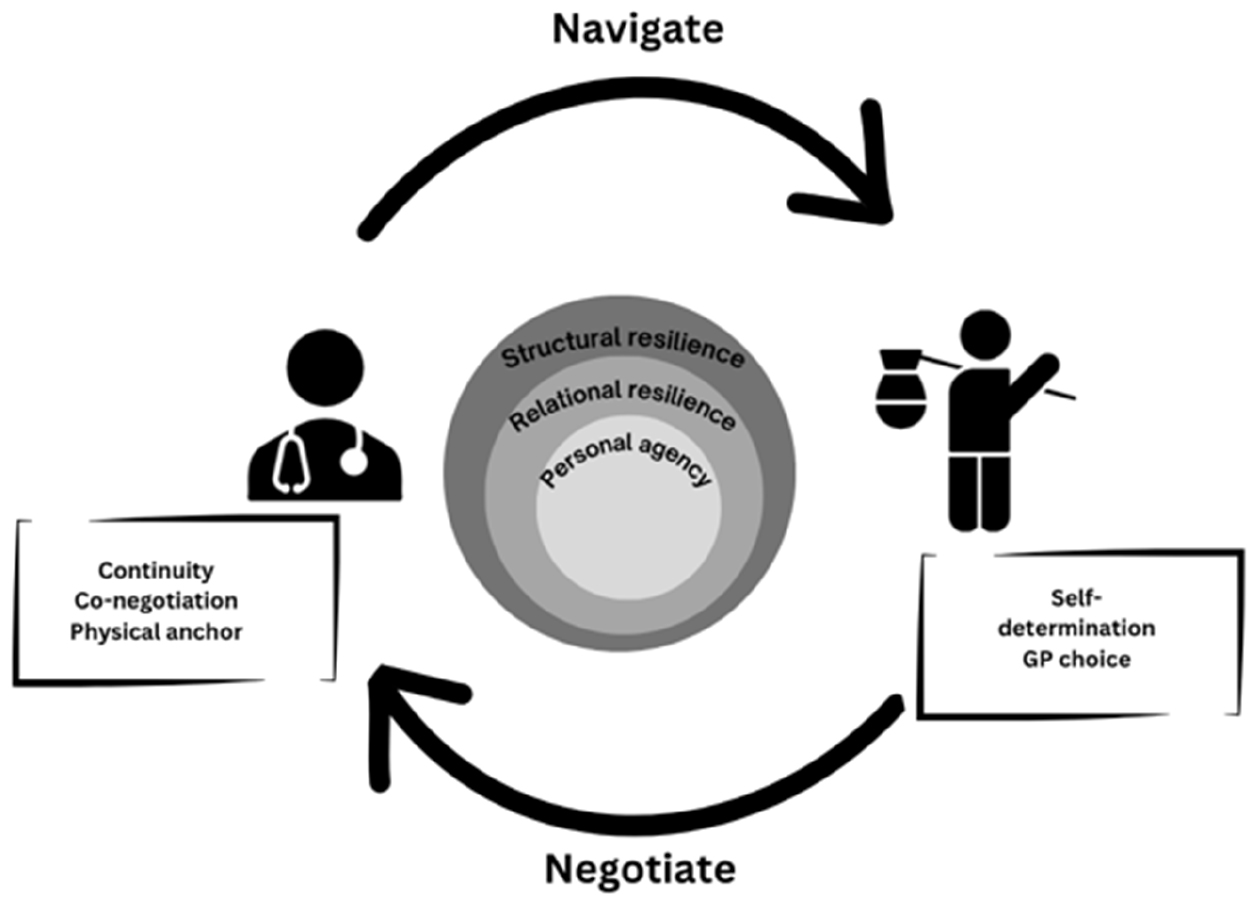
Figure 1
GPs and resilience.
GPs were not sought for spiritual guidance, though faith occasionally surfaced in conversations, as in Safa’s case. While not central to the GP–patient relationship, spiritual resilience, expressed as endurance, was present in participants’ narratives. The different levels of resilience did not appear as separate categories, but unfolded in interaction, reinforcing one another in response to changing needs. This supports a dynamic and relational understanding of resilience, in line with the works of Ungar (2006) and van Breda and Theron (2018), and highlights how structural rights become meaningful through trusted relationships in primary care. Ahmed’s case exemplifies the circularity of navigation and negotiation: initially denied bariatric surgery despite GP support, he later arranged treatment abroad. Although his GP was medically sceptical, he respected Ahmed’s decision, thereby reinforcing agency and multilevel resilience.
Participants stressed the value of supportive GP care, especially when GPs extended consultations beyond the standard 15–20 minutes, addressing complex migration‑related health needs. However, such extended care may place financial strain on GPs, as current reimbursement systems offer limited compensation for additional time (Kraft et al. 2024).
The importance of sufficient consultation time and continuity of care aligns with findings from earlier studies on refugee healthcare experiences (Cheng, Drillich & Schattner 2015; Haj‑Younes et al. 2022) as well as research linking continuity to lower mortality and reduced secondary care use in the general population (Hansen et al. 2013; Sandvik et al. 2022). Prior studies have emphasised GP traits such as empathy, competence, and familiarity with the patient’s history as central to effective care (Gruber and Frugone 2011; Tarrant, Colman & Stokes 2008; Tarrant, Stokes & Baker 2003). The support participants received from their GPs in our study was rooted in trust developed over time and characterised by a collaborative approach to problem‑solving. It extended beyond medical care through advice, referrals, and declarations. Given this support, the participants expressed they would keep their GPs despite language barriers.
In contrast to studies that emphasize cross‑cultural challenges, our results indicate that regular GPs can play an enabling role, even when barriers are present. While some studies suggest that GPs with migrant backgrounds may provide culturally competent care (Díaz & Hjörleifsson 2011), relying on shared background as a basis for effective care raises concerns about sustainability. Our study indicates that person‑centred care was not contingent on the GP’s migrant status, but rather on time and quality of relational engagement. This appears linked to continuity embedded in the GP scheme, fostering trust. Where trust lacked, the ability to change GPs reinforced autonomy. In such cases, personal resilience was supported by structural rights. While GPs supported resilience through continuity, trust, and practical help, such support operates within structural limitations. Given that resilience relies much on systemic resources (van Breda and Theron 2018; Ungar 2010), placing extensive responsibility on GPs to facilitate broader system navigation may not be sustainable. A study of GPs in Norway working with migrants found patients’ unfamiliarity with the healthcare system to be a key challenge, along with limited collaboration opportunities with welfare services (Goth, Berg & Akman 2010). Although this study focused on Norway, similar structural constraints exist across Nordic welfare states, potentially limiting GPs’ ability to provide sustained non‑clinical support (Eide et al. 2017).
These challenges add to existing pressures on GPs, including population ageing, rising multimorbidity, and growing administrative demands (Thompson and Walter 2016; Weigel et al. 2016). Such factors risk exacerbating GP burnout, reducing their capacity to provide care. To alleviate these pressures, Cohidon et al. (2020) suggest employing case managers for administrative duties. A related approach is seen in the UK’s National Health Service, where ‘care navigators’ support patients in accessing community and welfare services, thereby reducing GP workload while enhancing continuity of care (Tierney, Wong & Mahtani 2019). While some recent studies have explored the role of multidisciplinary teams in refugee healthcare (Harris 2024; White 2024), our study highlights how continuity and person‑centred care in the existing universal healthcare system itself can function as a resilience‑enabler for populations facing complex challenges, such as refugees. Proposals to strengthen primary care – for example, through the addition of care navigators tasked with addressing non‑medical concerns – offer valuable insights into how non‑clinical responsibilities might be distributed. If the patient–GP relationship is preserved, such models could support resilience while ensuring that primary care remains equipped to meet the increasingly complex needs of a diverse and aging population.
Strengths and limitations of the study
This study focused exclusively on Syrian refugees in Norway, which may limit the transferability of the results to other refugee populations. Although communication was supported by an Arabic interpreter, some participants were interviewed in Norwegian, which may have hindered their ability to articulate complex experiences. Moreover, the study did not include GPs, thereby lacking their perspectives. While theoretical frameworks provided a useful structure for analysis, they may have also narrowed the range of possible interpretations. Although the study’s depth is a key strength, future research could draw on larger, more diverse samples.
Implications and Conclusion
This study illustrates how regular, person‑centred GP care fosters trust, autonomy, and resilience among refugees, extending far beyond the clinical encounter. GPs often serve as trusted intermediaries, helping patients navigate both health and welfare systems. Strengthening GPs’ interpersonal competence and ensuring continuity of care may improve access and outcomes.
Our findings also point to a potential mismatch between standardised integration policies and the lived realities of refugees with complex health needs. Greater flexibility and cross‑sector collaboration between health, integration, and social services could enhance support systems. Future research should explore how trust is built across different institutional settings and how personal factors such as gender, class, and prior health shape access to supportive care. Investigating whether the relational strengths of primary care can inform other welfare services may offer valuable insight into more equitable, integrated systems.
By recognising and reinforcing the broader role of GPs in refugee resilience and integration, policymakers can help promote long‑term health and inclusion for both refugees and the wider population with complex needs.
Acknowledgements
We would like to express our sincere gratitude to our colleague, Dr. Wegdan Hasha, for her invaluable assistance with participant recruitment and thoughtful support throughout this project. We also thank all the participants whose contributions made this research possible.
Data Availability Statement
Supplementary materials related to this study are available. Additional anonymised data supporting the findings may be obtained from the corresponding author upon reasonable request, subject to ethical and confidentiality considerations.
Competing Interests
The authors have no competing interests to declare.