
1. Introduction
Migrants recognize themselves as participants in multiple national communities, as well as in a community that transcends the nation (Cohen 2011: 5). They engage in dual belonging, in which their origin and destination places have a simultaneous transnational presence in their lives (Levitt & Glick Schiller 2004). In this paper, both transnational simultaneity and connectivity (Byrne 2022) are emphasized because it explores transnational family trajectories of Eila and Aaro, the participants in the study, who experience dual belonging due to their migration trajectories.
Eila and Aaro immigrated to Canada because of an employment offer that Aaro received. The job provided prospects of economic security, so they settled and built their life on the new continent. At the time of the interview, they had lived in Canada for more than 50 years. Their ancestors were once refugees from Karelia, a Finnish territory that was lost to the Soviet Union in 1940 during the Second World War. These participants were once mobile, but the trajectories of all their family’s cross‑border mobilities were in the past. Their age is not crucial to the analysis, per se, but their long life trajectory is.
This new materialist and ethnographic study explores the relationship between transnational belonging and material culture and investigates the ways a single artifact—an inherited coffee creamer—represents transnational trajectories and belonging within one Finnish Canadian family across several generations. This study examines how older Finnish Canadian adults use discourse practices and meaningful artifacts to reflect on migration; belonging; and their experiences of heritage, space, and time.
Transmigrants’ daily lives depend on multiple interconnections across borders, and their identities are transnationally configured. Transnational belonging in this study refers to belonging that stretches across localities and spaces in historical times across generations. Transnational belonging occurs in what Byrne (2022: 33) described as the heritage corridor, meaning that the environment of migrants is ‘stretched between their origin and destination locales’ emerging from the agency of people in collectives who themselves are transnationally distributed. The ‘heritage corridor’ approach to migration represents an alternative to the heritage approach that, according to Byrne (2022: 109), deviates from the nation‑state frame in which heritage denotes merely something that is left behind. In this study, the term heritage (corridor) is associated with migration that has trajectories in the past but also significance in the present. The concept of migration assemblage—the social and material interactions that constitute migration as a process and set of practices (Rubinov 2014)—has also been applied in this study. We used the terms ‘transnational’ and migrant because the participants identify as ‘Finnish’ and occasionally also refer to themselves as ‘migrants.’
Abandoning your home normally means leaving behind most, if not even all, of your belongings. Migration is ‘grounded in objects’ (Basu & Coleman 2008: 323). In this study, we offer a new materialist approach to migration and belonging. New materialism rejects the traditional philosophical dualism between human and non‑human (Toohey 2018: 26). As Pennycook (2018: 129) wrote, the non‑human is seen as a meditation for human practices. For new materialists, ‘discourse and matter are mutually implicated in the unfolding emergence of the world’ (MacLure 2013: 659–660). According to Toohey (2018: 29), ‘[n]ew materialism sees people, discourses, practices[,] and things continually in relation, under construction and changing together, becoming different from what they were before.’ Through a historical lens, we investigate emergent co‑productive entanglements and show how one family artifact and humans are ‘mutually becoming’ (see Barad 2003, 2011; Toohey 2018). Mutually becoming means that subjects and objects become something together in the intra‑action; they are not ‘ready’ before they encounter each other. By applying a new materialist approach, we show that an artifact, a creamer—that is, an object—is part of someone’s story. We further emphasize that an artifact has a role in representation of belonging. We do this by conducting a new materialist analysis of an intra‑action, whereby family members; their artifact, life, and migration trajectories; the stories they tell; and the stories the artifact co‑tells are dynamically entangled and told together. We explored how a single artifact has acted, reacted, and enfolded the life history and migration trajectory of the family through different times and spaces.
We consider the relationship of the participants in the study as intra‑actions. Barad (2011: 451) adapted the term from interaction, explaining that, when two things are in interaction, they are seen as separate entities with individual characteristics, but if they are seen as what they are in relation to one another, they intra‑act and come into being through their entanglement (Barad 2011; Toohey 2018: 29). Discourse practices and environments are constantly changing and adapting through intra‑action. This relational ontology is the basis of the posthumanist account of the material participants. As Barad (2003: 814) wrote, this approach advocates for a causal relationship between practices embodied as material configurations of the world (i.e., discourse practices) and material phenomena (i.e., artifacts having active roles rather than being static objects).
Belonging is a concept that relies on processes of social identification because it ‘allows us to study the links between “the self” and “society” from the point of view of the person’ (May 2011: 368). Migrant trajectories, experiences, and patterns of belonging are commonly explored through life narratives (Georgakopoulou 2015). When exploring transnational belonging, memoirs and stories of migrant trajectories are traditionally the focus. Yet, when we concentrate only on what humans do, we ignore the fact that material things can also perform (Toohey 2018: 27). Not only are people, stories, trajectories, and artifacts entangled, but artifacts can also co‑narrate stories that facilitate belonging. Wang (2016) explains the ‘material turn’ in migration studies, emphasizing the growing significance of artifacts in them (see the object‑turn, Woodward 2001). This study presents a posthumanist and new materialist discourse on the role of a vintage creamer within a family emigration trajectory. Pennycook (2018: 6) describes posthumanism as a critical approach that questions the boundaries between ‘what is seen as inside and outside, where thought occurs, and what role a supposedly exterior world may play in thought and language.’ Posthumanism challenges traditional humanism by, for example, seeing the role of the material world in a different light and questioning the unique, central role of humans, suggesting we are deeply intertwined with the material world. From the posthumanist perspective of transnational belonging, we highlight the significance of the artifact and its intra‑action with the people involved differently and more profoundly than in existing scholarship.
2. Previous Research on Material Culture, Migration, and Belonging
Previous research on migration and material culture demonstrates that objects that are meaningful to migrants consist of either memorabilia or utility objects (e.g., Byrne 2022; Christou & Janta 2019; Parkin 1999; Povrzanovic Frykman & Humbracht 2013; Riikonen 2023). Earlier research describes the significance of artifacts for migrants: they can provide security, maintain family ties, and provide feelings of continuity and stability (Parkin 1999, Povrzanovic Frykman & Humbracht, 2013). Muhonen and Vaarala (2023) investigate how Finnish immigrants in Canada discuss an old Finnish school map and report how the map retells the nation’s history. Objects carry a performative repertoire of practices ‘imbued with affective connotations and shaped by the personal magnitude of things in the narratives of migrant lives’ (Christou & Janta 2019: 657). Woodward (2001) investigates preferences in domestic material culture through narratives regarding household objects. Objects occupy a position similar to that of space, time, and bodies; they are all foundational media through which social life is experienced (Woodward 2001).
Migrant objects have emotive capacities of consumption objects (Riggins 1994). Earlier research reports on assemblages being ‘relational spatialities’ that produce ‘unconscious arrangements of bodies, things[,] and ideas’ (Collins 2017). Material objects also function as support in adapting to, and feeling at home in, the new society and relate to homemaking (Christou & Janta 2019; Riikonen 2023; Rios & Watkins 2015; Rubinov 2014). Artifacts can strengthen memories and reinforce and reconstruct immigration identity (Mehta & Belk 1991; Muhonen & Vaarala 2023; Povrzanovic Frykman & Humbracht 2013; Riikonen 2023).
In previous studies, material artifacts were seen as nonhuman objects, following the dual understanding by which humans use them and keep them for material identity expression. In this paper, we introduce a new materialist lens to the study of migration and material culture. The novelty of our research is that artifacts are seen as mediators and participants in human practices and emigration narratives. We apply transnational intra‑action and the theory of assemblage, and we concentrated on exploring trajectories of belonging of one family and one artifact, because, according to the new materialist ontology in our study, these actors co‑emerge to express transnational belonging across generations, nations, national and state borders, spaces, historical events, and times. In contrast, earlier material studies are often ethnographic material culture studies grounded in one domestic or national setting, i.e., the migrant home, and concentrate on many artifacts (Boccagni 2014; Olesen 2010). These studies were often conducted among larger ethnic groups (e.g., Bonfanti 2020; Mehta & Belk 1991).
Previous studies also concentrate on what kinds of memories and meanings people assign to objects and on how objects carry memories and symbols of home and identity in the present‑day migrant home. In our study, artifacts co‑mediate meanings in assemblages. Our study goes beyond symbolizing culture or objects by reconceptualizing belonging as materially enacted and dynamically constituted human–material mediation. Research on migration and belonging that recognizes the entangled and material nature of humans, discourses, and artifacts is needed. Further, we conducted our study among Finns, a less‑studied migrant community. Modes of migrant transnationalism and belonging among older adult migrants also remain seriously understudied.
3. Research Questions, Data, and Methods
This paper focuses on an intra‑action in which a Finnish Canadian couple and one artifact, a creamer, are at the center of attention. The focus of our paper is on the information that is transferred in the intra‑action, which includes:
What is the role of the creamer in the intra‑action?
What stories of transnational family belonging, migration, time, and space are inspired by the intra‑action around the artifact?
We discuss how participants talk about the artifact and how the artifact co‑narrates with them—that is, how the artifact contributes to the stories of those for whom it is meaningful. The notion of assemblages considers ‘how things exist for each other[;] how the relations between things, semiotic resources, people, and space matter’ (Pennycook 2018: 129). An assemblage is a constellation of elements that come together to form an interlinked structure of meaning (Nail 2017). In this paper, our participants, the artifact, and the intra‑action are entangled in an assemblage, creating a transnational story of the family and their life trajectory. The advantage of the analytic frame of assemblages is that they allow for mobility to be analyzed even in the absence of movement because the imaginaries that are built around the materialities are equally important.
This study is based on two recorded in‑person interviews in Finnish; the first is an informal, unstructured interview co‑conducted with both researchers and where the participant talked freely about their life and migration trajectory, while, the second, a semi‑structured narrative and ethnographic interview, discussed material artifacts and included Muhonen (R) as a participant in the assemblage. The interview situations were relaxed and included laughter, mutual ground, and empathy. Using an interview as a research method allows for rich data to be collected. We carefully familiarized ourselves with the data, transcribed them, and translated selected excerpts into English. The new materialist approach alters what we traditionally consider a research interview to be because of the nature of entanglement between the participants: it changes the interview from being a tool for gathering verbal data into a complex, relational, and material assemblage. This reconfiguration invites researchers to attend to what the interview does, rather than just what is said. This intra‑action changes the relationship with the participant; it emerges in the assemblage, in the interview situation. The interview also creates intra‑action: the entanglement of material culture and the artifact adds three‑dimensionality and embodiments into the research practice (Barad 2007).
The interviews occurred in the private residence of the participants, around a coffee table. The study was approved by the Office of the Research Ethics (University of Toronto)1 and adheres to all the required regulations regarding information, confidentiality, research consent, and the use of data. Participants were informed about what it means to participate and about the privacy practices in using (consented) audio recordings and photos as data. This study was conducted among older adults, and we were particularly careful and clear when informing them about the research, risks of confidentiality, and how the material is being used for research purposes. We reminded the participants regularly about research confidentiality, and they were invited to ask questions several times during the field work. Participation in this study was voluntary, and participants could opt out at any time. All identifiable information has been removed, Eila and Aaro are pseudonyms, and their identity key is known only by the researchers. The creamer, also a participant, was visibly displayed on the coffee table around which the interviews took place.
In addition, to being part of the intra‑action, our researcher positionality as Finnish‑speaking Finns who have lived outside Finland, and R’s long trajectory as an immigrant in Canada, offers us an insider perspective to the data and analysis, allowing good access to the data and to the exploration of the family narratives within the framework of Finland’s history. R is a member of the Finnish Canadian community, which further helps to build trust. We acknowledge that doing ethnography among one’s own can also bring challenges and bias as well as impact objectivity. We also represent academic institutions, and we acknowledge asymmetries of power as a result. Throughout the research practice and field work, we remain professional, and the discourse data—transcribed audio‑recorded interviews and photographs—allow reliable analysis and conclusions to be drawn.
We applied a new materialist discourse analytical method and looked at the interview data through a ‘window of discourse,’ which means investigating some larger patterns of cultural discourse practices in use (Blommaert 2005: 66). Posthumanist and new materialist approaches to discourse suggest we should rethink our relationship with our environments and the objects in them (Pennycook 2018: 1), because, in practice, ‘we live our everyday lives surrounded by, immersed in, matter’ (Coole & Frost 2010: 1). This approach guides us to think about why we are accustomed to thinking there are boundaries between humans and artifacts (Pennycook 2018: 6). It recognizes ‘the significance of materiality in social and cultural practices’ (MacLure 2013: 659). Such a lens directs our attention to material objects and their role and importance in discourse. As Lähdesmäki et al. (2014: 96) note, when studying trajectories of belonging, attention should be given to practices to allow a more nuanced analysis and understanding of the multiplicity of attachments to a range of material and immaterial objects. Research on small narratives recognizes ‘the pluralism, heterogeneity, and productive coexistence of narrative activities, big and small, in the same event, by the same teller’ (Georgakopoulou 2015: 256). Following a new materialist approach, we combined a detailed analysis of the intra‑action with ethnographic methods. We were able to tell a story of Eila and Aaro’s experience, exploring how certain practices connect to real conditions of their lives (Heller 2008: 250). This study of material culture is located at the intersection of research on migration, new materialism, transnational belonging, life narratives, and intra‑action.
4. An Artifact that Tells Our Story: An Analysis
We first reflect on the Finnish coffee‑drinking practice as a culturally meaningful social assemblage and a special heritage corridor, in which the creamer has a central role (4.1). Then, we discuss how the creamer functions as an identity kit in these assemblages (4.2). The analysis of the intra‑action introduces the creamer as a participant who sits, hears, initiates, and inspires discourse (4.3); focuses on the role of the creamer in the transgenerational and transnational family history and migration trajectory (4.4); and concentrates on the reflections on belonging the artifact prompts (4.5).
4.1 Drinking coffee as a culturally significant assemblage
Cultural practices are relevant when studying migration and belonging (Lähdesmäki et al. 2014: 94). When asked, ‘What connects you to being Finnish?’ Eila immediately answered, ‘Making a pot of coffee,’ followed by Aaro’s affirmation, ‘Right.’ The meaningfulness of the Finnish coffee‑drinking tradition emerged across the interviews; it is a practice through which the participants actively manifest their Finnishness. Finland has one of the highest coffee‑consumption rates in the world (Reyes & Cornelis 2018), and drinking coffee together is a popular activity. The Finnish coffee‑drinking ritual includes a splash of cream in the coffee.
The interviews took place while drinking coffee and eating Finnish treats around the coffee table. The creamer has a central role in the coffee‑drinking rituals and a place on the coffee table. A collective experience emphasizes the feeling of belonging relating to an activity closely connected to a certain place. The embodied coffee drinking creates a heritage corridor in which the human participants and the artifact are transnationally entangled. According to Christou and Janta (2019: 657), such practices are acts of material consciousness, which are embodied, emotional, performative, and narrated accounts central to the practices and ways of being in everyday migrant lives.
The practice of drinking coffee positions Eila and Aaro as particularly Finnish. Lähdesmäki et al. (2014: 88) wrote that ‘the concept of belonging emphasizes the social aspects of living in a world with others and relating to others in a certain historical and cultural context.’ Eila regularly emphasizes that ‘Finnish coffee tastes better than Canadian coffee’ and praises Finnish treats, such as cinnamon buns, and rye bread. Daily coffee drinking is a routine and ritual that connects the participants to Finland, the country of their origin and heritage; it is embedded in transnational social spaces and their lives. As transmigrants, Aaro and Eila are strongly connected to their new country and maintain linkages to their homeland through their cultural coffee‑drinking tradition. Their coffee‑drinking ritual is also an activity during which objects, such as the creamer discussed in this paper, are present and intra‑act. It fundamentally frames the context of this study.
4.2 An artifact as a transnational identity kit
R initiates a discussion about artifacts, asking, ‘What did you bring with you when you migrated to Canada?’ Eila answers that they did not bring much and continues:
Eila: Our clothes, bedsheets, [and] a few of those keepsakes.
R: Did you have a trunk or suitcase?
Eila: We had small suitcases when we came by plane. We weren’t allowed to carry much. But we brought a wooden trunk on the ship […]. It had a few bowls and cups, just for three people; some glassware, Finnish‑made; just a few things […]. We came with very little stuff.
R: Now you have lived a long life here?
Eila: Since 1970.
Eila and Aaro migrated from Finland over 50 years ago with nothing other than what could fit into small suitcases and a trunk. Goffman (1961) calls these suitcases ‘identity kits,’ meaning that the comfort of carrying some familiar and necessary possessions from home helps avoid the identity‑alienation people can feel in new surroundings without material anchors to their previously established identities (see Mehta & Belk 1991: 400). Eila and Aaro brought some glassware and clothes that were needed when beginning a new life on a new continent for a family of three. They also brought the creamer.
4.3 The creamer sits on coffee tables, hears, and inspires
Lawrence (1985: 129) writes that homes are the ‘warehouses of personal experience.’ Material aesthetic culture in people’s homes ‘offers opportunities for exploration of cultural, emotional, and aesthetic meanings that can be manifested in domestic objects’ (Woodward 2001: 117). The way the participants represent Finnish belonging is reflected in the artifacts they display in their home. The few objects they have kept across their life trajectory are meaningful. When R asked, ‘What else?,’ asking about what other things they brought with them, Eila immediately gestured to the creamer, that was on the table:
Aaro: This must be 100 years old.
Eila: I’m not sure. My mother and father got it as a wedding gift.
R: How beautiful. This is old.
Aaro: For sure.
R: It reads Arabia.
Kell (2015: 442) stated, ‘things make people happen’ and ‘objects, in and of themselves, have consequences.’ R picked up the creamer, felt it in her hands, and read ‘Arabia’ written on its base (Figure 1):
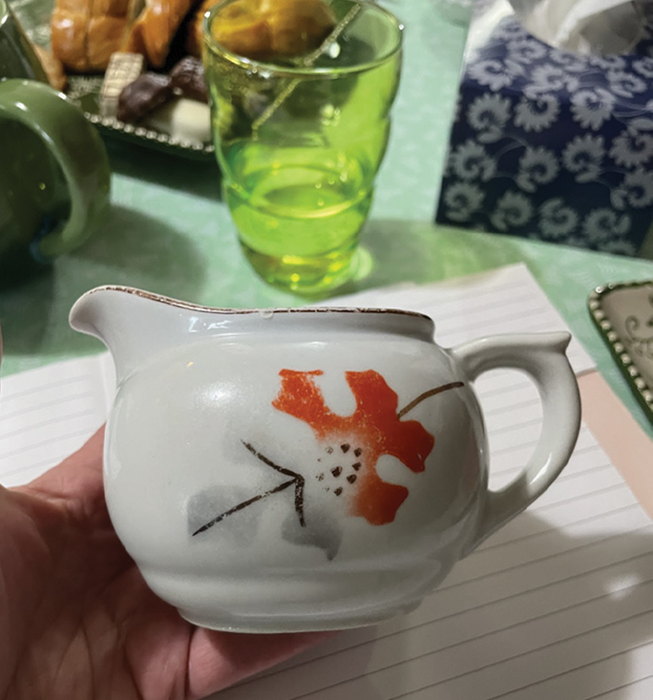
Figure 1
A 100‑year‑old creamer.
Arabia is both an iconic and historical Finnish glassware design brand and a name of a district where it was originally manufactured (Arabia 2023). Arabia refers to that place and time in history and to the symbolic cultural value that the creamer conveys through multimodal means. Eila’s reference to the creamer begins a long, meaningful intra‑action. When Aaro said ‘This must be 100 years old,’ Eila hesitated and said: ‘I’m not sure. My mother and father got it as a wedding gift.’ Eila’s parents received it to commemorate the beginning of their married life back in Finnish Karelia, and Eila does not know about its whereabouts before that. As the discussion unfolded, we analyzed the creamer as a biographical historical item that generates temporal and emotional references to participants’ belonging, providing a sense of generational continuity (Marschall 2019). As Riikonen (2023: 3) writes, ‘biographical items help in reaffirming the self in different phases of one’s migration trajectory.’
Toohey (2018: 28) notes that fixed and essential qualities cannot be attributed to human persons or non‑human things; rather, materials, people, objects, and discourses exist in relation to and with one another. Here, Finnishness is conveyed through the display of vintage Arabia porcelain and its trajectory in Finland, the creamer’s relation to the participants and their ancestors, and even in the ritual activity and assemblage of coffee drinking. The creamer assumes a more central role as the intra‑action continues:
R: Your parents received this as a wedding gift. When did they get married?
Eila: 1932.
R: Before the wars.
Eila: Yes.
Aaro: It has sat on many coffee tables.
R: It has, in Finland and then here in Canada.
Eila said her parents got married in 1932, to which R added, ‘Before the wars,’ which again refers to the lost Finnish Karelia. Eila’s parents got married there, which means that the creamer originates from there and has been used by generations of family members. Aaro comments on the role of the creamer and states, ‘If you could write down all the things that it has heard during coffee table chats, that would be a long history.’
Following new materialism, meaning‑making occurs in the intra‑actions in which participants and non‑humans are entangled (Toohey 2018: 168). In the present assemblage, the creamer intra‑acts and inspires the participants to think, reflect, and engage in a discourse of transnational family trajectory. Aaro emphasized that the inherited family creamer ‘sits’ in family gatherings, accompanies the human participants, and actively ‘hears’ the stories. Using the verb sit connotes the importance of mutual entanglement and the status of the creamer as a human‑like participant. By being a natural and important participant in coffee‑drinking rituals, the creamer is, and has been, a participant in countless family assemblages across generations, borders, and boundaries. As our analysis shows, it has been there, been used and touched, and has initiated discussions and memories. Aaro’s words imply that the creamer has also kept these stories, and he wishes ‘to write down all these stories’ to know them as well. According to Aaro, they are important and constitute ‘a long historical story’—a transgenerational and national narrative. R further noted that the creamer has been sitting on coffee tables in both Finland and Canada. The creamer’s presence in the current space and time and intra‑action connects the participants to different past locations and memories of them. The creamer has a longer history of being around coffee tables than the participants in the present assemblage, which was somewhat intriguing to Aaro. Through this nostalgic item, participants narrate their migration trajectories, maintaining memoryscapes (Basu & Coleman 2008).
Barad (2007: 136) writes that ‘post‑humanism doesn’t presume the separateness of any‑“thing.”’ The material world makes us recognize that humans participate ‘in a shared, vital materiality’ (Bennett 2010b: 14). This means that the creamer is a social participant in the intra‑action and the assemblage. It does not literally speak, but when Aaro notices it on the table, it prompts discussion, inspires the participants to interact with each other, and elicits their memories. It plays a role in the life narratives of their family trajectories. As in Burström’s (2014) study, the memories evoked by household utensils confer upon them a significance that far exceeds their practical utility. The creamer facilitates responses and memories of past and distant family members and is therefore more than just an artifact for Aaro and Eila.
4.4 The creamer represents stories of family history
The discussion returned to the artifact, with Eila explaining that it was given to her parents by an unknown relative:
Eila: I don’t know who gave it to my mother. Maybe it came from my father’s side of the family as a gift, or wherever it came from.
R: Could it be new, or was it used?
Eila: I don’t know that.
R: You didn’t ask your mother?
Eila: It never came up in conversation. Mother was not very good at telling stories about the past. She wasn’t a very chatty person in general.
R: Right, and these questions aren’t often asked.
Eila: I was out in the world too much. Since I was 12 [years old]. We were not together much.
During Eila’s life, some family stories were never discussed or transferred to the next generation, and some questions were never asked. Eila noted that her mother did not like to talk about things. The trauma involved in memories of war, escaping, and leaving home behind can trigger silence among people experiencing it and also have an impact on the next generation (Shorer et al. 2024). When there are few stories to recall, the artifacts the family members have left behind become particularly meaningful; this creamer is an important memory artifact for Eila. The creamer initiates and reminds the participants of some stories that are now captured in the prevailing assemblage and intra‑action that takes place in the current time and space. When R later repeated Aaro’s comment about the creamer hearing ‘all those life stories,’ Eila agreed: ‘It’s a lot of stories.’ ‘Objects bestow continuity in migrants’ practices and in places’ (Povrzanovic Frykman & Humbracht 2013: 47). Eila and the creamer have shared family and migration trajectories for generations.
The discourse continued with R asking, ‘How did it [the creamer] end up here [in Canada]?’ and Eila’s answer: ‘The same way when my mother said, take something with you. I didn’t even look [to see] if there was anything that I wanted to bring, so I said my sister can take the rest, or both the sisters.’ She continues, ‘There is still a lot of stuff to take, but thanks. I am not interested.’
In discourses of belonging, other people’s memories can become incorporated into one’s own (Chamberlain & Leydesdorff 2004: 229).
The entanglement and the intra‑action connect the participants to different times and places of their life trajectory. First, the creamer takes the participants to a time in Finland prior to Eila and Aaro’s migration to Canada. Eila’s parents’ memory is embedded in Eila and Aaro’s story in the intra‑action where the trajectories of the creamer—originally their wedding present and later a farewell present to Eila—as well as the trajectories of family members are elaborated and entangled. The intra‑action creates a memory of historical times that indirectly includes other members of Eila’s family. Eila’s mother encouraged Eila to take some artifacts from her family house, but she was initially ‘not interested.’ She mentions her sisters too and says that the creamer was one of the few objects Eila chose to inherit and retain as a family keepsake through her life. The creamer initiates memories of Eila’s parents and her sisters. We agree with Mehta and Belk (1991: 399) that artifacts and possessions can be seen as a part of the (individual and family) life trajectory, allowing migrants to bring along parts of their lives to new places. In the current intra‑action, the creamer manifests activities and acts as a gatekeeper to a time and space, the old home country of Finland that the couple has left behind, but it also reflects all the trajectories before that time through the trajectory of Eila’s parents.
Subsequently, R asked, ‘Have you used this?’ Eila said yes and stated, ‘You can see it has definitely been used since the gilding is fading and everything.’ Eila and Aaro noted that the objects they have kept—their objects of significance—have often been practical items and used in their household. Marschall (2019: 267) observed that some people develop a special relationship with utilitarian objects received as gifts, when, over time, they turn into memory objects, ‘precipitating memories and emotional attachment through routine usage.’ The creamer was originally a gift that was a functional utility item, and, now, it is also a precious emotional memory artifact for Eila and Aaro. The types of imaginaries that objects generate function as emotional links between places across several temporalities (Riikonen 2023: 13). Eila is not fond of things, but through everyday use, the creamer gains importance and value.
Heritage artifacts are objects associated with migration in the past that have survived into the present, constituting material traces of migration (Byrne 2022: 3). Bennett (2010a: 47) emphasizes that ‘materialities are actors alongside and within us,’ and, as demonstrated in this analysis, the creamer connects the meanings and symbolic values Eila and Aaro and their family members have invested in it while using it. The story of the creamer begins when Eila’s parents received the creamer as a wedding present and continues because Eila has kept and still uses it. Eila and Aaro chose to bring it with them when emigrating to Canada, and they have kept it through many moves within Canada, even their final move to the seniors’ center. The creamer has lived through three moves involving significant downsizing of material possessions: the evacuation of Finnish Karelia; the emigration to Canada; and, lastly, the move from a large family house into a one‑bedroom apartment at a residence for older adults.
Byrne (2022: 3) noted that ‘old places and things become heritage via processes of valuation that are enmeshed in the social, political, and economic environment of the present.’ As this analysis shows (see, for example, the data excerpt in 4.4), the creamer evokes memories of Eila’s family, parents, sisters, and the mother. The heritage corridor (assemblage) created here is a space in which the lives of the people who once left and those who were left behind are made relevant by transnational simultaneity (Levitt & Glick Schiller 2004). The intra‑action shows that, in the embedded history of the creamer, representations of transgenerational and transnational lived family histories are manifested, and many generations of family relationships and narratives are entangled. The creamer is part of the family trajectory, and it has a role in telling and preserving the family history.
4.5 The creamer reveals a true Karelian
We conclude this analysis with one more excerpt from the ongoing intra‑action. Eila was prompted to talk about a transformational experience in time, a memory of mobility from when she moved away from home at the age of 12 years to attend school in another city:
R: You left for school at age 12. That’s when you moved away from home?
Eila: Yes. That’s how I’ve learned to keep my head.
R: Have you had to cope?
Eila: I have had to. That’s how you know a true Karelian.
The topic was initiated by the trajectory of the creamer and the memories that Eila shared about her trajectory in the current intra‑action. Leaving her childhood family home at a young age has shaped Eila’s outlook on life. She said, ‘I have learned to keep my head,’ meaning that her early life experiences have taught her to become a mentally strong person who can stand up for herself. When asked, ‘Have you had to cope?,’ Eila answered, ‘I have had to.’ As Eila shared even earlier (see 4.4), she has been on her own since she was young. Her philosophical utterance ‘I was out in the world too much’ reflects almost a forced independence at a very young age, with a lack of parental support. Therefore, for Eila, the world is a place simultaneously entangled with the trajectories of the creamer and migration trajectories of earlier generations of family members. Chamberlain and Leydesdorff (2004: 232) claimed that self‑narratives can offer insights into cultural values, recognizing cultural narrative in a life story, offering understanding of an informant’s location in history. Through family memories, we also know more about Eila’s trajectories. Eila’s statement opens insights into understanding her and her family’s trajectories and their locations in history. The intra‑action creates a ‘mutual constitution of entangled agencies’ (Barad 2007: 33) where people, artifacts, and environments co‑construct discourse. Here, the intra‑action evokes memories, leading the participants to an almost philosophical discourse on Eila’s personality traits, offering some explanations about where they originate from. Among Finnish Canadians, there is a common perception of Finns, and Finnish Karelians particularly, of having inherited resilience and strength gained through the hardships of their ancestors.
Eila’s family originates from former Finnish Karelia. Eila’s emotional statement ‘That’s how you know a true Karelian’ and reference to being a ‘true Karelian’ indicates that she identifies herself with the Karelian settlers who were once displaced. Here, our study even opens perspectives to discuss participants’ relationships, feelings, and emotions. The fate of the Karelians is well‑known to Finns because of the history of the Second World War and the forced migration. Today, the lost territory of Finnish Karelia exists in the memories of Eila and Aaro through the stories that were told by their late family members. Being a true Karelian is a trajectory that stretches across Eila’s life span and family history and even further in the trajectory of the creamer, whose origins are in the pre‑war times of the lost territory. In the intra‑action, co‑presences are entangled within multiple scales: emplaced and embodied in the present location and participated in and visited other past distant memory spaces as imagined (see Riikonen 2023). When talking about the Karelian legacy, Eila not only credited her inner being as an ability to persevere but also narrated how Karelian legacy and the forced evacuation is reflected in the memories of her family trajectory. She also further acknowledged a collective memory of all Karelian ancestors.
Migrant stories can be linked with experiences of adjustment, nostalgia, loss, abrupt endings, new beginnings, and even new opportunities (Skrbiš 2008: 236). In Eila’s and Aaro’s lives, this is relevant in multiple ways: both of them, as well as the generations prior to them, have experienced both the loss of home and home country through migration. For the same reason, they have experienced abrupt endings and new beginnings (i.e., building a new home and a life in new places) and even new opportunities (for example, a successful work career in Canada for Aaro). In addition, as a consequence to all this, Eila and Aaro feel nostalgic for both Karelia and Finland. Expressions of transnational belonging across generations are actively performed in the intra‑action through the small narratives that are shared and the memoryscapes that are created—the creamer plays a fundamental role and is entangled in all of them.
The creamer is the only participant in the current intra‑action that has been in Karelia. Because the creamer is still physically present, we argue that it brings along the presence of Karelia and carries the family and migration trajectory in a very different way than memories and small narratives alone would do. Because the creamer is an artifact that can be touched, held, and used, it creates a direct, concrete, and bodily relationship to the family history. The creamer has also migrated and traveled across borders with family members from Finnish Karelia all the way to the Finnish Senior Center in Canada. All this becomes real again in the current assemblage and in the intra‑action, almost 100 years later across the Atlantic Ocean.
5. The Creamer Crossing Spaces and Times
This new materialist study explored the multifaceted intra‑active role and mediation of an artifact—an inherited vintage creamer—during a social coffee‑drinking assemblage, a typical heritage corridor for the participants of this study. The intra‑action is a result of co‑participation and coexistence between a human and non‑human object—between the human participants (Eila and Aaro), R, and the artifact they have used and preserved. This study further investigated the stories the artifact inspires and participates in and how these stories are entangled in the sociohistorical past and present of the participants and their family members. The focus of this study was to explore how the creamer intra‑acted and inspired and how it enfolded the life and migration trajectories of the family.
A new materialistic approach observes artifacts in their surroundings. Materialities and mobilities offer an intriguing way of thinking about places and spaces (Brooks & Waters 2018: 2). Byrne (2022: 14) emphasized that studies of material migrant heritage should draw on whatever historical sources are available, including oral histories, in addition to surveying the material record. Transnational belonging in this study is explored through understandings of mobility, space, and time—all present in the current intra‑action around Eila and Aaro’s coffee table. Mobility is involved in the life of the creamer and its owners. The creamer has left its home several times: first with Eila’s parents in the Karelian exodus, then again when Eila decided to take it to Canada. In Canada, it has accompanied the family’s many relocations. The creamer has had a presence across all these trajectories and places, by hearing and participating in stories that involve many generations. Representations of transnational belonging are found across trajectories in these assemblages, in a direct and ongoing material engagement, through the practice of intra‑acting with the surroundings (Barad 2007: 379).
Both humans and the artifact are an essential part of the assemblage, and, as we have shown, also the meaning‑making in the story of Eila and Aaro’s transnational belonging. Skrbiš (2008: 233–234) stated that theorizing about how migration, emotions, and belonging are experienced and understood in the context of transnational family life involves several closely interconnected concepts, including the institution of the family, the processes of transnationalism and migration, emotions, and the complex question of belonging. Artifacts hold special importance for belonging. They are meaningful because they remind people of their experiences, places, and relatives and because the objects are symbols of identities. Here, the human participants are closely interwoven into the material world, and, in the intra‑action, a memorable and meaningful social coffee‑drinking assemblage creates the entangled narrative of a transnational immigrant family trajectory.
The intra‑action occurs in the present time and space, in a gathering around the coffee table in their retirement home. The creamer becomes a mediator of different understandings of time and space in Eila and Aaro’s transnational family and migration trajectory, allowing the participants to recall other historical periods. The participants see the role of the creamer differently when they refer to the various spaces, times, and trajectories of their lives. When Eila talks about the trajectories of the creamer, she simultaneously co‑reflects on the trajectories of her family. The creamer shapes the understanding of mobility as well as the stories it invokes, facilitating movement between different times, spaces, and the participants in the assemblage. These trajectories are mutually entangled in the intra‑action where the artifact and participants move between past and present, between historical and present time.
Artifacts have a place in our stories through assemblages ‘where different things and people and places and discourses come together’ (Pennycook 2018: 129). The intra‑action also signifies representations of different geographical places. The participants move around in space while the intra‑action unfolds and features their life trajectory. The participants recall, enter, are positioned in, or talk about places that are embedded in the assemblage and in the story of their transnational belonging. Although the stories are told in Canada, the intra‑action entangles many places in memories. Finland is mediated through stories the creamer brings to life. The fact that Eila’s parents received the creamer in 1932 takes the intra‑action to a time before Eila or Aaro were born, to a space and time when their ancestors lived in Karelia. The participants expressed nostalgia for imaginatively constructed places that were once part of their lives. Remembering these places means remembering late or absent people, experiences, and stories.
We show that the boundary between human and non‑human is not fixed but more contingent and flexible than traditionally understood. Through the case of Eila and Aaro, we illustrate how the creamer operates as a material mediator in their everyday practices and lived trajectories. We do not claim that the creamer talks, but we demonstrate that it has a role in family narratives. It inspires the participants to remember family stories and trajectories across generations, state borders, and historical times. Toohey (2018: 97) writes that identities develop through current discursive practices but also through memories. The creamer tells a story, which is transferred through the voices of Eila and Aaro and their personal, historical, transnational trajectories but also seen in the intra‑action where the researchers participate in the discussion. The artifact participates, takes on meaning, and plays a semiotic role (Pennycook 2018: 46). We agree with Burström (2014: 144) that ‘our social identity is[,] to a large extent[,] dependent on and expressed through things.’ Furthermore, the artifact’s presence creates a physical closeness: one holds it in the hand when using it. Eila expresses a level of emotional closeness attached to the inherited creamer, and the intra‑action ultimately leads to Eila’s emotional description of herself as a ‘true Karelian.’
By observing the situations through the lens of new materialism, we described how the intra‑action connects the lives, spaces, mobilities, past and current times, and inner emotions of the participants. The new materialistic lens allows migration studies to place a stronger emphasis on the active role of non‑humans. The analysis of intra‑action and the assemblages between participants and artifacts offers a novel way of thinking about ethnography. From a new materialist viewpoint, humans are no longer depicted as ‘distinct, inalienable creatures’ who have the sole capacity to control the environment but instead have emerged with their interior (Pennycook 2018: 129). Discourse and matter emerge and unfold in the mutual space (MacLure 2013: 659–660). Here, the participants, Aaro and Eila; the interviewers; and the artifact create a multilayered intra‑action and assemblage, prompted by the shared materiality (see Bennett 2010b: 14), which depicts stories of transnationality in current and past times and spaces. Objects to which individuals are emotionally attached play a significant role in shaping their sense of belonging, their past, and their present. The fact that Eila and Aaro’s offspring were not included in this transgenerational ethnographic research is a limitation to this study but offers an interesting topic for a follow‑up.
The story of the creamer and its owner’s life journeys takes us from the historical events of the Finnish Karelian exodus into Eila’s analysis of her life philosophy. The earliest memories Eila and Aaro have of their family trajectory are their parents’ stories from Karelia, and, after its long transnational trajectory, it is still relevant to the participants after a long‑lived life. The co‑emerge of the artifact has lived through two major historical events: forced migration from Finnish Karelia and Finnish immigration to North America. Through the analysis of the intra‑action, the historical circle of Karelian heritage is closed. It also explains why Eila is who she is.
Through its presence, the creamer inspires and makes the human participants talk. It co‑narrates and co‑acts the story of the family migration. According to the participants, it also hears. The creamer has an influence on what people say, think, and feel about it. It is a part of a family trajectory involving generations of family members, places, and discourses that interconnect in this present setting, in a residence for older adults far away from Finnish Karelia, where the creamer’s earliest stories are set. The creamer is more than just a utility artifact for the participants; its trajectories are embodied in Eila and Aaro’s story. It is present; the participants can touch it; and, while using it, it inspires the participants to re‑experience the past and describe the present reality. Through intra‑action, the old creamer becomes a materialized site of memory, evoking and embodying the presence of people no longer physically present in the participants’ lives. Its material existence is entangled with the lives of all those who have encountered it—those who have kept it, used it, touched it, carried it, and considered it meaningful.
Note
Competing Interests
The authors have no competing interests to declare. The authors are not currently—nor have they ever been—members of the journal’s editorial team or board.