
Introduction
The question of how immigrants resettle after migration is of high political priority in most European countries. The debate about the effect on receiving countries—in terms of economic, cultural, and social cohesion—has intensified over the last 10 years with refugees’ arrival after flight from wars with the participation of European countries. The Danish politics around the reception and resettlement of refugees has, since the first ‘Integration Law’ in 1998, been framed as a question of integration. However, scholars characterize the concept of integration as exceptionally unclear and fuzzy and with different meanings in different contexts (e.g., Rytter 2018: 5). Thus, in emic, Danish (mainstream) language and discourse, integration is both means and ends (Olwig & Pærregaard 2011), referring simultaneously to a ‘utopian horizon of absolute integration’ (Rytter 2018: 5) and the process of getting there while facilitating the desired outcome (ibid.). However, as Danish refugee-integration policies are governed at multiple levels (Hepburn & Zapata-Barrero 2014), from supranational to national; regional; and, eventually, the frontline of the welfare state, the ends and means may have different meanings to different actors.
Danish immigration and integration policies have continuously tightened over the last 10 years. Between 2015 and 2019 alone, the government implemented 114 austerity measures (Vitus & Jarlby 2020), of which 46 directly targeted newly arrived refugees. In 2015, as in most other countries, the length of Danish residence permits was reduced from seven years to one or two years (DRC 2020a; Jacobsen et al. 2020). In 2019, a paradigm shift was introduced to existing policies prioritizing refugee employment, repatriation, and the revoking of residence permits by the authorities (Brekke et al. 2020; DRC 2020b; Folketinget 2019; Jacobsen, Karlsen & Khosravi 2020; Rytter & Ghanschi 2020). This paradigm shift meant a real tightening of policy and practice at multiple levels in refugee frontline work. This included conditions for receiving and keeping residence permits and the status of refugees as rights-holders. All of these changes had implications for refugees’ living conditions and well-being (see Rytter et al. 2023). The ideological and political foundation of the paradigm shift developed gradually, with significant changes introduced as early as 2001 and the pace of change increasing from 2015 onward. After the terror attacks of 9/11 (2001), the Danish Government’s response to immigrant integration followed the increased securitization in Western immigration politics, merging questions of immigration and integration with concerns about national and international security (Bleich 2009; Pedersen & Rytter 2011; Rytter & Pedersen 2013). Since 1998, the integration policy implementation and practical resettlement of refugees have been carried out in the Danish municipalities through a three-year integration program (known since 2019 as the ‘self-sufficiency and repatriation program’), increasingly involving stakeholders from both public (state and municipal) and third-sector organizations (non-governmental organizations [NGOs] and civil society) (Grubb & Vitus 2022). Thus, local stakeholders play a significant role in integration processes (see Campomori & Caponio, 2013; Hemmaty et al. 2024) as crucial contact points for many newly arrived refugees in providing social services, job training, legal assistance, and language classes. Throughout these activities, the local stakeholders transform integration policies into practice based on various interpretations (or ‘translations,’ see below) of and ethics regarding what constitutes successful integration and how and to what extent policies hinder or promote integration in practice. These interpretations eventually affect refugees’ prospects and everyday living conditions.
In light of the policy shifts over the last decade, this study focuses empirically on local stakeholders working with the municipal integration of newly arrived young refugees ages 15–25 years who received asylum in Denmark from 2015–2017. We analyze how local stakeholders interpret, align with, and contest national policy conceptualizations and goals of integration (Freeman 2006; Yanow 2000) and how fundamental questions of citizenship and deservingness are at stake in these interpretations. We first embed our study in scholarly discussions of the concepts of integration and citizenship. Then, we present the methodological design and analytical approach. In the following analysis, we empirically illustrate five ‘translations’ of integration articulated by local stakeholders. This leads us to analytically identify two ‘translation regimes,’ a national policy regime and a social justice regime, underlying the local stakeholders’ integration interpretations. Finally, we discuss how these regimes, which reflect two divergent forms of citizenship, neoliberal and social, and different ideas about refugees’ deservingness are potentially undergoing fundamental changes in the universal Scandinavian welfare state.
Scholarly Refugee Integration Conceptions
Immigrant integration has come to be a paradoxical concept that creates the problem it claims to address and solve. Scholarships widely recognize that in both research (e.g., Schinkel 2018) and politics (e.g., Favell 2022; Hemmaty et al. 2024; Phillimore 2020; Rytter 2018), integration has ceased to be a property of a social whole and become a property of individual immigrants, who can be integrated to various degrees. This individualization of integration implicitly creates an opposition between existing society and those needing integration. Moreover, it creates a separation between people: ‘natives’ (predominantly white in Western societies) are already seen as being part of society and therefore dispensed from being integrated, while ‘immigrants’ (mainly ethnically and racially minoritized) are expected to integrate further (Schinkel 2018: 5). The concept of integration thus inherently implies a specific kind of problematization (Bacchi 2012), identifying problems among immigrants and with immigration itself, resting on and consolidating an asymmetrical minority–majority relationship. Rytter (2018) identifies three scenarios in which the idea and practice of integration form asymmetrical relationships between minorities and majorities: ‘welfare reciprocity,’ ‘host and guest,’ and ‘Danes as an Indigenous people.’ These scenarios position immigrants as ‘objects’ of majority-defined interventions of ‘civilization’ and facing an inherently desirable yet almost impossible integration into majority society since they are not of ‘the same ancestry’ as the Danish population. However, with integration as a central concept in politics, policy, and practice around immigrant reception and resettlement, the question remains: What are the components of the ‘civilizing’ interventions, and where should these interventions lead?
Social research has struggled to produce operational concepts of immigrant integration, which tend to become part of political, public, and professional vocabulary. Emerek (2003) provides concepts to describe how to think about and incorporate minorities into majority society. Assimilation denotes when minorities voluntarily or forcefully take on the majority group’s culture, religion, norms, and practices. Segregation denotes when minorities voluntarily or by force live separately from the majority with their own culture, while integration denotes a process of mutual adaption that results in a multicultural society based on diversity. Nonetheless, these concepts may conflict when applied to real-life situations. Thus, young refugees can be part of some communities—for example, integrated or assimilated into local youth communities—while excluded or segregated from others, such as local sports clubs (Skytte & Bryderup 2014). The common normative understanding of integration in this scenario proves inadequate. Other commonly used terms of social, economic, political, and cultural integration into different spheres of society (Jöncke 2011; Rytter 2018) also overlap and may contradict one another. For example, refugees may be considered ‘economically integrated’ by becoming ‘self-sufficient’ through night-cleaning jobs, but this often means they have limited colleague interaction. As a result, they may acquire neither Danish language skills (cultural integration) nor new friends with majority backgrounds (social integration) (Rytter 2018). Scholarship has provided models, indexes, and frameworks that sustain the political governance of immigrant integration (e.g., Favell 2022: 5; Statham & Foner 2024). One widely used example is Ager and Strang’s (2008) model, which identifies domains crucial to ‘successful’ refugee integration. These domains include employment, housing, education, health, linguistic and cultural competencies, and social relations. Such scholarly definitions of integration tend to reproduce the national political logics of bordering by categorizing and differentiating nationals and foreigners, citizens and aliens, and majorities and minorities (Favell 2022: 6). In the Western context, these political discourses are partly constructions of Muslims and Islam as the counterpart of national identity—that is, ‘Danishness’ (Rytter 2018: 7,148). However, in their integration model, Ager and Strang (2008: 185) also identify access to citizenship and rights as foundational to ‘successful’ integration (Ager & Strang 2008: 185). Along these lines, Phillimore (2020) argues that crucial to either facilitating or hindering refugees’ integration are the contextual factors in the host country: the ‘opportunity structures’ created in local policy implementation, political rhetoric, and public discourse. Thus, to understand refugee integration and resettlement processes, migration research should focus on ‘opportunity structures,’ such as social relations, local initiatives, and support for refugees during resettlement, rather than on what Phillimore identifies as individualizing policy models (ibid.). Bassel, Monforte, and Khan (2021) take up the question of rights and citizenship, which we consider part of refugees’ ‘opportunity structures,’ and demonstrate how competing notions of refugees’ citizenship lead to different policy responses. In their study, they identify a neoliberal repertoire emphasizing ‘self-improving’ and responsible ‘active’ citizens, promoted not only as agents of ‘social cohesion’ but also as being law-abiding and politically passive. They also identify a coexisting alternative, contradictory response to the neoliberal ideas of citizenship and policies promoting refugees as individually ‘active’ subjects.
However, it is unclear what constitutes individual factors and contextual opportunity structures, and how they are invoked from the perspective of operating local stakeholders in refugee integration work? Hemmaty et al. (2024) analyze integration interpretations among Swedish local stakeholders, including those in municipalities, schools, higher education, youth, and integration agencies. Their study finds a consensus among these stakeholders that integration has generally failed, although they place the responsibility for this failure differently. Within a ‘separation repertoire,’ individuals or groups (of immigrants) are responsible, whereas a ‘de-migrantization repertoire’ places the responsibility on society for the failing results of integration.
Engaging in the scholarly debate on defining and practicing integration, this article contributes to a deeper understanding of the complexity of integration policy. In particular, our analysis provides insights into how local stakeholders interpret the dilemmas and ambiguities of (changing) national integration policies at the municipal level. By analytically tracing integration concepts and understandings in the ‘translations’ and ‘problematizations’ of local stakeholders, this article gives empirical examples of how dilemmas and ambiguities stem from the limitations of existing concepts. Furthermore, it demonstrates how discursive scenarios of state–immigrant relationships create different host–society opportunity structures for refugees’ resettlement. Through this engagement with the critical scholarly migration debate, our analysis provides insights into how citizenship understandings are (re)produced ‘from below,’ ultimately creating different conditions for refugees to become part of Danish society.
Methodological Design and Analytical Approach
In the spring of 2018, the second author conducted semi-structured telephone interviews with 19 (14 female and 5 male, all of ethnic Danish majority background) local stakeholders across 11 Danish municipalities who work closely with young refugees in the Danish welfare state’s frontline municipal or NGOs. The local stakeholders were social workers and pedagogues employed as municipal integration consultants, job coaches, coordinating caseworkers, and integration team managers in employment departments or social services centers. NGO actors facilitated language courses, counseling support, interpretation services funded by the Danish government, private donations, and special funds for integration projects. The municipalities represented rural areas, medium-sized cities, and urban areas (population of 40,000–300,000), which all received high numbers of young refugees relative to their populations in 2015–2017. The focus of the following analysis is on the translations and interpretations of integration policy widely shared among local stakeholders across different positions or tasks in the integration process. When citing local stakeholders, in parentheses we situate them regarding gender (female, male) and their organizational and geographical context (municipal frontline or NGO, rural area, medium-sized city or urban area).
Using a semi-structured interview guide, the interviewer posed open and explorative questions, inviting local stakeholders to reflect on their understanding of what integration is and should be. Underlining their role as experts by experience working with young refugees, we asked the local stakeholders to share insights from their integration work and perspectives on policy and practical barriers to and facilitators of integration. The interviews lasted 39–87 minutes and were audio-recorded, transcribed verbatim by the second author, and thematically coded using NVivo12. Immediately after the interview, the second author wrote reflective notes about the richness of the interviews; surprising moments; and apparent critical, positive, or resistant reactions during the interview. Interviewing by telephone allowed for the geographical spread of municipalities and flexibility in accommodating local stakeholders’ busy work schedules. Moreover, as the interview themes addressed non-sensitive or personal but professional issues at the heart of the interviewees’ expertise, the interview material proved rich in detail despite the limited nonverbal communication or the interviewer’s first-hand experience with the interviewees’ workspace. We followed recognized ethical guidelines by asking for informed consent before the interviews and granting anonymity to interviewees and municipalities (Danish Code of Conduct for Research Integrity 2014). When citing the informants below, we use general descriptions.
The overall framework of this analysis draws on interpretive policy analysis (IPA) (Yanow 2000; 2015) and ‘what is the problem represented to be’ policy analysis (WPR) (Bacchi 1999, 2009; Bacchi & Goodwin 2016). Epistemologically, IPA and WRP consider policy an open-ended process in which differently positioned local stakeholders constitute integration socially, contextually, and situationally based on various interests, values, and normative assumptions that shape the outcomes of their practices (Wagner et al. 1999: 96).
We draw on IPA to highlight how the context and situatedness of local stakeholders’ shape policymaking (Yanow 2015), the construction of policy problems (Yanow 2000), and the ‘architectures of meaning’ of policy arguments (Yanow 2000: 30). Local stakeholders are not merely neutral channels of policy implementation; they actively ‘translate’ policies into actions within integration programs, strategies, and instruments. Doing so makes policies dynamic, ongoing, and performative (Freeman 2006). Moreover, we analytically draw on the idea that policy ‘translations’ occur within ‘translation regimes,’ which frame or determine whether particular practices are legitimate or illegitimate or right or wrong (Freeman 2006) and whether thoughts, orientations, and opportunities are possible (Bacchi 2009; Wagner et al. 1999).
In addition, we draw on Bacchi’s WPR approach to illuminate how policy actors on different levels—in this context, on the local, frontline level—enact policy in daily actions and interactions by defining solutions based on different representations of the problems to be solved (Bacchi 2009). Analytically, we use the approach to identify, first, the solutions postulated in policies and, on this basis, second, to identify the problem representation (i.e., the problematization) implicit within the solutions (Bacchi & Goodwin 2016: 11). This approach also addresses how local stakeholders, based on problematizations implicit in their policy ‘translations,’ justify applying ‘appropriate’ technologies of governing (Bacchi 1999: 12; Bacchi 2009; Browne et al. 2019: 3; Colebatch 2006: 39–40).
Drawing on IPA and WPR approaches, we wish to illustrate how local stakeholder ‘translations’ of national policy are open to multiplicity, complexity, uncertainty, and competition between ‘translation regimes’ shaping practical integration efforts (Freeman 2006; Jenkins 2007; Wagner et al. 1999). This multiplicity and potential ambiguity surrounding integration work produces various images of nationhood, refugees, and citizenship, legitimizing politically and publicly held values about treating and positioning refugees vis-à-vis society.
In the empirical analysis, we adopted an abductive approach to categorize stakeholders’ statements with concepts from social research and policy discourse. This approach aimed to construct empirically based theorizations, specifically the proposed integration ‘translation regimes’ and ‘citizenship logics’ (Tavory & Timmermans 2014: 4). Initially, the second author coded the interviews into 112 thematic codes, adhering closely to the informants’ empirical statements (Braun & Clarke 2019). Second, we inductively identified eight basic themes following Attride-Stirling’s (2001) thematic network analysis approach. Due to the overlap in content and distribution across informants, we narrowed these down to five basic themes reflecting local stakeholders’ interpretations of the core elements in the problems and solutions concerning integration. From the basic themes, we identified global themes that reflect fundamental regimes and logics in the local stakeholders’ ‘translation’ of national policy into local integration, informed by concepts from social research and policy discourse. In the analysis below, we identify the content of and interlinking between ‘translations,’ after which we propose the underlying ‘translation regimes’ and, eventually, conflicting ‘citizenship logics’ (also presented in Table 1 and Figure 1). Throughout the analysis, we discuss ‘translations’ and ‘translation regimes’ in light of the above-presented conceptualizations on integration.
Table 1
‘Translations’ regarding solutions to and problematization of integration.
| INTEGRATION ‘TRANSLATIONS’ | SOLUTION | PROBLEMATIZATION |
|---|---|---|
| Assimilation and National Security | Strict immigration policies: limited access to Denmark and adaption to ‘Danish’ culture. | Diversity of norms, values, language, multi-culturalism, ‘parallel’ ethnic communities, social fragmentation, the risk of terrorism. |
| Employment and Self-Sufficiency | Labor market participation and low (discriminating) welfare services for refugees not in employment. | Refugees burdening the welfare state. |
| Competencies and Participation | Danish language skills; information/knowledge; and access to association activities, education, and employment. | Insufficient language and labor market skills, exclusion, lack of political subjectivity. |
| Social Relationships and Well-Being | Supporting reciprocity, recognition, legitimate belonging, access to local communities and societal domains, motivation, and a meaningful everyday life. | Marginalization, lack of social and support networks, and stigmatization. |
| Human Rights | Extending refugees’ rights to protection, family life, and welfare; securing (non-discriminating) basic needs. | Lack of equal social and human rights relative to Danes. |
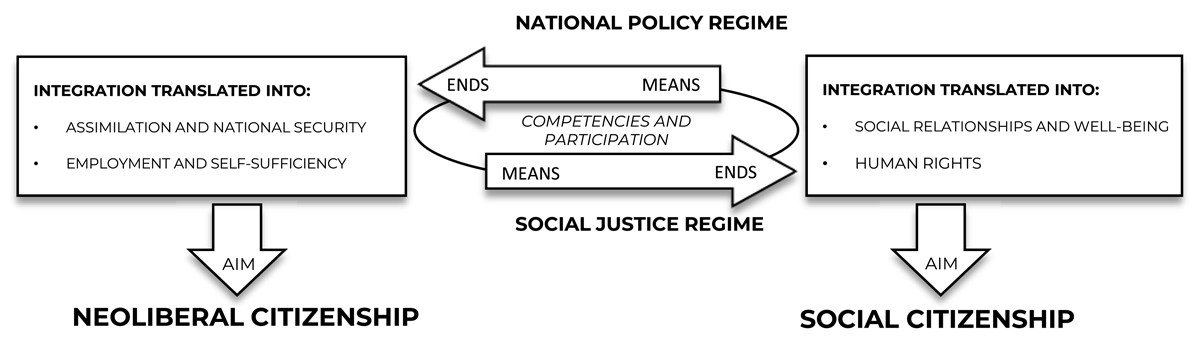
Figure 1
Conflicting integration regimes and citizenship logics.
Local Stakeholder Integration Translations
The following five dominant ‘translations’ reflect different solutions and implicit problematizations of integration as a policy issue. Local stakeholders articulated these perspectives about what integration is and should be when working with newly arrived young refugees. In addition, most of the local stakeholders articulated at least two ‘translations.’ While some local stakeholders argued in favor of the ‘translations,’ others acknowledged their existence but disputed them. As we argue, these contestations come down to underlying ‘translation regimes’ and ‘citizenship logics’ that reflect the existing understandings of immigrant integration at stake in Denmark. We categorize the ‘translations’ based on the central solution to integration that each one articulates, namely: 1) Assimilation and National Security, 2) Employment and Self-Sufficiency, 3) Competencies and Participation, 4) Social Relationships and Well-Being, and 5) Human Rights. Table 1 below presents these five ‘translations’ and the solutions to and problematizations of integration, which we will present in more detail below.
Assimilation and national security
A first ‘translation’ we empirically identify focused on integration as a matter of assimilation and national security. Some local stakeholders ‘translated’ the integration solution to make young refugees adapt to ‘Danishness’ in response to a perceived problem associated with cultural differences, particularly their lack of Danish values. One local stakeholder (male, NGO, rural area) found that cultural differences lead to misunderstandings and young refugees potentially making ‘mistakes’ when attending Danish education institutions or workplaces, hampering their resettlement opportunities. Another local stakeholder (female, municipal frontline, medium-sized city) found it essential when young refugees settle into a new environment that they leave behind their culture and religion and stated that ‘we have to require refugees to adapt and sanction if they do not.’ These ‘translations’ echo Emerek’s (2003) concept of assimilation, which requires refugees to voluntarily (or forcefully) adopt the Danish majority group’s culture, religion, norms, and practices. Additionally, they reflect Rytter’s (2018) identification of an asymmetrical ‘host and guests’ integration scenario. In this scenario, the Danish population is viewed as ethnically homogenous rather than multiethnic or multicultural. As superior hosts, they set the rules for how, if ever, refugees become ‘civilized’ through assimilation (Rytter 2018: 11).
While some local stakeholders in our data pointed to assimilation as the solution to individual integration barriers, others associated refugees’ lack of adaptation to Danish norms and values with a more general lack of societal cohesion and even a threat to Danish culture. One understanding of the solution to this represented problem included limiting the number of refugees in Denmark. One local stakeholder (female, NGO, medium-sized city) emphasized that ‘the legislation does not aim at the refugees who already live in Denmark, but those who are not supposed to enter.’ She referred to the increasingly strict immigration policy, limiting the number of residence permits given to refugees and family reunifications and the concurrent tightening of the integration requirements to deter refugees from applying for asylum in Denmark. According to some local stakeholders, numbers matter not only to security and border management but also to integration success.
However, some local stakeholders noted and distanced themselves from the dominant presence of assimilation and national security discourse. They argued that these approaches are not beneficial when translated into integration practice. One local stakeholder (female, municipal frontline, countryside area) argued, ‘most integration measures describe a group that has to give up many things.’ Instead, this stakeholder opted for approaches in which, following Emerek’s (2003) definition of integration, ‘we do not change [refugees], but we all change together […] and look for how [refugees] can contribute.’ Others argued that the intense pressure for young refugees’ assimilation leads to social isolation rather than helping integration efforts to build ‘social bonds and bridges’ (Ager & Strang 2008). On the contrary, a local stakeholder (male, municipal frontline, rural area) argued that even when young refugees try to assimilate through eagerness, hard work, and Danish language skills, they encounter social stereotyping, prejudice, and Danish society’s hostility. Translating integration into a question of national security appears to reflect the politically constructed opposition between Muslims and Islam and the national majority identity of ‘Danishness’ (Rytter 2018: 7), which makes the ‘security dimensions […] layered onto pre-existing concerns about integration, melting with parallel worries about immigration, crime, and the public’s association between Muslims and violence’ (Bleich 2009: 355; Rytter & Pedersen 2013). Mixing integration with national security issues in rhetoric and policy fosters this hostility; this local stakeholder critically argued, ‘The greatest barrier [to integration] is our constant focus on “foreigners,” “aliens,” “how Muslims act in our society.” I know that terrorism exists, yes, but, sadly, the general attitude then becomes “Can we trust [refugees]?,” “What kind of people are [refugees]?” We become too skeptical beforehand.’
Employment and self-sufficiency
A second ‘translation’ proposed Employment and Self-Sufficiency as the solution to integration challenges. The integration problem implicit in this position is society’s economic burden of refugees’ dependency on welfare state services and allowances. At the time of the stakeholder interviews, even before the 2019 policy paradigm of ‘self-sufficiency and repatriation,’ the requirements of economic independence of the Danish state constituted the central national integration policy goal and municipal success of integration. Some local stakeholders pointed to ‘necessary demands,’ ‘explicit expectations’ of, and ‘consequent sanctions’ on young refugees as part of this problematization, realized through low welfare services targeting unemployed young refugees to make them take individual responsibility for their integration rather than the municipality. One local stakeholder (female, municipal frontline, middle-sized city) stressed the implicit assumption that ‘the welfare state has a limit, so young refugees have to participate in the labor market and contribute to Danish society.’ Another (municipal frontline, urban area) said, “This is our biggest challenge; if we do not get [refugees] to be part of the Danish workforce, then “parallel communities” will flourish.’ Some local stakeholders argued that employment positively affects language acquisition and social networks, both central to integration, which makes it sensible to measure integration through the number of employed refugees.
Other stakeholders were critical of the ‘self-sufficiency through employment’ approach in integration work. One (male, NGO, rural) argued that this approach implicitly stages refugees as ‘scroungers’ and ‘convenience refugees.’ Others argued, tapping into Phillimore’s (2020) concept of opportunity structures and echoing the ‘de-migrantization repertoire’ of Swedish local stakeholders (Hemmaty et al. 2024), that, instead of placing the responsibility solely on young refugees to find employment, employers should focus on upgrading refugees’ qualifications and, most importantly, overcoming prejudice and discrimination. One stakeholder (male, municipal frontline, urban area) exemplifies this: ‘It is my biggest concern that we get to teach the Dane to see the difference, that it may well be a dark-skinned person sitting there facing you, but now look at his competencies and do not get hung up in the fact that his name is Mustafa and not [a traditional Danish name].’ Another critique of the Employment and Self-Sufficiency ‘translation’ was that the narrow political focus on employment overshadows other critical integration dimensions, such as education. One local stakeholder (male, municipal frontline, medium-sized area) highlighted, ‘From a long-term perspective, I am afraid that these young people will never get the chance to start an education, because they “just” need to get into work.’ Another (male, NGO, rural area) explained, ‘We should want them to get an education because this enables them to move on and maintain employment rather than if they just go into unskilled work [and] night-time cleaning with no colleague interaction. That does not improve their language skills or knowledge about Danish society.’
Competencies and participation
The third ‘translation’ of integration policies we identified among local stakeholders involves focusing on young refugees’ Competencies and Participation as solutions, overlapping with the goal of self-sufficiency. Competencies are considered essential, either as the means or the ends of different integration problems. The self-sufficiency requirement highlights insufficient competencies—such as language and labor market skills—necessary for quick employment and independence from the welfare state. Some local stakeholders, however, found that developing these competencies requires a long-term perspective, focusing on enhancing general language proficiency, labor market qualifications, and skills to navigate Danish society. Reflecting the assimilation approach to integration, one stakeholder (municipal frontline, middle-sized city) found that ‘in good integration lies an acceptance of how the surroundings, the new society, works and what values lie in it, based on knowledge about society and its core values.’ Competencies are a matter of investing in human capital, as another local stakeholder (male, municipal frontline, rural area) explained: ‘Becoming a good and enlightened citizen who understands and can contribute to the community is a longer process and requires education rather than employment. From this perspective, refugees develop competencies through civic activities, such as associations, during boarding school stays (before 2017, an option within the integration program), and social networks beyond work and school.’ Some local stakeholders linked competencies to participation, as exemplified below:
It is the municipal’s core task to strengthen the citizens’ possibilities to cope with their existence and to ensure, in co-operation with the citizen, that they participate in relevant communities […] that is what we aim at in our work. However, the way to it may also require others to invite them to get the competencies to participate (male, municipal frontline, rural area).
‘Translating’ integration into participation also overlaps with the ‘translation’ addressing self-sufficiency, competencies, and social relationships, again as the means or the ends of different integration problems. While some local stakeholders have ‘translated’ participation into employment and self-sufficiency —such as ‘participation in the labor market’—others viewed participation as crucial to social integration, seeing it as a key solution to fight social and political exclusion. Thus, participation was seen as essential to avoiding marginalization from central democratic processes in societal and democratic institutions beyond labor market institutions, such as associations, sports clubs, school boards, and public debates. One stakeholder (female, municipal frontline, urban area) stated that participation ‘fundamentally creates a sense of democracy—not just voting at elections—but through knowledge about how society works.’ However, he considered young refugees’ participation in education, work, and civil activities central to making them ‘accept Danish society’ and participate in informal social spheres. Local stakeholders also considered participation as the ability to speak for oneself as a subject rather than being spoken about as objects. This entails having a voice and being heard in public debates and in one’s asylum or social cases. One local stakeholder (female, NGO, urban area) shared the experience of a young refugee to illustrate this point: ‘He felt nobody ever heard him, only talked about him (…). People have many ideas about his wants, abilities, and desires without ever talking to him. He thought it was frustrating being a bystander to his own life and situation.’ This reflects what Rytter (2018) describes as an asymmetrical minority–majority relationship, positioning young refugees in a passive role and creating a power imbalance.
Other local stakeholders problematized barriers to participation and to creating social relationships with people with majority backgrounds (‘Danes’). They pointed out that stereotypes, reinforced by the focus on assimilation and self-sufficiency positions, limit opportunities available to young refugees, as we will elaborate on below.
Social Relationships and Well-Being
Another ‘translation’ of integration we identified among local stakeholders focused on the issue of isolation that many (young) refugees, particularly those in rural areas, may face. This fourth ‘translation’ emphasizes the importance of young refugees building social relationships to solve this problem. One local stakeholder (female, NGO, medium-sized city) elaborated on how building social relationships facilitates becoming part of Danish society through local communities and, as a result, provides experiences of recognition and a sense of belonging:
It is a matter of reciprocity; like in volunteer activities, we treat refugees as resourceful, with skills, dreams, and hopes. When these resources are put into play and supported, it greatly motivates them to become contributing and actively participating citizens.
Social relationships are also considered critical in terms of constituting support networks—social capital—as one local stakeholder (male, municipal frontline, medium-sized city) explained:
It is about having someone who can concretely open the doors to Danish society; for unaccompanied minors, it may be even to a Danish home, [but for all young refugees, it may be] a workplace or an internship […] or just [to] get the opportunity to meet ordinary Danish young people.
Another local stakeholder (female, municipal frontline, urban area) explained how:
Integration starts when they enter a network through a contact family, contact person, or study friends. Then, suddenly, we hear far less from them. Now, they are equipped to meet some of the challenges they face using their network, just like the rest of us […] Making friends with Danes pulls them into other networks: ‘You have to join in here.’ Peer social relations provide fantastic language training.
Local stakeholders considered social relationships closely related to the well-being of young refugees and a central solution to integration, requiring a clear policy focus on creating a supporting social environment in everyday life to sustain meaningfulness and motivation based on equal rights to needed services. The main problem they pointed to was refugees’ experiences of stigmatization, exclusion, and isolation from colleagues, study peers, and neighbors. This social marginalization prevents them from actively participating in municipal program activities and establishing a supportive network. Additionally, some refugees struggle with trauma-related issues, such as insomnia, stress, or anxiety, which further hinder their ability to meet the requirements of the integration program, especially when faced with multiple requirements simultaneously, as exemplified by one local stakeholder (female, NGO, rural area): ‘The greatest barrier to integration is when they do not feel well. Many are sick, mentally, and traumatized. They do not have the energy to get integrated and cannot just “get over it” and say, “Now a new life begins.”’
Some local stakeholders argued that sanctions and discriminatory policies, such as lower benefits for newcomers, efficiently push young refugees into individual responsibility for employment and self-sufficiency. However, they argued in favor of the position that unequal rights increase ‘negative labeling’ and young refugees’ unproductive disadvantages regarding access to education compared to Danish youth. Some local stakeholders—echoing the Swedish local stakeholders ‘de-migrantization repertoire’ described in Hemmaty and associates’ 2024 study—considered integration a ‘collective responsibility.’ They argued that the negative construction of refugees as ‘other,’ ‘unworthy,’ or ‘deviants’ hinders not only their inclusion but also the well-being of young refugees. One local stakeholder (female, municipal frontline, medium-sized city) described experiencing a meaningful everyday life in this way: ‘Being part of a meaningful community through voluntary work, employment, or education is crucial for them.’ Another (male, NGO, urban area) added, ‘No integration effort can necessarily remove young refugees’ difficult conditions of being displaced from their family and home country, which makes them more exposed, existentially, than Danish peers. However, good integration creates a meaningful everyday life and perspective on the future.’
In terms of sustaining young refugees’ motivation as a part of sustaining their well-being, one local stakeholder (male, municipal frontline, medium-sized city) pointed out the discouragement following the continuous tightening of the immigration and integration laws (see also Vitus & Jarlby 2020), which have deprived some young refuges of hope that they can meet the municipal program requirements:
Tightening on tightening on tightening discourages the refugees, who ask, ‘Well, it never happens’ [receiving permanent residency permit]. Their motivation drops every time the government implements a new tightening, making young refugees think: ‘Since I cannot apply until eight years from now, how many austerity measures have the government then adopted?
I might as well knock it out of my head and stop working for it.’
Human Rights
Finally, according to some local stakeholders, integration inevitably requires protection through human rights and refugees’ sharing of equal rights with Danish citizens, which we identified as the fourth ‘translation.’ These stakeholders were critical of new restricted laws, including a 2017 law that deprived young refugees of rights to welfare and services (including lowering social benefits) and access to education and vacation during the three-year municipal program. The solution to this problem, as articulated by local stakeholders, was extending refugees’ full rights to protection, family life (family reunification), and welfare. One local stakeholder (male, municipal frontline, rural area) pointed to the general lack of equal rights:
For the broad group of people who have come to Denmark, tightening both on family reunification, permanent residence permit, and citizenship, in many ways, affects integration negatively. People experience that, despite years of working hard to gain a residence permit or citizenship by adhering to all integration requirements, the ongoing tightening keeps raising the bar and makes it harder [for them] to achieve the same rights as the rest of the population.
In terms of how to improve integration efforts, one local stakeholder (female, municipal frontline, urban area) stated, ‘Good integration requires a holistic effort, where we focus on young refugees having the same youth opportunities and equal rights in Danish society. We are concerned about the individual and that everyone has the right to a dignified life.’
To several local stakeholders, the lack of equal rights to higher education critically hampers young refugees’ integration, as one (female, municipal frontline, medium-sized city) explained:
Successful integration requires equal opportunities and more significant consideration for the young people […] Being allowed not only to finish primary school. The current reasoning is, ‘We are not going to give them much education; it is too costly, so let us just send them out to work as unskilled.’ Instead, let us reason: ‘They need some education to be better off in the future.’
However, securing future opportunities for young refugees requires securing their human rights. The local stakeholder continued critically, ‘I do not see why we reason differently about young refugees than Danish youth.’
Conflicting Regimes of Integration and Citizenship Logics
In an IPA (interpretive policy analysis) and WPR (what’s the problem represented to be?) analytical reading, the local stakeholders’ ‘translations’ of integration form ‘architectures of meaning’ in professional work (Yanow 2000: 30; Yanow 2015: 405–406). These ‘translations’ are shaped by ‘translation regimes,’ which are systems of thought in political governance that reflect broader political agendas. These regimes frame or determine whether particular practices are legitimate or illegitimate, right or wrong (Freeman 2006), and they influence the orientations and decisions possible (Bacchi 2009; Wagner et al. 1999). Returning to Ager and Strang (2008), access to citizenship and protection by right is foundational to integration across multi-state levels (Hepburn & Zapata-Barrero 2014). In this light, refugees’ citizenship and rights represent the basis for identifying potentially conflicting assumptions and principles that shape policy and public debate on integrating refugees (Ager & Strang 2008: 185). We therefore analytically address what fundamental ideas about citizenship, rights, and, eventually, deservingness local stakeholders reproduce in their ‘translations’ of integration.
Across the five ‘translations’ of integration as a policy and practice problem to solve, we analytically identify two ‘translation regimes’: a National Policy Regime and a Social Justice Regime. In line with Hemmaty et al. (2024), a central distinguishing theme is allocating responsibility between individuals and societies, but not only that. Figure 1 illustrates how the five ‘translations’ of integration refer to two potentially conflicting regimes, each with different end goals and means that are understood as leading to the other end.
In what we term a National Policy Regime, young refugees’ Social Relationships and Well-Being and their Human Rights are considered means to the end goals of Assimilation and National Security, Employment and Self-sufficiency, and Competencies and Participation. In what we term a Social Justice Regime, young refugees’ Social Relationships and Well-Being and their Human Rights are considered the end goals of the integration, which local stakeholders aim to reach through means such as competencies for and participation in employment, education, and other social arenas. As shown in Figure 1, we argue further that both the National and Social Justice regimes fundamentally aim at different citizenship forms for refugees: neoliberal versus social citizenship. In Danish, citizenship can have two meanings: membership (‘medborgerskab’) and legal nationality (‘statsborgerskab’). However, the liberal–conservative government of 2001 introduced specific requirements for enacting ‘membership,’ which have increasingly become preconditions for obtaining ‘legal nationality.’ This shift leads to what Bassel, Monforte, and Khan (2021) term ‘neoliberal citizenship.’ We analyze these connections next, as illustrated in Figure 1.
National Policy Regime and Neoliberal Citizenship Logic
We argue that ‘translating’ integration primarily into a problem of Assimilation and National Security as well as Employment and Self-Sufficiency—using social relationships, well-being, (cultural) competencies, and (workplace) participation as means and by-products—aligns closely with the content and purpose of the national integration policy. The assimilation position reflects a long-established culturalist, security- and economy-focused discursive logic in immigration and ‘integration’ policies, which, since the early 1980s, implicitly (and rhetorically) has problematized the presence of migrants, ethnic minorities, and asylum-seekers (De Cleen et al. 2017). In Danish immigration and integration policy and politics, an ethnocultural conception of nationhood in Denmark (Borevi 2017; Mouritsen 2006), which is racially biased, offers a legitimate vocabulary to speak of refugees as cultural, ethnic, racial, and religious ‘others’ in essentializing ways (Rytter 2018: 8). In terms of self-sufficiency, politicians have legitimized the hardening of immigration politics by problematizing the ‘costs’ of immigration (e.g., immigrants’ welfare dependency), decreasing popular support for the welfare state model and threatening social cohesion (Hagelund 2005).
The national policy regime aligns with—and potentially qualifies refugees to meet—the legal criteria necessary to be eligible for a permanent residence permit (after eight years of residence in Denmark) and legal nationality (after one year of holding a permanent residence permit). These criteria include being in employment and (economically) self-sufficient; having no debt to the state or receiving certain kinds of welfare benefits; mastering Danish at a certain level; adhering to Danish laws (not having committed a specific form of crime); declaring allegiance and loyalty to, and demonstrating knowledge about, Denmark and Danish society; and taking part in a municipal ceremony in which you shake hands with the Mayor (NyiDanmark 2021). In a political context in which legal national and membership citizenship criteria increasingly converge, the national policy regime implicitly promotes citizenship in a neoliberal sense (Bassel, Monforte & Khan 2021). Neoliberal (membership) citizenship envisions citizens becoming individually responsible (for their resettlement and integration) through empowering self-improvement, self-made communication skills, resource access, and economic stability. Implicit in this national policy regime is welfare chauvinism, which implies a hierarchization of policy target groups’ ‘deservingness’ of public goods and rights (Careja et al. 2016; Jørgensen 2016). Moreover, in aiming for national security, integration policies increasingly adapt to the political immigration agenda of protecting Denmark’s national interests by restricting the influx of refugees and explicitly deterring asylum-seekers from seeking protection in Demark (Folketing Hansard 2015–2016: 8; Pedersen & Rytter 2011; Vitus & Lidén 2010; Vitus 2011; Vitus & Jarlby 2020). Aiming to align integration policy and practices with immigration politics of deterrence, we argue, clashes with ideals of social justice as fundamental in work with young refugees—ideals also present in local stakeholders’ integration ‘translations.’
Social Justice Regime and Social Citizenship Logic
Translating integration primarily as a problem of Social Relationships, Well-Being, and Human Rights—through employment, language skills, (cultural) competencies, and participation—local stakeholders align with a human rights ethic and a humanistic ethic of social and welfare institutional work. This ethic includes promoting the dignity, empowerment, and liberation of people (young refugees); showing care; and preventing the suffering of social distress (see also Dånge 2022). Stressing the importance of equal political and social rights for young refugees, allowing them to feel a part of society on equal terms with their Danish peers, and taking societal responsibility for creating a ‘welcoming’ environment lean into ideas of citizenship in the social, humanistic sense. This social citizenship logic celebrates social–democratic–liberal universal entitlements and the ideology of a shared life of substantial equality in sharing welfare goods and ‘being one of us’ (Mouritsen 2013: 97). Social citizenship secures universal rights to all people, contrasting with the welfare chauvinistic hierarchization between ‘deserving’ policy target groups inherent in neoliberal citizenship. The social justice regime echoes the traditional ideals of the traditional Danish universal, social democratic welfare state model (Careja et al. 2016; Jørgensen 2016) that used to dominate Danish social and immigration policy. Our analysis shows the centrality of this foundation of citizenship among local stakeholders, promoting the universal rights of all citizens and considering them equally deserving of the protection and support of the state. In national politics, however, social citizenship is on retreat, apparently overtaken by the policy-led neoliberal form of citizenship (Mouritsen 2013; Turner 2014).
Conclusion
This study sheds light on how integration is understood among local stakeholders working on the frontline of the Danish welfare state with newly arrived young refugees. Through analyzing their ‘translations’ of what is problematic regarding integration and the solution’s objective, we empirically identify five policy ‘translations’: ‘Assimilation and National Security,’ ‘Employment and Self-Sufficiency,’ ‘Competencies and Participation,’ ‘Social Relationships and Well-Being,’ and ‘Human Rights.’ Even though the study’s 19 local stakeholders are differently positioned—as female or male, as municipal frontline or NGO employees, and in different geographical areas of different sizes—they appear to tap into the various ‘translations’ with no systematic differences. Thus, they seem to negotiate the meaning of all these ‘translations’ and each position themselves both within and against them when problematizing the integration of refugees. These ‘translations’ shape specific solutions and limit others by legitimizing policy and practice, justifying particular actions, and locating the responsibility for integration differently. ‘Translations’ that locate the integration responsibility within individual young refugees include ‘Assimilation and National Security’; ‘Employment and Self-Sufficiency’; and, when interpreted as a means to the former two, ‘Competencies and Participation.’ These ‘translations’ reinforce and sustain the National Policy Regime, which implicitly promotes neoliberal citizenship, considering citizens individually responsible, law-abiding agents of ‘social cohesion’ (assimilation) who are politically passive (Bassel, Monforte & Khan 2021). Deserving welfare state services and benefits, goods, and rights depends on whether refugees show ‘responsibility’ through communication skills, resource access, and economic stability. Implicitly, it is up to refugees to earn these skills and resources through participating in and earning competencies for employment and economic self-sufficiency.
Moreover, these citizenship ideals fold into the political agenda of national security as a base of immigration politics, which declares that protecting Denmark from refugees is a goal. When tapping into this ‘translation’ regime and the neoliberal citizenship logic, local stakeholders implicitly, and perhaps unintentionally, in creating frontline politics, contribute to sustaining categorical borders of deservingness to rights, including a right and access to citizenship.
In contrast, ‘translations’ that locate the responsibility in the opportunity structures for integration efforts are ‘Competencies and Participation’—when interpreted as integration ends in themselves—as well as ‘Social Relationships and Well-Being’ and ‘Human Rights.’ These ‘translations’ lean toward a Social Justice Regime, which promotes social citizenship based on societal responsibility for refugees’ welfare as an extension of the traditionally humanistic welfare state approach to citizenship. While turning upside-down the cause and effect of integration processes of the national policy regime, this universal rights approach appears to align with a sociological concept of integration as a general process, embracing and securing all members’ belonging to society and common goods. As our analysis illustrates, in the frontline of local integration work, potentially clashing issues of national security versus social justice are contested, as is the fundamental issue of who ‘deserves’ human rights, including the right to Danish citizenship.
Refugees’ deservingness of welfare and human rights has come under even more pressure with the Danish immigration and integration ‘paradigm shift.’ Given the current scale of forced displacement globally, with numbers increasing year by year, the issue of how receiving countries—as well as international agencies—treat refugees has never been more critical. In this context, as part of the Danish multilevel state, local stakeholders’ contestations over the access and deservingness of refugees to protection, resources, and belonging reflect paradoxical tensions in Denmark and most other Western liberal democracies. These tensions revolve around balancing national border management and global–local solidarity. In this line of thinking, we propose that dominant ideas and politics of citizenship and the deservingness of rights in immigrant integration policies and local policy implementation constitute a critical, decisive opportunity structure. Moreover, the choices made by policymakers to constitute ‘society’ by placing some people outside it, with limited or no ways to become part of it, paradoxically creates the very problem of integration.
Competing Interests
The authors have no competing interests to declare.