
1. Introduction
Refugee migration is a global phenomenon that raises questions about inclusion, equity, cohesion, and not least, settlement, decent housing, and labor market conditions. Most receiving countries have developed integration policies for different spheres of the inclusion process at the national, regional, and local levels. The processes of organizing refugees’1 settlement, housing, and labor market inclusion in the receiving society are often addressed separately in research without the complex interrelationships and conflicts among these three spheres of inclusion at different geographical levels being fully acknowledged. There is also a lack of research on the organization of integration processes (Diedrich et al. 2020; Omanović, Tarim & Holck 2022).
The development of an integration policy must be understood as the outcome of complex dynamics among actors in different spheres and at different geographical levels, such as municipalities, national authorities, nongovernmental organizations (NGOs), and transnational actors (Scholten 2018), whose interests are related to their power and responsibilities. This can result in contradictions, unplanned consequences, and emergent conflicts that have an impact on the development of policies. We argue that policy revisions always involve a dialectic relationship between actors, as well as counterfactual outcomes.
In this article, we focus on reforms in societal organization regarding where refugees settle (in what municipality), how they live (find housing), and how they find employment. We are interested in the distribution of responsibility among actors in different spheres in different geographical contexts (i.e., states and municipalities), contradictions of interest, and alternative outcomes.
The study focuses on Sweden, a country that has long been categorized as a welfare state with a generous immigration policy and an ambitious integration policy. The discussion of how to best include newcomers in practice has been at the center of political debate for decades. Settlement policies, policies for housing, and policies for labor market integration have most often been subjects for negotiations between the national and local governments (municipalities) (Emilsson 2015; Gebhardt 2014: 3). In some municipalities in Sweden, receiving refugees has been viewed as difficult because of a lack of resources, while in other municipalities, the arrival of refugees is seen as beneficial in terms of population growth and the economic compensation the municipalities receive from the government (Hudson & Sandberg 2021). Thus, there are contradictory ideas and interests regarding the extent to which inclusion should be funded and organized by public and private actors or whether it should be the responsibility of individual migrants. These contradictory interests have often resulted in different solutions and reorganizations of settlement and inclusion in the labor market, motivated by their supposed effect on refugees’ labor market inclusion (Platt, Polavieja & Radl 2022). Thus, settlement policies are often formulated in relation to expected or intended effects on employment for newly arrived people.
Gradually, integration policy in Sweden has been prioritized on the agenda and transformed from a multicultural perspective to a stricter focus on employment (Diedrich et al. 2020). The shifting political focus from the goal of a multicultural society to a more mono-directional focus on employment for immigrants is visible in the reorganization of settlement, housing, and labor market activation policies. However, the steps taken along this transformation route were not the only possible options. This study explores two moments when alternative routes could have been taken.
Drawing inspiration from the dialectic approach developed by Benson (see Benson 1977; 1983), we show the complex dialectical relationships among different actors’ ideas and interests within a dynamic framework that recognizes the specific macro-societal and institutional settings at selected moments in time. By using the dialectic perspective, we identify not only different actors’ ideas and interests but also contradictions in the observed processes of organizing, which in turn lead to either maintenance of the status quo (no new praxis or significant reformulation of policy) or a search for alternative ways of organizing (a new transforming praxis or policy). Thus, some contradictions in these organizing processes may have potential openings for transformative praxes.
Thus, this article addresses the dialectical relationship between settlement, housing, and labor market activation policies for refugees. We do this through the following steps:
Mapping the organization and interrelations of settlement, housing, and labor market integration policies during two moments of institutional reform.
Examining the contradictions that emerge from the relationships between actors in different policy areas at different geographical levels and how they are addressed in successive reforms.
Proposing counterfactual alternatives that could have been chosen during each reform.
This article is organized as follows: we first present the main line of research in this adjunct research field and then describe the basic principles of dialectical analysis. We then describe the analytical method. Afterward, we describe two moments in the housing and labor market policy for refugees and then analyze the identified contradictions inherent in the two policy arenas and between them, as well as changing praxes. Finally, we discuss the possible transformative praxes that can develop from the current contradictions.
1.1 Settlement, Housing, and Labor Market Integration: Disconnected Research and Policy Areas
Numerous studies have sought to identify outcomes from different policy reforms and models focused on separate spheres such as employment (e.g., Andersson Joona et al. 2015; Andersson Joona et al. 2017; Elwert, Emilsson & Irastorza 2023; Hernes et al. 2019; Qi et al. 2021), geographical distribution (e.g., Robinson, Andersson & Mustard 2003; Vogiazides & Mondani 2020), and housing (Emilsson & Öberg 2022; Holmqvist, Jutvik & Lidén 2022).
Although there is general agreement that housing is one of the key pillars of integration for immigrant refugees (Ager & Strang 2008), it remains an area to which little attention has been given in general housing studies (Brown, Gill & Halsall 2022). Research on policies that are specifically directed at enabling or restricting refugee immigrants’ access to employment, education and training, and social welfare benefits often focuses on national ‘integration programs’ that include language courses, civic integration measures, financial benefits, labor market activities, and other types of assistance (see Emilsson 2015), but some studies also focus on the integration policies of cities (Dekker et al. 2015).
The importance of geographic and social context for newly arrived refugees is not only an important policy field, but also a large part of the research that has attempted to evaluate refugees’ success depending on where they first settle (Andersson et al. 2018; Vogiazides & Mondani 2020). The labor market situation in the initial municipality of settlement has, for instance, been found to be important for the speed at which refugees find jobs (Bevelander & Lundh 2007; Damm & Rosholm 2010). Studies on economic outcomes generally show a negative effect of dispersal policy since refugees who did not select their municipal initial location had worse economic outcomes than those who were able to select their location (Åslund & Rooth 2007; Bevelander, Mata & Pendakur 2019; Edin, Fredriksson & Åslund 2003). A literature review by Brown, Gill and Halsall (2022) revealed that dispersal policies increase the vulnerability of refugees.
Studies on the effects of dispersal policies have also highlighted that refugees choose to relocate from the initial location in which they are assigned to live, and that relocation positively affects refugees’ income growth (Haberfeld et al. 2019). To become established in the labor market, refugees, in many cases, decided to relocate from the municipality they were initially placed in, most often to the metropolitan areas where it was easier to find employment but also to areas with a higher concentration of other immigrants, who could offer important network contacts (Bucken-Knapp, Omanović & Spehar 2020: 74). Available housing alternatives are likely another key factor in immigrants’ (and probably even more so in refugees’) choices of destination, but we have not found research that systematically relates access to housing to employment opportunities for refugees.
Neither of these studies of labor market inclusion connects the policies directed at initial or long-term housing or dispersal policies directed toward asylum seekers. We argue that settlement and housing policies for asylum seekers are essential for inclusion processes both before and after admission, despite their possibility for resettlement after admission. Research that focuses on the effects of integration policies on employment is, however, plentiful (for a recent overview, see Platt, Polavieja & Radl 2022).
The disconnect between labor market inclusion and housing in research is also visible in politics. Although the geographic aspect of integration processes has been acknowledged, the policy field of integration is often disconnected from housing policies. Swedish housing policy is a part of the general welfare state policy, and as such, it is not explicitly directed to immigrants in general or to refugees. However, where to settle asylum seekers and accept refugees has been a major policy debate. Refugees’ tendency to concentrate in a few metropolitan regions and in specific dense immigrant neighborhoods is seen as problematic from an integration point of view (SOU 1984: 58; SOU 1986: 4, 5). Local governments (municipalities) also argue that it is a challenge to provide housing, social services and education to an increasing number of refugees (Prop. 1983/84:124). The idea of ‘dispersal’ of refugees between municipalities developed as a key idea to solve the perceived problems in Sweden in the late 1980s, as it was in other countries at the time (Robinson, Andersson & Mustard 2003).
2. Dialectical Perspective
The dialectical approach used in this study places the processes through which societal, institutional, and organizational arrangements are socially produced, maintained, and disrupted at the center of analysis (Benson 1977). Additionally, this approach particularly emphasizes the way in which contradictions emerge within social arrangements and potentially generate opportunities for transformation (Omanović & Langley 2023). From this perspective, any social arrangement (such as inclusion processes, integration policy for settlement, housing, and employment, or in more general terminology, organizing) is a product of past acts of social construction, and as such, it is always in a state of becoming. Social, institutional, or organizational arrangements, which seem fixed or permanent, are viewed as arbitrary and regarded as just one of many possibilities (Benson 1977). Therefore, the central focus in studies inspired by this theoretical perspective is not only on examining processes of organizing social arrangements but also on uncovering the contradictions and limitations of the present arrangements (see Benson 1977) as well as their potential for eventual transformation.
The dialectical perspective has, for instance, been used in organization studies on organizational and management change (Carr 2000), resistance and control (Mumby 2005), communication (Butler & Modaff 2008), organizational culture (Ogbor 2001), diversity in organizations (Omanović 2009; 2013), and organizational socialization of migrants (Omanović & Langley 2023). For instance, Omanović’s studies (2009) explore diversity and its management as a social–historical creation that is interrelated with and embedded in a larger cultural context.
As aforementioned, contradictions are of central interest in some dialectical-inspired studies, as are their potential for change. Omanović’s (2013) study shows, for instance, how a social production process involving the development of a corporate diversity program shapes and prioritizes ideas of and interests in diversity in organizations by opening and closing doors to actual diversity. However, such contradictory notions of organizing social arrangements are not seen as problematic from the dialectical perspective, but rather, as Sharma, Lawrence and Lowe (2010) argue, as a possibility for ‘institutional entrepreneurs’ to make changes in existing organizing practices. Additionally, Ogbor (2001), by studying organizational culture, elaborates on the dialectical tensions between organizational and individual identity. In particular, the author pays attention to the contradictory pressures of uniformity and diversity, as well as the mutual relationship between empowerment and disempowerment. Finally, Foster and Wiebe (2010) show that identifying contradiction in itself is not enough to change the existing structure (of domination). The critique of existing practices of organizing is a necessary step in the dialectical process. However, the dialectical approach has not been used as a theoretical framework to study and analyze the organization of settlements, housing, and labor market integration for refugees.
In this article, we build upon Benson’s approach (1977; 1983) and its four interrelated dialectical principles:
The first principle is that people socially construct/produce their social world through different ideas, interests, and actions. However, unlike the constructivist view, the dialectical perspective emphasizes that social production (of different social arrangements) depends upon not only certain interests but also the power of different actors, that is, their ability to channel the direction of social production.2
The second principle is that social productions occur in and are always shaped by social contexts (i.e., a specific socio-historical and organizational context). Despite efforts by people in power to centrally channel and control the processes of organizing, some aspects or actors both inside a specific site/level (e.g., societal or institutional/municipal departments or working groups, ‘subjects of integration,’ and managers) and outside it (e.g., governmental authorities and state ideologies) remain beyond the reach of rationalization. This makes possible the development of distinct, semiautonomous spheres or contexts for social production (of, for instance, organizing different dimensions of inclusion).
The third principle acknowledges that these mutual relationships can generate contradictions, i.e., confrontations between opposing ways of arranging social life. Contradictions are, from the dialectical perspective, important forces for any societal and organizational change, but they do not lead to it deterministically.
Finally, the fourth principle is praxis. Benson (1977) states that some of these contradictions may lead to the maintenance of the status quo (no new praxis), or they can lead to reflexivity in the form of the questioning of existing social arrangements (e.g., regarding the existing policy and practices of refugee housing and work integration) and the search for alternatives (e.g., mobilizing other actors to understand, engage in and accept alternatives), which can lead to a new, transforming, emancipatory praxis.
The dialectic approach, according to Benson, provides a specific form of structural analysis on the basis of the ontology that stresses, as previously mentioned, social construction/production and the reproduction of the social world. Thus, from this ontological standpoint, social constructions/productions are viewed as processes. The constructed/produced practices are shaped by social locations, interests, and constraints or limits. Practices are not only objective phenomena that can be observed, but also involve shared meanings, purposes, and assumptions. Routine practices shape assumptions about what is necessary or inevitable. Existing forms of social organization have determinate tendencies, but only so long as the core practices remain in place. New modes of social organization are developed as people (as well as institutions since they are also constructs/products of human doings/actions) strive to satisfy their needs or interests (Benson 1983: 332–333). Thus, our dialectical analysis allows us to not only elaborate on how refugees’ inclusion is (socially) organized in different contexts (spheres), but also identify and examine the contradictions that may generate sets of practices that threaten the existing form of organization and cause reorganization. We agree with Benson (1983: 333) that ‘an understanding of these contradictions provides a basis for projecting future possibilities’.
By focusing on the organization of settlement, housing, and employment, we identify and locate contradictions that emerge from the relationships between actors in different policy areas, how they are addressed in successive reforms, and propose counterfactual alternatives to the identified and studied organizing.
3. Methodology
To address the dialectical relationship between settlement, housing, and labor market activation policies for refugees, the empirical ground of this study is based on studies originally conducted separately, as well as on relevant national reports and policy documents. Our search for relevant empirical sources can best be described as an iterative process, starting in our previous research (Holmqvist, Omanović & Urban 2020). This report, based on approximately 380 different studies, reports, and policy documents, describes migration and migration policy, integration reforms, and research on housing integration/segregation in Sweden, as well as presents research on what role organizations have in terms of foreign-born establishment on the labor market.
Approximately 25 of these research studies and other reports have been identified as relevant for the purpose of this article. Our iterative process continued with the inclusion of more than 30 other research studies, national reports, and policy documents critical not only for identifying the actors and their (different) ideas, interests, and actions, but also for identifying the different interrelations inherent in the organization of settlement, housing, and employment of relevance for the two identified and analyzed moments. Importantly, only after reviewing the abovementioned collected empirical sources did we start to consider using the dialectical perspective described in the previous section.
Our dialectical analysis of the empirical data was divided into three interconnected phases.
In the initial phase of our interpretations and analyses of the empirical data, we focused primarily on identifying central moments in the organization of spheres that are of interest. We identified several central moments, but we had the most comprehensive and detailed empirical grounded sources for a dialectical analysis of two of them: (1). 2010 – Establishment Reform, and (2). 2016 – New Housing Act. The second, equally important reason for choosing these two moments was that they represent points in time at which the settlement, housing, and inclusion in the labor market are significantly reorganized. Our focus at this stage was also on identifying the actors involved in these organizing processes, as well as their (different) ideas, interests, and actions. The most important actors that are the focus of our analysis are the national government, municipalities, employers, and refugees.
In the next phase of interpreting and analyzing our empirical data, we identified different interrelations inherent in the organization of settlement, housing, and employment on the basis of our earlier preliminary interpretations. Our further interpretations and analyses not only contributed to a better understanding of these established patterns and structures, as well as certain interests of different actors, but also revealed some contradictions that emerged from the identified relationships between different policy areas.
On the basis of the above, in the final phase of our dialectical analysis, we proposed some counterfactual alternatives that could, from our point of view, be chosen during each reform. In other words, we aimed to show that in each moment, alternative paths could have been taken. Our search for alternatives is based on the view that the future is not necessarily a projection of the present order; instead, the future is full of possibilities (Benson 1977: 18). Thus, changes are possible, but they depend on situated conditions and human praxes (Omanović & Langley 2023).
To illustrate the dialectical relationship between actors’ relative interest, power, and responsibility in the social organization of each moment, we developed and used radar charts with a spoke representing each actor. In these charts, we let the data length of a spoke be proportional to our estimated magnitude (graded from 1 to 5, where 1 is very low and 5 is very high) of responsibility each actor has after the policy change in focus of each moment. The figure thus shows the dialectical relationship between actors’ responsibilities; when one actor has more responsibility, another actor has less responsibility. Responsibility could hypothetically be divided equally among the four actors (see Figure 1).
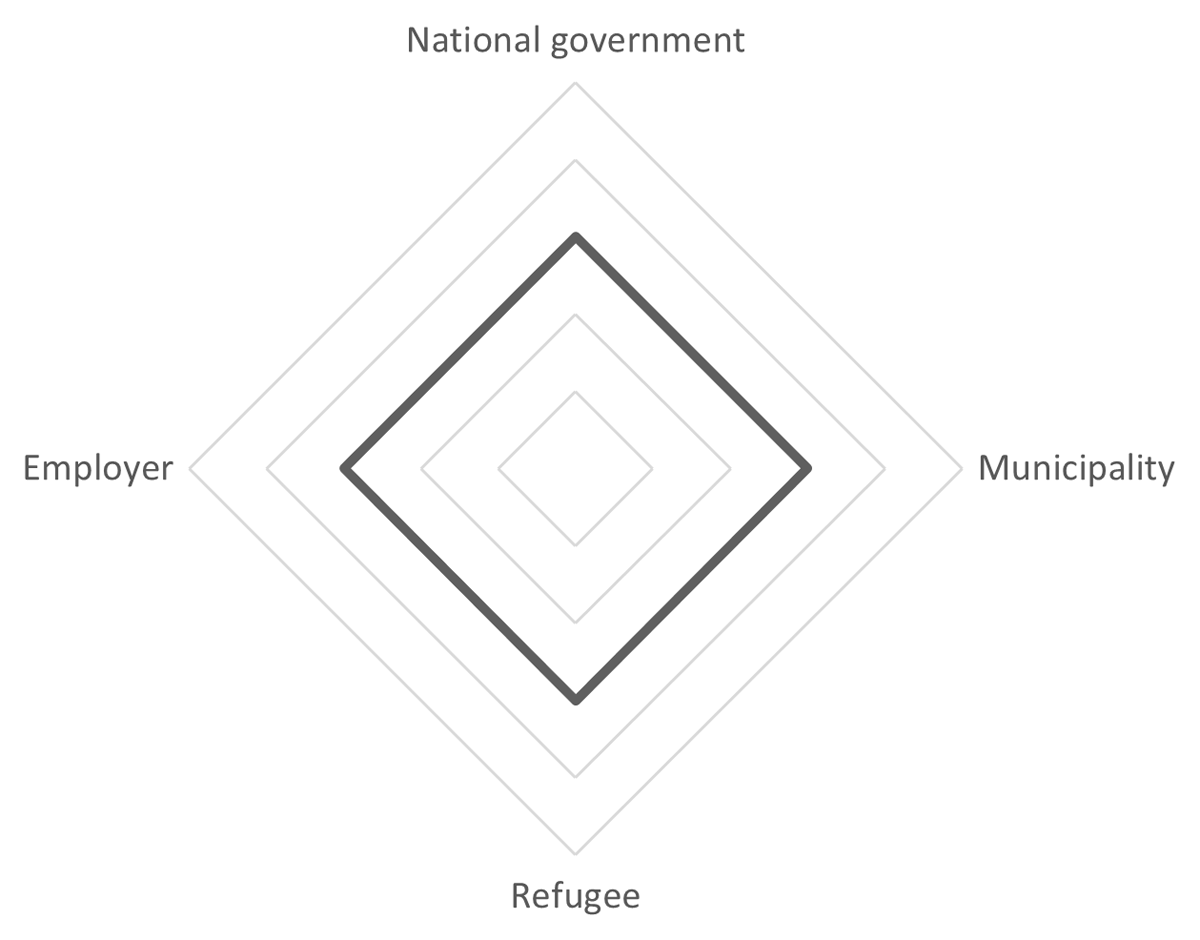
Figure 1
Hypothetical model of distributions of responsibilities.
For each moment, we used the radar charts to illustrate each actor’s relative degree of responsibility. However, since there are several actors, which actor will fill out the actor’s role with less responsibility is not given. In the analysis, we identified practices and contradictory interests in each moment that can be expected to have a transformative outcome. Contradictions can occur if there is a lack of responsibility among actors, if all actors have high or overlapping responsibilities, or if an actor has an interest in reducing or increasing his or her responsibility. To solve these contradictions, a new mode of organizing can be implemented with a changed distribution of responsibilities. The charts therefore also work as a tool to help us identify the possible alternatives that follow from the contradictions inherent in each moment.
We use the charts as a tool to visualize the identified dialectical relationships, and not as an ideal model of the distribution of responsibilities. In the charts, we chose to combine settlement and housing in one figure and the labor market in the other since the distribution of responsibilities looks quite similar in the settlement and housing spheres.
4. Organizing Settlement, Housing, and Inclusion in the Labor Market: Two Critical Moments
4.1 Centralization and Subcontracting Labor Market Inclusion: The Establishment Reform in 2010
In 2010, the responsibility for organizing labor market inclusion for refugees was transferred from the municipal level to the Public Employment Service (PES) at the national governmental level (Lag 2010: 197). The reform was launched as a reaction to extensive critique by several actors of the previous system. In the previous system, the municipalities were responsible for receiving refugees who had obtained a residence permit, resulting in various municipally coordinated introductory programs. The new social organization for labor market inclusion was formulated in an integration program called the Establishment Reform. The main aim of the reform, as stated by the government, was to reduce the time needed for refugees to become self-sufficient. PES developed a new centralized organization of introduction, which involved 2 years of mandatory participation in activities organized by the PES, while the municipalities continued to have responsibility for arranging education in Swedish and ‘societal knowledge’ (samhällsinformation in Swedish) and for providing housing. The reform also included subcontracting assistance for ‘job search activities’, a wide variety of private actors called ‘introduction guides’ (etableringslotsar in Swedish), from which refugees had to choose. The reform was described as a shift from an emphasis on local and diverse introductory programs on social support to a more structured and centralized organization of integration with increased emphasis on the activation of immigrants and their rapid entry into the labor market (Fernandes 2015; Larsson 2015; Qvist 2012).
The establishment reform did not directly address settlement or housing, although they ideally wished to match available housing and good labor market opportunities. The main target was matching skills and labor market opportunities, but this could result in a conflict between labor and housing, as vacant housing was often found in regions with less vibrant labor markets. The most common way for asylum seekers to settle while they waited for residency permits was to arrange the first housing themselves own accomodation (EBO). Those arranging their own housing more often turned down settlement and establishment offers and stayed in the municipality they lived in during the asylum process. Housing arranged by the Migration Board accommodation facility (ABO) became a less popular alternative, and asylum seekers who stayed at ABO could face long waiting times to be received in any municipality and obtain housing (Statskontoret 2012). The organization of settlements and housing changed slightly in the same year as the Establishment Reform – it became possible to make voluntary agreements between municipalities and the regional board on the number of asylum seekers that the municipality was to receive and for whom they were supposed to provide housing (SFS 2010: 408).
Actors and Interests
Regarding the actors we are focusing on here, we can identify the following interests that were driving and satisfied by the reform.
The national government had an interest in having more control of the process, streamlining the practice of labor market inclusion for refugees, and speeding up the process for refugees to be employed and pay taxes. This interest was the main driver of the reform.
The social context in this reform related to settlement and housing was that the municipalities had interests in the number of immigrants to receive. Some ‘immigrant-dense’ municipalities wanted a smaller ‘burden’, while others wanted more refugees to populate municipally owned rental apartments. However, interest in receiving more refugees decreased as housing shortages grew in almost all municipalities (Länsstyrelsen Stockholm 2020).
Refugees had an interest in obtaining work and income, as well as equal treatment, irrespective of the residential municipality. The Establishment Reform can be seen not only as a more effective way for refugees to become self-sufficient, but also as a limitation of their autonomy.
Finally, employers were interested in potential employees who were job ready, spoke Swedish, had relevant training, and had basic knowledge about Swedish society. Offering ‘introduction guides’ provided a business opportunity for private actors.
Conflicts of Interest
The Establishment Reform achieved somewhat better results in terms of labor market inclusion than did previous municipal Introduction programs (Andersson Joona et al. 2016; Qi et al. 2021), but part of the activities called ‘Preparatory and orienting education’ had varying quality and outcomes depending on the participants’ educational level (Riksrevisionen 2017).
However, the subcontracting practice of introduction guides did not work well. It was difficult for refugees to make informed choices, and the task of introduction guides was considered too broad to enable them to contribute effectively to inclusion in the labor market (Riksrevisionen 2014). The result was that the introduction guides prioritized social support, while support for finding a job for the new arrivals often took second place (Riksrevisionen 2014; Sibbmark, Söderström & Åslund 2016). The practice of subcontracting introduction guides ended in 2015. The problem was that no other actor was appointed to provide guidance and social support for refugees (Eriksson 2019). For instance, private actors/employers were criticized for being more motivated by attracting ‘diverse’ customers primarily to make a profit rather than actively engaging in the labor market and workplace integration of refugees (Larsson 2015).
At the same time, it has become more difficult for asylum seekers to find housing through the EBO system, as an increasing number of municipalities have experienced housing shortages. However, the system with voluntary agreements between the national government and the municipalities to receive refugees with new residence permits did not work well, and the waiting time in the reception system by the Swedish Migration Agency (which replaced the Swedish Immigration Board in 2000) increased. This also affected the possibility of accessing the reception program since it did not start until the refugee was registered in a municipality.
The contradictions between national government settlement policies, municipalities’ access to housing, and asylum seekers’ interest in residing in regions with employment opportunities when they obtained a residence permit escalated in 2015 when unprecedented numbers of refugees applied for asylum in Sweden and other European countries. At the time, most asylum seekers arranged their own accommodation (i.e., EBO), but could still also be provided housing in municipalities through voluntary agreements between municipalities and the regional board (i.e., ABO). However, the available housing that resulted from voluntary agreements with municipalities was often not satisfactory due to the increased number of newly arrived refugees, and the waiting time to be referred to a municipality was extended.
First, different economic stimuli were used by the national government to increase the willingness of municipalities to receive more refugees. This gave little result, and as a final attempt to solve the problem voluntarily, two national ‘coordinators’ were appointed by the government to negotiate with municipalities to persuade them to receive more refugees (in January 2014). The aim was to reduce the time spent in asylum centers as the number of refugees continued to increase (Arbetsmarknadsdepartementet 2015: 33; Regeringskansliet 2014). The initiatives to persuade all municipalities to take responsibility for refugees’ housing voluntarily were unsuccessful.
This organization of inclusion in the labor market at the national level and inclusion in housing at the municipal level also resulted in a contradiction – a geographical paradox – as refugees were supposed to look for employment in the whole country but had a more limited opportunity to choose in which municipality to settle both as an asylum seeker and after receiving a residence permit.
In addition, the municipalities had reduced responsibilities regarding inclusion in the labor market but slightly more responsibilities for housing. Refugees received fewer choices regarding settlement, housing, and employment, as well as less social support. Employers gained more access to employable refugees and could ask the national government to pay for education, internships, or different forms of subsidized, time-limited employment for the immigrants who fit the companies’ business needs.
Figure 2 (below) illustrates the distribution of responsibilities that resulted from this observed moment. Regarding housing, national control was slightly reduced since the municipalities had the opportunity to negotiate, and the responsibility for some of the municipalities was reduced. Asylum seekers had the same ability to choose between EBO and ABO, but the housing shortage limited the options available more than before, which impacted both asylum seekers and refugees’ ability to choose where to settle. As before, employers were not involved in the settlement and housing process. In terms of settlement and housing, all actors included in the figure had very low control and responsibility, which meant that other actors, such as municipal housing and their queuing system, as well as private housing companies, had more influence on refugees’ choices of where to live and find housing. The greatest change was that the responsibility and control of the labor market activation policy were transferred from the municipal level to the government level. Refugees received more efficient support to find jobs, less autonomy, and less social support, and the role of employers did not change.
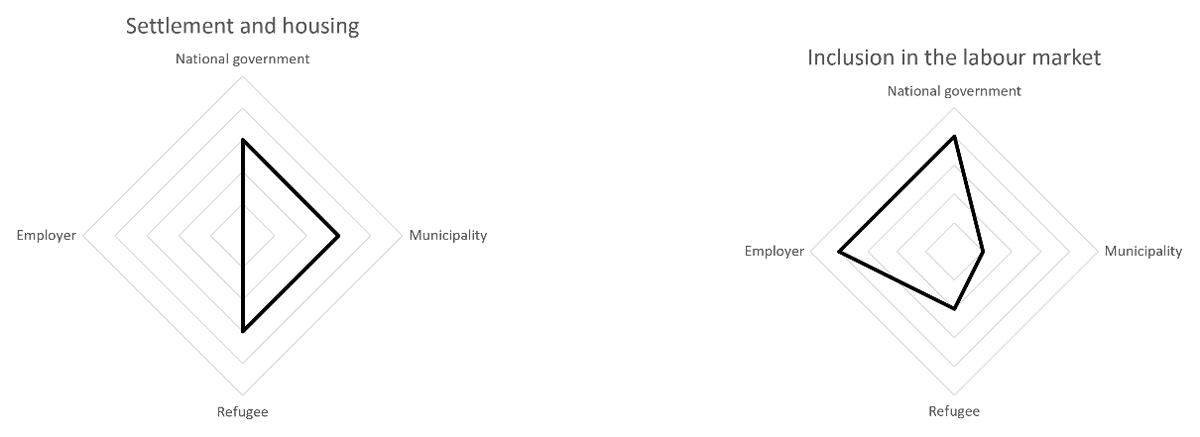
Figure 2
Responsibilities and control after the moment of centralization and subcontracting labor market inclusion in 2010.
Possible Organizational Outcomes
The identified contradictions and problems from the practice that had been put into place in 2010 opened up numerous possible reorganization options, particularly regarding settlement and housing, for example, improving possibilities to move to another municipality (i.e., exchange the system of local queues for rental apartments to a national system), improving access to housing in municipalities with labor shortages, and improving the labor market in municipalities with accessible housing. The labor market activation policies could also be changed; for example, labor market integration programs could be decentralized to adapt to local resources, opportunity structures, and markets; extra resources could be allocated to municipalities with a high intake to organize the integration process better; the time limit could be adapted to individual needs; or employer involvement in the integration process could be enhanced both in the pre-employment stage and after employment.
4.2 Centralized Decentralization of Housing and More Controlled Inclusion in the Labor Market for Refugees: The New Settlement Act (2016) and Stricter Establishment Programs (2018)
In 2016, the government launched the Settlement Act (Lag 2016: 38), which obliged all municipalities to provide housing for newly arrived refugees (i.e., those with residence permits). In the government bill (prop. 2015/16:54), the motivation was to decentralize the responsibility for integration: to improve the establishment of new arrivals in the labor market and in society, all municipalities should be involved and take responsibility for the reception of new arrivals (prop. 2015/16:54). The Settlement Act replaced the old system of negotiations between the national government (the Swedish Migration Agency) and the municipalities regarding the number and profile of refugees to settle. In this new system, the number of refugees each municipality was obliged to receive was determined through calculation matrices that considered previous reception numbers, ABO, the number of EBOs, and the labor market situation. Interestingly, vacant housing was not included in calculating the number of refugees the municipalities were assigned. The law strengthened the national government’s power over municipalities; however, it forced all municipalities to receive and settle newly accepted refugees, and no municipality could claim housing shortages to negotiate down reception numbers (Larsson 2017). When this law was instituted, the housing shortage was a reality in almost all Swedish municipalities, which might have contributed to the reduced percentage of asylum seekers who chose EBO, from 90% to 60% (Länsstyrelsen Stockholm 2020). The distribution between municipalities became more even (Länsstyrelsen Stockholm 2020).
Municipalities interpreted their responsibility for the housing of refugees in different ways. Some municipalities provided long-term or permanent housing, while others provided only short-term housing (2 years) and referred refugees to the ordinary housing market (Grange & Björling 2020; Magnusson 2018). Many municipalities aligned the 2-year period with the timeline of the establishment reform. After this period, refugees were supposed to find housing on the same terms as the general population (Grange & Björling 2020).
In the following years, more regulations were introduced to enable the national government to control and regulate refugees’ immigration, settlement, and daily activities (i.e., activities within the Establishment Reform were developed into Establishment Programs in 2018). These programs became stricter, including full-time activities to receive economic benefits (Andersson Joona 2020).
During this period, we also noted increased mobilization in society through various initiatives to speed up the entrance of newly arrived refugees into the labor market (Diedrich & Hellgren 2018). The Swedish government launched some of these initiatives, and others were launched by other actors, both from the private and public sectors. Many of these initiatives placed a greater focus on the role of employers regarding the labor market and the workplace integration of refugees. This emphasis on the role of employers and the importance of their active involvement in social integration, with the aim of faster labor market and workplace integration of refugees, can be viewed not only in light of the significantly increased number of asylum seekers and accepted refugees in this period in Sweden, but also in terms of recognizing the crucial role of employers in the practices of staff selection and recruitment, which directly affects who will receive an internship or employment and who will not.
Actors and Interests
In general, the actors’ interests in this second moment are the same as those in the first moment, on which we elaborated earlier. Both the national government and municipalities with large influxes of refugees still had an interest in controlling the settlement of refugees. However, the interest from municipalities in taking more responsibility for arranging housing and other social support for refugees decreased.
Municipalities interpreted their responsibility for the housing of refugees in different ways, which could be seen as an action taken to form the system to reflect their own ideas, and this in turn impacted refugees’ job prospects in Sweden (Holmqvist, Jutvik & Lidén 2022).
Refugees still had an interest in finding housing and employment for self-sufficiency and in deciding where to live.
Employers’ interest was primarily in obtaining job-ready staff and well-functioning workgroups, but there was also increasing social engagement with participation in the reception of refugees by local employers.
Conflicts of Interest
The reform strengthened some conflicts of interest and initiated some new conflicts.
The national government increased its responsibility and control over where newly arrived refugees should settle and start their labor market activities. The municipalities, however, continued to be responsible for housing and other kinds of integration activities (such as arranging language training) during the establishment phase of 2 years.
The New Settlement Act shortened the waiting time to be settled and find housing in a municipality after having obtained a residence permit and to be able to participate in the Establishment Program but limited asylum seekers’ opportunities to choose which municipality to settle in, at least in the long term (Holmqvist, Jutvik & Lidén 2022). It also reduced municipalities’ possibilities of impacting decisions on how many refugees to receive.
The situation became difficult for refugees who settled in municipalities that provided 2-year limited contracts when the residential contract ended. In most municipalities, 2 years constitutes too short a period to support refugees’ ability to meet the requirements needed to obtain housing (e.g., too short a time on housing waiting lists, not established in the labor market, and low and unstable income) (Grange & Björling 2020).
Thus, obtaining a stable housing situation increasingly depended on refugees’ establishment in the labor market. Thus, this system has a close dialectic relationship between housing and labor market inclusion. The housing problems encountered by refugees caused stress, and immigrants had to use different coping strategies, such as finding residences among friends and relatives, to address these problems (Larsson 2017). The housing situation is likely related to refugees’ inclusion in the labor market (Larsson 2017).
In 2019, the Settlement Act was revised to allow municipalities to exclude parts of the municipality from the reception system. Hence, refugees were not allowed to settle in areas already densely populated by immigrants who were listed as ‘extra vulnerable’ with parallel societies by the police authority; this limited refugees’ choices of where to settle.
At this moment, as illustrated by Figure 3 (below), refugees have fewer possibilities to control their settlement, housing, and labor market activities than at the first moment. Instead, the national government and the municipality have greater control and responsibility.
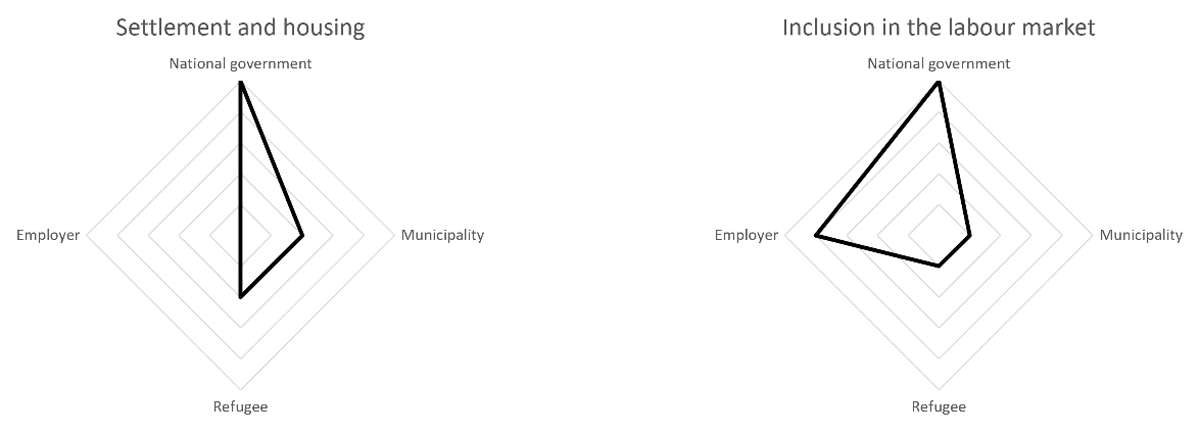
Figure 3
Responsibilities and control in the moment of centralized decentralization of housing (2016) and more controlled inclusion in the labor market (2018).
Possible Organizational Outcomes
Since the control over both settlement and employment at this moment is very concentrated at the national government level, possible reorganization could be to reduce national government authority in these respects. Municipalities could gain more influence in deciding how many asylum seekers to receive and more responsibility for organizing labor market integration activities. Refugees could obtain more control and authority over their own lives by receiving an increased opportunity to choose which municipality to settle in. They could, for example, bring an individual ‘integration voucher’ to finance extra resources arranged by the municipalities. Employers could also obtain more responsibility for housing if they owned and rented such housing to their employees.
5. Summary of Results and Discussion
In this study, we addressed the dialectical relationships among settlement, housing, and labor market activation policies for refugees. We selected and analyzed two critical moments where the social organization for settlement, housing, and labor market activities was transformed. After mapping the organization and interrelations of settlement, housing, and labor market activation policies, we found several contradictions that emerge from the relationships between actors’ ideas and interests in different policy areas at different geographical levels and how they are addressed in successive reforms.
Our dialectical analysis of the empirical data focused on four key actors (the national government, municipalities, employers, and refugees) and their ideas, interests, and actions in the process of organizing. As we also illustrate in the article, the mutual relationships between these different ideas and interests in the processes of organizing in different periods generate contradictions, which appear both within housing and labor market inclusion and between these two spheres of inclusion. In this study, we identify two important moments in which the organization of settlements, housing, and labor market inclusion for refugees changed. In both of these (re)organizing moments, we also identify and discuss contradictions and possible alternative organizational outcomes from each moment.
An overall conclusion is that the organization of the settlement and inclusion of refugees in terms of settlement, housing, and employment produces intentional but also unintentional contradictions that have several possible implications regarding the housing integration of refugees and their establishment in labor markets. The actual outcomes show that some contradictory ideas and interests in organizing housing and labor market integration are unresolved. From the policy side, ideas and interests were reorganized through decentralization and centralization simultaneously. However, the reorganization of the settlement and housing of refugees will not solve the problem of vacant housing being more often found in regions with fewer opportunities in the labor market. These conflicting interests between the geographical levels of the state and municipalities need to be handled differently.
The spheres of settlement and housing, on the one hand, and inclusion in the labor market, on the other hand, have a parallel influence on the possibility for refugees to become autonomous in socioeconomic terms. However, the spheres seem to be driven by separate logic. Sometimes, the changes went in diverging directions (as in the first moment when municipalities received more control over the number of refugees to receive but less influence on labor market programs) and sometimes in the same direction (as in the second moment when the government gained more control in both settlement and labor market inclusion).
The radar charts used to illustrate the complex dialectical relationships and distributions of control and responsibilities that result from the observed organizing processes show how the relative responsibility varies between actors at different moments. It is striking how the distributions of control and responsibilities can differ dramatically from one observed moment to another. When responsibility increases for one actor, it is often reduced for another. The national government has gained more responsibility over time concerning both the organization of settlement and housing and the organization of inclusion in the labor market for refugees; municipalities have received less control but more responsibilities regarding settlement and housing and less responsibility regarding employment. Refugees first had the possibility to choose settlement and get assistance to find housing, but then the possibility to choose a municipality of settlement was reduced, and possibilities to find long-term housing became more limited. Thus, their opportunity to choose how and where to find an employer interested in offering them an internship or employment was reduced. Employers have high control in the labor market as gatekeepers and in organizing work but have no formal responsibilities for the labor market inclusion of refugees. Concerning settlement and housing, employers have no responsibility. The autonomy of refugees in deciding where to live and undertake strategies to become included in the labor market and workplace has thus decreased over time, although it can be argued that the improved efficiency of the Establishment Reform has increased refugees’ autonomy in terms of self-sufficiency.
We also proposed some transformative alternative practices that could include the voices of refugees on more equal terms with those of other actors. In addition, it is clear that where and how refugees live are seen as the main problems to be solved by the national government (where), municipalities (how), and individuals but not employers. The responsibility for determining where refugees should live is transferred between the national government, the municipality, and the refugee. In contrast, the responsibility for finding short- and long-term housing after the permit is granted is placed alternately on the municipality or the individual.
We argue that to solve the geographical paradox between housing and employment, obtaining housing should not be solely a municipal or individual responsibility. For refugees, relocation to a municipality where they find employment is currently constrained by problems in the housing market (housing shortage, housing affordability, and housing access), particularly in larger cities. This indicates, we argue, that there is a need to create possibilities to use locally invested resources (e.g., queue time in public housing waiting lists) in a more flexible way to reach inclusion in housing and employment simultaneously. An alternative is that employers become more active in housing, as they have been for individuals who come to work as expatriates or economic migrants. Our dialectic analysis that focuses on mutual relations between actors’ ideas, interests, actions, and different spheres shows that the socioeconomic autonomy of refugees is negatively impacted by the contradictions inherent in the organization and distribution of responsibilities between the national government and municipalities. Acknowledging these contradictions and the alternative roles of significant actors may enable more creativity in policy, including better coordination in how settlement, housing, and labor market activities are organized. Perhaps enabling rather than restricting refugees’ mobility and choice of where to settle and how to be included in the labor market is a more fruitful way forward.
Notes
[1] In this article, the term refugee refers to immigrants who have applied for or have been granted residence permits for security reasons.
[2] See more about distinctions between ‘construction’ and ‘production’ of social arrangements in Omanović (2006).
Competing Interests
The authors have no competing interests to declare.