
1. Introduction
From May 2013 until March 2020, a large, white tent stood at Steintor Square near Hamburg’s central train station and across from the main bus terminal. The tent was set up by activists of the political movement Lampedusa in Hamburg (LiHH), a migrant1 activists’ group demanding the regularization of their legal status in Germany. For almost seven years, the Lampedusa tent functioned as an information center, a meeting point, and a protest site for the group and its supporters. In March 2020, with the introduction of coronavirus disease 2019 (Covid-19) restrictions in Germany, the tent was removed by local public health authorities and has not been re-established since then.
From March to September 2022, a small structure appeared outside the main entrance of Hamburg’s central train station, only a few hundred meters from where the former Lampedusa tent was situated. Decorated with different banners carrying political messages, the Refugee Info Point, as the infrastructure was called, was set up by some of the same activists who had built the Lampedusa tent to show solidarity with people fleeing from Ukraine and to provide a point of first contact in the city, especially for African students displaced from Ukraine by the Russian invasion.
This article is based on fieldwork conducted in Hamburg between 2017 and 2022. It traces the (dis)continuities between these two infrastructures, the Refugee Info Point and the Lampedusa tent. I explore their mutability, adaptability, vanishing, and (re)emergence in Hamburg’s urban spaces over several years. These infrastructures, one a transient site that existed only for a few months (Refugee Info Point) and the other a semipermanent feature of the urban environment around the central train station (Lampedusa tent), are both examples of migrant ‘arrival infrastructures’.
To make sense of these two sites, I follow the definition that Meeus et al. give for arrival infrastructures: ‘those parts of the urban fabric within which newcomers become entangled on arrival, and where their future local or translocal social mobilities are produced as much as negotiated.’ (2019: 1). Approaching the central station spaces as a continuum of arrival infrastructure provides insights into the entanglements among actors: migrants, state bureaucracy, nongovernmental organizations (NGOs), and solidarity groups.
The Lampedusa tent and the Refugee Info Point aimed to address the needs of migrants situated at society’s margins owing to their precarious legal status. Through the lens of ‘edges’, I emphasize that, even though these infrastructures are spatially positioned in Hamburg’s urban center, they are sociopolitically positioned at the margins of society and the edge of citizenship (see also Hall 2021: 151). Despite this position, relations and connections are forged to the urban environment and larger sociopolitical sphere. The infrastructures discussed here become ‘zones of interaction’ (Howitt 2001: 240), where power is constantly negotiated in urban encounters, and new openings and frictions emerge. I therefore argue, with deference to Hall (2021), that these sites are arrival infrastructures at the edge.
I define ‘arrival infrastructures at the edge’ as the adaptive practices of migrants positioned at the sociopolitical edges of urban spaces. These dynamic infrastructures respond to shortcomings in or exclusion from formal state-provided services for migrants in the city. Arrival infrastructures at the edge address the temporal and complex nature of arrival, offering spaces of possibility for individuals facing legal precarity in the migration process, and in doing so, they leave traces of (dis)continuity.
Moments of political upheaval, such as the ‘long summer of migration’ of 2015 (Kasparek & Speer 2015), the Covid-19 pandemic, and the Russian invasion of Ukraine in 2022, have created different degrees of policing and public discourses within which the actors embedded in the arrival infrastructures maneuver. Through my empirical material, I show that the arrival infrastructures studied here are dynamic sites within which precariously positioned migrants navigate and adapt to changing circumstances in the city, often in response to the dynamic landscapes of hospitality and hostility (Aparna & Schapendonk 2020).
The paper begins by discussing arrival infrastructures and how the notion of edges (Hall 2021) contributes to understanding specific migrant-built infrastructures. Subsequently, I outline the methodological considerations guiding this research. In the analytical section, I discuss two arrival infrastructures in Hamburg: First, the Lampedusa tent is unpacked as a site of political activism and an information point (re)made and unmade over several years. Next, the Refugee Info Point, a transient arrival infrastructure, is explored. I demonstrate that while the Refugee Info Point was built on the remnants of the Lampedusa tent, it presents a distinct arrival infrastructure entangled in a different geopolitical reality. I highlight specific encounters at the site that illustrate its role as a ‘zone of interaction’ (Howitt 2001: 240), where actors with different viewpoints meet and challenge their perspectives. Finally, I reflect on the transformative potentials of arrival infrastructures at the edge.
2. Conceptual Framework: Arrival Infrastructures at the Edge
The ‘infrastructure turn’ (Amin 2014) has become increasingly central in migration and border studies (Dijstelbloem 2021; Kleinman 2019; Meuss et al. 2019; Xiang & Lindquist 2014). These strands of literature conceptualize infrastructures as both spatial and material (for example, brick-and-mortar sites, roads, etc.) and social and digital infrastructures. As such, these infrastructures produce specific sites but extend beyond spatial and material inflection points and involve different human and non-human actors.
In the larger debate on migration infrastructures (Xiang & Lindquist 2014), one body of literature focuses mainly on how infrastructures are used to control and govern migration. Leurs (2019: 94) refers to these infrastructures as ‘migration crisis infrastructures’. Here, state and non-state actors come together to solve supposed ‘crises’ of human mobility by using different material infrastructures of deterrence and deportation (Kathiravelu 2021; Morris 2021; Walters 2018; Whyte, Campbell, & Overgaard 2020) as well as digital and biometric infrastructures in bordering practices (Dijstelbloem 2021; Pollozek & Passoth 2019).
Another strand examines how migrants repurpose existing infrastructures or build new ones in response to their exclusion from formal infrastructures. These approaches merge discussions from critical migration and citizenship studies with urban planning and architecture, predominantly focusing on urban contexts (Bonnin 2020; Hall 2021; Kleinman 2019; Mora-Gámez 2020; Tayob 2019; Wajsberg & Schapendonk 2022).
This article builds on scholarship exploring migrant ‘arrival infrastructure’ (Meuss et al. 2019). Arrival infrastructures address the specific needs of individuals ‘arriving’ in a place, offering services for ‘arrival’ facilitation (Wessendorf 2022), including shelter access and support in navigating local bureaucracy and institutions. The term ‘arrival’ requires a critical approach, as the official understanding may differ significantly from migrants’ lived experiences. As my examples show, arrival in a city is not a linear process, and the temporal dimension of arrival can vary according to different migration trajectories and state policies. Changing migration policies produce infrastructures that either support or impede migrants’ arrival, creating categories such as ‘permanent arrival’ and ‘permanent temporariness’ (Meuss et al. 2019: 2). The arrival infrastructures examined in this article are a response by those deemed ‘permanently temporary’ asserting their space in Hamburg.
The socio-material space of arrival infrastructures engages a myriad of actors and extends to different scales, ranging from specific sites of arrival (Kleinman 2019; Saltiel 2020) to neighborhoods (Wessendorf 2022) and ‘arrival cities’ (Saunders 2012). In this paper, I address arrival infrastructures from below, set up by non-state actors to facilitate access to information and shelter. Such ‘alternative infrastructures’ (Cowen 2017) often emerge where the state does not provide adequate services or access to infrastructure for those that are new to the city (see also Kleinman 2019: 104; Wajsberg & Schapendonk 2022). The material and social arrival infrastructures discussed here specifically tend to the needs of migrants who are at the edge of the migration and citizenship regime (Hall 2021) and restricted from accessing formal arrival infrastructures set up by state and NGO actors. This makes them particularly prone to experience precarity as they live with the looming prospects of ‘displaceability’ (Yiftachel 2020) and ‘deportability’ (De Genova 2002). The Refugee Info Point and the Lampedusa tent are spaces from and through which these processes are resisted. These sites provide support and information to migrants otherwise excluded from or deprioritized by formal arrival infrastructures, such as the asylum centers in Hamburg.The second theoretical underpinning of this paper draws on the concept of ‘edges’, which has been used by scholars within geography (Howitt 2001; Lepawsky & Mather 2011) and urban studies (Hall 2021). In her research on migrant entrepreneurship in the UK, Hall (2021) analyzes edges as productive sites of meaning-making for migrants. Here, the edge refers to the space between the known and unknown, and Hall investigates how migrants navigate this space. The edge here serves as both a site of possibility and precarity. Hall also extends the notion of edges to the concept of citizenship. Looking at the experiences of her interlocutors, she finds that many of them live at ‘the edge of citizenship’, meaning that, even after their migration trajectories have seemingly come to an end as they have ‘arrived’ in the UK, they continue to experience precarity and insecurity in their residence statuses and through processes of racialization and discrimination.
However, as Hall shows, her interlocutors continuously and creatively resist their precarious position by claiming their rights to be part of society. In doing so, they ‘rewire’ (2021: 137) the cities’ infrastructures to accommodate their needs, for example, by creatively restructuring small shop spaces to accommodate multiple businesses in one space. Drawing on Bell Hooks’ (1989) conceptualizations of edges as spaces of radical openness and resistance, Hall understands ‘the margin as a relation of power and an embodied edge from which to contest dominant cultural and racial orders.’ (2021: 22). The ‘edge’, which in this reading does not necessarily address spatial marginality but rather refers to sociopolitical marginalization, is thus a space where resistance to oppressive structures can occur and where new socialities become possible.
Hall’s (2021) notion of a ‘citizenship of the edge’ speaks to the large body of scholarship on ‘acts of citizenship’ and activist citizenship (Isin 2009; McNevin 2013; Nyers & Rygiel 2012), which engages with the myriad ways that marginalized groups claim rights to live and engage with the city, even when these rights are formally denied. This understanding of ‘being at the edge’ of society while resisting oppression and marginalization resonates with the examples of arrival infrastructures explored in this paper.
Geographer Richie Howitt presents a similar perspective on edges as sites of potential transformation, contestation, and resistance. In exploring spatial metaphors of exclusion, Howitt (2001: 240) draws on ecological terminology, which defines edges as ‘liminal spaces […] not lines of separation but zones of interaction’. At these edges, different elements meet and create environments of vast ecological diversity.
In contrast to the language of ‘borders’ and ‘boundaries’, which implies one is on either side, the ‘zone of interaction’ at the edge has a more productive capacity for change. In this liminal space, new entanglements and forms of interaction become possible, fostering the potential for something new yet unknown to emerge. My intention here is not to downplay exclusionary policies but to engage with the continuous meaning-making processes within the arrival infrastructures, where the edge constantly shifts (see Schapendonk 2020).
I understand the Lampedusa tent and the Refugee Info Point to be expressions of arrival infrastructures at the edge, as they are in a constant process of transformation ‘where things were becoming something else in action’ (Lepawsky & Mather 2011: 247). New openings and frictions emerge at these sites for those positioned at the edge of citizenship.
The socially driven arrival infrastructures in this article are sites built by migrants with precarious legal status in Hamburg to counteract their exclusion and create new spaces of possibility for themselves and other migrants with similarly precarious positions in society. These infrastructures are part of a myriad of navigational tactics employed at and from the edge to counteract processes of marginalization and discrimination.
3. Methodology and Positionality
This article is based on empirical material collected during fieldwork in Hamburg, which began during my graduate studies in 2017 and continued throughout my Ph.D. research project from 2019 until 2024. In my Ph.D. research, I explore how migrants with precarious legal statuses navigate infrastructures of exclusion in urban spaces and existing infrastructures of care and shelter in Athens and Hamburg while creating their own infrastructures to facilitate placemaking and mobility. I employ a theoretical and methodological approach called ‘patchwork ethnography’ (Günel et al. 2020), which challenges the idea of a bounded field and advocates for more complicated, non-linear, and ‘patchy’ understandings of ethnography.
In Hamburg, I conducted semi-structured interviews and informal conversations with activists from the migrants’ rights group LiHH and other migrants frequenting the Lampedusa tent and the Refugee Info Point infrastructures. Since 2013, LiHH has positioned itself as a visible and engaged local and national migrant rights actor. The group has actively fostered collaborations with academics and other actors from art and civil society to highlight its struggle for rights. Thus, LiHH has been open to engaging with researchers such as myself. Many interlocutors who were key in my research, such as Omer, have been long-term contacts, dating back to my initial research about LiHH and migrant activism in Hamburg as a student in 2017. Over the years, we have remained in contact through digital media and during my repeated visits to Hamburg.
All conversations with interlocutors were conducted in English and German, and the selection of interlocutors was thus limited to people who spoke one of these languages. In all conversations with interlocutors, I explained my research interests and sought their consent to use some of their statements and observations at the site in my research. All names have been anonymized.
Spatially, my research focused on the area around the Lampedusa tent and the Refugee Info Point located close to the central train station, as well as the adjacent neighborhood of St Georg, with its busy Steindamm road, which is an important arrival space for migrants in Hamburg (Budak-Kim 2022). On Steindamm, I often met up with interlocutors for conversations at one of the many cafes.
As a German citizen who is not a resident of Hamburg, my understanding of the city is shaped by research stays that were frequently interrupted, especially during the first years of the Covid-19 pandemic. Thus, upon every return to Hamburg, I had to refamiliarize myself with the city and its changing migration infrastructures. My citizenship status, along with gendered and racialized perceptions, influences how I and my interlocutors navigate and are perceived in public spaces. At the same time, my understanding of the city is informed by the insights of residents from racially minoritized interlocutors such as the activists from LiHH. Their perspectives are crucial to my research and highlight the risks of engaging in uneven, extractivist knowledge production.
Throughout my work, I try to remain aware of these complicated dynamics, which I describe elsewhere as ‘uneven emotional geographies’ (Wajsberg 2020) in which both researchers and interlocutors operate, recognizing the power imbalances inherent in our interactions. For example, as a researcher affiliated with a Northern European institution, I am in a position of relative power. This is compounded by my proficiency in the local language, citizenship status, and the gendered and racialized perceptions that affect how I, as a white woman, and my interlocutors, mostly Black men, are perceived in public spaces.
A commitment to addressing such uneven power dynamics in research and teaching is, however, not a one-time effort but a continuous journey (see Wajsberg 2020). I attempt to remain attentive, transparent, and reflexive, recognizing that reflections and discussions of power inequalities should be a continued purview throughout the research and teaching processes in the academy.
4. (Re)making Arrival Infrastructures at the Edge
In the following, I explore two migrant arrival infrastructures that reveal distinct facets of their position at Hamburg’s sociopolitical edge. The Lampedusa tent (4.2.) illustrates ‘permanent temporariness’ (Meuss et al. 2019: 2) and the role of infrastructures at the edge in the struggle for migrant rights. The Refugee Info Point (4.3.) was a support and solidarity infrastructure for those excluded from formal arrival infrastructures. However, I also highlight a moment of friction at the Refugee Info Point, which elucidates its function as a ‘zone of interaction’ (Howitt 2001: 240), a site where different discourses on the meanings of migrant solidarity collide and are negotiated. Both cases embody the ‘profound edge’ (Hooks 1989: 19), a space of ‘radical openness’ enabling creative resistance to exclusionary processes by marginalized groups.
4.1. Lampedusa in Hamburg
Before diving into the significance of the Lampedusa tent as an arrival infrastructure at the edge, I briefly outline the development of the political movement Lampedusa in Hamburg (LiHH):
LiHH is a migrant rights movement formed in 2013 by mostly West African migrants who were initially labor migrants in Libya. During the 2011 civil war, many fled to Italy, where they encountered challenges securing housing and employment even after being granted asylum. Many eventually migrated to other EU countries, including Germany and specifically Hamburg (Odugbesan & Schwiertz 2018). According to Dublin regulations, those granted asylum in one EU member state can travel to others for up to 90 days but are ineligible for work and residence permits. In 2013, around 300 African migrants, having obtained asylum in Italy and relocated to Hamburg, formed LiHH as a political protest movement.
LiHH advocates for regularizing their residence status, invoking §23 of the German Residence Act, under which groups can be granted asylum and work permits on humanitarian grounds (Lampedusa 2015). The group argues that their displacement from Libya was a result of the NATO intervention in 2011, and thus, the EU, rather than specific member states, should assume responsibility for their displacement. Moreover, LiHH protests German and EU migration policies and highlights the struggles of migrants in transnational contexts.
LiHH’s struggle to regularize its status gathered significant public support and coverage from regional and national media outlets. The group formed alliances with other social movements, such as anti-gentrification actors, a worker’s union, religious institutions, and urban citizenship campaigns advocating for migrants’ urban citizenship rights (Fischer & Bak Jørgensen 2021). The local football club FC St Pauli, with its history of left-wing activism, publicly supported the LiHH movement (Borgstede 2017). In March 2013, LiHH and its supporters organized a protest attended by 9000 people (N-TV 2013). These alliances encapsulate ‘geosocial throwntogetherness’ (Sparke & Mitchell 2018: 217) as they bring together diverse actors in the global city. They furthermore relate to the notion of the ‘profound edge’ (Hooks 1989) as a space where creative resistance against marginalization can thrive and alliances between different groups positioned at the edge can be formed.
LiHH received significant attention in the academic literature on migration and social movements (see Bak Jørgensen 2019; Borgstede 2017; Drangsland 2020; Fischer & Bak Jørgensen 2021; Meret & Diener 2019; Odugbesan & Schwiertz 2018; Sparke & Mitchell 2018). Owing to its alliance-building and widespread support among the local population, it is often referred to as a compelling example of migrant-led activism.
However, the role of the tent as a tactile manifestation of claims and an arrival infrastructure for marginalized migrants has thus far not been the object of study (for an exception, see Budak-Kim’s 2022 work on ‘ambivalent spaces of arrival’ in Hamburg, which mentions the Lampedusa tent). With this article, I hope to contribute to scholarship on the development of migrant rights movements such as LiHH over time and research how arrival infrastructures shape urban spaces.
4.2. Claiming Rights from the Edge: Lampedusa Tent (2013–2020)
From 2013 until 2020, the Lampedusa tent provided an entry point to Hamburg and was an important meeting point for predominantly African migrants in the city. The tent was the physical manifestation of LiHH’s activism, whose goal has been to have their residence status in Germany regularized. The Lampedusa tent symbolizes resistance against exclusionary migration and citizenship regimes and challenges the status quo.
The tent stood as a prominent white structure across from Hamburg’s central train station and in close proximity to Steindamm, a bustling street featuring specialty food stores, mobile phone shops, sex shops, gambling halls, and offices providing various public and NGO services, often catering to recently arrived migrants. Steindamm is an important location in Hamburg’s arrival infrastructure. The location of the Lampedusa tent at the corner of that road underpins its function as an arrival infrastructure for migrants in the city (Budak-Kim 2022).
The tent had a permit as a permanent rally (in German, Dauerkundgebung) and was open 24 hours a day. The large structure could comfortably accommodate several people (Figure 1). One or more LiHH activists were constantly at the tent, ready to talk with passersby and provide information to newly arriving migrants who needed to find their bearings in the city.
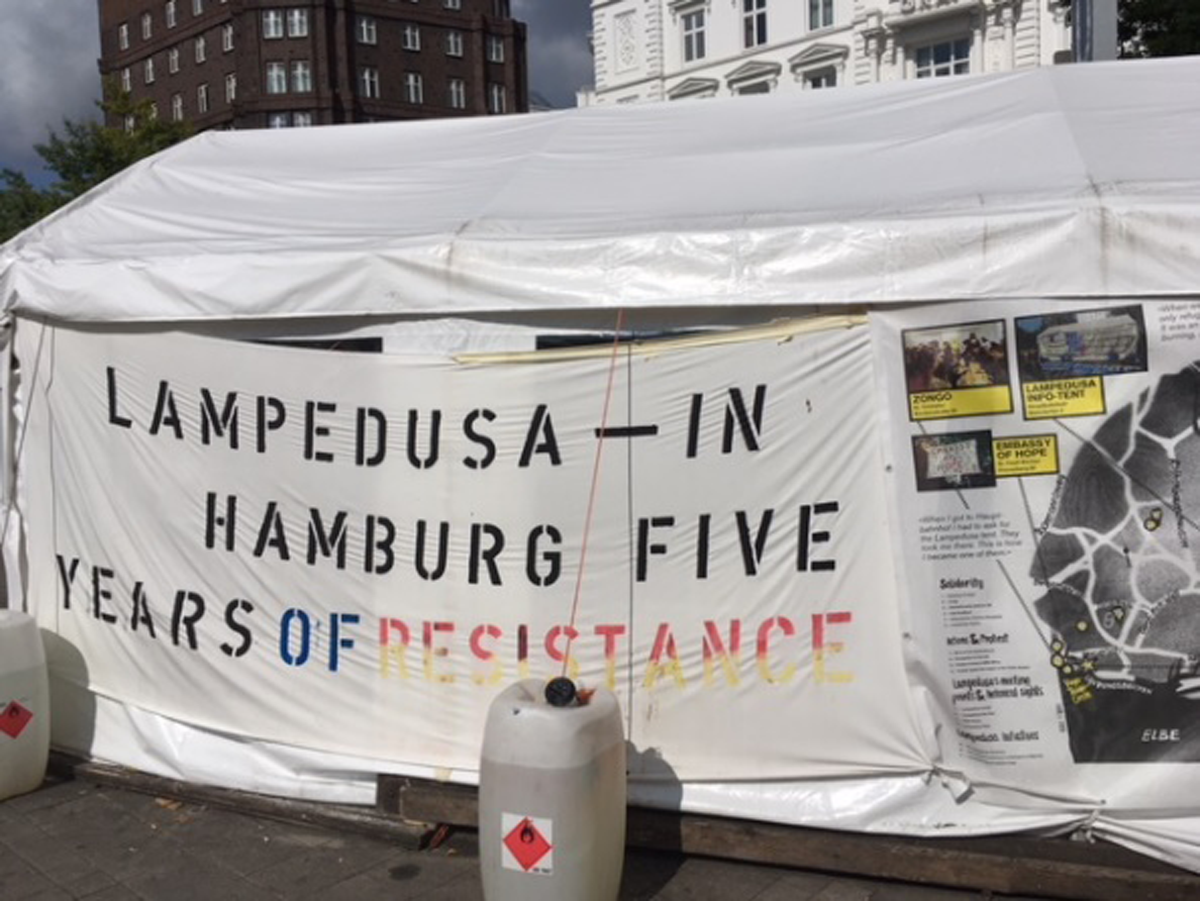
Figure 1
Photo: Wajsberg, October 2018.
The Lampedusa tent was the material expression of the ‘profound edge’—in constant dialogue with other actors, yet always positioned in a space neither inside nor outside. It functioned as a meeting and information point for recently arrived migrants and a social gathering place in Hamburg. It provided shelter for newly arrived migrants trying to find their bearings in the city. Moreover, it was a constant reminder to the public of LiHH’s ongoing struggle. Over the years, LiHH’s political message and the importance of the tent itself resonated far beyond the local urban environment.
In 2017, when I first engaged in research around the Lampedusa tent as a graduate student, I met Gabriel,2 a young man from Ghana who had just arrived in Hamburg from Russia, where he had been a student. When I asked why he chose to come to Hamburg, he explained that he had heard about the activist group and saw images of the tent online while still living in Ghana. Even before coming to Hamburg, Gabriel had a concrete idea of where to go upon his arrival. The tent’s role as an entry point to the city reverberated from Hamburg to other distant places.
The tent walls displayed political messages, highlighting LiHH’s displacement from Libya and their enduring fight for regularization in Hamburg (Figure 1). Over the years, the messaging on the tent walls also changed to include broader issues such as racism and racial police profiling, as well as the EU’s migration policies in the Mediterranean. The tent walls were a canvas through which LiHH communicated their message to those passing by.
The changing messages, moving from the more concrete case of LiHH’s claim to receive asylum according to §23 to more universal issues of migration governance and discrimination, also speak to the shifting situations of many LiHH activists. As the local authorities did not grant the demand for group asylum, some activists decided to apply for individual asylum, while others left Hamburg, were deported, or disengaged from activism because of personal circumstances.
Moreover, other geopolitical developments also affected LiHH’s position in the city. The high number of migrants arriving in Europe during the ‘long summer of migration’ (Kasparek & Speer 2015) in 2015 changed the dynamic in which Black African migrants were considered less ‘deserving’ than those fleeing from Syria (Fontanari 2022). At the same time, the public discourse on migration and asylum began to turn, and right-wing movements such as Pegida and the far-right political party Alternative für Deutschland (AfD) gained increasing support in Germany, further pushing the discourse and governance of migration to the right of the political spectrum. In this climate, LiHH’s liminal position became palpable as the group was pushed further toward the edge of welcome.
One LiHH activist reflected on these dynamics when he talked about the differential treatment that migrants from different geographical contexts received in Hamburg as a ‘refugee hierarchy’ (in Sparke & Mitchell 2018: 222), in which Black migrants were positioned at the bottom. He pointed out that the Lampedusa tent symbolized resistance against this stratification of deservingness. The tent was the edge from which resistance against the racialization and stratification in the asylum system could be publicly protested and support could be organized. It thus embodies a creative counter infrastructure for migrants at the sociopolitical edge.
Although the tent had become a semipermanent feature of the city, its existence was always precarious, and its ephemeral position became tangible on numerous occasions when it was removed or threatened with removal by local authorities. In 2016, for example, the tent was intended to be temporarily removed to make space for a construction site. In response, LiHH activists organized a protest under the motto ‘We are here to stay—and our protest tent must stay, too!’. In a pamphlet, LiHH argued that the physical presence of the tent was important as an information and meeting point but also stressed the importance of the tent as a manifestation of LiHH’s struggle for rights.
Until 2020, the group and its supporters always succeeded in rebuilding the tent. Sparke and Mitchell (2018: 221) argue that this constant rebuilding of the Lampedusa tent is ‘a kind of timeout from the dominant temporalities of “crisis”, “waiting” and “limbo” that are so often used to discipline and depict those seeking asylum.’ The intermittent disassembly of the tent solidified LiHH’s position of ‘permanent temporariness’ (Meuss et al. 2019: 2) and elucidates the condition of ‘displaceability’ (Yiftachel 2020), under which displacement and eviction are always possible.
This threat of displacement became a reality at the beginning of the Covid-19 pandemic when the tent was demolished by local authorities on the grounds of public health concerns (Zaheer 2020). In conversations with LiHH activists since the removal of the tent, I repeatedly encountered sentiments of frustration and exhaustion as people described that the lack of physical infrastructure had had adverse effects on the group’s ability to mobilize, as there is no common space that can be easily accessed by supporters. Moreover, the tent removal resulted in less public visibility of the movement, thereby making it increasingly difficult for LiHH activists to engage with and mobilize the local population.
The material infrastructure of the tent is thus entangled with the social infrastructure of the LiHH movement, and its absence impacted the movement in significant ways. Although LiHH as a movement has changed and transformed, the traces of the tent rematerialized in a different spot from March to September 2022, in the form of the Refugee Info Point.
4.3. (Dis)Continued Arrival Infrastructures: the Refugee Info Point (March to September 2022)
After having conducted fieldwork in Hamburg in 2020, shortly before the Covid-19, I returned to Hamburg in March 2022 to continue my research. My main aim for this trip was to investigate how the LiHH movement changed during the pandemic and how the absence of the Lampedusa tent had affected their activism. However, my arrival coincided with Russia’s full-scale invasion of Ukraine. By the time I arrived in Hamburg, hundreds of people fleeing from Ukraine were arriving in the city every day (Zinnecker 2022).
This development led to new arrival infrastructures in and around the central train station: The formal arrival space was in a converted office of the German national railway company Deutsche Bahn in the central station’s main hall. A second arrival infrastructure, the Refugee Info Point, was situated outside the central station.
NGO volunteers in brightly colored vests assisted arrivals from Ukraine, directing them to the converted Deutsche Bahn office where people could get information and be directed toward asylum centers and shelters. A busy marketplace had sprung up in the station’s main hall, with booths selling electronic accessories, phones, SIM cards, and chargers.
The second arrival infrastructure, the Refugee Info Point, was located outside the central station. It was set up by Omer,3 an activist from LiHH, and a network of supporters who obtained permission from the police to set up the pavilion days after the full-scale invasion. This makeshift arrival space differed from the formal arrival space in the station in its ad-hoc appearance. Moreover, it was designed to specifically address the needs of People of Color and Black people displaced from Ukraine but who were not Ukrainian citizens. Drawing on his own experiences as a migrant and political activist in Hamburg, Omer feared that African students4 from Ukraine would face difficulties accessing formal arrival infrastructures in the city owing to their temporary residence status in Ukraine, an under-prioritization of young, single people and particularly men, as well as racialized stratification in the asylum system. His worries were furthered by reports that African students fleeing Ukraine had been held back at the Ukrainian–Polish border in a display of racist border violence (Kortas 2022; Tondo 2022). Considering these adversities, the Refugee Info Point was designed to help racialized non-Ukrainian citizens in accessing shelter, care, and German bureaucratic processes. An additional goal of the infrastructure was to express solidarity with all displaced individuals through its presence and political messaging.
Omer estimated that, between March and September 2022, the Refugee Info Point was contacted by 340–350 people, most of them African students fleeing Ukraine. It was an entry point into the city for people without Ukrainian passports or permanent residence in Ukraine, whose legal statuses in Germany were uncertain. Many students I met at the Refugee Info Point could not access the asylum centers around Hamburg because they were already full. Through their network and reaching out to other diaspora organizations, Omer and the volunteers facilitated sleeping places for many of these students.
As the students’ temporary protection status was due to expire within a few months and their official residence situation thus uncertain, most of the students I spoke to expressed hope that they would be able to return to Ukraine soon to finish their studies and had little intention of staying in Germany. ‘I did not spend years learning Russian [the language of his study program] to become a refugee here’, a young man who was only a few semesters away from finishing his medical degree in Ukraine told me.
However, as the weeks went by, this possibility became less and less likely. They would have to come up with an alternative. To facilitate this, Omer set up a meeting with a lawyer to inform the students about their possibilities of applying for other types of visas to remain in Germany. Getting information about which legal-bureaucratic routes were available to them and their respective implications, for example, asylum versus a student visa, was essential for informed decision-making.
In August 2022, the risk of renewed displacement increased because the status that ensured non-Ukrainian citizens the right to temporarily remain in Germany expired. According to media reports, around 3000 non-Ukrainian nationals officially resided in Hamburg (Smudzinski 2022). To stay, people would have to navigate complex administrative hurdles, either by enrolling as students at universities, a task often complicated through various administrative hurdles such as providing a specific amount of money in their account; getting foreign school- and higher-education degrees certified in Germany; or applying for asylum.
Yet, this route is challenging, and the chances for individuals from countries declared as ‘safe third countries’ to receive asylum in Germany are low, despite displacement from Ukraine. In the meantime, German authorities began issuing so-called fictional certificates (in German, Fiktionsbescheinigungen), temporary residence permits valid for six months at a time, which are a legal-bureaucratic loophole but which perpetuate the condition of displaceability or ‘permanent temporariness’ (Meuss et al. 2019: 2), as the potential of displacement and deportation is only temporarily delayed (Bachmann & Lüdke 2022; Hamburg 2022). Issuing these ‘fictional certificates’ elucidates the role of state actors in creating protracted experiences of liminality for some groups of migrants in Germany, thus reifying the conditions of displaceability and deportability.
Visually, the Refugee Info Point was an ad-hoc and transient infrastructure: a white pavilion, weighed to the ground by e-scooters and a sound box. Images of similar temporary structures are often associated with crisis infrastructures and have become emblematic of the recent migration reception crisis in Europe, both as a site of care and one of abjection (Whyte, Campbell, & Overgaard 2020). Such infrastructures tend to be associated with state and humanitarian actors. In this case, while actors traditionally associated with helping migrants ‘arrive’ addressed the needs of Ukrainian citizens inside the train station, the Refugee Info Point focused on another group of displaced people, non-Ukrainian students. This challenges the image of humanitarian or state actors as the sole providers of services and shelter for migrants (Wajsberg & Schapendonk 2022).
The pavilion’s fleetingness was highlighted by its daily assembly and dismantling. Each night, Omer packed the pavilion into separate bags, carrying its components home. He repeated this process each morning when he constructed the pavilion anew. The arrival infrastructure was made, undone, and remade daily. On my last day in Hamburg, I visited the Refugee Info Point but could not see the pavilion in its usual place. I eventually saw Omer sitting on a bench nearby. Sitting beside him, I asked what had happened to the pavilion. ‘Too windy today,’ he said, pointing toward the cloudy sky. Omer had set up the pavilion in the morning but soon realized that the winds were too strong that day, and there was a risk that it might simply fly away. He mused that they would have to get a sturdier pavilion as he began to show me images of pavilion options on his phone. Taking down the pavilion was more than a routine; it was a pragmatic response to environmental challenges. Omer’s decision to buy a sturdier pavilion reflects the continuous adaptation to external forces. It highlights the necessity for adjustment and resilience in unpredictable elements.
The pavilion displayed banners with political slogans, such as ‘No More Weapons’, ‘No to NATO’, and ‘Black Refugees Matter’. The latter statement discursively connects the struggles of African migrants in Hamburg to the global activism of the Black Lives Matter movement. The intersectional forms of discrimination that Black migrants experience were also noted in the statements by LiHH activists mentioned in the previous section and is a common thread linking activism around the Lampedusa tent and Refugee Info Point. It further relates to broader public and academic discussions regarding the differential treatment of migrants by the European migration regime, which came into focus in the wake of displacement from Ukraine in 2022, prompting the European Council to activate the 2001 EU Temporary Protection Directive5 for the first time, granting temporary protection status to Ukrainian citizens (Carrera et al. 2022). In other cases, the EU had abstained from invoking this directive, even during the significant increase in arrivals in Europe in 2015 and 2016.
The significance of Howitt’s (2001) ‘zones of interactions’ as sites of friction and negotiation becomes tangible in Omer’s engagement with authorities to shape the arrival infrastructure and interactions with other urban actors around the train station. As the permit holder, Omer wanted to get an extension of the pavilion’s opening hours to better align with the train schedule. He expressed this during one of the daily police checks conducted at the pavilion. During these checks, Omer had to show his permit and verify his identity as the infrastructure’s permit holder. The police officer informed Omer that, to adjust the opening hours of the Refugee Info Point, he would have to apply for a new permit with the municipality. Once the police officers left, I asked Omer whether applying for a new license was difficult. He assured me that it would not be a problem for him. He had applied for many permits over the years and was comfortable navigating the various forms that must be filled out. Omer’s competence in navigating formal bureaucracy (Kleinman 2019: 196) was crucial to building and maintaining this new arrival infrastructure. This example illustrates Lepawsky and Mather’s (2011) argument that edges are not ready-made sites but rather evolve through social and material relations, such as interactions between Omer, the police, and the municipality.
However, interactions at the edge were not always smooth. During one instance, a Ukrainian passerby approached Omer, a German volunteer, and me while standing at the pavilion to express his deep offense at the pavilion’s anti-NATO banners, exposing a significant divergence in perspectives. He explained that he hoped for the involvement of NATO and provisions of weapons by international state actors to protect his family in Ukraine. As we stood together, he was joined by another Ukrainian woman. She agreed with the young man, calling the messaging offensive and anachronistic in the face of the war. Omer, in response, maintained his stance, emphasizing advocacy for migrant rights rather than wanting to take sides in geopolitical conflicts.
This incident highlighted tensions in how migrant advocacy and solidarity can be construed and enacted. Different historical and contemporary experiences complicated the understanding of advocacy proposed by Omer and LiHH activists. Since its beginnings, LiHH has regarded the NATO involvement in Libya in 2011 as responsible for their displacement from Libya. In 2013, LiHH declared, ‘We did not survive the NATO war in Libya to die in the streets of Hamburg’ (BBC 2013). The group’s anti-NATO stance was at odds with the specific demands of the young man as well as other Ukrainians in Hamburg and many German citizens who called for NATO involvement in the war.
A few months later, I asked Omer about this encounter. He explained that the topic continued to be heatedly discussed in conversation with passersby and online in the comment sections of the LiHH Facebook site, where some commentators demanded that the group position themselves in this conflict. Omer argued he did not view it as his or LiHH’s role to ‘take sides’ in the war but saw their role as being advocates for migrant rights, especially for African migrants, and to show solidarity with all people experiencing forced displacement, migrantization, and racialization. The interaction between Omer and the Ukrainian man and woman highlighted that, while the Refugee Info Point provided a critical support infrastructure for non-Ukrainian citizens fleeing the war, its political engagement and anti-NATO stance were not necessarily perceived as harmonious with Ukrainian political needs. The understanding of migrant solidarity and advocacy proposed by Omer and LiHH activists was complicated owing to different historical and contemporary experiences.
This instance also highlights the continuities between the Refugee Info Point and the Lampedusa tent, which are built on similar political underpinnings owing to the involvement of the same actors in both infrastructures but respond to different global events. The Refugee Info Point can thus be understood as a morphed continuation, albeit distinct in many ways from the Lampedusa tent, and elucidates how infrastructures are often built on sediments and layers of previous histories and materials, working ‘off all that precedes and follows it’ (Simone 2021: 1342). Yet, different encounters and external circumstances will create new motivations, and the political underpinnings that informed the LiHH movement—and which had been broadly accepted by other migrant activists’ groups and German left-wing supporters—resonated differently with some parts of society in the changed geopolitical reality of 2022.
5. Conclusion
In this paper, I have sought to expand upon scholarship relating to arrival infrastructures and urban citizenships by bringing in Hall’s concept of edge infrastructure in analyzing two spatially and politically similar, albeit temporally distinct, arrival infrastructures. Through the cases of the Lampedusa tent and the Refugee Info Point, I argued that these sites are a part of complex infrastructuring practices continuously adapting to changing discourses on and contexts for urban citizenship and migration. I elucidate how these sites, at the sociopolitical edges of Hamburg, make new demands and reorientate their roles when enmeshed with changing geopolitical and social landscapes.
My examples highlight that arrival infrastructures at the edge are a matter of arriving somewhere but that these spaces enable resistance to ongoing processes of precaritization that many people at the urban margins experience—viewed through the analytical lens of edges, the processual, relational, and transformative capacity of these infrastructures’ steps to the fore.
Infrastructures leave traces, even after they are disassembled. This is evident in the example of the Refugee Info Point, which is in many ways a continuation of LiHH’s activism for the rights of African migrants in the city but was located at a different site and addressed new realities in 2022. Looking at these (dis)continuities through the infrastructure lens highlights the changes in the discursive and political landscape that affect migration control and facilitation. Future research within this realm of arrival infrastructures would benefit from a focus on how the infrastructural aspects of migrant arrival intertwine with the histories of social movements at specific urban sites and how these connections evolve.
Finally, while these infrastructuring processes can potentially transform citizenship positions, they are not without friction. I showed how the arrival infrastructures of the edges, constructed by LiHH activists, exist within a landscape of stratified access to formal arrival and asylum structures. Introducing the concept of edges into the study of these transient arrival infrastructures elucidated some dynamics underpinning migrant arrivals in European cities. This deepens the understanding of the arrival infrastructures and provides insights into the surrounding society, its evolving discourses, and how citizenship at the edge unfolds in European urban spaces.
Notes
[1] In this paper, I use the term ‘migrant’ to include all people on the move regardless of their legal status, except when referring to a specific legal category, such as asylum seekers or refugees.
[4] In February 2022, approximately 76,500 international students, most from Africa, Asia, and the Middle East, resided in Ukraine (Bachmann & Lüdke 2022).
[5] The EU Temporary Directive provides displaced people from outside the EU with temporary protection within the EU. It was developed in response to the large-scale displacement of people during the Kosovo War but was not activated until 2022. The protection status is initially limited to one year but can be extended in different intervals thereafter (Carrera et al. 2022: 9).
Acknowledgements
I would like to thank the ‘Lived Cities’ research group at Roskilde University as well as Joris Schapendonk for their thoughtful feedback and encouragement on earlier versions of this article. I also extend my thanks to the anonymous reviewers for their constructive suggestions.
Funding Information
This paper is partly based on the author’s Research Talent Grant financed by Netherlands Organisation for Scientific Research (NWO). Grant number: 406.18.520.
Competing Interests
The author has no competing interests to declare.