
Introduction
We had the football ground there, but now it is torn apart, torn down. Actually, the sad thing is that the renovation we see now, it takes away all of our childhood. They take away all the memories. But that’s also their intention. They want to take it all away, so that there is nothing left of the old. That’s what they are doing. All of our memories and all of our things are being taken away. […] It’s not only that you move out; all of your memories are torn down. (Walking conversation with Vahid, March 2022)1
This quote by Vahid, a resident of Mjølnerparken for 33 years, illustrates the experience of being deprived of one’s past, present and future homeplace, not only through relocation but also through the physical transformation of a neighbourhood. Based on fieldwork in Mjølnerparken, a public housing neighbourhood designated as a ‘hard ghetto’ by the Danish state in 2018, this article highlights residents’ experiences of losing their homeplace in different ways due to interventions for social mix.
Despite the lack of evidence for positive outcomes, social mix has become an unquestioned goal in urban policy and planning across a wide range of countries (Lees, Butler & Bridge 2012). Policies for social mix build on the expectation that negative neighbourhood effects, caused by a concentration of poverty, will be reduced and replaced by positive neighbourhood effects through tenure diversification (Atkinson & Kintrea 2000). However, previous research has challenged the assumed causalities in policies for social mix and highlighted how housing mix does not necessarily lead to social mix and social opportunities (Musterd & Andersson 2005). Social interaction across class remains scarce, despite geographical proximity (Galster 2009), as the arriving white middle class tends to self-segregate (Davidson 2010; Lees 2008) and as relocated low-income households can feel socially displaced and isolated (Wood 2003).
Furthermore, previous research has emphasised negative outcomes. Social mix policies can be a pretext for gentrification and neoliberalisation of the housing sector, which can lead to the displacement of low-income groups (Lees 2008). Marcuse (1985) stresses how gentrification is not a cure for abandonment, but rather it breeds displacement of several kinds, such as exclusionary displacement, for example, displacement of future tenants through increased rent. On a similar note, others have underlined how renoviction (evictions following renovation and rent increase) leads to a reduction in the number of affordable housing options, which in turn leads to low-income filtering, that is, more segregation in other places (Polanska & Richard 2018).
Although the literature on social mix has focused on the effects of social mix policies on a neighbourhood scale, the consequences for individuals during the implementation phase are less explored. The displacement literature has investigated individuals’ perspectives, focusing mainly on physical out-migration. Thus, the perspectives of residents who try to stay put while neighbourhoods undergo redevelopment need further exploration. This article addresses this gap in the literature through the following research question: How are interventions for social mix experienced by residents in a neighbourhood targeted by the Danish ghetto legislation? Hence, the article focuses on experiences of interventions while they occur, thereby shifting the empirical focus from evaluating expected effects of social mix to exploring immediate (and unintended) consequences for residents during the implementation phase. While the literature on social mix and displacement is dominated by Anglo-American studies, this article addresses the need for more research on how the implementation of policies for social mix is experienced by residents in a Scandinavian context.
Mjølnerparken in Copenhagen, Denmark, provides an ideal case for this study because the neighbourhood has become a symbol of what constitutes a ‘ghetto’ in politics and in media representations (Stender & Mechlenborg 2022). Due to the Danish ghetto legislation, which aims to achieve social mix in public housing neighbourhoods, Mjølnerparken is currently undergoing renovation and partial sale. By highlighting residents’ experiences of the implementation, the article adds to the emerging literature on the consequences of the Danish ghetto legislation.
Over the past decades, Danish urban and integration policies have problematised the resident composition in multi-ethnic public housing neighbourhoods; they have depicted these neighbourhoods as deviant and as threats to Danish society, and they have presented social mix as the solution. However, previous research has emphasised how policies construct the problems they seek to address rather than describe an existing reality (Fabian & Lund Hansen 2020; Jensen & Söderberg 2022; Simonsen 2016). Ghetto-policies create an antagonistic and unadaptable ‘Other’ (Ibid.), turn places into governable objects, that is, ‘ghettos’ (Fallov & Birk 2022), and enable state-led territorial stigmatisation (Olsen & Larsen 2023). Through the discourse of social mix, housing and integration policies are conflated and extraordinary measurements are legitimised as physical changes are framed as a necessary means for social improvement (Bach 2019; Johansen & Jensen 2017).
Previous research that highlights the perspectives of residents has shown how internal and external perceptions of problematised neighbourhoods differ. Residents contest negative media representations and highlight how their neighbourhood is centrally located and a coherent part of Denmark (Stender & Mechlenborg 2022). Residents perceive architectonical interventions as a means to attract outsiders and to replace existing residents (Bach 2019; Stender & Mechlenborg 2022). Moreover, they see social interventions as dangerous and unpredictable (Johansen & Jensen 2017). Those residents affected by renovations experience a lack of direct communication and influence regarding renovation projects, and, paradoxically, renovation projects proclaiming to increase safety can be discerned as creating unsafety (Bech-Danielsen & Stender 2021). What is more, privatisation is seen to lead to displacement (Risager 2022).
Against this background, this article aims to highlight residents’ experiences of the implementation of policies for social mix. Building on ethnographic fieldwork, the analysis shows how residents live under a condition of evictability and are subjected to un-homing, even before relocation. The analysis emphasises how this un-homing is a discursive, material and psychological violence that can affect people on multiple scales. In addition, it demonstrates how un-homing is not equally distributed, as income, age and migration background affect experiences and scales of un-homing. The article thus illustrates how combining perspectives from critical migration studies and critical urban studies enables us to reveal the immediate, unintended and wide-reaching consequences of policies for social mix and ghetto legislation.
The structure of the article is as follows. First, a contextualisation for the analysis is provided, followed by the methodological approach and theoretical framework. Thereafter follows the analysis of the empirical material, which is divided into four subsections. Finally, the conclusion summarises the research findings and highlights the contribution of the research.
Contextualisation: Public Housing – from Idealised to Problematised
This section contextualises the analysis by introducing public housing in Denmark, the ghetto legislation and its consequences for Mjølnerparken.
In Denmark, public housing (almene boliger) consists of rental housing provided by non-profit housing associations governed by a resident democracy and managed by professional housing organisations. This sector houses nearly one fifth of the Danish population and is referred to as non-profit, public and social housing, as the municipality has the right to allocate 25% to people with urgent housing needs. Public housing has been a cornerstone of the Danish welfare state and was developed as a solution to the massive problems of unhealthy housing conditions and a housing shortage. The sector grew substantially between 1960 and 1980 and provided the general population with spacious housing, modern facilities and green areas free from traffic. However, as tax reductions favoured owned housing from the 1970s, a large portion of the middle class moved out; consequently, many of the vacant apartments were allocated to refugees, migrants and people with social problems during the 1980s and 1990s. Since the 1990s, urban and integration policies have been concerned with the resident composition in public housing areas. While focus was initially on social problems and society as a whole, ghetto-policies (launched in 2004, 2010 and 2018) have increasingly been racializing problems, targeting specific neighbourhoods and problematising ‘non-western immigrants’ (Jensen & Söderberg 2022). Claiming that non-Western immigrants had ‘lumped together in ghetto-areas without contact with the surrounding society,’ the ghetto-policy of 2018 demanded that housing organisations and municipalities transform the built environment and create a mixed resident composition (Regeringen 2018: 5). The policy resulted in a set of special laws being approved by a substantial majority of the Danish parliament, that is, Bill L38 and L7, commonly referred to as the ghetto package (ghettopakken) and the ghetto legislation (ghettoloven).
The emergence of ghetto-policies in Denmark reflects a turn towards restrictive migration policies, justified through a culturalist and workfare discourse that legitimises exclusionary mechanisms based on (presumed) cultural differences and (lack of) labour market integration (Jørgensen 2006). In a Scandinavian context, Denmark is known for its restrictive policies aimed at reducing immigration and restricting immigrants’ access to welfare and citizenship (Brochmann & Hagelund 2011), and promoting repatriation. Furthermore, ghetto-policies coincide with and contribute to the neoliberalisation of housing and urban policies, which have been commodifying public housing and private cooperatives (andelsboligforeninger) since the 2000s (Larsen & Lund Hansen 2015). The merging of migration, integration and urban policies through ghetto-policies has produced a spatialised discourse of securitisation, where the concentration of so-called non-western immigrants (a category established by Statistics Denmark in 1991) and also low-income households is constructed as a threat to security, to prosperity, to Danish values and to the welfare state. This spatialisation has led to a ‘politics of the exception’ that legitimises radical policy measurements (Olsen & Larsen 2023).
Since 2010, the Danish government annually publishes a so-called ghetto list2 based on numbers from Statistics Denmark. The ghetto list originally emerged from a policy aim to map disadvantaged neighbourhoods in need of renovation and intervention (Johansen & Jensen 2017). The categorisations and criteria have been revised several times3 since the ghetto terminology emerged in policies in 2004. With the ghetto legislation of 2018, public housing neighbourhoods of more than 1,000 residents are measured according to four criteria, which compare residents’ levels of employment, education, income and criminality with a regional average. A neighbourhood is designated as a ‘marginalized housing area’ (udsat boligområde) if it meets two of these four criteria. If it meets two of the criteria and more than 50% of the residents are ‘immigrants or descendants from non-western countries’, it is designated as a ‘ghetto’ (ghettoområde). Areas that have been on the ghetto list for five years are designated as ‘hard ghettos’ (hårdt ghettoområde). The consequences for the approximately 41,000 residents in the 15 housing areas designated as ‘hard ghettos’ in 2018 are severe, as the share of family units in these neighbourhoods must be reduced to 40% of the existing housing stock by the year 2030, either through demolition, sale, new-building or conversion of family units into senior or youth housing. The ghetto legislation enables forced relocation of residents on these grounds.
Mjølnerparken has been on the ghetto list since 2010 and was designated as a ‘hard ghetto’ in 2018. As a result, the housing organisation and the municipality had to present a re-development plan to the Ministry of Housing. At the annual housing department meeting in 2019, the resident-elected local board suggested a gradual conversion of family units (once families moved out), which a substantial majority of the residents voted for. However, the housing organisation went ahead with their plan of selling 60% of the apartments to a private investor. This reflects how housing organisations and municipalities have become main actors in the implementation of ghetto-policies since a 2008 governance reform and how the influence of the resident democracy has been reduced (Jensen 2021). Furthermore, due to a large rent gap formation in Mjølnerparken, the sales price – and potential profit – was much higher than in other ‘hard ghettos’ (Risager 2022). In December 2021, the housing organisation announced a sales agreement with the private investor NREP concerning 260 apartments, that is, two housing blocks. NREP later announced an approximate rent increase of 56% (Dahl 2022). Moreover, it stipulated that the apartments must be emptied prior to the finalisation of the sale. Parallel to the sales process, a massive renovation in accordance with the Master Plan (Helhedsplanen) began in 2021. This plan, developed by the housing organisation and approved by the residents in 2015, concerned extensive renovations and architectonical changes. The stated aims were to increase safety, to connect the neighbourhood to its surroundings, to improve the housing standard, and to achieve a more ‘mixed resident composition’ by attracting businesses and new residents. Although this plan included temporary rehousing, the sale of the 260 apartments implies that as the renovations gradually progress residents are permanently rehoused within the municipality. However, residents (including the resident-elected local board) have actively objected to the sale and the relocations and have fought against the discriminatory dimensions of the ghetto legislation through juridical, political and social tracks. This constitutes the context for the exploration of residents’ experiences of the implementation of policies for social mix in this article.
Methodological Approach
The methodological approach applied in this research is rooted in feminist methodology, which implies rejecting the idea(l) of ‘untainted data’ and disengagement, and instead seeks to acknowledge how knowledge is always situated (Haraway 1991). Inspired by Dahinden’s argumentation for a de-migranticisation (Dahinden 2016) of migration research, I define residents as my unit of analysis. De-migranticisation implies studying social processes concerning overall populations rather than migrant populations, while still – as a second step – being sensitive to how ethnicity or migration background matters to lived experiences in some contexts. The critique of methodological nationalism (Wimmer & Glick Schiller 2002) stresses that when migration research focuses on immigration as ‘the problem’ and uses the categorisation of migrants and citizens, inequalities between citizens, based on class, gender and ‘race’ are obscured, thereby creating the illusion of all citizens being equally included (Anderson 2019). Going beyond the migrant/citizen distinction enables one to see intersecting inequalities and reveal how mechanisms of exclusion exist within the imagined ‘integrated society’ (Ibid.; Hadj Abdou 2019; van Baar 2016).
The empirical material used in this article is generated through ethnographic fieldwork in Mjølnerparken, a public housing estate built in 1984–1987 and located within Nørrebro, a gentrifying neighbourhood in Copenhagen, known for its diversity and history of immigration (Schmidt 2016). Mjølnerparken consists of four red brick housing blocks, counting 560 apartments, with room for approximately 1,800 residents. Until spring 2022, each housing block had an open yard with a playground, trees and benches (see Figure 1), and the yards were connected by a pathway. Between the yards, there were basketball and football grounds and a common house, which residents could use for collective and private celebrations and meetings. During the last decades, the surrounding area has become more and more attractive for residents and visitors, with recreative spaces, shops, metro stations and bicycle paths, while Mjølnerparken has become rundown and exposed to negative media and political attention.
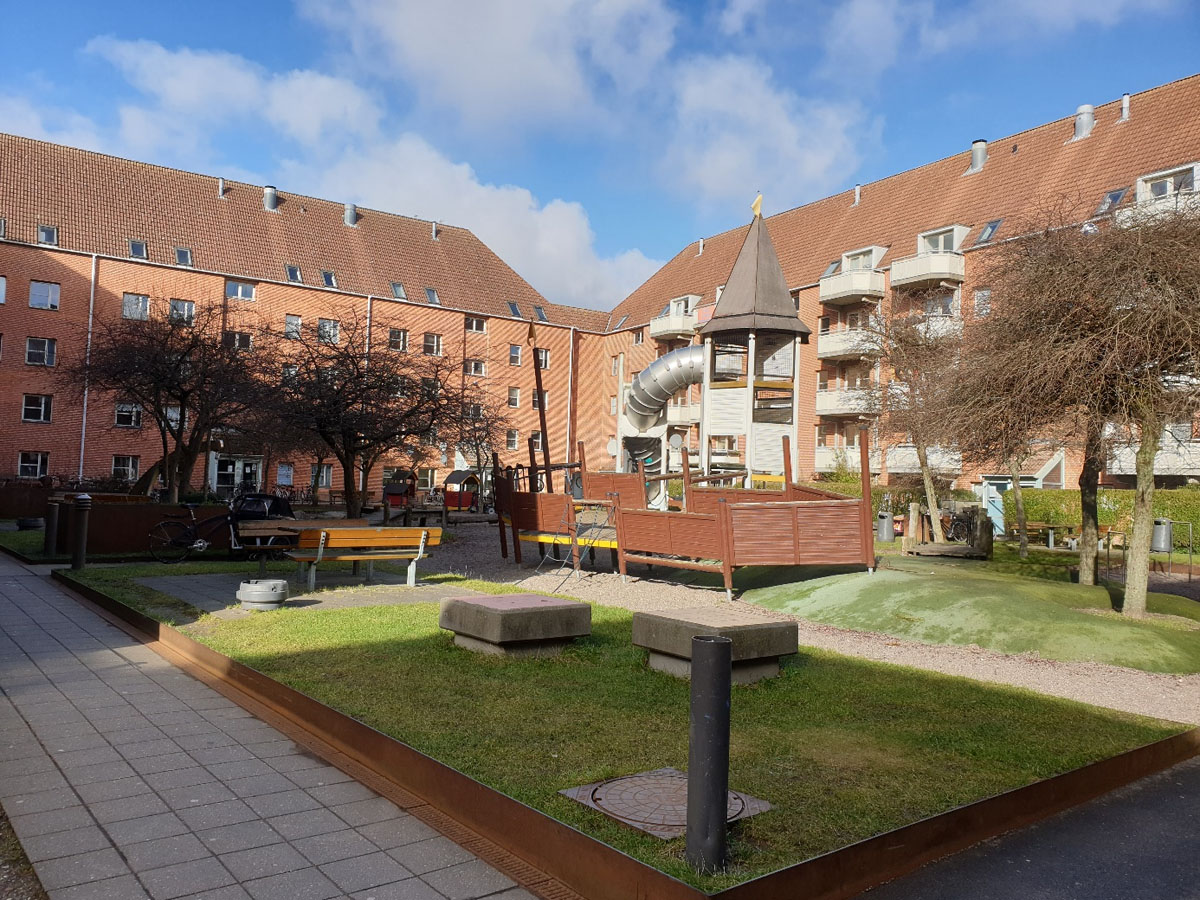
Figure 1
Photo of Mjølnerparken, taken by the author in February 2022.
The main part of the fieldwork was conducted from August 2021 to September 2022. It included participant observation at a wide range of meetings and events, semi-structured interviews with 17 residents, walking conversations, informal conversations and use of visual methods. Photos taken by research participants were used for photo elicitation and functioned as a springboard for a conversation about their experiences of their neighbourhood. In this article, the visual material illustrates the experiences described by research participants. The research participants differed in age, background, socio-economic status and length of residency in Mjølnerparken. Most research participants had lived there for over 9 years, and several were born there. During interviews, I asked open questions that would encourage research participants to describe their experiences. The following are sample questions: How would you describe the neighbourhood? What do you like about the neighbourhood? Do you wish that anything was different? I also asked questions related to the ghetto legislation, such as, how would you describe the plans for the neighbourhood? and how are you affected by these plans? Interviews were later transcribed and thematically coded using NVivo software. Building on broad empirical material, the chosen focus of this article is experiences of displacement, while themes of counternarratives and resistance are foregrounded in another article. The narratives produced during interviews must be understood within a specific social and societal context. As an ‘outsider’, my research agenda of social and spatial justice contributed to building trust, yet it simultaneously affected the content of the conversations. Furthermore, residents were well aware of the negative political and media-coverage their neighbourhood receives, and their underscoring of the positive aspects of their neighbourhood needs to be understood within this societal context.
Before initiating the research, an ethics approval from the Swedish Ethical Vetting Board was obtained.4 During the fieldwork, informed consent was obtained from all research participants before interviews were conducted. In those cases where children were participating, informed consent was obtained from both the children and their parents. Researching a neighbourhood exposed to media and political attention required continuous ethical considerations. Initially, I contacted a person on the resident-elected local board, who became a gatekeeper and key informant. Thereafter, I contacted residents at meetings and events of different kinds, and the snowball method was crucial for getting in contact with more residents. However, residents needed safe spaces without curious journalists and researchers, as many were afraid that voicing critical statements could have negative consequences for their housing situation. Fieldwork thus became a balancing act: sometimes attending events and showing engagement, and other times staying away to show respect.
The timing of my fieldwork impacted the sample of participants and the narratives produced. By 2021, the planned privatisation had been known to residents for over two years, and many residents with financial opportunities had already moved out. Residents with fewer options tend to be less positive to neighbourhood renewal (Bach 2019). Due to renovation, sale and rehousing, residents were in the midst of a turbulent time in their lives, which is reflected in their descriptions of their experiences. Descriptions might have materialised differently if interviews had been conducted retrospectively, once the process of mixing was finalized. The fieldwork was conducted during the first part of the implementation phase: during renovations, sales agreement and relocations on a voluntary basis. Thus, one limitation of the article is that it cannot reveal anything about how residents will experience the outcome of the interventions.
Theoretical Framework
In this article, I make use of theoretical concepts from the research fields of critical migration studies and critical urban studies. A theoretical framework of un-homing, evictability and multiscalarity enables me to contribute to the literature on social mix by highlighting the immediate and wide-reaching consequences of the ghetto legislation.
Critical urban scholars have emphasised how the neoliberalisation of the housing sector over the last decades has led to gentrification, social polarisation and a decrease in affordable housing for low-income groups (Baeten et al. 2017; Larsen & Lund Hansen 2015). While the displacement literature from the 1970s and 1980s focused on the out-migration of working-class residents due to gentrification, Davidson (2009), building on Heidegger and Lefebvre, stresses how the definition of displacement at that time tended to ‘reduce a socio-spatial phenomena to a purely spatial event’ (Ibid.: 223). Since then, research on displacement has broadened the concept to include not only the physical relocation of residents but also the experience of loss of one’s place while remaining in a neighbourhood undergoing physical and social transformation (Atkinson 2015; Baeten et al. 2017; Davidson 2009; Elliott-Cooper, Hubbard & Lees 2020; Marcuse 1985; Pull & Richard 2021; Westin 2021). This form of displacement was first defined as ‘displacement pressure’: the pressure of displacement occurs as a household sees its neighbourhood change dramatically, as friends move out, as stores are replaced for a new clientele, and as the area becomes ‘less and less livable’ (Marcuse 1985: 207). The notion of displacement pressure has later been further developed and conceptualised as ‘un-homing’ (Atkinson 2015) to better understand tenants’ attachments to place and their ‘feelings of injustice, anger, resentment and being supplanted even while remaining in place’ (Ibid.: 376). Un-homing has been described as a form of violence: as ‘a (n im)material rupture between self and home’ (Westin 2021: 240), which ‘violently severs the connection between people and place, undermining the right to dwell’ (Elliott-Cooper et al. 2020: 494). Un-homing is thus discursive, material and affective; it includes a psychological, unmeasurable dimension of displacement and thereby directs the attention of the researcher towards the lived experiences of residents, rather than towards quantitative measurements of in/out migration. The concept enables one to see residents’ experiences of systemic violence (Žižek 2009) and of symbolic violence (Atkinson 2015; Baeten et al. 2017). Un-homing offers an inclusive conceptualisation that enables the highlighting of several dimensions of socio-spatial injustices (Davidson 2009).
Though the displacement literature constitutes the foundation, this article uses the notion of un-homing because it includes both physical and psychological displacement (Elliott-Copper et al. 2020) and enables one to see the discursive, material and psychological dimensions. Furthermore, it relates to the notion of ‘homing’ (Boccagni & Kusenbach 2020), which emphasises the home as processual, relational and constantly enacted. With an understanding of the home as ‘both an emotion and a place imbued with meaning generated through the everyday life routines enacted in it’ (Ibid.: 597), the notion of un-homing enables an analysis of the violent rupture between the self and everyday routines. Un-homing is a suitable concept for exploring residents’ lived experiences of interventions for social mix during the implementation phase. However, the notion of evictability is crucial for understanding how the violence of un-homing is legitimised.
Perspectives from critical migration studies enable one to see how the violence of un-homing is connected to bordering practices. With the notion of evictability, van Baar (2016) bridges urban studies’ focus on neoliberalisation and eviction, and migration scholars focus on deportation. Evictability is defined as ‘the possibility of being removed from a sheltering place’ (Ibid.: 214). It builds on to and de-nationalises De Genova’s notion of deportability by showing how the EU’s border regime, including securitisation and racialisation, affects not only migrants crossing borders but also minorities within Europe. In combination with neoliberal logics, the securitisation and de-territorialisation of bordering practices illegalise migrants, while simultaneously transforming minoritized and low-income groups into ‘internal “dangers” to the state and its welfare systems’ (Ibid.: 213), thus legitimising special measurements towards those seen as a threat to security and prosperity.
In this article, the notion of evictability enables an analysis of how local urban regeneration is connected to (supra)national processes of securitisation, neoliberalisation and racialisation, legitimising violent measurements within the nation-state and the violence of un-homing. Evictability sheds light on the production of spatialised, racialised and long-term conditions for residents.
Furthermore, a multiscalar approach offers analytical entry points to study the processes of un-homing and evictabilisation, as well as to see both shared conditions and intersecting inequalities. Brenner and Schmid (2015) emphasize how global capitalism and neoliberalisation constitute the ‘context of context’ for urban redevelopment. Following Lefebvre, they view ‘the urban as a multiscalar process of socio-spatial transformation’ (Ibid. 165). Çağlar and Glick Schiller (2021) highlight how scales are not fixed territorial units, but entangled and co-constituting. For individuals, a changed perception of the domestic scale thus implies changes on other scales as well (Linder 2022). As home can refer to a room, house or neighbourhood as well as to a territory of identification (Boccagni & Kusenbach 2020), un-homing refers to a multiscalar process that can include the household, neighbourhood and city (Elliott-Cooper et al. 2020). The multiscalar approach enables me to show how the ghetto legislation has consequences beyond the neighbourhood: how different scales of home are dissolved in everyday life and how the violence of un-homing affects people on multiple scales and is unequally distributed.
Analysing Multiscalar Un-homing
In this analysis, I make use of a scalar taxonomy for analytical purpose, yet stress how different scales are dissolved in everyday life. The analysis first explores the condition of evictability and is thereafter structured according to different scales of un-homing: the neighbourhood, the city and the nation-state. As the aim is to highlight the multiscalar effects of the interventions, the analysis focuses on these scales and only touches briefly upon the obvious scale of un-homing: losing one’s dwelling.
‘Being other peoples’ game-pieces’ – Lived experiences of evictability
During the fieldwork, residents continuously talked about the threat of being evicted (smidt ud). While the public housing organisation encouraged residents to ‘voluntarily vacate’ their apartments, many residents felt under pressure and talked about forced relocation. As one resident stated, ‘it is not very voluntary when you don’t have any other opportunities’ (Interview with Asmaa, February 2022). Residents emphasized feelings of anxiety, uncertainty, unsafety, anger, sadness and fear related to the ghetto legislation and forced relocation. Several residents spoke about being treated as game pieces (ludobrikker) in a political game, being moved around by politicians as it pleased them.
Their experiences can be conceptualised as living under a condition of evictability. van Baar (2016) stresses how evictability is produced through bordering practices, intertwined with securitisation, racialisation and neoliberalisation. This normalises and legitimises violent measurements towards those whose mere presence is seen as a security risk – regardless of being outside the EU borders or inside the nation. Hence, neighbourhoods that are considered dangers to the state project are treated as border zones and sites where mobility is monitored and policed (Ibid.). Residents’ experiences reflect how internalised bordering practices include securitisation of neighbourhoods and relocation of residents as means of biopolitical governance and mobility control. Some residents compared the threat of forced relocation to their experiences of fleeing from war, of being deprived of their home against their will. Other residents explained how they felt discriminated against as they felt they were being deprived of their rights because of their address and/or their background. A 24-year-old man who had lived in Mjølnerparken his whole life, noted, ‘They take my home away from me. Just because they say me and my mother and my sister are from another country, a country that they don’t like’ (Interview with Ahmed, August 2022). As the ghetto legislation explicitly targets racialized and low-income groups and depicts them as a threat to Danish society, they, like the Roma minority (Ibid.), are constructed as undeserving, evictable and ‘ungrievable’ (Butler 2009). Evictability is thus more severe than the threat of eviction because it targets certain groups and legitimises differential treatment. However, the political construction of ‘the ghetto’ as a deviant, dystopian and dangerous place inhabited by secluded social, ethnic and religious groups threatening Danish society (Schmidt 2022; Stender 2018) simultaneously produces a spatialised condition of evictability, affecting all residents in Mjølnerparken. The focus of ghetto-policies on danger – meaning criminality and immigrants’ values (Schmidt 2022) – legitimises the construction of a different set of rules that apply to residents in ‘ghettos’ and drastic measurements for social mix, such as demolition, evictions and privatisation of public housing (Olsen & Larsen 2023). Furthermore, the territorial stigmatization contributes to the rent gap formation and the possibility of profitable privatisation (Risager 2022). As a resident declared:
All of it is wrapped in this rhetoric about safety. I mean [they say] ‘we need to transform the basements because it should be safe to be there, we need a new Mjølnerparken because it should be safe’. […] It is like that word safety can sell anything. If you just say that something is unsafe and should be made safe, then you can sell anything. (Interview with Emma, October 2021)
Ironically, residents revealed how the ghetto legislation and its implementation by their own housing organisation – not criminality – created a huge amount of unsafety. Concerns about criminality are thus primarily imposed from an external perspective (Bech-Danielsen & Stender 2021), and risks concealing the objective violence that residents are exposed to (Žižek 2009), that is, the discursive, material and psychological violence of un-homing. Residents described being treated as an experiment, and how everyone seemed to be indifferent to the violations of their rights. A 74-year-old resident remarked, ‘Some in the parliament try to surpass each other in restrictive policies, and I think it’s despairing. It’s like they have their mind set that Mjølnerparken is the worst place that exists’ (Interview with Ivan, November 2021). The production of evictability, tied to certain groups and places, thus produces an (un)safety paradox and enables and legitimises the violence of un-homing, depriving residents of their home-place. The following section highlights the material and psychological dimensions of un-homing on the neighbourhood scale.
‘A feeling of dissolvement’ – The neighbourhood scale
Many of the residents did not describe the home as in the neighbourhood but rather as being the neighbourhood. Without denying the existence of problems in the neighbourhood, they described how they feel at home as soon as they park their car, as soon as they arrive at the nearby metro station, or, as Vahid related, ‘As soon as I enter Mjølnerparken, I feel at home.’ Furthermore, the neighbourhood was described both as a family, where people know and respect each other, and as a place that contains family or family-like relations that are not delimited to the apartment. A 14-year-old girl from one of the yards that will be sold showed me a photo she had taken (see Figure 2) and indicated that the educational staff at the nearby playground were the most attentive grown-ups in her life. She described the playground in the following way:
We’ve always been there, every day, since we were small kids, and have a lot of good memories there. […] We won’t always live here. And I wanted a picture, so I won’t forget what it looks like. […] I mean, Mimersparken, it has just been our home for the most of our lives. […] The only things we don’t do there is to sleep, go to school and do our homework. Sometimes we also do our homework there. Because it is really nice to be there; there are a lot of people and very cosy. We always laugh, the atmosphere is really nice, to just be there. (Interview with Tahira, September 2022)
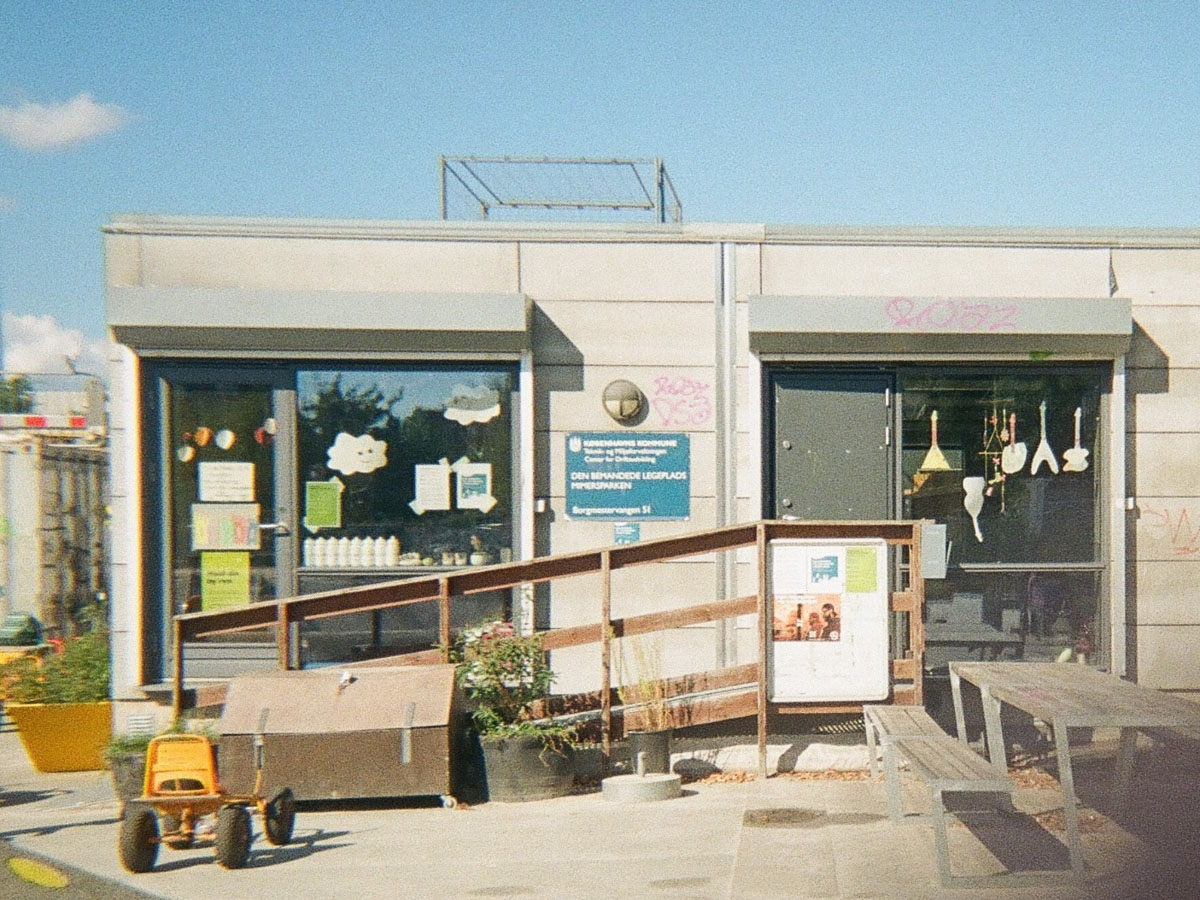
Figure 2
Photo taken by Tahira in September 2022 of the nearby playground.5
Residents’ experiences of their homeplace thus dissolve the scalar distinctions between home and neighbourhood. Hence, leaving the neighbourhood would mean losing homeplaces and family-like relations that go beyond their apartment walls. This was also the case for a group of elderly residents who live in a senior citizen communal living (seniorbofællesskab) in Mjølnerparken. The communal living consists of 18 small two-room apartments and a shared space with kitchens, a large dining table, washing facilities, and a garden where they meet for Sunday coffee and common meals. Despite having their disagreements, the daily (or weekly) interaction with housemates seemed to provide them with strength in uncertain times: ‘If there comes a letter […] we meet and talk about it, and then it is shared, right?’ (Interview with Nikolai, November 2021). Residents from the communal living have actively objected to the sale of Mjølnerparken; they have attended demonstrations, collected signatures for petitions, talked to journalists and written pieces in the media. The sale threatens the communal living’s very existence, as the housing organisation is not obliged to treat it as a collective in the rehousing process. Assisted by lawyers, residents of Mjølnerparken have insisted on the right to be rehoused within the neighbourhood – a legal right for residents in neighbourhoods affected by re-development plans. However, referring to the Master Plan, the housing organisation claims they can rehouse residents anywhere within the municipality. Regardless of this heated debate, there is no place to rehouse the communal living collectively within the neighbourhood, and its residents risk being scattered across the city. Hence, the sale threatens to deprive elderly residents of their home on multiple scales: the apartment, the communal living and the neighbourhood. The violence of un-homing through material rupture between people and place thus threatens to deprive both young and elderly residents of homeplaces and family-like relations that go beyond the apartment.
Furthermore, a person can experience a loss of place even before the moment of out-migration (Atkinson 2015). In addition to the harm done through material rupture, focusing on the psychological dimensions of un-homing enables one to see how the physical and social transformation of the neighbourhood disrupts everyday routines – through which a place is generated as homeplace – and deprives people of their sense of home and belonging. Pull and Richard (2021) have shown how residents who remain in neighbourhoods undergoing renovations are exposed to domicide, that is, the deliberate destruction of home through dispossession.
As Mjølnerparken undergoes physical transformation, everyday routes and routines are disrupted. During the first half of 2022, the walking path that connected the four yards was closed off, and all recreational areas between the buildings were transformed into construction sites. As Figure 3 illustrates, The playgrounds were demolished, along with all the private gardens, public benches and the common house. Fences erected around building sites and deep holes in the yards restricted the everyday movements of residents. Ivan, a 74-year-old resident, described how this created a feeling of being trapped and ‘a feeling of dissolvement.’ Many residents experienced the intrusive renovation as harassment: ‘we voted for new kitchens, and now we have construction sites everywhere at once.’ They stressed how the initial plan to renovate one yard at a time had been changed without their consultation, and how they experienced the noise of renovations, the dirt, the increased danger for children, and sometimes even difficulties getting home. As an elderly woman expressed when struggling to find an accessible way to her front door with her walker, ‘It is pure harassment!’ Residents claimed that their neighbourhood was being transformed into a non-liveable space while they still lived there. A 13-year-old girl recalled how she used to play in the yards ‘before they destroyed them’. She showed me a photo she had taken of where her favourite bench used to be (see Figure 4), and declared, ‘I am not in Mjølnerparken that much anymore […] because they have removed almost all the benches […] and it is very difficult to get around, so you just want to go away. That’s easiest’ (Interview with Malika, July 2022).
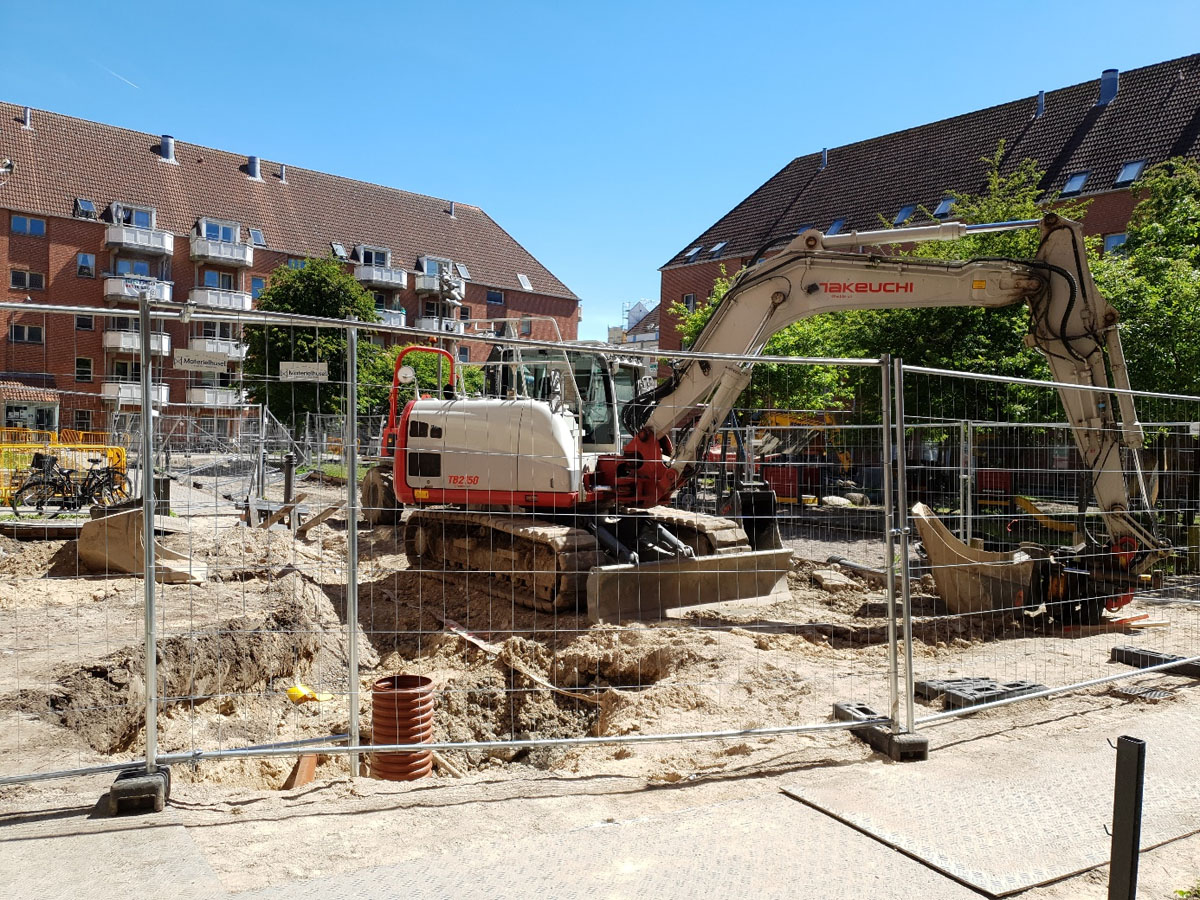
Figure 3
Photo of Mjølnerparken, taken by the author in June 2022.
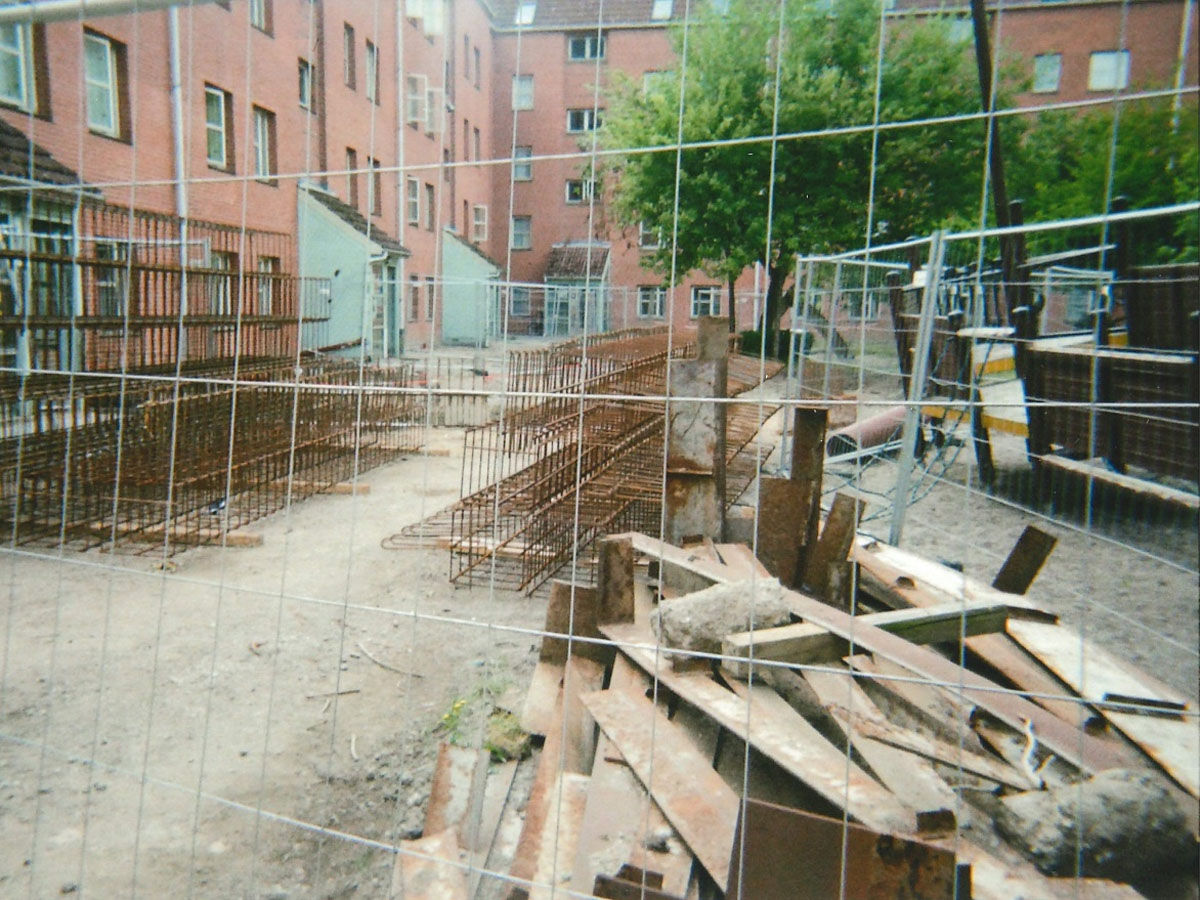
Figure 4
Photo taken by Malika in July 2022 of where her favourite bench used to be.6
Negative perceptions of the renovations should be understood in relation to residents’ awareness of the sale, implying that the majority of current residents will not be allowed to stay in the neighbourhood and experience the final results.
The use of harassment as a strategy by landlords, leading to the pressure of displacement, has been documented in other contexts as well (see Baeten et al. 2017; Marcuse 1985; Polanska & Richard 2018), and landlords’ strategies have been described as symbolic violence, leading to residents ‘choosing’ to act in the interests of the landlord (Ibid.). However, in Mjølnerparken, both the way in which the renovations are conducted and the neglect of maintenance – which residents had experienced several years before the renovation plan was even approved – are experienced as harassment and lead to un-homing. Residents related how the lack of maintenance of playgrounds, washing machines, front doors and staircases, combined with a lack of cleaning, was tiring, embarrassing, and served to increase prejudices about them and their neighbourhood as a ‘ghetto’. Some perceived this as a deliberate strategy on the part of the housing organisation: ‘But it is this thing that if they don’t do the cleaning, then people might move out faster’ (Interview with Helen, November 2021). Materiality is thus crucial to the psychological dimension of un-homing as the neglect of maintenance and the intrusiveness of the renovations disturb residents’ everyday routes and routines: processes of homing through which a place continuously becomes a homeplace.
Residents also expressed concerns about the social transformation of the neighbourhood: that the sale of the two middle yards and the rent increase in these blocks would create inequality among residents and that the social community would be lost. A woman who has a son with special needs and whose parents-in-law will have to move conveyed:
It severely affects both my family in-law and us, who are very dependent on them, because they help us very much with our son, so that he can develop and have a break. So, it will be hard on all of us, that they all of a sudden have to leave this place. And we don’t know if it is, I mean, how far away it will be, right. (Interview with Asmaa, February 2022)
Hence, social relations that are crucial for a functioning everyday life are affected by the interventions intended for increased social mixing. Highlighting the material and psychological dimensions of un-homing thus enables one to see how political interventions affect both those who have to leave the neighbourhood and those who are able to stay. The physical and social qualities of the neighbourhood – those aspects that make a place feel home – are destroyed through physical and social transformation.
However, many residents refused to have their everyday life disrupted. They held on to daily life routines such as having Sunday coffee in the garden and arranging the yearly graduation party in Mjølnerparken, despite the demolition of the common-house and extensive construction work. Some moved fences in order to maintain everyday routes, while others complained about what they perceived as non-liveable conditions. The homeplace is an important site of resistance (hooks 1990), and these mundane, everyday practices of homing can be understood as acts of resistance against the violence of un-homing.
‘I actually can’t afford to move’ – The city scale
However, for many residents, neither evictability nor un-homing is spatially delimited to the neighbourhood. Several residents expressed concerns about ending up far away and/or in a too expensive apartment through the rehousing. As a woman on sick-leave disclosed, ‘I actually can’t afford to move somewhere else. […] So, it’s that fear, that they will give me an apartment which is more expensive than what I get, that creates a huge fear’ (Interview with Farida, October 2021). A retired man stated:
I mean, there has been built a lot in Copenhagen, an enormous amount, but it is not any of it that we would afford to live in, right. I mean, in Nordhavnen and Sydhavnen and other places, we don’t have any possibility to pay the rents. But it is a reality that there is a gentrification, that is, ‘Out with the poor. You can move to Lolland-Falster,7 we don’t care, you just have to disappear from here’, right? (Interview with Lennart, March 2022)
For those who could not afford an apartment elsewhere in Copenhagen, relocation threatens to take away not only their apartment and neighbourhood but also to deprive them of their hometown. Deregulation, market-orientation and commodification of Danish public housing and private cooperatives have decreased the affordable housing stock dramatically (Larsen & Lund Hansen 2015). And over the last three decades, the share of working-class residents in Copenhagen municipality has decreased from 56% to 21% (Olsen et al. 2021). To some degree, this development mirrors a general decline of the Danish working class (to 33% of the Danish population), yet to a larger extent, it reveals a tendency towards exclusionary displacement (Marcuse 1985). As the sale of Mjølnerparken further reduces the affordable housing stock and relocates residents, this intervention for social mix risks having the opposite effect on a city-wide scale, thus leading to un-homing and exclusionary displacement of low-income groups.
Furthermore, as relocated residents can expect a higher rent in their new place of residence, the material and psychological dimensions of un-homing do not necessarily terminate with relocation, but can continue to haunt them in the future. For racialized and low-income groups, evictability risks becoming a permanent condition as the ghetto legislation deems their background/socio-economic status as a problem and restricts their access to public housing.
‘This is my home’ – The national scale
In addition to material and psychological dimensions, un-homing has a discursive dimension. Westin (2021) highlights that when people are told they do not deserve to live in their homes, they are displaced and alienated from their homeplace. A woman with a refugee background, having had previous experiences of un-homing on a global scale, explained:
It [the ghetto legislation] says a lot about how as an immigrant, you’re not welcome anymore. I mean, it’s in there with capitalised letters […] I shouldn’t have to constantly be reminded about where I come from and that I don’t belong here. Who decides that? Why should some guy decide what I feel? (Interview with Farida, October 2021)
Another woman, who was born in Denmark by parents from the Middle East, described her frustration over the ghetto legislation and the political rhetoric accompanied by comments on social media, full of prejudices like ‘Then this will be a lesson for them, they can just integrate, or they can just go back to their home-countries.’ She declared:
Yes, but this is my home! I am more Danish than I am Arabic. […] This have somehow become my home, even if there are some people who think it is not my home. And then I am like, well, then I’m just, then I’m just homeless. Then I don’t know what I am. (Interview with Asmaa, February 2022)
Un-homing has been defined as ‘a form of violence that removes the sense of belonging to a particular community or home-space’ (Elliot-Cooper et al. 2020: 503). Discursive dimensions of un-homing primarily affect residents with a migration background. The rhetoric of the politicians and the ghetto legislation function as bordering practices, increasing feelings of not being welcome, not being accepted as belonging and as not contributing to their neighbourhood or to society. This affected residents differently. For example, Asmaa disclosed, ‘you can’t avoid being angry at almost the whole society in the end,’ yet she channelled her anger into the struggle for creating a more nuanced image of Mjølnerparken. A young man told me how he now feels more suspicious of people from the surrounding society, as they might have a lot of prejudices about him because of his address and because of the political designation of the area as a ‘ghetto’. Territorial stigmatisation (Wacquant 2007) is thus interlinked to the discursive violence of un-homing on the societal scale.
In this way, being racialised as non-western by the state can lead to an experience of multiscalar un-homing as it is not only the feeling of home in the apartment and in the neighbourhood that is ruptured, but also the sense of belonging in Danish society. For residents with a migration background, evictability is an existential threat beyond the spatial scales of the neighbourhood and the city. Paradoxically, social mix policies that claim to aim for ‘integration’ can thus contribute to ‘ambivalent belonging’ (Antonsich 2010) and processes of othering, isolation (Fabian & Lund Hansen 2020), and multiscalar un-homing.
Conclusion
This article has explored what residents’ experiences can tell us about the implementation of policies for social mix in a Scandinavian context. Building on concepts from both critical migration studies and critical urban studies, the analysis shows how residents are subjected to evictability and violent un-homing already before actual relocation. The article adds a perspective from migration studies to the literature on social mix and displacement by using the notion of evictability to explain how un-homing is legitimised and targets migrants and low-income groups. The analysis also contributes to the de-migranticisation of migration research by highlighting how policies that primarily target migrants and minorities also affect non-migrants. The article contributes to the development of the notions of evictability and un-homing by emphasising how evictability can be spatially delimited, but also a permanent and existential condition (for racialized residents). Furthermore, the text underscores the multiscalar dimensions of un-homing – how un-homing on the neighbourhood scale affects other scales. The analysis shows how age, income and migration background affect experiences and scales of un-homing.
The empirical findings of this article are in line with previous Scandinavian research, which highlights how interventions aimed at improving safety can create unsafety, a lack of democratic influence and displacement for current residents (Bach 2019; Bech-Danielsen & Stender 2021; Risager 2022; Stender & Mechlenborg 2022). However, the findings of this article add to the literature by emphasising multiscalar effects: how interventions for social mix risk generating the opposite effect on a city-scale, and how policies, that declare to have integration as their aim, risk depriving people with a migration background of their sense of national belonging. Though previous research has stressed how ghetto-policies frame ‘the problem’ at the scale of the neighbourhood (Olsen & Larsen 2023; Jensen & Söderberg 2022) and has evaluated the effects of area-based policies for social mix, this article adds to the literature by emphasising how the consequences of the ghetto legislation reach beyond the neighbourhood scale. The empirical findings thus add to the literature on social mix by showing how policies targeting neighbourhoods can have wide-reaching negative consequences for individuals and groups, depriving residents of their home on multiple scales already in the implementation phase. The findings suggest that planners and policymakers need to take into consideration the potential multiscalar effects and the immediate harm done to current residents, and not focus solely on the potential long-term effects on a neighbourhood scale. Hence, this article contributes to the existing critique of social mix policies and highlights the need for taking into consideration the perspectives of those affected by policies.
Notes
[1] To protect research participants’ anonymity, pseudonyms are used and personal details are blurred. The author has translated Danish quotes into English.
[3] Since 2018, the share of non-western immigrants is the determinising criterion for designating an area as a ‘ghetto’. In 2021, the Danish Government added a categorisation to the list: ‘preventive areas’ (forebyggelsesområder). Furthermore, without any change of content, ‘ghettos’ were relabelled as ‘parallel societies’ (parallelsamfund), and ‘hard ghettos’ became ‘transformation areas’ (omdannelsesområder). In this article, I use the names of the categorisations used between 2018 and 2021, as these were the ones that my research participants explicitly used and made references to.
Acknowledgements
I am grateful to the research participants for sharing their experiences. Thank you to Jonas Strandholdt Bach for acting as discussant and providing valuable feedback at the MIM Migration seminar in Malmö, Sweden in 2022.
Funding Information
The research is part of the SEGMIX project and funded by Formas (The Swedish Research Council for Sustainable Development) within the National Research Programme for Sustainable Spatial Planning [grant number: 2018-00067].
Competing Interests
The author has no competing interests to declare.