
Introduction
Despite their location a mere 150 km from the capital of Copenhagen, HR personnel experience it as next-to-impossible to attract highly specialized Danes to fill vacant positions on the two southern islands of Lolland and Falster. They blame the Danes’ reluctance to move there on the islands’ location in Denmark’s peripheral geography, nicknamed the ‘rotten banana’1 and on the media-driven image of social and economic backwardness. Here, it is important to note that the designation of center and periphery may differ significantly from country to country. As Jeppe Høst points out, ‘what is understood as the extreme geographical outskirts in Denmark (“Udkantsdanmark”) would hardly qualify as semi-peripheral in Finland’ (Høst 2016: 124).
In a bid to secure the needed medical doctors and engineering professionals, companies and health care authorities have turned to international recruiting. ‘It is very interesting that a lot of the prejudices that Danes harbor … for example about transportation and distance, foreign labor do not have those […] because their perception of location is different.’ This is how Lisa2 who has many years of experience in recruiting for jobs on Lolland and Falster explains to me why local businesses engage in ‘cracking the difficult nut’ of attracting and retaining internationals for their vacant specialist positions. Her recruitment experience indicates that internationals have a different mindset regarding the location: ‘Well, many of the internationals do not think that Copenhagen is far away when they live on Lolland–Falster. They have a different perception of distance and geography.’ The recruiters and other local stakeholders from the municipality workers to the business association representatives expressed similar ideas about foreigners’ apparently different attitude to the relative peripheral location of Lolland–Falster in the Danish geographical context. However, this notion was challenged during the interviews I conducted with highly specialized international work migrants. The interviews were part of an ethnographic study conducted in 2020. It focused dually on the local employer perspective concerning recruitment and retention strategies and on the international employees’ migration motivations and settlement experiences. My study is one of five projects in the anthropological research collective ‘Remote Relocations,’ which examines how the everyday inclusion of newcomers in Danish rural areas is shaped by precarities of work and place.
In this article, I explore the process of coming to know and making sense of Lolland–Falster as a particular place. Based on the experiences of the international newcomers, I investigate how they gather knowledge to form a (more) nuanced understanding of the area through everyday practices. The analysis shows that their work and workplace are central arenas for the formative knowledge process during which the internationals gradually become aware of the ‘peripheral conditions’ of the islands. What I term peripheral conditions here cover the range of economic and demographic challenges facing areas of Denmark that are in Danish referred to as ‘Udkantsdanmark’ which translates to ‘Peripheral Denmark’ or ‘Marginal Denmark’ (Sørensen 2016a; Winther & Svendsen 2012). I use the term Peripheral Denmark in this article. The term relates not only to geographical locations on the fringes of Denmark but also invokes negative subtexts about spirals of decline. As such, it resembles what Loïc Wacquant calls ‘territorial stigmatization’ (Wacquant 2007). This includes narratives of decreasing population numbers, social and economic deprivation, shop closure, ruined houses, and increased distances to welfare institutions such as schools and hospitals (see also Gulløv & Gulløv 2020b; Høst 2016; Høst & Larsen 2016; Larsen 2022a; Larsen 2022b; Ledstrup 2021; Sørensen 2016a; Winther & Svendsen 2012).
For the international migrants, the islands’ geographical location in Denmark and the 1.5–2-hour distance to the capital of Copenhagen did not matter much when they decided to move to Lolland–Falster for work, and in many cases, brought their partners and children along. Indeed, the distance in geographical terms continues to be a matter of lesser importance to them. Instead, it is the peripheral conditions, everyday experiences of area deprivation, that are shaped by the territorial stigmatization and ‘the sticky reality of spatial taint’ (Wacquant 2009) that, over time, emerge as concerning for the internationals. Across the ethnographic material, we will see that over time, the peripheral conditions become a source of increasing apprehension, both as an everyday practical reality and as a potential obstacle for future opportunities.
The following sections situate the geographical context and the methodological and theoretical frame of the study. Then, I draw on ethnographic case material to discuss the role of work and the workplace in the internationals’ process of coming to know Lolland–Falster.
The Islands—Lovestorm from the ‘Rotten Banana’
Located in the southernmost part of Denmark, the islands of Lolland (1,242 km2) and Falster (514 km2) comprise two municipalities. The joint name Lolland–Falster is often used as a collective designation of the area in the media and in colloquial conversation, as well as in the formal naming of local associations, for example, Business Lolland–Falster. According to Statistics Denmark, approximately 100,000 people currently live on the islands (Figure 1).3 Just under 9% of the inhabitants are not of Danish origin.4 In comparison, immigrants and descendants make up about 14% of the total population in Denmark and about 21% in the Greater Copenhagen area.5
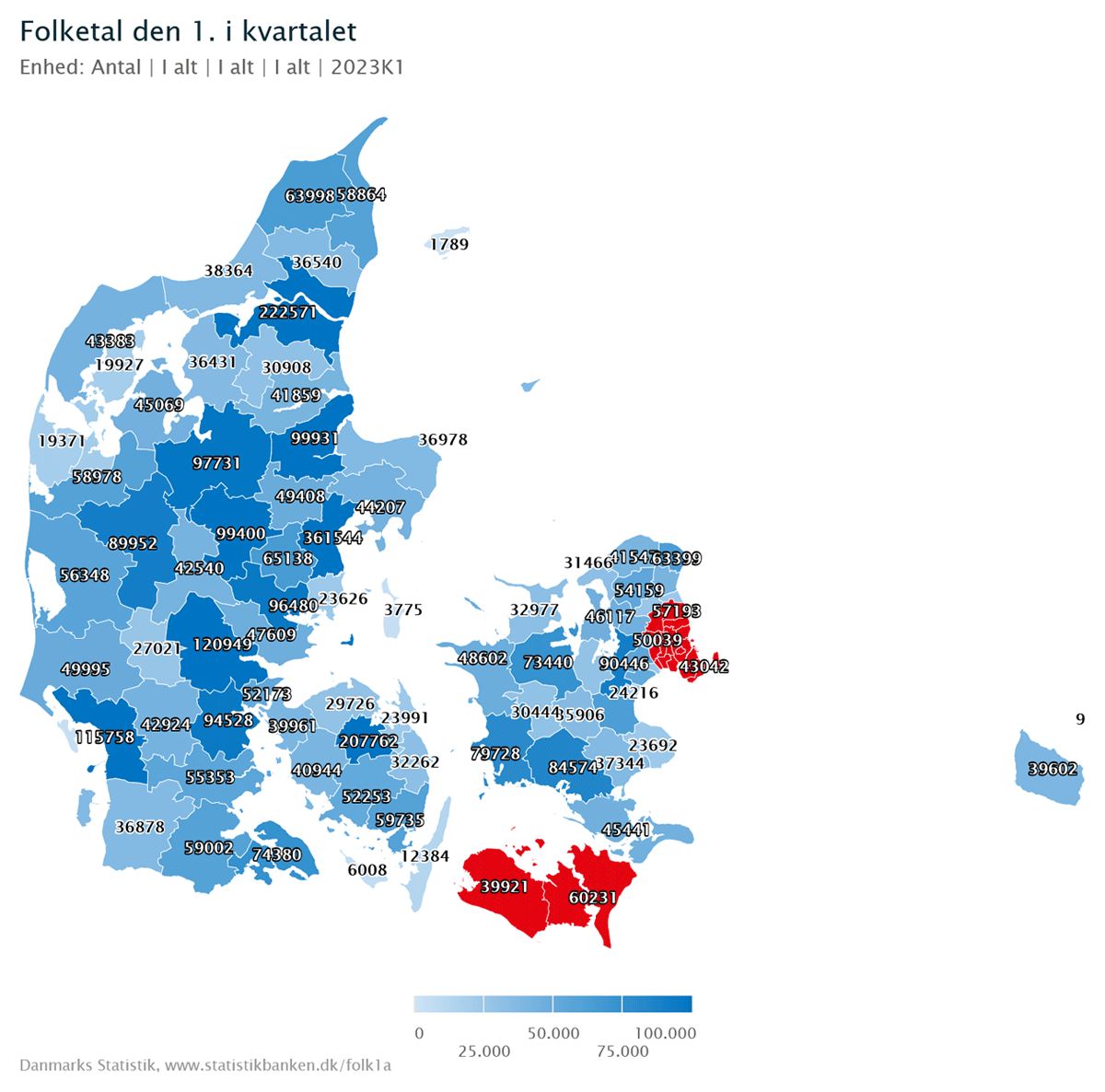
Figure 1
A map of Denmark with population numbers per municipality (Q1, 2023). The Lolland and Falster islands are highlighted in red on the map, as is the Greater Copenhagen area. Due to the density of municipalities in Greater Copenhagen, the total population number of 1,891,871 people in this area is not visible on the map. Source: Statistics Denmark, https://www.statistikbanken.dk.
With 17,000 inhabitants, Nykøbing Falster is the biggest city on Lolland–Falster, and it is the educational, commercial, and industrial center of the islands. The only hospital is also located here. As the second-biggest city with about 12,500 inhabitants, Nakskov on the western coast of Lolland has a history of prosperity and industrial prominence. However, the city was severely impacted by the closure of the shipyard and other industries in the late 1980s. And then further by the centralization-drive that saw state and public sector workplaces merge and move as part of the Danish Municipal Reform in 2007 (see also Larsen 2022a; Larsen 2022b). Nakskov’s post-industrial struggles are the backdrop for the way in which not just the city but the islands in general have become the national go-to case to illustrate precarity and narratives of ‘the broken good life’ (Ledstrup 2021: 364). In popular narration, Lolland is Peripheral Denmark’s ‘locus classicus’ (Sørensen 2016b: 24). Presentations of the islands as bleak places populated by destitute people appear in various Danish films and books and in the nationally broadcast television documentaries entitled ‘The City of Hopelessness’ and ‘Ruined in Nakskov’ (see Ledstrup 2021).
Looking at a map of Denmark, the two islands make up one end of the so-called ‘rotten banana’ of Peripheral Denmark. As a metro-centric metaphor, the ‘rotten banana’ envelops all of the supposed problems with the peripheral—often rural—areas, including popular beliefs that they are ‘backward, depopulated, demolished, deprived of infrastructure, lack employment opportunities, have ageing and poorly educated populations’ (Gulløv & Gulløv 2020a: 37; Winther & Svendsen 2012: 466).
The unflattering media coverage of the islands has met with local resistance. Much of the pushback stems from a Facebook group called Lolland–Falster Lovestorm, which was formed by a group of local women in 2015. They were called to react after seeing the area presented as miserable and impoverished in trailers for the series called ‘Ruined in Nakskov’ that was screened on a national TV channel. The purpose of the Lovestorm group was to ‘let the love for the area flow’ through positive stories to counterbalance the negative ones (Ravnkilde 2017: 22). In just 48 hours after launching, the Lovestorm group had 22,000 members, and the group itself became national news. What originally started out as a reaction campaign is still active in 2023. It is now regularly brought up as a major publicity asset for the area, with one of the two local mayors describing it as a way for ‘all residents of Lolland–Falster to take on the ambassador role for the area’ (Ravnkilde 2017: 32). The narrative resistance effort appears to have had an impact as the use of the terms ‘rotten banana’ and ‘udkantsdanmark’ has slowly decreased in the Danish media since 2010 (Winther & Svendsen 2012). However, the peripheral conditions may take significantly longer to change than the use of derogatory nicknames. A recent study shows, for example, that Lolland–Falster now has the lowest life expectancy in Denmark. A substantial factor contributing to this development is the in-migration of people from other areas of Denmark who suffer from multiple lifestyle diseases. Poverty and unemployment are believed to be among the root causes of such diseases and the shorter life expectancy rates (Lynge & Holmager 2021).
The Methodology and Material
This article is based on data collected during ethnographic fieldwork that took place over 11 months in 2020, where I spent time in various locations on Lolland–Falster to follow and interview interlocutors at their workplaces and have informal conversations in canteens and cafes. However, that particular year was marked by the COVID-19 virus and the resulting restrictions on mobility and social activities, as well as two extended periods of national lockdown in Denmark. Consequently, I had to reorganize fieldwork plans and scale back on the planned participant observation. Instead, I conducted ‘anthropology from home’ (Góralska 2020), which included doing qualitative interviews via telephone and online platforms such as Zoom, Teams, and Skype. I also used LinkedIn and Facebook as sites for digital ethnography, following posts and discussion threads about Lolland–Falster.
In total, I conducted 38 semi-structured qualitative interviews: 21 online, 12 face-to-face, and 5 via telephone. My group of interlocutors includes various local stakeholders and human resource professionals (18), and highly specialized international migrants (20). Among my international interlocutors, some currently live on the islands or commute there for work (from the Greater Copenhagen area), some are considering moving to the islands (from the Greater Copenhagen area), and some have previously lived there (and now live in the Greater Copenhagen area). The internationals are from 14 different countries in Asia and South and Eastern Europe, and they hold university degrees in the fields of medicine, engineering and planning, design and architecture, law, marketing, and finance. Nine of the 14 male internationals had relocated to Denmark with their nuclear families (partner and children, if any), whereas this was the case for four of the six female interviewees. The internationals had spent between 0 and 15 years in Denmark/on the islands at the time of the interview, with the majority having lived there between 2 and 5 years. Their relocation to Lolland–Falster can be described as self-initiated expatriation, meaning that they are among ‘the highly skilled people whose movement from one country to another is by choice’ (Habti & Elo 2019).
In terms of motivations for accepting a job and/or moving to Lolland–Falster, work-related reasons featured prominently. However, upon closer examination, they turned out to revolve around quality of life and improved conditions for family life. That is, the internationals were seeking better work-life balances and better work conditions, explaining this to mean less work hours, higher salaries, favorable holiday and pension schemes, and job stability. Many of the internationals expressed that the overarching motivation for this was to be able to provide better futures for their children. Futures in which they could spend more time together as a nuclear family in stable financial conditions. Free schooling and a nice area for children to grow up in were two of the other often-mentioned motivations to move to Lolland–Falster. This underlines how the internationals’ motivations for migrating engage with the intergenerational imaginaries of Lolland–Falster as a place of future opportunities, particularly for their children.
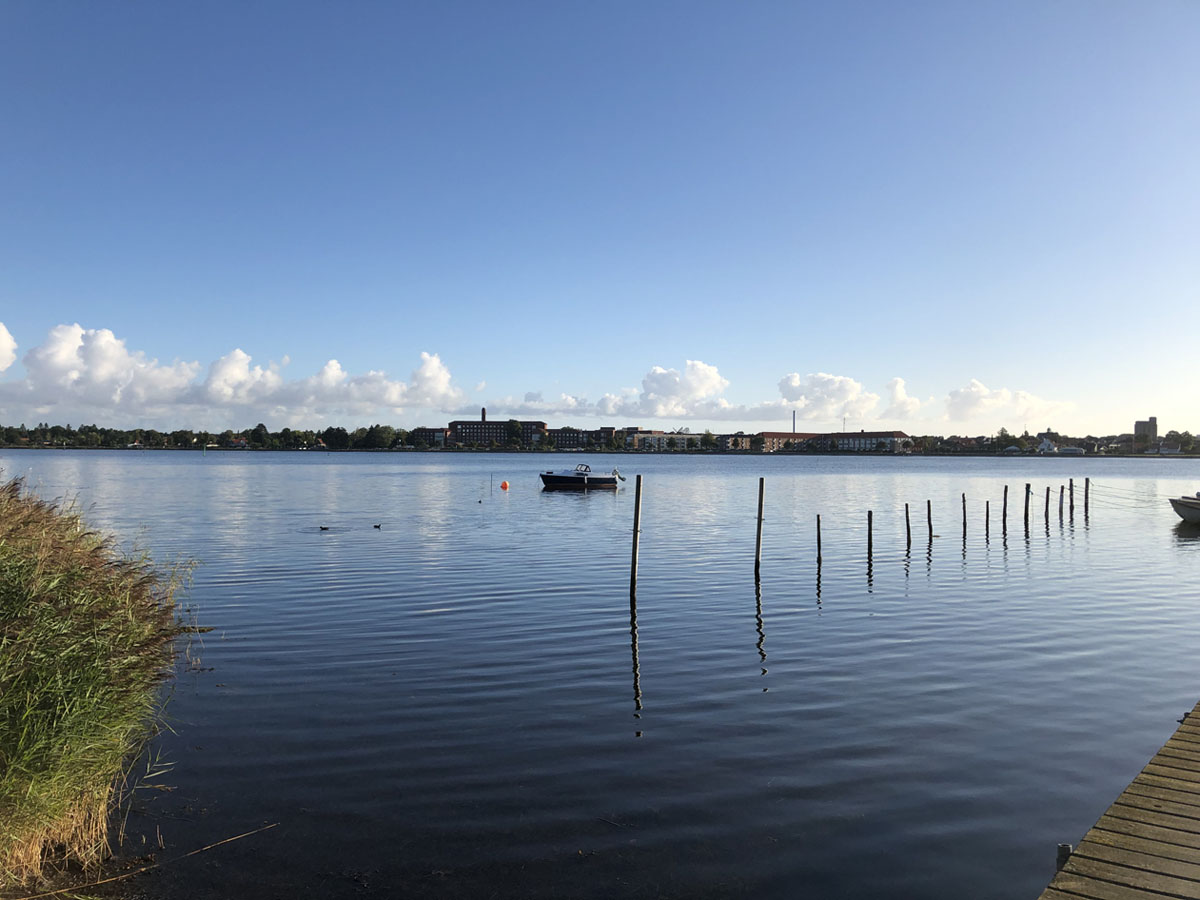
Figure 2
A view from Lolland to Falster across the strait of Guldborgsund in September 2020. Photo by the author.
Theories of Coming to Know a Place
Questions about relations between places and people have been examined by many social scientists. In an extensive review of theories about place, the geographer Tim Cresswell argues that ‘places are assemblages, gatherings, of materiality, meaning, and practice’ (Cresswell 2019: 188). And following Doreen Massey, among others, places are dynamic and continually shaped and reshaped through people’s interactions, interpretations, and engagements with it (Massey 1994). A place is thus lived concreteness, and it is through people’s investment, embodied encounters, and experience with it that a place makes sense and becomes meaningful. Therefore, different experiences, life stories, positions, and opportunities influence people’s perception of a place, their sense of attachment to it, and evaluation of whether to stay or leave (Gulløv & Gulløv 2020b). Taking this dynamic and practice-based approach to place (meaning)-making as my vantage point, I find research about the process of coming to know and making sense of a place through daily activities and movement in it particularly interesting.
In an essay investigating the relations between becoming knowledgeable, walking along, and experiences of the weather, the anthropologist Tim Ingold uses walking as an example of an everyday activity that builds knowledge (Ingold 2010). By walking and by carrying out other everyday activities as we make our way through the world, we create paths. And along those paths of movement, knowledge about the ground, the landscape, and the place is formed. To Ingold, the process of coming to know a place, of becoming knowledgeable, is therefore closely related to activities of movement in everyday life. Along similar lines, the anthropologist Allice Legat has explored the meaning of becoming knowledgeable among the Tåîchô people in Northwestern Canada (Legat 2016). As children, the Tåîchô hear stories of places from their parents and elders and thus build narrative relations with these places. As they grow and start visiting the sites named, the children experience them directly and begin to leave their own (narrative) footprints. Legat writes of this walking and observing the land as a practice that binds stories of a place to the knowledge achieved by sensing and experiencing that place in person. That is, walking the land is a way for a person to become intimately familiar with a locality, combining past and present narratives and bodily knowledge of that place. In this case, to become knowledgeable is to learn through an activity, in action, and practical engagement with others and the environment.
Shifting now to an urban context, the psychologist Andrew Stevenson (2017) has examined how people develop meaningful attachments to and knowledge of a new city. Using ethnographic methods in working with a group of newly arrived international students in Manchester, Stevenson describes diverse ways of coming to know the city through daily living. For example, one student attends church and finds not only a community of practice but also meets companions for weekly city tours. Another student gets to know the city through a project to film a documentary, record city soundscapes, and do interviews with elderly residents. A common denominator for the students’ introduction to their new city turns out to be walking. During these walks, the newcomers accumulate knowledge of the city along the way on a know-as-you-go basis, constructing the place through the body and the senses (Stevenson 2017: 553, 562). With reference to Tim Cresswell’s work on mobility and place (Cresswell 2004, 2006, 2019), Stevenson terms this process ‘mobile place-construction’ (Stevenson 2017: 546). Indeed, the mobile and dynamic approach to place (meaning)-making resonates across these researchers’ work, foregrounding mundane movement in and engagement with the surroundings as central to the process of coming to know a new place. Inspired by this approach to placemaking and becoming knowledgeable as a process defined by movement and by doing instead of simply being in a place, I suggest that the internationals on Lolland–Falster become knowledgeable about the islands during the everyday practice of working. In the next sections, I will explore how and why the internationals’ work life impacts their perceptions of the islands and in which ways the workplace becomes a central arena for developing an awareness of peripheral conditions.
The Role of Work and the Workplace
When tracing the growing peripheral awareness and concern among internationals on the islands, I found that their changing perceptions of the area are influenced by encounters and experiences at work. By focusing on the impact of working and the workplace for how highly specialized internationals come to know a new place and country of residence, this article builds on but also complements findings from other studies. This includes the role of friends and personal social networks for newcomers’ sense of community integration (Frykman & Mozetič 2020) and the impact that local hosts and mentor programs have for workplace inclusion (van Bakel, van Oudenhoven & Gerritsen 2017).
My interlocutors’ workplaces include small, mid-size, and large private companies as well as a large public sector institution. Some of these workplaces have English as their company language, which reflects a company policy, rather than the dominant native language among employees. The interlocutors working in such companies talked of many (online) meetings with international colleagues and clients. At the other end of the continuum, the only local hospital is an example of a workplace where Danish is the work language and where the workday primarily consists of interactions with patients and their next of kin from the hospital’s local catch area. My analysis indicates that for the interlocutors who work in places that require frequent engagements with the local residents and with the ‘institutional Denmark,’ such as the local municipal administration and the public systems, their work and workplace are central to their process of coming to know the area. They thus articulate a strong relation between everyday work experiences and the way that these influence their gradually developing knowledge about Lolland–Falster as a place in Denmark, and not least how they come to perceive it as peripheral.
An example of this is Carl, a former resident of global cities like Shanghai, Hong Kong, and Amsterdam who moved to Nykøbing Falster with his family a couple of years ago. Being very experienced with international relocations, Carl benefits from what Cristina Ramos terms ‘migratory knowledge’ (Ramos 2018). According to Ramos, migrants accumulate migratory knowledge when they move and settle in unfamiliar places. Migratory knowledge is thus an understanding of how to navigate beginnings in a new country, how to negotiate feelings of exclusion, and where to look for support through social networks. ‘Having already been through a first migration, helps individuals and families understand what the migration process entails and, therefore, what they can expect,’ she states (Ramos 2018: 1843). Carl underlines that, given his extensive experience with moving internationally, he feels competent in formulating his family’s needs and evaluating whether a place can meet them. This process of aligning expectations is the most important thing before making a move, he says. In their 20s, for instance, he and his partner focused mostly on what nightlife and exciting weekend getaways a region offered, whereas now their priorities have changed. When I prompted him to further explain how he had evaluated whether the islands of Lolland–Falster and the city of Nykøbing would meet their current needs as a family with small children, he said:
For me it was very good that a city of 20.000 people had its own zoo, and a cool indoor swimming pool, and a beach nearby, and a lot of forest, and Knuthenborg6 on Lolland. In my mind, it had enough. It had sufficient, how would I say, activities around, for my children to have a fun and nice childhood.
However, since arriving his perception of the area has started to change, shifting his focus from the recreational qualities of the area to the population composition and decline:
I have been here almost 2 years, and I can see the changes […] Maybe I am noticing it more than someone else because I am obsessing about it. I want my kids to be in Nykøbing. But I don’t want them to stay in an empty Nykøbing. You know that is also a worry for me […] And I have noticed that a lot of people are moving out. A lot of young people are moving out and going to Copenhagen and a lot of older people who are getting retired are coming to Lolland […] You know, Nykøbing is turning into a city of old people […] It’s easy for me to notice it because of our client structure, you know, because what our clients are looking for. As an architect you often get to build new buildings, right […] In our case, we get a lot of apartments for old people to retire. It is like … I would really love to do a kindergarten, you know. I would really like to do a youth center, or youth housing, or a school […] That’s the basics of my problem. I mean, not MY problem but the problem of the city in general. That they don’t … The planning is not for younger people to move in.
Here, Carl draws a direct link between the changes that he starts to notice and the insights into the building plans and future cityscape that he gets at his workplace. In other words, his opinions about the developmental direction of the city and the area are directly influenced by the kind of building tenders and design tasks that he faces at work.
In contrast, the interlocutors who work in companies that are oriented toward an international market and client base and who have English as their work language talk more of non-work-related ways of coming to know the local area. This includes, for example, hobby associations, their children’s daycare or school, and private interactions with ‘institutional Denmark,’ such as the health care system, the tax authorities, or the municipality. An example of this is Paul, whose team at work includes engineers from South Asia, Eastern Europe, and North America but no Danes. Since it is not required at work, he has not learned Danish, but he declares himself well settled. Paul is single and moved to Denmark on his own. After 3 years in a rental property, he is now looking to buy a house in a village on Lolland. He has also applied for a Danish hunting permit. Paul has previously worked in other countries around the world, but he still owns a house in his European country of origin, referring to this as his base. A ‘headhunter’ approached Paul online with an offer to interview for his current job. He says that after deeming the job content and contract terms enticing, his deliberations focused on Denmark as a country of living in general and not on Lolland as the specific location. A key thing for him was the good work-life balance offered, with the social protection system and the decent pension funds also factoring into his positive judgment. After the first couple of years on Lolland, Paul still appreciates the quietness of local life and the easy access to beautiful nature. However, he has also started to see some downsides to life there, and when talking about what he calls ‘the flaws,’ he mentions the health care system as an example. He says:
I did not find it very friendly on a few occasions … It was the competence of the individual, you know […] I was not very happy with that. But anyway, I got it sorted in my home country […] Another colleague was also not happy. He showed me like 200-something comments on Facebook from both expats and locals complaining about the local medical system […]I don’t make a big deal out of this, but just let’s hope we don’t get sick, ha-ha. In this instance, I just said I will sort this out in my home country[…]It’s not ideal to pay for a trip, you know, to have something fixed that could have been fixed here locally.
Paul relates how his contact with the local health care system made him concerned about the quality of care available locally. In one case, this made him seek medical care in his home country. This complaint about the health care on the islands, including the long distances that some residents in the catch area must travel to the hospital in Nykøbing Falster, the few available specialist doctors, the high doctor turnover in general practices, and the experiences of questionable competences was reiterated by many interlocutors. Besides the dissatisfaction this created in interlocutors’ everyday life, the surprise of it seemed to add to the disappointment, as many had held the Danish health care system in high esteem before they came to the islands.
The above examples point to various sources of influence in the internationals’ process of coming to know the islands. In Paul’s case, the experiences that raised an awareness of a particular ‘flaw’ took place outside of work. Even so, the workplace and his colleagues still feature in the experience as sounding boards or experience exchangers. To further tease out the influence of work and workplace on the internationals’ process of coming to know Lolland–Falster, I present the cases of Agnes and Iris, who work at the local hospital.
Hidden Truths and Daily Work Life
Agnes and her husband came to Denmark with their children a couple of years ago. They are both medical specialists and their primary motivation to move was ‘to provide a better life for the children.’ During years of discussions about whether to leave their European home country and where to go Agnes and her husband prioritized being together. This meant that they looked for a hospital where they could both get a job within their medical specialty in a country where they deemed opportunities for their children to be good. Spurred on by online reports about work-life balance, good salaries, and free education, they looked toward Scandinavia. But, having also read stories of Danish being a difficult language to learn, they first had their sights set on going to Sweden or Norway. However, as it turned out, Nykøbing Falster Hospital was the only place that offered them both employment. Agnes describes how they initially concentrated on going through all the papers related to their potential employment in Nykøbing. With so much of their focus on the work and its conditions, they paid less attention to contextual details surrounding the actual workplace, such as the hospital’s location in Denmark, for example. Agnes says
So, when we came here, we did not know where we came to. Denmark, yes, that sounds exciting. And you cannot expect to get a job in the capital city, you cannot expect that in other countries either. But to us coming here was not progress. Because we both come from [jobs in] university hospitals. We said yes [to coming] because we really wanted to get out of our home country where there are lots of challenges … social, corruption. We were not poor, but we earn more here in comparison. So, there are many advantages. But we really did not know what it was about, this place and Nykøbing in itself.
This sense of not-knowing the place that they had moved to arose despite them having taken part in a comprehensive recruitment process that included an all-paid visit to the hospital to do in-person interviews. Agnes’ account addresses the difference between surface and in-depth ways of knowing, contrasting the knowledge gathered during the recruitment from other people’s narratives of the hospital and Lolland–Falster to the knowledge generated from their own bodily experiences of living in Nykøbing Falster and working at the hospital every day. She continues
Yes well, how can I put this nicely … I believe that certain things were hidden from us. Things like, this is not the best place in Denmark. On the contrary, rumors have it that it is the worst. And things like that they have big challenges with recruitment, and that they lack staff and that there are more [work] hours than the 37 that the contract states. So, we were not told everything. We were also not lied to. But we did not get the whole truth.
So, despite a visit to do interviews and tour the hospital and a thorough effort by HR professionals to provide them with detailed newcomer information, Agnes still felt that they did not actually know the place they moved to. In trying to explain their initial experience of not-knowing, she points to a sense of concealment. Talking about it now, she underlines that what she considers as an omission of information was not an ill-intended action but just part of the strategic promotion of the hospital as an attractive workplace. Agnes’ comments raise questions about the relationship between information given and gathered about a place and one’s own lived experience of that place, drawing parallels to Legat’s (2016) work on narrative and bodily knowledge discussed above. I suggest that we think about Agnes’ experiences as an example of how textual, oral, and visual information and even brief visits cannot necessarily prevent a sense of not-knowing at arrival and during settlement. That is, despite thorough preparations, a degree of not-knowing is to be expected for newcomers as they merge narrative and bodily knowledge in the process of becoming knowledgeable through everyday interaction in and with a place. The geographer John Agnew suggests that a place consists of three elements: location, locale, and sense of place (Agnew in Cresswell 2019: 167–168). In this triad, the location situates a place in relation to other places and refers to the objective position of a place. The locale is the landscape of a place in the sense of the physical and social setting for particular practices that mark it out from other places. The sense of place relates to the meanings attached to a place, either individually or collectively. Following this, there must be a difference in when and how one can come to know the different elements of a place. For example, the location can quite easily be known beforehand. In contrast, one can only come to know about locale and sense of place over the course of everyday practices, in meetings with others, and the meanings they attach to Lolland–Falster. When I asked Agnes to describe how they had eventually come to know the place, she explained
We found out just by working, being every day at work and hearing from colleagues and hearing from the patients. By experiencing the challenges you face here every day when you must come to work to cover for the colleague who always calls in sick or for the one who just does not show up […] So, we learned along the way.
Here, Agnes explains how her experiences at work and interactions with colleagues influenced and changed her understanding of the hospital as a workplace. Furthermore, the everyday experiences were a locus for her forming an understanding about Lolland–Falster, and not least for coming to perceive of it as a peripheral area in Denmark. Part of this arising sense of periphery came from the meetings and interactions with patients. Agnes explains how her impressions of the patients colored her view of the local area, marking it as marginal and ‘not the best place in Denmark’ based on her experiences of disadvantaged, less educated, and intolerant patients. She said
So, the patients here … Remember that we are talking about Lolland-Falster. There are old, sick, and angry people here. Angry because they cannot get a Danish doctor. That is the first thing they say, ‘again a foreigner.’ And that is annoying. In the beginning, it hurt me. Now I live with it, and I laugh with them and tell them I am here to find out why they are ill. I understand their frustration […]The people are old and there are also many that are alcoholics—and this is not something secret. There are lots of people here that have psychological problems and who find it hard to accept foreigners. So, they just close down and don’t listen […] And the special medical language I must use … well, it is based on Latin, and I can do that without problems but when you have to explain it to patients then you cannot use those advanced terms. You must speak in ordinary everyday Danish … and well, we are talking about Lolland-Falster, so you must explain things in the most basic language.
Other medical specialists I talked to also emphasized the need to be incredibly careful in their communication with patients, not just because of the pronunciation and making sure that the patients understand their accented Danish. But also, because many of the patients have special needs. One doctor expressed it as ‘I think that here you have to speak very clearly, very slowly, and very loudly.’ A member of the hospital HR unit explained that the reason for their strong insistence on the international doctors’ acquiring proficiency in Danish partly has to do with the patient group in the hospital’s catch area. She said: ‘Particularly in our part of the country, our patients do not speak English. Here we get old Mrs. Hansen. She does not understand English. So Danish language is particularly important.’
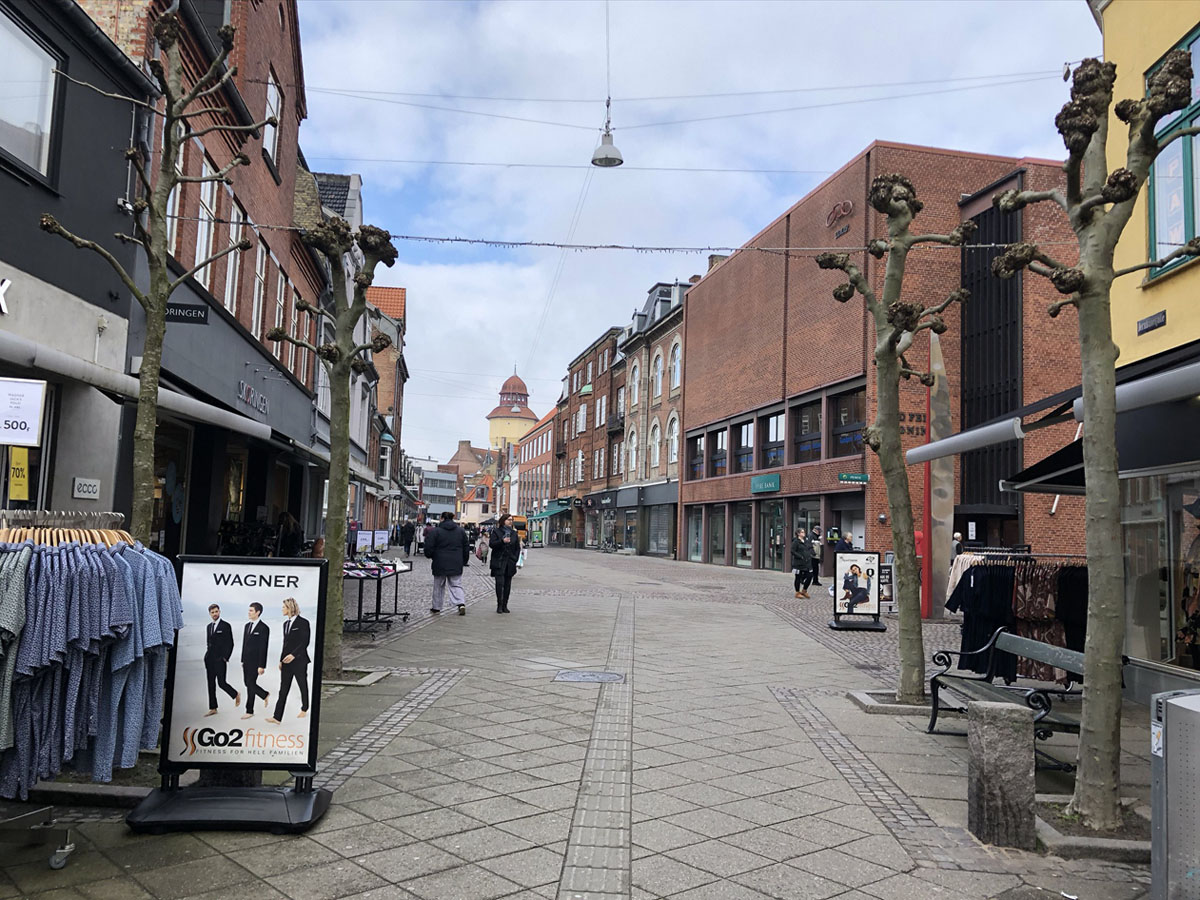
Figure 3
The main shopping street in Nykøbing Falster on a weekday in March 2020. Photo by the author.
Encounters with Prejudices and Re-evaluations of the Islands
Like Agnes, Iris is a medical specialist. Looking to start a family, Iris and her husband wanted to settle somewhere away from the hustle and bustle of the big city life that they knew from their European home country. Iris would have preferred to move somewhere with a sunny climate, and she said that she initially thought of Denmark as the North Pole. However, she was convinced to give it a try by her husband, who had been keen on Denmark since visiting as a young man. When they learned about the specific opportunity for Iris to work at Nykøbing Falster hospital, they searched the internet to gather information and impressions of the area. During their ‘charm visit’ as the hospital HR person calls it, Iris and her husband got a positive impression of the facilities at the hospital and of the city and the surrounding area as quiet and beautiful. Iris describes how she started to get a more nuanced view after they arrived in Denmark:
For me before, Denmark was like one unit … When I came here that changed […] we really started to see that there are different areas. So, we were in Budapest for our Danish language course offered by the recruitment company. We were there for six months, and we learned a little about Danish geography and everything … but I don’t know whether it was because we were there in Budapest, but I really cannot remember that anything at all was said about that this is a poor area, a poor municipality compared to others. I really don’t recall them telling us that.
Here, Iris, like Agnes, hints at a sense of being uninformed about the actual socioeconomic conditions in Lolland–Falster despite attending the mandatory pre-arrival courses. She also points to the curious fact that the courses to prepare the foreign medical specialists to work and live in Denmark took place in Hungary. Not only did this require a 6-month temporary relocation to another European country. It also meant that Denmark and the Danish language remained abstract subjects of teaching in a classroom in Budapest. This decoupling between the preparation phase and the actual everyday life surroundings and conditions awaiting them on Lolland–Falster explains some of Agnes’ and Iris’ initial experiences of not-knowing. Due to the recruitment arrangement, it was difficult for them to form nuanced impressions of the area they were moving to and the everyday life conditions they would encounter. Iris recalls that her understanding of Lolland–Falster as a particular kind of place started to transform in the meeting with colleagues at professional gatherings in other parts of Denmark:
It was something that I found out as I met other doctors here, other doctors in Denmark with the same specialty as mine, and they started to ask me why I am working at this hospital. Maybe when I was at the first course or doctor congress or something like that in the Greater Copenhagen Region. Then I had this experience of others asking: ‘Really, are you on Falster?’ So, it was when I went away from Lolland-Falster and other people said: ‘But, on Falster, why are you there?’ I was happy here so I could not understand it. But it was like the prejudices that they had about this region, about Lolland-Falster. Of course, now I see why. Now that we have been here for 5+ years and I see that there are some really socially deprived families especially on Lolland. Maybe not so many on Falster but more on Lolland
Despite facing these prejudices, Iris remains positive about her quiet family life here and praises the area’s natural beauty. Her husband has met difficulties in finding a job to match his educational qualifications in the area, yet they remain committed to staying as they believe it is a good place for their children to grow up. Iris says that she often endures teasing comments of ‘you will be moving to the capital soon, ha-ha’ from specialist colleagues at other hospitals. They think, she explains, that she is overqualified for her current position and that she is wasting her skills and time working at a small provincial hospital. To this kind of thinking, Iris responds: ‘But, really, it is more about what you want from life. I did not want to continue with the life I had in my home country, I wanted something different.’
Like Iris, Agnes has also encountered skepticism about her choice to live and work in Lolland–Falster when she is among medical colleagues from other areas of Denmark. But in contrast to Iris’ reaction, Agnes’ meeting with other people’s prejudices of the area has left her concerned. Her growing awareness of the peripheral conditions has left her worried and uncertain about potential stigmas. She says
If I had known then maybe … I am not saying that it would have changed my decision, but it would have made me think twice at least [laughter]. Precisely because our primary concern was our children … We don’t want them to have a bad start. I don’t know how it is but when they hopefully will be doing further education in Copenhagen … well, I don’t know how others look at people who come here from the south [the islands]? At least, I can tell you that in my world, in the doctor’s world when I meet other doctors they say ‘oh, right, you work at Nykøbing’ and then they do like this [she makes an expression of scrunching up her nose]. They see it like it is the world’s last station here. My husband says that it is like a label.
This statement emphasizes that Agnes’ apprehensions about the peripheral conditions center around her children’s future opportunities. As there are no higher education institutions in Lolland–Falster, her children will have to move to pursue further education. As her awareness of the islands’ national image has grown, Agnes worries that a move within Denmark will lead to uncomfortable confrontations with Danes’ prejudicial views on the islands. Particularly, she worries about the contagiousness of the prejudices, meaning the risk that the islands’ destitute ‘peripheral Denmark’ image may infect the way her children are perceived by others. She fears that this could bring reputational struggles and uphill battles of representation akin to the negative stereotypes she says are often associated with her home country. This kind of struggle against prejudice was one of the issues that Agnes and her husband tried to prevent their children from facing by moving to Denmark. Therefore, she is very unhappy with the gradual realization that their place of settlement in Denmark may have landed the children in a new but unforeseen battle against stereotypes, this time against national Danish prejudices of the islands. To her, and most of my other interlocutors with children, this puts Lolland–Falster as a space of opportunities for their children in serious question.
Conclusions
This article has explored diverse processes of place knowledge formations among highly specialized international work migrants on two islands in ‘Peripheral Denmark.’ Following other studies that have discussed how migrants settling in a new place can impact the existing ‘place-encoded hierarchies and identities’ (Svašek & Komarova 2018: 15), I have traced the internationals’ processes of coming to know the islands through everyday activities. The article details their dawning awareness of territorial stigmatization and the consequences of this in daily life. HR professionals and local stakeholders express hopes that the internationals will look at the area through lenses uncolored by the Peripheral Denmark associations. However, the ethnographic examples show that in many cases, the internationals adopt and accept the common Danish denominations of the area as peripheral and deprived. This suggests that in the case of Lolland–Falster, the notion of being peripheral is not just based on a negative narrative but also on everyday structural challenges. The peripheral is thus both narrative and reality. For the internationals, it is especially experiences and encounters at work and interactions with colleagues that stand out as central to their process of forming an understanding about Lolland–Falster, and not least for coming to perceive it as a peripheral area in Denmark.
As Stevenson notes about the ways that international students in Manchester come to know the city, they ‘bestow meaning following journeys from elsewhere’ (Stevenson 2017: 547). Similarly, the ways that the internationals in this case relate to and come to know Lolland–Falster are inscribed into, and take meaning according to, their individual biographies of prior experiences. That is, the formal, narrative, and bodily knowledge that they have grown along different educational paths, life trajectories, and migration routes up to their move to the islands. However, their migration to Lolland–Falster and the diverse ways of coming to know the area should not just be understood in the context of prior journeys. Rather, I argue that the internationals’ settlement experiences and their reactions to the growing awareness of the peripheral conditions reach forward in time and engage with intergenerational imaginaries of Lolland–Falster as a place of future opportunities, particularly for their children. This means that their expectations of Lolland–Falster as a place of potential are central to how and why the peripheral conditions on the islands are experienced as a problem. That is, because the peripheral conditions were quite unexpected, they were experienced as hidden truths—a negative ‘label’ on the area—that they uncovered over time. This led to senses of concealment, disappointment, and uncertainty about the future. In particular, for those who had imagined Lolland–Falster to offer what they thought to be better conditions for their children.
By ethnographically detailing the differences in the internationals’ reactions to the discovery of peripheral conditions on Lolland–Falster, the article highlights the ways in which the migrants’ reactions to the peripheral are closely intertwined with their diverse expectations and motivations for choosing to move and especially with their intergenerational imaginaries of Lolland–Falster as a place of potential for their children. As it is, the internationals’ growing place awareness of Lolland–Falster over time sustains rather than changes or challenges the islands’ bottom placement in the Danish national place-encoded hierarchy. But the hopes for a peripheral transformation on Lolland–Falster persist, now centering on the Fehmarn Belt Tunnel. This is a major infrastructure project that will link Lolland directly with the German island of Fehmarn through an immersed tunnel. The mayor of Lolland municipality, Holger Schou Rasmussen has stated that the building of the Fehmarn Belt tunnel instigates a new beginning in which ‘Lolland will no longer be [located] at the end of Denmark with our backs to Germany. We are going to be on the central corridor between Scandinavia and Central Europe and right between the two metropoles Hamburg and Copenhagen’ (Lolland-Kommune 2020). The Fehmarn Belt tunnel is expected to open in 2029.
Notes
[1] The term “rotten banana” was coined by geographer Hanne Tanvig in the 1990s to discuss development in rural areas of Denmark.
[3] Lolland Municipality: 40,241 people; Guldborgsund Municipality: 60,317 people in 2021. Source: http://www.statistikbanken.dk.
[4] In Q1, 2022, a total of 8,883 people on Lolland–Falster are not of Danish origin: 7,042 immigrants and 1,841 descendants. Source: http://www.statistikbanken.dk.
[5] The Danish population numbers for Q1, 2022. Total: 5,873,420. Immigrants: 640,922. Descendants: 206,119. In the Greater Copenhagen area, total: 1,867,948. Immigrants: 290,624. Descendants: 100,588. Source: http://www.statistikbanken.dk.
Funding Information
This work was supported by the Danish Agency for Science and Higher Education under Grant number 8091-00083B. The funding body has held no role nor influenced the research process from study design to article submission.
The research has been conducted within the field of Humanities and does not include medical research on humans. It follows the ‘Policy for research integrity, freedom of research and responsible conduct of research’ of Aarhus University based on the ‘Danish Code of Conduct for Research Integrity’ (https://ufm.dk/publikationer/2014/filer-2014/the-danish-code-of-conduct-for-research-integrity.pdf).
Competing Interests
The author has no competing interests to declare.