
Introduction
Exclusion and exploitation have been two central dimensions of the racial world order throughout its long history. In a theoretical article discussing the nature and recent development of the Swedish racial regime, Mulinari and Neergaard (2017) make the distinction between two facets of contemporary racial ideologies: exploitative racism and exclusionary racism. In doing so, they relate to a long tradition of critical studies on racism that have analysed the central dynamics of both exclusion and exploitation in racialized social systems (Bhattacharyya 2018; Gurminder 2021; Robinson 1983). The purpose of the present study is to test whether exclusionary and exploitative racism can be represented as distinct racial ideologies and empirically investigate their relationship to socioeconomic status and established measures of modern racial ideologies. This is of interest given that, even though theories and research on race and racialized social systems have emphasised both exclusionary and exploitative socioeconomic dynamics, measures of racial ideology or racial attitudes have not made this distinction. Instead, they have arguably focused more on the exclusionary and resentful aspects of racial ideologies. Hence, the approach taken in the present study explores the preliminary validity of a new way of conceptualising and measuring racial ideologies.
The conceptual basis for the understanding of exclusionary and exploitative racism in the present study is an understanding of racial ideologies as parts of a racialized social system (Bonilla-Silva 1997). In a racialized social system, the racialized categories in which people are placed are hierarchically related and intimately tied to the distribution of income, wealth, status and power within that society (Bonilla-Silva 1997). From this perspective, racial ideologies refer to the ideological aspects of the social system that crystalize racial notions and stereotypes and provide rationalisations for the social, political and economic interactions between the ‘races’ (Bobo 1988; Bonilla-Silva 1997). Given this understanding, the present study examines the racial ideologies of exclusionary and exploitative racism as closely tied to exploitative and exclusionary social, economic and political processes in both historic and contemporary racialized social systems. In this context, it should also be noted that the term ‘race’ in the present study is understood as the result of socially embedded processes of racialization (Miles 1993). In Sweden, where the present study was conducted, the concept of ‘race’ however is very rarely used and often seen as controversial in Swedish public discourse. In fact, with reference to the history of racial biology and eugenics, the concept of race is officially avoided and discarded (SOU 2015: 103). Instead, concepts like ‘migrants,’ ‘migrant background’ or ‘ethnicity’ are used as proxies for race in Swedish public discourse (Bredström & Mulinari 2022; Mattsson 2005). Despite this, these proxy terms are closely tied to an implicit notion of ‘race,’ and ‘Swedishness’ is intimately tied to racialized ‘whiteness’ (Hübinette & Lundström 2014; Mattsson 2005; Neergaard & Mulinari 2017).
When understanding racism as a social system intimately tied to how value and profits are created and distributed, the exclusionary mechanisms of racism have been central to the acquisition of land, raw material and other resources of central importance to the accumulation of wealth (Bhattacharyya 2018; Fraser 2016; Robinson 1983). This has been evident in the historic practises of expropriation in colonised regions and the associated expulsions, mass-killings and genocides of the original inhabitants of those regions (Edwards & Kelton 2020; Jones 2010). The hegemonic dominance of a parallel racial ideology, where those racialised as non-whites were seen as non-humans or of lesser value, motivated and legitimised these exclusionary practises (Bonds & Inwood 2016). On the other hand, exploitation has been equally central to the racialised world order, where the possibility to use populations racialised as non-white as cheap – -and often forced and non-paid labour – enabled the accumulation of wealth for those in a privileged position within the system (Butt 2013; Fraser 2016; Gurminder 2021). Here, the corresponding ideological standpoints rested upon dehumanisation and the construction of the non-white other as someone who did not deserve the same rights as white workers and whose natural state was that of subordination and servitude (Boskin 1986; Goings 1994; Jewell 1993). An extensive amount of research has shown that these historical processes are still central to contemporary economic and power relations and that race remains a key aspect of how modern societies are structured (e.g. Bhattacharyya 2018; Gurminder 2021; Miles 1982).
In order to understand the role of racism and the distinction between exclusionary and exploitative racial ideologies in contemporary societies in Western Europe and North America, it is central to understand the intersectionality of race and class. Indeed, in theories aiming to understand the structure and functions of contemporary capitalism, the concepts of class and race are often strongly linked (e.g. Anthias & Yuval-Davis 1996; Bhattacharyya 2018; Hall et al. 1978). From this perspective, it is seen as inadequate both to conceptualise race as an epiphenomenon of class or as a mere result of what is functional to capital, as well as a completely distinct and separate social structure. Rather, it is increasingly clear that the two concepts cannot be easily disaggregated, since racialisation takes place within the class structure and class structuration takes place in a racialised context (Anthias & Yuval-Davis 1996). The term racial capitalism refers to an understanding of the association of racialised power relations and capitalism as an historical fact rather than as an a priori necessity: Racism predates capitalism and is not a product of the capitalistic mode of production and capitalism is not by necessity integrated with racialised power relations. Yet, capitalism as a historical fact has developed in a period with markedly racialised demarcations of the world and has been shaped by that racialised structure (Robinson 1983). Furthermore, contemporary capitalism continues to operate both alongside and through processes of racialised expropriation and exploitation, so that economic exploitation and racism reinforce and often amplify each other (Fraser 2016). Based on the perspective discussed above, the present study argues both of these facets of racism – exclusion and exploitation – are highly relevant in order to understand racial social systems, and seeks to empirically validate a model aimed at increasing our understanding of these two facets of contemporary racial ideologies using data retrieved from a large survey conducted in Sweden. First, however, we turn to a more in-depth discussion of contemporary forms of exclusionary and exploitative racial ideologies and their functions in contemporary Western societies.
Exclusionary Racism
In connection with the sharp increase in popular support and the political mobilisation of right-wing parties and political forces in Europe and North America during the last decades, exclusionary racial ideologies have come to the foreground of the political debate (Nagan & Manausa 2018; Sandrin 2021; Vieten & Poynting 2016). By exclusionary racial ideologies in this context, we refer to ideologies that construct the racialised non-white ‘other’ as a threat or a burden, and whose presence makes the situation worse for the racialized ‘white’ majority. As previously stated, the last decade has seen sharp increases in the electoral and political support for right-wing parties and movements in several European countries, where anti-immigration policies constitute a central part of the political project (Nagan & Manausa 2018; Sandrin 2021). For example, in 2017 – one year after Donald Trump was elected president in the United States after a political campaign using distinctly exclusionary racist arguments – far right political movements made strong electoral advancements in elections in France, Germany, Austria, Bulgaria and the Netherlands. In Hungary and Poland, right-wing parties have been in power for several years.
In Sweden, where the present study was conducted, the far-right Sweden Democrats have steadily increased their share of the votes, reaching over 20% in the 2022 elections. In addition, many of the other parties in Sweden have adopted more restrictive immigration policies, and a political discourse where groups that are racialised as ‘non-white’ – especially from the MENA region – are tied to a range of social problems has dominated much of the political debate (Brune 2004; Mattsson 2005; Strömbäck, Andersson & Nedlund 2017). In addition, the political debate in Sweden during the last years has been increasingly dominated by what Andersen and Bjørklund (1990) named well-fare chauvinism, which refers to the notion that welfare benefits should be restricted to certain groups, particularly to the natives of a country, as opposed to immigrants.
Several explanations have been suggested for this rise in organised and politically articulated form of exclusionary racism, and the explanatory factors are likely to vary across different countries and different subgroups of the population (see Rodrik 2021 for a recent overview). A complete review of all the suggested explanations goes beyond the scope of this article, but a recurring factor in many explanations is the economic development during the last decades, where globalisation has contributed to the loss of jobs in manufacturing industries due to the reallocation to countries with cheaper labour costs. During the same period, neoliberal economic policies of austerity, privatisation and financial deregulation, coupled with the weakening of labour unions, have led to the concentration of capital, a rise in housing costs, cuts to welfare provisions, stagnation of wages, precarious jobs and unemployment, all contributing to a growth in inequality and disempowerment (Rodrik 2021). These trends have produced greater economic anxiety and put the livelihood of large segments of the population under increased pressure (Vacas & Fernández-Macías 2017), creating dissatisfaction that can then be mobilised by right-wing populist parties (Rodrik 2021). In relation to this, research on attitudes towards immigration in Sweden consistently indicates that those with tertiary education and above have more positive attitudes towards immigration compared to those with lower levels of education. When it comes to employment, professional employees have the most positive attitudes, whereas unemployed, persons on long-term sick leave, and those on disability pensions are the least positive (Strömbäck & Theorin 2018). From a perspective of racial capitalism, this pattern of differential attitudes can be understood as reflecting a process where those with weaker position on the labour market are more likely to perceive themselves to be under more competition from immigrant groups that – through racialized class structuration – is assigned to a similar or subordinate socioeconomic position and which – by having higher levels of unemployment – can be used to create a downward pressure on wages and work conditions (Longhi, Nijkamp & Poot 2005). Those in more privileged positions on the labour market, however, are less likely to perceive the same level of competition for limited resources and might therefore tend to have less exclusionary racist attitudes towards immigrants.
Another relevant perspective to take into account when discussing explanations for the rise in exclusionary racism and the form that it takes are the different effects of globalisation on individual and collective identities discussed by Hall (1997). From this perspective, cultural flows among nations and global consumerism can lead to cultural homogenization, erasing national identities and creating global forms of identification. In addition, migratory trends can produce new hybrid identities, where the possibilities of identity are widened by diasporic communities who share and belong to different cultures and histories at the same time. Lastly – and perhaps most relevant to the understanding of exclusionary racism – migration can also lead to the strengthening of identities, where dominant ethnic groups, feeling threatened by the presence of ‘others’ in ‘their’ territory, react defensively. In addition, minority groups, in response to experiences of racism and exclusion, might also strengthen their identities. Hence, instead of creating hybrid identities, globalisation can lead to polarisation among groups who appeal to the ‘essence’ of identities under threat by the presence of a different ‘other’ (Hall 1997).
Finally, in a context of increased economic insecurity, the importance of the social and cultural privileges tied to whiteness – what Roediger (2007) calls the ‘wages of whiteness’ – is likely to be seen as of greater importance. That is, status and privilege conferred by race could be used to make up for alienating and exploitative class relationships, where workers racialized as white can seek privileges in an identity as ‘whites’ (Roediger 2007) and show an increased endorsement of exclusionary racial ideologies.
Exploitative Racism
As stated earlier in the introduction, increasing the opportunities for exploitation is another core feature of the racialised world order (see, e.g. Gurminder 2021). In contemporary Western economies, racialised exploitation is seen in the intersectionality of race and class discussed above, where non-white workers are increasingly over-represented in sectors of the labour market characterised by low-paid jobs with high levels of insecurity (Glenn 2015). This development is clearly visible in the Swedish context, where the present study was conducted. Here, the hierarchical structure of the Swedish labour market is becoming increasingly racialized, where those racialised as non-white are overrepresented in segments of the economy where wages are low and working conditions are worse (Akay & Ahmadi 2022; Neergaard 2021; SCB 2022). In their article discussing the racial regime in Sweden, Mulinari and Neergaard (2017) suggest that exploitative racism operates by producing an exploitable racialised labour force through both discursive and institutional practises. The discursive practises involve constructing an image of the ‘immigrant’ as either as especially well-suited for certain service jobs (Mulinari & Neergaard 2017) or as less competent, welfare dependent, and requiring incentives in the form of lowered welfare benefits and a low-wage deregulated service sector in order to establish themselves in the labour market (Mattsson 2005; Strömbäck, Andersson & Nedlund 2017). The institutional factors refer, for example, both to special regulations on the labour market directed towards immigrants as well as more broader deregulations and weakening of the legislated rights of labour, often officially motivated by the need to provide job opportunities for people of immigrant background (SOU 2020:30). Through more insecure work conditions and lower wages, this racialisation of the working class renders workers more vulnerable to exploitation and provides benefits to employers given the weakened labour market positions of workers (Neergaard 2021). On this background, the present study is based on an understanding of ‘exploitative racism’ as an ideological position characterised by the view that immigration is positive, since people of immigrant origin can be used as cheap labour, thereby increasing profit and making certain services cheaper, and since they can perform work and services that others do not want to perform. Given this understanding of exploitative racism, those in a privileged social position might benefit from the presence of a low-wage segment of the workforce with higher levels of unemployment, who can perform ‘low status’ jobs and – by having lower wages – can increase profit and render certain services cheaper. This leads to the prediction that these groups may have attitudes more in line with exploitative racism, in that they might be positive to forms of immigration that can be used to make certain services cheaper, more available and increase the possibilities for profit.
Relationship between Exclusionary and Exploitative Racism and Modern Racism
Another relevant aspect to discuss in relation to exclusionary and exploitative racism, is how they are related to other aspects or frequently employed measures of contemporary racial ideologies. It should be noted that an incomplete review of all measures or aspects of racism and racial ideologies is beyond the scope of this article, instead, we will focus on modern racism, which is a frequently used operationalization of contemporary racial ideology in Sweden (Akrami, Ekehammar & Araya 2000).
Modern racism is the idea that racism is a thing of the past and that ethnic minorities today are pushing too hard in their demands for equal rights (McConahay 1986). Hence, any gains made by ethnic minorities are considered undeserved since the very tactics that have led to these gains are believed to be unfair (McConahay 1986). Similarly, Sears (1988) characterised modern racism – or symbolic racism – as consisting of three components: denial of continued discrimination, antagonism towards minority group demands, and resentment about special favours for minority groups.
As can be seen from the above, modern racism has at its ideological core a denial of the existence of racism and the systematic negative treatment of certain ethnic minorities, as well as a resentful attitude towards issues related to ethnic minority rights. Instead, modern racism emphasises the risk that anti-racist or anti-discrimination policies will lead to so-called ‘reverse discrimination,’ that is, the discrimination of ‘whites’ (Kawashima 2017). In this respect, it clearly overlaps our conceptualisation of exclusionary racism, which stresses that the presence of the racialised non-white ‘other’ has predominantly negative consequences and creates a worse situation for the ‘white’ majority. On the other hand, modern racism is conceptually clearly more distinct from exploitative racism, where the racialised non-white ‘other’ is not seen as a problem or threat, but rather an ‘asset,’ which – through their structural subordination – provides increased opportunities for profit and other material benefits. Hence, a reasonable assumption based on the above is that modern racism is more closely related to exclusionary racism than exploitative racism.
Purpose and Hypotheses
Based on the above, the purpose of the present study was to empirically investigate the empirical adequacy of a model separating exclusionary and exploitative aspects of racist ideologies. This distinction has not been empirically tested in previous research, and no published measure exists of the exploitative aspects of racial ideology discussed above. Our hypothesis in this part of the analyses (hypothesis 1) was that a model representing exclusionary and exploitative racism as separate latent variables will provide an adequate fit with the data. In addition, the present study was designed to test the predictions discussed in the introduction regarding how these aspects are related to socioeconomic status. Here, our hypothesis (hypothesis 2) was that exclusionary racism would be negatively related to socioeconomic status, whereas exploitative racism was expected to be positively associated with socioeconomic status. In addition, the present study also wanted to test predictions regarding how exclusionary and exploitative racism are related to modern racism. The main purpose of this comparison was to explore how this new distinction between exclusionary and exploitative racial ideologies related to an established and frequently employed conceptualization and operationalization of contemporary racial ideology in Sweden. Here, the prediction was that exclusionary racism would share more common elements with modern racism, when compared to exploitative racism. Hence, our hypothesis (hypothesis 3) is that the correlation would be positive and significantly stronger between modern racism and exclusionary racism, than with exploitative racism.
Method
Participants and Procedure
Participants were recruited as a part of a larger survey regarding work conditions, work life experiences and attitudes regarding racial discrimination and racialised differences in labour market outcomes conducted in Sweden in 2021. An invitation to participate in the survey was administered via employers, unions and other organisations with connections to the labour market or to questions regarding discrimination, as well as via social media. The link to the survey was possible to share and spread, and we know that this was done to a large extent. Given the method employed to distribute the invitation to participate in the survey, we have no way of knowing how many that were reached by the invitation, and hence cannot assess the response rate. To participate in the survey, one had to be at least 18 years old. In total, 2,863 valid and complete responses were received from the survey. Since the present study concerns the topic of exclusionary racist attitudes among the Swedish population likely to be racialised as ‘white,’ only answers from participants who were born in Sweden, Western Europe and North America – and where both biological parents were born in the same regions – were included in the present study. In addition, the questionnaire also contained an item measuring self-identified ‘race’ by asking ‘what group with respect to skin colour would you say that you belong to?’ On this item, 98.1% of those born in Sweden, Western Europe and North America – and where both biological parents were born in the same regions – self-identified as ‘whites’ and were included in the study. This rendered a final sample size of 1922 participants. Descriptive statistics regarding the respondents are presented in Table 1 together with available reference data from Statistics Sweden (SCB) regarding the corresponding statistics for the Swedish population between 18 and 65. Comparing the composition of the sample with reference statistics for the Swedish workforce indicates that the sample is quite similar to the general population on the measured variables. There are important differences, however, that should be noted: there is an overrepresentation of females (54.7% vs. 47%), the average level of education is higher (53% vs. 45% with post-secondary education), and the sample is younger (53.4% vs. 40.9% below 40) compared to population statistics for the Swedish workforce.
Table 1
Descriptive statistics for the respondents in comparison to reference data from Statistics Sweden (SCB).
| RELATIVE FREQUENCY IN THE PRESENT SURVEY (%) | REFERENCE DATA FROM SCB (%) | |
|---|---|---|
| Gender | ||
| Male | 44.2 | 52.61 |
| Female | 54.7 | 471 |
| Other/do not want to say | 1 | – |
| Age | ||
| 18–30 years | 26 | 19.22 |
| 31–40 years | 27.4 | 21.72 |
| 41–50 years | 20.4 | 20.22 |
| 51–60 years | 15.2 | 20.42 |
| 61–70 years | 10.9 | 17.12 |
| Occupation | ||
| Employed | 89.6 | 90.51 |
| Entrepreneur | 2.6 | – |
| Unemployed | 5.9 | 8,21 |
| Other | 1.5 | - |
| Level of education | ||
| Compulsory school (9 years) | 7.3 | 113 |
| Upper secondary school (11 or 12 years) | 39.7 | 423 |
| Post-secondary education < 3 years | 21.9 | 153 |
| Post-secondary education ≥ 3 years | 31.1 | 293 |
| Form of employment | ||
| Permanent | 84.5 | 84.01 |
| Fixed-term/temporary | 14.6 | 161 |
| Other | 0.9 | |
| Sector | ||
| Public | 34.4 | 29.64 |
| Private | 65.6 | 68.64 |
The study was performed, approved and conducted in accordance with Swedish law on ethics in research on humans.
Exclusionary and Exploitative Racism
Items measuring endorsement of exclusionary and exploitative racial ideology were rationally constructed using the understanding and definitions of the two concepts provided above, which in turn are based on the conceptualization of the two constructs provided by Mulinari & Neergaard (2017). The items were constructed in the form of statements, and the participants were asked to rate the extent to which they agreed with each statement on a five-point scale ranging from ‘Completely disagree’ to ‘Completely agree.’ In this context, it should be noted that the items did not include the word ‘race.’ The reason for this is that, as previously stated, ‘race’ is a word that is rarely used in mainstream public discourse in Sweden and is likely to elicit negative reactions and biases in the response patterns of the respondents. Instead, we use ‘proxy terms’ more frequently employed in the Swedish political discourse, such as ‘ethnicity’ and ‘immigrants,’ which nevertheless are used in a highly racialised and racializing way, where being ‘Swedish’ in practise is intimately tied to whiteness (Hübinette & Lundström 2014). The items constructed to measure exclusionary racism were: ‘1. Sweden will be a better country if the people who live here are as similar to each other as possible when it comes to aspects such as ethnicity, culture and history,’ ‘2. Sweden has accepted too many immigrants from countries that are different from ours when it comes to ethnicity and culture’ and ‘3. We should make sure that all ethnic Swedes have a job and a good place to live before we accept immigrants from other countries.’ The items constructed to measure exploitative racism were: ‘1. It is good that immigrants from other countries are coming to Sweden, since they are willing to do jobs and perform services that few ethnic Swedes are interested in today,’ ‘2. It is good that immigrants from other countries are coming to Sweden, since it makes certain types of services cheaper (such as construction, taxi, and cleaning services)’ and ‘3. It is good that immigrants from other countries are coming to Sweden, since it makes it easier for companies in Sweden to find cheap labour.’ When analysed as separate scales, both the scale for exclusionary racism and the scale for exploitative racism showed excellent internal consistency (Exclusionary racism: Cronbach’s α = 0.88; Exploitative racism: Cronbach’s α = 0.83). The hypotheses concerning the relationship between exclusionary racism, exploitative racism and modern racism (hypothesis 3) were tested using the sum of the scores on the items measuring exclusionary and exploitative racism. The average score on the scale measuring exclusionary racism was 6.0 (SD = 3.8), and for exploitative racism, the mean was 7.1 (SD = 3.2).
Modern Racism
Modern racism was measured using the Modern Racial Prejudice Scale, which has been validated in a Swedish context (Akrami, Ekehammar & Araya 2000). The scale consists of nine statements relating to the dimensions denial of continuing discrimination, antagonism towards demands, and resentment about special favours. The participants are asked to rate the degree to which they agree or disagree with the statements on a five-point scale. The scale has been frequently used to measure modern racism in Sweden and has shown good psychometric properties (Akrami, Ekehammar & Araya 2000). In the present study, the internal consistency of the scale was high (Cronbach’s α = 0.89).
Socioeconomic Status
Socioeconomic status was measured using two variables: average monthly income and highest level of completed education. Average monthly income was rated by the participants on an interval scale with 16 intervals, where each interval (except the highest) had a width of 4,999 Swedish Kronor (SEK). The lowest interval was ‘5000–9,999 SEK’ and the highest interval was ‘More than 80,000 SEK.’ The score on this scale of average monthly income of the participants in the present study was 7.24 (SD = 3.32), which represents an income in the interval 35,000–39,999 SEK. This represents a good fit with reference data from Statistics Sweden, where the average income of working people in Sweden in 2020 is reported to be 36,100 SEK (SCB 2021b).
The variable ‘Highest level of completed education’ was constructed using the self-reported level of highest completed education presented in Table 1. In the analyses of the present study, the variable was dichotomized, and the participants were assigned to one of the two groups ‘Upper secondary education (12 or 11 years) or lower’ (N = 903) and ‘Post-secondary education’ (N = 1019).
Data Analysis
The hypothesis (hypothesis 1) that exclusionary and exploitative racism represent two distinct facets of contemporary racist ideologies was tested using confirmatory factor analysis (CFA, Brown 2006). CFA was chosen as the data analytic method in this part of the study since we examine a theoretically derived model where we have clear hypotheses of the relationship between the indicators and the latent variables (Brown 2006). Using AMOS™, we tested the fit of a measurement model where exclusionary and exploitative racism were represented as two separate but correlated latent variables indicated by the six items described above. None of the error terms were allowed to correlate. The model is presented in Figure 1. Maximum likelihood estimation was used to assess the parameters of the models. To estimate model fit, we selected three fit indices in addition to the χ2-value: the root mean square error of approximation (RMSEA), the comparative fit index (CFI) and the Tucker–Lewis Index (TLI). On these indices, Hu and Bentler (1998) suggest that the values 0.06 (RMSEA), 0.95 (CFI), and 0.95 (TLI) are indicative of good model fit.
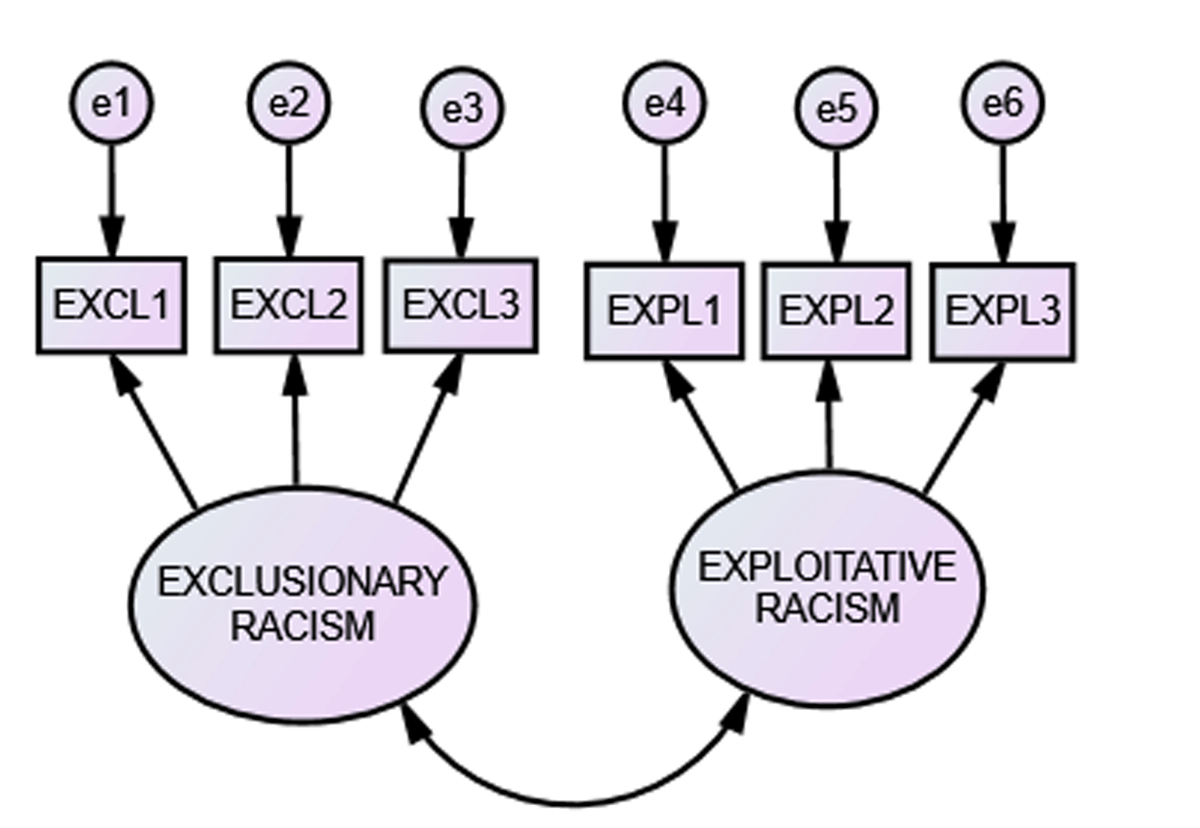
Figure 1
Model used in CFA to test the suggested factor structure for the constructed measures of exclusionary and exploitative racism (model 1).
To test the predictions regarding how exclusionary and exploitative racism would relate to socioeconomic status, structural equation modelling (SEM) was used as a data analytic technique. SEM was chosen as a data analytic method since it allows for several indicator variables per construct (e.g. socioeconomic status can be represented as a latent variable indicated by both income and education), rather than treating the indicator variables as separate variables in several separate analyses. This procedure facilitates more valid conclusions at the construct level (Tarka 2018). In addition, SEM can take measurement errors into account by including them in the model. By doing this, conclusions about the relationships between the latent variables are not biased by measurement error (Blunch 2013). A final motivation for using SEM in the present study is that it enables the simultaneous testing of a complex pattern of relationships between many variables, instead of performing several separate analyses. Maximum likelihood estimation was used to assess the parameters of the models, and we used the same estimates of model fit as in the CFA described above. The full structural model is presented in Figure 2. Apart from an adequate model fit, the regression weights of the path from ‘Socioeconomic status’ to ‘Exclusionary racism’ needed to be negative and the path from ‘Socioeconomic status’ to ‘Exploitative racism’ needed to be positive in order for our hypotheses (hypothesis 2) to be supported.
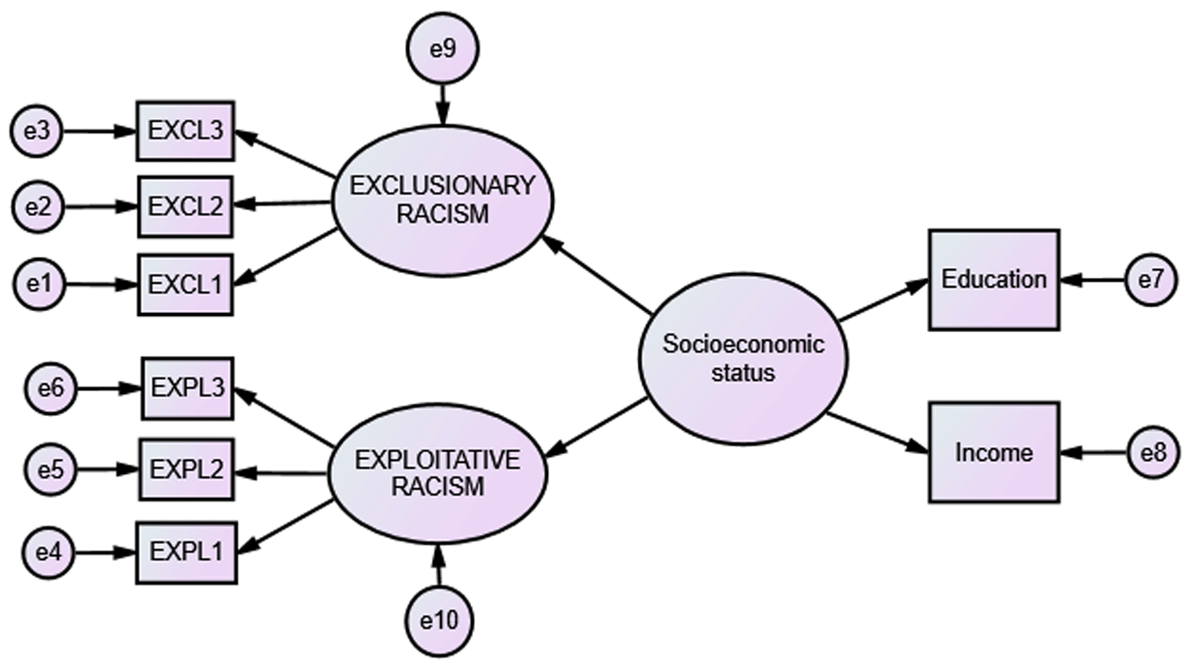
Figure 2
Model used in the SEM-analysis of the relationship between socioeconomic status and exclusionary and exploitative racism (model 2).
To test the hypothesis regarding the association between exclusionary and exploitative racism and modern racism, correlation analyses were performed, and Fisher’s r-to-z transformations were used to test the difference between the two correlation coefficients.
Results
Hypothesis 1: Exclusionary and Exploitative Racism as Separate Racial Ideologies
As previously stated, the assumption that exclusionary and exploitative racism can be empirically represented as two distinct facets of racial ideologies was tested in a CFA of the model described in Figure 1 (model 1). Fit statistics for the tested model (model 1) is presented in Table 2. As can be seen, the result indicates good model fit, hence providing support for our hypothesis (hypothesis 1) that exclusionary and exploitative racism can be represented as two separate facets of contemporary racial ideologies. In addition, the analysis indicated that exclusionary and exploitative racism were only weakly correlated with each other (r = 0.06; p < 0.01). Taken together, the performed analyses suggest that they are best represented as distinct constructs.
Hypothesis 2: The Relationship between Exclusionary and Exploitative Racism and Socioeconomic Status
The predictions regarding the associations between exclusionary and exploitative racism and socioeconomic status were tested using SEM (see section ‘Data Analysis’ for further description). The model used in the analyses is depicted in Figure 2, and Table 2 presents statistics on model fit.
As can be seen in Table 2, the results suggested that the model (model 2) provided a good fit with the data, indicating that socioeconomic status (as indicated by level of education and average monthly income) is reliably related to exclusionary and exploitative racism. Table 3 presents the path coefficients for all paths in the model. As can be seen, the paths from socioeconomic status to both exclusionary and exploitative racism are significant. In addition, the direction of these associations provided support for the hypothesis (hypothesis 2) that socioeconomic status would be negatively associated with exclusionary racism but positively associated with exploitative racism.
Table 3
Estimates for all paths in Model 2.
| PATH | UNSTANDARD REGRESSION WEIGHT | STANDARD ERROR | CRITICAL RATIO | P |
|---|---|---|---|---|
| Socioeconomic status → Exclusionary racism | –0.84 | 0.17 | –5.05 | <0.001 |
| Socioeconomic status → Exploitative racism | 0.55 | 0.13 | 4.15 | <0.001 |
| Socioeconomic status → Education | 1.00 | – | – | – |
| Socioeconomic status → Income | 8.78 | 1.68 | 5.23 | <0.001 |
| Exclusionary racism → EXCL1 | 1.00 | – | – | – |
| Exclusionary racism → EXCL2 | 1.23 | 0.03 | 47.4 | <0.001 |
| Exclusionary racism → EXCL3 | 1.05 | 0.02 | 46.0 | <0.001 |
| Exploitative racism → EXPL1 | 1.00 | – | – | – |
| Exploitative racism → EXPL2 | 1.31 | 0.04 | 32.0 | <0.001 |
| Exploitative racism → EXPL3 | 0.92 | 0.03 | 33.0 | <0.001 |
Hypothesis 3: the Relationship between Exclusionary and Exploitative Racism and Modern Racism
The associations between exclusionary and exploitative racism and modern racism were examined using bivariate correlation analyses. The results showed that the correlation between exclusionary racism and modern racism was strong and positive (r = 0.84; N = 1,922; p < 0.001), whereas the correlation between exploitative racism and the same variable was weak and negative (r = –0.04; N = 1,922; p < 0.001). In addition, Fisher’s r-to-z transformation indicated that the difference between the correlation coefficients for exclusionary and exploitative racism was statistically significant (z = 39.1, p < 0.001). Hence, the results from the performed analyses provided support for the hypothesis (hypothesis 3) that the correlation would be positive and significantly stronger between modern racism and exclusionary racism, than between modern racism and exploitative racism. The results indicate that – whereas modern racism and exclusionary racism have strong associations – exploitative racism represents a distinct and separate way of conceptualising racial ideologies.
Discussion
The purpose of the present study was to investigate whether exclusionary and exploitative racism can be empirically represented as two separate racial ideologies and to test theoretically grounded assumptions regarding how these ideologies relate to socioeconomic status. In addition, the study sought to investigate the relationship between exclusionary and exploitative racism and modern racism, which is a frequently employed operationalisation of contemporary racial ideology in Sweden.
The results of the performed study indicate that the suggested distinction between exclusionary and exploitative racism can be empirically motivated. Exclusionary racism in this context is understood as negative attitudes regarding the immigration of people racialised as non-white, and of racial and ethnic heterogeneity as something negative. Furthermore, another central aspect of exclusionary racism is the belief that the racialised other is competing for resources and social benefits such as jobs and housing, hence creating a situation where those racialised as ‘white’ are worse off. Based on previous research on the rise of right-wing populism in the United States and Europe (Rodrik 2021; Vacas & Fernández-Macías 2017), our assumption was that exclusionary racist attitudes would be more prevalent in segments of the ‘white’ population, which more clearly have been negatively affected by the development of the recent decades, characterised by neoliberal economic policies of austerity, privatisation, financial deregulation, weakening of labour unions and increased inequality (Rodrik 2021). In support of this assumption, we found exclusionary racism to be negatively related to socioeconomic status, indicating that participants with higher income and higher education tended to support such positions to a lesser extent.
Exploitative racism, on the other hand, was conceptualised as a racial ideology where the racialised ‘other’ can be used to increase profit (through lower wage costs) and render certain services more available and cheaper for privileged segments of the population. Hence, this ideological position is not characterised by negative attitudes towards immigration or resentment against people racialised as ‘non-whites.’ Instead, the position is racist in that it constructs the non-white ‘other’ as separate from the white ‘us’ and as someone that can be used to receive certain benefits or privileges. In support of this conceptualisation of exploitative racism, the present study found that this form of racial ideology was positively associated with socioeconomic status, indicating that participants with higher income and education tended to endorse such attitudes to a larger extent.
In addition, the present study tested predictions regarding how exclusionary and exploitative racism would be related to modern racism, which is a frequently used measure of racial ideology in Sweden. Here, as expected, the results indicated that exclusionary racism has a stronger positive association with modern racism, when compared to exploitative racism. This might be interpreted as reflecting the fact that modern racism contains a component of negative attitudes towards groups racialised as non-white (e.g. that they are two demanding in their struggles for equal rights and that it is ‘their own fault’ that they have worse outcomes in the labour market), as well as the fact that the denial of racism as a problem in contemporary societies is central to the operationalization of modern racism. Both of these aspects are more likely to share ideological commonalities with exclusionary racism, whereas the attitudinal core of exploitative racism is less hostile and less related to traditional conceptualisations of racism, but rather contains a stronger element of distanced condescension and an ‘othering’ aimed at legitimising exploitation and creating opportunities for increased profits.
An important aspect to discuss in relation to the results of the performed study is that the fact that exclusionary and exploitative racism are conceptually and empirically distinguishable as separate racial ideologies, does not imply that they are structurally or theoretically unrelated. On the contrary, as was discussed in the introduction, social and economic processes related to exclusion and exploitation have been central to the racial world order throughout its entire history. Not as contradictory or mutually exclusive processes, but as central and intertwined components of the dynamics of the system. In addition, one could also argue that exploitative and exclusionary racism are mutually related, in that exploitative racism as an ideological and political project paves the way for increased exclusionary racism. The argument here is that one of the central effects of exploitative racism is to create a racialized segment of the labour force which can be subject to increased exploitation, but which can also be used to create a downward pressure on wages and working conditions for the entire working class. This development will in turn create increased social inequality, produce greater economic anxiety and put the livelihood of large segments of the population under increased pressure, hence creating dissatisfaction that can then be mobilised by right-wing populist parties using the rhetoric of exclusionary racism (Rodrik 2021). However, it is important to note that the interactional dynamics between exploitative and exclusionary racism is not linear, in the sense that exploitative racism leads to increased exclusionary racism. Rather, the dynamics is reciprocal in that increases in exclusionary racism renders the racialized ‘other’ more easily exploitable (Neergaard & Mulinari 2017). Hence, exclusionary and exploitative racism are two racial ideologies that despite their apparent contradictions, are actually reciprocally reinforcing each other within the context of a racialized social system.
When interpreting the results, there are important limitations to the present study that should be kept in mind. The main limitation comes from the fact that the study uses a cross-sectional design, which renders causal inferences regarding relationship between the studied variables impossible to make. Hence, it cannot be concluded that socioeconomic status is causally related to exploitative and exclusionary racism, only that they are associated with each other in a way that fits well with the suggested model. Another important limitation is that the operationalization of exclusionary and exploitative racism in the present study relies entirely upon self-report. This leads to an increased risk for the responses to be influenced by perceived social desirability, and the validity of the constructed measures of exploitative and exclusionary racism in terms of how they are related to behaviours remains unclear. However, with regard to social desirability, one should notice that this effect is likely to counteract the hypotheses under investigation (i.e. when self-rating, people are more likely to answer in a way that makes them appear less ‘prejudiced’; Stocké & Hunkler 2007). When it comes to the generalizability and validity of the findings, the strength of the study is that it uses a comparatively large and diverse sample compared to other studies of racial ideologies in Sweden (see, e.g. Akrami, Ekehammar & Araya 2000; Schutze & Osanamni Törngren 2022). It is important to note, however, that the sample in the present study has an overrepresentation of females, is younger, and has a higher education level compared to the population statistics of the Swedish workforce, which should be taken into account when interpreting the results. Based on previous research (see, e.g. Akrami, Ekehammar & Araya 2000; Rodrik 2021), a likely consequence of this is that the sample is more progressive on issues of race and racism, at least with regard to exclusionary racial ideologies, than the general population. With regard to the hypotheses under investigation, however, this sampling issue would if anything be likely to lead to an underestimation of associations between exclusionary and exploitative racial ideology and socioeconomic status. It should also be noted that the sample is a convenience sample where we do not know how many took part in the invitation to participate, and hence cannot calculate response rates, either in general or for specific groups. Based on both of these limitations, future research should try to investigate the dynamics of exploitative and exclusionary racial ideologies using randomly selected representative samples to increase the external validity of the results.
Despite the limitations discussed above, we believe that the present study makes important conceptual and empirical contributions to the scientific understanding of contemporary forms of racial ideologies. To our knowledge, it represents the first attempt to conceptualise and measure contemporary racial ideologies along the dimensions of exclusion and exploitation, rather than focusing primarily upon exclusionary attitudes and racial resentments. In addition, the study provides empirical support for the assumption that these forms of racial ideology are differently related to both socioeconomic status and a frequently used measure of racism, thereby broadening our understanding of contemporary racial ideologies and highlights the need for future research on the ideological dynamics of racism.
Data Accessibility Statements
The data that support the findings of this study are available from the corresponding author upon reasonable request.
Ethics and Consent
The study has been performed in full agreement with the Swedish Law on Ethics in Research on Humans. All participants provided their informed consent prior to participating.
Competing Interests
The authors have no competing interests to declare.
Author Contribution
Both authors have contributed to conceptualization, design, data collection, data analyses and writing and revisions of the manuscript.