
Introduction
Maryam:1 ‘I have lived here nearly 16 years, and I’m not close to having a permanent residence permit yet. I must apply for renewal every so often, so it is an uncertain situation […] It makes me a bit sad, but I can’t really do much. It also makes me insecure now that I have a child, and my child has never seen [country of origin], and he holds the exact same permit as I do […] So, it isn’t a safe situation to be in; we never know what answer we might get.’
The above interview excerpt exemplifies how temporary protection for refugees in Denmark is a long-term condition and source of uncertainty and insecurity, which the individual cannot eliminate. Since the so-called ‘refugee crisis’ in 2015, many countries in Europe have seen a strong right-wing move to control borders and migrant mobility (Bregnbæk 2022b: 348; Shapiro & Jørgensen 2021). The current Danish policy, which has repatriation and temporary protection as its explicit goals, can be seen as a radical example of a more general trend of making refugee protection temporary. Danish politics has gone through a ‘return-turn,’ initiated in 2015 and completed with the so-called ‘Paradigm Shift’ Law, which was adopted by parliament in 2019 (Brekke, Birkvad & Erdal 2021; Stoyanova 2022; Vedsted-Hansen 2022). Denmark’s approach has been particularly strict compared to neighboring countries, and several times policies have made international headlines due to their conflict with international conventions (Bregnbæk 2022b). The Paradigm Shift law adopted in 2019 states that refugees and individuals who have been granted family reunification must have their asylum permits confiscated ‘unless this is strictly at odds with Denmark’s international obligations’ (ibid.: 354). As Jacobsen shows, through subtle, legal interventions since 2014, the idea of temporary protection has moved from being peripheral to becoming the norm in Danish immigration policies (2022: 824–25). Despite the chronicity of many conflicts and crises around the world (Vigh 2008, 2011), Danish politicians have succeeded in framing current wars and conflicts as exceptional phenomena with bounded temporalities, thereby making temporary protection for individuals fleeing from such wars a logic response (Jacobsen 2022: 822–23). In tandem with an explicit focus on temporary protection and repatriation, requirements for achieving permanent residence status have been made increasingly difficult to meet over the past two decades (Vedsted-Hansen 2022: 9). To offer unpleasant conditions to asylum seekers and refugees and to enact populist immigration policies can be viewed as examples of ‘negative nation branding’ (Gammeltoft-Hansen 2017) aimed to discourage new influxes of migrants by making it ‘less attractive’ to seek protection in Denmark (Bregnbæk 2022b: 354; Vedsted-Hansen 2022: 16; Whyte Cambell & Overgaard 2020).
The aim of this article is not to consider whether the restrictive policies or unpleasant practices have had the intended effects of limiting new influxes of migrants; rather, through an engagement with refugees’ narrated experiences of temporary protection in Denmark, this article contributes with an analysis of the effects of the ‘return-turn’ for young adults with refugee backgrounds who have spent their formative years in Denmark, and who have witnessed continuous legal modifications that hamper a conversion of their temporary asylum permits into permanent ones. Before 2015, temporary asylum permits were typically given for 5-year periods. Currently, they must be renewed every or every other year (Vedsted-Hansen 2022: 16). While this may seem like a minor, bureaucratic detail, I argue that the heightened frequency coupled with recent years’ revocations of Syrians’ temporary permits is important to pay attention to when understanding the effects of the ‘return-turn’ from the point of view of those subjected to it. As Maryam’s quote above testifies, to live with temporary protection generates basic uncertainties about one’s life: what answer will I receive next time I apply for renewal, and what happens if we are denied protection and deported to a country fully foreign to my child?
In addition to the increased focus on temporality, repatriation, and the limited duration of temporary asylum permits, I wish to highlight a modification of the requirements for permanent residency made in 2016, which particularly affects individuals who are granted protection when they are young. The modification states that education no longer counts on equal terms with ordinary employment or self-employment (Vedsted-Hansen 2022: 9). Thus, children who are granted asylum in Denmark after they have turned 10 years old2 must meet the employment requirement on equal terms with adults to have a temporary permit converted into a permanent one. This requires that the applicant has been in ordinary full-time employment or self-employment for 3½ years during the past 4 years and is currently active in the labor market (Ibid.). Even if they meet the other requirements, such as having lawful residence in Denmark for 8 years, refugees arriving at a young age often spend many years in the education system before they enter the labor market full-time. Consequently, refugees like Maryam, who came to Denmark when she was 14 years old, are subjected to temporary protection in Denmark for a prolonged period, regardless of their language mastery, societal participation, and their estrangement from their countries of origin.
In dialogue with the growing body of migration research focusing on temporality and uncertainty, combined with concepts developed in anthropological studies of long-term conflict, this article offers an original analysis of the effects of the current, politically imposed temporality. Drawing on Henrik Vigh’s (2008, 2011) work on the chronicity of violent conflict and hypervigilance as a response and mode of being in contexts marked by lack of predictability and threats of violence, the central argument developed is that long-term temporary protection subjects individuals to a situation comparable to long-term conflict, adding to the presence of both radical and protracted uncertainty (Horst & Grabska 2015). Even though the threat of physical violence is not present in the way it is in war-torn or conflict-ridden areas, I argue that to live with temporary protection for an indeterminate period of time, during which the threat of deportation to a regime one has fled from lingers like an underlying and unpredictable danger—a negative potential in Vigh’s terms (2011)—generates a sense of basic uncertainty and insecurity similar to the uncertainties and insecurities generated by long-term conflict. This sense of basic uncertainty positions young adults like Maryam in life situations where fear of deportation, as well as an active, willed hope for a long-term future in Denmark, shape everyday experience and orient actions and choices in the present. Engaging with the concepts of work of hope (Horst & Grabska 2015) and hypervigilance (Vigh 2011) makes it possible to show connections between the legal precarity produced by the return-turn in the form of temporary protection and the threat of deportation and increased precariousness in other, everyday realms. The effects of temporary protection, it will be argued, go far beyond the temporary permits per se; uncertainty becomes the basic starting point for life in exile.
Temporality and Uncertainty in Migration Research
Within migration research, temporal aspects of migration have gained increasing scholarly attention over the past decade, offering much-needed supplements to spatially oriented analyses of migration processes. Several studies pay particular attention to how migration regimes discipline and exert control over migrants through temporal exclusions (Bhatia & Canning 2021), bureaucratic violence such as structurally imposed waiting time (Abdelhady, Gren & Joormann 2020: 14), and ‘temporal borders,’ which refer to the creation of deadlines and time limits that impact migrants’ lives (Tazzioli 2018). Other studies include more phenomenologically inspired explorations of how such temporal exclusion and bordering are felt, experienced, and dealt with by migrants during various stages of the migration process (Axelsson, Malmberg & Zhang 2015; Canning 2021; Dånge 2022; Griffiths 2014; Horst & Grabska 2015; Lindberg & Edward 2021; Maury 2022; Rytter & Ghandchi 2020; Verdasco 2019; Weiss 2020).
In contexts of asylum-seeking processes (Verdasco 2019) as well as deportation centers (Canning 2021; Griffiths 2014), protracted temporariness is described as saturating everyday life. Griffiths (2014) highlights how individuals in deportation centers experience what she terms a sense of dual uncertainty. The sense of dual uncertainty is spurred by the lack of change (waiting for cases to be processed) and the imminent threat of change (being deported). Thus, the potential of rapid change, as well as a lack of change, can make people’s lives feel chaotic and unstable (Ibid.: 2001).
The sense of dual uncertainty concerns future unknowns. Horst and Grabska (2015) emphasize how the power of governments to structure migrants’ lives around deadlines, such as the creation of temporary asylum permits with frequent renewal rates, is a source of uncertainty as it keeps individuals in positions where they per definition cannot predict very basic questions concerning their near and long-term futures: where can I live, with whom, and for how long? Further, the lack of access to clear or convincing information is a source of uncertainty (Ibid.: 4). The authors describe how the lack of (reliable) information is often outspoken in conflict situations, where rumors and contradictory accounts challenge civilians’ constant attempts to find reliable information (Ibid.). I add that reliable information can be equally hard to access for individuals in exile, where bureaucratic processes and reasoning can seem deeply obscure and inaccessible (see also Maury 2022: 109; Weiss 2020: 196).
While temporality during processes of flight, asylum seeking, and deportation have gained some attention, the role of temporality and uncertainty after asylum has been granted is less illuminated. Nerina Weiss’ (2020) work adds an important move in that direction as she explores the role of waiting time for refugees who have been granted asylum in Norway. Weiss shows how individuals must often stay in reception centers for an indeterminate period after being granted asylum, waiting for available housing outside the centers. She emphasizes how the waiting time is experienced as extremely stressful and difficult (Ibid.: 197). Thus, factors related to life in exile, after being granted asylum—and not only experiences before and during flight—can be sources of traumatization and severe mental stress.
Weiss writes that the refugees in her study had received resident permits and, as such, had a secure future in Norway—albeit without knowing when it would start (Ibid.: 197). Therefore, the effects of making protection for refugees temporary are not addressed. Nor are the bureaucratic processes that follow temporary protection: frequent renewal processes and subsequent waiting while decisions regarding one’s right to stay are processed. Given the current ‘return-turn’ in migration policies in Denmark and beyond, more attention ought to be paid to these effects. Susanne Bregnbæk’s work offers important insights (2022a, 2022b), pointing to the human consequences of the paradigm shift in Danish politics and its emphasis on temporary protection for all refugees. She highlights families’ ambiguous relationship with the welfare state offering care but also potentially enacting repercussions. Focusing on Afghan refugees with temporary permits in Denmark, Rytter and Ghandchi (2020) question the celebrated ‘integration-success’ of inclusion of refugees into the Danish labor-market, showing how fear of deportation drives refugees in ‘integration programs’ to accept precarious work conditions, thereby becoming a cheap labor reserve. Working with non-European migrant students in Finland, and not asylum seekers or refugees, Olivia Maury (2022) develops a similar argument in relation to temporary permits. She shows how the annually recurring, obscure, and long, drawn-out processes of renewing temporary student permits both limit students’ mobility and keep them in precarious, low-paid jobs (Ibid.: 106). In this sense, the temporary permits become a temporal border that functions as a technology (i.e., Tazzioli 2018: 4) to control migrants’ mobility and add to a low-paid labor force (Maury 2022: 101). Also focusing on the impact of return-turn and temporal protection in a Danish context, Louise Dånge (2022) follows recently arrived young refugees’ resettlement in Denmark and their navigation toward future aspirations, in which they juggle the paradox of being expected to integrate as well as repatriate.
Building on the above, this article supplements existing research with a focused analysis of the role of being subjected to long-term temporary protection by engaging with the perspectives of young adults who have spent their formative years in Denmark. These young adults are neither in resettlement processes nor integration programs, as they had spent as many as 16 years in Denmark when I met them. Nevertheless, they are still subjected to temporary protection and frequent renewal processes. In particular, the article argues that temporal borders (Maury 2022; Tazzioli 2018), in the form of frequent renewals of residence permits coupled with requirements for permanent residency that are difficult to meet, create life situations in which unpredictability is not an exception but a permanent condition (i.e., Vigh 2008) that saturates everyday life with various forms of uncertainty. It is marked by a dual sense of uncertainty (Griffiths 2014; Weiss 2020), where change is both absent (individuals only slowly move closer to permanent residency) and imminent (individuals never know whether their right to stay will be revoked: they are ‘deportable’ to paraphrase Poulsen (in press)).
Further, Horst and Grabska’s (2015) distinction between radical and protracted uncertainty offers important nuances when understanding the effects of temporary protection for refugees in Denmark. The authors show how radical uncertainty, entailing unpredictability about the immediate future, is closely connected with actual flight situations. Here, decisions are made in an environment characterized by rapid and dramatic events, whereas protracted uncertainty, entailing a more long-term form of uncertainty, is often characteristic of life in exile (Ibid.: 6). However, this article nuances this distinction. It will be shown how refugees with temporary permits are subjected to what I describe as a detrimental combination of protracted and radical uncertainty: years on end of not knowing whether they can remain in Denmark long-term while undergoing recurrent application processes and subsequent waiting time, coupled with periods where the unpredictability of the immediate future is felt to be more urgent due to dramatic events such as an interview with Immigration Services or a permit revocation.
To illuminate the effects of living with such uncertainty long-term, the article engages with the work of anthropologist Henrik Vigh on the chronicity of crises (2008) and hypervigilance (2011). Vigh’s work is based on fieldwork in Guinea-Bissau and Belfast, where long-term conflict has made violence and harm a chronic threat in everyday life. A hypervigilant mode of action entails engagement with future unknowns, and it entails heightened attentiveness toward negative potentials, always being on the watch to steer free from unpredictable dangers in the form of physical violence and other harms (Ibid.: 94). Applying Vigh’s concepts to the current analysis, it is important to emphasize that in this context, it is not the threat of physical violence that makes up the immediate danger. Rather, it is the ever-present threat of deportation. Further, hypervigilant behavior in this context is not solely about steering free of dangers. Whereas negative potentiality is central in Vigh’s work, it will be shown how hypervigilance in the context of temporary protection for refugees in Denmark is linked simultaneously to fear of dangers as well as hope: to steer free of dangers is essential to nourish hope for the future and a sense of progress toward permanent protection.
Methodology
The fieldwork underpinning this study was carried out in spring 2021, and the empirical material consists of a combination of introductory participant observation and semi-structured interviews. Study participants include adults aged 18–33 who live with a temporary residence permit—either as refugees who have been granted asylum or as relatives who have been reunited with a family member who have been granted asylum—and who came to Denmark when they were young, that is, between 12 and 22 years old. Participants have different national backgrounds (see Figure 1).
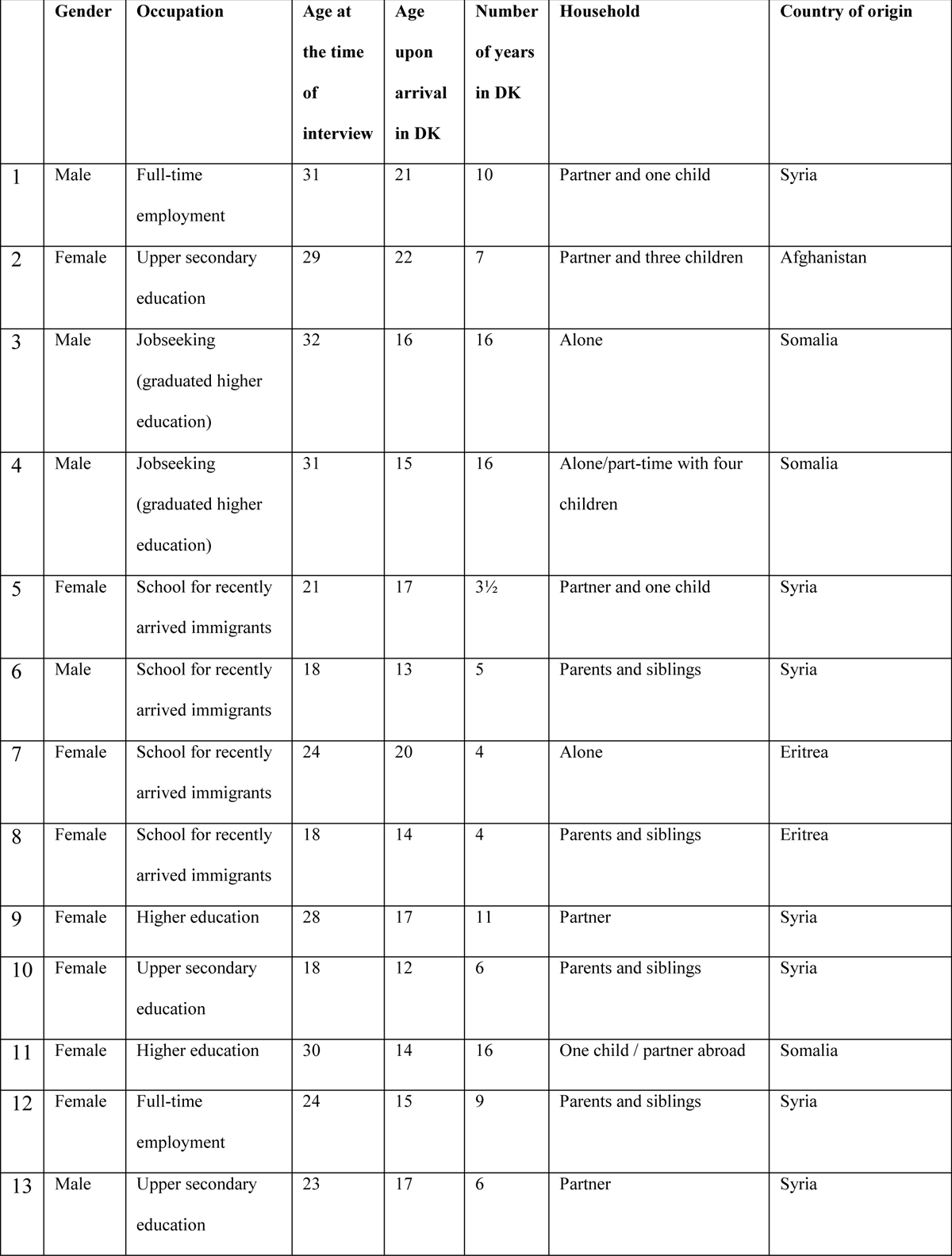
Figure 1
Overview of study participants.
I initially conducted 3 days of participant observation in a school for newly arrived foreigners aged between 14 and 22. This served three purposes: it afforded a platform for presenting the study and inviting students to participate in later interviews; it provided me with a sense of how everyday life in the school played out, and it gave me a common frame of reference during later interview situations. Besides recruiting participants among students currently attending the school, a former teacher at the school served as a gatekeeper (O’Reilly 2011) and put me in contact with former students. This provided an opportunity to talk to individuals who had more long-term experience with life in Denmark. In addition, I relied on a snowballing approach, where interview subjects put me in touch with others. In total, I conducted 13 semi-structured interviews of 30–120 minutes’ duration, which were recorded and transcribed. For ethical reasons, all participants signed an informed consent letter and were given an information letter, where it was stated that participation was voluntary, that participants could withdraw at any time, and that confidentiality would be strived for by using pseudonyms and excluding information that could reveal their identity. Further, the study was registered in the institutional data protection scheme.
The overall methodological approach can be characterized as what Bøttcher et al. (2018) term ‘cyclical inductive-deductive.’ This entails an approach where existing concepts inform themes prepared in the interview guide, but where openness to new themes and questions brought about by participants is equally central in spurring explorations of new concepts, thus creating a cyclical process. It is important to note that the analysis presented below does not represent all the empirical material collected in this study. The interview material has been read and coded thematically across interviews (Brøndum 2018). The analysis strategy has been to filter the empirical material to present findings on themes concerning the future and the role of living with temporary protection. The choice to focus the analysis on these matters rests on the observation that living with temporary permits presented itself as a great concern to most participants in the study, and it takes up substantial space in the empirical material. Often, questions concerning temporary protection overlap with considerations about education, work, and family life. A consequence of this analytical choice is that the refugee identity stands out in ways that participants do not necessarily identify with or wish it to do in everyday life, and the reader should be aware of this analytical construction.
Research Context
Revocations of Temporary Permits
Already during 2019, Denmark, as the only country in Europe, assessed that the general security situation in Damascus was improved (Bendixen 2021). On this basis, the Danish Immigration Services began to revoke temporary residence permits to Syrians from Damascus who had been granted asylum based on the general security situation in the country (Bendixen 2021; Jacobsen 2022). In spring 2021, Danish authorities assessed that the security situation in the greater region, Rif Damascus, was improved. Consequently, hundreds of Syrians from the region had their temporary permits revoked. In autumn 2021, 90 persons had lost their permit for good (Bendixen 2021).
Even though none of my interlocutors had their permits revoked (yet), this makes up an important context for the study. For everyone I talked to, regardless of country of origin or type of protection, it has caused great distress, both because the legal arguments underpinning the revocations are not entirely clear and because people know from experience that the legal landscape surrounding their current rights is prone to change. Some had friends whose permits had been withdrawn. Others expressed fear that they or close relatives would be next. A report published by the Danish Refugee Council confirms that refugees across ethnicities and legal statuses experience distress due to a heightened focus on temporary protection (Bækgaard 2019). Social workers describe how trauma treatment has been undermined due to the increased focus on temporary protection and deportations, as clients do not experience being on safe ground (Kusk & Jessen 2022). What had previously only been a negative—and perhaps unlikely—potential was widely realized in spring 2021, and it reminded everyone with a temporary permit of their vulnerability in relation to the state’s ability to enact deportations.
Imagining Futures in Denmark: Protracted Uncertainty
Horst and Grabska show how displaced persons often find it challenging to envisage their future in exile (2015: 7). To accept and to imagine a future elsewhere than the homeland can be a challenge for people forced to flee for whom the country of origin may represent memories of a good life before conflict, while the country of exile may be marked by a sense of estrangement (e.g., Ahmed 2000; Bregnbæk 2022b). Among the young adults participating in this study, the reverse tendency can be observed: for most of them, the country of origin mainly represents memories of war and a sense of estrangement, and it is difficult, if not impossible, for them to imagine a future there. For those who have had children since they came to Denmark, the country of origin represents a fully foreign place to their children. When asked to describe a future they hope for, they describe life in Denmark. Roble, a 33-year-old man who has lived in Denmark since he was around 17 years old, tells me:
The only country I know is Denmark, and my country, what do I know from there? Just my grandmother who says, ‘lay down flat on your tummy!’, and we don’t have any good memories from [country of origin]; the only good memories are from here in Denmark, and it’s fair enough, I don’t feel that I’m not Danish, but I feel the damn residence permit [because it is temporary].
Salma, a 24-year-old woman who has lived in Denmark since she was 15, expresses the following about her future imaginations:
It changes all the time [giggles a bit]! I hope I still work as a dentist’s assistant […] And that I’m in the process of applying for permanent residency, or that I have it already. And that I am still here in Denmark […]. Because I always create my future … I mean, I always imagine that I am here in Denmark.
However, even though my interlocutors imagine and hope for a future in Denmark and emphasize the importance of converting their temporary permit into a permanent one, they all struggle with the uncertainties connected with the temporary permit. Salma explains:
Researcher: ‘Yeah, so if your future in five years looks like your life now, then it is actually a good future? Just with a permanent residence permit instead of a temporary one?’
Salma: ‘Yes, because I can’t create a future with a temporary permit. If I get a permanent permit, I might be able to think about something else. Try a new job or something … ’
That it is not possible to create a future with a temporary permit reflects the dual uncertainty (Griffiths 2014) inherent in such a legal status: Salma and others do not know whether they will be deported, and they do not know if or when they will get a permanent residence permit. For most, it confines future-oriented plans, such as changing jobs, starting a family, traveling, or finding a permanent place to settle down. Resonating Weiss’ (2020) work, to be in a temporary position for an indeterminate period is felt to be extremely stressful and detrimental, particularly to those who have lived in Denmark for many years, who express ‘feeling worth less and less.’
To illustrate the duration of time in which refugees who have come to Denmark when they were young can be subjected to temporary protection, a timeline is offered below of the trajectory in Denmark of one of the participants, Maryam:
2005: as a 14-year-old, she is granted family reunification with her father together with her siblings. She attends a reception class for one year.
2006–2011: she attends language school and graduates 9th grade (lower secondary school).
2012: she repeats 9th grade to improve her grades, especially in Danish.
2013: she attends and graduates 10th grade.
2014–2016: she attends and graduates Higher Preparatory Examination (HF).
2016: she applies for higher education. She is accepted in her second priority, where she studies one semester.
2017: she applies for her first priority and is accepted for enrollment in 2018.
2018: she has her first child and is on maternity leave for one year.
2019: she begins her first priority education.
2021: she has completed the first five semesters of her study within the prescribed time frame. She begins maternity leave with her second child.
Maryam is now 30 years old, and she has been living in Denmark for more than half her life. If she completes her studies on time in 2023, which she plans to do, she must work full time for at least 3½ years thereafter before she meets the current criteria for permanent residency (Vedsted-Hansen 2022: 9). By then, she will have spent at least 21½ years with only temporary protection.
Even though politicians frame the wars that individuals seek protection from as exceptional phenomena with a bounded temporality to justify why protection should be temporary (Jacobsen 2022: 823), the insecurity and conflicts people flee from often develop into chronic crises. Consequently, refugees’ need for protection is often chronic. Leaning toward Vigh’s work on crisis and chronicity (2008, 2011), in which the chronicity of wars, conflicts, and other crises is put at the forefront, I wish to emphasize the way in which the return-turn in Danish migration policy makes temporary protection a permanent condition for individuals such as Maryam. To understand what it means to live with temporary protection in Denmark, therefore, requires us to approach it not as a transitional phenomenon but rather as a chronic ‘terrain of action and meaning’ (Vigh 2008: 8), as a starting point from which refugees in Denmark must form their lives. To understand what this terrain of temporary protection looks and feels like, below I show how the slow, protracted uncertainty described above is combined at times with a more radical sense of uncertainty, spurred by unexpected events that generate fear of what the immediate future holds.
“You Wait and Every Day You Check Your E-Boks”: Radical Uncertainty
Yasmin came to Denmark in 2010, when she was 17 years old. She spent the first 4 years in Denmark in an asylum center together with her father and brother. It was a very difficult time for her, living in an asylum center for so long without knowing what the outcome of her application would be. She was granted asylum in 2014 and given a temporary residence permit for 5 years. She also applied for family reunification with her mother and husband, started school, and began to establish her life in Denmark. However, when she applied for renewal of her residence permit at the required deadline—after the Paradigm Shift—she received an unexpected letter from the Danish Immigration Services. Yasmin narrates the story to me in an agitated voice:
When I had sent the application, I received a letter in E-Boks3 stating that I had to go for an interview with Immigration Services in Copenhagen. And I was like, “Oh! What does this mean?” Because I know a lot of people from [country of origin] whose permits were just renewed after two or three months.
Yasmin was scared that she could be sent away straight after the interview. Before traveling to Copenhagen for the interview, she said goodbye to her peers and her teacher, as she was unsure if she will return to school:
‘It was so difficult to be in school and leave, and I was so sad, and I thought about it and stressed about it. I said to my teacher, “I don’t know what I can do.” […] There [at the interview] was an interpreter and a man who said he was a caseworker or something, and he begins to ask me about all sorts of stuff, “what will you do if you are sent back?.” And I got so upset and stressed, and I cried. I said, “I have nothing left. My life is here now.” […] I did the interview in December 2020, and I received an answer in March or April, so about three months later. And during that time, you wait, and you don’t know what is going to happen. Because you wait and every day you check your E-Boks. And finally, they told me, “Two years” […].
Researcher: ‘Did they tell you why you had to be interviewed? Do they select people randomly?’
Yasmin: ‘That’s the thing, not everyone has to go. I know people who’ve just had it renewed for two more years without an interview. So, it’s not everyone, so you don’t know what it means or how their system works.’
To be called for an interview with Immigration Services, and not knowing the reason why one is called or what the outcomes of the interview will or can be is a source of radical uncertainty (Horst & Grabska 2015), as it sparks fear of what the immediate future holds. That the bureaucratic processes surrounding renewal processes are obscure (i.e., Maury 2022: 109) and that information about the purpose and potential outcome of the interview is not made available to Yasmin, adds to the sense of radical uncertainty. Yasmin feared for her immediate future and described how she was in a position of constant waiting until she received an answer from Immigration Services. The waiting time was felt to be very stressful, challenging Yasmin’s participation in her education and her general well-being and resonating Weiss’ work (2020: 197). Upon receiving an answer, Yasmin did not feel at ease, as it does not eliminate the temporariness of her protection, which is the source of the uncertainty and insecurity she experiences:
Yasmin: ‘When I think about that I might have to go to such an interview again in two years, and again, and again, and again … And I can’t apply for a permanent residence permit yet; I must finish my studies and then work. And then when I’ve worked, I can apply for a permanent residence permit. Because it is so important to apply for a permanent residence permit and later citizenship […] It would give me some peace because, constantly, you think about this. Two years pass by like this [claps her hands]. They pass so fast! […] We have to say, ‘we don’t know, maybe’, it is always with us. We have that insecurity all the time; we have something that weigh us down, constantly.’
In the above excerpt, Yasmin pinpoints how the temporal borders (Tazzioli 2018), combining frequent renewal processes and requirements for permanent permits that make temporary protection take on a chronic character, create a detrimental combination of protracted and radical uncertainty. Rather than adding to a sense of time being punctuated (Maury 2022), Yasmin’s experience reflects a sense of temporal looping (Poulsen in progress): a continuous circular repetition of renewing her temporary permit that does not generate much sense of progress toward permanent protection but rather keeps her in a chronic circular movement over which she has little influence. To hold temporary protection entails a sense of being deportable, and, as Poulsen (ibid.) shows, this undermines the sense of actually being protected.
The question remains of how such outspoken uncertainty and unpredictability are dealt with. If the starting point is uncertainty and unpredictability, to cope with such situations cannot rely merely on available information as it involves dealing with future unknowns. Horst and Grabska describe the work of hope (2015: 10) as one strategy often adopted by individuals in contexts marked by protracted uncertainty. Vigh (2011) suggests hypervigilance to be another such strategy. Below, I unfold how individuals adopt both strategies and explore how the two interact.
Works of Hope
Maryam tells me how she has done ‘as much as possible,’ meaning she has studied all the years she has lived in Denmark. Nevertheless, she is still subjected to what Griffiths (2014) terms the dual sense of uncertainty: her life situation is simultaneously marked by a lack of change—she has spent 16 years in Denmark with a temporary permit—and fear of change—her temporary permit might be revoked. Yet, Maryam still expresses hope for the future:
Maryam: ‘But I hope to … when I graduate, then I hope I can work for the years required in order to get a permanent residence permit. […] I mean, it is not that I couldn’t get a job, but I’ve always focused on getting an education; I think it’s important. Then your future is secured […] [In five years,] I hope to have finished my education and have a job and a permanent residence permit, and maybe I am in the process of applying for citizenship. It’s a big dream for me. I hope I achieve this within five years …’
Horst and Grabska describe how the work of hope can be a mediator of future unpredictability and a driver of action (2015: 10). To stay hopeful in contexts of protracted uncertainty and instability can be considered an achievement, a willed action that prevents resignation and encourages action (Ibid.: 11), and it makes it possible to resist political intentions of making protection in Denmark temporary (i.e., Lindberg & Edward 2021: 91). For Maryam, to continue with her education and then aim for employment gives her hope of reaching a desired future long-term, both with regards to the kind of work she will be doing, but also regarding getting a permanent residence permit and, eventually, citizenship.
For couples where both hold a temporary permit, the work of hope also entails concentrating efforts in different realms. Amir is 29 years old. He came to Denmark when he was 20, and he has started a family. His wife was expecting their second child at the time of our interview. Amir has chosen to put his educational aspirations on hold. Currently, he works full time, while his spouse is studying when she is not on maternity leave. The choice to put his studies on hold in favor of working was made partly because he secured a good opportunity, partly to give them better financial security, but his temporary residence permit and the employment criteria also take up space in Amir’s considerations:
‘I mean, so far, I heard about the rules and that there are 500 families whose permits were not renewed, and of course it gives us … we begin to think about ‘what will happen if I’m next?’ and stuff like that; you think about it [……] I hope in five years that I will have permanent residency, that’s the most important thing for me. Because I’m not that worried about myself and my life. It’s my kids, right; they’re born and raised in Denmark; they’re safe and well here, and, if they take them elsewhere, it will affect them a lot, so it is very important for me.’
To put his education on hold to work enables Amir and his family to hope for a secure future in Denmark. Several of the study participants have children, and they all emphasize how this alters their uncertain situation. To imagine the life of their children in a, to them, foreign country is unbearable. Therefore, it is central for them to strategize in order to minimize the time they are subjected to temporary protection.
But the hope Amir, Maryam, and others work to keep alive through long-term planning is fragile. They know that the security assessments of their countries of origin or the legal landscape, which they navigate within may change before they meet the current requirements. Further, and central to the analysis below, the current legal landscape is complex and not fully transparent to them, and fear of doing something that could jeopardize their sense of hope and slow progress toward permanent protection is outspoken.
Hypervigilance and the Governing Effects of Temporary Protection
When uncertainty and unpredictability are not a transitional phenomenon but made a starting point for individuals’ living and being, it spurs a heightened attentiveness toward negative potentials and dangers looming: what Vigh terms hypervigilance (2011). To work to stay hopeful and to be hypervigilant toward dangers can be seen as two sides of the same coin: negative potentials prolonging the time one is subjected to temporary protection are to be avoided if the hope of a desired long-term future is to live on. That this hypervigilant attentiveness in turn can add to precarity in other, everyday realms will be shown below.
Amina is 29 years old. She came to Denmark when she was 22, and she lives with her husband and their three children. Amina worries about the temporary residence permits. She fears that her children will be sent back to a country they have never known. Amina and her husband have a strategy, however. While she aspires for further education, he works full time as a cleaning assistant, hoping to be able to meet the employment criteria in a couple of years. If her husband gets a permanent residence permit, Amina hopes it will increase the chance that their three children can stay in Denmark. She tells me it was very difficult for her husband to enter the labor market in the first place. He sent hundreds of applications and did hard, physical work in unpaid internships for a long time. The job he currently holds is central to the family, not just because of the salary he earns but also because it enables them to nourish their hope of getting a permanent residence permit. I ask Amina about her husband’s job:
Researcher: ‘But where he works now, is he paid properly, and is it steady work? It sounds good even though it also sounds like hard work.’
Amina: ‘Mmm … He is scared. If he is ill one day, I tell him, “call in sick”, but he says “no! I’m scared of losing this job”.’
Researcher: ‘So, he never calls in sick?’
Amina: ‘No. You should see his hands. He has eczema on his hands; it’s itchy, and it’s really bothering him, but he continues because he fears losing the job he finally got after so many applications.’
The above excerpts testify to links between temporary protection and increased precarity in other, everyday realms. Amina’s husband is scared that demanding basic rights at the workplace could jeopardize his employment—which in itself is felt to be precarious as he is employed as an unskilled laborer—and thereby undermine their possibilities for getting a permanent residence permit. His employer has not made any explicit threats. Rather, Amina’s husband’s actions are marked by hypervigilance. He is oriented toward not-yet-manifest negative potentials (Vigh 2011). Similarly, Amina tells me how she does not dare to contact the municipality to explore options for receiving economic support over the summer when she has no income:
Amina: ‘I ask all kinds of people who have lived here for a long time, and my bonus parents, but they don’t know that much about it. […] And I don’t know who to ask from the municipality—the department of cash benefit? And I think … if I at some point want to get Danish citizenship or permanent residency, then it could have a negative effect if you received something from the municipality within the last nine years, so I actually don’t dare to ask the municipality … ’
Long-term temporary protection with built-in frequent renewal processes spurs people to be extremely attentive toward actions that could potentially jeopardize their progress toward permanent residence permits. In this sense, to be subjected to temporary protection in Denmark is argued to spur hypervigilant behavior comparable to how Vigh (Ibid.) shows long-term conflict spurs hypervigilance. However, in Denmark, it is not the threat of immediate physical violence individuals with temporary permits face. Rather, the politically imposed temporality can be viewed as a form of bureaucratic violence (Arendt in Abdelhady, Gren & Joormann 2020: 13), which threatens to revoke rights to protection at any point. From personal, practical experience, and from the multiple examples of Syrians who have had their temporary permits withdrawn, refugees holding temporary permits know that it does not entail safe ground.
Several scholars have emphasized how waiting time and temporal borders, for example, in the form of frequent renewals of temporary permits, can serve as efficient governance technologies to discipline and control migrants (Maury 2022: 108; Tazzioli 2018; Weiss 2020: 197;). Likewise, the examples above show how temporary permits have a strong governing effect on the individuals subjected to them. Difficult work conditions are accepted, and rights to economic support are not claimed nor sought clarified. In general, attention from authorities is avoided. From a state perspective, high employment rates and low rates of cash benefits may be celebrated as successful disciplining of refugees (e.g., Rytter and Ghandchi 2020). From the perspective of my interlocutors, fear of undermining chances of permanent residency, and fear of increasing the time they are subjected to temporary protection, increase precarity in other everyday realms in the present, and cause economic distress, poor health, and so on.
In her study among migrant workers with temporary residence rights, Axelsson describes a similar dynamic where migrants do not refuse precarious job arrangements because it might jeopardize their possibilities to secure work in the future (2015: 23). However, for refugees with temporary permits, tolerating precarious work conditions reflects a two-fold concern that is important to keep in mind: it reflects the hope for a secure future in Denmark, which is closely related to the fear of being deported to a country they fled from due to insecurity. Even if the threat of deportation is never realized, the threat in itself has detrimental consequences for the individual.
Conclusion
Recent years’ political developments in Denmark have made temporary protection for refugees and frequent reassessments a long-term condition. My aim in this article has been to unfold how this condition—long-term temporary protection and the looming threat of deportation—is experienced and handled by young adults who have spent their formative years in Denmark. By showing how the ‘return-turn’ generates basic uncertainties that become the starting point for the young adults’ lives in Denmark, and by engaging with recent research within the field of migration studies focused on temporal aspects of migration as well as the anthropology of conflict and violence, the article contributes with new insights into the effects of the current migration regime in Denmark. I highlight three key takeaways below.
Firstly, the argument developed throughout the article is that uncertainty is not only a premise during processes of flight and asylum-seeking (Verdasco 2019) or during deportation processes (Griffiths 2014). Given the current return-turn in migration policies (Vedsted-Hansen 2022), outspoken uncertainty continues to be a basic condition for refugees many years after asylum has been granted. The young adults who participated in this study all experienced a sense of dual uncertainty (Griffiths 2014) in their everyday lives marked by the simultaneous presence of a lack of change (slow progress toward permanent protection) and the immediate threat of change (deportation). The image of a temporal loop (Poulsen, in press) aims to capture this sense of being caught in a repetitive, circular movement without much progress or possibility to influence the speed or direction but with a constant, at times heightened, fear of falling out. Further, to highlight the detrimental presence of both protracted and radical uncertainty (Horst & and Grabska 2015) underscores that long-term protracted uncertainty is combined with moments (stretching over months) where the fear of deportation is felt to be more urgent. The temporal borders (Tazzioli 2018), in the form of frequent reassessment procedures coupled with examples of revocations are central sources of radical uncertainty, while the current criteria for permanent residency inevitably generate protracted uncertainty.
Secondly, by engaging with the experiences of young adults who have been subjected to temporary protection long-term, the article argues that life with temporary protection creates conditions and spurs behavior comparable to life in contexts marked by long-term conflict and violence, making uncertainty the starting point for being and acting in the world (Vigh 2008, 2011). This analytical prism paves the way for an analysis that dwells on the effects of temporary protection beyond the legal realm. Everyday realms at present are saturated by uncertainty and existential unknowns.
Thirdly, building on the above, the article shows how the work of hope (Horst & Grabska 2015), focused on a desired, long-term future, and vigilant behavior (Vigh 2011), focused on avoiding potential dangers, both serve to deal with the uncertainty experienced. However, while individuals actively engage with and try their best to navigate their uncertain situations, temporary protection is argued to have a strong governing effect. Individuals’ possibilities to claim or investigate rights are undermined because they fear prolonging the time they and their relatives (especially children) are subjected to temporary protection and thus implicitly categorized as ‘deportable.’ Resonating Rytter and Ghandchi (2020: 186), temporary protection, frequent renewal processes, and the current criteria for permanent residency create a precarious subclass of people, who cannot claim or investigate rights.
I round off the article with a quote from Roble, whose words call for a continued, critical reflection on the human consequences of being subjected to temporary protection long-term and on the kind of protection formally recognized refugees are currently offered in Denmark:
Roble: ‘I can’t just be kept down, completely down, completely down, and then suddenly one day [if a permanent residence status is granted] say, “now I’m all the way up here” [gesticulating with his hands]. I just can’t. […] The older you get, the less you feel worth.’
Notes
[2] For children who are granted asylum before they turn ten years old, there is a possibility to apply for permanent residency when they turn 18 without fulfilling the employment criteria. Children and young people who are granted asylum after they have turned ten years old must meet the same requirements as adults (https://nyidanmark.dk/da/Applying/Permanent%20residence%20permit).
Acknowledgements
I thank all the participants in this study for taking time to talk with me and share their experiences. Further, I would like to thank colleagues at the research programme for Everyday Life and Leissure Activities, VIA University College, Mikkel Rytter as well as anonymous reviewers for constructive comments on earlier drafts.
Competing Interests
The author has no competing interests to declare.