
I. Introduction
In an influential article, philosopher Mark Sagoff distinguishes two kinds of art restoration – purist and integral restoration – which he took to exemplify different ideas about what is permissible in restoration:
An integral restoration puts new pieces in the place of original fragments which have been lost; a purist restoration limits itself to cleaning works of art and to reattaching original pieces that may have fallen. Purists contend that nothing inauthentic—nothing not produced by the original artist—may be shown. If damage obscures the style of the original, a purist may allow a few substitutions, but only in outline or in another color, to avoid any pretense of authenticity.1
The distinction drawn by Sagoff corresponds to a genuine divergence of approaches in the practice of restoration and so allows for easy illustration. Sagoff’s own example of an integral restoration is the restoration in the 1970s of Michelangelo’s Pietà, which involved the replacement of (damaged) authentic parts with (intact) inauthentic parts. A clear example of a purist restoration is the restoration in the 1950s and 1980s of Laocoön and His Sons, which involved the replacement of (intact) inauthentic parts with (damaged) authentic parts. However, Sagoff’s way of drawing the distinction obfuscates the fact that purist restoration can be remedial as well as preventive.2
Preventive purism demands of restorers that they limit themselves to cleaning works and to reattaching parts that were removed or had fallen off. Adding new parts to a work is not permitted. If an exception needs to be made, for example to preserve the work or to render it ‘legible’, then what the restorer adds needs to be visibly different from what the original artist put in place. In this way, there is no risk that inauthentic parts (of the work or of the hybrid object constructed during restoration) get mistaken for authentic parts of the work.
The most eye-catching examples of preventive purism probably are found in architecture. Think, for example, of the modern structures that were added during the restoration of classical buildings such as the Reichstag in Berlin, the Monnaie Theatre in Brussels, and the Opera House in Lyon. In a similar vein, some architects have wanted to add a glass and steel structure to Notre Dame Cathedral in Paris to replace the roof that was destroyed in a fire in 2019.3 In each of these cases, stylistic features were supposed to make new parts easily distinguishable from original parts so that any semblance of authenticity is avoided. As the recommendation is formulated in the Venice Charter for the Conservation and Restoration of Monuments and Sites: ‘[A]ny extra work which is indispensable must be distinct from the architectural composition and must bear a contemporary stamp.’4
Remedial purism demands of restorers that they remove everything that is inauthentic, for example paint applied by restorers who did not heed the principles of preventive purism. As in the case of preventive purism, the demand is meant to avoid any conflation of authentic and inauthentic material, which – purists fear – might impede a proper aesthetic experience of the work in question and even amount to a form of deception (think of what is sometimes called ‘hyper-restoration’).5
Although remedial purism has, to my knowledge, not been codified in guidelines or charters, it does capture an important part of the contemporary practice of restoration. Representative of this part are various twentieth- and twenty-first-century de-restorations carried out with an overriding concern for authenticity, for example the de-restoration of the Laocoön sculpture mentioned above and the de-restoration of the Landsdowne Herakles sculpture, an ancient Roman sculpture whose eighteenth-century marble additions were removed in the 1970s because of purist scruples.6 As the conservator responsible for the de-restoration put it, ‘[t]he new restoration of the statue was made not only for technical reasons, but also to show the original as much as possible free of alien additions’.7 The recent (de-)restoration of the Ghent Altarpiece, to be discussed at length in Section III, is another case in point. As one of the conservators involved in this restoration put it, ‘[t]he goal of our conservation was –and still is – to remove everything that we are 100% sure is not original’.8
Preventive purism does not entail remedial purism. The first says ‘Don’t add!’ whereas the second says ‘Remove!’ Even if the removal of inauthentic parts counts as a form of cleaning, it is only permitted by preventive purism, while remedial purism requires it. This is not just a logical point. At least in particular cases, there may be good practical reasons for selectively opting out of remedial purism, for example when the removal of certain inauthentic parts is likely to cause permanent damage to a work. It is harder to think of cases where one opts for remedial purism while going against preventive purism. In any case, the two prescriptions are not equivalent. Nonetheless, they are connected by a common concern for material authenticity in the sense that the origin or provenance of material parts such as paint layers is considered of the utmost importance. (Henceforth, ‘authenticity’ shall mean ‘material authenticity’.) As Sagoff put it in the passage quoted above, ‘[p]urists contend that nothing inauthentic – nothing not produced by the original artist – may be shown’. If that is the underlying conviction, then the goal of both preventive and remedial purism seems to be to obtain an object – or a visually distinguishable portion of an object – that is completely free of inauthentic additions.
The term ‘(in)authentic’ is often considered problematic in the theory of conservation. For example, Salvador Muñoz-Viñas has argued that the term can only be used to state tautologies or contradictions.9 In a similar vein, David A. Scott has pointed out that the term is multiply ambiguous.10 However, the meaning assigned to ‘authentic’ by philosophers such as Sagoff is a very specific one, concerning the provenance of anything that could reasonably be taken to be part of a work, for example because it is attached to the work or because it is in the same location as the work. In this sense, to state that a putative part of a work is authentic is to state that it was produced by whoever produced the work. Such a statement may be hard to evaluate in a particular case, but conceptually it is not more problematic – tautologous, contradictory, or ambiguous – than stating that the engine of a certain Toyota car was produced by BMW. Hence, in what follows, purism will not be rejected on conceptual grounds.
Like any other conviction, purism comes in degrees. A moderate purist might regard its demands as prima facie duties (in Ross’s sense) only,11 whereas a radical purist would probably regard them as absolute or categorical. In what follows, my concern will be with more radical varieties of purism, ones that leave very little (not necessarily zero) room for exceptions. An example of a radical variety that still allows for exceptions is one that adheres to the demands of purism in all circumstances except where the demands conflict with the continued existence of the work.
II. The Perils of Purism
Purism faces an obvious practical problem in that it is often uncertain what is authentic and what is not. This would not be much of a problem if removing parts were always reversible. Unfortunately, it is not. For example, removing paint with solvents and scalpels – a common operation condoned by purists – is irreversible.
The problem of uncertainty is compounded by the fact that purism encourages risk taking in two ways: first, by encouraging interventions; second, by blinding one to the risks involved. These are the two ‘perils’ of purism that the title refers to.
To start with the first: recall that the goal of purist restoration is to obtain an object free from inauthentic additions. This goal naturally propels purists to dig deeper and deeper, as it were, until every inauthentic layer has been removed. To be removed in the first place are layers produced by other artists and restorers, of which there are usually plenty in older paintings such as the Ghent Altarpiece. Even patina would have to be removed because it is not produced by the artist and so, strictly speaking, it is inauthentic. Few purists will admit to being under an obligation to remove patina, however; such is the respectability patina enjoys thanks to the work of Cesare Brandi and others.12 Instead, purists may say that they are trying to return the original appearance of the work – something that is hard to achieve without the removal of patina. For example, the conservator quoted earlier wrote that ‘we would like to come as close as possible to how The Ghent Altarpiece appeared when Jan Van Eyck finished working on it in 1432’.13 This is a clear but by no means exceptional indication of where one is led when one takes purism to its logical conclusion.
Even if patina can be considered authentic in some broader sense, there usually is a history of past interventions that the purist will have to systematically undo, for example by stripping off paint layers or by removing marble components from a sculpture. At each step in the process, it becomes at least slightly more likely that restoration has gone too far. Although the process may be reversible in the case of sculptures (for example, the Landsdowne Herakles appears to be impeccably re-restored), paintings are almost certain to come out as permanently damaged.
Meanwhile, very little weight is given to judgements of authenticity based on what might loosely be called ‘intuitive’ considerations; instead, one relies almost entirely on results obtained by natural-scientific methods such as radiography and chemical analysis. Although these results usually leave many possibilities open, their scientific status may create the impression that one is on firm ground and so lead to one to overestimate the certainty with which one reaches conclusions about authenticity.14 This is bound to lead to risky interventions as one is not fully aware of the risks involved. Moreover, there is risk-blindness even if the risk involved is defined entirely in purism-friendly terms – namely, in terms of the possible loss of authentic material. If other factors such as aesthetic value are taken into consideration,15 then there is even more risk-blindness. After all, the aesthetic condition of a work is (even) harder to evaluate scientifically than the authenticity of its parts. Scientific evidence simply leaves open whether a certain intervention would be beneficial or detrimental from an aesthetic point of view. As a result, any intervention based solely on scientific evidence will come with unknown aesthetic risks.
So, purists’ risk-blindness is due, at least in part, to their overreliance on science. But what is responsible for the latter? Well, if restoration is all about authenticity, as purists contend, then scientific evidence can be sufficient to decide whether a certain restoration is permissible or called for. After all, questions of authenticity fall within the purview of science; think, for example, of how the detection of titanium white led to the downfall of art forger Wolfgang Beltracchi. Of course, it does not follow that science can always decide whether something is authentic. However, given a cultural or institutional climate that strongly prefers scientific to non-scientific evidence, it becomes tempting to rely exclusively on the former at the expense of the latter. After all, under such conditions, what role is there for non-scientific evidence to play except to confirm the conclusions based on scientific evidence? For example, it is hard to imagine non-scientific evidence overturning scientific evidence when the latter is considered more reliable. In other words, purism opens the door to scientism in restoration.16
One might suggest that it is only remedial purism that is problematic because of the risks it engenders. After all, it is hard to see how preventive purism could result in a loss of authentic material, although it may be ill-advised for other reasons. So, what if purists were to limit themselves to cleaning works and reattaching pieces? Logically, this is an option. However, it will be difficult to convince restorers to refrain from any form of remedial treatment. Purists will want to have the means to achieve the goal of restoration as they conceive of it: an object that is free of inauthentic additions. In most cases, purely preventive interventions cannot achieve this goal or even bring one closer to achieving it. (Most pre-twentieth-century works contain inauthentic additions.) Hence, although purely preventive purism is logically an option, it is unlikely to be found an appealing one. As we will see later, it may also be unnecessary to avoid the perils of purism.
Figure 1 is a schematic representation of the argument that has just been developed. Note that the arrows represent probabilistic-causal rather than logical relations. No claim is made to the effect that purism must (by necessity) lead to faulty restorations through one of the indicated routes.
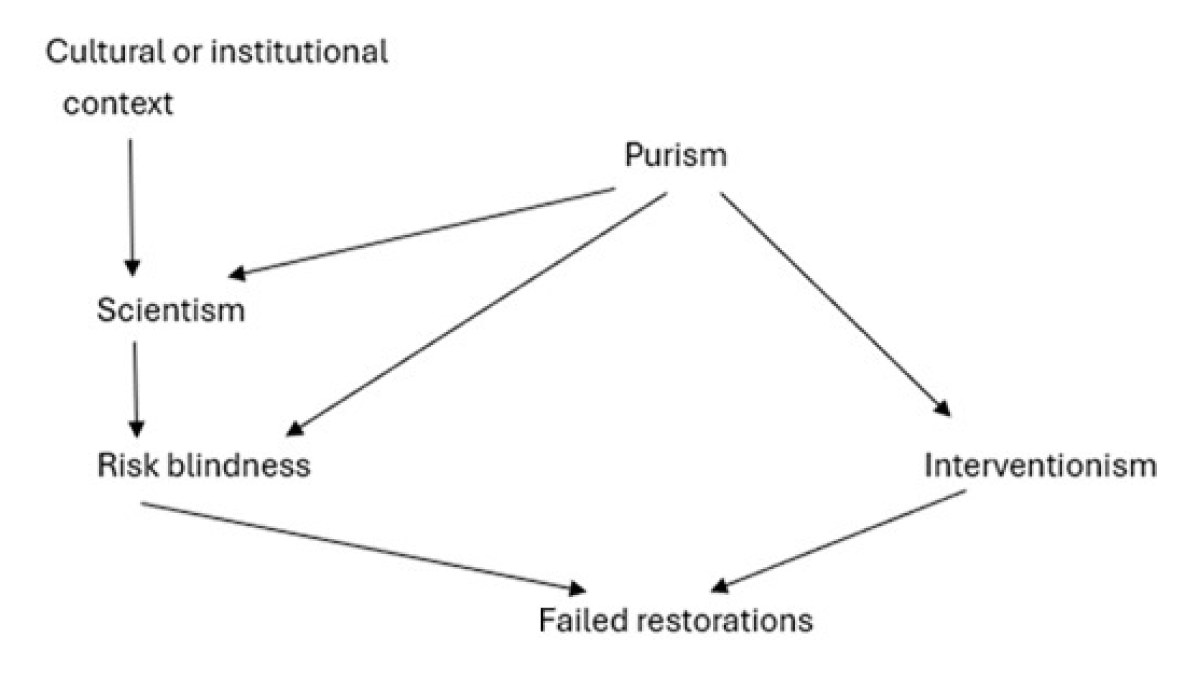
Figure 1
The argument.
In the next section, my aim is to illustrate the route from scientism to risk-blindness by means of a case study: the recent restoration of Hubert and Jan van Eyck’s Adoration of the Mystic Lamb (1432), also known as the Ghent Altarpiece. The case is interesting for several reasons. First, it is a complex case, since one artist started work on the altarpiece while another artist – his brother – modified and completed it, which raises questions about authenticity and (co)authorship that are not just philosophically interesting but practically relevant. After all, complex cases are far from exceptional; think, for example, of The Feast of the Gods, which was first painted by Bellini and later modified by Titian. Second, there is clear evidence of a purist motive in the case of the Ghent Altarpiece, including, for example, the statement about the goal of the restoration quoted earlier. This makes the case interestingly different from past controversies surrounding the cleaning of paintings such as Velázquez’s Philip IV of Spain in Brown and Silver17 and Michelangelo’s Sistine Chapel ceiling frescoes.18 In these cases, the focus usually was on the removal of darkened varnishes and dirt rather than overpaint, and, partly as a result, the purist motive was less pronounced even though it may be suspected to have been present. Third, while purist restorations of, for example, buildings and marble sculptures are well documented, the restoration of the Ghent Altarpiece appears to be special in being a well-documented purist restoration of a panel painting. As conservator David Scott reported recently,
Purism has indeed wreaked havoc on some panel paintings, but this is the subject for a different discussion and much of the relevant information regarding panel paintings is not in the public domain as it has never been published, probably as an embarrassment of past excesses.19
Fourth, lest one is inclined to dismiss the restoration of the Ghent Altarpiece as illustrative of local (mal)practices only, it may be worth noting that the restoration was supervised and endorsed by an international team of experts, including conservators (formerly or presently) affiliated with the National Gallery in London, the Louvre Museum in Paris, the Metropolitan Museum in New York, and the National Gallery of Art in Washington.
The final section will present an alternative to purism that does not suffer from the same shortcomings.
III. The Case of the Ghent Altarpiece
Figure 2 shows what the Ghent Altarpiece looked like before the restoration that started in 2012, and which is currently in its third and final phase. So far, it has involved the replacement of degraded varnishes, the removal of what is taken to be inauthentic overpaint (estimated to be two-thirds of the total area of the work), and some inpainting and retouching in accordance with preventive purist principles. To investigate the layered structure of the painting, use was made of state-of-the-art technology, including digital infrared macrophotography, infrared reflectography, X-radiography, and macro X-ray fluorescence scanning.20
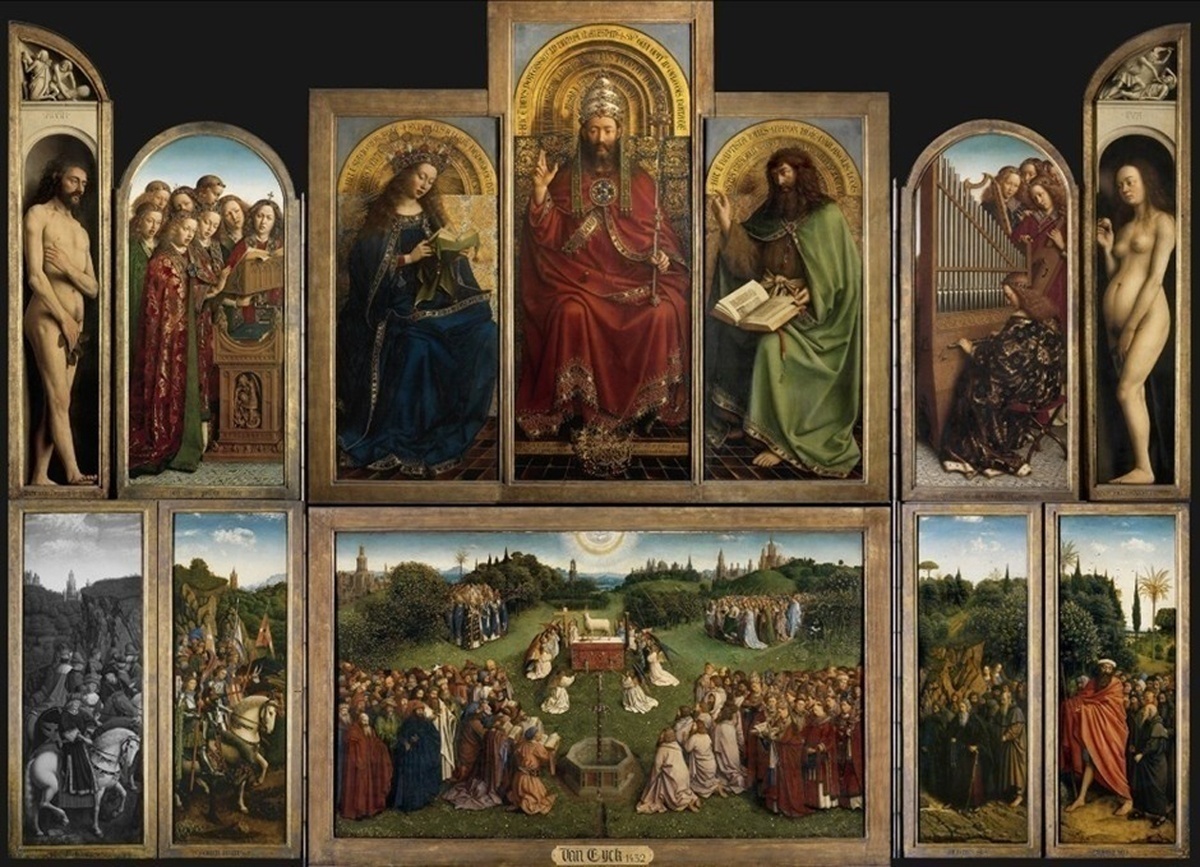
Figure 2
The Ghent Altarpiece, before restoration. Source: Hubert and Jan van Eyck, Adoration of the Mystic Lamb, Saint Bavo’s Cathedral, www.artinflanders.be, photo closertovaneyck.kikirpa.be; contractual restrictions.
When the result of the second phase of the restoration was revealed to the wider public, eyebrows were raised at the sight of the central figure – namely, the lamb. Before the restoration (Figure 3, left), the lamb looked realistic. For example, its eyes were on the sides of its head and its ears above the eyeline (see Figure 4 for a close-up). After the restoration (Figure 3, right), the lamb had frontal eyes and cylindrical ears attached to its head below the eyeline (see Figure 5 for a close-up).
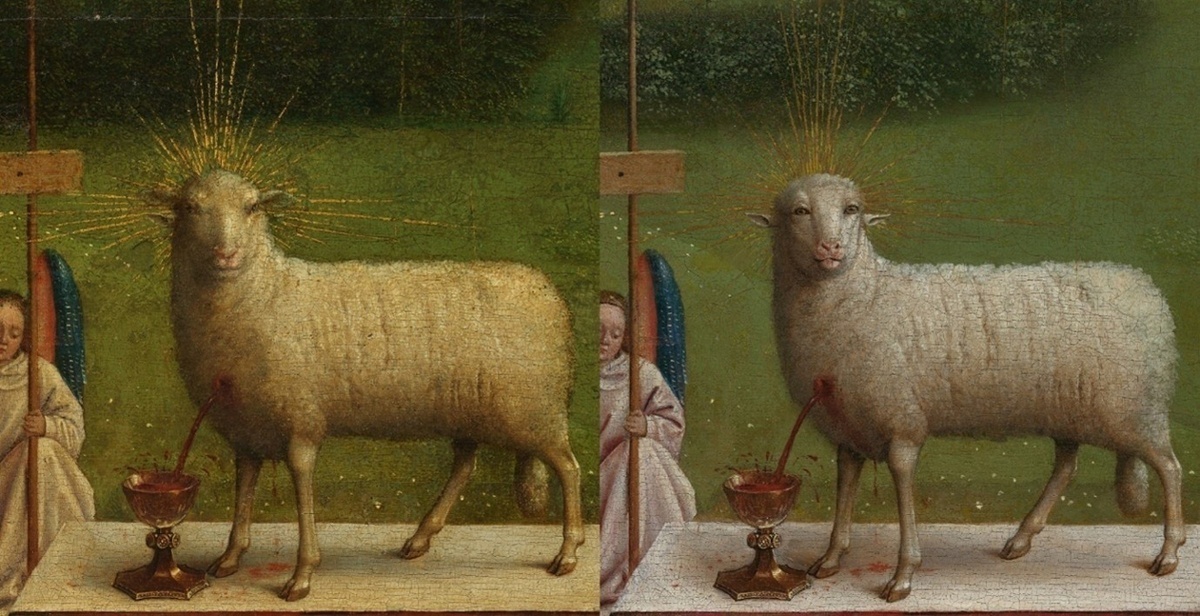
Figure 3
The Mystic Lamb in the Ghent Altarpiece, before (left) and after (right) restoration. Source: Hubert and Jan van Eyck, Adoration of the Mystic Lamb, Saint Bavo’s Cathedral, www.artinflanders.be, photo closertovaneyck.kikirpa.be; contractual restrictions.
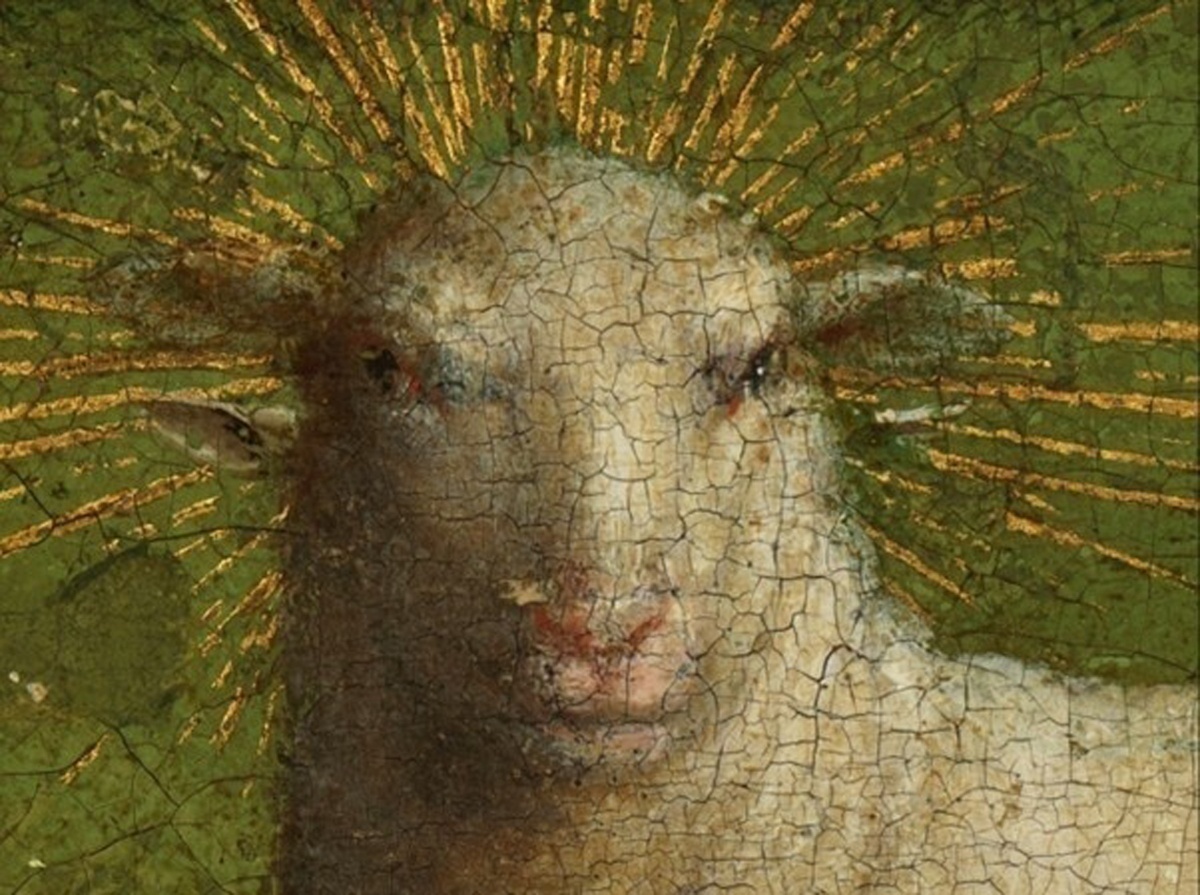
Figure 4
Close-up of the pre-restoration lamb. Source: Hubert and Jan van Eyck, Adoration of the Mystic Lamb, Saint Bavo’s Cathedral, www.artinflanders.be, photo closertovaneyck.kikirpa.be; contractual restrictions.
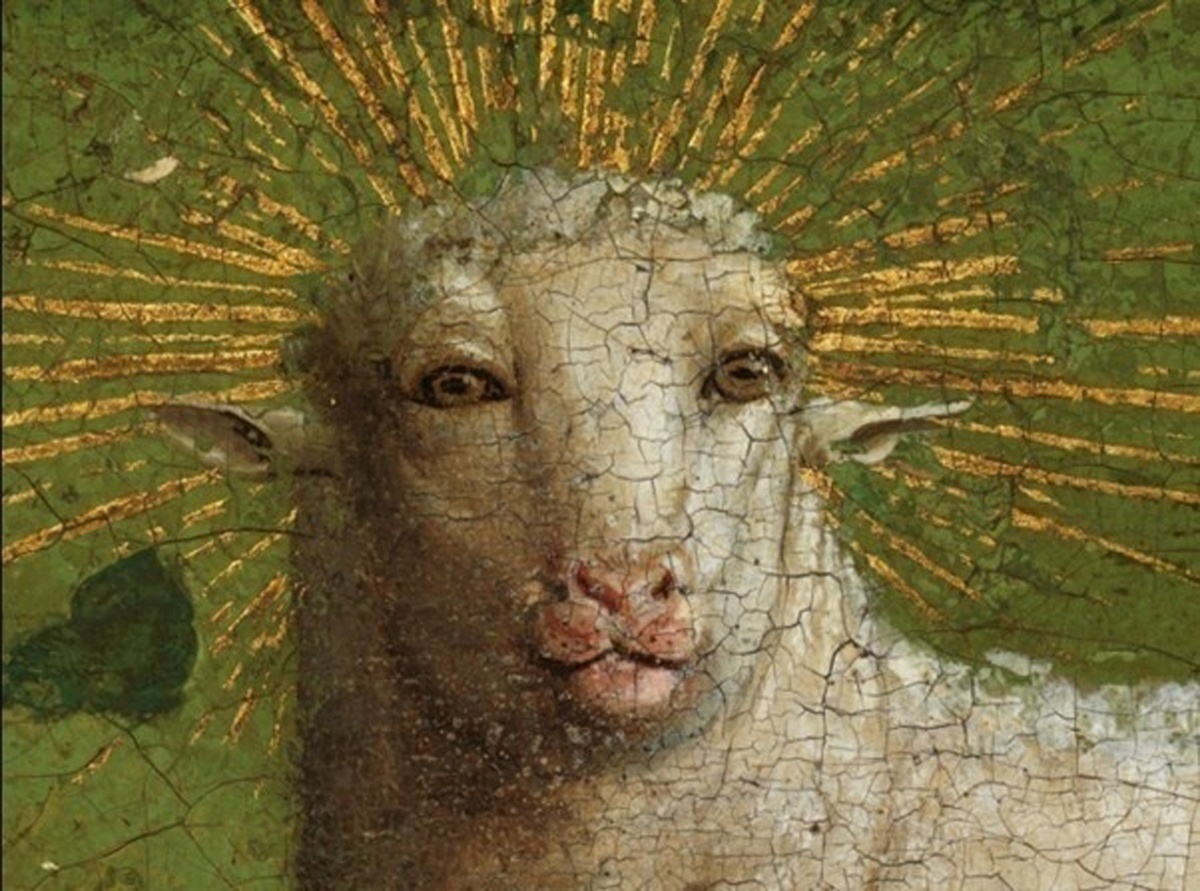
Figure 5
Close-up of the post-restoration lamb. Source: Hubert and Jan van Eyck, Adoration of the Mystic Lamb, Saint Bavo’s Cathedral, www.artinflanders.be, photo closertovaneyck.kikirpa.be; contractual restrictions.
One explanation given for the frontal eyes was that Van Eyck may have wanted to anthropomorphize the lamb since it symbolized the man Jesus. However, the decision to remove the overpaint was not based on any such expectation but on a wealth of scientific evidence suggesting – to the restoration team – that the overpaint is inauthentic and that, underneath it, there is a depiction of the original lamb, that is, the lamb that was seen in the painting when Jan van Eyck had just completed the painting (around 1432). It is this lamb that the remedial restoration was supposed to recover in line with what purists consider to be the goal of restoration.21 Henceforth, it will be referred to as the ‘post-restoration lamb’ to remain neutral on the question of whether it is indeed identical to the original lamb. As we will see, there are some who think that the original lamb is closer to the pre-restoration lamb, that is, the lamb that was seen in the painting just before the most recent restoration (and in all reproductions predating this restoration).
The ‘wealth of evidence’ suggesting – again, to the restorers – that the original lamb was hidden underneath a layer of overpaint consisted of a number of observations, the most important of which include: (1) a cross-sectional sample taken from the body of the lamb (during a restoration in the 1950s and now reanalysed) that reveals several layers of paint separated by varnishes, which provides clues regarding the number of times that work on the altarpiece was considered completed; (2) spectroscopic images showing the location of some of the ‘original’ lamb’s facial features (for example, nostrils and jawline), as well as the extent to which golden rays penetrate the area covered by the pre-restoration lamb’s head (suggesting that the original head was smaller); (3) lower-placed cylindrical ‘ears’ uncovered by the 1950s restoration, which have been in plain view ever since; (4) a reference in a historical document to a ‘cleansing’ that the altarpiece would have undergone around 1550; and (5) a copy of the altarpiece by the painter Michiel Coxcie from around 1557–1558 that includes the pre-restoration lamb, suggesting that the original lamb had already been overpainted by then.22
Based primarily on observations of the second sort, the authors of a Science article on the Ghent Altarpiece distinguish three versions of the lamb:
A first, highly finished, small Eyckian version, a second version whereby the hindquarters were enlarged and squared off (revealed after overpaint removal), and a third, 16th century version that extensively modified the head but respected the shape of the body from the second version.23
According to the authors, the three versions are, respectively, definitely original, possibly original, and definitely unoriginal. However, it is not entirely clear why the modified, pre-restoration head of the lamb is considered unoriginal. The reason given is that, after the removal of sixteenth-century overpaint from body and head, the head changed (while the body retained its outline). But this assumes that the overpaint covering head and body dates to the sixteenth rather than fifteenth century. It is not clear from the evidence in the article, or from the website that chronicles the restoration’s progress, how this has been established. Note that, even in the fifteenth century, several people had already worked on the painting: first, Hubert van Eyck, then his younger brother Jan van Eyck, and probably some other artists as well. Hence the possibility, recognized by the authors of the Science article, of an authentic second version. Note, too, that there is no precise description of the ‘cleansing’ undertaken in the sixteenth century and that there are no differences in material or technique that allow one to exclude the possibility of a fifteenth-century overpainting.24
Art historian Hélène Verougstraete has also expressed scepticism about the dating of the overpaint by the restoration team. According to her, the team based its dating on a non-scientific assessment of painting style, and more specifically on the overpainted parts’ ‘granular’ appearance.25 If Verougstraete is right, then the evidence for the dating seems feeble indeed. At the same time, it becomes hard to accuse the restoration team of scientism. However, my suspicion is that the team would not have given much weight to this impression of granularity if it did not seem to confirm what they already believed on the basis of the scientific evidence cited earlier, and in particular observations (1)–(3), which does suggest that there is an earlier version of the lamb – the question is just whether this earlier version is also more authentic. Moreover, the impression of granularity is an isolated piece of non-scientific evidence. If the team had been more open to such evidence, then they probably would have reached a different conclusion, one that would have made abundantly clear the risks involved in removing the ‘16th century’ overpaint. The following observations (to be read with reference to Figure 5) may help to explain why.
First, the head of the post-restoration lamb has a weirdly contorted look because parts of the face and neck (the cheeks, the wrinkles in the wool?) suggest that it is turned slightly to the left, whereas other parts (the mouth, the eyes) suggest that it is turned slightly to the right.
Second, the pink snout is strikingly feline because of the accentuated curved split upper lip and the dots suggesting the presence of whiskers. Together with the wide-open eyes (one larger than the other), these features have changed the demeanor of the lamb’s face from serious to comical. Indeed, the person in charge of the restoration, art historian Hélène Dubois, has herself described the result as ‘cartoonish’.26
Third, as mentioned, the position of the ears and eyes is unusual for a mammal and simply inaccurate in the case of a sheep, an animal with which the Van Eyck brothers were no doubt acquainted. For what it is worth, another fifteenth-century Flemish painter, Hans Memling, did not make the same mistake when he painted St John the Baptist with a lamb (he also omitted the feline features mentioned above).
Fourth, it is unlikely that someone like Jan van Eyck would have made such mistakes, given his general skill but also his skill at rendering animals realistically, as shown by the dog in the famous Arnolfini Portrait (Figure 6), which was painted only two years after the Ghent Altarpiece.
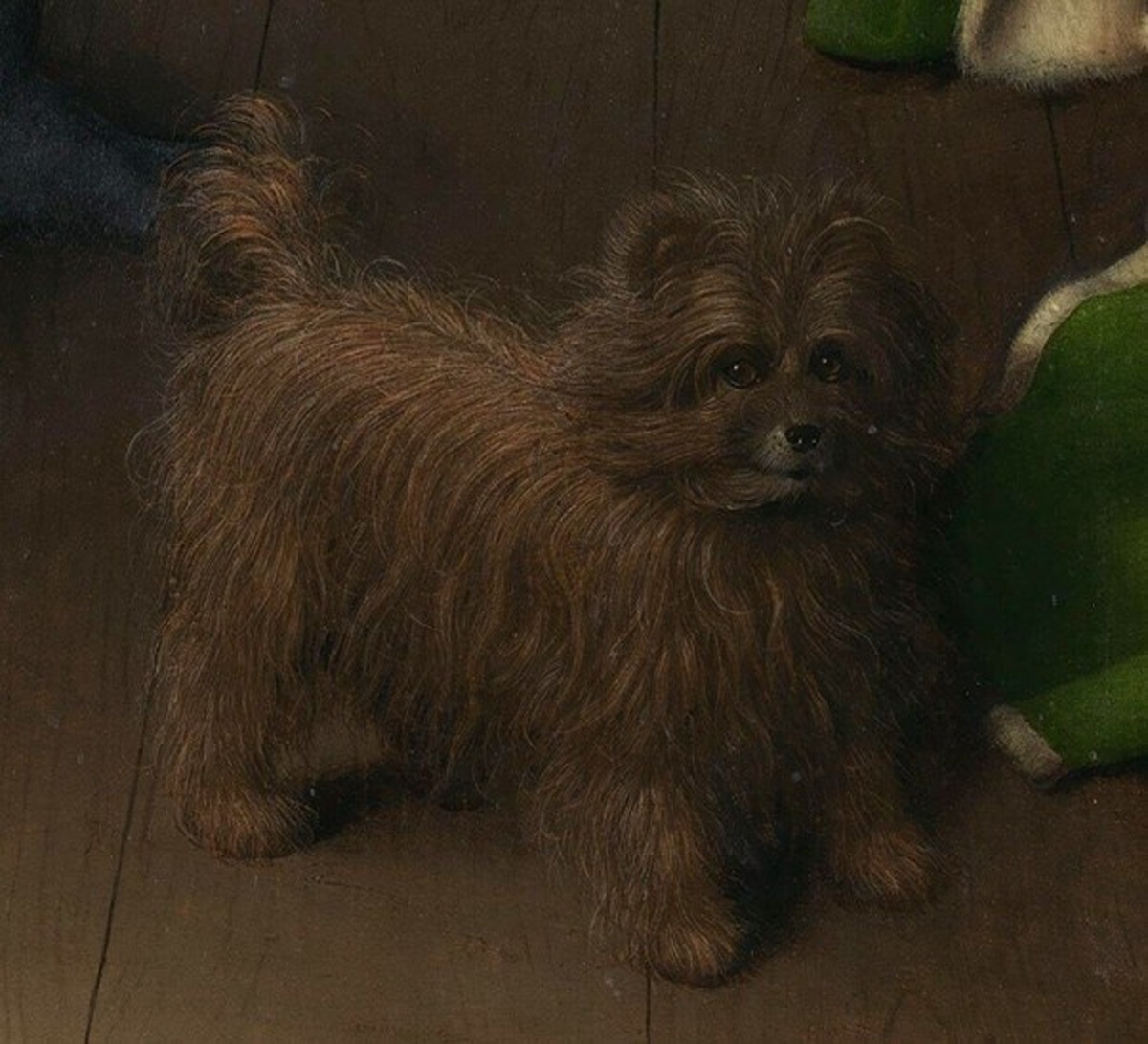
Figure 6
Detail of Jan van Eyck, The Arnolfini Portrait (1434). Image: The National Gallery, London. © The National Gallery, London.
Fifth, the lamb is not just a background figure but the most central figure of the altarpiece, symbolizing Jesus. It is unlikely that Jan van Eyck would proceed with the greatest care when painting an ordinary dog (for the Arnolfini Portrait) and botch up when painting the Lamb of God (for the Ghent Altarpiece).
Observations such as these cannot be cast entirely in the language of the natural sciences. For example, they refer to the demeanor of the lamb and to Jan van Eyck’s skill and motivation. Nonetheless, these are the kinds of observations on which our aesthetic response to a painting depends. They cannot be dismissed as irrelevant to the project of restoration. Moreover, they are consistent with the scientific evidence. However, once we combine the two kinds of observation, scientific and non-scientific, the conclusion of the restoration team’s argument, that the post-restoration lamb is identical to the original lamb, starts to look less certain. The suspicion arises that, although the post-restoration lamb may correspond (partly or wholly) to an earlier version of the lamb, it is not the most authentic version of the lamb in the sense of the version painted and sanctioned by Jan van Eyck.27
In fact, the hypothesis that an earlier lamb was superseded by a more authentic lamb is not new. In a book published in 2011, just before the start of the latest restoration, biblical scholar Luc Dequeker argues that Hubert van Eyck had painted an apocalyptic lamb (or ram, with seven horns and eyes), which Jan van Eyck has replaced with a paschal lamb. Dequeker’s evidence is art-historical and theological and meant to establish connections between the altarpiece’s depictive content and the description of the end time in the New Testament’s Book of Revelation. To be sure, Dequeker’s evidence is not conclusive. Regardless, given the value of the altarpiece and the fact that removing paint and glazes is an irreversible operation, the uncertainty attaching to the identity of the post-restoration lamb is hard to accept.
IV. Avoiding the Perils
If one were persuaded by the argument presented in Section III, then one’s immediate reaction may be to blame scientism in restoration. After all, it seems that the restoration team could only reach its conclusion (that the post-restoration lamb is the original lamb) by relying entirely on estimations of temporal priority backed up by hard scientific evidence. More generally, one may be tempted to put the blame on how the restoration was executed rather than on how the goal of the restoration was conceived. If sufficient caution had been exercised, it might be thought, the detrimental result would have been avoided and there would have been no need to switch from a purist to an impurist conception of the goal of restoration. The thought is right, but it should not make one optimistic about the possibility of a quick fix. The team responsible for restoring the Ghent Altarpiece was certainly aware of the importance of caution, as were their international advisers. Both their public statements and the professional set-up of the restoration are testimony to this fact. Yet they were somehow pushed to throw (some of that) caution to the wind. Based on what has been said, two possible explanations suggest themselves. First, there are strong cultural and institutional incentives to focus exclusively on natural-scientific evidence and to aim for surprising discoveries. Second, remedial purism itself amounts to a permanent call to perform actions that are, at least in the case of painting, irreversible. The only way for a purist to resist the call and so to avoid the risk of irreversible damage is to work entirely within the bounds of preventive purism – an option that John Ruskin would have welcomed28 but that, as noted above, few others will be willing to accept.
It is therefore worth reconsidering purists’ understanding of the goal of restoration (as it was stated in the beginning of this article) because it promotes both scientism and interventionism, and thereby imperils some of humanity’s greatest treasures, including the Ghent Altarpiece. A sense of urgency is justified because, if this purist trend continues, the time may come that we can no longer understand why these were once considered humanity’s greatest treasures. (Imagine the Mona Lisa being turned into a ‘cartoonish’ sketch of a woman.)
Of course, reconsidering purism can only lead to improvement in the practice of restoration if there are alternatives, so let me end this article by calling into mind one such alternative. According to this alternative – let us call it impurism – the goal of restoration is to return ‘the appearance of a painting to a state as close as possible to that which the artist originally intended’.29 The goal of restoration is not here stated in terms of material authenticity, let alone temporal priority, but in terms of something that is much less easily brought within the purview of the natural sciences: a work’s intended appearance, which can be cashed out in terms of intended perceptual and aesthetic properties that the work possessed ‘at some point after completion’.30 (The reference to ‘some point after completion’ allows the intended appearance to differ from the original appearance. This observation is relevant to what was said earlier about purism and the removal of patina.)
For an impurist, authenticity only constrains how the goal of restoration is to be achieved. More specifically, changes to the original material (brought about by the restorer) are to be minimized, both to ensure that the work survives the restoration – in other words, to ensure that the intended appearance is returned to the work – and, more generally, to reduce the lifespan of the work as little as possible.31 As a result, there is no obligation on the part of the restorer to remove inauthentic material, let alone patina. Overpaint and reconstructions of lost or damaged parts can be kept if they correspond to the artist’s intentions as realized in the work at an earlier point in time. In other words, impurism permits integral restoration and so offers less reason to intervene than purism.
Perhaps some of the key terms employed in the statement of impurism will be deemed problematic. Does the term ‘aesthetic property’ not refer to something entirely subjective? Can we ever know what the original artist(s) ‘intended’? And who is ‘the’ original artist anyway, it may be asked, if there is more than one, as in the case of the Ghent Altarpiece? A full response to these concerns lies outside the scope of this article and, in any case, has been attempted elsewhere. For example, regarding the first concern, Eddy Zemach has argued that aesthetic judgements are objective, and Louise Hanson has argued that there is no good reason for thinking that aesthetic judgements are less objective than moral judgements.32 Regarding the second concern, E. J. Hirsch, Robert Stecker, Noël Carroll, Paisley Livingston, and Kathleen Stock have argued that knowledge of (actual) intentions is indispensable to the interpretation of art.33 It does not follow from their view that complete knowledge of the artist’s intentions is required. Partial knowledge may suffice. The same is true when the intended appearance of a work is to be determined in connection with an impurist intervention. After all, just like restorations in general do not aim to return to a work all of its properties, impurist restorations do not aim to return to a work all of its intended properties. They may even ignore some of the work’s intended perceptual properties for the purpose of a partial restoration.
Finally, Livingston, Sondra Bacharach, and Deborah Tollefsen have analysed the notion of joint authorship in terms of intentions, which bears on the third and last concern.34
Regarding the first two concerns, what can be added here is a speculative diagnosis of what gives rise to them: a natural-scientific method of verification is taken as a precondition of knowledge of the external world and whatever fails to meet this condition is either not a case of knowledge (for example, beliefs about the artist’s intentions) or not about the external world (for example, aesthetic judgements). In other words, the diagnosis is that the two concerns are rooted in scientism, which impurism was supposed to help us avoid.
The third concern, regarding works for which more than one artist seems to be responsible, is not so easily dismissed as rooted in scientistic preconceptions. Of course, if it points to a real problem, then it is one for purism, too, since an authentic part is supposed to be one ‘produced by the original artist’.35 However, the problem seems to be primarily a practical one – namely, a matter of deciding whose work is to be restored. Moreover, insofar as it is a theoretical problem, it does not seem to be an intractable one. As Livingston, Bacharach, and Tollefsen demonstrate, analytic philosophy provides plenty of resources to analyse various kinds of artistic collaboration, including joint authorship.36
But let us not oversell impurism. There is no guarantee that an impurist conception of the goal of restoration will result in better restorations. For example, a careless look at the scientific evidence could convince an impurist that the post-restoration lamb does have the perceptual and aesthetic properties intended, and realized, by Jan van Eyck. Likewise, there is no reason to expect disagreements to disappear once purism is replaced with impurism. Presumably the disagreements will simply shift to different issues. However, the advantage of impurism is not that it rules out failure or disagreement in the field of restoration. The advantage, if the argument developed in this article is correct, is that it helps to avoid the twin perils of purism, at least in the sense that it does not itself give rise to them. (Obviously, interventionism and risk-blindness can also have causes other than purism.) Last but not least, apart from its practical advantages and disadvantages, impurism may simply be true.37
Notes
[1] Mark Sagoff, ‘On Restoring and Reproducing Art’, Journal of Philosophy 75 (1978): 457.
[2] The obfuscation is evident in Lisa Giombini, ‘But Is This Really Authentic? Revising Authenticity in Restoration Philosophy’, Lebenswelt, no. 12 (2018), 22, where Sagoff’s purism is identified with preventive purism (only).
[3] For criticism of preventive purism in architecture, see Léon Krier, Architecture: Choice or Fate? (London: Papadakis, 2007); Matthew Hardy, ed., The Venice Charter Revisited: Modernism, Conservation and Tradition in the 21st Century (Newcastle upon Tyne: Cambridge Scholars, 2008).
[4] The charter is available at https://www.icomos.org/charters-and-doctrinal-texts/.
[5] Sagoff, ‘On Restoring and Reproducing Art’; Mark Sagoff, ‘Art and Identity: A Reply to Stopford’, British Journal of Aesthetics 57 (2017): 319–29.
[6] For more on restoration history of the Herakles sculpture and other relevant cases (for example, Leda and the Swan), see David A. Scott, Art: Authenticity, Restoration, Forgery (Los Angeles: Cotsen Institute, 2016); ‘Ancient Marbles: Philosophical Reflections on the Restoration of Sculpture’, Studies in Conservation 68 (2023): 388–406. Diebold discusses another interesting case of de-restoration, the Aegina pediments; see William J. Diebold, ‘The Politics of Derestoration: The Aegina Pediments and the German Confrontation with the Past’, Art Journal 54 (1995): 60–66.
[7] Zdravko Barov, quoted in Scott, ‘Ancient Marbles’, 399. It may be noteworthy that the eighteenth-century pieces have since been reattached.
[8] Kathleen Froyen, ‘Revealing Van Eyck, Six Centuries Later’, visitgent, 12 September 2024, https://visit.gent.be/en/blog/revealing-van-eyck-six-centuries-later.
[9] Salvador Muñoz-Viñas, ‘Beyond Authenticity’, in Art, Conservation and Authenticities: Material, Concept, Context, ed. Erma Hermens and Tina Fiske, 33–38 (London: Archetype, 2009).
[10] David A. Scott, ‘Conservation and Authenticity: Interactions and Enquiries’, Studies in Conservation 60 (2015): 291–305.
[11] William David Ross, The Right and the Good, ed. Philip Stratton-Lake (1930; Oxford: Oxford University Press, 2002).
[12] Cesare Brandi, ‘The Cleaning of Pictures in Relation to Patina, Varnish, and Glazes’, Burlington Magazine 91 (1949): 183–88; Cesare Brandi, Teoria del Restauro (1963; Milan: La Nave di Teseo, 2022).
[14] In other words, the idea is that a conclusion drawn from scientifically respectable premises must itself be scientifically respectable. Of course, that idea is wrong. For example, the premises may be irrelevant to the conclusion. But the idea is tempting in the same way that arguments from authority are tempting.
[15] As recommended by, for example, Lamarque and Hales. Peter Lamarque, ‘Reflections on the Ethics and Aesthetics of Restoration and Conservation’, British Journal of Aesthetics 56 (2016): 281–99; Steven D. Hales, ‘Value Pluralism in Restoration Aesthetics’, British Journal of Aesthetics 64 (2023): 397–414.
[16] By ‘scientism’ I mean the tendency to expect science to answer questions that it cannot answer by itself. For relevant historical context, see Salvador Muñoz-Viñas, Contemporary Theory of Conservation (Oxford: Elsevier, 2005), 69–90, on the ‘(hard)scientific approach’ to restoration. An early critic of this approach was Gombrich; see Ernst H. Gombrich, Art and Illusion: A Study in the Psychology of Pictorial Representation (1960; London: Phaidon, 2002); ‘Dark Varnishes: Variations on a Theme from Pliny’, Burlington Magazine 104 (1962): 51–55.
[18] James Beck and Michael Daley, Art Restoration: The Culture, the Business, and the Scandal (New York: Norton, 1996).
[20] The website of the restoration project lists three historical research methods (such as archival research) and 15 natural-scientific ones (such as protein mass spectrometry). See closertovaneyck.kikirpa.be.
[21] Recall: ‘The goal of our conservation was – and still is – to remove everything that we are 100% sure is not original’ (Froyen, ‘Revealing Van Eyck’).
[22] Observations (1), (2), (3), and (4) can be found in Geert Van der Snickt et al., ‘Dual Mode Standoff Imaging Spectroscopy Documents the Painting Process of the Lamb of God in the Ghent Altarpiece by J. and H. Van Eyck’, Science Advances 6, no. 31 (2020), 1–10. Observations (4) and (5) can be found in Hélène Dubois, ‘The Conservation History of the Ghent Altarpiece’, The Burlington Magazine 160 (2018): 754–65. See also https://closertovaneyck.kikirpa.be/ghentaltarpiece/#home.
[24] Later, in phase three of the restoration, it was reported (see Royal Institute for Cultural Heritage, ‘First Results Promise Stunning Outcome’, press kit, 26 March 2024, https://www.kikirpa.be/files/Pers/Dossier-Het-Lam-Gods/Press-Kit-Phase-3-Ghent-Altarpiece-26032024-KIK-IRPA-EN.pdf) that posnjakite had been found in the paint that was removed from the green meadow surrounding the lamb. Posnjakite is supposed to have been a rare pigment in the fifteenth century. Apart from the fact that this is at best inconclusive evidence for the dating of the pre-restoration lamb itself (and even for the dating of parts of the meadow, as posnjakite can be an alteration product as well as a pigment), it should be noted that the decision to remove overpaint in phase two of the restoration was not, according to any of the reports made available, based on the discovery of posnjakite.
[25] Hélène Verougstraete, ‘The Ghent Altarpiece: The Catastrophic Restoration of Phase 2’, 2023, https://www.closertohubertvaneyck.be/en/; ‘Adoration de l’Agneau (Fase 2 de la restauration): Questions de méthodologie’, manuscript.
[26] Hannah McGivern, ‘Ghent Altarpiece: Latest Phase of Restoration Unmasks the Humanised Face of the Lamb of God’, Art Newspaper, 18 December 2019, https://www.theartnewspaper.com/2019/12/18/ghent-altarpiece-latest-phase-of-restoration-unmasks-the-humanised-face-of-the-lamb-of-god.
[27] Add to this that the post-restoration lamb is not the only part of the Ghent Altarpiece that raises doubts about the most recent restoration. For example, there is no clear explanation for the disappearance of a castle (tentatively identified as the Cortewalle castle) and the replacement of a chapel by a newly painted river. See the https://closertohubertvaneyck.be/ website and Verougstraete, ‘Adoration de l’Agneau’ for details.
[28] John Ruskin, The Seven Lamps of Architecture (1880; New York: Dover, 1989).
[29] David Bomford, ‘Conservation and Restoration’, in Oxford Companion to Western Art, ed. Hugh Brigstocke (Oxford: Oxford University Press, 2003), 148–53.
[30] Rafael De Clercq, ‘The Metaphysics of Art Restoration’, British Journal of Aesthetics 53 (2013): 267, 274.
[31] This justification of minimal intervention derives from ibid., 273; see also Rafael De Clercq, ‘Conservation and Restoration’, in Routledge Companion to the Philosophies of Painting and Sculpture, ed. Noël Carroll and Jonathan Gilmore (New York: Routledge, 2023), 458. Hales, who himself defends a form of impurism, construes De Clercq, ‘Metaphysics of Art Restoration’ as prioritizing ‘relic value’, that is, authenticity; see Hales, ‘Value Pluralism’, 407–8. However, this construal seems to conflate a constraint on the achievement of a goal with the goal itself. For example, if one needs to go to the hospital because of an emergency, then one may wish to minimize the distance travelled. It does not follow that distance is one’s most important consideration (presumably, getting to the hospital in time is).
[32] Eddy M. Zemach, Real Beauty (University Park: Pennsylvania State University Press, 1997); Louise Hanson, ‘Moral Realism, Aesthetic Realism, and the Asymmetry Claim’, Ethics 129 (2018): 39–69.
[33] E. D. Hirsch, Validity in Interpretation (New Haven, CT: Yale University Press, 1967); Robert Stecker, Artworks: Meaning, Definition, Value (College Park: Pennsylvania State University Press, 1997); Noël Carroll, ‘Interpretation and Intention: The Debate between Hypothetical and Actual Intentionalism’, Metaphilosophy 31 (2000): 75–95; Paisley Livingston, Art and Intention: A Philosophical Study (Oxford: Clarendon Press, 2005); Kathleen Stock, Only Imagine: Fiction, Interpretation and Imagination (Oxford: Oxford University Press, 2017).
[34] Livingston, Art and Intention; Sondra Bacharach and Deborah Tollefsen, ‘We Did It: From Mere Contributors to Coauthors’, Journal of Aesthetics and Art Criticism 68 (2010): 23–32.
[37] For a defence of the truth of impurism, see De Clercq, ‘Metaphysics of Art Restoration’ and Lamarque, ‘Reflections’, which presents the restoration of York Minster’s stained glass as a challenge for purism. On the philosophical significance of stained-glass restoration, see also David A. Scott, ‘The Restoration of Chartres Cathedral: Theories and Practices’, in Routledge Companion to the Philosophy of Architectural Reconstruction, ed. Zoltán Somhegyi and Lisa Giombini (London: Routledge, 2024), 310–22.
Acknowledgements
Versions of this article were presented at Renmin University of China (Heritage and Conservation conference) and Peking University (School of Arts). I am grateful to audience members, as well as to Arnold Burms, Jean-Pierre Coppens, Paisley Livingston, David Scott, and especially Hélène Verougstraete for helpful, encouraging discussion. Comments from two reviewers for this journal have also led to significant improvements.