
I. Introduction
The Geography of Taste, co-authored by Dominic McIver Lopes, Samantha Matherne, Mohan Matthen, and Bence Nanay, builds on the fundamental observation that the music, poetry, and natural objects (animals, plants, and landscapes) that one finds beautiful (or otherwise aesthetically values) are those that conform to the ‘standards of taste’ instilled by a culture.1 Where cultures disagree, there is no right or wrong. Two North Indians can argue in a principled way about the merits of Kalidas because a single culture informs their arguments. However, there is no equivalently fine-grained way to argue about the relative merits of Kalidas and John Milton. David Hume holds that the outstanding figures of European literature are more meritorious than those of other traditions. According to the fundamental observation that motivates The Geography of Taste, this makes no sense.
The book’s Introduction, ‘Cultural Diversity: A Challenge and an Opportunity for Aesthetics?’, jointly written by the four co-authors, sketches how theoretical aesthetics in the European tradition from Hume to contemporary analytical aesthetics is implicitly or explicitly committed to the proposition, often treated as foundational, that there is a universal standard of taste. The fundamental observation implies that theoretical aesthetics needs to be reconfigured. The four authors, all committed to the cultural diversity of aesthetic value, sketch their approach to different aspects of this reconfiguration.
In Chapter 1, ‘The Emergence of Tastes’, Matthen briefly recounts the first reactions of European travellers to India, where they encountered music, painting, and architecture in almost completely unfamiliar forms. They found these forms enjoyable but not worth engaging with in fine detail. This gives us two explanatory projects: why and how did these travellers find something to enjoy in these arts, however superficially? And why were these arts so different? Matthen offers a historical posit regarding cultural divergence to explain both the commonality and the difference.
In Chapter 2, ‘Cultures and Values’, Lopes approaches aesthetic diversity through minimal notions of culture and of value. He provides constitutive accounts of hedonic, aesthetic, and artistic cultures, each organized around values in different ways. Hedonic cultures generate hedonic payoffs. Aesthetic cultures coordinate sundry activities around distinctive vocabularies of aesthetic value. Artistic cultures leverage media of making to generate different varieties of value. The argument for this three-way division of the geography of taste is that it provides an effective framework for empirical investigations of the striking variation within each culture of taste.
In Chapter 3, ‘Beyond the Either/Or in Aesthetic Life: A New Approach to Aesthetic Universality’, Matherne asks what a flourishing aesthetic life is. The classical model suggests that it is organized around universal aesthetic value. A diversity-based model suggests that we flourish by finding what aesthetically speaks to us as individuals and members of local communities. Rather than choosing between these two models, Matherne proposes a new account of aesthetic universality that complements aesthetic diversity in a flourishing aesthetic life.
Finally, in Chapter 4, ‘Everyday Aesthetic Injustice’, Nanay shows that we are constantly in danger of committing aesthetic injustice. This follows from three premises: (A) we can never fully be ‘participants’ in a culture other than own, (B) we daily engage with works from different cultures, and (C) aesthetic judgement has a degree of intersubjective normativity. If the argument is valid, then, in order to avoid being culpable of everyday aesthetic injustice, we would need to discard (at least) one of (A), (B), and (C). Nanay argues that our best option is to reject (C) and approach works from other cultures with aesthetic humility.
The critical commentaries that follow begin with Murray Smith’s consideration of Lopes’s tripartite division among hedonic, aesthetic, and artistic cultures, each based on different articulations of value. James Harold explores Matherne’s and Nanay’s arguments, while Paloma Atencia-Linares examines Matthen’s and revisits Matherne’s. The symposium concludes with responses from the authors of The Geography of Taste, ordered alphabetically by surname.
II. Rip It Up and Start Again
Murray Smith
The project initiated by The Geography of Taste is strongly revisionist, though its targets and degree vary across the four contributions comprising the volume. Lopes’s essay, ‘Cultures and Values’, is – at least in certain respects – the most profoundly revisionist. Like his co-authors, Lopes takes as his starting point and foil the ‘tidy arrangement’ bequeathed by three centuries of Western theorizing on aesthetics and the arts, according to which ‘[t]he arts are aesthetic, the aesthetic is a hedonic phenomenon, and so are the arts too’, the three phenomena unifying metaphysically, axiologically, and culturally (GoT, p. 72).
Lopes proposes a wholesale redesign of the conceptual framework by which we theorize the aesthetic, the artistic, and the pleasurable, a project of conceptual reengineering that has implications for a wider array of value-laden phenomena. Although Lopes retains a focus on this triad, he proposes a more complex (and, following the metaphor, messier) set of relations among the pleasurable, the aesthetic, and the artistic. In place of the neat, tidy, and nested schema given to us by tradition – ‘[a]rtistic value is aesthetic value, and aesthetic value is hedonic value’ (ibid.) – we have a tripartite distinction among hedonic, aesthetic, and artistic cultures.
Lopes gives as an example of a hedonic culture akratcheak, an Inuit exercise of physical prowess in which participants jump off two feet, touch a hanging target with one foot, and land on that same foot. What makes akratcheak a hedonic culture is that the pleasure it generates – a pleasure in physical strength and skill, for both participants and spectators – wholly explains the existence and persistence of this social practice (a point to which I will return). ‘By contrast, the norms and behaviors of philosophy don’t constitute a hedonic culture,’ writes Lopes, ‘even if they brought considerable pleasure to earlier practitioners, for they aren’t sustained just by the pleasure they bring’ (ibid., p. 88).
An aesthetic culture, on Lopes’s definition, is also a social practice governed by norms regulating the actions of its members. It contrasts with a hedonic culture, however, in two ways. First, it is realized through an aesthetic profile, a ‘repertoire of ways of realizing aesthetic values in items’ other [non-aesthetic] features’ (ibid., p. 92). For example, within the aesthetic profile of tartan plaid, ‘red makes for noble, and yellow plus lilac is light and lively, though these same colors are decidedly somber in the Kunbi plaid aesthetic’ (ibid., p. 91). Second, an aesthetic profile may perform functions beyond delivering pleasure – tartans may equip ‘Scots with badges of identity’ (ibid., p. 94), for example – none more fundamental than another. Lopes thus slices through the Gordian knot traditionally tying aesthetic activity tightly to pleasure.
An artistic culture, another kind of social practice governed by norms, contrasts with both hedonic and aesthetic cultures. ‘[A]rtistic cultures are domains each populated by items of a kind’ – movies, songs, landscapes, dances, and so on. In other words, each artistic culture is realized through a medium, ‘a technical resource for making things’ (ibid., p. 102). Like the instances of an aesthetic culture, the items produced within an artistic culture – artworks! – may be designed to elicit pleasure, but they may also perform other functions, none more basic than any other.
Artistic cultures are not essentially organized around aesthetic profiles or aesthetic value. Artworks ‘can and do have many kinds of value, but none is constitutive of artistic cultures. Values vary from one artistic culture to the next’ (ibid., p. 103). Each artistic culture is distinctive by virtue of the value or cluster of values it realizes and functions it performs. Within the musical (artistic) practice of méringue lente, the song ‘Ti Zwazo’ ‘serves an interest in preserving a memory of the past’ (ibid.) of slavery. This function and value are absent from its calypso adaptation, ‘Yellow Bird’ (ibid., p. 75), which instead seems to create a sense of celebration in the present. There is thus more to an artistic culture than a medium. While méringue lente and calypso share the medium of music, they are distinct artistic cultures because they realize different values.
The injection of ‘culture’ into this revised landscape is central to the agenda of GoT as a whole, as it is through the notion of culture that the significance of variation and difference, across and within populations, is recognized and given salience. According to the ‘fundamental observation’ on which GoT builds, the ‘standards of taste’ by which individuals judge the aesthetic value of objects and experiences are ‘instilled’ by culture. The ‘minimal theory’ of culture that Lopes sets out as the basis of his discussion holds that a culture is ‘a regularity in the behavior of a population that is due to [and thus can be explained by] members of the population sharing formative conditions distinct from the formative conditions shared by other populations’. Importantly, ‘culture’ operates here as an ‘abstract classifier’, picking out not populations but ‘properties of populations’:
a group’s having a culture, in the minimal sense, implies neither that every member of a group displays the same behavior nor indeed that no member behaves in ways that disrupt the pattern. Behavioral regularities can change over time, and they can include side currents, sub-currents, and counter-currents. (Ibid., pp. 77–78)
The minimal theory thereby eschews making various more complex and ambitious properties – such as unity, adaptive value, or organic coherence – essential features of culture.
A further corollary of Lopes’s tripartite division among ‘cultures of taste’ is that, for a hedonic culture, pleasure is both necessary and ‘exclusively sufficient’ (my phrase) for that culture (see the uses of ‘just’, ibid., p. 88). Any other benefit it bestows must be secondary, a ‘by-product’ (ibid., p. 99) of that culture, not the etiological function which explains its persistence.
With Lopes’s rearrangement of the furniture in mind, let me dig into two facets of the argument: the viability of strictly hedonic cultures and the fate of aesthetic value in this framework.
An initial question regarding ‘hedonic cultures’ is whether the ‘pure’ pleasures Lopes has in mind – pleasures unalloyed with the additional dimensions brought into play by aesthetic and artistic cultures – are sufficiently rich to sustain a culture in the sense stipulated, that is, a behavioural regularity specific to some population that arises and persists as a practice distinct from the cultures of other populations through local formative conditions. Based on Lopes’s flagship examples – akratcheak and East African kudoda – I think the answer must be yes: while both activities cultivate physical prowess, these two variants of hedonic culture might plausibly be explained by the local social and physical resources available where they are respectively practised. Lopes does not offer us that explanation – on his view, that is the job of the human and social scientists who study these traditions. The philosopher-theorist’s job is to devise a framework that enables and makes sense of such empirical projects. Lopes repeatedly emphasizes this naturalistic desideratum.
So far, so good. But a different objection arises in relation to the examples. Are these not cases of (proto-)sport? In Lopes’s Beyond Art, the foundation for many arguments he advances in GoT, he defines sports as ‘games displaying physical prowess’.2 In GoT, Lopes speaks of the ‘skilled performance’ that both akratcheak and kudoda engender, and the pleasure performers and spectators derive from them; the physical skills integral to the games are not just exercised but displayed. All this sounds like sport. So long as the framework accommodates sporting cultures alongside hedonic, aesthetic, and artistic cultures, this is not a problem. In fact, let me go right ahead and propose a definition of a sporting culture, one which mirrors Lopes’s definition of an aesthetic culture:
SC: each sport has a ‘profile’, that is, a distinctive combination of physical and cognitive demands against which excellence can be measured (akin to the ‘aesthetic profiles’ Lopes posits for aesthetic cultures, such as cultures of plaid).
However, regarding akratcheak, kudoda, and kindred structured exercises of physical prowess as sporting cultures opens the door to a more complicated (and still messier) story about their functions and benefits. Consider the array of functions Lopes attributes to ice dance.3 The problem is not that cultures/practices serve many functions and afford many benefits. The worry is this: anything rich enough to count as a culture (in Lopes’s sense) is apt to evolve such that it serves non-hedonic functions. It then becomes an empirical matter which functions are primary and etiological and which are secondary by-products. This may explain why Lopes is cautious about putting too much weight on particular examples. But the examples play an important role in demonstrating the plausibility, in the theory, of carving out a separate space for strictly hedonic cultures (recall the corollary noted above). Although Lopes’s cultures ‘can change over time, and […] can include side currents, sub-currents, and counter-currents’, any given culture can only bear such complexity if it is sufficiently stable to be identifiable as a culture in the first place. It is not clear that hedonic cultures, as actual phenomena rather than theoretical posits, are viable in this sense.
Turning now to the fate of aesthetic value in Lopes’s framework: aesthetic cultures vary in their aesthetic profiles but share the generic social norm to act in accordance with a governing aesthetic profile. On the traditional view – ‘aesthetic value is hedonic value’ – the function of aesthetic cultures (practices, features, profiles, and so on) is to afford pleasure (formalized by Lopes as aesthetic culture hedonism, GoT, p. 93). However, decoupling aesthetic value and pleasure and positing distinct hedonic and aesthetic cultures with distinct value-structures is central to Lopes’s disruption of the ‘tidy arrangement’. Lopes surveys a wide range of aesthetic cultures (organized around aesthetic profiles in natural environments, science, philosophy, interface design, clothing, and so on) and he notes
the vast range of beneficial functions served by these aesthetic cultures. They can help to convey ideas more clearly, smooth practical tasks, signal capacities to care for self and close associates, sharpen social distinctions, impose social benefits and burdens, foster a sense of community, boost ethnic or national pride. (Ibid., p. 94)4
Here we hit the worry: given Lopes’s emphasis on what we would customarily think of as instrumental functions served by aesthetic features, what is left of the traditional idea of the aesthetic as that to which we attend ‘for its own sake’?
The canonical expression of this idea is Immanuel Kant’s notion of disinterested pleasure: ‘[O]nly […] the taste for the beautiful is a disinterested and free satisfaction; for [in the case of such satisfaction] no interest, neither that of the senses nor that of reason, extorts approval.’5 Disinterested pleasure becomes available to us not merely when we find something agreeable, practically useful, or epistemically significant but rather when we attend to and find value in something for its own sake; that is what bestows aesthetic value on that something. James Shelley contends that ‘the disinterest thesis’ preoccupied eighteenth-century aestheticians and remains central to ‘[m]uch of the history of more recent thinking about the concept of the aesthetic’.6 Robert Stecker’s definition of aesthetic experience as ‘the experience of attending in a discriminating manner to forms, qualities or meaningful features of things, attending to these for their own sake or for the sake of this very experience’7 provides one contemporary example. Another is Gary Iseminger’s take on aesthetic appreciation, glossed by Lopes as ‘finding experiencing a state of affairs to be non-instrumentally valuable’.8
By contrast, non-instrumental attention (experience, appreciation, value) is notably absent in Lopes’s overview of the benefits aesthetic cultures may afford. On Lopes’s view in GoT, aesthetic features become nothing more than the spoonful of sugar that makes the philosophical, ethical, ideological, or affiliative medicine go down.
Lopes appears prepared to bite this bullet and consider this conception of aesthetic value and experience part of the baggage he wants to leave behind. But it is not obvious (to me, anyway!) that the conception of the aesthetic as non-instrumentally valuable is reducible to pleasure and thus falls with hedonism – baggage we must leave behind if we accept Lopes’s theory.9 Lopes sidesteps this question by noting that there is no theoretical consensus on the nature of aesthetic features, appealing instead to the consensus on paradigm examples and terms (GoT, p. 90). In his determination to rearrange the furniture, has Lopes blocked an important source of light falling into the room of human experience? Has the baby (of inherited wisdom) been prematurely dispatched with the bathwater (of ossified theoretical orthodoxy)?
Note that the objection is not that ‘attention for its own sake’ is sacrosanct but that, especially given its centrality in the Western philosophical tradition, Lopes owes us a clearer account of its place in his reordered landscape. Additionally, as I imagine Lopes would agree, it is an empirical question whether this conception is a narrowly Western one, prematurely anointed as universal and imposed on other cultures, or whether it is universal and basic to human experience.
Before leaving Lopes, let us return briefly to his chief examples of hedonic culture: structured exercises of physical prowess such as akratcheak and kudoda. It seems to me that these examples are vivid and compelling to readers unfamiliar with these hedonic cultures because they readily translate: a single paragraph is all that Lopes needs to convey the practices to a (mostly) Western-educated and -embedded readership. I suspect we can all readily draw on analogous practices within the scope of our experience, such as kick-ups and hacky sack, and similar games in other cultures, such as the Japanese kemari, which dates back more than a millennium (others include chinlone from Myanmar, Malaysian sepak takraw, and Philippine sipa).
The family resemblance among these practices has implications not only for the question of cross-cultural understanding but also for the question of explanation. Lopes is surely right that each variant culture requires its own explanation, but explanation must be sensitive both to distinctive local formative conditions and to the physical and cognitive possibilities, needs, resources, and constraints shared across cultures. The cover of GoT (Figure 1), displaying footwear from different cultures, suggests as much: we recognize the diversity as immediately as the underlying kinship in basic function. As Lopes notes, ‘ours is an era that celebrates difference. Yet we must not forget that difference only signifies against a backdrop of similarity’ (ibid., p. 106). Matherne echoes the point in describing The Iliad as ‘an epic treatment of grief that speaks to us as humans, culturally situated as we are, who grieve’ (ibid., p. 197). A background of similarity is needed, and is assumed, to make the relevant differences salient.
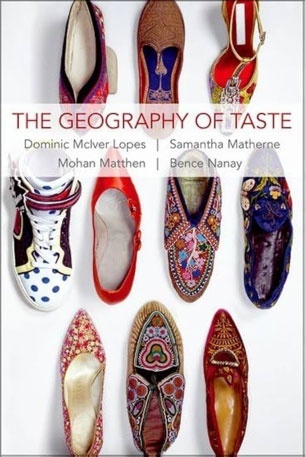
Figure 1
The front cover of The Geography of Taste.
Arguably, then, akratcheak and kudoda, as examples of hedonic cultures, are cognitively accessible – readily comprehended – across cultures. Does this give us cause for optimism about the accessibility of aesthetic and artistic cultures, notwithstanding the scepticism expressed by GoT’s authors? Or do hedonic cultures differ in this respect from aesthetic and artistic cultures?
Let me focus here on the pessimism about meaningful and ‘sound’ cross-cultural understanding of aesthetic and artistic phenomena expressed in the essays by Matthen and Nanay. Nanay’s scepticism is focused specifically on aesthetic and artistic experience, arising from the path-dependent character of perceptual learning. Borrowing a dyad from Michael Baxandall, Nanay argues that, when approaching remote aesthetic or artistic cultures, we can only be observers; the experience of the cultural participant is foreclosed to us, given the facts of human psychology. Even decades of immersion in an unfamiliar culture cannot overcome the effects of early, path-dependent cultural learning. Matthen is also doubtful about the prospects for aesthetic or artistic appreciation between distant cultures, casting this at one point in terms of ‘incommensurability’ (ibid., p. 65). He contrasts basic sensory and perceptual phenomena (‘Anybody can find a use for pepper and for silk’; ibid., p. 30), which are not strongly culture-dependent and remain available to cultural outsiders, with more complex experiences characteristic of aesthetic and artistic practices. Perhaps Matthen would situate hedonic cultures like akratcheak and kudoda with the more universally accessible phenomena, but he regards the artistic and aesthetic ones as largely inaccessible to those not raised in the culture.
Without denying the reality and importance of cultural difference, diversity, and specificity, I am inclined to push back against this scepticism. I suggest we avoid the related pitfalls of perfectionism, preciousness, and pessimism. Let us not lock ourselves out of valuable experiences, and the value of expanding our aesthetic and artistic and sporting (and so on) appreciative repertoires, by positing an unachievable ideal of aesthetic experience; here I find common ground with Matherne’s emphasis on the value of aesthetic exploration (ibid., pp. 130–36). With so many enemies and defeaters of fully realized aesthetic experience and appreciation abroad, why make perfection an impediment to cross-cultural aesthetic exploration? Let’s settle for being aesthetic and artistic satisficers rather than optimizers. Lowering the appreciative stakes, perhaps we should embrace the immortal words of Freddie Sykes in the closing moments of The Wild Bunch: ‘It ain’t like it used to be, but – it’ll do.’
None of this is to say that we should revert to (in Nanay’s words) the ‘hard universalism’ (ibid., p. 189) that GoT challenges. But we should avoid rebounding into ‘hard localism’, or worse still sliding into radical particularism, which would undermine culture’s significance from the other direction, by fetishizing individual uniqueness and idiosyncrasy rather than the ability to ascend to universal, empyrean judgement. Not everything can or should be explained as individual ‘resonance’.
III. Resonance and Varieties of Aesthetic Judgement
James Harold
In my commentary, I focus on the arguments in the last two chapters of The Geography of Taste: ‘Beyond the Either/Or in Aesthetic Life: A New Approach to Aesthetic Universality’ by Matherne and ‘Everyday Aesthetic Injustice’ by Nanay. Both address the normative question of what appreciators should do when faced with the great diversity of aesthetic objects and practices. After discussing each, I close with a few thoughts about the two chapters together.
III.1. On Resonance and Compromise Positions
Matherne seeks a third way between a classical conception of aesthetic universality, which she attributes to Hume and Kant, and a diversity-based approach to aesthetic engagement. The classical conception takes aesthetic appreciation to be universal in two respects. First, everyone should enjoy and pursue the same set of beautiful objects. Second, everyone should work to develop the capacities that will allow us to appreciate these objects. We can summarize as follows:
Classical conception of aesthetic universality (CCAU): (1) aesthetic value is universal; (2) there are general capacities for aesthetic appreciation that can be shared by all; and (3) the aesthetic ideal involves both the pursuit of universal aesthetic value and the development of the general capacities for appreciation.
Matherne considers three objections to CCAU. First, it ‘enshrines an ideology that privileges an elite, white, European, masculine perspective, which dismisses and denigrates anything that is “other”’ (GoT, p. 119). She takes this objection seriously but thinks that the neo-Humean or neo-Kantian proponent of CCAU can recentre the view on alternative, feminist, and anti-racist objects and capacities.10 Second, it is not possible to occupy the neutral standpoint that universalism requires. Third, even if it were possible, it would be bad to do so. To occupy such a standpoint would erase the differences that define us. She takes these last two objections to be decisive and abandons CCAU.
But the standard alternative to CCAU, as she sees it, is equally unacceptable. This relativistic approach allows each person (or group) to forge their own conception of what is beautiful. This implies not only that different people pursue different objects but also that they need to develop different capacities for appreciating those objects. Its key idea is ‘resonance’: diversity-based views focus on engagement with objects that happen to fit the appreciator. As Matherne describes it, ‘[r]esonance marks aesthetic experience that involves a kind of individual attunement to an aesthetic item: an attunement that depends on the value the item has for us’ (ibid., p. 128). We can summarize the view this way:
Diversity-based views of the aesthetic (DBVA): (1) aesthetic value resonates with persons, communities, culture, or the like, differently; (2) different capacities for aesthetic appreciation are oriented towards the aesthetic values that resonate with each of us; and (3) the aesthetic ideal is to promote the ‘good of resonance.’
Whereas CCAU sees the aim of aesthetic engagement as common for everyone, DBVA seeks works that resonate with something specific about each person. Matherne thinks DBVA, like CCAU, is unsatisfactory. Her central objection to DBVA is grounded in its dependence on the ideal of resonance. An aesthetic ideal tied to resonance, she argues, undermines the motive to engage in aesthetic exploration.
Matherne cites the Irish novelist John Banville, who, asked how his reading tastes had changed over time, replied that they had not, and that this was an ‘awful’ thing and a source of some regret. Matherne’s worry is that the pursuit of art that resonates with who we are leaves us with a limited set of objects to appreciate, and gives us no reason to explore – or even a reason not to explore, since only works whose value we can already respond to will resonate with us. Banville regrets his inability to enjoy much of modern literature, because he does not respond to it. Resonance thus prevents us from exploring the artworld widely.
Therefore, Matherne proposes a third, compromise position that profoundly revises CCAU, while retaining its underlying commitment to aesthetic universality. We can state it as follows:
Radically revised conception of aesthetic universality (RRCAU): (1) there are general capacities for aesthetic exploration that can be shared by all; (2) the aesthetic ideal involves the development of these general capacities for exploration; and (3) unfamiliar aesthetic values can be accessed through aesthetic exploration.11
Importantly, RRCAU drops CCAU’s commitment to universal aesthetic value but also does not adopt DBVA’s relativist conception of aesthetic value, remaining silent on this matter. Its capacities for aesthetic appreciation are largely the same as the capacities for aesthetic exploration in CCAU. RRCAU thus avoids the preceding objections; it also articulates an aesthetic ideal, the ideal of exploration, that Matherne thinks is an important part of having a flourishing aesthetic life. Matherne’s account is original and exciting but I believe there is an even more promising path: revising the diversity approach rather than CCAU.
Matherne’s concern about DBVA is that resonance might undermine aesthetic exploration, but I think that advocates of DBVA have resources to address this concern. Consider the case of aesthetic exploration in music over a person’s life. Numerous studies have shown that most people narrow their musical exploration as they age, preferring the music encountered in adolescence.12 Adolescents, by contrast, have greater ‘open-earedness’13 and curiosity towards novel genres and artists. Young people are more open about what might resonate with them. So resonance itself might not be the problem – if it were, we would expect young people to be just as closed-minded (or closed-eared) as older adults.
A resonance-based approach to aesthetic value that combines curiosity and humility can answer this objection in two ways. First, until one knows more about the music one has not listened to carefully, or the book one has not read, one cannot know the work’s qualities well enough to know whether it will resonate – that is, whether the work has the kind of value to which one is attuned. Young people might be more likely to be uncertain in this way than those in middle age. Such uncertainty supports aesthetic exploration. Second, and more importantly, we can turn that curiosity and humility on ourselves, and consider whether we might resonate with something very different from what has resonated with us in the past. This is uncertainty about who we ourselves are, such that we might respond to values in ways that surprise us. Older people might be more inclined to be (over)confident in thinking that they know their aesthetic selves. This last point is particularly important because we can and do change as aesthetic beings, and we can do so while still holding onto the ideal of resonance. But humility about our own self-knowledge can also move us to engage in aesthetic exploration.14
The diversity theorist can therefore agree with Matherne about the value of aesthetic exploration but retain the focus on resonance as well as rejection of universalism about aesthetic value. Consider the following, revised approach:
Revised diversity-based view of the aesthetic (RDBVA): (1) aesthetic value resonates with persons, communities, culture, or the like, differently; (2) there are general capacities for aesthetic exploration that can be shared by all; and (3) the aesthetic ideal involves developing these capacities.
This account seems to have all of the merits of Matherne’s approach, and it has one other virtue. Matherne’s RRCAU is agnostic about whether there are any objects of universal aesthetic value; RDBVA is not. RDBVA says that whether or not something is of aesthetic value to someone is a function of how it resonates with that person or group. It rejects the contentious claim that some objects possess aesthetic value everyone ought to recognize, no matter who we are. In the book’s concluding ‘Discussion’, Matherne expresses optimism that some works – she mentions Homer’s Iliad – may have universally shared value. So, despite RRCAU’s official agnosticism, perhaps Matherne would want to endorse the universal value claim.
III.2. On Intersubjective Normativity and Varieties of Aesthetic Judgement
Nanay’s chapter begins with a simple dilemma and ends with a robust defence of why rejecting a key premise is the right solution. Here is the dilemma:
(A) We can never fully be ‘participants’ in a different culture
(B) We engage, on a daily basis, with works from different cultures
(C) Aesthetic judgment has a degree of intersubjective normativity.
(D) [So, o]ur (intersubjectively normative) aesthetic judgments of works from different cultures […] is an instance of aesthetic injustice. (GoT, p. 159)
Nanay argues that, since (D) follows from (A), (B), and (C), we should reject one of these premises – and the right one is (C). I find this persuasive: rejecting (C) is not merely the least-bad solution but the right move in any case. I have doubts, however, about Nanay’s reasoning and questions about what his solution might imply.
First, in his defence of rejecting (C), Nanay claims that in most non-‘Western’ aesthetic traditions, the idea of intersubjective normativity is not central, and so nothing is really lost except an unusual ‘Western’ view about normativity. His first example is Chinese aesthetics, and here he is mistaken. Throughout most of Chinese philosophical history, particularly in Confucian thought, the idea that harmonious music and beautiful sights merit universal agreement has been widely, almost universally accepted.15 Nanay cites Chad Hansen’s study of Daoism, particularly Zhuangzi, as evidence that the Chinese tradition does not prize intersubjective normativity. But, while Zhuangzi can indeed be read as opposing aesthetic normativity,16 Zhuangzi is a highly heterodox thinker. His views on virtually all matters – political, moral, and aesthetic – oppose the dominant thinking of his time.
Nanay quickly passes over rasa aesthetics, though he seems to concede that rasa tradition also supports intersubjective normativity. There is therefore reason to think that at least two major non-‘Western’ aesthetic traditions, Chinese and South Asian/rasa, make use of something like intersubjective normativity. This is not to say that Nanay is wrong to doubt the universality of intersubjective normativity – in fact, I would be surprised if there were not at least some aesthetic traditions in which intersubjective normativity were marginal or absent.17 However, some form of intersubjective normativity may turn out to be common in many or most aesthetic traditions. But Nanay does not need intersubjective normativity to be rare. His dilemma still gives us strong independent reasons for rejecting it.
Second, avoiding (D), I think, does not require rejecting (C) but rather (C*):
(C*) All aesthetic judgements have a degree of intersubjective normativity.
Suppose there are two species of aesthetic judgement: participant judgements, which have aesthetic normativity, and observer judgements, which do not. Could judgements made and shared only among fellow participants retain intersubjective normativity? We might then avoid the dilemma by replacing (C) with:
(C**) Some but not all aesthetic judgements have a degree of intersubjective normativity.
The challenge would be to specify how these two species of judgement remain recognizably aesthetic even though one has a kind of normativity the other lacks.
Nanay’s description of the aesthetic activity we can engage in when we encounter ‘outsiders’ demonstrates humility, and leaves aside the expert attitude that tells us to expect agreement. What, then, are we doing in these cases? Might we, following Nick Riggle, be engaged in ‘vibing’?18 Or is this humble engagement more like Matherne’s ‘marvelling’?
III.3. Matherne and Nanay: Concluding Thoughts
Matherne introduces the idea of ‘marvelling’ as a kind of aesthetic engagement that does not involve resonance: ‘marveling is a more distanced mode of aesthetic engagement, which is distanced from who we are, with our particular hedonic preferences, personal tastes, and local ambits’ (GoT, p. 134). Thus understood, marvelling at a work from another tradition might be read to involve injustice on Nanay’s account. If what causes me to marvel is my (the outsider’s) recognition of real value in the work, which recognition in turn requires an expert attitude, then I seem to be committing an injustice.
However, one could also marvel without any pretence of having recognized universal value in the work. One might instead marvel at the value that the work clearly has for participants, and at the qualities it has (or seems to an outsider to have) to which participants can respond. Here Matherne’s agnosticism leaves matters unclear. I would favour the latter conception of marvelling, which does not require an assertion of universal aesthetic value.
Second, on behalf of the diversity theorist, I suggested to Matherne that agents can and do change who they are as aesthetic agents, opening up more possibilities for what kinds of object they might resonate with. However, Nanay argues for significant limits on our ability to change our early perceptual learning. He writes: ‘This early perceptual learning and mere exposure effect cannot be reversed or fully counteracted later in life’ (ibid., p. 170). So perhaps the resonance theorist is stuck, and we can predict accurately what sorts of works we will be able to attune to?
I also think this is potentially a challenge for Matherne. The ideal of aesthetic exploration means that everyone should strive to understand works from other traditions and cultures. Even if marvelling does not involve intersubjective normativity, if Nanay is right, there may be limits to how fully we can experience works from other traditions. So what are we marvelling at, if we aren’t seeing the work as a participant does? The outsider and the participant might be interacting with importantly different works.
This is a hard question, but I do not think all hope is lost. Even on Nanay’s sceptical view, there seem to be things I can do to widen my aesthetic vision and narrow the gap between observer and participant. Perhaps there can still be value in having non-expert, ‘outsider’ aesthetic experiences that see the work differently but still lovingly. This causes me to wonder whether we will not end up needing different kinds of aesthetic judgements and experiences to do justice to aesthetic diversity.
IV. Convergence, Divergence, and the Scope of Resonance
Paloma Atencia-Linares
Some claim art is a universal language that transcends barriers. This idea aligns with a long-standing tradition in aesthetics since the eighteenth century, which holds that aesthetic judgements and values are universal, with the greatest aesthetic and artistic value being something all humans can share. The authors of The Geography of Taste are sceptical of this perspective, not only because traditional universalist theories in aesthetics are rooted in ‘classist, colonialist, imperialist, racist, sexist, and heteronormative biases’ (GoT, pp. 17–18) but also because substantial evidence of cross-cultural aesthetic differences challenges their legitimacy.19
Each chapter of the book is outstanding and thought-provoking. Reading them feels like a breath of fresh air after being steeped in a philosophical tradition that, while venerable, often overlooked that taste is not only subjective but contextually situated. Given limited space and the agreed division of labour for this symposium, I will focus on two chapters: Matthen’s ‘The Emergence of Tastes’ and Matherne’s ‘Beyond the Either/Or in Aesthetic Life: A New Approach to Aesthetic Universality’.
IV.1. The Emergence of Tastes
We are all aware of the vast diversity of artistic and creative expressions across the world, along with individual tastes that come with them. The misunderstandings and challenges arising from these cultural divergences are equally familiar. For instance, many who appreciate classical figurative painting often recoil at contemporary art, while some who enjoy particular musical genres might find heavy metal ‘satanic’ and be put off by its loud, aggressive sounds. European colonizers dismissed Aztec music as primitive and unsophisticated. And I, despite my best efforts, struggle to fully appreciate reggaeton – a genre my nephews enjoy – though I sometimes find myself dancing to it at weddings, much to my amusement and shame.
In ‘The Emergence of Tastes’, Matthen addresses two foundational questions – or, rather, two sets of questions – prompted by cases like these. The first focuses on the similarities in art and art appreciation across cultures: how can people recognize an artistic practice – be it music, painting, or otherwise – from a different culture as that art form or category, even when it feels unfamiliar, strange, or aberrant given where they stand? More importantly, how can we sometimes appreciate artworks from other cultures, at least minimally? The second set of questions explores the differences in artistic appreciation between cultures: why can we not appreciate an artwork from another culture in the same way, or to the same degree, as members of that culture do?
To address these questions, Matthen develops a descriptive theory of how art and taste emerge and diversify. I cannot capture the richness of his account here, but I will try to give a rough idea of his answers.
In response to the first question – similarities in art and artistic appreciation – Matthen appeals to the origins of art. Classical theories likewise posited shared origins, suggesting that ‘humanity was created with the capacity for ideal music, painting, literature, and decoration, with subsequent diversity being the result of independent degenerative or progressive histories’ (ibid., p. 33). Matthen, however, disagrees. Instead, he argues that each art form or broad category of art – music, dance, fiction, or depiction – can be traced to one or more culturally transformative singular events. Their initial appeal – the ‘facilitating pleasure’ that sustained engagement with them – was driven by largely culture-independent ‘primary attractors’: features attractive because they are innate or based on psychological processes, instinctive behaviours, natural preferences, or mere exposure. These common origins help explain the limited cross-cultural appeal of art and the commonalities of taste across cultures.
Why, then, is our appreciation of works of other cultures limited? Matthen traces differences in taste back to cultural differences that cannot be breached by instruction or guidance by locals. This is because appreciation of art is not achieved merely by an intellectual endeavour; it constitutively depends on cultural affective resonance (ibid., p. 30).
Understanding this requires some explanation. Matthen argues that ‘art is […] creation that gives aesthetic pleasure [which facilitates its cultivation and development] by means of culture’ (ibid., p. 66). The production of art, as well as its appreciation or the affective response of taste, are embedded within a specific culture and culturally coordinated actions.
By culture, Matthen refers to a network of individuals who share a set of mental attitudes, such as beliefs, preferences, and behavioural dispositions, that are transmitted among them. These mental attitudes include culture-reflexive beliefs: explicit or tacit beliefs about the mental attitudes broadly shared within the community.
Networks of individuals (communities) engage in practices of culturally coordinated actions based on these culture-reflexive beliefs. The production and appreciation of art are examples of such coordinated actions. The idea is that artists (who are part of the network) create works for audiences by drawing from commonly shared backgrounds. In doing so, their works acquire culturally specific attractors (‘secondary attractors’), and the optimal mode of engagement with them is shaped accordingly. Audiences (also part of the network) understand the manner of engagement with these works because they share the same mental resources and thus experience more facilitating pleasure. Both art forms and their enjoyment are therefore sustained by culturally coordinated actions and expectations.
This notion of culture is compatible, in general terms, with Lopes’s minimal theory of culture invoked earlier in this symposium. On Lopes’s account, a culture is a regularity in the behaviour of a population explained by the fact that its members share formative conditions distinct from those shared by other populations. Matthen, however, offers a more psychologically and socially articulated picture. Culture is identified not only through behavioural regularities and their formative conditions but also through shared and transmitted mental attitudes, including beliefs about what is shared within the community. This helps explain how artistic production and appreciation become culturally coordinated: artists create works for audiences against a shared background, and audiences know how to engage with those works because they participate, to varying degrees, in that same network of attitudes and expectations.
In a nutshell, for Matthen, our appreciation of works from other cultures is limited because their optimal mode of engagement – the mode from which we will get most facilitating pleasure – depends on culturally specific attractors and, in turn, on mental attitudes that have not been fully transmitted to us. We can come to grasp intellectually or adopt some relevant beliefs, but without the full set of mental attitudes and culture-reflexive beliefs we cannot engage optimally and thereby achieve the right cultural affective resonance.
I now return to the two questions outlined above: how Matthen explains cross-cultural similarities in art and art appreciation, and how he explains divergences in taste. I suggest two refinements: commonalities may arise from sources other than shared origins, and cultural proximity may sometimes intensify, rather than reduce, disagreement.
IV.2. Commonalities and Origins
Matthen’s framework illustrates what happens at the two extremes of art appreciation. On one end, when cultures are extremely distant, we may still be able to achieve minimal appreciation of artworks because we can rely on primary attractors – culture-independent factors such as innate capacities, psychological processes, and instinctive behaviours. On the other end, complete insiders, fully sharing the culture and the entire set of mental attitudes, have an optimal mode of appreciation enabling full cultural coordination.
While this framework is useful for exposition, it seems to overlook (likely more common) intermediate possibilities that can explain why cross-cultural commonalities in taste exist beyond shared origins.
First, even when cultures differ, they can overlap. Members of one culture may share mental attitudes with those of another, enabling them to appreciate that culture’s artistic expressions to some extent. For example, when Pietro de la Valle encountered Indian music in the seventeenth century, his ability to appreciate it was likely not solely due to innate capacities or psychological commonalities rooted in the shared origin of music. Certain mental attitudes from his own musical culture may also have allowed him to grasp and enjoy aspects of it. Similarly, my Latin American roots, time spent living there, and familiarity with Latin hip-hop likely provide cultural resources that enable a partial appreciation – and even enjoyment – of reggaeton, despite my not fully engaging with it.
Cultures may also converge. Migration, travel, and the passage of time not only bring diversity but also foster such convergences. For example, Rosalía, a Spanish singer partly trained as a folk flamenco singer, gained acclaim with an album that reimagined flamenco by blending it with urban sounds. Later, she released songs that had clear flamenco influences but were best described as reggaeton. Flamenco and reggaeton are arguably very distant musical traditions, yet her fusion allowed at least some fans of flamenco (who disliked reggaeton) and reggaeton (who disliked flamenco) to appreciate the convergence of the two styles.
Finally, there is aspectual appreciation. Someone unfamiliar with art-house films and Iranian culture might watch a film by Asghar Farhadi without appreciating it as a film – perhaps finding it boring or simplistic compared to Hollywood films – yet still appreciate part of its content by relating to human problems common across societies and cultures. While she may not engage with the film’s genre or cultural background, her belonging to a society where similar problems occur might help her appreciate an aspect of the film – namely, its content (or parts thereof).
IV.3. Cross-Cultural Divergence and Appreciation
According to Matthen, we cannot fully appreciate an artwork from another culture because full appreciation requires more than intellectual understanding or external guidance. It requires a shared cultural background – mental attitudes, culture-reflexive beliefs, and forms of cultural coordination – that allows us to engage with the work in the right way. This is why, for Matthen, artistic appreciation is constitutively dependent on cultural affective resonance.
I am sympathetic to this view, but divergence may not always be best explained by cultural distance. If affective resonance depends on shared attitudes and coordinated expectations, culturally proximate groups should be well placed to appreciate one another’s artistic products. More specifically, if one culture, C1, shares a larger set of common mental attitudes with C2 than it does with C3, its members should be more likely to appreciate works from C2 than works from C3. However, significant divergences in taste often arise between closely related cultures. Cultural proximity may facilitate appreciation in some respects but it may also generate resistance, rivalry, or sharper disagreement, especially when what is at stake is the proper continuation, transformation, or boundary of a shared practice.
Take the emergence of photography, for instance. Many, if not most, critics of photography’s status as art – those unable to fully appreciate photographs – were deeply embedded in the culture of painting. In contrast, many laypeople or individuals from other industries were often more receptive. One might argue that appreciating painting and appreciating photography involve more common cultural background and, thus, those familiar with depictive arts should be better equipped than members of different artistic cultures to appreciate photography. Yet this case suggests that profound divergences in taste can arise precisely from cultural proximity. What is at stake in this case is not merely whether photographs were found pleasing but whether they could be approached as artworks and invited the kind of attention and appreciation appropriate to art. This matters because, on Matthen’s account, art forms and modes of appreciation are shaped together: culturally coordinated expectations determine not only what counts as a practice but also how its products are to be engaged with and enjoyed. Resistance to photography as art was therefore resistance to a new mode of aesthetic engagement.
A structurally similar phenomenon can be observed in food practices. For example, while Greeks and Cypriots share much cultural background, they sharply disagree about yogurt. Similarly, there are significant disagreements among Valencians about the ‘normative’ ingredients of paella despite sharing the same cultural heritage. These cases display a similar pattern: shared cultural background does not always soften divergence. Sometimes it gives participants more reason to care about apparently small differences, especially when these differences bear on what counts as the authentic or proper continuation of a familiar practice.
These cases do not show that cultural affective resonance fails to explain commonalities in taste. Rather, they suggest a more complex relation between cultural proximity and divergence. On Matthen’s view, artistic practices, modes of aesthetic engagement, and facilitating pleasure are shaped together through culturally coordinated expectations. Disagreements about taste therefore concern not only what is pleasing but also how a practice should be understood, what forms of attention and appreciation it calls for, and what counts as its proper continuation or transformation. Cultural proximity can sometimes intensify divergence precisely because participants share enough background for these differences to matter.
IV.4. Beyond the Either/Or in Aesthetic Life: A New Approach to Aesthetic Universality
If Matthen’s project is descriptive, Matherne’s is normative. She aims to develop a model for how we should engage aesthetically with objects to lead a flourishing aesthetic life. Her radically revised conception of aesthetic universality (RRCAU) seeks to move beyond both the classical model associated with Hume and Kant and the diversity-based model that emphasizes resonance. Since Harold has already summarized these models, I focus on how his reading interacts with my own. While I resonate deeply with the spirit of Matherne’s view, I share Harold’s hesitation about whether RRCAU represents a genuine third way rather than a revised diversity view.
Harold reconstructs Matherne’s concern that the diversity-based view (DBVA), by emphasizing resonance, might discourage aesthetic exploration. The John Banville example underscores this point: a fixation on resonance can trap us in a narrow range of engagements, leading us to miss out on unfamiliar forms of value. Matherne responds to this worry with RRCAU, which shifts the ideal from resonance to exploration, emphasizing volitional openness and reflective projection. While this proposal is appealing, I wonder, like Harold, whether it is less a radically revised account of aesthetic universality than a cautionary amendment to the diversity model.
As Matherne acknowledges, her view is compatible with the diversity model. After all, developing personal sensibilities and aesthetic resonance requires exploration in the first place. This is not a one-time event that leads to a linear progression of resonating sensibilities. Discovering or deciding who we are, who we want to be, is a complex and often disjointed process. Identities and communities are not stable; we change, we move, we grow, we suffer, we break, we pull ourselves back together, we live… and through all these experiences we transform and must renegotiate or reinvent who we are. This often puts us in unfamiliar psychological, corporeal, geographic, and aesthetic territories, where we must explore not only to re-encounter familiar forms of aesthetic resonance but also, crucially, to find new ones. Therefore, pursuing aesthetic resonance to live a flourishing life, as the diversity model encourages, does not preclude exploration – it seems to require it. This aligns with Harold’s idea that humility and curiosity about our aesthetic selves can sustain the drive to explore.
A concern remains that the diversity model might lead us to seek only objects that resonate with us, missing out on things that could offer ordinary enjoyment or a sense of wonder simply because they are distant or different from what fully aligns with us. However, an advocate of the diversity model could offer a response. One could argue that resonance exists in degrees, and in exploring what might resonate with us we may encounter things that do not fully ‘click’ but can still be enjoyed to some extent (like my occasional dancing to reggaeton at weddings). Other times, we may find that certain things are so distant from us that we cannot fully resonate with them, yet still engage in imaginative or intellectual resonance, acknowledging their aesthetic value without feeling it ourselves, given where we stand and who we are.
Harold’s revised diversity-based view of the aesthetic (RDBVA) preserves the model’s emphasis on personal and cultural attunement while incorporating general capacities for exploration. It thus retains the model’s pluralism but addresses Matherne’s concern that it lacks normative drive to explore.
Perhaps Matherne hesitates to view her approach as an amendment to the diversity account because she is unwilling to commit to the idea that aesthetic value is necessarily diverse and not universal. In the concluding discussion, she suggests that some works might have value that can be shared universally. This distinction could indeed separate the two views. However, I wonder if this intuition might be incorporated into the diversity account.
The diversity view holds that aesthetic value is shaped by communities and practices. While some communities are small, others involve larger networks of individuals spanning different geographic regions. Alternatively, different communities may still share some mental attitudes, even if they differ in others. The appeal of certain works – or what Matthen calls their ‘secondary attractors’ – might not stem from hardwired human capacities, as the traditional view suggests, but rather from a shared general background or partially overlapping mental states that emerge from similar life experiences, such as love, hardship, climate change, childbirth, caregiving, loneliness, or friendship. Although these experiences differ, common structures or overarching themes may still provide enough unity.20
Many works, particularly in literature or film, tap into these recurrent – if not fully universal – themes because their creators assume a shared human background, not based on a fixed human nature, but on shared experiences of living in this world. This might explain both the idea that art speaks a universal language that transcends barriers and the intuition that some works have, if not universal aesthetic value, at least something very close.
In sum, I agree with Harold that Matherne’s RRCAU makes valuable contributions, particularly in spotlighting exploration as a central aesthetic ideal. But it may be more fruitful to see her proposal as deepening the diversity model rather than departing from it. In that light, the best path forward might not be a radically new account but a more capacious and flexible understanding of resonance itself.
V. Why Feel Obliged to Start Again
Dominic McIver Lopes
Aesthetic cultures differ from one another (so do artistic ones), but philosophers have had little to say about what the differences consist in. The Geography of Taste opens with two chapters that fill the gap, and it closes with two weighing what the differences mean for us as appreciators. The halves work in tandem. I argue in Chapter 2 that, to fill the gap, we need to radically rethink what makes cultures aesthetic (also artistic). Smith warns that I go too far, jeopardizing what matters to us as appreciators. But, before getting to that, sport.
Smith writes that ‘anything rich enough to count as a culture (in Lopes’s sense) is apt to evolve such that it serves non-hedonic functions’. A stronger claim is that no culture exists unless it serves some non-hedonic functions. If hedonic cultures are patterns of group behaviour that persist only because they supply finally valuable experiences (or pleasures), the stronger claim implies that there are no hedonic cultures. From Smith’s weaker claim it follows that they are unstable, likely to morph into something else.
Either way, fine by me. According to the tidy package, there are many different aesthetic and artistic cultures because people like different things. Some like tweed and some leopard print; some like gamelan and some like 1980s Scottish indie pop. Of course, differences between tweed and leopard print cultures also reflect different uses of resources and technologies. Nevertheless, the thought is that differences in the values they embody do not reduce to differences in resources and technologies; they are grounded in what people like. If this is right, then there must be hedonic cultures. I offer akratcheak and kudoda as examples. Smith contends that they might be sports but he does not mean to quibble about examples. Once you have a pattern of behaviour in a group that persists because it doles out pleasures, it is likely to acquire other functions. Maybe it becomes an aesthetic or artistic culture or maybe it becomes a sport – and I agree that we need a theory of sport cultures. At any rate, fine by me. If there are no hedonic cultures or if they tend to morph into non-hedonic cultures, then aesthetic and artistic cultures cannot reduce to hedonic cultures. Bye-bye, tidy package.
Philosophy flourishes on a varied menu of theoretical options, but maybe, to quote Orange Juice, I go too far when ‘I take my pen and feel obliged to start again’. Smith raises two concerns about the impact of my revisionism on us as appreciators. First, I instrumentalize aesthetic values, representing them as ‘nothing more than the spoonful of sugar that makes the philosophical, ethical, ideological, or affiliative medicine go down’. Second, I fail to accommodate the ‘traditional idea of the aesthetic as that to which we attend “for its own sake”’.
The first concern rests partly on a misunderstanding. Aesthetic cultures bring sundry benefits – personal fulfilment, engagement, a sense of community, freedom, self-creation. All work for me. I can get away with being ecumenical because I do not say that the aesthetic value of an element of a culture (such as the Orange Juice song) lies in its contribution to the benefits that the culture brings (such as teenage self-awareness).
This is an unfamiliar idea. We tend to think that elements of a culture are good insofar as they promote the benefits of the culture. Riggle has recently defined aesthetic value as whatever it is in an element of a culture that contributes to the culture’s providing two benefits, discretionary valuing and volitional openness.21 This is a ‘defined benefit’ model of value.
I propose that aesthetic values are not ‘defined benefit’ values. They are what coordinate cultural activity, and it is the coordination, not the values, that yields various benefits. Being bold is an aesthetic merit of a leopard print, and members of the leopard print culture coordinate with one another around a conception of boldness. By coordinating, they forge their identity, which is good. The coordination, not the boldness, is the means to the benefit.
What about traditions in which aesthetic values merit engagement for their own sake? Aesthetics should be cautious of a priori methods. I propose an empirically informed framework within which scholars can explain how each aesthetic culture persists distinct from other aesthetic cultures. Perhaps they will discover that some persist because they promote engaging aesthetic values for their own sake. Smith and I agree that this will have to be a discovery, not an a priori commitment. Nothing I say rules out that some cultures might persist at least partly because they promote that kind of engagement. Perhaps what I say encourages us to stop focusing on those cultures – to soften our bias by attending more to other cultures.
To let go the tidy package we need only deny that it is constitutive of aesthetic cultures that they persist because they promote engaging aesthetic values for their own sake. In an important tradition in philosophy, it is a priori that aesthetic values merit engagement for their own sake. If that tradition is correct, then some apparently aesthetic cultures will turn out not to be genuinely aesthetic: their members misuse aesthetic terminology to misdescribe their activities. That price is too high. If it accommodates the self-understanding of some folk, it erects a barrier between those included and those excluded from the universe of ‘genuine’ aesthetic culture that has no place in a geography of taste.
VI. The Point of Aesthetic Exploration
Samantha Matherne
Why aesthetically explore, especially if you already know what aesthetically works for you? Time is short.
In ‘Beyond the Either/Or in Aesthetic Life’, I consider two reasons for aesthetic exploration: resonance and marvelling. Resonance is a more personal mode of aesthetic engagement: something strikes a chord with who we are as individuals and members of communities and cultures. Marvelling is a more distanced mode of aesthetic engagement: we stand in awe of something not because of who we are but because of what it is.
Both give us reason to aesthetically explore. We seek out what is aesthetically unfamiliar in the hope of finding things that both speak to us and take us out of ourselves. However, if resonance is our only motive for aesthetic exploration, then the scope of our exploration will be overly narrow. It will be tethered to what we might resonate with given who we are.
Harold and Atencia-Linares defend resonance-based aesthetic exploration. On their models, whatever exploration we do in hope of resonance should be in keeping with the fact that our aesthetic selves, and by extension our aesthetic resonators, are dynamic and unpredictable. This gives us reason to be curious and humble about what might resonate and to explore in an open-minded way.
I find their picture compelling. Still, marvelling-based models of aesthetic exploration involve a kind of openness absent from resonance-based models. The ultimate aim of aesthetic exploration on resonance-based models is finding new aesthetic things that reflect or express who you are. Even if we grant that who you are dynamically changes over time, aesthetic exploration is teleologically oriented towards what resonates with who you are. If you could somehow know that something will not resonate with you, then you would not have reason to explore it. But the marvelling-based model is not circumscribed in this way. It encourages us to be open to the world of aesthetic value that extends beyond who we are, or might be.
This raises the question about what account of aesthetic value, if any, a marvelling-based model is committed to. Although the radically revised view of universality that I present remains neutral on this question, as Harold and Atencia-Linares point out, I leave open the possibility that some things might have universal aesthetic value. I describe this in the thin terms of universal aesthetic appeal. Some aesthetic things, like certain stretches of nature or works of art, seem to invite human beings across space and time to take them up not in spite of but in light of who they are as individuals and the local communities or cultures they are situated in. This is what Harold might describe as a compromise view of aesthetic value and what Atencia-Linares might have in mind in her discussion of artworks that touch on lived experience.
But I think the question about the universality of aesthetic value is separable from the question of whether a marvelling-based account is more open than a resonance-based one. The kind of aesthetic exploration I am interested in involves the exploration of unfamiliar items with aesthetic value. Although I am open to the idea that some things have universal aesthetic value in a thin sense – even if, like Harold, you think that aesthetic value should be defined in diversity-based terms – the world of aesthetic value extends wider than an individual’s horizon of resonance. No matter how much we change over time, aesthetic sensibilities are selective, not catholic. Not everything can resonate with someone because not everything can reflect or express who they are. But on the marvelling-based model you still have reason to explore even if something will never resonate with you. The point is to explore that marvellous world of aesthetic value.
This model of aesthetic exploration presupposes that marvelling is a good thing. But, as Harold points out, it is not so clear that my co-authors would agree. The more distanced mode of engagement looks like the engagement of an observer, rather than a participant. But if so, and if Matthen and Nanay are right, then the marveller is doomed to suboptimal experiences at best and injustice at worst.
Although a marveller can sometimes fall into the category of the observer, there is just as much fodder for their aesthetic exploration in the cultures they participate in. All that aesthetic exploration requires is engaging with an unfamiliar item that has aesthetic value. And I worry that accounts that privilege the participant, the insider, or the expert occlude the value of being a novice. What I would not give to read Pride and Prejudice for the first time! Although there is no doubt much that our aesthetic experiences gain through familiarity and expertise, there is also something lost: the paradise of a fresh encounter. I take this line of thought to be broadly in keeping with Smith’s optimistic counter to Nanay and Matthen’s pessimism: success in aesthetic life is not just a matter of being an optimizer; we can also be satisficers. But I also think there is an optimization of being a beginner that should not be lost on us either. This is one of the joys that the aesthetic exploration of marvelling promises – not as a path to resonance but as a joy in itself.
VII. Art and Cultural Descent
Mohan Matthen
The Geography of Taste aims to overthrow the value universalism at the heart of classical aesthetic theory and to recognize the culture assumed by the artist as an essential term in the appreciation of art. Our critics are sympathetic to our rejection of universalism but it is no surprise that they find much to question and contest. After all, we four authors disagree about much – why not the critics? I am especially grateful to Atencia-Linares and Smith. Atencia-Linares’s critique prompted me to think more about how my view should be applied to the cases she describes. Smith’s warning not to allow ‘perfectionism, preciousness, and pessimism’ to lock oneself out of valuable experiences was salutary.
Let me recapitulate my position briefly. I define culture as a body of mental attitudes shared by transmission within a community, including some ‘culture-reflexive beliefs’ – beliefs about which beliefs are shared. Artists create their works for their audiences to read/listen to/look at/taste. To do this, they exploit some culture-reflexive beliefs – culturally shared beliefs about musical forms within the culture, for example.
That is the role of culture, but why are cultures diverse? I offer a historical thesis. Over the long migratory history of human beings on Earth, communities and their cultures – linguistic, religious, familial, civic, and, of course, artistic – have multiplied and, since they are insulated from the culture-transmission of their ancestors, diverged. Just as this process has led to different languages connected by descent from proto-languages such as the theoretically posited Indo-European and modification therefrom, it has also led to genealogically connected but diverse cultures of music, drama, painting, and poetry.
This historical thesis is modelled on theories of ‘cultural’ evolution – this is structurally similar to Charles Darwin’s theory of descent with modification, though the descent is mediated by communicative transmission, not biological reproduction. This structure is supposed to explain both the essential similarities that define music as music, poetry as poetry, and so on, and the differences among diverse musical cultures, diverse poetry cultures, and so on. The similarities across diverse musical or poetry cultures are explained by common descent from the corresponding proto-cultures. The differences are explained by the modifications along the line that created distinct cultures within the broad rubric.
Atencia-Linares concedes that my account is persuasive regarding totally alienated cultures but questions whether it sheds light on less extreme cases. As an example, she wonders what it would say about her capacity to enjoy reggaeton, which rests on the appeal of chance similarities with the genealogically distant form of the music she really knows and loves. Does my explanatory framework explain these chance similarities? (And should it? After all, they are by chance.) Again, how would I explain differences within a unified community – in her example, ‘there are significant disagreements among Valencians about the “normative” ingredients of paella’. In short, what can I say about similarities and differences that do not track genealogy?
Two responses. First, genealogy is not the only game in town. It is particularly relevant where there is hierarchy – siblings closer than cousins and so on. For instance, why do dogs have so many wolf-like characteristics? Because they descended from them. But this does not imply that all their common characteristics were passed on from wolves. Some may have evolved independently. For instance, the wolf-like fur of German shepherds may not have descended from wolves – it was bred in by humans. Non-evolutionary convergence is ubiquitous in culture – humans readily learn from foreign practices, and their inventiveness results in many spontaneous parallelisms. And individual differences (among Valencians, for instance) are unexplainable brute facts.
Atencia-Linares’s second example is an extreme version of cross-cultural communication. The Spanish pop star Rosalía blends urban influences into flamenco. Her ‘La Fama’, for instance, is a collaboration with The Weeknd, who is from a suburb of Toronto. This would have been an unlikely confluence of cultures but for global travel and international markets. But the fact is that culture has become less tied to place in our age of travel – when we were discussing GoT, we mentioned K-pop as a less highbrow example.
I conclude with a thought about Smith’s exemplary desire, echoing Matherne’s ideal of aesthetic exploration: ‘Let us not lock ourselves out of valuable experiences […] by positing an unachievable ideal of aesthetic experience.’ When I find myself without a guide in a museum in Penang or Tashkent, I should not deny myself the pleasure of looking at the artefacts. Well, true. But here is the enigma of his, and also Matherne’s, ideal of personal fulfilment through ‘aesthetic exploration’: what, really, could I hope to enjoy in this museum other than the genealogical common ancestors of their culture and mine? Putting it more harshly: what could I hope to take from the culturally denatured distillates of these artefacts? Am I just looking at pretty pictures of stumbled-upon scenes and people?
Remember the early European travellers that headlined my chapter. They went to India and encountered Hindu temples that violated almost every norm of European architecture and sacred iconography. What struck them most forcefully was the many-armed deities carved on the exterior – ‘monsters’, they thought. They concluded that Hinduism was a degenerate fall from Eden and the temples a celebration thereof. Sadly, that is the kind of experience I would be apt to enjoy in that museum in Tashkent – valuable, perhaps, but utterly mendacious.
VIII. Globalizing the Conversation
Bence Nanay
One of the most important aims of The Geography of Taste was to get a conversation going about what we could call ‘global aesthetics’. A small group of aestheticians have long been interested in taking the global perspective on aesthetics more seriously, among them the four authors of the book, and we have been talking extensively about these issues for a while. Working on this book gave us an excellent excuse to do more of that, very much culminating in the appendix of this volume, which is a lightly edited version of our actual discussions.
But the three commentators, Atencia-Linares, Harold, and Smith, have taken this conversation to another level. Not only did they engage with the arguments in the book but they spotted connections between the four views presented in the book – as well as other possible views in the vicinity – that I myself most certainly did not see. And it is difficult to overstate how refreshing it is that we can now have discussions about questions like just how central Zhuangzi is in Chinese aesthetics or how one could and should interpret various versions of the Rasa theory. This could not have happened 10 years ago. It is fantastic that we, as a discipline, have moved past the confines of ‘Western’ aesthetics and this obviously also opens up many new questions, new conversations, and new directions.
One case in point is Smith’s structural suggestion that we could resist what he calls, following my coinage, ‘hard universalism’, while at the same time also avoid – his words this time – ‘hard localism’. This is eerily similar to the basic premise of my forthcoming book, where I argue that, when engaging with artefacts from another culture, we cannot rely on the ‘source culture’ (our own cultural background) but we cannot use the ‘target culture’ (the culture that produced the artefact) either.22 I put this in terms of keeping a safe distance both from universality and locality and take global aesthetics to have a home in this middle ground.
Another new direction that both the comments by Smith and by Harold gesture at is to say more about what such engagement from a distance would amount to. I agree with Harold that more needs to be said about this attitude that I labelled ‘aesthetic humility’ and I also agree with Smith that perfectionism is really not the way to go here.
In The Geography of Taste, I spent a lot of time and effort trying to drive home the point about just how difficult it is, and what a challenge it is, to engage with artefacts from another culture. And just how lost we can feel each time we are trying to do so. Here, in response to Smith’s and Harold’s challenge, I want to highlight just how extraordinarily rewarding such engagement can be. Aesthetic humility is not just the right thing to do. It is also glorious fun!
It is glorious fun because that is the only way we can exercise real aesthetic curiosity. Aesthetic curiosity has an open-ended, question–answer–question–answer–etc. structure. We are looking for some kind of coherence in a painting. We find something like that, but then this one motive seems out of place. How does that fit into the overall composition? And so on. Aesthetic curiosity is curiosity that is never fully satisfied.
And, because aesthetic curiosity is open-ended, it always has a degree of freedom. Engaging with an artefact from the safety and security of our own cultural background is, in some sense, easy. But it is also just boring, predictable, and barren.
If we approach an artefact from a different culture armed with our own culturally engrained concepts, categories, and expectations (and, if I am right, many of those expectations will be wrong, the categories and the concepts ill-fitting and misleading, but that is not the point here), this can be reassuring and it can also help against the feeling of being lost. But it also excludes the possibility of any form of genuine surprise, and it works against aesthetic curiosity.
Conversely, engaging with artefacts from a different culture without being constrained by the straitjacket of our own tradition can be, and often is, liberating and it helps us to appreciate why aesthetic engagement can be so rewarding and personally meaningful. In this sense, the questions our volume The Geography of Taste raises, the questions about how aesthetic engagement can bridge cultural divides, are as central to aesthetics as they get. All aesthetics is global aesthetics.
Notes
[1] Dominic McIver Lopes, Samantha Matherne, Mohan Matthen, and Bence Nanay, The Geography of Taste (Oxford: Oxford University Press, 2024), hereafter: GoT. The book is an open access publication, accessible via Oxford Academic.
[2] Dominic McIver Lopes, Beyond Art (Oxford: Oxford University Press, 2014), 99.
[4] On Lopes’s account, then, aesthetic value is widely distributed across all manner of domains, whereas ‘artistic’ value – the compound of values realized in any given art practice – is located in artistic cultural pockets.
[5] Immanuel Kant, Critique of the Power of Judgment, trans. Paul Guyer and Eric Matthews (Cambridge: Cambridge University Press, 2000), 5:210.
[6] James Shelley, ‘The Concept of the Aesthetic’, in Stanford Encyclopedia of Philosophy, ed. Edward N. Zalta, spring 2022 ed. (Stanford University, 1997–), https://plato.stanford.edu/archives/spr2022/entries/aesthetic-concept/.
[7] Robert Stecker, ‘Aesthetic Experience and Aesthetic Value’, Philosophy Compass 1 (2006): 4.
[8] Lopes, Beyond Art, 114; Gary Iseminger, The Aesthetic Function of Art (Ithaca, NY: Cornell University Press, 2004), chap. 3.
[9] If experiencing something for its own sake is defined as ‘that which is pleasurable’, then it is trivially true that experiencing something as non-instrumentally valuable is pleasurable. What is not obvious is that this is the only or best conception of experience ‘for its own sake’. See Lopes’s discussion in Being for Beauty: Aesthetic Agency and Value (Oxford: Oxford University Press), 54–56. The question is whether what is finally valuable – that is, valuable for its own sake (ibid., 55) – is by definition pleasurable (in a broad sense) or whether final value encompasses states, perhaps including knowing, personal transformation, or aesthetic experience, whose axiological significance is not reducible to their hedonic character.
[12] See David J. Hargreaves, ‘The Development of Aesthetic Reactions to Music’, Psychology of Music 10 (1982): 51–54; Morris B. Holbrook and Robert M. Schindler, ‘Some Exploratory Findings on the Development of Musical Tastes’, Journal of Consumer Research 16 (1989): 119–24.
[13] David J. Hargreaves and Arielle Bonneville-Roussy, ‘What Is “Open-Earedness” and How Can It Be Measured?’, Musicae Scientiae 22 (2018): 161–74.
[14] A further question is whether resonance requires a self-conscious awareness of one’s tastes. I cannot see that it does; however, such awareness would enable resonance with a wider variety of objects. Similarly, resonance is normally not an intentional act; however, one might intentionally engage in self-study or study of the object to facilitate resonance. (Thanks to an anonymous referee for raising this matter.)
[15] I lack space to cite all of the evidence, but the most famous statement of this view probably comes from Mengzi; see Mengzi: With Selections from Traditional Commentaries, trans. Bryan W. Van Norden (Indianapolis: Hackett, 2008), 6A8. Then there is the long history of criticism of painting and poetry. See Paul Goldin, The Worlds of Classical Chinese Aesthetics (New York: Routledge, 2024), and Jianping Gao, The Expressive Act in Chinese Art: From Calligraphy to Painting (Uppsala: Uppsala University, 1996).
[16] I am inclined to view Zhuangzi as arguing against the kind of intersubjective normativity endorsed by the Confucians and Mohists but favouring another kind of (fully objective) normativity, one that follows tian, as illustrated by the Woodworker Qing passage in ‘Fathoming Life’. See Zhuangzi: The Complete Writings, trans. Brook Ziporyn (Indianapolis: Hackett, 2020), 149–56.
[17] I am not entirely persuaded by Nanay’s brief discussions of normativity in the Yoruba, Japanese, and Islamic traditions, either, but I am also less knowledgeable about them. What little I do know seems to me more ambiguous on this matter.
[18] See Nick Riggle, ‘Convergence, Community, and Force in Aesthetic Discourse’, Ergo 8 (2021), https://doi.org/10.3998/ergo.2248.
[19] Keren Gorodeisky defends a universalist view that differs from the traditional one in Beholden to Beauty: Aesthetic Value and the Authority of Pleasure (Oxford: Oxford University Press, 2026).
[21] Nick Riggle, ‘Aesthetic Value and the Practice of Aesthetic Valuing’, Philosophical Review 133 (2024): 113–49.
[22] Bence Nanay, Global Aesthetics (Oxford University Press, forthcoming).