
I. Introduction
A central practice in the Western musical tradition involves composers producing musical works by means of writing instructions for their performance in a score. These works are subsequently performed by musicians who follow the relevant scored instructions. This practice has been referred to in the recent debate as the work-performance practice of Western classical music.1
One of the most influential attempts to offer a theory that explains the role of scores in this practice came from Nelson Goodman.2 Criticisms and comments were quick to follow. Some of the early reactions focused on technical aspects of Goodman’s theory,3 as well as problems associated with Goodman’s ontological commitments.4 Among these is the counterintuitive ‘wrong-note’ paradox, which holds that a performance of a work with even a single wrong note cannot be considered a true performance of the work itself.5
However, this consequence of Goodman’s theory goes against musical practice, for in real practice a performance of a work with no wrong notes is hardly ever found. As this paradox illustrates, most recurrent criticisms have concerned how Goodman’s theory relates to musicians’ actual practice.6 These criticisms crystallized in 2001 in Stephen Davies’s book Musical Works and Performances, where he presents his own theory of musical scores and notation, partly in response to Goodman’s theory. In this text, Davies aims to do justice to the practical reality of musicians by presenting a theory that purportedly dissolves the difficulties he sees in Goodman’s theory.
In this article, I present a Goodman-based theory of musical scores and notation in light of Davies’s objections, which suggest that Goodman’s original theory is disconnected from the work-performance practice. First, I argue that Goodman’s theory provides a clear criterion for distinguishing between different kinds of musical notations. Second, I contend that, once disentangled from the ontological commitments that he endorses in his general theory of symbols and reinterpreted in an epistemological key, Goodman’s theory is compatible with a normative conception of scores. Then, we shall see that Goodman’s theory accommodates the everyday practice of the musicians involved in the Western musical tradition better than Davies’s proposal does. To do so, I first present Goodman’s theory (Section II). Then, in Section III, I indicate some of the problems that, according to Davies, this theory faces, and the alternatives he proposes. Next, in Section IV, I question the appeal of Davies’s theoretical proposals in relation to musical practice. Finally, in Section V, I contend that, when interpreted through the epistemic approach I propose, Goodman’s theory is better than Davies’s theory at tackling the relevant challenges, rendering it more practically plausible.
II. Goodman’s Theories of Musical Scores and Notation
According to Goodman, a score can serve various practical and theoretical functions. A central practical function in Western music is to guide the musician’s performance of a given work (LA, p. 128). Thus, scores inherently possess a normative character, providing performers with prescriptions, recommendations, or suggestions. However, irrespective of their practical uses, Goodman attributes a fundamental ontological role to scores, which he considers their primary theoretical function – namely, ‘the authoritative identification of a work from performance to performance’ (ibid.). In other words, a score determines which performances belong to a given musical work and which do not.7 Therefore, according to Goodman, something counts as the score of a specific musical work if and only if
| (1) | the score unambiguously specifies the invariant properties of the musical work that must be present in every performance of that work,8 and |
| (2) | given a proper performance of the work, it is possible to recover or rewrite its score. |
For a score to fulfil this function, the language in which it is written must satisfy five syntactic and semantic requirements, which constitute Goodman’s theory of notation. The syntactic requirements determine the symbols’ features and relationships, while the semantic requirements establish how these symbols relate to the sounds they refer to.
Consider Figure 1, a well-known children’s song:
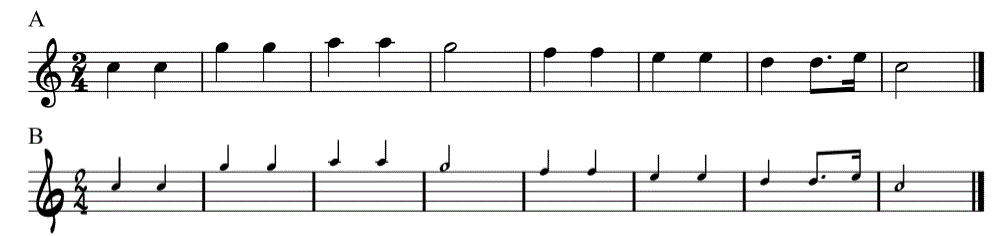
Figure 1
Two musical staves with different typography of Twinkle, Twinkle, Little Star.
Figure 1A includes a set of different inscriptions or marks, some similar to each other and others different. Each of these marks belongs to a character. A character is a symbol formed by a class of syntactically undifferentiated and interchangeable marks (LA, p. 131). In the Standard Musical Language (SML)9 we are using, the character ‘quarter note’ – the first figure that appears in Figure 1A – can have multiple inscriptions, each of them different in terms of colour, size, stem direction, and so on, as seen in Figure 2:
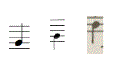
Figure 2
Three inscriptions of the quarter note character.
Each of these marks can be substituted by other mark of the same character without altering the syntactic structure. Thus, despite their inscriptive variations, Figures 1A and 1B remain syntactically equivalent. However, if this set of inscriptions is to determine the pattern of sounds we call ‘Twinkle, Twinkle, Little Star’, each symbol must still be recognizable and distinguishable. This implies, first, that no mark can belong to more than one character – the requirement of syntactic disjunction – and, second, that we can decide which character any mark belongs to – the requirement of finite differentiation between characters. In both Figure 1A and Figure 1B, we can see that we are facing a set of articulated symbols – what Goodman calls a notational scheme – since there is no possible theoretical confusion about which character we are dealing with in each case. Table 1 displays the notational scheme of Figure 1.10
Table 1
Notational scheme of Twinkle, Twinkle, Little Star.
| CHARACTER | MARK |
|---|---|
| Treble clef | 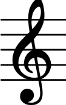 |
| Two–four time signature |  |
| Half note |  |
| Quarter note |  |
| Eighth note |  |
| Sixteenth note |  |
| Bar line |  |
| Staff |  |
| Dot |  |
| Double bar line |  |
The characters in Table 1 – combined with each other – refer to a set of sounds that constitute their reference domain. Goodman calls compliants of that character the set of sounds in the reference domain that make up the extension of a combination of characters in the notational scheme. Thus, for example, any sound with a frequency of 440 Hz will be a compliant of the character to which Figure 3 belongs in SML:
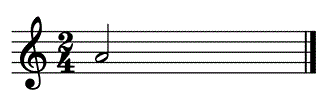
Figure 3
Character A in SML.
Accordingly, for this scheme to be part of a system that unequivocally determines the set of sounds it refers to, three semantic requirements must also be met.
First, a single character cannot have several compliant classes – the non-ambiguity requirement. In Figure 1, the two quarter notes in the first measure, being inscriptions that belong to the same character C, have exactly the same compliants. That is, any sound that is a compliant of the first will also be a compliant of the second.
Second, two characters cannot have any compliants in common – the semantic disjunction requirement. In Figure 1, no sound is a compliant of both the character C – the first quarter note – and the character G – the third quarter note.
Finally, it must be theoretically possible to determine which character any specific sound is a compliant of – the semantic finite differentiation requirement. For example, if we hear a sound with a frequency of 523.25 Hz, we can determine that it is a compliant of the first quarter note in Figure 1.
Goodman calls any symbolic system that meets these five requirements a notational system or notation. Therefore, a score, according to Goodman, is a character in a notational system and strongly determines which sounds belong to its reference domain. This way, for Goodman, a score describes the properties that a performance must have to be considered a performance of the work denoted by the score, and it does so through a notational system that possesses the features defined by the relevant syntactic and semantic requirements. The fact that score compliance is non-negotiable leads to the aforementioned ‘wrong-note paradox’, of which Goodman is fully aware (LA, pp. 186–87).11
In practice, any musician who intends to perform a specific work must comply with its score and, to do so, he or she must be familiar with the notational conventions governing the system. These conventions are the rules that allow each of the notational scheme’s elements to be linked to its reference domain, and thereby allow the instructions encoded in the notation to be decoded. Therefore, for Goodman’s theory, notation is self-sufficient, as it determines which object it denotes independently of any external elements. That is, a score denotes all the conditions that a performance must satisfy to be a member of a certain class of performances – a musical work, according to Goodman’s ontology – with no need to appeal to anything other than the notational conventions necessary to read it and, consequently, to perform the work.
III. Davies’s Criticisms
Goodman’s conception of scores has been the subject of numerous comments, critiques, and clarifications.12 Many of them have pointed to difficulties of conciliating Goodman’s theory with musicians’ actual practice, but the most relevant alternative theory with systematic ambitions was not proposed until the publication of Davies’s Musical Works and Performance.13 In this work, Davies aims to overcome the problems that critics have found in Goodman’s view by developing a theory that is closer to and grounded in musical practice. I will examine Davies’s three main criticisms of Goodman and his proposed solutions to assess which theory better aligns with practice.
First, Davies argues that Goodman’s theory overlooks the practical functions of various musical symbolic systems beyond identifying works. For example, in Davies’s view, the notations used by folklorists do not aim to identify a musical work but rather to transcribe a specific performance. Similarly, notations for technical exercises or memory aids serve purposes other than work identification (MWP, pp. 140–41). In short, scores can fulfil multiple functions that Goodman’s account neglects.
To address this difficulty and develop a theory of musical notation that is closer to practice than Goodman’s, Davies (MWP, pp. 99–150) proposes a functionalist theory based on the following premises:
| (1) | Although a kind of notation may serve various functions, it is defined solely by its principal function. |
| (2) | Nothing in the configuration of a notation determines which kind of notation it belongs to. |
One main consequence follows from (1) and (2):
| (3) | If two notations share the same principal function, they belong to the same kind of notation. |
On this basis, Davies distinguishes three kinds of notations: scores, mnemonic notations, and notational transcriptions.14 A score is the kind of notation that functions to prescribe a musical work, providing instructions so that a musician, following them, can correctly perform a work. A mnemonic notation, on the other hand, serves to support the performance of a work that has been memorized by the performers. Finally, a notational transcription is defined by its function of describing a musical event, whether this be a performance, a work, or an improvisation. According to Davies (MWP, p. 99), the same notation, regardless of the characteristics of its marks, can be considered a score, a mnemonic notation, or a notational transcription, depending on its specific use within a musical practice.
Second, Goodman regards musical notation as self-sufficient (MWP, p. 143). Consequently, he does not consider the instructions dictated by the conventions of musical practice at the time of composition to be essential for the proper performance of the work, a viewpoint that Davies (MWP, p. 141) deems indispensable. In other words, for Goodman, all the work’s constitutive properties are denoted by the score. But, for Davies, this is not sustainable, since some of these properties are not explicitly reflected in the notation.
In contrast with what we may call Goodman’s notational conventionalism (NC), Davies proposes a form of historical conventionalism (HC). For the former, reading the score in order to comply with it only requires knowledge of the notational conventions that connect the score’s characters to their reference domain. In contrast, according to Davies’s HC, not all the instructions that determine a work are explicitly recorded in the score, as some are given by the practical conventions in place at the time of the work’s composition. Thus, instructions derived from the practice at the time of the work’s composition are ontological requirements,15 and not just interpretative options for the performer to comply with the work’s score. For example, according to Davies, for the performance of an aria composed in France in the late seventeenth century to be compliant with the work’s score, it is mandatory to ornament its melody when it is repeated. This requirement is stated by a well-established practice of the seventeenth century that is not explicitly reflected in a score from that period but instead reaches us through other sources – usually textual – which are external to the score.
Finally, Davies (MWP, p. 140) argues that Goodman overlooks the normative role of scores by focusing only on their descriptive function. According to Davies, in practice musicians treat scores as performance instructions. While Goodman acknowledges that scores can be read as prescriptions, he argues that the scores’ principal function is based on ‘the nominative or predicative aspects of the symbols, not their assertive or imperative or interrogative force’ (LA, pp. 154–55). That is, what Goodman fundamentally cares about is what these symbols refer to, regardless of whether they are instructions, obligations, pieces of advice, or recommendations.
As an alternative to Goodman’s descriptivism,16 Davies offers a normativist theory that stems from his definition of a score. For Davies, a score is ‘[a] musical notation the main purpose of which is to serve as a prescription. It records a set of instructions, addressed to performers, the faithful execution of which generates an instance of the piece it specifies’ (MWP, p. 100). For Goodman, only those inscriptions that can potentially identify the work are part of the score: those that meet the notational requirements in Figure 4 and denote the pitch and duration of the sounds.

Figure 4
Beginning of the second movement of Ludwig van Beethoven’s Kreutzer Sonata. Violin part.
In contrast, for Davies, a work’s score instructs musicians on how to properly perform the work in question. In this sense, the score indicates what musicians must do to perform the work, as opposed to describing it, where this includes all the marks and inscriptions present in the text such as tempo indications, dynamics and expression markings, which, along with pitch and duration, would be part of the score in Figure 4.
This approach enables Davies to explore the normative nature of the score’s notations in more detail. According to Davies, not all the indications included in a score have a deontological status, and hence the same normative force. He distinguishes the work’s determinative instructions from other indications that have the status of recommendations. The former are instructions that suffice to characterize the work and whose compliance is strictly mandatory if one wants to perform that work and not another. The latter, in contrast, are suggestions left to the musician’s discretion, such as fingerings, technical guidance, or even certain dynamics (MWP, p. 106).17 Consistent with his historicist approach, the determination of what qualifies as a determinative instruction or a mere recommendation is governed by the performance practices prevailing at the time of the composition of the work.
IV. Questioning the Appeal of Davies’s Proposal
In the previous section, I outlined three key features of Davies’s theory: its functionalism, HC, and normativism. These aim to offer an alternative to Goodman’s account that better reflects the role of scores in musical practice. In this section, without attempting a systematic critique, I examine some challenges for Davies’s theory concerning the use of scores. This will prompt questions about the motivations for preferring his view over Goodman’s.
Davies seeks to improve on Goodman by advancing a functionalist theory of notation, which classifies notational kinds solely by their practical use. For instance, he distinguishes scores from mnemonic notations based on whether their function is prescriptive or mnemonic. For Davies (MWP, p. 123), mnemonic notations are incomplete notations characterized by their function of helping the performer to remember the details of a musical work retained in memory, thus sustaining an oral tradition of performing such works. From this definition, it follows that mnemonic notations, like scores, have a prescriptive character, since certain instructions for performers are written in them. What sets mnemonic notations apart is that, although some of the instructions that they encode are work-determinative, they are not sufficient to specify the work. This way, scores are complete notations as to the work-determinative properties, whereas mnemonic notations are incomplete, requiring information retained in the performer’s memory to execute the work properly.
Davies provides the example of in campo aperto notations. This is the case of the Codex Buranus – partially reproduced below as Figure 5 – where only the direction in which the melody should move is indicated, with no further specifications.18 To properly perform the piece, the Codex’s notations must be completed with the content of the performer’s memory.
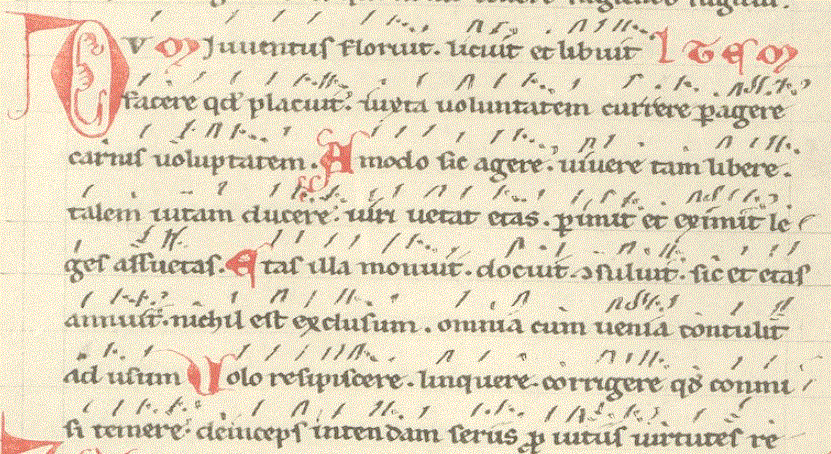
Figure 5
Excerpt from the Codex Buranus.
Once completed with the information from the performer’s memory, this notation complies with the function of mnemonic notations by supporting the performance of the work in question whose constitutive instructions would be memorized by the musicians.
Two issues arise with mnemonic notations. First, when written with the intent to be merely used as memory aids, notations tend to be more schematic and less detailed than full scores. While a notation suitable for a score will always serve as a mnemonic, the converse is not true. This intuition is reflected in Hoppin’s remark:
Early neumatic notation […] indicated many subtleties of performance in ways that later forms of plainchant notation found difficult or impossible to duplicate. […] There is no way to determining the size of successive melodic intervals or even the note on which the melody begins. The notation thus served only as a memory aid for a singer who already knew the melody. For anyone else it was useless.19
The fact that some kinds of notations are more apt for one function than for another suggests that those differences are grounded in structural or internal features of the notation itself. In relying solely on external criteria – namely, function – to distinguish types of notation, Davies’s theory fails to fully account for some intuitive distinctions evident in practice.20
On the other hand, if ‘it is memory […] that bridge[s] the gap between the notation and the melody constituting the given work’ (MWP, p. 125), then the information necessary to complete the performance of the Codex Buranus derives from the collective memory of those involved in the musical practice from which it originated around the thirteenth century. However, since none of those who could convey its determinative instructions are alive and the oral tradition has been irreparably disrupted, the only way to retrieve that information is through surviving documentary sources and the study of other oral traditions presumed to resemble the original practice. Crucially, these are the same sources that, according to Davies’s HC, complete a work’s score through the instructions determined by the interpretive conventions of the time of composition, without which it is impossible to adequately determine the work.
Accordingly, there seems to be no difference in musical practice between the conjunction of the score and the conventions, on the one hand, and the conjunction of mnemonic notation and memory, on the other.21 Nowadays, both the content once held in memory and the tacit conventions of interpretive practice are inferred from the sources that are currently available to us. As such, the Codex Buranus would not be considered a mnemonic notation in current practice; rather, it would be regarded as a musical score, similar to that of a Mozart sonata, since both serve the same function in contemporary practice. Moreover, the issue is not merely that the notations are indistinguishable in current practice but also that, in the performance practice at the time of composition, tacit conventions were always retained in the performer’s memories.22 Therefore, a manuscript of a Mozart sonata, at the time of its composition, would fulfil the function ascribed by Davies to mnemonic notations, just as the Codex Buranus did in its own time. Accordingly, Davies’s functionalist theory of notation blurs the well-established distinction between mnemonic notation and scores. While in practice there is an intuition that mnemonic notations and scores are different kinds of notations, Davies’s theory is unable to capture this distinction.
A second difficulty with Davies’s theory lies in the function it assigns to scores. According to his theory, a score includes the instructions that – sufficiently – determine the musical work that the score encodes. Thus, in every performance of the work, certain invariant properties – those that make up the identity of the work – will be present as the result of following the determinative instructions established at the time of the work’s composition. Therefore, it follows from Davies’s theory that the work has a stable identity over time.
However, in musical practice, there are non-marginal cases that contradict this stability. What happens when two scores of the same work written by the same author specify different determinative instructions? What if those scores are produced at sufficiently distant times for the practical conventions to have changed? Does the author err in naming them alike, so that we actually have two different works, or are we dealing with the same work, whose identity is not determined by following its determining instructions?
In examples such as the different revisions made by Anton Bruckner or Edward Elgar to their symphonies, it is hard to deny that the work’s properties are affected to some degree. Hence, Davies is forced to affirm that ‘a degree of ambiguity need not undermine a work’s identity, though it requires acknowledgement that the piece exists in several versions’ (MWP, p. 122). The identity of the work would thus reside in the fact that its different versions form a unity, since they have a common origin and an important part in common (MWP, p. 121). Thus, crucially, Davies attempts to overcome these difficulties by appealing to the flexible identity of the musical work. In his words, the identity of the work must be ‘flexible enough to survive the haziness created by such cases’ (ibid.). Accordingly, by assuming that scores – along with the conventions of the performance practice conventions of its time – determine the musical work, and at the same time trying to explain certain firmly established practices – such as allowing for different versions of the same work – Davies oscillates between defending a stable identity of the work and a flexible one. In other words, by demanding a stable identity of the work in his theory of scores, Davies fails to account for a musical practice that requires the flexible identity of its productions. This oversight weakens his claim to offer a theory perfectly compatible with practice. This critique also applies to Goodman’s original theory. In the next section, I show that its epistemic reinterpretation avoids the problem by treating the score not as what determines the work but as a means to know or perform it.
V. With and beyond Goodman
We have seen that Davies develops his theory of musical scores and notation partly to address some perceived deficiencies in Goodman’s theory, as noted in Section II: (1) the theory’s purported failure to account for the various symbolic systems and their different functions (uses) employed to represent music throughout history; (2) the emphasis on the descriptive, rather than the prescriptive, nature of scores; and (3) its failure to consider the conventions of the practice at the time of composition as an ontological requirement for compliance with the work’s score. However, there are plausibly points of conflict between Davies’s alternative theory and musical practice (Section IV), which casts doubt on its initial appeal. In what follows, I will argue that a Goodman-based account, that is, a reinterpretation and modified version of Goodman’s theory, can overcome the challenges posed by Davies. To address the relationship between Goodman’s theory and musical practice, I will assume that SML is a notational system that reasonably fulfils the syntactic–semantic requirements demanded by the theory.23
Regarding the theory of notation, we have seen that Davies’s functionalism cannot adequately characterize different notations without appealing to some intrinsic criterion that informs us of how they fulfil their function. Interestingly, despite Davies’s opinion to the contrary, Goodman’s theory does indeed provide such a criterion. Specifically, Goodman highlights the presence of alternative symbolic systems, each varying in their adherence to the five syntactic and semantic requirements necessary for every musical language to fulfil its theoretical function of identifying correct performances of the musical work encoded in the score.
Scores, as notations, are articulated both syntactically and semantically, meaning that both the set of symbols that make up their notational scheme, and the sounds of their reference field are delimited and differentiated from each other. Meanwhile, Goodman calls unarticulated schemes and symbolic systems dense. According to him, a scheme will be syntactically dense ‘if it provides for infinitely many characters so ordered that between each two there is a third’ (LA, p. 136). Furthermore, a system will be semantically dense if the compliants of a reference field are not differentiated, in which case it can never be asserted that a sound does not comply with several characters, or which sounds comply with a given character (LA, pp. 152–54).
Thus, Goodman labels as sketches those symbolic systems that do not meet any of the five requirements, characterizing these systems as dense both syntactically and semantically. An example of a sketch used as a symbolic system intended to be performed by musicians is the work December 1952 by the composer Earle Brown, reproduced in Figure 6.
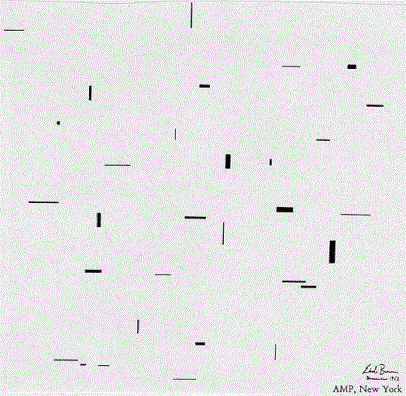
Figure 6
December 1952 by Earle Brown. Copyright © 1961 by Associated Music Publishers, Inc. (BMI). International Copyright Secured. All Rights Reserved. Used by permission.
In this example, since any difference in length or thickness in the inscriptions is significant, we have neither a differentiated nor a disjointed scheme; therefore, from a syntactic point of view, it does not meet the requirements of notational systems. Similarly, from a semantic point of view, the system is dense, as there is nothing to indicate that two characters cannot have the same compliant or that one sound cannot comply with several characters.
Second, Goodman labels as scripts those symbolic systems that meet the syntactic requirements but not all the semantic requirements to be notational; that is, those that are syntactically articulated and semantically dense. An example of a script is the symbolic system for tempo indications traditionally used in musical language. As words of natural language, terms like ‘andante’, ‘allegro’, and so on are syntactically differentiated and disjointed. However, semantically, they constitute a dense system, since it is not possible to assign a specific beat to one and only one of the terms, just as it is not possible to precisely limit the range of each term.
Therefore, Goodman’s syntactic and semantic requirements allow us to differentiate a score written in the SML from other musical symbolic systems. Moreover, even though this distinction is independent of the uses that may be given to such texts, Goodman’s theory does allow for explaining those uses. Let us illustrate this with another example.
As noted earlier, in the fragment of the Codex Buranus reproduced in Figure 5, the signs merely indicate to the singers which direction the melody should take. As we have seen, Davies’s theory of notation fails to explain the difference between a symbolic system like this one and a score, since there is no significant difference between the practical conventions necessary for score compliance and the memorized information that completes mnemonic notation. In contrast, Goodman’s theory allows for a closer analysis of practical intuitions. On the one hand, the musical symbolic system in which the Codex Buranus is written follows a notational scheme;24 that is, it meets the syntactic requirements. However, the same cannot be said of the semantic requirements, regarding neither pitch nor, of course, durations. According to Goodman (LA, p. 199), this would not be a score but rather a script: a symbolic system that meets the syntactic requirements but not the semantic ones.25
As noted, there is a key difference between a score that prescribes a work and a notation serving merely as a memory aid. Goodman’s theory does not precisely differentiate them because any notation can function as a memory aid under certain conditions. What Goodman’s theory helps to identify is what type of notation is unsuitable for prescribing a work, like the one used in the Codex Buranus. Therefore, it seems that Goodman’s theory, like Davies’s, also does not allow us to differentiate between an authoritative codification of a work and a mnemonic notation. However, there is a practical aspect in which Goodman’s theory may be relevant for distinguishing them. If a notation meets his criteria and clearly denotes what it represents, its use as a memory aid is irrelevant for musical practice. But, then, what allows us to conclude that a notation such as that of the Codex Buranus was used as a memory aid? In principle, it is musicological research, and not any notation theory, that must determine whether a document has been used as mnemonic notation. However, the fact that such a document, as a semiotic system, is insufficient on its own to prescribe a work strongly suggests that the determining instructions for the work, in the absence of a major hypothesis, were stored in memory – either individual or collective. Thus, there seems to be a significant difference between a score written in SML and one written in what is typically identified as mnemonic notation. And this is something that Goodman’s notation theory accounts for but Davies’s theory does not: the symbolic system’s ability or inability to unambiguously specify which properties a sonic event must have for it to count as a performance of a particular musical work. In contrast, according to Goodman’s theory, there would be no difference between a score and a notational transcription, insofar as both allow the identification of a work.
Having examined Goodman’s theory of notation, we now assess the compatibility of his theory of scores with musical practice. As noted in Section II, Goodman defines a score as a symbolic system whose primary function is to identify a musical work through its performances. The syntactic and semantic requirements of notation are thus essential not only for fulfilling this theoretical function but also for enabling the practical uses of scores that Goodman recognizes. Among these is the score’s role as a prescriptive guide for musicians: to perform a work accurately, the performer must reliably assign a sound referent to each sign in the score. This, however, is only possible if the symbols are unambiguous and syntactically and semantically differentiated – precisely the criteria Goodman imposes on notational systems.26
This is why, although Goodman emphasizes the theoretical function of a score as ‘identification’ in an ontological and descriptive sense, there is another possible reading: an epistemological sense of the term ‘identification’ that is closer to the practice of performing musicians; that is, identification as recognition. Recognizing the instructions that a musician must follow in order to perform a work is a practical task that is independent of any ontological commitment, and it is possible because these instructions are encoded in a notational system.27 After recognizing these instructions, the musician is presumed to intend to follow them correctly, playing the appropriate notes. Doing so allows the work to be recognized in its various performances.28 This allows, in turn, a normative reading of Goodman’s theory; more specifically, instead of interpreting Goodman’s point as outlined in Section I – namely:
| (1) | The score unambiguously specifies the invariant properties of the musical work that must be present in every performance of that work. |
We can interpret it as follows:
| (1*) | The score unambiguously specifies the actions that a performer must carry out in order to perform the musical work. |
It is important to note that from (1*) it no longer follows that the score determines the musical work but rather that it allows us to know and perform it. Moreover, since Goodman’s theory – normatively and epistemologically interpreted29 – is independent of the adopted ontological commitments, it can be stated that critiques based on these commitments are neutralized. The wrong-note paradox ceases to be a problem insofar as the score no longer defines the work but rather functions as a normative ideal for all performances. From Goodman’s original descriptive perspective, the score of a work W establishes the necessary and sufficient conditions for a sound event to be a performance of W, regardless of the actions that originate that event. In this sense, either the performance complies with the score or it does not, giving rise to the wrong-note paradox. In contrast, a normative conception of the score allows us to assess to what extent that intended performance of W complies with the score of W. Therefore, a performance of W can more or less comply with its score without ceasing to be a performance of W.
Therefore, we are now in a position to reformulate point (2) presented in Section II as follows:
| (2) | Given a proper performance of the work, it is possible to recover or rewrite its score. |
| (2*) | Given a performance of a work, the possibility of recovering or rewriting its score serves as an indicator of the degree to which it complies with the composer’s original instructions.30 |
In sum, an epistemological and normative reinterpretation of Goodman’s theory of scores, while fully consistent with its theoretical premises, overcomes Davies’s criticisms and enables it to align with actual musical practice.
Regarding the theory of performance, we have seen that Goodman’s theory only requires considering notational conventions that unequivocally relate the score to its compliants. The alternative proposed by Davies is HC, whereby the conventions of musical practice at the time of composition, along with notational conventions, determine the properties of the work. One of the main differences between NC and HC is that HC constrains the performer’s interpretative choices more than NC does. While the value of granting a performer greater freedom in executing a piece can be debated, there seems to be little doubt that such freedom is evident in musical practice. This is reflected in examples such as the controversial interpretation of the ‘Rondo alla turca’ from Sonata No. 11 in A major, K. 331 by Wolfgang Amadeus Mozart, performed by Andreas Staier,31 as well as in the various interpretative versions and revisions of the music of Johann Sebastian Bach and Georg Friedrich Handel throughout history.32 In practice, interpretative freedom tends to be the rule rather than the exception. Therefore, a theory that accommodates such instances will be more in line with this practice.
Additionally, for Davies’s theory to apply, a musical practice must exhibit homogeneity and broad consensus among musicians of its time. Our knowledge of past practices relies on written and iconographic sources, such as treatises by Carl Philipp Emanuel Bach, Johann Joachim Quantz, and Leopold Mozart, which reflect their views on music. However, these authors’ personal opinions often contrast with prevalent practices and contemporary prejudices, challenging the assumed homogeneity.
For instance, in his violin treatise, Leopold Mozart criticizes some violinists for their continuous and indiscriminate use of vibrato, which he condemns as distasteful.33 In making this judgement, Mozart informs us of two things: first, when vibrato should be used according to his criteria, and second that in his time there were violinists with different criteria. So, which practical rule should guide our execution of, say, an early work by Joseph Haydn? Should it be the one advocated by a contemporary authority of the time and place of composition or the one predominantly followed by musicians of that era? While this example does not entail that Davies’s theory falls into the ‘fallacy of the homogeneous past’,34 it does demonstrate the practical difficulty in establishing the homogeneity required by the theory.
This being so, it does not seem plausible that the practical conventions at the time of composition for reading scores should be considered ontological requirements. This is for two reasons: on the one hand, considering conventions in this way would require significantly restricting the freedom that performers demonstrate in actual practice when making their interpretive decisions; on the other hand, the study of documentary sources suggests that the rules governing these practical conventions, being ambiguous or contradictory – as in the case of vibrato – are instead recommendations. In contrast, Goodman’s theory* does not require any homogeneity in past practices. The only requirement is that we clearly and unequivocally know what we need to do to carry out a performance of the work in question. This makes it more plausible that the necessary conventions to guarantee compliance with a work’s score are only the notational conventions linked to the instructions recorded in the score, as in Goodman’s theory* of performance.
In conclusion, once reinterpreted in the ways considered above, not only does Goodman’s theory* remain fully consistent with a normative conception of the score but in two key respects it also aligns more closely with work-performance practice than Davies’s. On the one hand, it offers a theory of notation that provides a clear criterion – its notational requirements – for distinguishing between different musical languages in accordance with empirical reality. This is something that Davies’s functionalist theory struggles more to achieve. On the other hand, Goodman’s theory of performance aligns more closely with musical practice in explaining how musicians act when they intend to perform a musical work by following its score.
However, a clarification about Goodman’s theory is called for concerning the relationship between his theory of scores and his theory of notation. While Goodman does not explicitly state it, it might appear that there is a perfect correspondence between these two theories. Subsequent discussions on this topic have assumed that Goodman defends the idea that the work is a pure sound structure composed exclusively of pitches and durations, and that the other properties of performances are not part of the work and therefore do not determine its identity.35 It is assumed that Goodman is committed to this because these properties – or, in normative terms, the determinative instructions – are the ones that meet the requirements of notationality. However, this conclusion does not follow from a careful reading of Languages of Art. Let us see why.
First, we know that the invariant properties of the work – those that result from following the determining instructions – will be among those denoted by the notational indications, and it is the presence of these invariant properties that determines whether a performance of the work is properly given. Second, the fact that Goodman commits to the invariant properties of the work being pitches and durations does not imply that, if it is shown that there are more indications that meet his criteria of notationality, another conclusion can be reached regarding what determines the identity of the work.36 Goodman himself leaves this possibility open by pointing out that ‘metronomic specifications of tempo […] qualify as notational and may be taken as belonging to the score as such’ (LA, pp. 185–86). Furthermore, this leaves open the possibility that notational indications do not denote invariant properties. An example of this is found in the cadenza scores that Wolfgang Amadeus Mozart wrote for his piano concertos. These cadenzas are written in SML and, therefore, according to Goodman, their indications meet the notational requirements. However, in practice, it is assumed that these are mere recommendations for the performer, and therefore that whether to play them or not is an interpretive option. Thus, whether a notational indication is a determining instruction of the work or not is an empirical question. In other words, the relationship between the theory of scores and the theory of notation can be analysed by considering these two points:
| (1) | All elements that make up the score – namely, those denoting the invariant properties of the work – must be notational. |
| (2) | Not all notational elements necessarily denote invariant properties of the musical work. |
In summary, given the epistemological reinterpretation of Goodman’s theory*, as defended here, it follows that every determining instruction must be expressed by a notational indication, but not every notational indication denotes a determining instruction. Hence, the notationality of indications is necessary but not sufficient for recognizing the determining instructions of the work. Therefore, an additional criterion beyond notationality is necessary for deciding whether a particular characteristic is part of the score. This criterion cannot be theoretical and seems to reside in musical practice, thus leading us into the realms of interpretation and, therefore, of aesthetic and artistic evaluation.
VI. Conclusions
This paper has tried to motivate the idea that for a musician to have epistemic access to a musical work the score in which it is represented must sufficiently fulfil the syntactic and semantic requirements outlined by Goodman’s theory. Goodman’s theory has been criticized for being detached from actual musical practice. However, we have seen that those criticisms can be dismissed if we embrace an epistemological and normative interpretation of Goodman’s theory of scores*. Furthermore, this reinterpretation of the theory enables a better understanding of certain aspects of musical practice than if we approach it with the lens of Davies’s theory. On the one hand, we have observed that Goodman’s theory is closer to actual musical practice in that it grants greater interpretive freedom to the performer than Davies’s theory allows. On the other hand, Goodman’s notation theory allows for distinguishing between different kinds of musical notations recognized in practice, something that Davies’s theory struggles to do.
For the performer to know what she should play, whether it is an obligation, an expressive suggestion, a technical guideline, or a mere example in the score’s indications, the syntactic–semantic requirements demanded by Goodman’s theory* are necessary but not sufficient. It is essential, therefore, to engage in an act of interpretation of the score. In any case, this interpretation cannot occur without the first step provided by Goodman’s theory*.
Notes
[1] Julian Dodd, Being True to the Works of Music (Oxford: Oxford University Press, 2020); Andrew Kania, ‘The Heart of Classical Work-Performance’, British Journal of Aesthetics 62 (2022): 125–41; Nemesio G. C. Puy, ‘Interpretive Authenticity: Performances, Versions, and Ontology’, Estetika 59 (2022): 135–52.
[2] Nelson Goodman, Languages of Art: An Approach to a Theory of Symbols (Indianapolis: Bobbs-Merrill, 1968), hereafter: LA.
[3] Benjamin Boretz, ‘Nelson Goodman’s Languages of Art from a Musical Point of View’, Journal of Philosophy 67 (1970): 540–52; Kendall L. Walton, ‘Languages of Art: An Emendation’, Philosophical Studies 22 (1971): 82–85; William E. Webster, ‘Music Is Not a “Notational System”’, Journal of Aesthetics and Art Criticism 29 (1971): 489–97.
[4] Paul Ziff, ‘Goodman’s Languages of Art’, Philosophical Review 80 (1971): 509–15; Alan Tormey, ‘Indeterminacy and Identity in Art’, Monist 58 (1974): 203–15.
[5] Goodman accepts this implication, since permitting one wrong note risks allowing others, potentially resulting in an entirely distinct performance. While the wrong-note paradox falls outside this paper’s central focus, we will return to it subsequently.
[6] Lydia Goehr, The Imaginary Museum of Musical Works (Oxford: Oxford University Press, 2007); Bengt Edlund, ‘On Scores and Works of Music: Interpretation and Identity’, British Journal of Aesthetics 36 (1996): 367–80; Stefano Predelli, ‘Goodman and the Score’, British Journal of Aesthetics 39 (1999): 138–47.
[7] This is ontologically relevant for Goodman, who, as a nominalist, defines a musical work as the set of performances that comply with its score.
[8] I acknowledge that the Platonic terminology conflicts with Goodman’s nominalism. I adopt it for three reasons: for clarity and consistency with Davies’s contrasting view; because Goodman himself is not fully consistent – see LA, p. 46; Nelson Goodman, Ways of Worldmaking (Hassocks: Harvester Press, 1978), 28 – and because, under an epistemological reading, the paper’s conclusions are largely ontology-independent.
[9] In what follows, I use ‘music symbolic systems’ or ‘musical languages’ for the various written representations of musical works, and ‘SML’ for the current notational system taught in music institutions.
[10] For simplicity, I have limited the notational scheme to the characters shown in Table 1, though SML’s full scheme is much broader.
[11] Given his revisionist stance on the relationship between theory and practice, Goodman defends the logical implications of his theory, regardless of whether they align with actual musical practices.
[12] Edlund, ‘On Scores and Works of Music’; Goehr, Imaginary Museum; Predelli, ‘Goodman and the Score’.
[13] Stephen Davies, Musical Works and Performances: A Philosophical Exploration (Oxford: Oxford University Press, 2001), hereafter: MWP.
[14] In addition to scores, mnemonics, and notational transcriptions, Davies mentions non-standard and non-musical notation. Yet, as these lack a clearly defined primary function, they do not meet premise (1) and seem to fall outside the same taxonomy.
[15] As we shall see, similarly to Goodman’s case, problems for Davies’s theory also arise from his commitment to an ontology that underpins his theory but restricts the musician’s actions in ways that do not reflect actual practice. Whether such issues generally stem from grounding theories in specific ontologies is a compelling question for future research, beyond this article’s scope. I thank an anonymous reviewer for this insight.
[16] Although ‘descriptivism’ has multiple technical meanings, I use it here because Davies applies it to Goodman’s position (for example, MWP, p. 159).
[17] Goodman’s notational/non-notational distinction does not align with Davies’s instruction/recommendation distinction: the former is logical, while the latter is normative. Notationality does not determine performers’ obligations, unlike in Davies’s view.
[18] Bayerische Staatsbibliothek, Carmina Burana, Cod. lat. mon. 4660, manuscript, Kärnten/Steiermark or South Tyrol, ca. 1230–fourteenth century, https://daten.digitale-sammlungen.de/0008/bsb00085130/images/index.html?fip=193.174.98.30&id=00085130&seite=5.
[19] Richard H. Hoppin, Medieval Music (New York: Norton, 1978), 59.
[20] We will see (Section V) that Goodman’s theory does provide us with an intrinsic criterion to distinguish between different kinds of notations.
[21] Kivy questions whether medieval notations are incomplete, arguing that ‘all successful notations […] fully determine the performance’ – see Peter Kivy, New Essays on Musical Understanding (Oxford University Press, 2001), 9 – and finds no evidence they failed to do so. If correct, Davies’s distinction would collapse. However, for the sake of argument, I assume Davies is right and mnemonic notations are incomplete. The argument I present is, in fact, a version of Kivy’s.
[22] This includes current works, notations, and conventions. Davies’s theory fails to distinguish between a score of a work by Arvo Pärt and an online transcription of ‘She’s a Rainbow’ with guitar chords.
[23] Webster challenges this claim with examples from SML that presumably violate Goodman’s requirements, rejecting his theory as inconsistent with the ‘empirical state’ of music (Webster, ‘Music Is Not a “Notational System”’, 497). However, the issue stems from Webster’s phenomenological view of musical works, which contrasts with Goodman’s physicalist stance; see Nelson Goodman, ‘Some Notes on Languages of Art’, Journal of Philosophy 67 (1970): 566. Goodman focuses on notations denoting sounds; Webster, by contrast, situates himself within the realm of perceiving those sounds as music and, therefore, as interpreted sounds – as ‘tones’ in Scruton’s sense; see Roger Scruton, The Aesthetics of Music (Oxford: Oxford University Press, 1997), 19–79. Thus, Webster expects Goodman’s theory to explain more than it intends, such as harmonic function, which arises only through interpretation.
[25] The designation of these texts as ‘scripts’ can be seen in specialized literature on medieval notation. Thus Atkinson speaks of ‘Paleofrankish script’ and ‘Aurelian script’; see Charles M. Atkinson, The Critical Nexus Tone-System, Mode, and Notation in Early Medieval Music (Oxford: Oxford University Press, 2009), 106.
[26] One might argue that, given Goodman’s extensionalism, the move from theory to practice is unwarranted. However, my aim is precisely to show that his theory – reinterpreted – also applies to intentional contexts like performance.
[28] Davies follows this line of argument (MWP, p. 161) in proposing his criterion for work recognition: a sound event counts as a performance if it reproduces the score’s sound structure to a sufficient degree so as to be recognized by a competent listener.
[29] From this point onwards, I will use an (*) when referring to the reinterpretation of Goodman’s theory defended in this paper.
[30] It is important to note that this point stands independently of the different positions one might take regarding authenticity in musical performance.
[32] Nemesio G. C. Puy, ‘A Twist on the Historically Authentic Musical Performance’, Philosophical Studies 181 (2024): 2661–80.
[33] Leopold Mozart, A Treatise on the Fundamental Principles of Violin Playing, trans. Editha Knocker, 2nd ed. (Oxford: Oxford University Press, 1985).
Acknowledgements
This work would not have been possible without the intellectual generosity, honesty, rigor, and unwavering support of Paloma Atencia Linares and Nemesio G. C. Puy. I am also deeply grateful to Sergio Añón Lijó for his friendship and for serving as my principal interlocutor throughout this work. Finally, I wish to thank the anonymous reviewers for their insightful and constructive feedback, which helped me clarify the structure and strengthen the final version of the paper.
Competing Interests
The author has no competing interests to declare.