
Pointing out that something is a ‘matter of perspective’ often serves to justify the existence of different views on the same thing. Man and fish do not agree on what seawater is to them, as Heraclitus pointed out in the sixth century bc. ‘The sea is most pure and most polluted water: for fish, drinkable and life-preserving; for men, undrinkable and death-dealing.’1 In the history of thought, we come across similar observations about the same thing appearing differently depending on who it appears to. From the Renaissance onwards, these observations have often been expressed using the term ‘perspective’, denoting a particular painterly technique. The term has become so established in common parlance that we can dispense with knowledge of painting techniques when using it. Moreover, the term has also enjoyed a distinguished philosophical career, dating back to Friedrich Nietzsche, who stated: ‘We cannot look around our corner: it is a hopeless curiosity to want to know what other kinds of intellects and perspectives there might be.’2 This has often been taken as evidence of Nietzsche’s scepticism and ethical relativism.
And yet numerous twentieth- and twenty-first-century philosophers agree that the plurality of perspectival experiences of the same thing or event (such as a car accident) does not contradict its reality. On the contrary, the multiplicity of perspectival views can serve to validate what we encounter as real. This agreement extends from phenomenology (Edmund Husserl, Martin Heidegger) to hermeneutics (Hans-Georg Gadamer), to some analytic philosophy (Thomas Nagel), political theory (Hannah Arendt), and contemporary realism (Jocelyn Benoist). In various iterations of the ‘God’s-eye view’ critique, philosophers as diverse as Nietzsche, Maurice Merleau-Ponty, Paul Ricœur, and Hilary Putnam all agree that a reality that can only be seen from one point of view, or a reality that cannot be seen from any point of view at all, is an utterly untenable concept. There seems to be a relatively strong consensus that perspectivism does not qualify as epistemological scepticism, according to which it is futile to discuss any truth claims.
According to Emmanuel Alloa, the figurative use of perspective has taken on a new form in recent years, both in philosophy and in the world of popular culture and politics. The vocabulary of perspective often strives to suggest that different views have nothing in common. When the thesis of the untranslatable difference of perspectives is combined with a pluralist ethos that demands respect for all that is different, such an argument can kill any discussion. There is no discussion between fish and men. Denying climate change, rejecting the theory of evolution, and distrusting the efficacy of vaccines or the electoral system are all then simply a matter of perspective, which bears the same justification as any other perspective. Some of the debates that characterize our post-truth era are based on the belief that a multiplicity of perspectives is a multiplicity of views among which no common ground can be found.
The purpose of Alloa’s book The Share of Perspective is to explore and ultimately reject this assumption. His detailed excursion into the history of perspective leads Alloa to claim that to hold a particular perspective is always to differ and share. There are at least two other claims related to the central one. First, according to the author, perspective must be understood as a medium. Second, what we encounter through this medium is reality. Although each perspective is partial, it is ‘a condition of access to reality. Far from relativizing reality, perspective realizes it.’3
I. History of the Concept
The guiding idea in Alloa’s account of the history of the concept is that ‘perspective is a means or a medium’. This understanding is not yet present in Boethius’ Latin rendering of the Greek optiké techné by perspectiva, since the ‘per’ here serves to emphasize the clarity or perspicacity of the ‘art of seeing’. It is only with Albrecht Dürer, at the beginning of the sixteenth century, that the term begins to imply a certain kind of mediation: ‘perspectiva is a Latin word that means seeing through [Durchsehung]’ (SP, p. 6). In Dürer, observations on perspective are no longer related to a general theory of seeing (referring to such approaches as optics and the physiology of the eye, as in the Greek optiké techné) but specifically to the representation of objects and figures in paintings. In his 1927 treatise on the history of perspective, Erwin Panofsky adopted not only the metaphor of the painting as an ‘open window’ (Leon Battista Alberti) but also Dürer’s idea that seeing in perspective means ‘seeing through’ (Figure 1). Panofsky states:
We shall speak of a fully ‘perspectival’ view of space […] when the entire picture has been transformed […] into a ‘window’ […]. The material surface upon which the individual figures or objects are drawn or painted or carved is thus negated, and instead reinterpreted as a mere ‘picture plane’. Upon this picture plane is projected the spatial continuum which is seen through it and which is understood to contain all the various individual objects.4
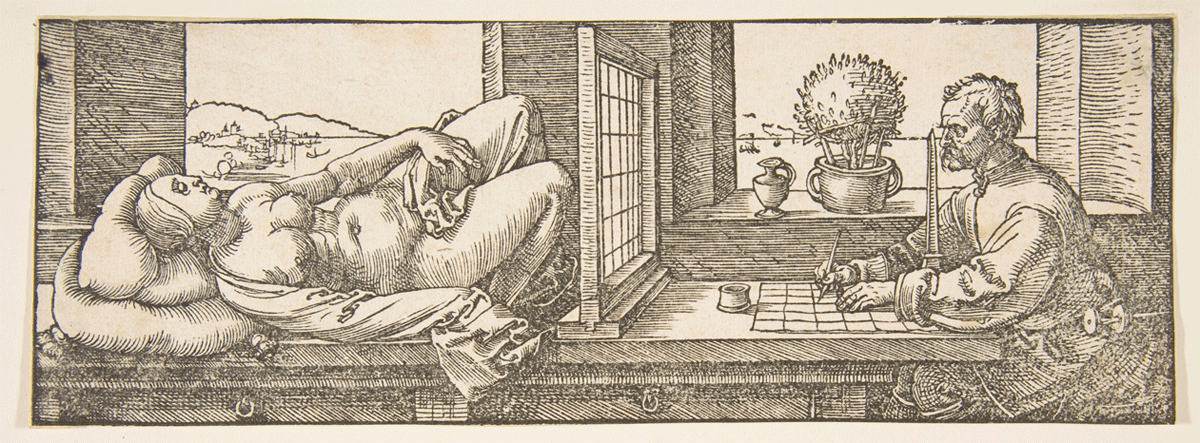
Figure 1
Albrecht Dürer, Draughtsman making a perspective drawing of a reclining woman, circa 1600. Public domain.
In his account of the history of the concept, Alloa draws attention to the use of ‘perspectiva communis’. Alloa takes Filippo Brunelleschi’s experiment as an ‘interpretation of what common perspective might be’ (SP, p. 12). Brunelleschi created an interactive device that consisted of a mirror and a table with a painted Florence baptistery, which had a hole in its centre. When the user of this installation stood in front of the baptistery, holding the mirror in one outstretched hand while placing the plate with the painted baptistery directly in front of the eye, the user could see through this opening the painting reflected in the mirror, with the outline of the baptisterium continuing beyond the edges of the mirror. The real building was thus directly in line with the painted (and reflected) building. The picture and reality were a match.
In his commentary, Alloa argues that two conclusions can be drawn from this experiment. First, the experiment shows that perspective is something that is common. Brunelleschi created ‘a device that makes it possible to measure the objectivity of all figuration’, not only of the existing image used by Brunelleschi but of all figuration ‘yet to come’. The commonality of perspective consists in the possibility for everyone to verify, that is, to see the same thing for themselves (SP, p. 12). Everyone can say: ‘I saw it with my own eyes.’ Second, the experiment shows, for Alloa, that perspective is a medium: perspective, as ‘through what’ we see reality, is projected into what we see (as reality) and who we are when seeing it. Depicted in a linear perspective, the building does not look, strictly speaking, as if I had seen it ‘with my own eyes’ but – as art historian Hubert Damisch adds5 – ‘rather, with my own eye’. The ‘common’ subject required by the experiment is reduced to a fixed position occupied by one eye, a motionless spectator. The linear perspective achieves, as Alloa puts it, ‘a split between the eye and the gaze’ (SP, p. 103). Nevertheless, for Alloa, the advantage of linear perspective is that it makes the medial character of painting particularly clear while also facilitating a shift towards a generalized notion of perspective that no longer refers to how space is represented within a surface, but to seeing in general. No vision is unmediated. ‘We never see by ourselves, all seeing must pass through something other than itself’ (SP, p. 4).
An important step in the history of perspective consists in the extension of its use beyond painting. The birth of the novel as a new genre is associated with the ‘relativity of points of view’, the multiplicity of which in Cervantes, for example, encourages not a synthesis of the way Sancho Panza and Don Quixote see things but rather burlesque, humour, and joy. The same relativity is reflected both in Machiavelli’s The Prince and in Montaigne’s reflections on the diversity of cultures (particularly in his essay ‘On Cannibals’).6 With this proliferation of the use of the term, which Alloa richly documents, comes a generalization that encapsulates only certain features. What exactly does perspective, in the extended, metaphorical sense, mean?
Perspective denotes a ‘structural relation’ that has a subject-related component (point of view) and an object-related component (aspect of the object). This structural relationship is further described by Alloa as implying: (1) address (things appear perspectively to someone), (2) antirepresentationality (things present themselves), (3) mediality, (4) objectivity (it is ‘always a perspective of something’), and (5) plurality, since every perspective implies an alternative position (‘where there is no alternative, there is no perspective’; SP, pp. 41–42, 176–79).
With this set of features, Alloa arrives at a generalized notion of perspective that can be applied to a wide array of phenomena, such as perspective painting, the way the subjects see the ruler and the ruler sees the subjects (Machiavelli), how Europeans see the inhabitants of the ‘new world’ and vice versa (Montaigne), the way that nocturnal animals, which prefer hearing to sight, ‘see’ the environment (in Jakob von Uexküll’s analyses), the way that blood is to the jaguar roughly what manioc beer is to the Native Americans (in Viveiros de Castro’s analyses), and so on. But doesn’t the notion of perspective lose its distinctness as its field of application expands? Alloa believes that, even in this general form, the term retains some specific features. Most importantly, it is a medium – namely, one through which we see reality and which enables sharing.
II. No Language without a Perspective
In his reflection on the mediality of perspective, Alloa emphasizes its irreducibility to other media. He uses the example of perhaps the most discussed medium: language. He opposes the claim, held by Émile Benveniste, that language is the only semiotic system that is capable of reflecting itself, while being able to interpret all other semiotic systems. Alloa’s criticism of this ‘superiority of verbal language’ is twofold. First, painting is able to refer to itself. This self-referentiality is demonstrated by interpictoriality (Picasso alluding to Las Meninas, 1957) or by intrapictoriality (in the painting Las Meninas itself). There is a fundamental finding, unearthed by self-referentiality in painting, which is also presupposed by language: every meaning is linked to a point of view, somebody sees something in a certain way. Meaning or significance is always perspectival, that is, bound to a certain point of view and to the possibility to change it. This is something language presupposes and reflects in its use of deictics or personal pronouns (Roman Jakobson’s ‘shifters’): the ‘I’ is both specific (me here and now) and anonymous (any other ‘I’). True to his phenomenological sources of inspiration, especially Merleau-Ponty, Alloa proposes a ‘reversal of perspective’. He shows, in other terms, the ‘blind spot in thinking on discourse: its debt to visuality’. One cannot unilaterally claim that perception is structured by language. The reverse is also true:
[N]o language without deictics. Without a distribution of places and parts, without a sensible spacing out induced by the distribution of shares, in short: without the work of perspective, a language would be like a map of an unknown city without the red dot to tell us where we are. This distinctive role of shifters is to put language into motion, to inflect its movement in a certain direction, and to project a certain horizon of meaning, which begins with assigning the place from where the enunciation is made […] painting in turning back on itself gives us something to understand that goes beyond painting, namely the perspective any enunciation requires. (SP, pp. 106–7)
Reflections on perspective as a medium have thus shown that (1) this medium takes historically different forms in the way it organizes the visual field and (2) this medium in a sense precedes and grounds linguistic meaning.
There is a certain tension here: perspective is always a particular, historically dependent structure, and at the same time it is a general structure. Heraclitus did not know the Renaissance perspective, yet he could point out that sea water is something different for humans and fish, and thus draw attention to a general structure of experience. I believe that one way to resolve the tension in Alloa’s book is to understand it as talking about perspective in two different meanings. In the first sense, it is a historically variable way of seeing, while in the second it is a fundamental condition of all experience, language, and action. At one point, Alloa decides to adopt such a distinction: while linear perspective is a ‘cultural invention’ (SP, p. 149), the perspectival character of our experience is a ‘general condition that governs all appearing, all processes of emergence in which something comes to visibility’ (SP, p. 150).
Although the distinction between the two meanings of ‘perspective’ in the book is unclear, it is, in my opinion, an important distinction. Only if we have at least a rough idea of perspective as a general structure of our experience can we understand particular types of perspectival representation as different explorations of this general structure. This is what Alloa demonstrates in the following section. Works of art can sometimes subvert established structures of perspective without abandoning the general condition of perspectivity. On the contrary, they further explore it precisely by doing so.
III. A Seeing That Is about To Get Lost
Alloa considers examples of art that radically abandon linear perspective. He analyses Robert Smithson’s artworks and land art installations, whose aim is to stage such a ‘seeing that is about getting lost’ (SP, p. 116). He achieves this, for instance, by loosening relations between the centre (the figure) and the periphery (the background, the horizon). These relationships are stirred up, for example, by leaving the exhibition space, by bringing the spectator out into the open landscape.
Without the support of the prearranged and curated artworks, it is up to the spectator to coordinate his or her own movement to determine what is the centre and what is the periphery when viewing the land art works (Figure 2): ‘the gaze needs to be taken out of its routine, the eye must come off its hinges’ (SP, p. 121). But, even when situating his works in a conventional exhibition space, works such as Gyrostasis (1968), are intended, as Smithson says, ‘to build or invent a structure that sees nothing’,7 or, in the words of Alloa, ‘to bring about a gaze gazing onto nothing but its own loss’ (SP, p. 125). These attempts to turn seeing onto seeing itself show the limited nature of one particular type of perspective but also the indispensable elements of the perspectival mode by which we experience reality: the constant movement and instability of the scene, which is only deceptively and temporarily pacified and dominated by linear perspective. To understand perspective, one has to be able to lose it. As Alloa states much earlier in his book, ‘[b]eyond the capacity for taking positions, there is perhaps even more fundamental capacity for knowing to free oneself of one’s own’ (SP, p. 64). Art that sheds the stereotypes of central perspective reveals some of the basic features of general perspective: perspective presupposes both change and fixation, movement and ‘moments of rest’. In this sense, visual experience is ‘dialectic’ (SP, p. 121).
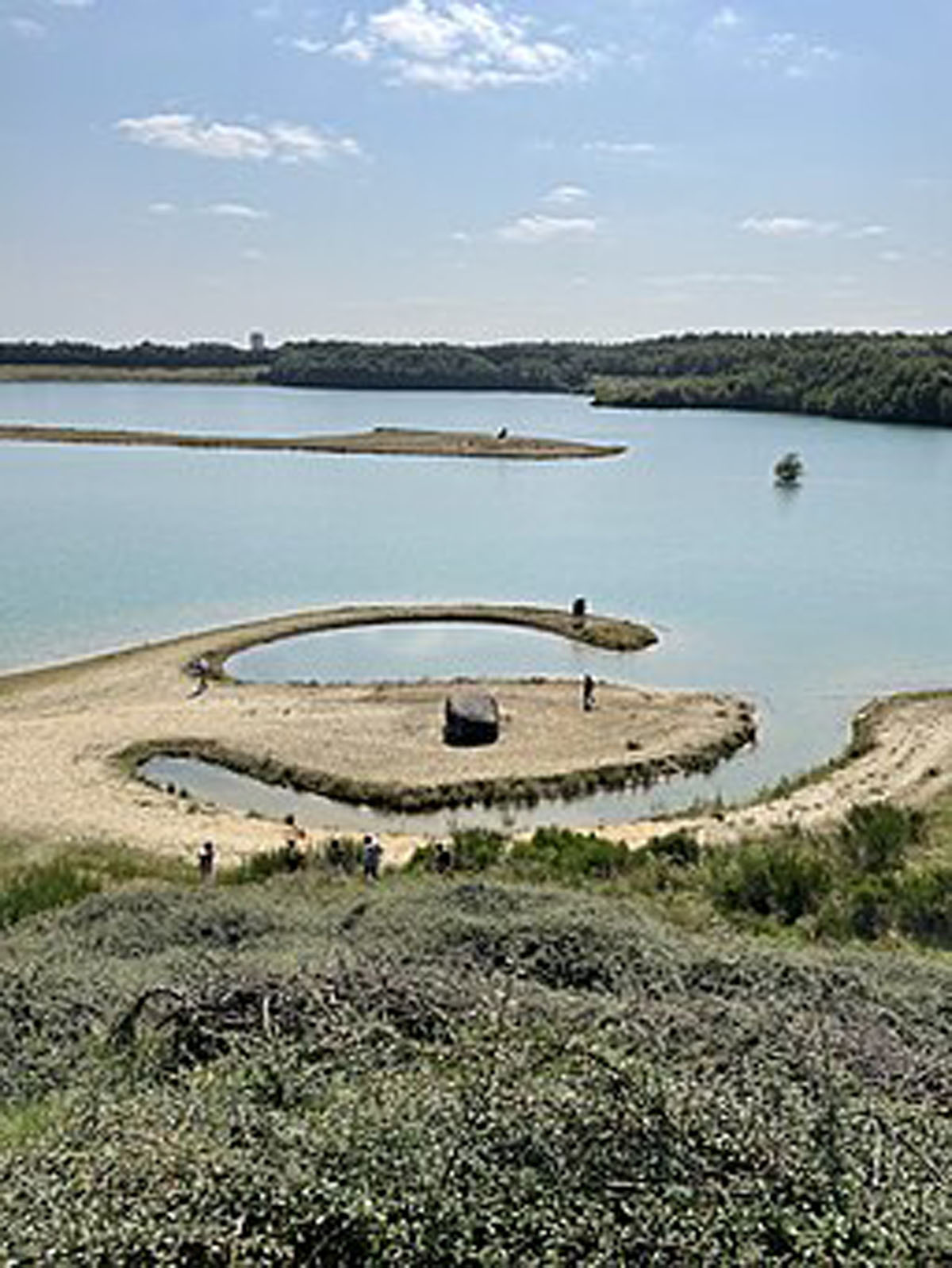
Figure 2
Robert Smithson, Broken Circle / Spiral Hill, 1971. Photographed by Hey Kranen. © CC BY 4.0.
IV. Contemporary Misunderstandings of Perspectivism
Alloa has undertaken his expedition into the history of perspective, through the history of painting and the history of thought, in the conviction that this can inspire us to address the contemporary problems of societies that are deeply divided by conflicting perspectives. His diagnosis of our present situation essentially consists in making two points. First, it claims that the vocabulary of perspective is now used in various forms to justify the denial of facts. Second, it claims that the typical response to these attitudes is to refute their falsehoods by alluding to facts. Both approaches are misguided, as the first fails to grasp what perspective is, while the second denies perspective altogether.
The term post-truth, declared word of the year in 2016 by Oxford Dictionaries, is symptomatic of the first approach. Whether the earth is flat, the theory of evolution is wrong, vaccines actually work, the twentieth-century genocides did take place, the noxious effects of tobacco on human health have been sufficiently proven, climate change is real, and so on: all of this is a matter of perspective. This is how Alloa understands the term ‘alternative facts’, used in 2017 by Donald Trump’s adviser Kellyanne Conway when attesting to the number of participants at the presidential inauguration. According to Alloa’s interpretation, the term invokes ‘the heritage of pluralism and the idea that a multiplicity of perspectives must be taken into account’ (SP, p. 158).
It is tempting to refute these claims by pointing to verified data. Does that mean, asks Alloa, that we should return to factualism and ‘get rid of the perspectivist error’? Must the criticism of post-truth claims necessarily result in the idea that ‘the facts themselves are independent of our way of conceptualizing them’? This ‘neofactualism’ is not better than post-truth. Together they represent, for Alloa, ‘two similarly fatal opposing options’, ‘the Scylla and Charybdis between which we must learn to navigate’ (SP, p. 158).
Alloa is primarily concerned with the second ‘epistemological cliff of our present’, the return to realism in contemporary philosophy. In his critique of John Searle (and his distinction between ‘brute facts’ and ‘institutional fact’), Alloa maintains a post-Kantian stance: no statement about reality is as it is, regardless of our access and categorial grasp of it. The ‘brute fact’ that Rembrandt was born in 1606 makes sense in a society that uses one calendar, agrees on one meaning of ‘to be born’, and imbues this fact with value for whatever reason. Moreover, Alloa claims that the return to a belief in facts independent of human access ‘can be just as populist as the politics neofactualism – understandably – seeks to thwart’ (SP, p. 162). The defence of brute factuality ‘reduces intellectual labor to a purely reactive struggle’ and ‘amounts to a call for the death of all critical thought’ (SP, p. 166).
Unlike the critique of neofactualism, Alloa does not offer a direct critique of the first of the two ‘fatal opposing options’ of our time – namely, post-truth. His reply, nevertheless, is implied in his distinction of the three types of perspectivism: reclusive, additive, and diagonal. While reclusive perspectivism elevates one’s own perspective to a single view, and is thus a combination of closedness and universality (which is encouraged by social networks, for example, by their increasing personalization of the content offered), additive perspectivism believes in the compatibility of different perspectives. The insistence of the adherents to ‘alternative facts’ on their own perspective (when the ‘mainstream’ also has its facts) would be an example of reclusive perspectivism. Additive perspectivism includes Hans-Georg Gadamer and his concept of the ‘fusion of horizons’ or Jürgen Habermas and his concept of the ideal speech situation. While the first type of perspectivism is too self-enclosed (or ‘autistic’, as Alloa says) and the second too optimistic, the third – namely, diagonal perspectivism, takes seriously the ‘conflict of perspectives’. As much as such perspectivism involves sharing, what is shared is not the same position but rather the same conflict (‘a shared agonality’, SP, p. 169). The ‘dispute shapes the collectivities that are involved’ and makes it impossible to ‘return to unilateral standpoints’ (SP, p. 170).8 To be capable of (diagonal) perspectivism implies strength, plasticity, or power – not in the sense of the capacity to assert one’s point of view but the ability to bear multiple, incompatible points of view.
V. Conflict of Perspectives: What Conflict?
Emmanuel Alloa has written not only a well-informed excursion into several disciplines but also a proposal on how the consideration of perspective can help address contemporary problems. The book may prompt certain formal reservations: the author often interrupts his main line of reasoning with a series of long-winded historical excursions. Some enrich the main argument (especially the chapter devoted to Smithson), while others contribute less to it (Chapter 5 on perspective as symbolic form). Owing to these extensive historical digressions, there is little space left for the argumentation of the main thesis. Aside from these stylistic reservations, conceptual ambiguities should be mentioned. As noted, the book works with at least two notions of perspective without explicitly analysing this distinction: perspective as a historically changing representation of the way we see things and perspective as a ‘general condition’. This raises the question of whether it is really appropriate to speak of perspective as a medium ‘through which’ we see. The idea of mediation is more in line with the first concept of perspective (historically changing ways of representation) but it eclipses one feature of (general) perspective that is also important for Alloa: the presence of a particular someone for whom things appear in this perspective (differently from someone else). Certainly, ‘we never see by ourselves’ but, at the same time, it is true that we always see from our particular point of view. The mediality thesis obscures one part of the structure of perspective (the first part of Alloa’s own definition: the ‘pole of address’) and brings the concept of perspective very close to what is referred to in the contemporary discussion, for example by Judith Butler, as ‘frame’ (or ‘framing’).9 And yet there is no perspective without the particularity of point of view, however much it may be true that someone else can also adopt it. Personally, I believe it is better to say that we see in perspective (which also means: we are part of it) than that we see through it.
Some ambiguities accompany Alloa’s claim that perspectivism is not antithetical to realism, since perspective is ‘a condition of access to reality’. Alloa follows the tradition of phenomenology: reality is accessible only perspectivally; it appears in each particular perspective as independent of it.10 Alloa claims that the various perspectives refer to the same object. This may be true of the discussion prompted by different observers of a painting over the same work of art (SP, p. 171) but is it also true of fish and men? Is seawater the same object for both, seen from different perspectives? When discussing such examples, Alloa resorts to either positing the object as a ‘regulative ideal’ (SP, p. 178), without explaining how it should work, or dropping the notion of ‘object’ (thing) and retaining only the category of ‘world’. He concedes that ‘there is nothing obvious about the identity of objects’ perceived by, say, an insect, a bird, and a man, as they perceive a completely different world. However, he then adds: ‘a completely different world and not another world – all these beings share the same world but relate to it in radically heterogeneous ways’ (SP, p. 46). Consequently, it is far from clear what kind of realism we are advocating when we claim perspectivism. Furthermore, is it possible to reject certain perspectives because they do not relate to reality? Alloa criticizes neofactualism (because it denies the fundamental perspectivism of human existence). Does this mean that he rejects the possibility of distinguishing between truth and untruth (whether it takes the form of illusion or purposeful deception)? In reference to Eduardo Viveiros de Castro and Roy Wagner, he writes: ‘facts oblige you to believe in them, perspectives oblige you to believe out of them’ (SP, p. 179). What does this mean? Is he criticizing any appeal to facts or merely a particular way of working with facts (which commands an uncritical reliance on them)? When criticizing blind factualism and calling for ‘critical thinking’, Alloa owes us an explanation as to how such thinking proceeds. The general (and somewhat transcendental) thesis that we always approach reality through perspectives does not help us here.
Let us return, finally, to the key claim of the book: perspective enables not only division but also sharing. Everything boils down to the question of what idea of sharing Alloa is promoting when he speaks of the ‘conflict of perspectives’ as a shared one. He offers two types of conflictual sharing. The first type: the hunter trying to adopt the perspective of the prey to better hunt it; the warrior attempting to understand ‘the enemy’s point of view’ (SP, p. 174). Here, the claim that perspective is shared implies no cooperation whatsoever. It posits but a formal structure of experience that is well compatible with the absence of sharing in the actual course of experience: the hunter kills an animal, the warrior defeats an opponent, the conqueror wipes out the indigenous inhabitants (also thanks to the ability to share another’s perspective). There is no empathy, participation or bond. The second type: when jointly perceiving and discussing a work of art or a movie, we might conflict, yet the fundamental situation is one of co-perception and joint attention (SP, pp. 21–25, 170). In such sharing, as we have read, the ‘dispute shapes the collectivities that are involved’, making a ‘return to unilateral standpoints’ impossible. In these two sets of observations, a different understanding of ‘conflict’ is at work. A confrontation between prey and hunter is different from a dispute over the interpretation of an image in the art gallery. While in the second conflict knowledge of the other perspective can enrich both, in the case of the first it facilitates the victory of one side at the expense of the other. In articulating the book’s central claim that perspective enables sharing, Alloa relies on the latter case and downplays the former. At times, Alloa even reaches for harmonistic vocabulary when, for example, he describes the process of diagonal perspectivism as one in which ‘a common sense emerges’ (SP, p. 170). By drawing on Merleau-Ponty and his concept of co-perception, Alloa is still very close to Gadamer (and to the position Alloa calls ‘irenic’ sharing).
What in my view impedes the effort to better understand the perspectives that divide society is not only the ambiguity of the term ‘conflict’, the consequences of which have remained undeveloped, but also the fact that Alloa limits himself to an epistemological view of perspective. Some of his own sources (Merleau-Ponty or Gadamer) study perspective as making part of a broader existential or ontological structure. Perspective is not a way of seeing simpliciter but a way of seeing embedded in the pursuit of certain goals, the expression of a certain orientation (style, way of being, way of existing, as Merleau-Ponty would say).11 The paradigm example provided by Merleau-Ponty is not one of two people contemplating the same countryside (or painting) but one of a person trying to regain their balance (after losing it on an uneven surface) or trying to reshape one’s life orientation after a severe loss (of a close person). Perspectives can be motivated by the existential concerns of individuals, by the rules, goals, and self-understanding of their society (what Gadamer calls the ‘prejudices’ of the given tradition) or by divergent interests (that can turn people into enemies). When visual art, as Alloa shows, stages the experience of loss, when it takes the gaze ‘out of its routine’, it can provoke an interrogation of what makes us see things the way we do. This invites us to extend the analysis of perspective beyond questions of epistemology to include also questions of practical philosophy (and to inquire into the motivations of perspectives).
When confronting the post-truth and factual falsehood in general, it is not enough to refute it. In this, Alloa is right. Claims such as ‘the attack on Ukraine was not unprovoked’ (my example) are divisive. As Alloa states, they are ‘undermining the belief in a common and shared world’, and he is right here too. And yet, if the conflict in question is not only a dispute but a confrontation (even a war), his epistemological approach seems to run up against its limits. Perspectives, in such cases, are not only different ways people know reality but also expressions of their divergent orientations (the advocacy and dissemination of a particular perspective can serve as a means of effective warfare). Perspective would then be not just a view of reality that can be disputed but a means in pursuit of the ends for which the war is being waged. One possible step beyond epistemological analysis would be to reflect on the instrumentalization of perspective.
In many ways, I believe Alloa has succeeded in making a case for the book’s claim – namely, that perspective implies sharing of a conflict. My objections rest on two ideas. Depending on whether we understand conflict as a dispute or as a struggle, we arrive at a different idea of sharing. And, further, if we accept that motivation enters into the formation of perspectives, we move beyond epistemology towards practical (and therefore also political) philosophy.
Notes
[1] Heraclitus, frag. B61, in Early Greek Philosophy, ed. and trans. Jonathan Barnes (London: Penguin Books, 1987), 104.
[2] Friedrich Nietzsche, The Gay Science, trans. Josefine Nauckhoff (Cambridge: Cambridge University Press, 2001), § 374, 239.
[3] Emmanuel Alloa, The Share of Perspective, trans. Nils F. Schott (New York: Routledge, 2025), 4. Hereafter: SP.
[4] Erwin Panofsky, Perspective as Symbolic Form, trans. Christopher S. Wood (New York: Zone Books, 1991), 27; quoted in SP, p. 8.
[5] Hubert Damisch, The Origin of Perspective, trans. John Goodman (Cambridge: MIT Press, 2000), 132.
[6] Miguel de Montaigne, Essays, trans. J. M. Cohen (London: Penguin Classics, 1993), 105–19.
[7] Eugenia Tsai and Cornelia Butler, eds., Robert Smithson (Los Angeles: Museum of Contemporary Art, 2005), 138.
[8] Philosophical examples provided by Alloa include Nietzsche (the power lies in the ability to see with multiple eyes at once) and ‘standpoint epistemology’, which argues that marginalized or oppressed members of society possess ‘certain privileges concerning knowledge’ (‘stronger objectivity’) because they are able to ‘play in two registers at once’.
[9] Judith Butler, Frames of War: When Is Life Grievable? (London: Verso, 2009).
[10] ‘[B]y realism we mean the postulate that things exist independently of our way relating to them’ (SP, p. 35; see also p. 151).
[11] Maurice Merleau-Ponty, Phenomenology of Perception, trans. Donald Landes (New York: Routledge, 2014), 466, 482.
Competing Interests
The author has no competing interests to declare.